

THE BESTIARY
Unit III · Lesson 21Lake Monsters
Professor Sable Rookmere
Bestiary Keeper
The Bestiary Hall • School of Evershade
Professor's Introduction

Lesson 20 ended at a loch in 1933, and called the creature there the sea serpent's freshwater heir. This lesson opens the heir's own folder — and finds it is three folders, tied together by nothing but a shape and a habit of paper. File them together and you will invent a species out of a silhouette. File them apart, lake by lake, mark by mark, and you will learn what a record can hold when it is never allowed to borrow strength from the lake next door. Bring your lightest hand for the third file. Part of it is not ours to grade, and the lesson will show you where the grading stops.
The Bestiary
Bestiary Keeper
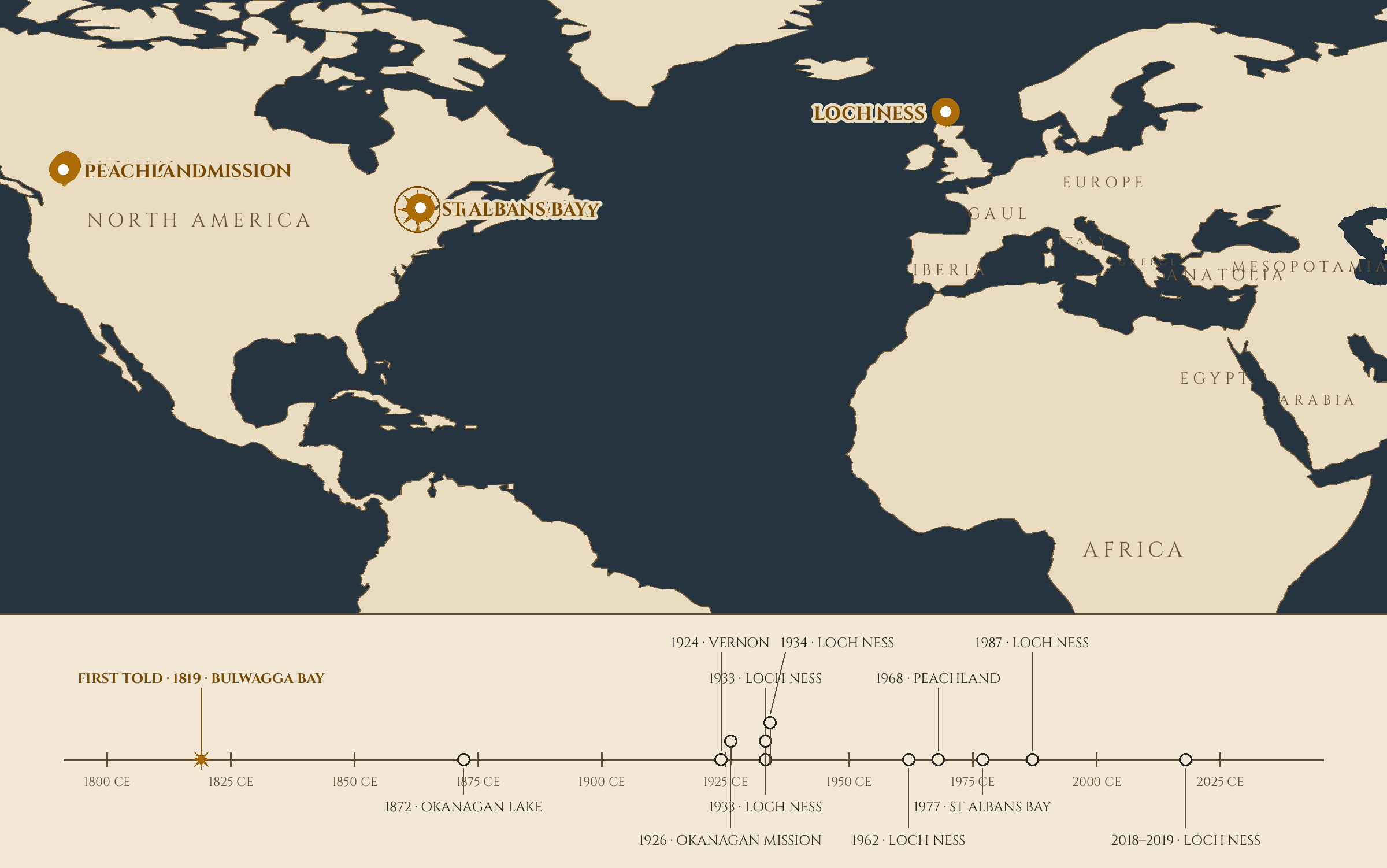
Where this lesson travels: three lakes, three files, and no line between them — each lake's record is graded on its own paper only. Loch Ness, where the starred pin stands at Iona, about 697: Adomnán's Life of Columba was written there a century after his saint's death, though the water beast of its miracle is set in the River Ness, not the loch; the line then sleeps until the A82 shore, 15 April 1933, and the Dores road, 22 July 1933 opened the modern file. Lake Champlain, starred at 1609: Samuel de Champlain's Voyages describe the chaousarou, the fish his 1878 editors identified as the longnose gar — a fish description, not a monster sighting; the monster's paper begins in settler reports of 1819, and the famous quotation Champlain never wrote was manufactured by Vermont Life magazine in 1970. Okanagan Lake, where the settler file opens with Susan Allison's account of 1872 and the creature is christened Ogopogo at Vernon in 1924. The Syilx stops are prose-only and are not plotted on this map: in Syilx teaching, siwɬkʷ — water itself — is a relative, a living relation to be protected, and n̓x̌aʔx̌ʔitkʷ is the tangible form of the lake's spirit, carried in captikʷł, the teachings held in story; that being is not a monster, and Ogopogo, the settler name, is beside it a mascot built of misunderstanding. Each starred pin is that file's first record; each short dashed line stays inside its own lake.
Lesson Objectives
By the end of this lesson, you will be able to:
- Describe the lake monster as the reports describe it — one shape in three lakes — and say why this lesson keeps three separate files, not one travelling being.
- Give Nessie's first record as what it is: a saint's Life written about 697, set in a river, and state what the text does not place in the loch.
- Tell the 1933 wave and the Surgeon's Photograph as dated events — Mackay, Spicer, and the hoax confessed in 1994.
- State what Champlain actually wrote in 1609, name the fish his editors identified, and trace the quotation he never wrote to the magazine that invented it in 1970.
- Explain the difference between n̓x̌aʔx̌ʔitkʷ and Ogopogo, and say why the keeper's marks grade the settler paper here and not the Syilx teaching.
- Recount what the 2018–19 environmental DNA survey found and did not find, in its leader's own words.
Your Assignment Packet
This lesson's work lives in its packet: the Lexicon Handout (every term, the core terms marked with the keeper's diamond ◆), Materials, Guided Practice, the Assignment Manual written out whole, the Scholar's Entry Page, the Reflection Questions, the Workbook Checklist, and the Keeper's Notes, for whoever teaches the lesson. Download the packet before you begin and keep it beside you as you read. The packet's assignment is Rookmere's own word for the work: Entry No. 21 — Lake Monsters (written) ✎. The Unit III Quiz is not printed in the packet; it waits at the end of the unit, with Lesson 22.
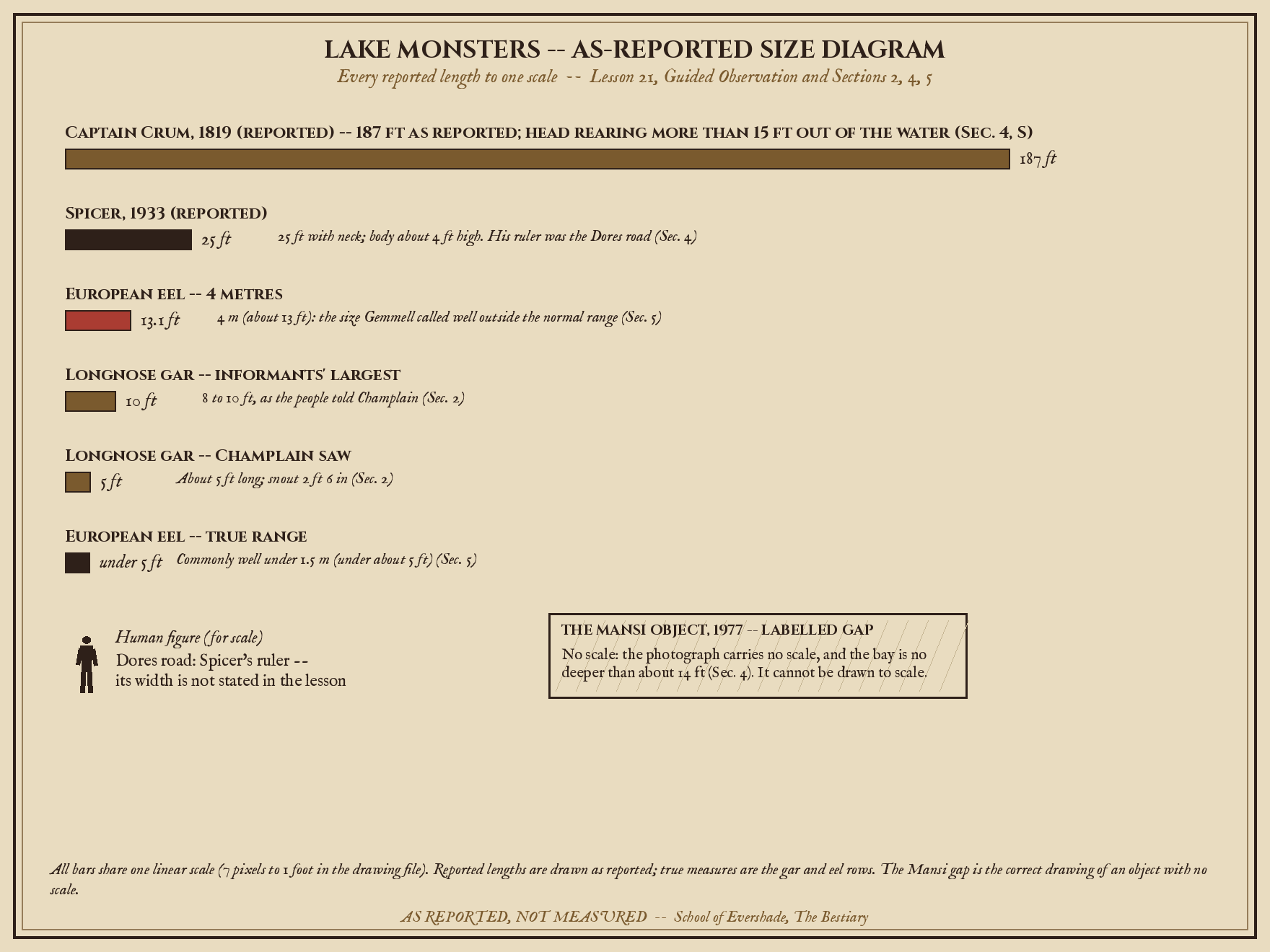
The lesson's pictures are a typeset programme, not a gallery — no photograph of any creature in this lesson is reproduced. This diagram draws every reported length in the lesson to one scale, against a human figure, the Dores road, and the true measures of the gar and the European eel; the Mansi object appears as a labelled gap, because the photograph that reports it carries no scale — which is the correct drawing of it. Typeset diagram, the school's own rendering.
The Creature
Ask what a lake monster is, and three lakes answer with one shape: a long body in dark water, a back that shows in humps — rounded rises in a line, breaking the surface one after another — a neck raised clear of the water in the fullest reports, a small head, great size, and then nothing. The sameness is the first thing a keeper should distrust: the witnesses were not describing one another's lakes, but they were all reading the same century's newspapers. This lesson therefore keeps three files under one cover — Nessie, Champ, and the settler creature called Ogopogo — and grades each on its own paper only.
Nessie is the monster of Loch Ness in the Scottish Highlands: a long, narrow, very deep loch, peat-dark, the largest body of fresh water in Britain by volume. Her standard portrait — a small head on a long neck above humps — was assembled in a single year, 1933, out of two reports and one photograph that was not what it claimed to be. Sections 2 to 4 take the assembly apart in order.
Champ is the monster of Lake Champlain, the 125-mile lake shared by New York, Vermont, and Quebec. The file under the name is a settler file from first page to last: newspaper reports from 1819, one famous photograph in 1977, disputed underwater recordings, and a town that keeps a board of sightings. Champ's supposed first witness is the most famous name in this lesson, and he witnessed nothing of the kind. That correction is Champ's spine, and it stands in section 2.
Ogopogo is the monster of Okanagan Lake in British Columbia — and here the lesson changes its grip, because this file has a fault line through it. The Syilx (Okanagan) people, whose lake this has been since long before any paper, know a being of these waters: n̓x̌aʔx̌ʔitkʷ, in nsyilxcən — a name built, as the Syilx storyteller Coralee Miller teaches it, from n, inside; x̌aʔx̌ʔ, divine; and itkʷ, moving water. In Syilx teaching, siwɬkʷ — water itself — is a relative, a living relation to be protected, and n̓x̌aʔx̌ʔitkʷ is the tangible form of the lake's spirit, whose stories are told through captikʷł, the teachings carried in story. That being is not a monster and was never described by its own people as one. Ogopogo is a different thing: a settler monster, named in the 1920s from an English music-hall song, built — on Miller's published account — out of settler misunderstanding and sensationalising of the Syilx being and its ceremonies. Miller's own comparison is that Ogopogo is like a mascot beside n̓x̌aʔx̌ʔitkʷ.
All three lakes are long, narrow, deep, and cold, with water dark enough to hide a hull a few feet down. A witness gets the surface, for seconds, at distance, in weather. The lakes keep the rest. That is geography, and it is F. Everything that swims below is filed at the strength of its paper, lake by lake.
First Told
✦ On the class test
This lesson's map has three starred pins, one in each lake, and the first belongs to Nessie — with a caution pinned through it. The record stands at Iona, about 697, where Adomnán, ninth abbot of Iona, wrote the Life of Columba a century after his saint's death; but the event is set at the River Ness, and a keeper registers both places: a text's pin stands where its evidence stands.
The passage is Book II of the Life, among the miracles. Columba comes to a riverbank where Picts are burying a man killed by a water beast. He sends his companion Lugne to swim across for a boat; the beast rushes at the swimmer, open-mouthed; Columba makes the sign of the cross and commands it — in the words every retelling keeps — to go no further, not to touch the man, and to go back with all speed. It flees, and the Picts glorify the saint's God. Adomnán places the beast in the river, not the loch; he gives it no great size; and his book is a saint's Life, whose business is miracles — so the lesson files the writing F, dates it about 697, and files the encounter as the text's own claim. Scholars of the passage, Jacqueline Borsje among them, have shown that the river beast and the loch monster were identified as one only by the monster's own century.
Nessie's line then sleeps for twelve centuries of paper and wakes in a single spring — the A82 shore, 15 April 1933, and the Dores road, 22 July 1933 — told in section 4.
Champ's starred pin stands at Lake Champlain, 1609 — through a text, not a sighting. In his Voyages, Samuel de Champlain described a fish the people of the country called the chaousarou: at the very largest, as the people told him, eight or ten feet; the ones he saw about five feet long and as thick as his thigh; a snout two and a half feet long with a double row of very sharp teeth; scales a dagger could not pierce; silver-grey. The editors of the 1878 translation named it in their own footnote: the bony-scaled pike — the longnose gar, a real, armoured fish that lives in Lake Champlain still. There is no monster in the passage.
The monster enters Champ's file three and a half centuries later, wearing Champlain's name. In the summer of 1970 the magazine Vermont Life attributed to him a sighting he never recorded — a twenty-foot serpent, thick as a barrel, with a head like a horse — and the quotation has been copied ever since. No one has found it in anything Champlain wrote, because it is not there. Champ's first record is therefore twofold: a fish description of 1609, filed F as a text and F as a gar on the editors' reading; and a quotation manufactured in 1970, filed F as a printing and false as a sighting.
Ogopogo's first told cannot be given a year, and the lesson does not invent one. The Syilx telling of n̓x̌aʔx̌ʔitkʷ runs through captikʷł, in Syilx keeping, older than every date in this section — pointed to here, in Miller's published teaching, and not graded, dated, or mapped by this class. The settler file's firsts can be dated. In 1872, Susan Allison, among the first non-Indigenous settlers in the Okanagan, reported something large moving in the lake against the wind — the first detailed settler account in the standard histories. And in 1924, at Vernon, the creature got its lasting name out of a joke: an English music-hall song, "The Ogo-Pogo," whose hero had hardly any tail. The historian Mark M. Orkin, who traced the naming, keeps his own caveat with the date — one dictionary line gives the name's first application as early as 1912.
The Tales
Nessie has no folktales in the old sense — no hero, no bargain, no moral. Like her sea-serpent parent she has cases, and they stand in section 4. Her file's one tale-shaped item, the Columba encounter, is a miracle story, in which the beast exists so that the saint's word can master it: file it T, in its own century's terms.
Champ's tales are civic folklore, kept by towns rather than tellers — the board, the resolutions, the annual day, all in the box below — and his file knows its own beginning: Champ begins in settler paper, in 1819. The Indigenous traditions of the Champlain valley are older than the lake's present name, are their holders' own, and are not Champ's root; the lesson states that and does not retell them.
Ogopogo's tales divide at the fault line, and the division is the teaching. On the Syilx side stand the captikʷł teachings: stories that carry law about water — that siwɬkʷ is a relation, owed care and respect, and that those who take it lightly put themselves in danger. Miller recounts the being's form in story — dark, serpent-bodied, horse-headed, deer-antlered — as the tangible shape of the lake's spirit, and the modern Syilx statement of the same law is a public document: the Syilx Water Declaration, endorsed by the Okanagan Nation Alliance in July 2014, which holds that water has the right to be recognised as "a familial entity, a relation, and a being with a spirit," and that the Nation accepted the responsibility to serve "for all time as protectors of the lands and waters in our territories." On the settler side stand the monster tales proper, told in section 4, marked S, where they belong.
KEEPER'S CHECK-IN
At Okanagan the tales divide at a fault line — what do the Syilx teachings carried in story hold about water, and how does that differ from a settler monster tale?
Spotted
✦ On the class test
Loch Ness, 1933 — the wave. On 15 April 1933, Aldie Mackay, who managed the Drumnadrochit Hotel, was driving the A82 with her husband John when she saw an enormous creature rolling and plunging in the loch for about a minute, its body — in the report's words — resembling that of a whale. Alex Campbell, the local water bailiff who also wrote for the papers, carried it into the Inverness Courier of 2 May 1933 as "Strange Spectacle in Loch Ness," and the word monster entered the modern file with it. File the sighting S, the printing F, and beside them the enabling fact, also F: the audience had just been built a road.
On 22 July 1933, George Spicer and his wife, driving between Dores and Inverfarigaig some twenty yards from the water, reported the file's most consequential sighting: a large animal crossing the road fifty yards ahead. Spicer's letter, printed in the Courier on 4 August, described a body about four feet high and, with the neck, about twenty-five feet long; a long, wavy, narrow neck, slightly thicker than an elephant's trunk. "I saw the nearest approach to a dragon or pre-historic animal that I have ever seen in my life." Two notes belong in the margin. The report grew in its own retelling: Spicer's earliest version had the creature carrying a small animal, which the Spicers later re-read as a tail swung round against the body. And a modern proposal, argued by Daniel Loxton and colleagues in 2013, holds that the sighting's shape owes something to the long-necked dinosaur that rises from a lake in King Kong, released in London that same spring — write it proposed. After Spicer, the monster has a neck.
Loch Ness, 1934 — the photograph that was an event. In December 1933 the Daily Mail, which had hired the big-game hunter Marmaduke Wetherell to find the monster, was ridiculed when the great tracks he found were identified at the Natural History Museum as the work of a dried hippopotamus foot. On 21 April 1934 the Mail published the photograph the century would keep: a small head on a long neck, attributed to Robert Kenneth Wilson, a London gynaecologist — the Surgeon's Photograph. The picture is not reproduced in this lesson, and the reason is the rest of its file. In interviews in 1991–93, shortly before his death, Christian Spurling — Wetherell's stepson, a model-maker — told the researchers David Martin and Alastair Boyd that it was a hoax he had helped to build: a head and neck of plastic wood, about a foot high, mounted on a clockwork toy submarine, photographed in the loch and sold through Wilson as its respectable front man, in revenge for the hippo-foot humiliation. Martin and Boyd published the confession in 1994. File the publication F and the confession F: a confessed fake, still doing a real animal's work in the imagination thirty years after its maker explained the tin and putty.
Loch Ness, 1962–87 — the organised answer. The shore watches of the Loch Ness Phenomena Investigation Bureau (1962–1972) are filed in full in Lesson 20's box; this lesson does not spend them twice. Their successor: in October 1987, Operation Deepscan put twenty-four boats with echo-sounders in a line across the loch, under Adrian Shine of the Loch Ness Project, and swept its length. The sonars made three contacts of unusual size and strength at mid-depths; when the boats swept again, the contacts could not be found. Later analysis read some traces as bottom debris, and Shine himself proposed seals that had entered the loch. File the sweep F, the contacts F as contacts, and their identity as unfiled.
Lake Champlain, 1819–2005 — a file of seconds. Champ's oldest named report is Captain Crum's, carried by the Plattsburgh Republican of 24 July 1819: in Bulwagga Bay, off Port Henry, a black thing two hundred yards away rearing more than fifteen feet out of the water, its head like a sea-horse's — and a length, as reported, of one hundred and eighty-seven feet. The report reaches this class at second hand, through the lake region's own heritage record, and the entry files it so; its value is precisely its measure, which no water on Earth could float. Mark it S.
Champ's defining photograph came on 5 July 1977, on the Vermont shore — the bay is usually named as St Albans Bay — when Sandra Mansi, holidaying with her family, photographed a dark, long-necked, humped object rising from the water. It too is not reproduced in this lesson: a private photograph of 1977, under copyright, and its file is the teaching. Mansi told investigators she had thrown away the negative, and she could not afterwards say where she had stood — so the picture has no scale, and the bay is no deeper than about fourteen feet. Experts who examined the print found no sign of tampering, which settles the print, not the object. A rising, waterlogged tree trunk is the candidate reading most often proposed. File the photograph F as an object, its subject S at best.
Two later items arrive merged in the retellings and must be separated in the entry. In 2003, working for a television programme, the Fauna Communications Research Institute, led by the bioacoustician Elizabeth von Muggenthaler, lowered hydrophones into the lake and recorded clicking, pulsing signals at three places, which the team described as biological echolocation — the sonar sense of whales and dolphins, which no known creature native to the lake possesses. The claim reached the scientific literature as a short report in the Journal of the Acoustical Society of America in 2010. Weigh it as the file weighs it: a real recording, a claimed identification, and a named dissent — the cetacean researcher Lance Barrett-Lennard, who examined the recordings, did not believe them to be a marine mammal. And in the summer of 2005, Dick Affolter and his stepson Pete Bodette filmed a dark object moving at the surface beside their boat; the footage, broadcast by ABC News the following year, was reviewed by two retired FBI image analysts, who found it apparently authentic and unmanipulated — and unidentifiable.
Okanagan Lake, 1872–1989 — the settler file. Allison's 1872 account opens it. Its signature mass sighting came in September 1926, at Okanagan Mission beach by Kelowna, where — as the story has been told since — the occupants of some thirty cars watched something large moving in the lake at once: a crowd, a beach, a shared minute, and no instrument but eyes. The file was kept for over thirty years by the Kelowna author Arlene Gaal, whose archive is the settler record's main shelf. In 1968, Art Folden, driving Highway 97 near Peachland with his family, shot about a minute of 8mm film of a large disturbance moving through the water near shore: it shows a real disturbance and identifies nothing. And in 1989 the file corrected itself, as Gloucester's did: a shore video of a swimming, tail-slapping animal was read on examination — by many of the creature's own proponents among others — as a beaver.
KEEPER'S CHECK-IN
Two defining photographs anchor this file — the Surgeon's Photograph of 1934 and Sandra Mansi's photograph of 1977 — what happened to each one's standing, and why is neither reproduced in this lesson?
What People Watched For — the Board, the Day, and the Crossing
Three lakes produced three kinds of watching, and this box keeps them in three compartments, because borrowing a custom from one lake to fill another's box is how files rot.
At Okanagan, the watching was a duty before it was a search. Settler records of the crossing at Squally Point, by Rattlesnake Island — the narrows where the being was said to live beneath the water — describe travellers making an offering before they crossed, that they might pass safely. File that version as it reaches us: reported in settler records, in settler words, about a Syilx practice. The Syilx side of the same water is stated by its own people, in the present tense: Coralee Miller teaches that the Syilx held ceremonies for the spirit of the lake, that those ceremonies are where the settler misunderstanding began, and that what is owed to siwɬkʷ is respect for a relative, under Syilx law — the law the Water Declaration of 2014 sets down for anyone to read.
At Champlain, the watching became a town's furniture. Port Henry, New York, keeps a sightings board at Bulwagga Bay, where reports are posted as they come in, and holds Champ Day on the first Saturday of August. Around it stand the civic acts: Port Henry's declaration of its waters as a safe haven for Champ in 1981; the Vermont House's resolution of 1982 protecting the creature from any wilful act of death, injury, or harassment; New York's matching resolutions of 1983 — resolutions all, not statutes, and the entry keeps the distinction, because a town voting to protect an animal it cannot produce is performing a belief, and beliefs performed in public, on dates, by named bodies, are exactly what this box exists to file. File the board, the day, and the resolutions F. File everything the board records S.
At Loch Ness, the watching was organised like a science — the posted watchers of 1934 and the Bureau's decade of rotas and cine cameras from 1962 — and it is filed in full in Lesson 20, whose box this one does not repeat. Three lakes, three watchings: a duty, a festival, and an investigation.
What It Actually Is
Begin with the foundation fact, the same in all three lakes as in Lesson 20: no body, bone, skin, or tissue sample of any unknown great animal from Loch Ness, Lake Champlain, or Okanagan Lake has ever reached any collection on Earth. What the record offers instead is a row of candidates — and, in one lake, a systematic answer of a new kind.
The water itself. A long, narrow lake composes monsters as the sea composes serpents: boat wakes that meet, stand, and travel on in calm water long after the boat is out of sight; waterlogged trunks that rise as they shift; lines of otters swimming in file, each back a hump in sequence; deer swimming low; wind raising a sudden roughness at a narrows while the rest of the lake lies flat. At a distance, in poor light, for seconds, the lakes build section 1's shape out of processions and weather — which is why reports from three unconnected lakes resemble one another more than any animal could explain.
Loch Ness: the survey that read the whole loch. In June 2018 a team led by the geneticist Neil Gemmell of the University of Otago took 250 samples of the loch's water and read the environmental DNA in them: the genetic traces every living thing sheds into water, matched against the world's databases until the loch had confessed some three thousand species. The results, announced on 5 September 2019, are the file's firmest sentences. There was no reptile DNA — no trace of any creature remotely related to the plesiosaur of the popular picture; no shark DNA, no catfish DNA, and none from sturgeon, the great fish most often proposed. And there was, in Gemmell's words, "a very significant amount of eel DNA" — the European eel, found at pretty much every location sampled. The eel therefore gets its measure: a true fish of the loch, long and snake-shaped, commonly well under a metre and a half — and Gemmell himself noted that an eel of four metres, as some sightings would require, would be well outside the normal range. His conclusion, in his own careful form, is the one the entry must copy exactly: the data do not reveal the eels' size; the sheer quantity "says that we can't discount the possibility that there may be giant eels in Loch Ness"; and "based on our data, giant eels remain a plausible idea." A candidate not ruled out is not a monster found. File the survey F. File the giant eel proposed.
Lake Champlain: the fish that was there all along. For the 1609 text there is nothing to explain: the longnose gar is a real fish, and Champlain described one. A big gar runs to a grown man's length and beyond — Champlain's informants said eight to ten feet for the largest — and it carries its description on its body: the long beaked snout with the double row of teeth he counted, the pike-shaped body, and a coat of hard, enamelled ganoid scales, the armour that turned his dagger. For the Mansi object, the record's standing proposal is the rising waterlogged trunk. The echolocation recordings remain unfiled as to source.
Okanagan Lake: a correction and a boundary. The settler file's candidates are its cousins' — wakes, wind at the narrows, otters in file, large fish — plus its own Scoliophis moment, the beaver of 1989. There the settler file's roots end. Those candidates are proposals about settler reports, and they explain nothing about n̓x̌aʔx̌ʔitkʷ, which was never a sighting-report to be explained. The Syilx being's root is not an animal mis-seen; it is a teaching about water, held by the water's own people, and the only accurate sentence a bestiary can write under this heading for that side of the file is the one its owners publish: siwɬkʷ is a relative, n̓x̌aʔx̌ʔitkʷ is the tangible form of its spirit, and the responsibility runs from people to water. Under all three files, the plain balance: thousands of reports; two defining photographs that collapsed; three sonar contacts never refound; one loch-wide census of DNA with no unknown animal in it; and not one specimen.
Still With Us
Nessie's modern life runs on the double track Lesson 20 described for her parent: the reports continue — the loch's sightings register still logs new ones in this decade — and the instruments improve, from sworn questionnaires to a census of every species the water could be made to confess. The two curves have still never met at a specimen. What has changed is the portrait's status: the monster's face is now known, on the record, to be a toy submarine's passenger, and the face is used anyway — on signs, on tea towels, at the loch's own visitor centre — because a place may keep a picture it knows is false as the emblem of a question it still enjoys asking.
Champ's modern life is civic, and it suits him. The board at Bulwagga Bay still takes new names; Champ Day still opens August in Port Henry; the resolutions of 1981–83 still stand in the records of two states and a village, guarding an animal none of them can produce. In 2019 the monster received the folklorist's own honour: a marker under the William G. Pomeroy Foundation's Legends & Lore programme, on Cumberland Head Road in Plattsburgh, recording that over three hundred sightings have been reported since 1819. A marker is a record that the legend exists, which is exactly what it claims to be.
Ogopogo's settler afterlife is the loudest of the three: Canada Post put the creature on a stamp in its folklore series in 1990, and the lakeside towns keep the statues, the souvenirs, and the name the music hall lent them. But the file's important modern entry is a correction, and it runs the other way. The Syilx correction of the record is public, dated, and ongoing: the Sncewips Heritage Museum teaches n̓x̌aʔx̌ʔitkʷ in its own terms to the lake's visitors, the Water Declaration of 2014 states the law of the water in the Nation's own name, and the storytellers' insistence — that the being was never a monster, and that the monster was made by misunderstanding — now stands in the published record beside the sightings file. The last word in this file belongs, by right of first keeping, to the lake's first keepers: the water is a relative, and it is still there, and so are they.
Guided Observation
This lesson's plates are a programme in type, not a gallery — the reasons are in the Images block below — so the observation is worked on the programme itself, the honest furniture of a file whose famous pictures cannot be shown.
Begin with the as-reported size diagram. Every length in this lesson is drawn there to one scale: Spicer's twenty-five feet, measured against the road he used as his ruler; the Mansi object, which cannot be drawn, because the photograph that reports it carries no scale — look for its place, and find instead a labelled gap, which is the correct drawing of it; Captain Crum's one hundred and eighty-seven feet, drawn in full, running off the line of plausible water; and beneath them, to the same scale, the real measures: Champlain's gar, at the five feet he saw and the ten his informants claimed, and the European eel at the outer edge of its true range, set against the four metres Gemmell called well outside it. Write one sentence on what the diagram does that no single report can do for itself.
Then the timeline, read as three short lines, not one long one. Nessie's line sleeps from about 697 to 1933 and then crowds everything into a single year. Champ's line begins twice, in 1609 and in 1970, and the second beginning invented the first. The settler Ogopogo line begins in 1872 and is christened in 1924. And across the Okanagan line, in a different ink, the Syilx teaching is marked as running underneath it without a start date, because it was never the timeline's to date.
Last, the documents plate: three sentences, set in type, that a keeper of this file must be able to place. Champlain's measures of the chaousarou, in his own numbers. Spicer's "nearest approach to a dragon," in his own words. Gemmell's "our data doesn't reveal their size," in his. Three centuries, three kinds of paper — and the whole lesson is the distance between the first two sentences and the third.
Assignment Manual
✎ WRITTEN · ⚒ HANDS-ON · ◐ BOTH
✎ Written · Entry No. 21: Lake Monsters.
- Rule your entry page. Turn to the Scholar's Entry Page in this packet and rule the next page of your journal to match it, as you did for the entries before this one.
- Write the entry, to the standard. The Creature: the shared shape the reports agree on, and one line on why this entry keeps three files under one cover. First Told: three firsts, kept apart. For Nessie: the Life of Columba, about 697 — a river, a saint, a beast with no size given — with one line on when the river beast became the loch's monster. For Champ: Champlain's chaousarou, 1609, quoted by its measures, with the editors' fish named; and, in its own sentence, the Vermont Life quotation of 1970 that Champlain never wrote. For Ogopogo: two openings in one field — the Syilx teaching, stated in its owners' terms and left undated; and the settler file's dated firsts, Allison 1872 and the Vernon naming of 1924, with Orkin's caveat attached. The Tales: the Columba miracle filed as its book files it; Champ's civic folklore; and the division of the Ogopogo tales at the fault line, with the Water Declaration of July 2014 named, dated, and quoted in one line. Spotted: the set cases, each in its own short paragraph with its lake and date leading — Mackay and Spicer, 1933; the Surgeon's Photograph as an event, 1934, with its confession of 1994; Deepscan, 1987; Crum, 1819, with its second-hand status written beside it; Mansi, 1977, with the negative and the fourteen feet; the Fauna recordings of 2003 and the Affolter–Bodette film of 2005, in separate sentences; the thirty cars of 1926; Folden, 1968; and the beaver of 1989. What It Actually Is: the water itself first; then the DNA survey, in Gemmell's own careful conclusion; the gar, with its armour; and the boundary sentence for Okanagan. Still With Us: the register still logging; the board, the day, and the marker of 2019; the stamp of 1990 and the Syilx correction standing in the published record. The Keeper's Line: your own judgment, in one or two lines.
- File the cases. Under your Keeper's Line, add a short table of the three lakes, three lines: for each, one sentence marked F stating what the record establishes (a text written, a photograph confessed, a survey completed), and one marked S stating what the witnesses reported seeing. Beneath the table, one further line, unmarked, for Okanagan: the sentence that states what the marks do not grade, and why. That unmarked line is part of the examination.
- Mark every line. Go back through your entry and mark every line in the margin with the keeper's marks: T for tale, S for sighting-report, or F for fact. The special disciplines of this entry are three. First: a line that says "Champlain saw the monster" must be caught and corrected in the margin — the record supports a fish, described, and a quotation invented in 1970. Second: a line that dates the Surgeon's Photograph without its confession is half a line; complete it. Third: the marks grade the paper — the settler files, the newspapers, the surveys — and where a line reports Syilx teaching, write Syilx teaching, as published beside it and leave the marks off it.
Materials
· Your bestiary journal, with your earlier entries in it
· Pencils, and a pen you like
· A ruler, for ruling your entry pages
· This lesson's packet (the Scholar's Entry Page is in it)
· The lesson page, for the map, the timeline, and the size diagram
Reflection
Adomnán's beast is in a river, has no size, and appears in a book of miracles. By what steps — whose acts, in which centuries — did it become the Loch Ness Monster?
Champlain's gar passage and Spicer's road-crossing are both descriptions by named men of things in front of them. One is filed as a fish and the other as a monster's birth certificate. What, in the paper itself, makes the difference?
At Okanagan, the settler record and the Syilx teaching describe the same water. The lesson grades one and not the other. Defend that difference in a few lines — or argue against it, with the same care.
A Closing Note
Three lakes filed, and your bestiary has learned the last manners of the waters: to keep a confession with its photograph, a caveat with its date, and another people's teaching out of your grading hand altogether. What remains in this unit swims in rivers and billabongs, on the far side of the world. Bring your marks, your lightest hand, and the question this lesson taught you to ask first: whose paper is it?
The Bestiary
Bestiary Keeper
Further Reading & Sources
Adomnán of Iona, Life of St Columba (written c. 697–700), Book II — the water beast of the River Ness in its own book; and Jacqueline Borsje, "The monster in the river Ness in Vita Sancti Columbae," Peritia 8 (1994), on the passage, its river, and the size that was never given.
The Inverness Courier, 2 May and 4 August 1933 — the Mackay report and Spicer's letter.
David Martin & Alastair Boyd, Nessie: The Surgeon's Photograph Exposed (1999) — Christian Spurling's account of the 1934 photograph, given in 1991–93, first published 1994.
The Loch Ness environmental-DNA survey, University of Otago (sampling June 2018; results 5 September 2019) — Neil Gemmell's team's census of the loch, in his own quoted words.
Samuel de Champlain, Voyages (Prince Society edition) — the chaousarou passage, with the 1878 editors' identification; read beside Vermont Life, summer 1970, where the quotation attributed to him first appears.
Robert E. Bartholomew, The Untold Story of Champ (2012) — the settler file kept whole; and Vonmuggenthaler, Gregory & Mardis, "Echolocation in a fresh water lake," Journal of the Acoustical Society of America 127 (2010).
Coralee Miller (Westbank First Nation; Sncewips Heritage Museum), on n̓x̌aʔx̌ʔitkʷ and siwɬkʷ, in "The Spirit of the Lake," Tourism Kelowna (2025) — read first among the Ogopogo sources, before any monster book.
The Syilx Water Declaration, Okanagan Nation Alliance, July 2014.
Mark M. Orkin, Speaking Canadian English (1971) — on the naming of Ogopogo at Vernon in 1924, with the author's own caveats.
### Images No photograph of any creature in this lesson is reproduced, and the absence is the lesson's picture-teaching: the two defining images of the file — the Surgeon's Photograph of 1934 and the Mansi photograph of 1977 — are both excluded, the first as a confessed hoax and a press photograph treated as under copyright, the second as a private photograph under copyright. Both are taught in section 4 as events. No image of n̓x̌aʔx̌ʔitkʷ was sought: published Syilx representations belong to the Syilx, and settler mascot art is part of the record the lesson describes, not a plate for it. The lesson's pictures are therefore the school's typeset programme:
The three-lakes map (`be-u3l21-map-timeline.png`) — three lakes, three short dashed lines, one per file, and no line between the lakes; the Syilx teaching is named in the map's prose, not plotted.
The timeline — the paper record from about 697 to 2019, the confessed and corrected items marked as events.
The as-reported size diagram — every reported length in the lesson to one scale, against a human figure, the Dores road, and the true measures of the gar and the European eel; the Mansi object appears as a labelled gap, for want of a scale.
The documents plate — three sentences in type: Champlain's measures, Spicer's dragon, Gemmell's caution.
Two candidate-animal plates, both public domain, were identified in the research pass and are logged, with their licences, in the reframe art manifest (`MANIFEST-lake.md`) as pending verification on their own file pages; they are not in hand and are not promised as plates in this master: the U.S. Fish and Wildlife Service longnose gar (`be-rf-lake-gar-usfws.png`, pending) — the chaousarou itself, at full length — and Bloch's European eel plate of 1774–1804 (`be-rf-lake-eel-bloch.jpg`, pending).
Submit your work for this lesson using the form below.
CONTINUE IN THE BESTIARY HALL
← Previous · Lesson 20: Sea Serpents Next · Lesson 22: Kappa & Bunyip →
Unit III — Creatures of the Waters The Bestiary Hall — All 41 Lessons
The rest of Unit III: Lesson 16 · The Kraken · Lesson 17 · Mermaids · Lesson 18 · Selkies · Lesson 19 · The Kelpie & the Each-Uisge · Lesson 20 · Sea Serpents · Lesson 22 · Kappa & Bunyip