

THE BESTIARY
Unit III · Lesson 20Sea Serpents
Professor Sable Rookmere
Bestiary Keeper
The Bestiary Hall • School of Evershade
Professor's Introduction
Every other being in this class comes to us in a book somebody wrote. This one comes in paperwork. The sea serpent has no Physiologus, no Paracelsus, no single author to star on the map — it has ship's logs, sworn statements, a captain's letter to the Admiralty, and five centuries of newspaper columns. That makes it the most instructive file on the shelf: here, the record is not the being's frame. The record is the being. Read the three set cases the way an underwriter reads a claim — who saw it, how close, for how long, and what, precisely, would settle it — and you will have learned the last skill this unit exists to teach.
The Bestiary
Bestiary Keeper
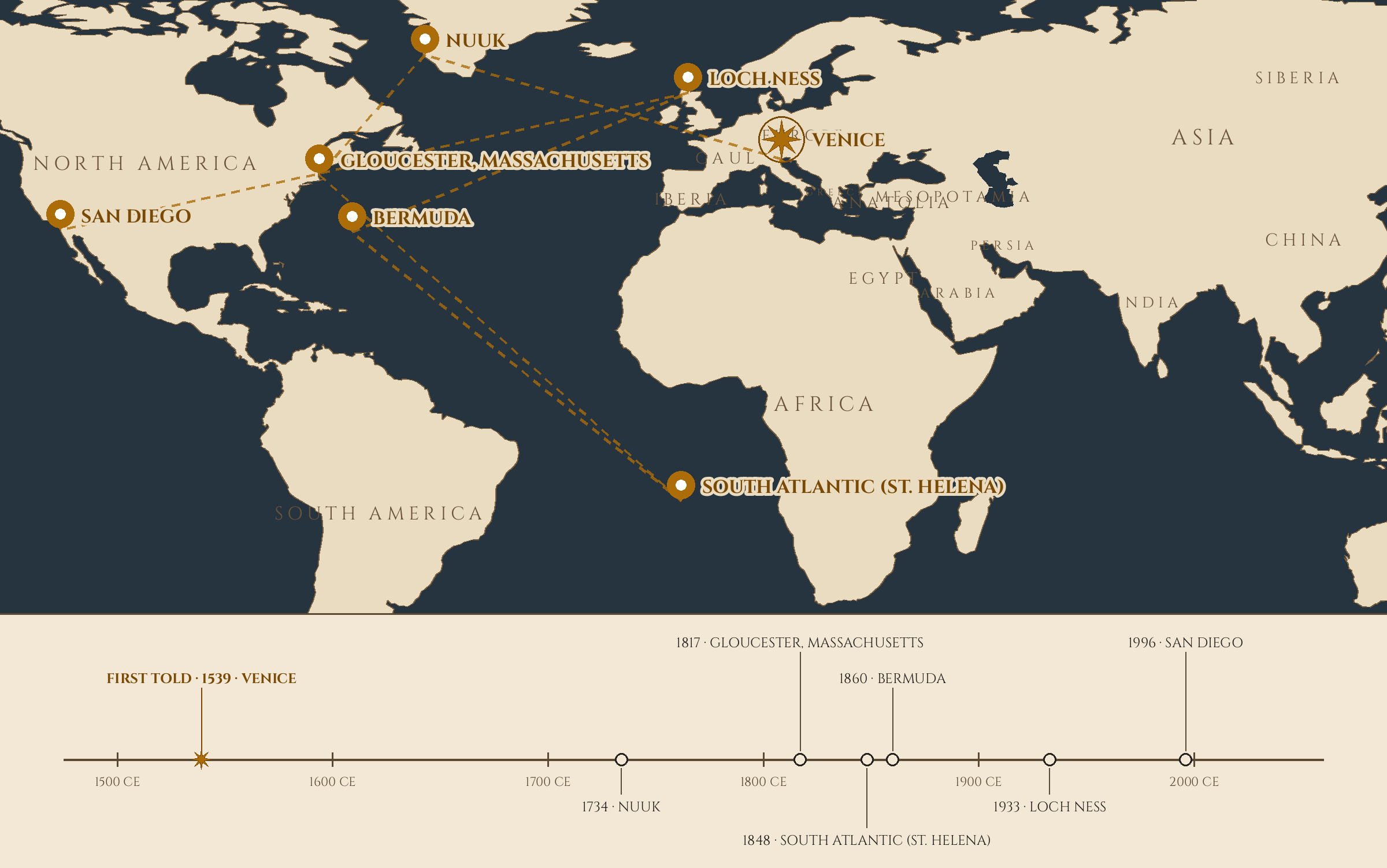
Where this lesson travels: Venice, where Olaus Magnus's Carta Marina (1539) drew the great sea serpent off Norway — the being's first famous portrait, and a picture for a first record; the sea off Greenland, where Hans Egede's party reported a vast serpent rearing beside their ship in 1734; Gloucester, Massachusetts, where the harbor serpent of 1817 was formally investigated under oath by the Linnaean Society of New England; the South Atlantic, off St Helena, where HMS Daedalus met its serpent in 1848 and Captain M'Quhae's report reached The Times; and Loch Ness, where the sightings of 1933 opened the modern era of the sea serpent's freshwater heir. The starred pin is the first record; the dashed line is the telling, traveling.
Lesson Objectives
By the end of this lesson, you will be able to:
- Explain why the sea serpent is this class's purest record-built being: no single author, no bestiary cradle — only logs, letters, depositions, and newsprint.
- Describe the serpent as the reports describe it, and read its plates across three centuries of paper.
- Give the being's first record as what it is: a picture on a map, the Carta Marina of 1539, and say what kind of evidence a picture is.
- Tell the three set cases — Egede (1734), Gloucester (1817), and the Daedalus (1848) — with their dates, their witnesses, and the exact point at which each one's evidence stops.
- Recount what the Gloucester specimen, Scoliophis atlanticus, turned out to be, and which body corrected the record.
- Name the candidates the record itself offers for what the witnesses saw, each labeled as firmly as the record labels it — and state the file's plain balance after five centuries.
Your Assignment Packet
This lesson's work lives in its packet: the Lexicon Handout (every term, the core terms marked with the keeper's diamond ◆), Materials, Guided Practice, the Assignment Manual written out whole, the Scholar's Entry Page, the Reflection Questions, the Workbook Checklist, and the Keeper's Notes, for whoever teaches the lesson. Download the packet before you begin and keep it beside you as you read. The packet's assignment is Rookmere's own word for the work: Entry No. 20 — Sea Serpents ✎. The Unit III Quiz is not printed in the packet; it waits at the end of the unit, with Lesson 22.
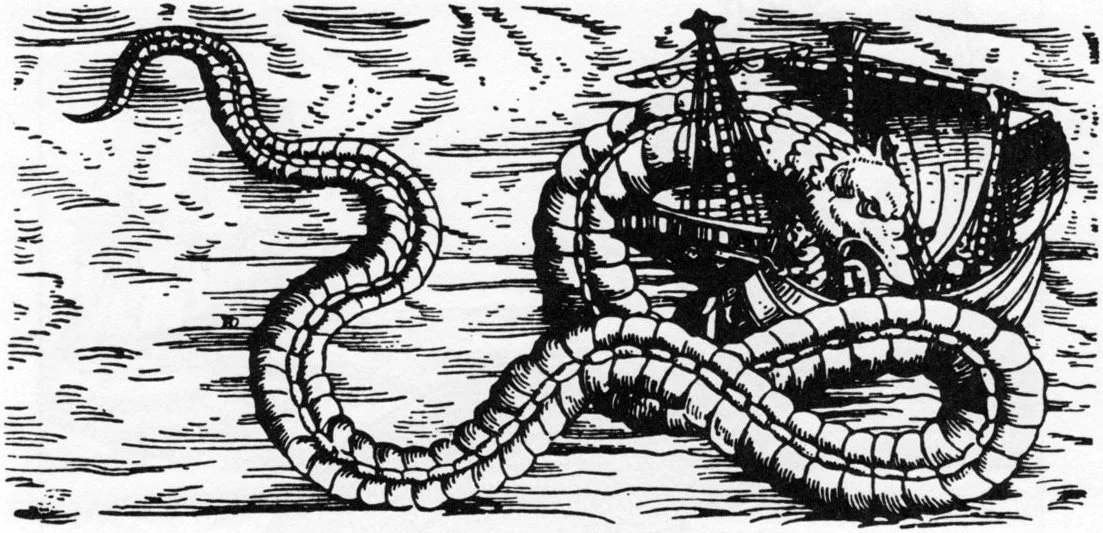
The great sea serpent of Olaus Magnus's Historia de Gentibus Septentrionalibus (1555): the two-hundred-foot serpent coiling around a ship — the most copied sea-serpent image of the early modern world. Public domain, via Wikimedia Commons.
The Creature
Ask what a sea serpent is, and the record answers with a shape, not an animal: a long body in the water, a head raised clear of the surface, a back that shows in humps or coils, great size, and steady, unexplained motion. No bestiary ever carried the being: it was born too late for the beast-books and too wild for them, a creature of the age of sail and print. Its authorities are not Pliny and Isidore but harbormasters, missionaries, naval officers, and the committees of scientific societies.
Read its pictures in order, as you have learned to do. The hero plate is Olaus Magnus's serpent of 1555, coiling around its ship: the body drawn as a chain of neat segments, coiling twice around the little ship, and the head — more dog than snake, with an ear and a long snout — has hold of a sailor at the rail. The cutter gives you no weather and hardly any sea. Coils and a ship were the whole report, and coils and a ship are what he cut. The second plate is the Egede engraving: the long neck rearing, the water spouting from the snout, the ship alongside for scale. The third is paper of a newer kind — the Illustrated London News page of 1848, M'Quhae's serpent engraved for the breakfast tables of London. And the line ends with a photograph, new to this lesson: United States Navy trainees holding a 23-foot giant oarfish found near San Diego in 1996 — not a serpent at all, but the closest thing the real sea hands a witness, at full length beside men for scale. Three centuries of report-pictures, and then the candidate animal itself.
Two older water-beasts stand behind the serpent in the imagination, and the class names them here so they are not mistaken for records. Hydra, the many-headed water snake of Greek story, was set among the stars, where the constellation still winds along the spring sky. Cetus, the sea-monster sent against Andromeda in the Perseus story, is a constellation too, in the autumn dark. They are the serpent's celestial cousins — pictures men made of the sea's dangers, centuries before anyone filed a sighting. The sea serpent of this lesson works the other way round: nothing but sightings, filed one after another, with no story underneath them.
A third older water-beast belongs in that same margin, and he is filed differently from the other two, because his record is a record. Jörmungandr, the Midgard Serpent of the Norse telling, is the serpent the gods cast into the deep sea in Snorri Sturluson's Gylfaginning — the first book of his Prose Edda, written about 1220 — where he grows until he lies in the midst of the ocean encompassing all the land, and bites upon his own tail. His set tale is Thor's fishing for him. Thor rows out with the giant Hymir, baits a very strong hook with the head of Hymir's largest ox, and hauls the serpent up to the gunwale, fists crashing against the boat and feet plunged through its bottom — until Hymir, gone pale at the sight, cuts the line, and the serpent sinks back into the sea. The tale is older than Snorri's prose. Verses attributed to Bragi Boddason, the ninth-century skald — fragments sometimes thought to belong to his Ragnarsdrápa, among the earliest skaldic poetry that survives — already tell Thor's fishing, as a picture on a shield; the eddic poem Hymiskviða tells the fishing again; and carved stone tells it too: the eleventh-century Altuna stone in Sweden shows Thor in the boat, his foot gone through the hull as he pulls, and the Gosforth stones in England carry the same scene. Poem, poem, prose, and stone, across four centuries: a genuinely old spine, and this lesson does not pretend otherwise.
File him honestly all the same. Jörmungandr is one named being in one story-cycle — a god's opponent, met by a god, in a boat, in a poem. He is not a kind, and he is not a sighting tradition: no sailor ever filed a deposition about him, no committee ever took oaths on him, no newspaper ever carried him. The sea serpent of this lesson is the opposite shape of file — hundreds of unnamed reports with no story underneath them. Keep the two apart, and you have the distinction this lesson exists to teach, in its purest form: a serpent with a story and no sightings, named here beside a serpent with sightings and no story.
The file also grew by changing its instruments, and a keeper should know its librarians. In 1753, Bishop Pontoppidan's Natural History of Norway — the book that stars Lesson 16 — gave the northern sea serpent sober, footnoted pages: the being had a bishop for its naturalist. Through the nineteenth century the newspaper replaces the natural history as the record's home, and the scientific society replaces the bishop as its judge: reports arrive dated, placed, and signed, and are argued over in print by named men. The century closes with the file's first librarians. Henry Lee's Sea Monsters Unmasked (1883) argued the skeptics' case with a showman's energy; A. C. Oudemans's The Great Sea-Serpent (1892) catalogued more than three hundred references and proposed, in earnest, a giant long-necked seal behind them all. And in 1968 Bernard Heuvelmans published In the Wake of the Sea-Serpents, sorting the whole archive into kinds.
First Told
The starred pin on this lesson's map stands at Venice, 1539 — the city where the map was printed, though the serpent itself is drawn off Norway, and a keeper should register that small lesson at once: a picture's pin stands where the picture was made. The map is the Carta Marina of Olaus Magnus, the Swedish archbishop in exile, the first great printed map of the northern seas. Its waters swarm with beasts, and off the Norwegian coast the greatest of them coils around a ship. The map's own key names it without poetry: a worm 200 feet long, wrapping itself around a big ship and destroying it. That is the sea serpent's first famous portrait, and the being's first record on our shelf: not a sentence but a picture, drawn from what Nordic sailors told the mapmaker, and printed for every court in Europe.
The dashed line runs north and forward. Its second pin stands in the sea itself, off Nuuk in Greenland, in 1734, where the missionary Hans Egede's party met the rearing monster of section 4. The third stands in an American harbor — Gloucester, Massachusetts, 1817 — where the serpent was not merely seen but investigated, under oath. The fourth is the open South Atlantic in 1848, at the point, off St Helena, where HMS Daedalus met the most famous serpent of the century. And the line comes ashore at the last pin, Loch Ness, 1933, where the sea serpent's freshwater heir opens its modern era. Five pins: a picture, a missionary's journal, a legal investigation, a naval report, and a newspaper sensation. The map of this being is a museum of the kinds of evidence itself — which is why the lesson teaches the map before the cases.
Olaus Magnus glossed his own picture sixteen years later. In the Historia de Gentibus Septentrionalibus — the History of the Northern Peoples, printed at Rome in 1555 — the serpent of the Norwegian coast gets its chapter: a serpent 200 feet long and 20 feet thick, living in the rocks and caves toward the shore near Bergen, which comes out on clear summer nights to eat calves, lambs, and hogs, or goes to sea for fish and crabs; it has hair a cubit long hanging from its neck, sharp black scales, and flaming eyes; it rears its head up like a pillar, catches men from the ships, and devours them — and its appearance, Olaus adds, portends some change in the kingdom. Conrad Gessner, whose Historia Animalium we met in Lesson 1, took Olaus's two Carta Marina serpents into print again in 1558 — the beast-book tradition absorbing the map's monster within a generation.
The Tales
This being has no folktales. It has cases. There is no serpent story with a hero, a bargain, or a moral — nothing told for the telling's sake. What the record holds instead is a single repeating scene: a ship, a witness, a thing in the water, gone before a second look could settle it. The three set cases stand in the next section, in rising order of paperwork, and they are this lesson's tales in everything but kind: mark them S, not T — sighting-reports, each one only as strong as its witnesses, its closeness, and its paper.
KEEPER'S CHECK-IN
This being has cases, not tales — why does the lesson file its three set cases under S for sighting-report rather than T for tale?
Spotted
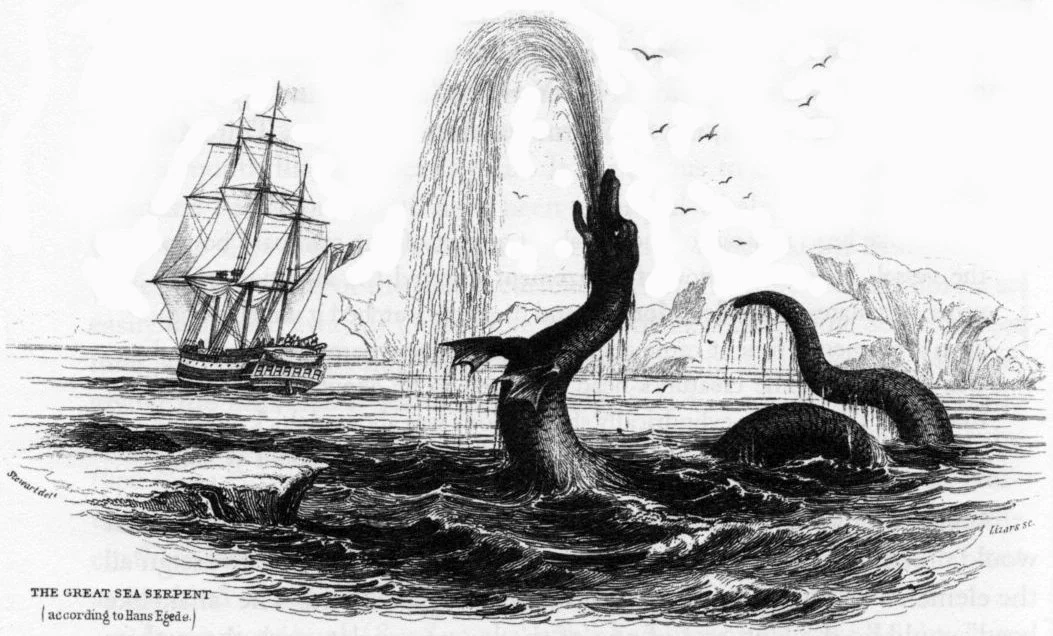
The serpent of the Egede report (Greenland, 1734): a long neck rising from the sea, spouting water, beside the missionary's ship — engraved by James Hope Stewart and William Home Lizars after the account Egede printed in 1741. Public domain, via Wikimedia Commons.
Greenland, 1734. On 6 July 1734, off Greenland at the 64th degree of latitude, a great sea creature reared beside the ship of the missionary Hans Egede. As Egede printed it in his book of 1741 — in English, A Description of Greenland (1745) — the head rose as high as the ship's main-top; it had a long, sharp snout and blew like a whale; it had broad flippers; its body seemed covered with scales, its skin wrinkled and rough; and its rear was formed like a serpent's, so that when it plunged backward, its tail rose from the water a whole ship's length from the body. The engraving in this lesson — drawn from the account by the missionary Bing, who was of the party — shows the rearing neck and the spout. Now the keeper's caution, and it is the finest in this lesson: Hans Egede was in all likelihood not the eyewitness. Modern scholarship — a close re-reading of the Danish sources by C. G. M. Paxton and colleagues (2005) — concludes the sighting was probably his son Poul's, reported to a father who printed it with care. Even the cleanest report in the file has hands in it. File the printed account F; file its seeing as reported, at one remove; file the monster S.
Gloucester, 1817. In August 1817 a great serpent took up residence, for some weeks, in Gloucester Harbor, Massachusetts, and was seen by hundreds — fishermen, townspeople, crews of whaling vessels — described as fifty to a hundred feet long, thick as a barrel, moving with wonderful speed. America answered with the most keeperly instrument it had: a committee. The Linnaean Society of New England appointed three of its members — a United States district judge, John Davis; a physician, Jacob Bigelow; and Francis C. Gray — who traveled to Cape Ann, circulated questions, and took sworn depositions from the witnesses. Their report, printed at Boston in 1817, concluded the animal was real and undescribed. Then the case produced the thing no other case in this lesson ever produced: a body. In late September a small snake about three feet long, with a strange bunched and undulating spine, was killed near Loblolly Cove and brought to the Society, which examined it, declared it the great serpent's young, and named a new genus and species for it: Scoliophis atlanticus, the Atlantic crooked-snake. There the record rested for nearly fifty years — until the Boston Society of Natural History re-examined the preserved specimen and reported, in the 1860s, what it was: a common black snake with a deformed spine. The giant of Gloucester Harbor was never identified; its supposed child was a sick snake with a Latin name. No case in this class teaches the whole method faster: sighting, oath, pamphlet, specimen, name — and, given time, correction.
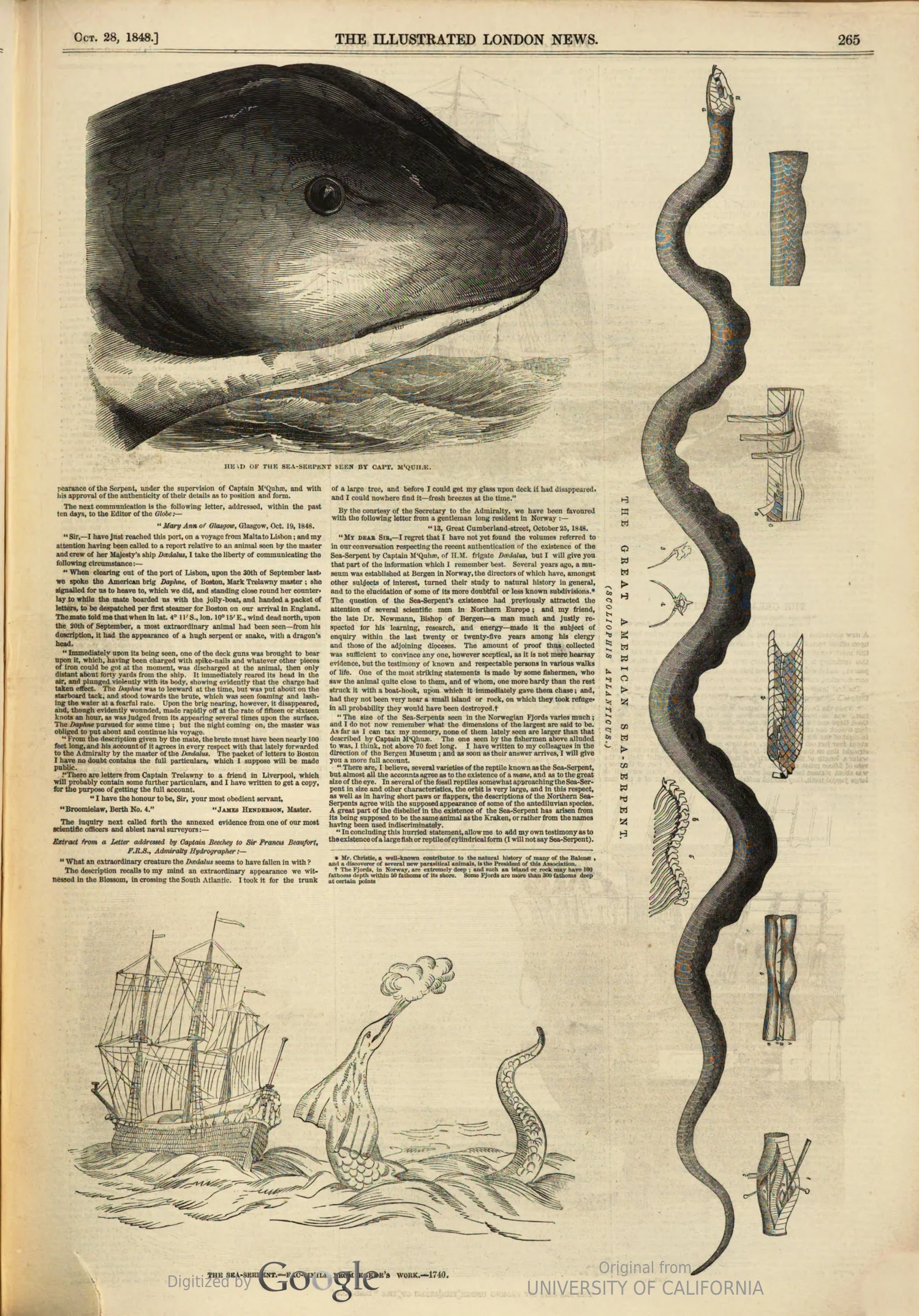
The Illustrated London News page of 1848 reporting HMS Daedalus's sea-serpent sighting, with a study of the creature's head: the report in its public dress — the same particulars Richard Owen would answer in print with an elephant seal. Public domain, via Wikimedia Commons.
The South Atlantic, 1848. The set text of this lesson, and the file's most famous document. On the afternoon of 6 August 1848, HMS Daedalus, homeward bound from the East Indies between the Cape of Good Hope and St Helena, was passed at close range by an enormous serpent. Captain Peter M'Quhae reported it to the Admiralty in a letter of 11 October, printed in The Times that month and engraved for the Illustrated London News — the page in this lesson's plates. Read the report as the lesson's model of its kind. It is signed. It is dated and placed by latitude and longitude. It measures: the head and shoulders kept about four feet above the surface; at least sixty feet of the animal at the surface; the diameter behind the head fifteen or sixteen inches; the color dark brown, yellowish-white about the throat; no fins, but something like the mane of a horse — or a bunch of seaweed — about the back. It names its witnesses: the captain, two lieutenants, the master, the boatswain's mate, the quartermaster, the man at the wheel, who watched it for some twenty minutes as it passed close under the lee quarter, so close, M'Quhae wrote, that had it been a man of his acquaintance he should have known the face. And it notes, precisely, what did not happen: no portion of the animal was seen to propel it, by vertical or horizontal undulation.
Then the answer came, also in The Times, in November: Richard Owen — the anatomist who named the dinosaurs — held that the officers had seen a great elephant seal, its forequarters and the eddy in its wake accounting for the whole description; and he pressed the keeper's hardest question: in all the centuries of reports, the sea had yielded no bone, no carcass, no specimen of any such animal. M'Quhae replied in print, indignant, holding every particular of his report. There the case rests, and a keeper leaves it there: the best-attested serpent of the nineteenth century is a signed report, a famous drawing, a great anatomist's counter-reading, and an unanswered question about bones.
KEEPER'S CHECK-IN
Captain M'Quhae's Daedalus report is signed, dated, placed, measured, and witnessed by seven men — what one thing is still missing that would settle the case?
What People Watched For — the Watchers of the Loch
A belief held by enough people, with cameras cheap enough, produces a custom this lesson can date to the year: the organized watch.
Its theater is the map's last pin. In April 1933, Aldie Mackay saw the great rolling creature in Loch Ness, and the Inverness Courier carried the report on 2 May; that July, George Spicer and his wife watched a long-necked animal cross the road before their car, and the modern era of the Loch Ness monster — the sea serpent's freshwater heir — was open. What people did next is the custom. In the summer of 1934, twenty men with binoculars and cameras were posted around the loch, nine in the morning to six in the evening, for five weeks. A generation later the watch took institutional form: the Loch Ness Phenomena Investigation Bureau, founded in 1962 by a company that included the MP David James and the naturalist Sir Peter Scott, kept the loch under volunteer observation for ten years — watches kept from vantage points up and down both shores, cine cameras on long lenses, a caravan camp and viewing platform at Achnahannet from 1965, logs kept, reports filed, and, by the Bureau's own 1969 account, more than a thousand members. It disbanded in 1972, its film cans full and its question open.
File the Bureau as F — charters, camps, rotas and all. File what it watched for as S. And note the shape of the thing: when the record was only testimony, people argued; when the watching could be organized, they organized it — rotas, platforms, lenses, logs. The watching changed; the serpent did not.
What It Actually Is
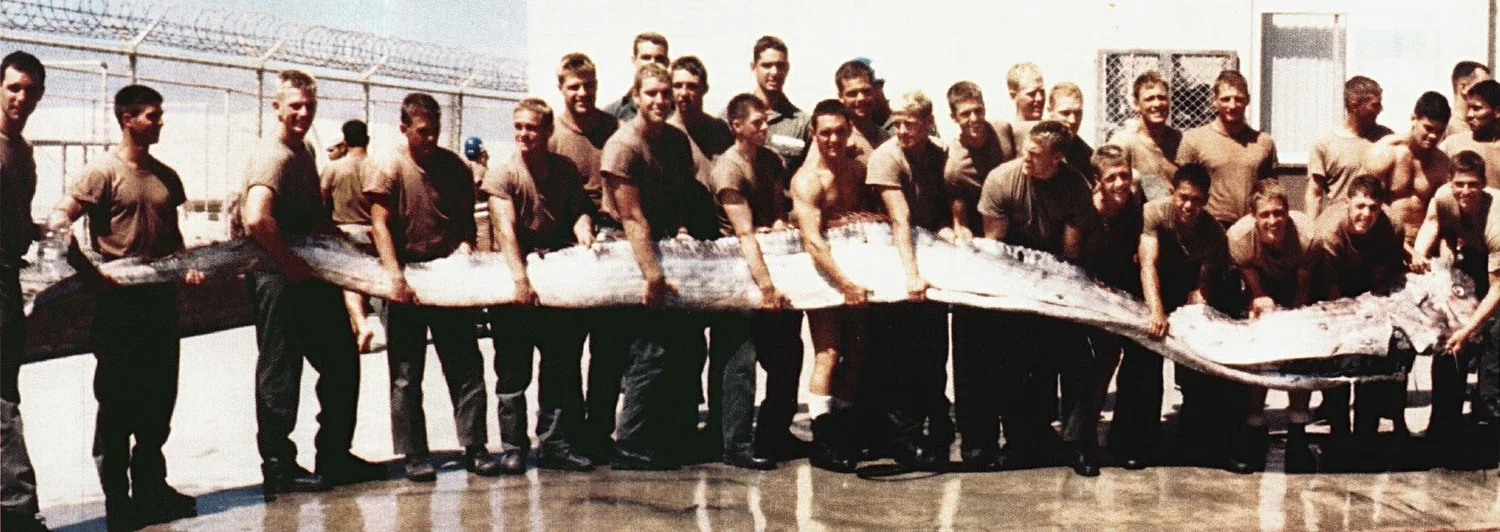
The candidate animal itself: United States Navy trainees holding a 23-foot (7 m) giant oarfish (Regalecus glesne) found near San Diego, California, in September 1996 — the real animal behind a family of sea-serpent reports, at full length beside men for scale, the red crest still showing along its head. The same photograph later circulated far from home, in Laos, as proof of a river dragon. Public domain (U.S. Navy / U.S. federal work), via Wikimedia Commons.
No body of a great sea serpent has ever reached a museum: that is the file's foundation fact, and Owen stated it in 1848. What the record offers instead is a row of candidates, each proposed for particular cases, and a keeper files them as proposals, not as solutions.
Whales, seen unfamiliarly. A humpback whale feeding at the surface, rolling and scooping fish, was the Boston Society of Natural History's own suggestion for the Gloucester sightings; and the modern re-reading of Egede's monster (Paxton and colleagues, 2005) concludes that the party most likely saw a whale — a humpback, a right whale, or one of the last Atlantic gray whales — in a posture no one aboard had a drawer for. The oarfish. A real fish of the deep water, ribbon-long, with a red crest along its head, which comes to the surface only when sick or dying: it matches, detail for detail, a whole family of the older reports, and oarfish strandings have been written up, in more than one coast's papers, as the end of a serpent story — at Bermuda in March 1860 a sixteen-foot oarfish came ashore and was described at the time as a sea serpent, and the photograph in this lesson's plates shows a 23-foot specimen held by Navy trainees, with the red crest still showing along its head. Lines of life. A basking shark's successors, a file of porpoises, a swimming deer, a floating tree, a boat's wake standing in calm water: at a distance, in poor light, the sea composes serpents out of processions. Owen's seal, and its heirs. For the Daedalus animal, Owen proposed a great elephant seal; a modern biologist, Gary Galbreath, has proposed a sei whale at the surface, holding its course. Both are readings of a description, offered by men who were not there, against seven men who were. A keeper writes them in the margin, labeled with their authors' names and their standing: proposed.
Give the oarfish its measure, since it earns its place in this file honestly. It is the longest bony fish alive. Most of the ones that come ashore run about ten feet; the largest reliably measured reach about twenty-six feet — the San Diego fish of the photograph was twenty-three — though the reports thin out as the numbers grow, as reports in this lesson tend to do. The body is a flat silver ribbon with no scales to speak of, and a red dorsal fin runs the whole length of it, rising at the head into that crest. It lives in deep water, down to about a thousand meters, and swims by rippling the long fin while its body hangs nearly straight. Picture a dying oarfish at the surface — silver side flashing, red crest awash, the rest of it trailing away out of sight underwater — and you have about the closest thing the real sea can hand a witness to a serpent ready-made. The same photograph carries its own lesson in how reports grow: the San Diego picture later circulated far from home, in Laos, as proof of a river dragon caught by American servicemen — a real photograph, honestly taken, wearing a false caption. Keepers check captions the way they check compasses.
Under all of it, the plain balance of five centuries: thousands of reports; a handful of signed, measured, multi-witness cases of real quality; and not one bone, skin, or tissue sample of an unknown great serpent in any collection on Earth. The file is testimony all the way down. That is not a reason to sneer at it — testimony is most of what history is — but it fixes the being's kind exactly: the sea serpent is a creature of the record.
Still With Us
Heuvelmans's catalogue of 1968 made the serpent a subject with a literature; its freshwater heir made it a celebrity. Loch Ness kept the file open through the twentieth century — the famous photograph of 1934, confessed as a hoax sixty years later; the sonar sweeps; and, in our own century, two systematic answers. In 2003 a BBC-sponsored sonar survey swept the loch and found no animal of substantial size. In 2019 a team led by Neil Gemmell published the loch's environmental DNA — every species its waters could be made to confess — and found no reptile, no sturgeon, no unknown great animal; and, in abundance, eels. The modern face of the sea serpent is thus a double portrait: the reports continue, as they have continued since 1539 — the loch's sighting register still logs new reports in our own decade, which is the honest answer to why some people still think something is there — and the instruments improve, as they have improved since the Linnaean Society's questionnaires — and the two curves have never yet met at a specimen. Nessie — the loch's monster, as the modern reports name her — now co-leads Lesson 21, Lake Monsters, where her own file is kept in full.
The Daedalus report is still quoted wherever evidence is taught, and you can see why teachers love it. Seven men watched for twenty minutes, and their captain wrote it all down with measures. It is about as good as testimony gets. It still is not an animal in a museum case, and M'Quhae, for all his indignation, could not make it one. That gap — between the best report in the file and the specimen that never came — is where this lesson leaves you. Keepers spend a good deal of their working lives at that address.
Guided Observation
Begin with the hero plate: Olaus Magnus's serpent of 1555, coiling around its ship. Read it against its own chapter, which you have in section 2: the pillar-raised head, the ship in the coils, the sailor being taken. Which of the text's details has the woodcut kept? Which has it quietly dropped — the flaming eyes, the cubit of hair? What has it added that no sentence in Olaus wrote? A picture is a record with an editor, and this is the class's first picture-record: treat it with the same suspicion, and the same respect, as a text.
Then the Egede engraving: the long neck rearing, the water spouting from the snout, the ship alongside for scale. Egede's words give the tail a ship's length behind the body when the creature plunged. Look for the tail. Then the Illustrated London News page of 1848: M'Quhae's serpent engraved for the breakfast tables of London, set among the paper's other wonders — including, on the same page, the American Scoliophis of 1817, thirty years dead and still swimming in print. Three plates, three centuries, three kinds of paper: a scholar's folio, a missionary's book, a newspaper. Write one sentence on what each kind of paper does to the serpent it carries — what it adds, what it guarantees, what it cannot help believing.
Last, the photograph: the oarfish at San Diego, 1996. No artist, no engraver, no editor between the animal and your eye — and yet this very picture was later captioned, far away, as a dragon. What does that afterlife tell you about the plates you have just been reading?
Assignment Manual
✎ WRITTEN · ⚒ HANDS-ON · ◐ BOTH
✎ Written · Entry No. 20: Sea Serpents.
- Rule your entry page. Turn to the Scholar's Entry Page in this packet and rule the next page of your journal to match it, as you did for Entries No. 1–19.
- Write the entry, to the standard. The Creature: the shape the reports agree on, and the depiction line — Magnus's woodcut, the Egede engraving, the Illustrated London News page, the oarfish photograph. First Told: the Carta Marina, Venice, 1539 — a picture for a first record; write one line on what kind of evidence a picture is, and where its pin stands and why; then Olaus's chapter of 1555 (the measures, the Bergen caves, the flaming eyes) and Gessner's copying. The Tales: one short paragraph — this being has cases, not tales, and why. Spotted: the three set cases, each in its own short paragraph with its date leading — Egede 1734, with the caution about whose eyes; Gloucester 1817, from the first sightings to the Boston correction; the Daedalus 1848, from the captain's own measures. What It Actually Is: the candidates, each with its author's name and its standing as a proposal — whales, the oarfish, processions, Owen's seal and its modern heirs — and the foundation fact beneath them all. Still With Us: Nessie as the freshwater heir; the hoax confessed; the sonar of 2003 and the DNA of 2019; the reports that still arrive. The Keeper's Line: your own judgment, in one or two lines.
- File the cases. Under your Keeper's Line, add a short table of the three set cases, three lines: for each, one sentence marked F stating what the record establishes (a book printed, a report signed, a specimen re-examined), and one marked S stating what the witnesses reported seeing. The serpent's entry is not finished until its evidence is filed separately from its animal.
- Mark every line. Go back through your entry and mark every line in the margin with the keeper's marks: T for tale, S for sighting-report, or F for fact. In this entry, watch especially for the report that tries to become a settled sighting: a line that says "Egede saw" where the record only supports "Egede printed" must be caught and corrected in the margin. That catch is the lesson.
Materials
· Your bestiary journal, with Entries No. 1–19 in it
· Pencils, and a pen you like
· A ruler, for ruling your entry pages
· This lesson's packet (the Scholar's Entry Page is in it)
· The lesson page, for the map and the plates
Reflection
The Daedalus report is signed, dated, placed, measured, and witnessed by seven men — and it is still not proof. What is missing? Name the thing itself, as exactly as you can.
Gloucester's committee did everything this class teaches — traveled, questioned, took oaths, examined a specimen — and still named a sick snake a new species. Where exactly did their method fail: in the seeing, the questioning, the specimen, or the wanting?
The Carta Marina's serpent is a picture drawn from sailors' talk. Is a picture a tale, a report, or a fact? Defend your filing in three lines.
A Closing Note
Twenty entries in, and your bestiary holds a being made entirely of other people's honesty and error. The unit's last lesson, two lessons on, is its strangest pairing: a river-child of Japan with a dictionary for a birth certificate, and a power of the Australian billabongs whose record reached paper through other men's pens. One of them gets a map. The other gets the truth about why not. Bring both marks, and your lightest hand — we file another people's inheritance next, and we file it carefully.
The Bestiary
Bestiary Keeper
Further Reading & Sources
Olaus Magnus, Carta Marina (Venice, 1539) and Historia de Gentibus Septentrionalibus (Rome, 1555) — the portrait and the chapter; the 1555 serpent passage is widely reprinted in translation.
Hans Egede, A Description of Greenland (English edition, 1745) — the 1734 monster in the missionary's own book; and C. G. M. Paxton, E. Knatterud & S. L. Hedley, "Cetaceans, Sex and Sea Serpents" (Archives of Natural History, 2005), the modern re-reading of whose eyes saw it.
Report of a Committee of the Linnaean Society of New England, Relative to a Large Marine Animal, Supposed to Be a Serpent, Seen near Cape Ann, Massachusetts, in August 1817 (Boston, 1817) — the Gloucester depositions in the original pamphlet.
Captain Peter M'Quhae's report and the Owen correspondence, The Times, October–November 1848 — the Daedalus case in its first print.
A. C. Oudemans, The Great Sea-Serpent (1892), and Bernard Heuvelmans, In the Wake of the Sea-Serpents (1968) — the file's two great catalogues, skeptic's and believer's, shelved together as they should be.
Submit your work for this lesson using the form below.
CONTINUE IN THE BESTIARY HALL
← Previous · Lesson 19: The Kelpie & the Each-Uisge Next · Lesson 21: Lake Monsters →
Unit III — Creatures of the Waters The Bestiary Hall — All 41 Lessons
The rest of Unit III: Lesson 16 · The Kraken · Lesson 17 · Mermaids · Lesson 18 · Selkies · Lesson 19 · The Kelpie & the Each-Uisge · Lesson 21 · Lake Monsters · Lesson 22 · Kappa & Bunyip