

THE BESTIARY
Unit III · Lesson 18Selkies
Professor Sable Rookmere
Bestiary Keeper
The Bestiary Hall • School of Evershade
Professor's Introduction

Here is the gentlest file in the unit, and the one that will teach you the most about what a record is. The selkie's first full tale in print is dated 1822. Nobody — no collector, no keeper, no scholar of the ballads — believes the tales began in 1822. They were old when the printers found them, carried mouth to mouth along the seal coasts of the far north for longer than anyone can count.
So this lesson carries a warning the kraken and the mermaid did not need: on this map, the dates are the ages of paper, not of tellings. A late record says something about paper, and nothing about worth. These are beings whose people had other ways of keeping — in memory, in song, at the fireside through the winter.
The Bestiary
Bestiary Keeper
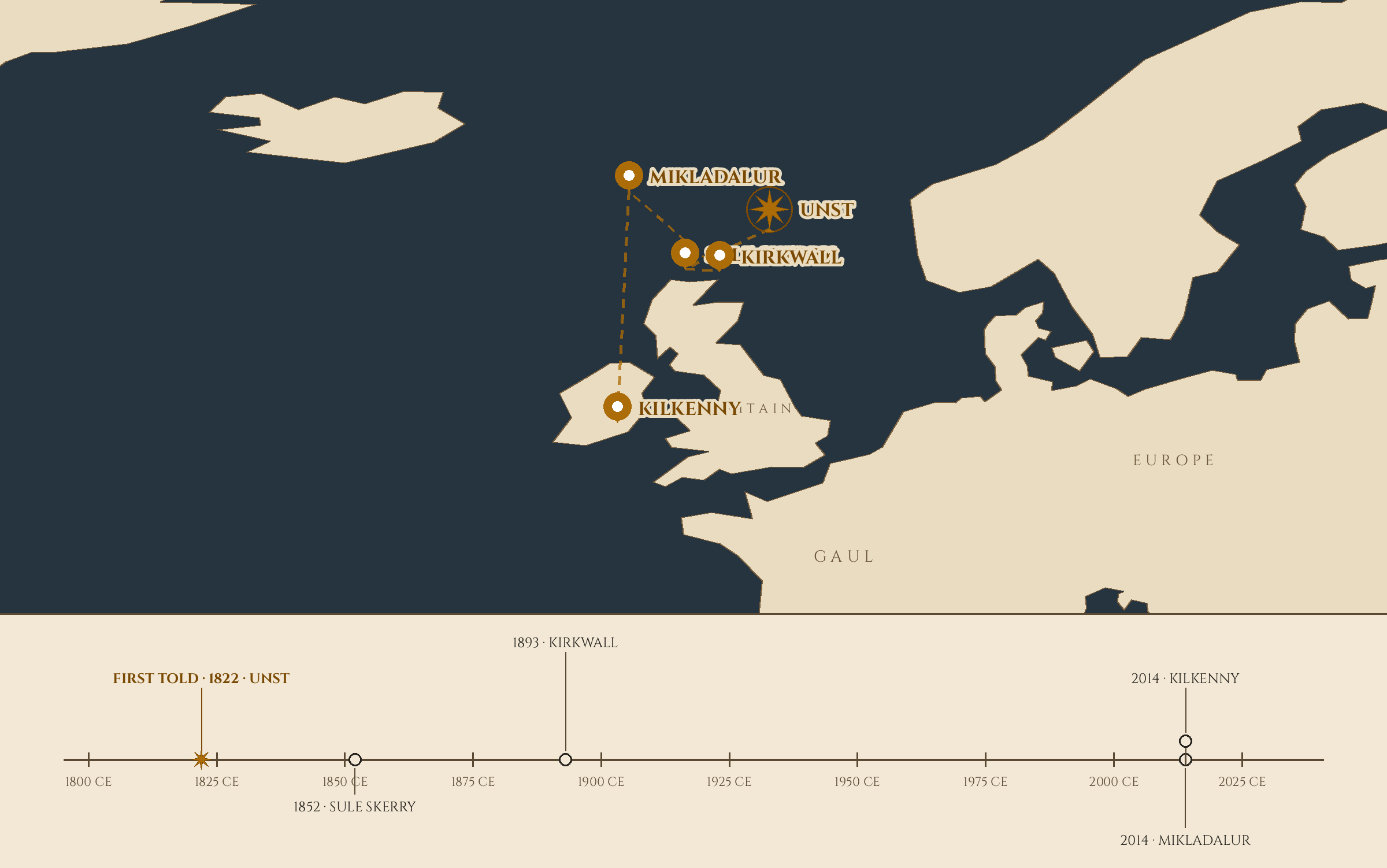
Where this lesson travels: Unst, where Samuel Hibbert's Description of the Shetland Islands (1822) printed a selkie-wife tale localized to the island — the being's first full tale in print; Sule Skerry, where The Great Silkie of Sule Skerry was first written down in 1852 by Lt. F. W. L. Thomas, from an old woman of Shetland; Kirkwall, where W. Traill Dennison's Orkney folklore papers (1893) insisted “selkie” is the being's proper name, against Hibbert's “mermen”; Mikladalur, where the Kópakonan, the seal-woman statue, was unveiled in the Faroe Islands in 2014; and Kilkenny, where Cartoon Saloon's Song of the Sea (2014) made a selkie the heart of the film. The print record is late because the tradition was oral for centuries — the stops are the first printings, not the tradition's age. The starred pin is the first record; the dashed line is the telling, traveling.
Lesson Objectives
By the end of this lesson, you will be able to:
- Describe the selkie, and say why its pictures begin as late as they do.
- Say what the word selkie means, and name the book that prints the being's first full tale, with its date and its island.
- Explain why this record begins so late, and what the map's dates do and do not claim.
- Tell the selkie's tales: the stolen skin, the ballad of Sule Skerry, and the seal woman of Mikladalur.
- State the naming correction of 1893, and why a keeper fights for a being's proper name.
- Describe the empty box in this lesson, and why the class leaves it empty rather than filling it.
- Name the real animal at the root of the tales, and mark every line of the entry T, S, or F.
Your Assignment Packet
This lesson's work lives in its packet: the Lexicon Handout (every term, the core terms marked with the keeper's diamond ◆), Materials, Guided Practice, the Assignment Manual written out whole, the Scholar's Entry Page, the Reflection Questions, the Workbook Checklist, and the Keeper's Notes, for whoever teaches the lesson. Download the packet before you begin and keep it beside you as you read. The packet's assignment is Rookmere's own word for the work: Entry No. 18 — Selkies (both) ◐. The Unit III Quiz is not printed in the packet; it waits at the end of the unit, with Lesson 22.
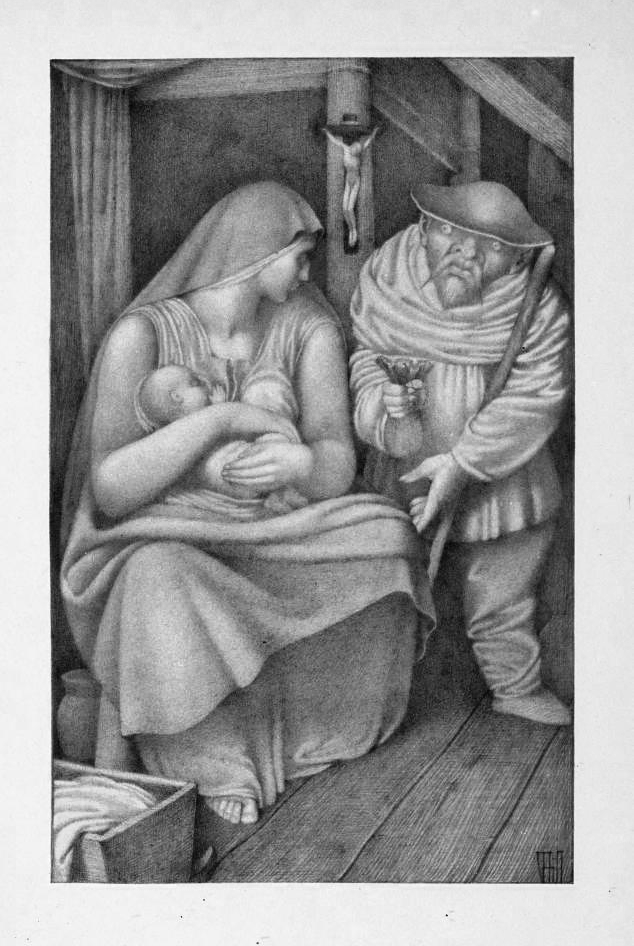
Vernon Hill's illustration to “The Great Silkie of Sule Skerry” (1912): the selkie wife, her child in her arms, standing before her fisherman husband in the cottage — the ballad's parting scene. Public domain, via Wikimedia Commons.
The Creature
The selkie is the seal-folk of the northern coasts: a seal in the sea who can come ashore, shed the seal-skin, and stand in human form — and who, if the skin is stolen and hidden, must stay on land in that form until it is found again. The word is Scots, and it is modest: a selch is a seal, and selkie is its diminutive — "little seal." Lieutenant F. W. L. Thomas, who wrote down this lesson's ballad, explained the northern name silkie the same way: a common name for a seal, from selch, the old word for the animal. Few beings on our shelf carry so plain a name. The selkie is not named for a terror, a goddess, or a moral. It is named for the animal it is.
Its pictures begin late, and that is a fact of the record, not a gap to be ashamed of: there is no medieval selkie, no early-modern selkie, because the tradition lived in mouths and songs, not in books with plates. The depiction line opens in 1912, with Vernon Hill's illustration in Ballads Weird and Wonderful, which stands at the head of this lesson: the selkie wife in the cottage, her child in her arms, before the fisherman husband — the ballad's world, domesticated into a picture of the parting everyone who knew the tales understood was coming. Look at the plate itself: the wife sits in the foreground with the child at her breast, her face turned away from us toward the fisherman, and he stands before her in his sea-going clothes, a staff in one hand and what looks like a small bunch of flowers in the other — a man who has brought a gift to a farewell. The room around them is bare boards and beams. There is no sea in the picture at all, and there does not need to be. The second plate is the animal itself: the grey seal photograph that closes this lesson's plates, one seal at the surface, watching the camera with the steady regard section 5 takes up. An oral tradition had become, in ninety years of print, a thing that could be illustrated, anthologized, and sold. The tales are still told on the coasts that made them.
First Told
✦ On the class test
The first record is a printing, and the map at the head of this lesson says so in its own preface, which keepers should memorize: the print record is late because the tradition was oral for centuries; the stops are the first printings, not the tradition's age. In 1822, Samuel Hibbert published his Description of the Shetland Islands, and in it a full selkie-wife tale, set on Unst, the northernmost of the Shetland Islands: a man finds a selkie's seal-skin, hides it, and so compels her to become his wife on land — while in Hibbert's telling she already had a husband of her own kind in the sea, waiting under the water the whole marriage through. Hibbert, reaching for the nearest shelf-label, called such beings mermen and mermaids. It was the wrong label, and a later collector would correct it in print; the correction is one of this lesson's pins, and you will meet it below.
The map works as all our maps work, with the caution doubled. The starred pin is Unst, 1822: Hibbert's book, the first full tale in print. From there the line walks south to a rock in the sea — Sule Skerry, 1852, where the great ballad was written down — then to Kirkwall in 1893, where the being got its proper name defended in print. And then the line jumps, farther than any map in the class so far, to 2014 — twice: to Mikladalur in the Faroe Islands, where the seal woman stands in bronze at the harbor, and to Kilkenny in Ireland, where a film made a selkie child its heart. Five pins, all print, paint, bronze, and film. Underneath every one of them lies an oral tradition of unmeasurable age, and the honest map shows the paper only.
For centuries the telling grew the way it began: by mouth, in the places where people and seals share a coast — Shetland, Orkney, the Faroe Islands, the north of Scotland, and the Irish shores. Seal coasts had the whole apparatus of the tales at hand every season: the animals hauling out on the skerries, the skins that were wealth and clothing, the boats, the weather, the waiting. A tradition like that does not need print to grow. It needs winter evenings, and it had them.
Print, when it came, came through the collectors, and the second pin is the file's treasure. In 1852, Lieutenant F. W. L. Thomas of the Royal Navy — a surveyor working in northern waters, and a careful listener — wrote down The Great Silkie of Sule Skerry from the dictation of an old woman of Snarra Voe, in Shetland, to a tune he described as "sufficiently melancholy." The ballad was printed in the first volume of the Proceedings of the Society of Antiquaries of Scotland; the great collector Francis James Child later took it into The English and Scottish Popular Ballads as Child Ballad No. 113. Students of the ballad note that Thomas's text, taken down in Shetland, is the only collected version from outside Orkney — the island group the tale calls home. Sule Skerry itself is a small rocky islet some twenty-five miles west of Hoy Head in Orkney, visible from the headland in clear weather: a real place, a seal place, that everyone who sang the ballad could point to on the horizon.
The third pin is a correction, and keepers should weigh what that means. W. Traill Dennison, an Orcadian farmer and folklorist, published his Orkney folklore papers in 1893 and insisted, against Hibbert and the habits of seventy years, that selkie was the being's proper name: these were not mermen, not mermaids, not fish-tailed people at all, but seals who shed a skin — a different being, with a different nature, and entitled to its own word. He was right, and print has followed him since. A name in a bestiary is not decoration; Isidore taught this class in Lesson 1 that a thing's name explains its nature. Dennison's correction is that doctrine doing its work in 1893: file the being under the wrong name and you will file the wrong nature with it.
The Tales
The selkie's central tale is the stolen skin, and it is told, with local furniture, all around the northern coasts. A seal comes ashore where the seal-folk dance or rest in human form; a watcher takes the shed skin and hides it — in a chest, under a roof-tree, in a wall. The selkie cannot return to the sea. She (in most tellings it is she; the ballad below tells the other side) becomes the watcher's wife: keeps his house, bears his children, works, and grieves in the manner of the stories, quietly and for years. And the tales are unwavering about the ending. One day the skin comes to light — a child finds the key, a chest is left unlocked, a hiding place is given away in talk — and the selkie takes her skin, sees first that her children are safe, and goes back to the sea.
In Hibbert's Unst telling, the sea she returns to holds her first husband, of her own kind; the land marriage was the interruption, not the story. In the Orkney tale of the Goodman of Wastness, the tale says the stolen wife bore her captor seven children before the skin came to light — seven children, and still the sea. A keeper reads that number the way it is offered: not as arithmetic but as the tale's measure of a life spent in the wrong element.
Hibbert's book also prints the tradition's hardest tale, and it belongs to the seal-skerries themselves. Sealers working the Ve Skerries, he records, would stun seals where they lay and strip the skins from them on the rock; the tale tells of a man left behind among the skinned and the living, and of a selkie mother seeking the skin of her son. Tell it soberly and briefly, as Hibbert prints it: it is the stolen-skin story seen from the rock instead of the cottage, and it shows what the tales looked like to the men whose living was seal-skins.
The ballad tells the male selkie's side. The Great Silkie of Sule Skerry opens with a nurse on land singing of the child she has borne to no earthly man, and the silkie comes to her and names himself: "I am a man upo' the lan', / An' I am a Silkie in the sea; / And when I'm far and far frae lan', / My dwelling is in Sule Skerrie." He pays her in gold for his son, and takes the boy to rear in the sea — and he foretells the rest, in the ballad's cold arithmetic: she will marry a proud gunner, and that gunner will shoot, one day, both the silkie and the silkie's son, playing together in the water. The tale does not call this unjust. It calls it certain. On a coast where men shot seals for a living, the ballad's ending is not a twist. It is a forecast.
The last tale is the Faroes', and it stands behind the map's fourth pin. In the legend of Mikladalur, seals were people who had once sought death in the sea; and once a year, on Twelfth Night, they come ashore on the island of Kalsoy, shed their skins, and dance as human men and women until dawn. A young farmer of the village watched the dancing, took the skin of a seal woman, and locked it in a chest, keeping the key on his person; she became his wife, and they had children; and one day, home from fishing, she found the chest's key forgotten — found her skin, made sure her children were cared for, and went back to the sea and her own people. Later, when the men of Mikladalur hunted seals and killed her seal husband and her sons, she laid a curse on the men of the island: they would go on dying — at sea, and by falls from the cliffs — until the dead could link arms around the whole island. Islanders say the count is not yet complete. That sentence, still said in the present tense, is the oldest layer of this lesson wearing modern dress: a tale behaving the way tales behaved before print, as a standing warning attached to a real shore.
KEEPER'S CHECK-IN
The stolen-skin tales are unwavering about their ending — what does the selkie do first when the skin comes to light, and where does she go?
Spotted
This section is honestly empty, and the lesson leaves it so in one line, the way the box below is left empty: no dated, named sighting-reports of selkies stand in the record — nobody filed a selkie the way Gloucester filed its serpent — because this being's record is tales collected from tellers, not reports filed by witnesses. What the collectors printed is in sections 2 and 3, marked as what it is.
KEEPER'S CHECK-IN
This lesson's Spotted section is honestly empty — why do no dated, named selkie sighting-reports stand in the record, and what stands there instead?
What People Watched For — a Box Left Empty, on Purpose
Every lesson in this class since the fairies has carried this box when a documented saying or custom could be produced: a named source, a date, a practice real people kept. For the selkie, keepers made the search — and this lesson leaves the box empty, and tells you why, because an explained absence is worth more than a filled page.
The Twelfth Night dance at Mikladalur will not fill it. That is the tale's own setting — the night the seal-folk are said to come ashore — not a documented practice of islanders watching for them. The often- repeated rule that it is unlucky to kill a seal will not fill it either: it circulates widely in modern retellings, but the keepers could not tie it to a named, dated source the way the brownie's bowl is tied to Scot (1584) and Henderson (1866), or the fishermen's soundings to Pontoppidan (1753). A custom that cannot be cited cannot be taught as one — not in this class.
Record the emptiness correctly, then: it is evidence about the record, not about the people. An oral tradition kept on seal coasts, in communities whose writing went to boats and rents and kirk registers, leaves fewer customs on paper than a literate age leaves. The box stands empty the way the class leaves a shelf-space for a book known to exist and not yet found. If a dated source for a selkie custom ever reaches this hall, the box will be filled, and the filling-in will be dated too.
What It Actually Is
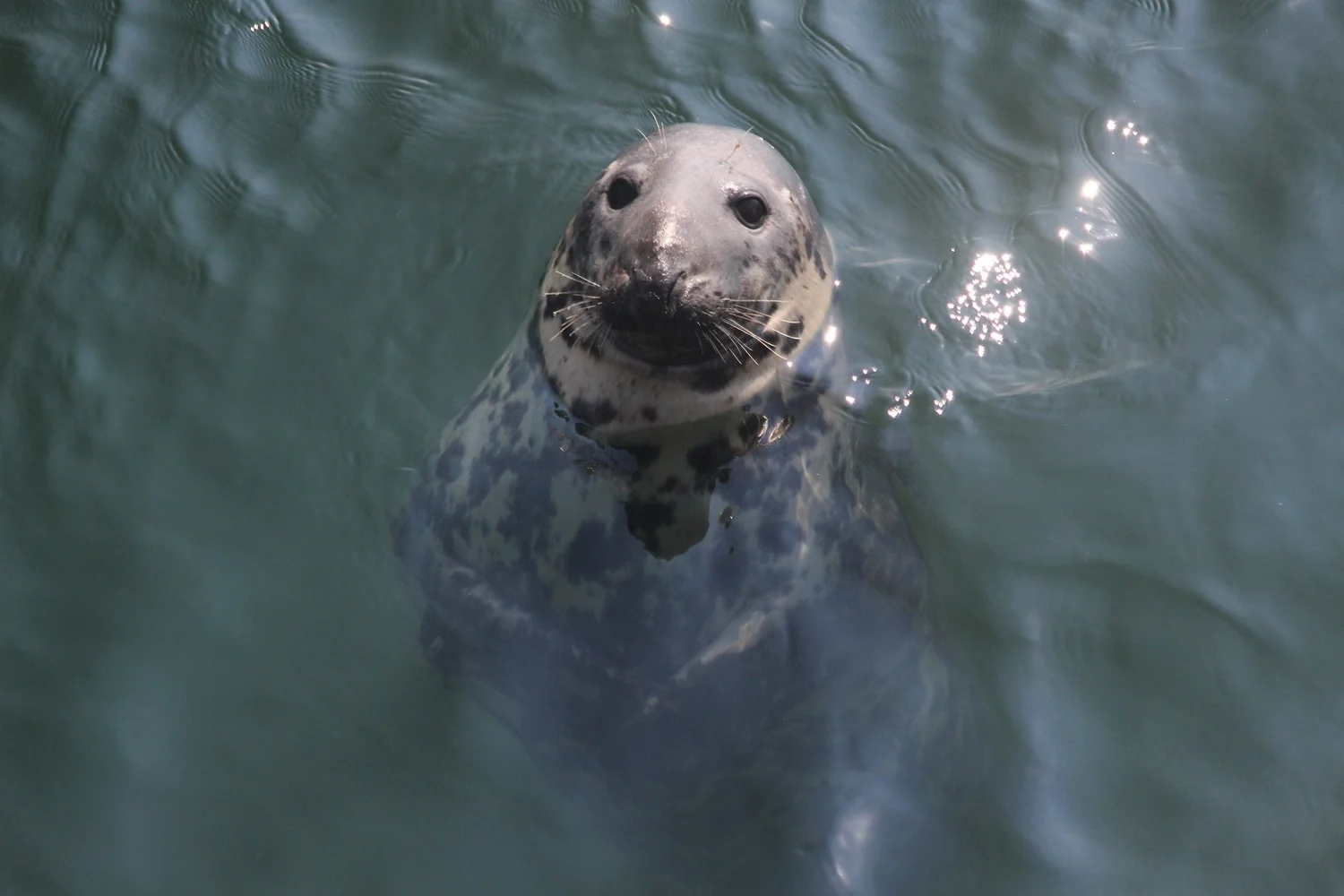
The real root: a single grey seal at the surface in the Stellwagen Bank National Marine Sanctuary — the animal whose skin the selkie sheds. Public domain, via Wikimedia Commons.
The selkie's real root is the seal itself — in these waters chiefly the grey seal, the large seal of the North Atlantic coasts — and the root requires less explaining than any other in Unit III. A grey seal hauls out on the skerries in companies and rests there for hours, as the tales' seal-folk rest. At the surface it rides low, head up, and looks — steadily, with large dark eyes — at boats and people, as the photograph in this lesson shows: one grey seal at the surface in Stellwagen Bank National Marine Sanctuary, watching the photographer with the exact regard that, in fog, at distance, from a small boat, has made better sailors than landsmen write strange things in logs. Seals shed their coats in an annual molt. And a seal out of the water is a creature visibly between two elements — at home in both, quick in one and helpless-looking in the other — which is the selkie's whole nature, described by zoology.
Put a measure on the animal while we are here. A grown female gray seal runs about seven and a half feet long. A big male can reach ten feet, and carries the long, curved nose that gave the species its scientific name: Halichoerus grypus is, roughly, "hook-nosed pig of the sea." Gray seals are true seals, so there are no ear flaps to see — only a small hole where an ear would be — and the whiskers on that blunt muzzle are working instruments, fine enough to feel the trail a fish leaves in the water. The pups are born wearing a coat of white fur, the lanugo, and spend their first weeks hauled out on the rocks. The seal in this lesson's photograph has the mottled coat and the steady look the species is known for: head up out of green water, whiskers fanned, watching the camera the way seals watch boats — for as long as the boat cares to stay.
The human root stands beside the animal one. These tales come from communities that hunted seals — for skins, oil, and meat — as a season of the working year. A skinned seal on a rock and a person without their skin are images such a coast had in its hands every season; Hibbert's Ve Skerries account is those images at their harshest. And the tales themselves, in telling after telling, are about keeping and being kept: the theft is never praised, the thief is never the hero, and the selkie is never the villain. Whatever the tales were for — and a keeper files speculations about purpose as T, however fond of them — their sympathies are a documented fact of the texts, and they are the sympathies of people who knew exactly what it costs to hold someone from their own element.
Still With Us
The selkie entered film quietly and stayed. The Secret of Roan Inish (1994), directed by John Sayles from Rosalie K. Fry's 1957 novel Secret of the Ron Mor Skerry, set the seal-folk on the coast of northwest Ireland: a girl, Fiona, sent to live with her grandparents by the sea, a lost baby brother said to have been raised by the seals, and a family legend of descent from a selkie — the oral tradition carried, whole and unhurried, into a cinema. The film does not explain the tales or laugh at them. It keeps their pace.
Then came 2014, the year the map gives two pins. On August 1, 2014, at the harbor of Mikladalur on Kalsoy, the Kópakonan — the Seal Woman — was unveiled: a statue in bronze and stainless steel, some nine feet tall, by the Faroese sculptor Hans Pauli Olsen, standing where her legend is set, facing the water she returns to. A tale that spent centuries without a page now has a monument, a harbor, and visitors; islanders still tell the curse's count in the present tense, within sight of her. And the same year, in Kilkenny, Cartoon Saloon released Song of the Sea, in which Saoirse, a young selkie — the last of the seal-children — is the heart of the film: the skin, the sea-longing, and the parting, drawn for a new century's children out of the same northern stock of tales that Thomas wrote down in 1852.
That is the selkie's file: a little-seal name, a stolen skin on Unst, a ballad off a rock in the sea, a name defended in print, an empty box where a custom could not be proven, and a bronze woman on a Faroese harbor. The record arrived late, and the file says so on its face. Late is all it is. The tales it carries were old when the printers found them.
Guided Observation
Study Vernon Hill's illustration at the head of this lesson — the selkie wife in the cottage, her child in her arms, standing before her fisherman husband (1912). Read the room as evidence of the years on land: the furniture, the dress, the child. Then read the figures. The illustrator has not drawn a monster, a captivity scene, or a rescue; he has drawn a parting, and everyone in the picture knows it. What in their postures tells you so? And what does it mean for this file that the tradition's most famous picture is of a farewell indoors — no sea in it at all?
Then turn to the photograph: a single grey seal at the surface, in Stellwagen Bank National Marine Sanctuary. Look at the head, the eyes, the steady regard. Write down what a sailor in fog, at fifty yards, in a small boat, might honestly make of that face over the water. Then write down what the photograph refuses to give you: no skin shed, no woman, no dance — one animal, in daylight, being an animal. The space between those two paragraphs is the whole lesson.
Assignment Manual
✎ WRITTEN · ⚒ HANDS-ON · ◐ BOTH
◐ Both · Entry No. 18: Selkies.
- Rule your entry page. Turn to the Scholar's Entry Page in this packet and rule the next page of your journal to match it, as you did for your earlier entries.
- Write the selkie's entry, to the standard. The Creature: the description, the plain name, and the late depiction line — Hill's 1912 plate and the seal photograph, with one line on why no earlier pictures exist. First Told: Hibbert's Description of the Shetland Islands, 1822 — the Unst tale, with the map's caution that the date is the printing's, not the tradition's age; the oral centuries in one line; Thomas and the ballad of 1852; Dennison's naming correction of 1893. The Tales: the stolen skin and how it ends; the Great Silkie, with his saying and his forecast; the seal woman of Mikladalur and the curse. Spotted: one honest line — no sighting-reports stand in this file. What It Actually Is: the grey seal — the haul-out, the regard, the molt — and the sealing coast the tales came from. Still With Us: Roan Inish; the Kópakonan of 2014; Song of the Sea, the same year. The Keeper's Line: your own judgment, in one or two lines.
- Two homes, one road. ◐ On a fresh page, draw the tale's geography as a keeper's diagram: the skerry, the shore, the cottage — and mark the skin at each stage of the story: shed on the rock, hidden in the chest, found, taken up, carried back to the sea. Beneath the diagram, write the stages in order, one line each. The drawing is the point: a selkie tale is a map of two homes with one road between them, and the road is a thing that can be stolen. Keepers draw what the record describes, so that the next reader can see its shape.
- Mark every line. Go back through your entry and mark every line in the margin with the keeper's marks: T for tale, S for sighting-report, F for fact. The special discipline of this entry: every date in it is F — they are the dates of printings, pictures, and films — and the tales themselves are T, however old they feel. The age of the tales is unmarked and unmarkable, and your entry should say so in as many words. A line left honestly unmarked teaches more than a line forced.
Materials
· Your bestiary journal, with your earlier entries in it
· Pencils, and a pen you like
· A ruler, for ruling your entry pages
· This lesson's packet (the Scholar's Entry Page is in it)
· For Step 3: a fresh page, and the lesson's map as your model coastline
Reflection
The selkie's first record is dated 1822, and nobody believes the tales began in 1822. What exactly does a first record date, then — and what would be lost if the map quietly pretended the date was the being's birthday?
Dennison fought, in print, for the right name: selkie, not merman. Why does a keeper spend effort on a name — and what goes wrong in a file when a being is kept under the wrong one?
In the tales, the theft of the skin is never praised and the selkie is never the villain. What can a story's sympathies tell a keeper about the people who told it — and under which mark, T, S, or F, will you file your answer?
A Closing Note
Eighteen entries in, and your bestiary has learned to hold a record that is honest about its own lateness — a harder honesty than any bishop's hedge. Next lesson we come in from the sea to the dark rivers and lochs, for the water-horses: the kelpie, and a kin of his you will be glad to have met on paper first. Keep your journal dry, your marks plain, and your empty boxes explained.
The Bestiary
Bestiary Keeper
Further Reading & Sources
Samuel Hibbert, A Description of the Shetland Islands (Edinburgh, 1822) — the first full selkie tale in print, localized to Unst.
F. W. L. Thomas, "The Great Silkie of Sule Skerry," written down 1852 and printed in the Proceedings of the Society of Antiquaries of Scotland, vol. 1 — with Thomas's note on the name silkie.
Francis James Child, The English and Scottish Popular Ballads — "The Great Silkie of Sule Skerry" as Child Ballad No. 113.
W. Traill Dennison, Orkney folklore papers (1893) — the defense of selkie as the being's proper name.
R. Pearse Chope (ed.), Ballads Weird and Wonderful (1912) — the volume of Vernon Hill's illustrations, including this lesson's plate.
The Kópakonan at Mikladalur — the statue by Hans Pauli Olsen, unveiled August 1, 2014; the Faroe Islands' official visitor guides tell the legend in full.
Song of the Sea (Cartoon Saloon, 2014) and The Secret of Roan Inish (1994, from Rosalie K. Fry's Secret of the Ron Mor Skerry, 1957).
Submit your work for this lesson using the form below.
CONTINUE IN THE BESTIARY HALL
← Previous · Lesson 17: Mermaids Next · Lesson 19: The Kelpie & the Each-Uisge →
Unit III — Creatures of the Waters The Bestiary Hall — All 41 Lessons
The rest of Unit III: Lesson 16 · The Kraken · Lesson 17 · Mermaids · Lesson 19 · The Kelpie & the Each-Uisge · Lesson 20 · Sea Serpents · Lesson 21 · Lake Monsters · Lesson 22 · Kappa & Bunyip