

THE BESTIARY
Unit III · Lesson 22Kappa & Bunyip
Professor Sable Rookmere
Bestiary Keeper
The Bestiary Hall • School of Evershade
Professor's Introduction

The last lesson of the waters is a pair that never met. Japan's river-child and Australia's billabong power share nothing but the element and this page, and they arrive by opposite roads: one through the most papered folklore on Earth, the other through a handful of colonial newspapers that were never the being's own. File them as they come. The kappa's folder is thick, dated, and illustrated; the bunyip's is thin, second-hand, and honest about it. Do not tidy either folder to match the other. The difference between them is part of the record.
The Bestiary
Bestiary Keeper
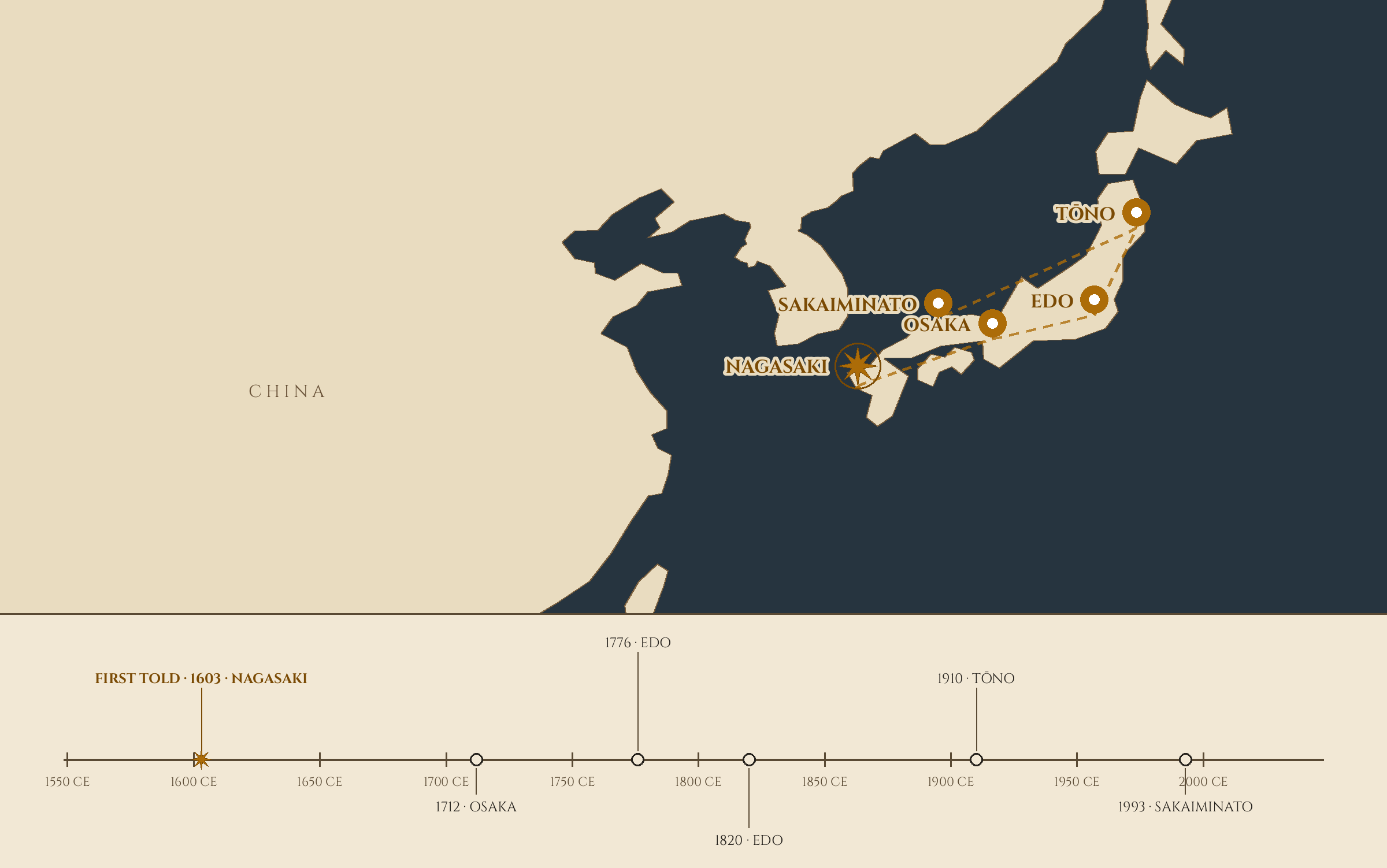
Where this lesson travels — and where it honestly does not. The map is the kappa's: Nagasaki, where the Jesuit press's Japanese–Portuguese dictionary of 1603 glosses kawarō, a monkey-like being that lives in rivers — no shell or dish yet; Osaka, where Terajima Ryōan's Wakan Sansai Zue (1712) gives the kawatarō its first illustrated encyclopedia entry, the water-holding hollow on its head included; Edo, where Toriyama Sekien's Gazu Hyakki Yagyō (1776) sets the kappa's image in print; Tōno, where Yanagita Kunio's Legends of Tōno (1910) records the kappa of the Sarugaishi River; and Sakaiminato, where the Mizuki Shigeru Road opened in 1993 with a bronze kappa among its yōkai. The bunyip has no pins and no dashed line: his stops — Sydney 1812, Geelong 1845, the Murrumbidgee skull of 1846–47, Buckley's account of 1852, Deniehy's speech of 1853, Macfarlane's picture of 1890 — are carried in the lesson's prose, each with its place named, because no journey exists in his record for a keeper to draw. The starred pin is the first record; the dashed line is the telling, traveling.
Lesson Objectives
By the end of this lesson, you will be able to:
- Describe both beings, and read the kappa's picture line from the ape-like kawatarō of 1712 to the finished kappa of the Edo print shops.
- Give the kappa's first record exactly: a dictionary gloss, Nagasaki, 1603 — and say what the being did not yet have when the record opens.
- Follow the kappa's image as it is fixed, step by step: encyclopedia (1712), picture-book (1776), folklore classic (1910), bronze street (1993).
- State the bunyip's paper record in its stops — 1845, 1846–47, 1852, 1853, 1890 — while stating, in the same breath, whose tradition the being is and how much older than its paper it runs.
- Explain why this lesson's map belongs to one being only, and what a keeper writes instead of a line that was never traveled.
- Recount the named-cucumber custom and the two-day museum queue, and file each as what it is: the customs two different records produced.
Your Assignment Packet
This lesson's work lives in its packet: the Lexicon Handout (every term, the core terms marked with the keeper's diamond ◆), Materials, Guided Practice, the Assignment Manual written out whole, the Scholar's Entry Page, the Reflection Questions, the Workbook Checklist, and the Keeper's Notes, for whoever teaches the lesson. Download the packet before you begin and keep it beside you as you read. The packet's assignment is Rookmere's own word for the work: Entry No. 22 — Kappa & Bunyip ✎. The Unit III Quiz is not printed in the packet; it closes the unit, and it stands at the end of this very lesson, below.
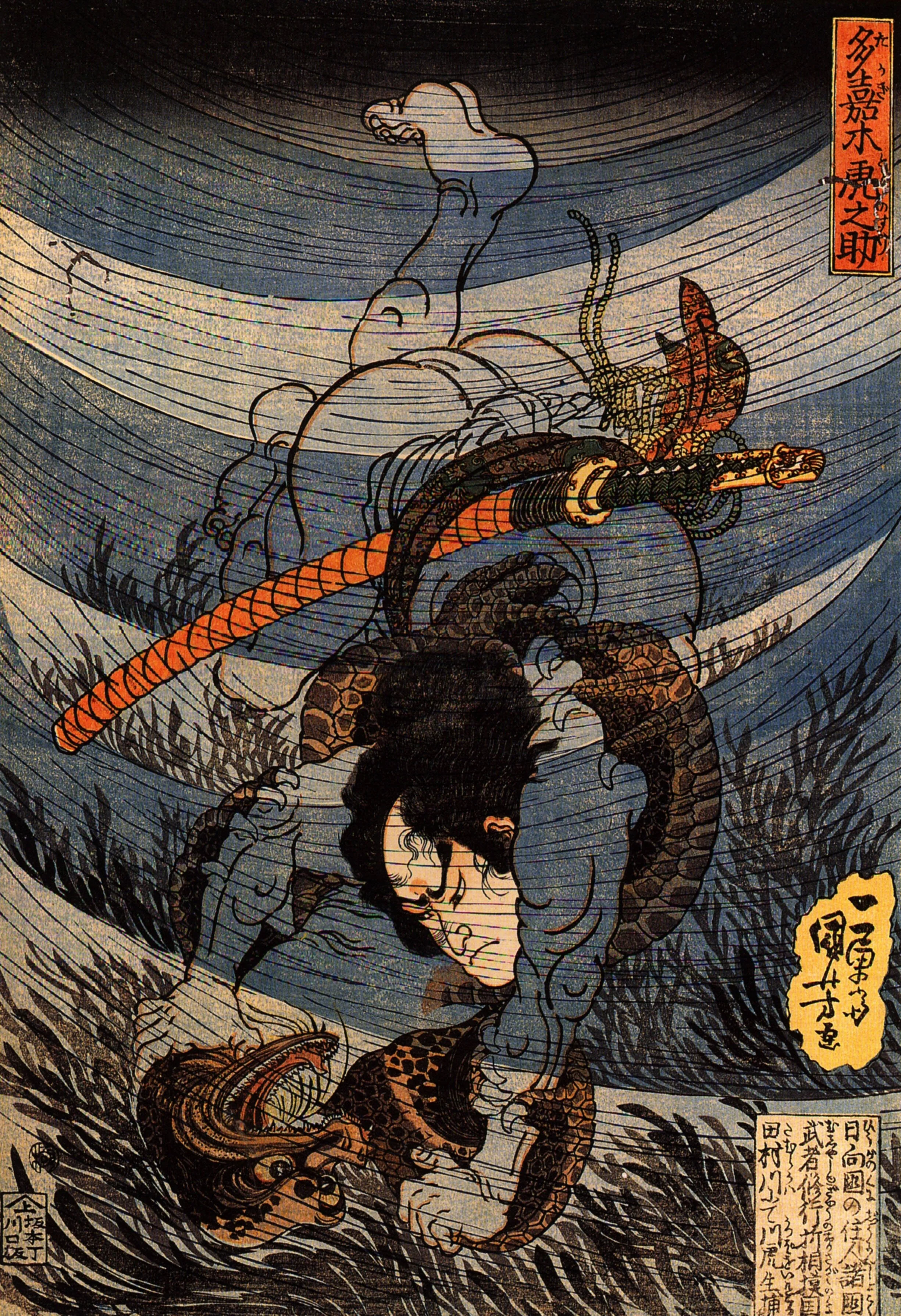
Utagawa Kuniyoshi's woodblock of the strongman Takagi Toranosuke grappling a kappa underwater in the Tamura River: the kappa as Edo-period popular art drew it — dish, beak, shell and all. Public domain, via Wikimedia Commons.
The Creature
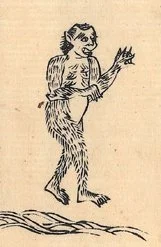
The kawatarō of Terajima Ryōan's encyclopedia Wakan Sansai Zue (1712) — the kappa's first illustrated entry, drawn as a furry, ape-like river creature, before the green, shelled, beaked form of the later print shops; the water-holding hollow on its head is already in the text. Public domain, via Wikimedia Commons.
The kappa is Japan's river-child: kappa itself is a squeezing-together of kawa, river, and wappa, a child. In the older books he is kawatarō — Tarō of the river, a boy's name for a being the size of a child — and komahiki, the horse-puller, for his worst habit. He is small and green in the pictures, web-fingered, beaked like a bird, shelled like a turtle, and on the crown of his head he carries the thing he cannot live without: the sara, a shallow dish that holds water. While the dish is full, he is strong out of all proportion to his size. Let it spill, and he must creep back to his river to fill it.
But read the kappa's earliest picture before you settle that description, because the finished kappa is a late arrival. The new plate in this lesson is his first illustrated entry: the kawatarō of Terajima Ryōan's encyclopedia Wakan Sansai Zue (1712) — a furry, ape-like river creature, with no green shell and no neat beak, drawn matter-of-factly beside its text. Scholars of the depiction line note that the kappa's image before the eighteenth century favored this ape type. The green, shelled, beaked kappa arrives with the picture-books and the print shops: Toriyama Sekien's Gazu Hyakki Yagyō (1776) sets the image for the popular eye, and the hero plate of this lesson — Kuniyoshi's strongman wrestling a kappa underwater — shows what that image became: dish, beak, and shell, complete and unmistakable. Kuniyoshi turns the whole scene upside down: the strongman Toranosuke hangs head-downward in a whirl of river water, his sword still belted at his side, while below him the kappa — scaly, clawed, open-mouthed — has hold of him and means to keep it. The river itself is drawn in great sweeping bands that fill the print, so the fight happens inside the water, with no bank and no rescuer anywhere in the frame.
The bunyip is a power of the still waters of south-eastern Australia — the billabongs, swamps, creeks, and waterholes. His name is the colony's spelling of banib, a word of the Wemba-Wemba and Wergaia peoples of Victoria, glossed in English today as "devil" or "evil spirit" — and a keeper files that gloss with its caution attached, for it is the colonists' rendering, and it may not carry the word's older weight. The being himself was never one being across the continent: nation by nation he carries other names — kianpraty along the Murrumbidgee — and other shapes. What Lesson 22 can grade is narrower than the tradition, and the lesson will keep saying so: it is the paper record, which begins when settler pens begin. His picture line is the file's plainest evidence of that: the one plate in this lesson, Macfarlane's bunyip of 1890, is a settler artist's picture, made for settler readers. No Aboriginal depiction stands in this file, and the lesson does not pretend otherwise.
The school pairs them to teach, side by side, a record that is nearly all document and a record that is nearly all testimony about someone else's document.
First Told
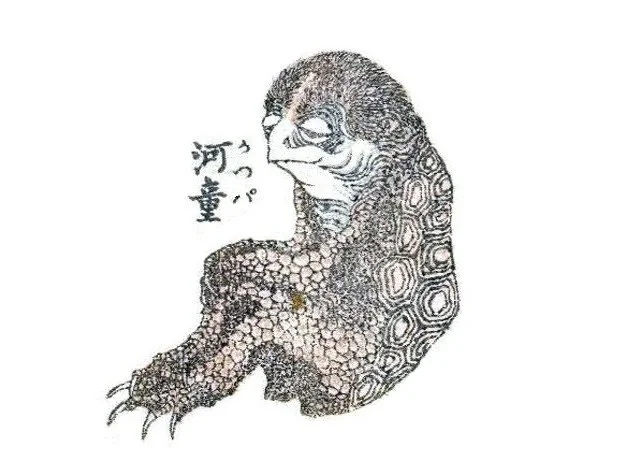
A kappa from Hokusai's manga sketchbooks: the creature reduced to a few sure lines by the master sketch artist — a brevity that measures how completely his readers already knew the being. Public domain, via Wikimedia Commons.
This lesson's map requires a keeper's word before anything else, and the word is this: the map is the kappa's. Its five pins follow one being's record, in one country, through four centuries of print. The bunyip has no dashed line on it, because no such journey exists in his record for a keeper to draw: his stops, which are real and dated, stand in this text below, each with its place named in prose. A map that pretended to chart the bunyip's travels would claim a shape for evidence that does not have one. Write that into your entry; it is the unit's last map lesson.
The kappa's starred pin stands at Nagasaki, 1603, and it is the most modest first record in the class: a line in a dictionary. The Jesuit press in Nagasaki printed a Japanese–Portuguese dictionary that year, and among its words stands kawarō, glossed as a monkey-like being that lives in rivers. That is all. No dish, no shell, no beak — a word, a gloss, and a habitat. The being enters the written record not in a tale but in a word-book, the tool of translators.
From the gloss, the pins build the picture. At Osaka in 1712, Terajima Ryōan's encyclopedia Wakan Sansai Zue gives the kawatarō his first illustrated entry — the ape-like plate of section 1 — and the water-holding hollow on the head is in the text: between the dictionary and the encyclopedia, the being has acquired his dish. At Edo in 1776, Toriyama Sekien's picture-book Gazu Hyakki Yagyō sets the kappa's image for the popular eye. At Tōno in 1910, Yanagita Kunio's Legends of Tōno records the kappa of the Sarugaishi River with a folklorist's care. And at Sakaiminato in 1993 the line ends in bronze: the Mizuki Shigeru Road, a street of statues of the yōkai from the great cartoonist's work, a bronze kappa among them.
The kappa's growth between those pins is a history of Japanese print doing what print does. The dictionary gloss of 1603 becomes the encyclopedia's illustrated article of 1712; the encyclopedia's article becomes Sekien's picture-book figure of 1776, one of the hundred demons of his parade; and the figure escapes the books into everything — prints, toys, shop signs. Yanagita's folklore studies in the twentieth century gather the regional tellings into scholarship, and Mizuki Shigeru's manga makes the kappa a national character: mischievous, mannerly, and known to every schoolchild in Japan.
And the bunyip's stops, in prose, as promised. In 1812 an earlier spelling of the word, bahnyip, appears in the Sydney Gazette — a large black animal like a seal, with a terrible voice: the word, in print, before its famous decade. In 1845 the word takes its modern shape at Geelong. In 1846–47 a skull travels from the Murrumbidgee to a Sydney museum and back out of science in two days. In 1852 the longest witness statement in the file is published, from a man who had lived thirty-two years inside the tradition. In 1853 the word enters politics, in a speech. In 1890 a colonial artist gives the being the picture in this lesson's plates. Those six stops are the bunyip's map, drawn in sentences.
The bunyip's growth runs through one instrument only: the newspaper. The 1840s and 1850s are his great decades in print — sighting reports, fossil stories, and letters to editors from the south-eastern colonies. Then the word itself emigrates, as the kappa's never did: by the 1850s bunyip is Australian slang for an impostor, a pretender, a humbug — and on 15 August 1853, at the Victoria Theatre in Sydney, the young orator Daniel Deniehy turned the slang on the men who proposed to give New South Wales a hereditary aristocracy of colonial lords. His name for their order — a bunyip aristocracy — brought the house down, was reported in the Sydney Morning Herald the next morning, and has never left the language since. The being of the billabongs had become, eight years after the Geelong bone, a metaphor with a date on it.
The Tales
The kappa's tales are a rulebook for living beside rivers, told as encounters. He is the horse-puller: kappa drag horses and cattle into the water to drown them — it is in his name, komahiki — and the tellings give the offense its legal ending. At Tōno, the record says, a kappa caught in the act of pulling a horse was let go upon signing a written promise to do it no more: the being inside a contract, filed by Yanagita in 1910. He is a wrestler, forever challenging passers-by to sumo, and unbeatable while his dish is full. And he is the most courteous monster in this bestiary, which is his undoing: the kappa is bound by manners, and if you bow to him, he must bow back — the water spills from the sara, his strength runs out on the ground, and he must scramble back to his river to refill it. Children were taught the bow as they were taught the river path: it is the only counter-charm in this class delivered as etiquette. Last and soberest, the record says the kappa reached into his drowned victims for the shirikodama, a round ball within the body where the soul was held to sit: the tale's way of saying what a drowning takes. File the ball as T.
The bunyip's tales must be told with their teller named at every step, for they come to us entirely at second hand — and in this file the tales and the sighting-reports are the same documents, so they stand together in the next section, each with its newspaper, its date, and its limits written beside it.
KEEPER'S CHECK-IN
The kappa is the most courteous monster in this bestiary — how does a simple bow defeat him, and why does it work every time?
Spotted
The kappa was reported as well as told of, and the reports were gathered early: by 1820 a scholar had assembled the Suiko kōryaku, a whole compendium of reported kappa sightings and captures, with sketches — a sighting-file kept inside the most papered folklore on Earth, two centuries before the Loch Ness watchers of the last lesson organized theirs.
The bunyip's reports are his whole paper life, and they must be read with their teller named at every step. The Geelong Advertiser of 2 July 1845 printed what its informants gave it: a great bone shown to an Aboriginal man, who recognized it at once — it belonged to the bunyip, which he declared he had seen — and drew the creature without hesitation: a being, the paper wrote, "uniting the characteristics of a bird and of an alligator," twelve or thirteen feet high when it walked upright, killing its prey, the paper said, by hugging. The same report carried a story of a woman killed by a bunyip, and its "most direct evidence": a man named Mumbowran, who showed deep wounds on his breast said to be the claws' work. All of this is testimony, filtered through a colonial newspaper that had fossils to sell a story with; a keeper files the printing as F and every detail inside it as reported speech — mark it S, and write reported beside it.
The file's one long witness is William Buckley, the escaped convict who lived from 1803 to 1835 among the Wathaurong people, and whose life story was published in 1852. Buckley writes of Lake Modewarre and the other inland waters: in them "is a very extraordinary amphibious animal, which the natives call Bunyip." He claims sight of it more than once — and what he claims is the most keeperly sentence in the whole bunyip file: "I could never see any part, except the back, which appeared to be covered with feathers of a dusky grey colour. It seemed to be about the size of a full grown calf... I could never learn from any of the natives that they had seen either the head or tail." A back, dusky and feathered-looking, calf-sized, in the water — and a witness who writes down the limits of his own evidence in the same paragraph. Buckley also reports the belief that the being had supernatural powers, and repeats, as hearsay and marked as such, the story of a woman killed.
KEEPER'S CHECK-IN
William Buckley claimed to have seen the bunyip more than once — what exactly did he say he saw, and what did he write down, in the same paragraph, that he had never seen?
What People Watched For — the Named Cucumber
The kappa is the only being in this unit whose belief produced a household custom gentle enough to survive on a menu.
The kappa's favorite food, in all the tellings, is the cucumber. And in Edo — the old Tokyo of the shoguns — families acted on it in form: they wrote the names of their family members on cucumbers and set them afloat on the streams, so that the river's tenant, finding his dinner labeled, would take the vegetable and spare the named when they went into the water. In some districts the custom ran the other way round the table: people ate cucumber before swimming, as a protection — while in others it was held that eating it before swimming would guarantee an attack, the smell of his favorite food being the surest way to summon him. The record keeps both rules, in different districts, without embarrassment; a keeper keeps both too.
The custom's modern survival is edible: the cucumber sushi roll is kappamaki to this day, named for the being's taste, on menus far from any river he haunts. File the named cucumbers F — the practice is documented in the folklore record of the Edo period and after. File the bargain they struck as T.
The bunyip's record, honestly kept, holds no matching household custom for the keeper to file — what the colonies did with their being was different in kind, and it is in section 5 below: they queued to look at its skull. The absence is data.
What It Actually Is
For the kappa, the root is the river. Japan is a country of rivers running fast off mountains through farmed valleys, and the kappa stands at every dangerous pool in them: a child-sized being for the child-sized victims drowning most often took. The bowl of the sara, the bow, the cucumber with a name on it — the whole apparatus is instruction for the water's edge, memorable in proportion to its strangeness. Beneath the tales the record also keeps real animals in view, as candidates, labeled as such: the Japanese giant salamander, a great flat-headed river animal that can grow longer than a child is tall and hauls itself through the shallows, has often been proposed behind early kappa reports; and the otter, upright in the water at dusk, is another candidate of the record's margins. Proposals, both — write them in pencil.
The salamander deserves a closer look, because it is a startling animal in its own right. A big one runs to about five feet long, which puts it among the largest amphibians alive. It has a broad, flat head, small eyes, and loose, wrinkled, mud-brown skin. Cold, clear mountain streams are its home; it hides under rocks and in bank burrows by day and hunts fish and crabs by night, finding them largely by smell and by feel, having no eyesight worth the name. A fisherman wading at dusk who met one — a long, dark, child-length shape working through the shallows — had something real to carry home and describe. What he described it as depended on the stories his river already kept.
For the bunyip, the record hands us its own roots, in order. The bones of 1845 were fossil bones: the colonies were digging up the remains of giant marsupials — the Wellington Caves finds of 1830 were later identified as Diprotodon and its kin. Diprotodon itself was no small thing to dig up: the largest marsupial that ever lived, about ten feet long in the body and standing about as tall as a man at the shoulder, a heavy plant-eater built on the wombat's plan — and great bones, shown to the people whose country they came out of, were named with the name their tradition kept for the waters' inhabitants. The skull of 1846 had the briefest career of any specimen in this class: taken from the Murrumbidgee near Balranald, it was examined by the naturalists W. S. Macleay and Richard Owen — the same Owen who would answer the Daedalus report a year later, now identifying a water monster from the other side of the world — and by July 1847 it stood identified as the deformed foetal skull of a foal or calf. And in that same July, the Australian Museum in Sydney put the disproved skull on display, and Sydney queued for two days to see it. The queue is the bunyip's custom: a city turning out to look at a monster's skull is evidence — about the city. For the voice in the swamps, the record offers the Australasian bittern, whose booming call across night water earned it the bush name of the bunyip bird. The bittern itself is a stocky, streaked-brown bird of the reed beds, roughly two feet tall, that freezes with its bill pointed at the sky when something alarms it. The male's call is a deep boom, and on a still night it carries across the water from a singer nobody ever seems to see. As a source for a voice in the dark that sounds large and near, the record could hardly have proposed better. For the backs in the rivers, the record's earliest description — 1812's bahnyip, "a large black animal like a seal" — points at the seals that travel far up Australia's rivers still.
And beneath the settler record, the keeper writes the line this lesson exists to hold: the tradition is Aboriginal, and it is older than every date in this section. The paper begins in 1812 and 1845 because paper is what the colonies brought. What the bunyip was, and is, in the keeping of the peoples whose word banib the newspapers borrowed, this lesson can point to but cannot grade.
Still With Us
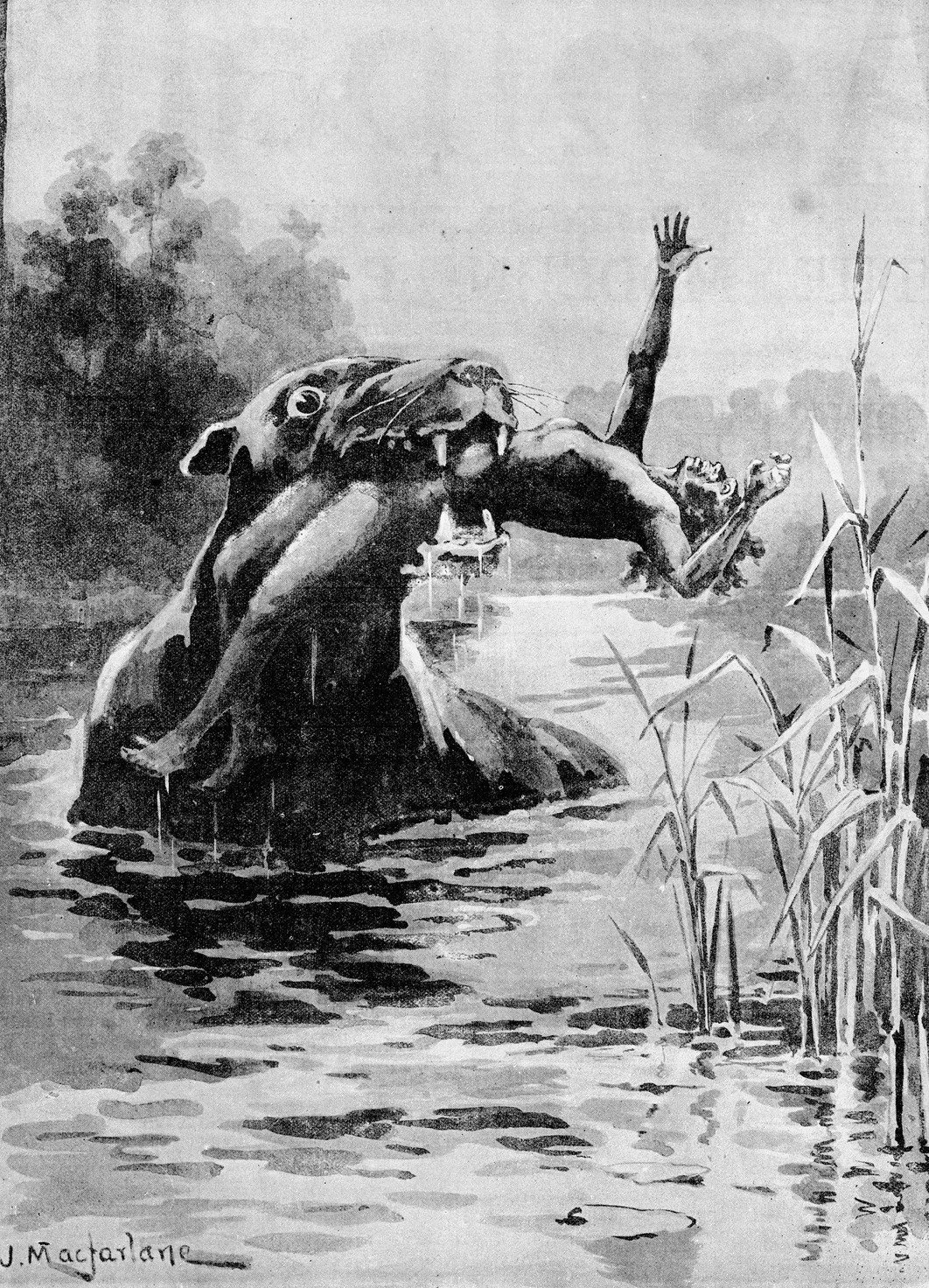
J. Macfarlane's bunyip of 1890, seizing a man in a billabong: the colonial-era picture of the Aboriginal water being, printed for settler readers — the last stop on the bunyip's paper record. Public domain, via Wikimedia Commons.
The kappa's modern face is the map's last pin, and it is friendly: a national character. Mizuki Shigeru's bronzes line their street in Sakaiminato (1993); at Tōno, the Kappabuchi — the kappa pool — keeps its tenant's name on the town's own signs, and the being who signed a written promise in the legends is the town's emblem; in Tokyo's Kappabashi district, cucumbers are still laid at the kappa's altar at Sōgenji temple. And the kappa does his oldest work in his newest dress: he is still Japan's standing teacher of water safety to children, the face on the warning at the riverbank.
The bunyip's modern face is a word at large in a language. A river and a town in Victoria carry the name Bunyip on the map itself. The political insult of 1853 is still quoted whenever a colony's pretensions need deflating. Macfarlane's picture of 1890, in this lesson's plates, remains the being's standard portrait: a settler's idea of an Aboriginal power, drawn for settler readers. And the modern scholarship gives the file its last honest shape: the writer Robert Holden, in 2001, counted at least nine regional forms of the being across Aboriginal Australia. The bunyip was never one animal with one description. The record that flattened him into one was the newspapers'; the tradition's own shape is a family.
Guided Observation
Begin with the hero plate: Utagawa Kuniyoshi's woodblock of the strongman Takagi Toranosuke grappling a kappa underwater in the Tamura River. Play the keeper's checklist against it. The dish on the crown — find it. The beak, the shell, the webbed hands — find each. By the time this print was made, the Edo picture-shops could assume a buyer who knew the whole anatomy at a glance; the plate is a record of a being at maximum documentation, drawn for sport.
Then the earliest picture: the kawatarō of the Wakan Sansai Zue (1712). Set it beside the Kuniyoshi. The furry, ape-like river creature of 1712 has no shell, no beak, no green — write down what the picture line gained, and what it quietly dropped, in the century between the encyclopedia and the print shops.
Then Hokusai's kappa, from the master's manga sketchbooks: the same being in a handful of lines. What could Hokusai leave out? Everything his readers would supply — which is to say, the sketch measures how much of the kappa lived in the audience's head by the early nineteenth century.
Last, Macfarlane's bunyip of 1890, seizing a man in a billabong. Read it as you read the Carta Marina in Lesson 20: as a record with an editor. This is a colonial artist's picture, made for colonial readers who had never seen the being and never would. What does it borrow from the monsters of other continents — the claws, the bulk, the theatrical seize? What does it admit, by its staging, that it cannot show you — the water, the night, the voice that the record, at its most honest, kept reducing to a back in the water and a boom in the swamp? Write one sentence on the difference between the two Japanese plates and this one.
Assignment Manual
✎ WRITTEN · ⚒ HANDS-ON · ◐ BOTH
✎ Written · Entry No. 22: Kappa & Bunyip.
- Rule your entry page. Turn to the Scholar's Entry Page in this packet and rule the next page of your journal to match it, as you did for Entries No. 1–21.
- Write the pair's entry, to the standard. The Creature: both beings described, the kappa's picture line read in order — the ape-like kawatarō of 1712, Sekien's fixing, the finished Edo kappa — and one line on whose pictures the bunyip's file holds, and whose it does not. First Told: two firsts in one field, each dated, and the kinds kept apart. For the kappa: the dictionary gloss — Nagasaki, 1603, kawarō, a monkey-like being that lives in rivers — with one line on what the being did not yet have. For the bunyip: the newspaper — Geelong, 2 July 1845 — with one line stating whose tradition the being is and that the paper is not its beginning. The Tales: the horse-puller and his written promise; the bow and the spilled dish; the shirikodama, filed as the tale's explanation of drowning. Spotted: the Suiko kōryaku compendium of 1820; the Geelong report and what it actually is; Buckley's back in the water, quoted or closely paraphrased, with his own limit written beside it. What It Actually Is: the river and the child; the salamander and the otter, in pencil; the fossil bones, the foetal skull, the bittern's boom, the seal; and the line about where the bunyip's tradition runs beyond the paper. Still With Us: Sakaiminato and Kappabuchi; the word Bunyip on the map and in the insult. The Keeper's Line: your own judgment, in one or two lines.
- Draw the map the record allows. In your entry's First Told field, add two lines headed The Stops: the kappa's five map stops, in order, with dates; and then the bunyip's stops as this lesson lists them — 1812, 1845, 1846–47, 1852, 1853, 1890 — each with its place. Under them, one sentence: why one being in this entry has a dashed line and the other has a list. That sentence is the unit's last map examination.
- Mark every line. Go back through your entry and mark every line in the margin with the keeper's marks: T for tale, S for sighting-report, or F for fact. In this entry the marks have a third discipline to observe: where a line reports Aboriginal testimony through a settler's pen, mark it F for the printing — and write reported beside it. The record of a report is not the report of a record, and the margin is where a keeper keeps the difference.
Materials
· Your bestiary journal, with Entries No. 1–21 in it
· Pencils, and a pen you like
· A ruler, for ruling your entry pages
· This lesson's packet (the Scholar's Entry Page is in it)
· The lesson page, for the map and the plates
Reflection
The kappa's first record is a dictionary entry; the kelpie's is a hall's name; the sea serpent's is a picture. Rank the three as evidence, and defend your order in a few lines.
Buckley saw a back, and wrote down that he saw only a back. Why is his page worth more to a keeper than the Geelong Advertiser's complete, upright, twelve-foot bunyip?
The named cucumber is a bargain: food for safety, struck with a being. What does the custom assume about the kappa that the sumo tales and the bow do not — and why might that assumption be the one that survived on a menu?
A Closing Note
Twenty-two entries, and the waters are done: your bestiary has swum from a bishop's footnotes to a Sydney queue. Next, the class takes to the air. Unit IV opens with the greatest file on the shelf — the dragons of the West: hoard, hero, and saint, in the longest record any being here can show. The sky lessons are the heaviest in the book.
The Bestiary
Bestiary Keeper
Further Reading & Sources
The Vocabulario da Lingoa de Iapam (Nagasaki, 1603) — the Jesuit press's Japanese–Portuguese dictionary, where kawarō gets the kappa's first dated line.
Terajima Ryōan, Wakan Sansai Zue (1712), and Toriyama Sekien, Gazu Hyakki Yagyō (1776) — the encyclopedia and the picture-book that fix the kappa's form; both widely reproduced.
Yanagita Kunio, The Legends of Tōno (1910; English translation by Ronald A. Morse, 1975) — the Sarugaishi River kappa and the horse-puller's written promise.
The Geelong Advertiser, 2 July 1845 — "Wonderful Discovery of a New Animal": the bunyip's name in print, the bone, and the drawing.
John Morgan, The Life and Adventures of William Buckley (1852) — the file's longest witness, thirty-two years among the Wathaurong.
The Sydney Morning Herald, 16 August 1853 — Deniehy's "bunyip aristocracy" speech, reported the morning after.
Robert Holden, Bunyip: Mythical Creatures of Australia (2001) — the modern count of the being's regional forms.
The Unit III Quiz
The Unit III Quiz checks the whole of the unit — Lessons 16–22, from the kraken to the kappa and the bunyip — and its answers and self-check stand at the back of the quiz packet, so you can mark your own work the keeper's way. Take it with your bestiary beside you, Entries No. 16–22 open: everything it asks for is work your own hand has already done.
Download the Unit III Quiz (PDF)
Submit your work for this lesson using the form below.
CONTINUE IN THE BESTIARY HALL
← Previous · Lesson 21: Lake Monsters Next · Lesson 23: Dragons of the West →
Unit III — Creatures of the Waters The Bestiary Hall — All 41 Lessons
The rest of Unit III: Lesson 16 · The Kraken · Lesson 17 · Mermaids · Lesson 18 · Selkies · Lesson 19 · The Kelpie & the Each-Uisge · Lesson 20 · Sea Serpents · Lesson 21 · Lake Monsters