
THE BESTIARY
Unit IV · Lesson 23Dragons of the West
Professor Sable Rookmere
Bestiary Keeper
The Bestiary Hall • School of Evershade
Professor's Introduction
Unit IV takes the class into the skies, and it opens with the being every scholar thinks they already know. Set that knowing down at the door. The Western dragon is not one creature but a growth: a serpent that put on legs, wings, and fire across a thousand years of copying, and kept every earlier shape somewhere in its file. This lesson watches the growing happen, record by record — and it begins, as this class always begins, before the wings.
The Bestiary
Bestiary Keeper
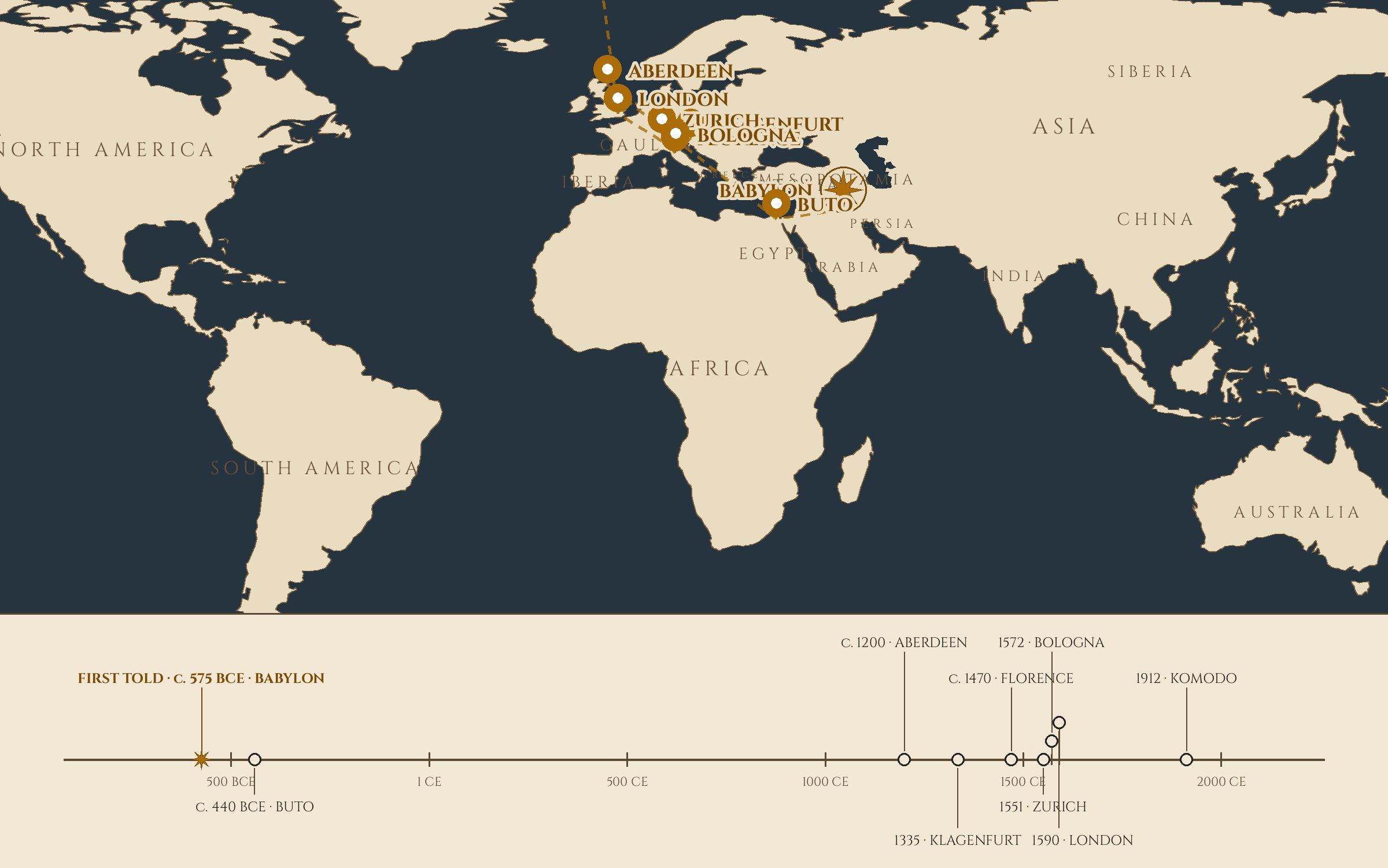
Where this lesson travels: Babylon, about 575 BCE, where the mušḥuššu strides in glazed brick along the Ishtar Gate in the reign of Nebuchadnezzar II — a composite already: serpent's head with horns, a lion's forelegs, an eagle's hind legs, a scorpion's sting; Aberdeen, about 1200, where the bestiary dragon coils around the elephant; Florence, about 1470, and Uccello's saint; Zurich, 1551, where Gesner set the dragon in print among the serpents of natural history; London, 1590, where Spenser's Redcrosse Knight fought his three days' combat; and Komodo, 1912, where P. A. Ouwens described the record's first real dragon. The starred pin is the first record; the dashed line is the telling, traveling.
Lesson Objectives
By the end of this lesson, you will be able to:
- Trace the word dragon from the Greek for a sharp-sighted serpent to the winged beast of the bestiaries.
- Name the map's first record — the mušḫuššu of Babylon's Ishtar Gate — and say what kind of creature it already is.
- Tell how the telling grew: the Roman standard, the bestiary dragon, the saints' dragons, and the dragon in print.
- Retell the tales: Beowulf's last fight, Fáfnir on his gold, and George at Silene.
- Give the real roots honestly: great serpents reported, bones misread, dragons manufactured — and the real dragon science named in 1912.
- Describe the custom of carrying the Tarasque through Tarascon, with its sources and its dates.
Your Assignment Packet
This lesson's work lives in its packet: the Lexicon Handout (every term, the core terms marked with the keeper's diamond ◆), Materials, Guided Practice, the Assignment Manual written out whole, the Scholar's Entry Page, the Reflection Questions, the Workbook Checklist, and the Keeper's Notes, for whoever teaches the lesson. Download the packet before you begin and keep it beside you as you read. The packet's assignment is Rookmere's own word for the work: Entry No. 23 — Dragons of the West (both) ◐. The Unit IV Quiz is not printed in the packet; it waits at the end of the unit, with Lesson 28.
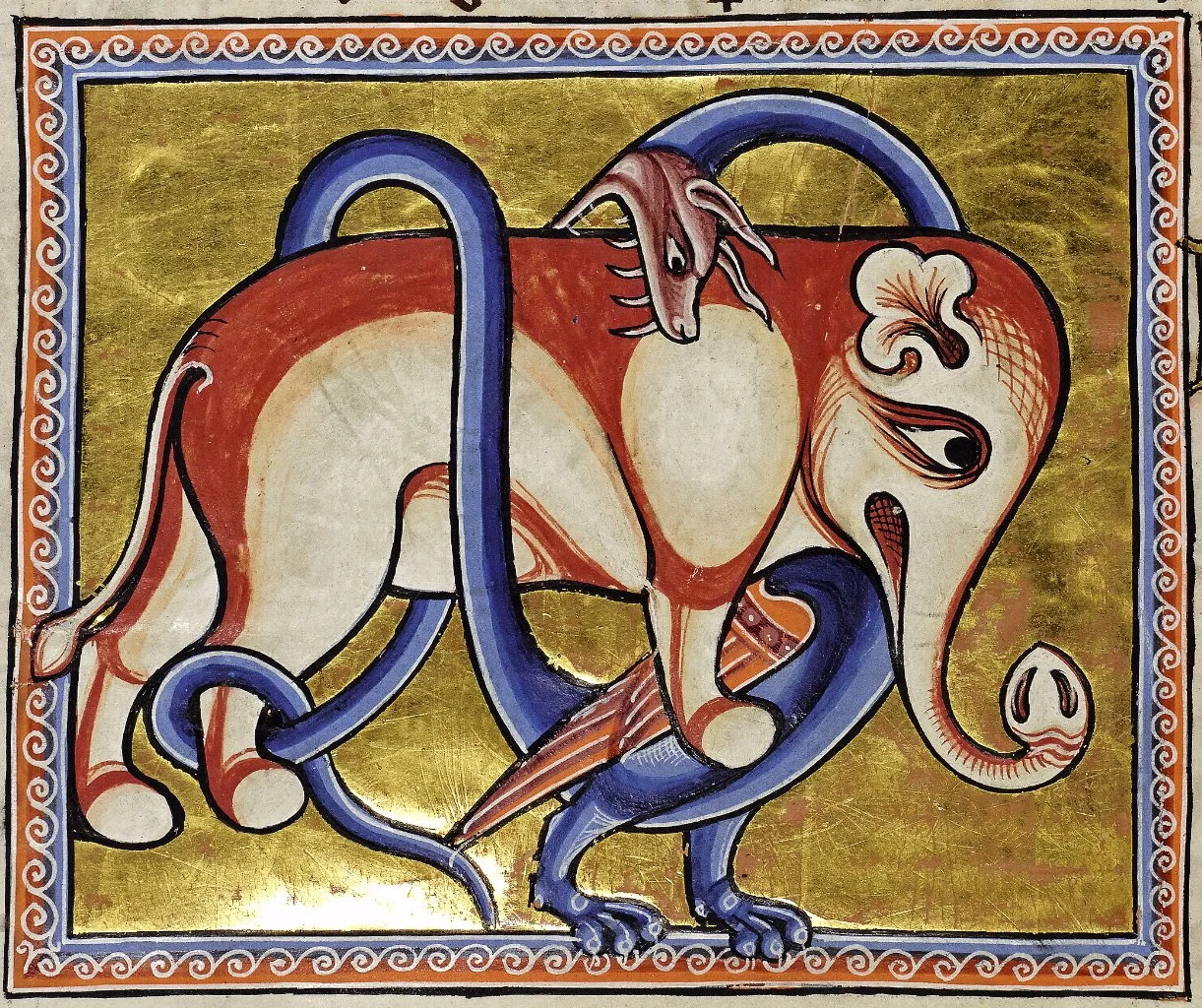
The dragon of the Aberdeen Bestiary (about 1200; MS 24, f. 65v): the great serpent coiled about its hereditary enemy the elephant, exactly as the bestiary's dragon chapter describes the feud. Public domain, via Wikimedia Commons.
The Creature
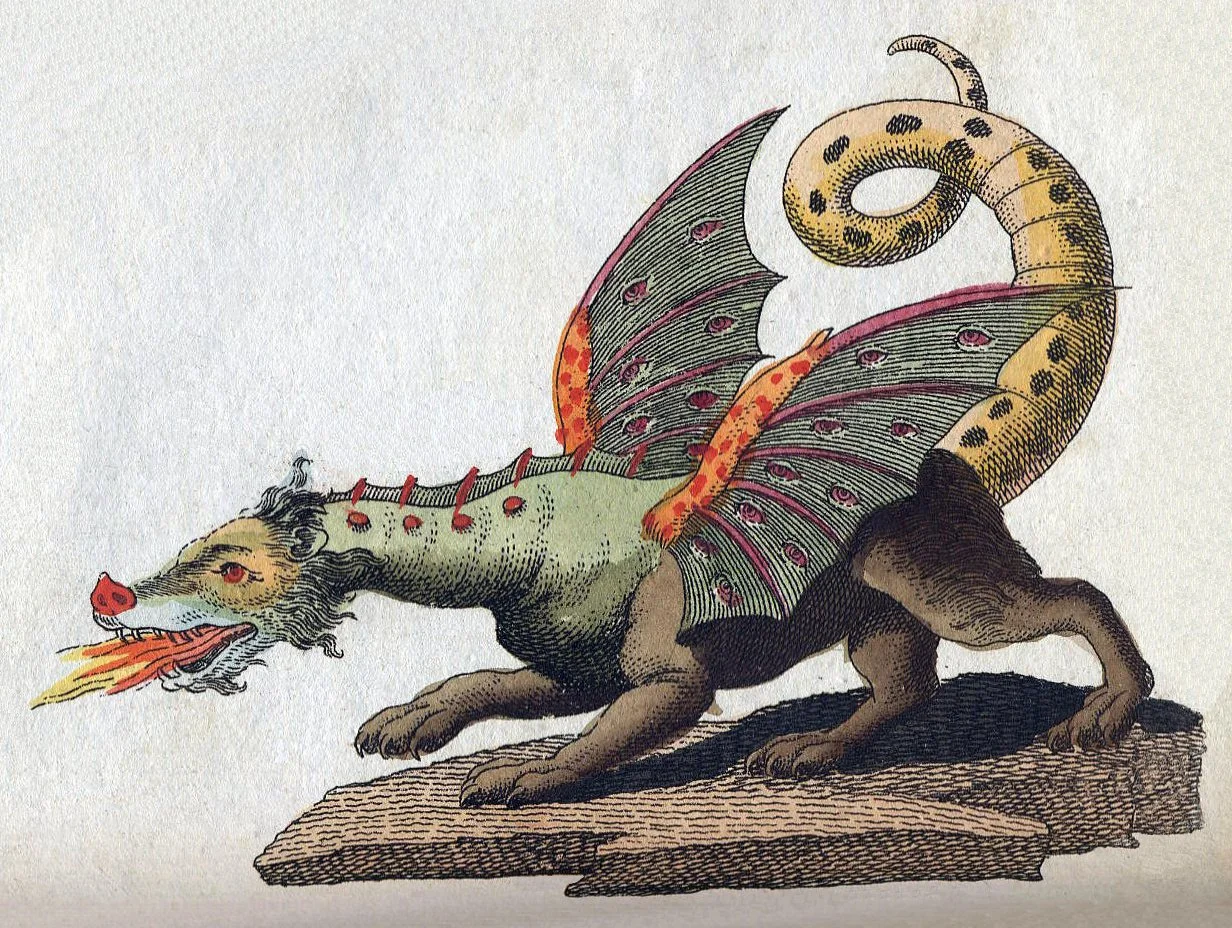
Friedrich Justin Bertuch's dragon for his Bilderbuch für Kinder (1806): the winged, fire-breathing dragon fully standard — four legs, bat wings, fire — as a children's picture book presents it, between Uccello (about 1470) and Skelton (1908) in this lesson's line. Public domain, via Wikimedia Commons.
The dragon of the West begins as a word for seeing. The Greek drakōn comes from a root, derkomai, "to see clearly," and a drakōn in the oldest Greek record is a serpent — a very large one, with a crest and a terrible stare — set where something precious needed guarding. Ladon, a dragon of a hundred heads, coiled around the tree of the golden apples in the garden of the Hesperides. A dragon watched the golden fleece at Colchis, and never slept. A dragon at Delphi guarded the oracle's spring before Apollo killed it and took the place. The first duty of the dragon, in the record, is not fire. It is watching.
Latin took the word whole, as draco, and Rome gave the shape a job: the draco standard, borrowed from the horse-peoples of the steppe, was a dragon's head of bronze on a pole, with a body of cloth behind it that filled and streamed and twisted in the wind when the cavalry rode. A whole army could watch its dragons move. Keep the picture: for centuries of soldiers, a dragon was a thing carried, flying on a pole, above a battle — long before it was a thing fought.
The plates of this lesson read the dragon's growth in pictures. The oldest is new to the lesson: the mušḫuššu of Babylon's Ishtar Gate (about 575 BCE), in glazed brick — a serpent's horned head and scaled neck (the new plate shows the head in detail), a lion's forelegs, an eagle's talons behind, and a scorpion's sting in the tail: a composite, assembled from the strongest parts of other animals, at the very start of the file. Then the Aberdeen Bestiary's dragon (about 1200): a crested serpent coiled around an elephant, with no wings at all. Then Uccello's St George dragon (about 1470), no bigger than a horse, with the wings the copies had by then given it. Then Bertuch's dragon of 1806, drawn for a children's picture book with the full modern equipment — four legs, bat wings, fire. And last, Skelton's dragon of 1908, facing Beowulf under his shield. Read in that order, the plates show the lesson whole: the legs, the wings, and the fire all arrive late. The watcher at the gate was there from the beginning.
First Told
✦ On the class test
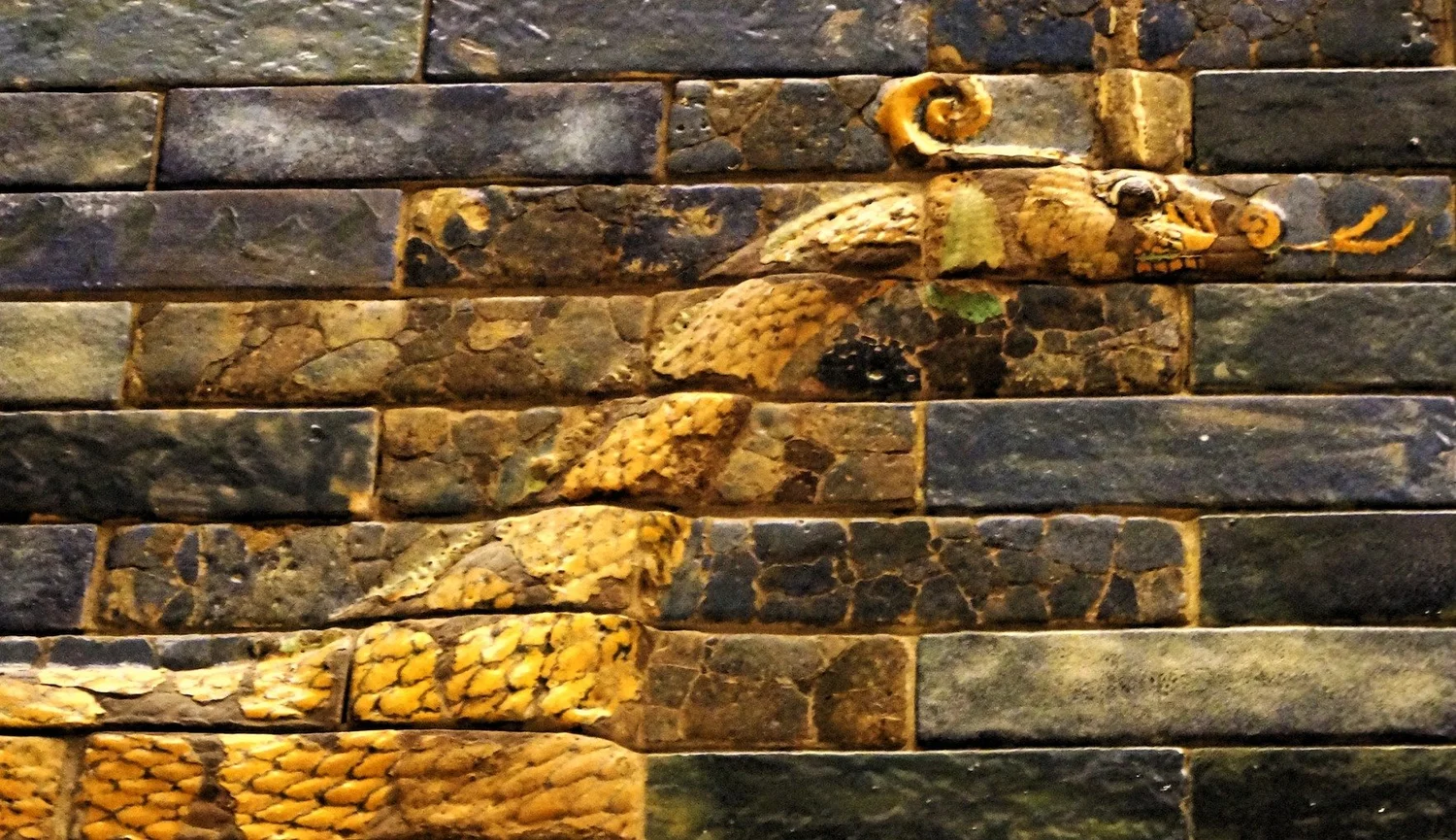
Detail of the mušḫuššu of Babylon's Ishtar Gate (about 575 BCE), in glazed brick — the horned serpent head, forked tongue, and scaled neck of Marduk's dragon (Pergamon Museum, Berlin): a composite already, assembled from the strongest parts of other animals, at the very start of the file. CC0 1.0, via Wikimedia Commons.
The map at the head of this lesson begins further east and far earlier than Greece. The starred pin is Babylon, about 575 BCE: on the Ishtar Gate, built in the reign of Nebuchadnezzar II, the mušḫuššu strides in glazed brick along the processional way — Marduk's dragon, the city's own beast. Look at what it already is: a serpent's head with horns, a long scaled neck, the forelegs of a lion, the hind legs of an eagle with talons, and a scorpion's sting in its tail. The dragon is a composite from its first datable picture — assembled from the strongest parts of other animals, the way the bestiaries would still be assembling it two thousand years later. The map itself notes that the creature-type is older still in Mesopotamian art; the gate is simply where this class can first point and say: there, dated, in brick. From Babylon the dashed line runs to Aberdeen about 1200, where the bestiary dragon waits; to Florence about 1470, and a saint; to Zurich in 1551, and print; to London in 1590, and a poem; and at the end of the line, in 1912, to an island in the Indies where the record does something it has never done before. Hold that last pin. We will come back to it.
The dragon's medieval shape was set by the books this class knows best. Isidore of Seville, in the Etymologiae, made the dragon the largest of all serpents, crested like a cock, living in India and Ethiopia, and — here is the keeper's detail — dangerous not in its teeth but in its tail: it kills by constriction, by the coils. The bestiaries copied him. The Aberdeen Bestiary (about 1200; the hero plate of this lesson, f. 65v) gives the dragon its set piece: the ancient feud with the elephant. The dragon coils around the elephant's legs and trunk and suffocates the greatest of beasts with the strength of its tail, and the two fall together, the elephant crushing its killer as it dies. That is the bestiary dragon whole: serpent, crest, coils, enmity — and not one word yet, in the text, of the fire and wings that a modern child would draw first.
Look at the elephant in the plate while you are here, because the painter had a problem with him too. A real African elephant stands about three metres at the shoulder and weighs several tons. Its trunk is its nose and upper lip drawn out long, and it can pick up a log or a single blade of grass with the end of it. An English painter around 1200 had no more seen one than he had seen the dragon, so his elephant, like his dragon, is built out of the text in front of him and the animals in his own yard. That is why the two of them fit together so neatly in the picture. They came out of the same workshop, by the same method.
The wings arrive the way everything arrives in this class: gradually, in the copying. Northern Europe's dragons were wyrms — the Old English wyrm, the Norse ormr — great serpents of barrow and water, some of them flightless crawlers, some already flying by night with fire in their throats, as Beowulf's dragon does. Across the middle centuries the shapes merge: legs are added, then wings, then the fire settles in as standard equipment, until by the late Middle Ages the dragon has reached the form the modern world inherited — the four-legged, winged, fire-breathing guardian of a hoard. Nobody invented that dragon on a single day. It grew by slow additions, copy after copy, around the old serpent at the center.
Two kinds of book carried it furthest. The first is the saints' lives. Jacobus de Voragine's Golden Legend (about 1260), the most-read book in late medieval Europe after the Bible, fixed the dragon as holiness's opponent: St George's dragon in Libya, St Martha's Tarasque on the Rhône, St Margaret's dragon, which swallowed her whole and burst. In these tellings the dragon is the shape evil takes when it must be fought in person — and notice, it is defeated as often by prayer, a girdle, and a sign of the cross as by any sword. The second carrier is print. Conrad Gesner's Historia Animalium (1551 — the Zurich pin on your map) still set the dragon among the serpents of natural history, between the reports and the authorities, as a creature a learned man might reasonably file. Edward Topsell's History of Serpents (1607) followed him. And in London in 1590 — the map's fifth pin — Edmund Spenser published the first part of The Faerie Queene, with the dragon fight of the Redcrosse Knight at the climax of Book I: three days of combat to free a kingdom. The dragon had become the test of heroes in the national poem, while the naturalists were still filing it as an animal. Both records are real. Mark them R — and mark what each book claims with your other mark.
The Tales
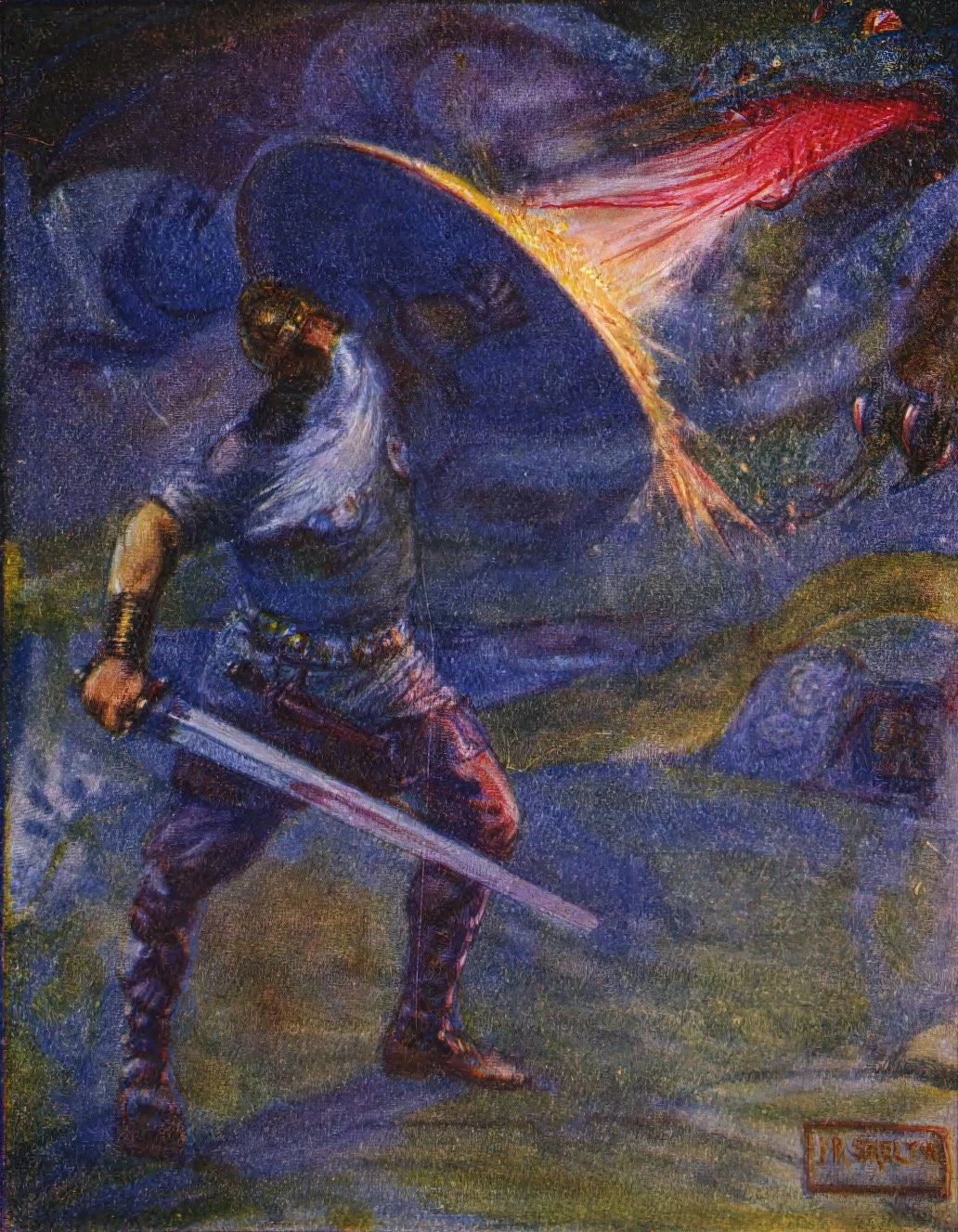
J. R. Skelton's picture of Beowulf's last fight (1908, for Stories of Beowulf): the old king alone under his shield against the fire-dragon of the barrow — a modern illustrator's imagining, nine centuries after the poem's copyist, and captioned as what it is. Public domain, via Wikimedia Commons.
Three tales carry the Western dragon, and a keeper should hold all three.
The oldest in our file is a poem's. In Beowulf — the record is the manuscript, Cotton Vitellius A XV, copied about the year 1000 — the hero is an old king when a runaway slave, fleeing a beating, stumbles into a barrow and steals a single cup from the hoard of a dragon that has guarded it, undisturbed, for three hundred years. The dragon counts its treasure, finds the loss, and burns the country in answer, flying by night and firing halls. Beowulf goes against it with a company; all flee but Wiglaf, his young kinsman; king and dragon kill each other. The hoard is dug out — and buried again with the king's ashes, in the poem's bleak judgment, as useless to men as it had ever been. This lesson's third plate is J. R. Skelton's picture of that fight, drawn in 1908 for Stories of Beowulf. The manuscript itself carries no picture of the dragon, and the plate is captioned as what it is: a modern illustrator's imagining, nine centuries after the copyist. Keepers caption honestly; the difference between 1008 and 1908 is most of this class.
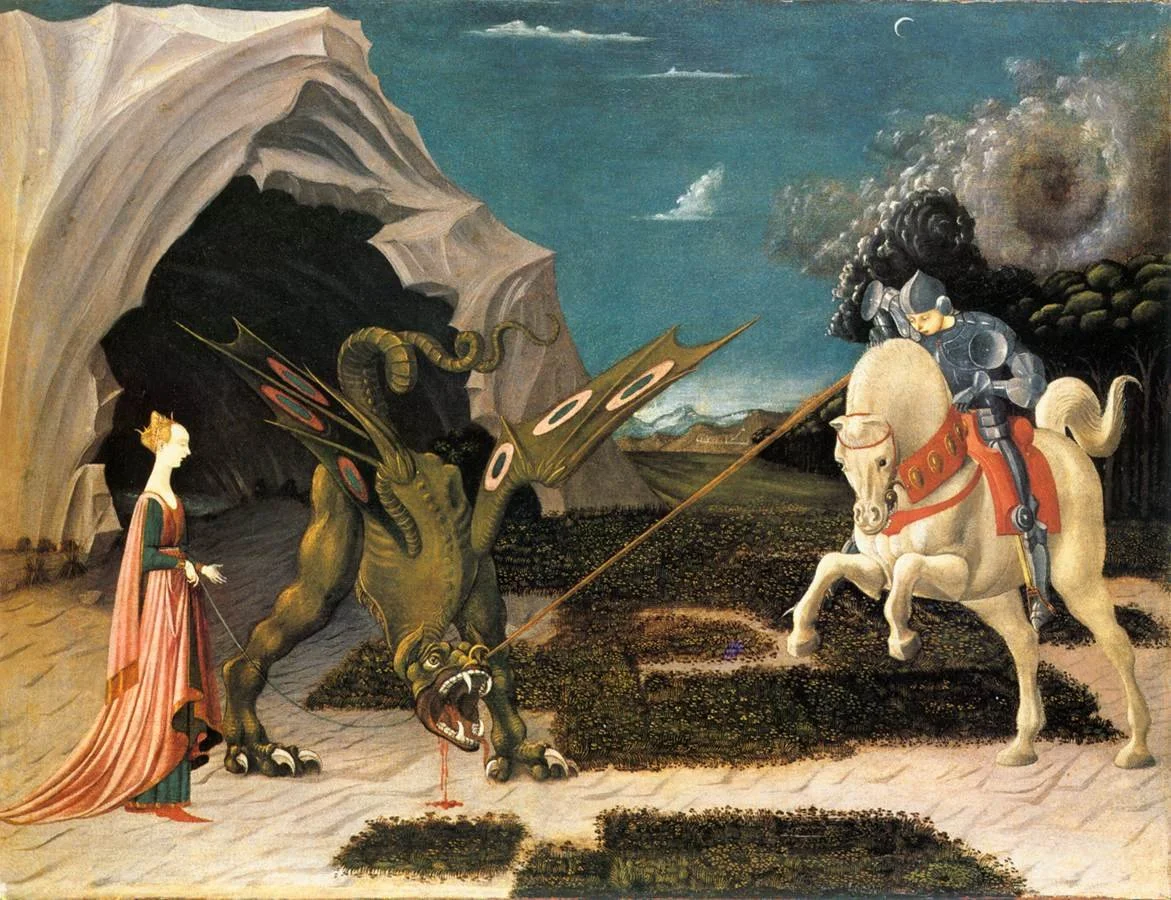
Paolo Uccello's Saint George and the Dragon (about 1470; National Gallery, London): the lance through the dragon's eye, the princess composed with the subdued beast on her own girdle for a leash — in the saint's record, size was never the point. Public domain, via Wikimedia Commons.
The second tale is the North's. Fáfnir, in the poems of the Poetic Edda and in the Saga of the Volsungs (written down in the 1200s), began not as a dragon but as a dwarf — a person — who seized a cursed hoard of gold, murdered his own father for it, and drove his brother away; and lying on the gold, wanting nothing but to keep it, he became a dragon, the great wyrm of Gnitaheiðr. His brother Regin raised the hero Sigurd to kill him. Sigurd dug a pit in the dragon's path, struck upward as Fáfnir crawled over it, and, roasting the dragon's heart for Regin, burned his thumb, sucked it — and understood the speech of birds, who told him of Regin's treachery. Notice what the North has done with the shape: the dragon is not a species here. It is a destination. Greed, given long enough on a hoard, grows scales.
The third tale is the saint's, from the Golden Legend. At Silene in Libya a dragon held the city's water and was fed sheep, then youths chosen by lot, until the lot fell on the king's daughter. George, a soldier passing by, wounded the dragon with his lance, and the princess led the subdued beast into the city on her own girdle, like a dog on a leash; the king and all his people, seeing it, accepted baptism; and only then did George kill it. Paolo Uccello painted it about 1470 (the Florence pin on your map): the lance through the dragon's eye, the princess composed with the leash in her hand, the dragon no bigger than a horse. In the saint's record, size was never the point. Submission was.
KEEPER'S CHECK-IN
Fáfnir did not begin as a dragon — what was he, and what turned him into one?
Spotted
The Western dragon was also reported — by travellers, in chronicles, and once in a town's own keeping. The reports stand in this section, each filed as what it is: a sighting-report, marked S, with what each one turned out to rest on waiting in §5.
Great snakes and crocodiles stand behind the oldest stratum, reported by travelers from Africa and India and growing in the telling, the way the kraken grew (Lesson 16). Herodotus — whom you will meet properly in Lesson 25 — reported that he went to Arabia and saw the bones of winged serpents there, in heaps, near Buto; he recorded what he saw and thought, in the fifth century BCE, exactly what a keeper would: that the record and the animal were both worth setting down.
Bones stand in the ledger too, and not always the bones men thought. The city of Klagenfurt in Austria keeps a dragon: the Lindwurm, a wingless serpent-dragon said to have haunted the marsh before the city was founded, whose stone image has stood in the square since the 1590s. The standard account in Klagenfurt says the sculptor modeled the fountain dragon's head on a great skull found nearby in 1335 — a skull the town kept as the lindwurm's own, and which modern examination identifies as the skull of a woolly rhinoceros, an animal of the ice ages, dead ten thousand years before any Austrian dug. The skull was real. The record it generated was real. The dragon was the reading between them.
In May 1572 the report became a specimen. A peasant on a road outside Bologna killed a small dragon-like creature, and the body was brought to Ulisse Aldrovandi, the most serious naturalist of his age, who examined it and described it; his History of Serpents and Dragons (1640) printed the account and the picture. File it S — a dated report with a named examiner. Its ending stands in §5, with the other manufactured dragons: modern study (Senter and Hill, 2013 — the paper was later withdrawn, and a keeper notes that too) concludes the Bologna dragon was made, not born.
One caution belongs here, because the dragon attracts it. The phrase "here be dragons" is famous — and almost never where people think. So far as keepers have found, exactly one old map carries the words, Hic sunt dracones, on the Hunt-Lenox globe of about 1510. Medieval mapmakers filled their seas with beasts, yes; but the famous sentence is nearly modern, and nearly unique. A lesson in miniature: even the quotations have first records, and they reward checking.
KEEPER'S CHECK-IN
The great skull Klagenfurt kept as the Lindwurm's own was real — what does modern examination say it actually is?
What People Watched For — the Dragon in the Streets of Tarascon
One Western dragon still walks out in public, on a schedule, and has done for over five centuries. This lesson's box is its file.
The Golden Legend tells how St Martha came to a place on the Rhône then called Nerluc, where a dragon — the Tarasque, thicker than an ox, longer than a horse, with teeth like swords — was killing travelers and sinking boats. Martha found it devouring a man, and tamed it with prayer and holy water and the sign of the cross, bound it with her girdle, and led it into the town, where the people killed it. The place, the legend says, took the beast's name: Tarascon.
What people did with that story is the documented part. King René of Anjou, who ruled Provence from Tarascon's own castle, organized festivities in the Tarasque's honor in 1469, and on 14 April 1474 he founded an order — the Knights of the Tarasque, the Tarascaires — to keep the games with dignity. A great effigy of the beast was built and carried through the streets, at Pentecost and on St Martha's day, and the festival answered a real fear: the Tarasque had been blamed for the Rhône's floods and its broken dykes, and carrying the tamed dragon through the town was a way of parading the danger in the one form in which it had been beaten — led, on a girdle, by a saint. The original effigy was destroyed in the Revolution. The modern festival was revived in 1946, and the Tarasque still fills Tarascon's streets on the last weekend of June, worked from inside by its knights, snapping at the crowds it once was said to eat. In 2005 UNESCO proclaimed the processional giants and dragons of Belgium and France — the Tarasque among them — part of the oral and intangible heritage of humanity.
Mark it the keeper's way: the saint and the dragon are T, belief, as the Golden Legend gives them. The procession is F — dated, founded, suppressed, revived, and walked by named townspeople this year. A town does not carry a story through its streets for five hundred years by accident. What Tarascon keeps is not a zoology. It is the memory of the river, given claws, and beaten once a year in public.
What It Actually Is
The Western dragon's root is not one animal. It is several, and a ledger.
And some dragons were made by hand, in workshops, for money. As collecting became a fashion, dealers learned that a ray or a skate, cut, twisted, sewn, and dried, makes a convincing small dragon — the things collectors call Jenny Hanivers. Ulisse Aldrovandi, one of the most serious naturalists of his age, kept such dragons in his Bologna museum and printed them among the serpents in his History of Serpents and Dragons (1640). A keeper must say of them what Pliny said of a certain phoenix: they were manufactures, and the honest filing is under their makers' names, not nature's.
And then, the last pin. In 1912 the Dutch zoologist P. A. Ouwens formally described, from the island of Komodo, a monitor lizard up to ten feet long — Varanus komodoensis. Science had found its real dragon, and science itself reached for the name: the Komodo dragon is a dragon in the index of zoology, not by courtesy.
Meet him properly, since he is the one dragon in this file you could go and see. He is the largest lizard alive. Most wild adults weigh around seventy kilograms, and the long tail makes up about half the animal's length. He hunts deer and pigs and eats carrion besides, following scent with a forked tongue that tastes the air the way a snake's does. His teeth are serrated, like a shark's, and glands in his lower jaw make a venom that keeps blood from clotting, so an animal that escapes the first bite may still weaken and go down. He lives on Komodo and a few neighbouring islands in Indonesia, and nowhere else on earth. He does not fly and he breathes no fire. He does not need to. The file that began in glazed brick at Babylon ends, for now, with a living animal on a real island, measured and named by the record's own rules.
Still With Us
The modern Western dragon wears both its histories at once. It is still the enemy of the hoard in the stories the modern world tells most — J. R. R. Tolkien, who taught Beowulf for a living, rebuilt the type as Smaug in The Hobbit (1937), Fáfnir's greed and Beowulf's barrow fused in one red dragon on stolen gold — and at the same time it has become a friend, a mount, a guardian, a pet, in a thousand books and films that assume the reader will love it. No other being on this shelf has been so thoroughly forgiven.
It also stands on a flag. The red dragon of Wales — carried, by the tradition, for well over a thousand years and quartered on no royal banner of surrender — is among the oldest national emblems in Europe, and it is the Aberdeen dragon's own shape: four legs, wings, long tail, red as Gesner's painters made it. Add heraldry everywhere, dragon-named lizards after the Komodo pattern, and a word that now means any magnificent or terrible winged thing, and the modern face is clear: the Western dragon lost its file in natural history and won the language.
That is this lesson's file: a watcher at a garden gate, a brick dragon on a Babylonian wall, a windsock over Roman cavalry, a crested serpent strangling an elephant in a monk's book, a dwarf grown scaly on his gold, a saint's dog on a girdle, a rhino's skull, a ray in a collector's cabinet, and a ten-foot lizard on Komodo, real at last. Next lesson the class crosses the world for the other dragon — the one that was never an enemy at all.
Guided Observation
Begin with the hero plate: the dragon of the Aberdeen Bestiary (about 1200), coiled about its enemy the elephant, exactly as the book's text describes the feud. Read the picture against Isidore's words: the crest is there; the killing coils are there; where are the wings the modern eye expects? What in this picture tells you the painter was following a text rather than inventing?
Then Uccello's St George (about 1470). The dragon here is the size of a horse, the lance is already through its eye, and the princess holds its leash with the calm of a woman walking a dog. Look at the wings he has given it: by 1470 a painter put wings on a dragon the way he put a tail on it, without thinking, because the copies before him had them. The Aberdeen painter, working from his text, had left them off. Between those two pictures you can watch the wings arrive. What has the painter done to the scale, and why does the story need the beast small at exactly this moment? Find the girdle. It is the most important weapon in the picture.
Last, Skelton's Beowulf dragon (1908): wings full-spread, the barrow, the old king under his shield. Set it beside the Aberdeen folio. Skelton knew the poem; the Aberdeen painter knew a text about the poem's kind of beast. Six and a half centuries apart, what does each artist give the dragon — and which dragon would the poet of Beowulf have recognized?
Two more plates belong to this lesson's line. The first is the oldest of all: the mušḫuššu of the Ishtar Gate (about 575 BCE), in glazed brick — the new plate shows the head and scaled neck, the horn and the forked tongue, of the dragon Babylon set along its processional way. And in 1806 Friedrich Justin Bertuch drew the dragon for his Bilderbuch für Kinder, his picture book for children: four legs, bat wings, fire — the shape complete, a century before Skelton. Set Bertuch beside Aberdeen and say what the six hundred years between them settled, and what they left exactly as the bestiary had it.
Assignment Manual
✎ WRITTEN · ⚒ HANDS-ON · ◐ BOTH
◐ Both · Entry No. 23: Dragons of the West.
- Rule your entry page. Turn to the Scholar's Entry Page in this packet and rule the next page of your journal to match it, as you did for your earlier entries.
- Write the dragon's entry, to the standard. First Told: Babylon and the mušḫuššu — the gate, the reign, the date, and what the creature is already assembled from; and beside it the Greek drakōn, the watcher at the gate. How the Telling Grew: the draco standard; Isidore and the bestiary dragon; the wings arriving; the saints' dragons of the Golden Legend; Gesner and Spenser in print. The Tales: Beowulf's last fight; Fáfnir; George at Silene — a short telling of each, as the record gives them. What It Actually Is: the serpents reported, the Klagenfurt skull, the manufactured dragons, and 1912. Still With Us: Smaug, the Welsh flag, the forgiven dragon. The Keeper's Line: your own judgment, in one or two lines.
- Label the beast. ◐ Copy the Aberdeen dragon — or Uccello's — into your entry as a careful labeled drawing. Label every feature your picture gives it: crest, wings or their absence, legs, tail, coils, fire or its absence. Beside each label, write the record the feature comes from — Isidore's words, the folio's paint, the painter's pageant — and mark the label F if it stands in that record or T if your hand added it out of habit. A keeper's dragon carries its sources on its back.
- Mark every line. Go back through your entry and mark every line in the margin — T for a tale or telling, S for a sighting-report, F for a checkable fact — as always. This entry holds a hard case: the Tarasque's procession is F — it walks the streets on dated days. The Tarasque is T. Keep the marks separate, and keep them all.
Materials
· Your creature-guide journal, with your earlier entries in it
· Pencils, and a pen you like
· A ruler, for ruling your entry pages
· This lesson's packet (the Scholar's Entry Page is in it)
· For Step 3: your drawing tools, and the lesson page open at the plates
Reflection
The Western dragon grew wings across centuries of copying, and no copyist thought he was changing anything. What does that growth teach about every other being on this shelf?
Isidore wrote that the dragon kills with its tail, not its teeth, and Europe believed him for a thousand years. Find another line in this lesson where a writer's sentence outlived the animal it described. Whose sentence was it?
Tarascon still carries its dragon through the streets. Is the town keeping a belief, a story, or a river? Defend your answer with the keeper's marks.
Cross-Class Connections

A word from the Celestial Tower, keeper to keeper. Your dragon keeps to gates and books in this lesson, but he holds a second address in my keeping: Draco, the Dragon, coils himself around the north celestial pole, circling the still point of the sky — and from our latitude he never sets at all. El dragón del norte no duerme — the dragon of the north does not sleep. The star-tellers set him where the gate-builders of Babylon set his brother: where he can watch, forever.
The lesson is Lesson 21: Constellations & Their Stories, in Unit IV of Celestial Studies. Come up on a clear night and find him overhead.
Celestial Studies
Keeper of the Celestial Tower
A Closing Note
Twenty-three entries in, and the largest file in the class is closed. Hold on to the dragon's lesson: the most famous shape in the whole record was assembled by nobody, over centuries, each copyist swearing he had changed nothing. Next lesson we cross the world to the other dragon — the one that brings the rain, is older than this one, and has never once been fought by a saint. Keep your T, S, and F honest, and your labels on the beast.
The Bestiary
Bestiary Keeper
Further Reading & Sources
The Aberdeen Bestiary, University of Aberdeen — the dragon chapter (f. 65v), with translation: abdn.ac.uk/bestiary.
Isidore of Seville, Etymologiae, Book XII — the dragon among the serpents.
Jacobus de Voragine, The Golden Legend (about 1260) — the lives of St George and St Martha, in William Granger Ryan's translation (Princeton, 1993).
Beowulf — the manuscript is British Library Cotton Vitellius A XV; Seamus Heaney's translation (2000) is the readable modern text.
The Saga of the Volsungs and the Poetic Edda's Fáfnismál — Fáfnir and Sigurd; Jesse Byock's Volsungs translation (Penguin) is the handy one.
Edmund Spenser, The Faerie Queene, Book I (1590) — the Redcrosse Knight's dragon.
UNESCO, "Processional giants and dragons of Belgium and France" (proclaimed 2005) — the Tarasque of Tarascon on the heritage list; and the Office de Tourisme, Tarascon — the festival's own history, King René's order of 1474.
Submit your work for this lesson using the form below.
CONTINUE IN THE BESTIARY HALL
← Previous · Lesson 22: Kappa & Bunyip Next · Lesson 24: Dragons of the East →
Unit IV — Wings and Skies The Bestiary Hall — All 41 Lessons
The rest of Unit IV: Lesson 24 · Dragons of the East · Lesson 25 · The Phoenix · Lesson 26 · The Roc · Lesson 27 · The Thunderbird · Lesson 28 · Winged Peoples