
THE BESTIARY
Unit IV · Lesson 25The Phoenix
Professor Sable Rookmere
Bestiary Keeper
The Bestiary Hall • School of Evershade
Professor's Introduction
This lesson's bird is the most famous in the class, and its file begins with the most useful paragraph we own. The first man to write the phoenix down for us did not believe everything he wrote, and he put the doubt in the record beside the wonder, where every keeper since has had to step around it or learn from it. Most stepped around. We will learn. This file holds a bird, a fraud, a calendar argument, two other birds wearing its name, and a badge over a London door.
The Bestiary
Bestiary Keeper
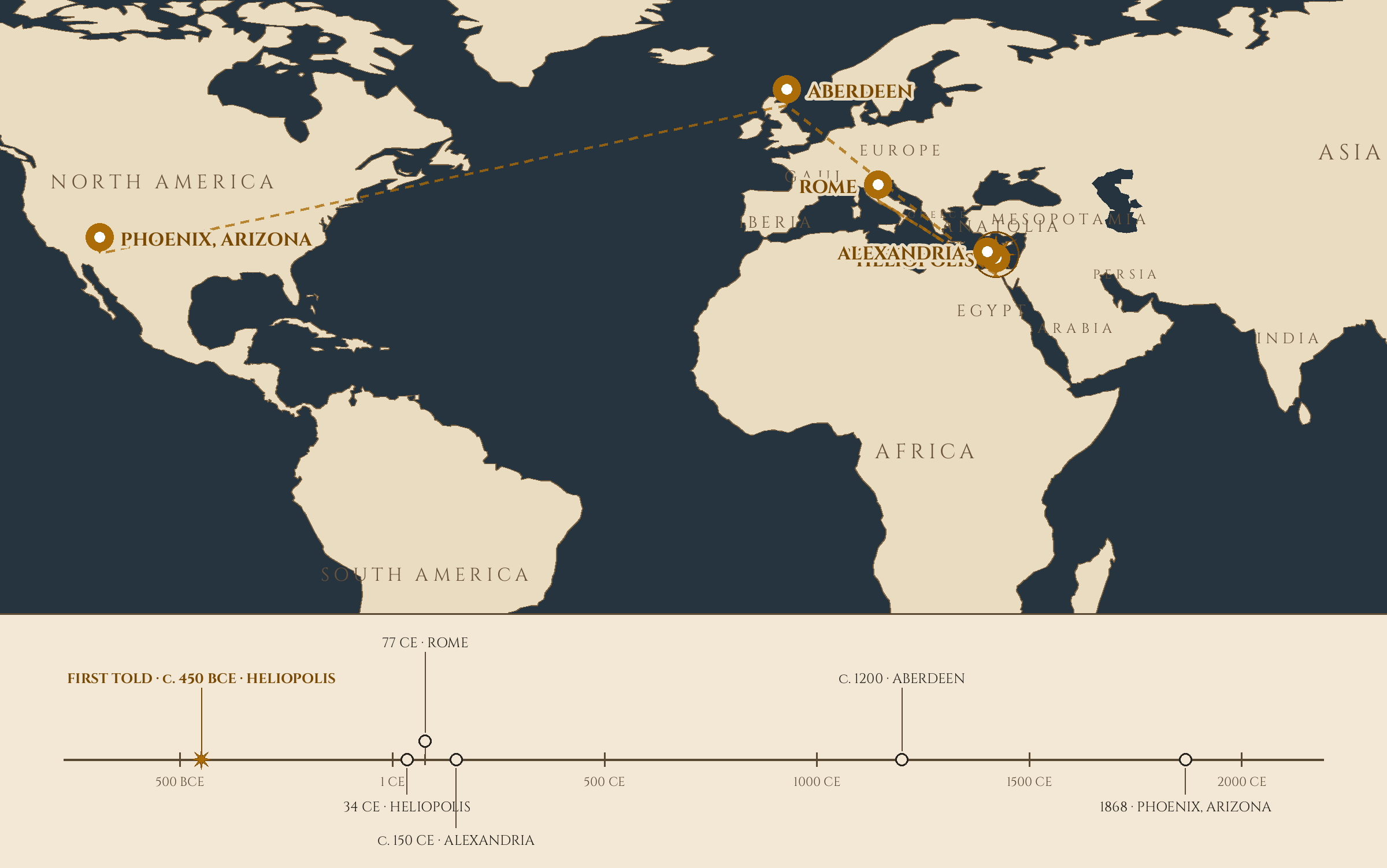
Where this lesson travels: Heliopolis, about 450 BCE, where the men of the sun city told Herodotus of the phoenix — and where he saw only its picture; Rome, where a phoenix exhibited in 47 CE was recorded by Pliny (77 CE) with his verdict standing beside it, that no one doubted it was false; Alexandria, where the Physiologus fixed the fire and the third day in the second century; Aberdeen, about 1200, where the bestiary's phoenix burns and rises in one picture; and Phoenix, Arizona, 1868, where a new settlement in the Salt River valley took the bird's name outright. The starred pin is the first record; the dashed line is the telling, traveling.
Lesson Objectives
By the end of this lesson, you will be able to:
- Tell Herodotus's report (Histories 2.73) and mark precisely what he claims, what he attributes, and what he doubts.
- Show that the famous burning is not in the first record — the fire enters the file later, and say where.
- Follow the growth: Pliny's exhibited fraud, Tacitus's argument about the period, Clement, the Physiologus fixing the third-day pattern, and Aberdeen's picture.
- Distinguish three birds that one name covers: the phoenix, the Egyptian bennu, and the Chinese fenghuang.
- Give the real root honestly: no bird burns; the pattern grew in books, around a real city, a real word, and real altar fires.
- Describe the fire-mark custom and name its source and its founding date.
Your Assignment Packet
This lesson's work lives in its packet: the Lexicon Handout (every term, the core terms marked with the keeper's diamond ◆), Materials, Guided Practice, the Assignment Manual written out whole, the Scholar's Entry Page, the Reflection Questions, the Workbook Checklist, and the Keeper's Notes, for whoever teaches the lesson. Download the packet before you begin and keep it beside you as you read. The packet's assignment is Rookmere's own word for the work: Entry No. 25 — The Phoenix (written) ✎. The Unit IV Quiz is not printed in the packet; it waits at the end of the unit, with Lesson 28.
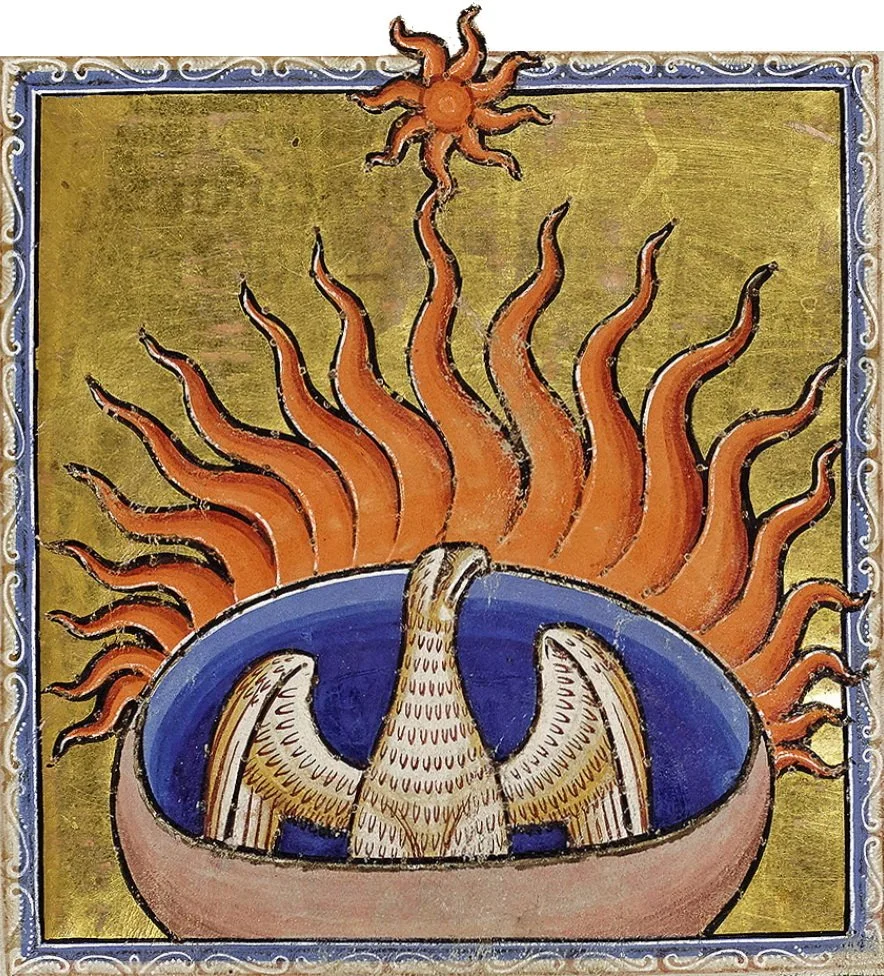
The phoenix of the Aberdeen Bestiary (about 1200): the bird in its nest of flames beneath the sun, burning and rising in the one picture — by 1200, the fire was the bird. Public domain, via Wikimedia Commons.
The Creature
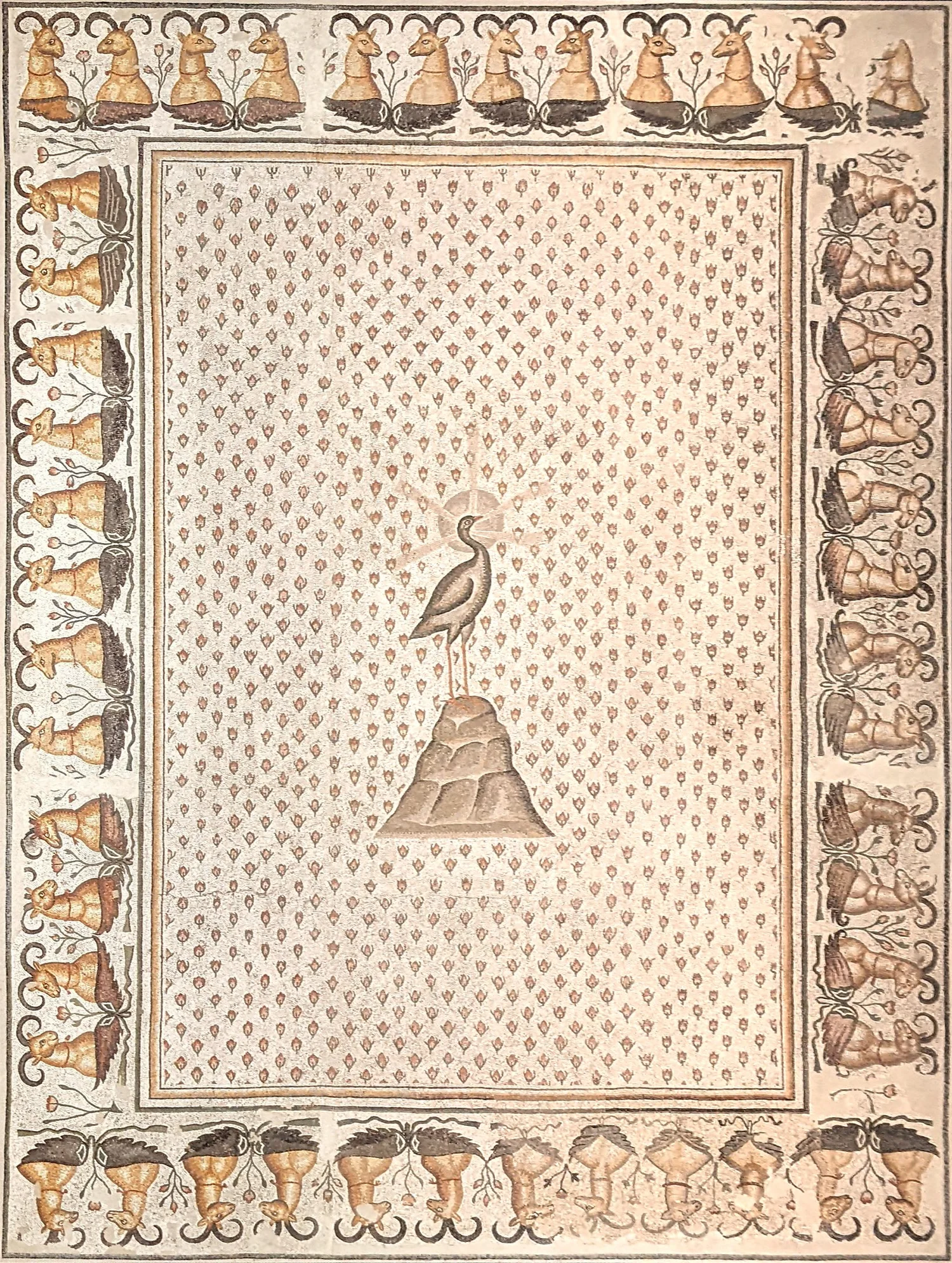
The Roman phoenix in stone: the great mosaic panel from Daphne, by Antioch, now in the Louvre — the bird standing on its mound at the center of a patterned field, in no hurry and entirely unburned. This may be the sort of picture Herodotus saw. Public domain, via Wikimedia Commons.
The Greek word is phoinix, and it is a small record problem by itself: the same word named the Phoenician people, a purple-red dye, and a palm tree, and the bird seems to carry the color in its name — the red one. Keepers file the puzzle and move on.
Take the picture's measure seriously for a moment. "Most like an eagle in shape and size" gives you a big, broad-winged bird: the largest eagles spread about two metres across the wings and weigh up to about six or seven kilograms. That is the size of bird Herodotus is asking you to imagine — a real size, for a real kind of bird, carrying a load of myrrh he is careful to say it tested first. Whatever else the report is, it is not careless about weights and measures. Its author thought like a man who had watched porters load a ship. Herodotus even gives the method: the bird molds an egg of myrrh as large as it can carry, tests the weight by flying with it empty, then hollows it, lays the father inside, and seals the opening with more myrrh.
The pictures that survive tell the same file in three frames. The Roman mosaic from Daphne, now in the Louvre, shows the phoenix unburned: a long-tailed, crested bird standing on its mound at the center of a patterned field, built of small stones — more heron than eagle, and in no hurry. The Aberdeen Bestiary's phoenix (about 1200) burns in its nest of flames beneath the sun and rises in the same picture: by 1200, the fire was the bird. And in 1806 Bertuch's picture book for children drew the phoenix standing in its flames as a standard marvellous creature, on the same page-set as the dragon of Lesson 23. One picture is missing from the line, and the lesson leaves the gap standing: no lawful copy of a picture of the bennu, the Egyptian heron behind the tale, could be verified for this class — which is fitting. The first record of this bird is a picture its reporter never got past, either.
First Told
✦ On the class test
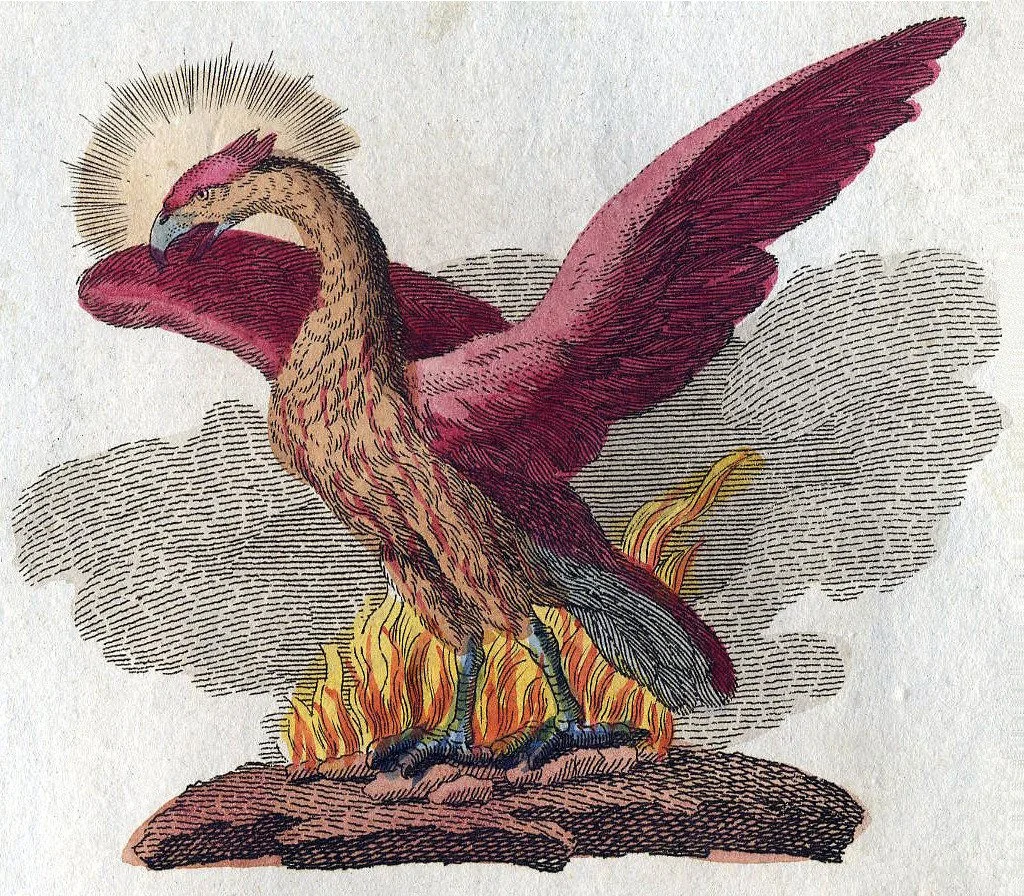
The phoenix of Friedrich Justin Bertuch's Bilderbuch für Kinder (1806): the bird standing in its flames as a children's encyclopedia of 1806 drew it, between the Aberdeen Bestiary (about 1200) and the present in this lesson's line — by 1806 the burning is simply what a phoenix looks like. Public domain, via Wikimedia Commons.
Herodotus, writing his Histories in the fifth century BCE — the passage is Book 2, section 73, dated about 450 BCE; it is the starred pin on your map, at Heliopolis in Egypt — reports what the men of Heliopolis told him about a sacred bird. He has, he says, heard it called the phoenix. It comes to Egypt once in five hundred years, and only when its father dies. If it is like the paintings, he says — and here the sentence every scholar in this class should copy into the front of the journal — I have not seen it myself, except in a picture. The bird in the picture is most like an eagle in shape and size, its plumage partly golden and partly red. And it does a remarkable thing: from Arabia it carries its father, plastered in an egg of myrrh, to the Temple of the Sun in Egypt, and buries him there.
Now mark the paragraph the keeper's way. That the men of Heliopolis told this story is F — Herodotus is our witness that they told it. What the bird does is T — he attributes it, exactly, to his informants. And his own sighting is none: a painting. There is no eyewitness anywhere in the phoenix's first record, and the record says so. The census line for this lesson is the whole class in six words: skepticism included from day one.
And one thing more, the thing this lesson exists to catch: in Herodotus, the phoenix does not burn. No fire, no ashes, no rising. The most famous fact about the most famous bird in the world is absent from its first record. The fire is coming — the telling will add it, the way the telling added wings to Lesson 23's dragon — but a keeper who starts from the first record starts from a bird that carries its father in myrrh and is never once seen alive. The map walks it forward from Heliopolis: to Rome, where a text of 77 CE records a phoenix exhibited — and doubted — a generation earlier; to Alexandria, where the Physiologus fixes the pattern in the second century; to Aberdeen about 1200; and at the end of the line, in 1868, to a desert settlement in Arizona that takes the bird's name outright.
Meanwhile the fire was entering. Clement of Rome, writing to the Corinthians about 96 CE, takes the phoenix up as the first Christian writer to do so — as evidence for resurrection, and his version already carries the new machinery: the bird lives five hundred years in Arabia, dies in a nest built of frankincense, myrrh, and spices; from its decaying flesh a worm is born; the worm grows feathers and, grown strong, lifts the whole nest with its father's bones and carries it to Heliopolis, laying it on the altar of the Sun. Then the Physiologus — the root book of this whole class, Alexandria, second century; you have known it since Lesson 1, where the phoenix stood in its list of chapters — fixes the pattern the next thousand years will copy. The phoenix, feeling the weight of years, flies to Heliopolis and mounts the altar; the priest kindles the offering; the bird burns. In the morning the priest finds in the ashes a worm. On the second day, a young bird. On the third day the phoenix entire, grown and whole, which greets the priest and flies away to its old home. There it is: the fire, the ashes, and the third day — the famous pattern, complete by the second century, and not in Herodotus. The bestiaries kept the pattern, and read the bird — in a line of depiction history — as a picture of resurrection: the Aberdeen Bestiary's phoenix (about 1200) is this lesson's hero plate — the bird in its nest of flames beneath the sun, burning and rising in the one picture, because by 1200 the fire was the bird.
The poets ornamented what the books had built: Ovid, in the Metamorphoses, gives the bird its spice-nest and a young phoenix rising from the father's body; a Latin poem On the Phoenix Bird, attributed to Lactantius (about 300 CE), gives the fullest ancient portrait of its paradise in the far east.
Two other birds wear the phoenix's name in English, and a keeper must not merge their files. The bennu is Egypt's own: the sacred heron of Heliopolis — the very city of Herodotus's report — a bird of the sun god Ra and of creation, standing on the first mound in Egyptian telling. Scholars connect the bennu with the phoenix, and the connection is plausible; but the Egyptian record never burns him. The fire is Greek and Roman growth, not Egyptian root. And the fenghuang of China — borrowed into Japan as the hōō — is a different bird altogether: a composite of grace, beak of a cock, neck of a serpent, patterned with the written characters for virtue, appearing rarely and only, the record says, when the rule of the land is good. No fire, no ashes, no five hundred years. English calls all three "phoenix." The entries must not. (A keeper notes the echo of Lesson 24: the same lesson, taught by another bird.)
The Tales
The phoenix has one tale, told two ways, and the distance between the ways is the lesson.
Herodotus's way is a funeral. A son crosses the world carrying his father's body, sealed in myrrh, to bury him in the Temple of the Sun; he tests the weight first, like a carrier who has done this before and will not fail at it. It is solemn, practical, and strange, and it needs no fire: the wonder is devotion and distance — a bird that comes twice in a millennium to perform one duty.
The Physiologus's way is a liturgy. The bird chooses its death, mounts the altar as its own offering, and the three days do their measured work: worm, fledgling, phoenix. Where Herodotus's story is about a son, this one is about a pattern — and patterns, unlike funerals, can be preached, which is why the second telling, and not the first, is the one the world kept. The bestiaries, the church carvings, the badge over the London door: all of them descend from the altar, not the egg.
One detail every telling keeps, and it is worth a keeper's pause: there is only ever one. Pliny, Tacitus, Clement, the Physiologus — the record is unanimous that the phoenix is singular, a species of a single bird, succeeding itself. Shakespeare, who calls it "the Arabian bird," built a whole poem, The Phoenix and the Turtle (1601), on that uniqueness. The file's agreement on this point, across a thousand years of writers who agree on little else, is itself a datum. Mark it R — the agreement is a fact — and the one bird is B, as always.
KEEPER'S CHECK-IN
The phoenix has one tale told two ways — what is Herodotus's way about, and what pattern does the Physiologus's way put in its place?
Spotted
Twice, the record claims the bird was not merely told of but shown. Both claims stand in this section as sighting-reports — S — and both were doubted by the very books that filed them.
Rome handled the phoenix the way Rome handled everything: it put one on show. Pliny the Elder, in his Natural History (77 CE), records that in the consulship of Claudius — the year 47 CE — a phoenix was brought to Rome and displayed to the public, a matter of official record; and Pliny adds, in the keeper's favorite clause of the unit, that no one doubted it was false. The record filed the bird, and filed the fraud as a fraud, in the same breath. That is not a failure of the record. That is the record working.
A century on, the record argues. Tacitus, in the Annals (6.28), reports that in 34 CE a phoenix was said to have appeared in Egypt — and what he gives us is not the bird but the scholarship: learned men disputing the interval. Five hundred years, said some. Others held for 1,461 years — the great Egyptian cycle, the Sothic cycle, after which the calendar and the stars come round together — and named the kings under whom earlier birds had come. Whether the 34 CE bird was genuine divided them, and Tacitus leaves the argument standing. Notice what has happened to the file: the phoenix has become a question of periods — a bird you do chronology with.
KEEPER'S CHECK-IN
Pliny records a phoenix exhibited at Rome in 47 CE — what verdict does he file beside it in the same breath?
What People Watched For — the Phoenix over the Door
This lesson's custom is worn on the front of houses, and people watched for it in the worst minutes of their lives.
Fire insurance was London's answer to the Great Fire of 1666, and with it came a piece of street furniture: the fire mark, a metal badge fixed high on the front of an insured house, bearing the company's emblem and the policy's number. Companies kept their own brigades in those days, and when a street was burning, the mark was what the brigade read — whose house this was, whose duty to fight for it, whose claim would be honored after. The sign had to be readable from the street, in smoke.
In 1782 a company took this class's bird for that sign. The Phoenix Assurance Company, founded in London that year by a group of sugar bakers — men whose trade burned so often that ordinary insurance had failed them — put a phoenix rising from flames on its marks. The London Museum holds the company's marks and records the first of them: issued in that founding year, 1782, carrying policy number nine, to a Mr Helmkin, insuring his furniture and clothing at 32 Old Fish Street. The company raised its own fire brigade the following year. The Phoenix's firemen were famous enough to earn a street name: Francis Grose's Dictionary of the Vulgar Tongue (1785) lists "Phoenix men" — the firemen of the office whose badge was charged with a phoenix, "these men were likewise called firedrakes." The dragon of Lesson 23 turns up in the same sentence as slang for the bird's own men; the record has jokes, if you read far enough.
The sugar bakers chose the badge with open eyes. Every other emblem on the street promised strength or union or a crown. The phoenix promised the one thing a burned householder needed to hear: this is not the end of the story — the building burns, and something rises from the ashes, and here, in metal, is the firm that will pay for the rising. It is the Physiologus's pattern turned into a business: the bird doing over a London door the work its picture had done for a thousand years. Fire marks fell out of use in the 1840s, as the city brigades took the work over (the Victoria and Albert Museum's collection notes the date), and the phoenixes stayed on the walls anyway. Some are there still, policy numbers and all, over streets that no longer remember the brigades.
Mark it: the bird is T. The badge is F — dated 1782, numbered nine, named and addressed in a museum's record. And the custom — fixing the bird over your door so that help, arriving in a burning street, would know your house — is as documented a watching as this class owns.
What It Actually Is
Say it plainly first, because this lesson's root is the class's honest extreme: there is no bird that burns and rises. No specimen, no nest, no ash with a worm in it has ever stood in any record that survived checking. What stands in the record is a chain of texts — and around the chain, several real things that fed it.
The city is real. Heliopolis was one of Egypt's great temple cities, the seat of the sun's cult, and its priests were the astronomers of their world; both Herodotus's informants and the Physiologus's altar belong to it. The bennu is real in the same way: a sacred heron of that city, pictured for two thousand years, and it has been proposed that behind the bennu stands a real bird of the region — a great heron of the Arabian shores, larger than any heron living now, which modern writers call the Bennu heron and count extinct. File it as proposed, because it is a proposal: a plausible ancestor for the picture Herodotus saw, no more. Herons are easy to picture once you have watched one work. A grey heron stands about a metre tall on long thin legs, with a wingspan approaching two metres and a heavy dagger of a bill, and it hunts by standing perfectly still in shallow water until a fish comes within reach of one fast strike. A bird like that, standing on the first dry mound at dawn in a flooded land, is a strong thing to build a sacred bird on. The Egyptian artists gave their bennu a long crest of two feathers, and it is that crested heron, in picture after picture, that Herodotus's informants would have known. The fire is real too, in its place: altars at Heliopolis burned real offerings daily, and a bird that mounts the altar and is consumed belongs to that city's furniture — a keeper may read the altar-fire into the tale, and must mark the reading as a reading. And the number is real: five hundred years in Herodotus, 1,461 in the rival count of Tacitus's scholars, is the arithmetic of the Egyptian calendar and its Sothic cycle — the phoenix's lifespan is a piece of astronomy wearing feathers, which is why the argument about it was always an argument among calendar men.
So the root, honestly: a heron of the sun city, a word that meant red, altar smoke, and a calendar — assembled by the texts, the way the dragon was assembled by them, and argued over for two thousand years. The phoenix is the class's purest case of its own first lesson: a record that generated a being, rather than a being that generated a record. That is the root, honestly filed, and the entry leaves it there.
Still With Us
The phoenix's modern face is a place name and a phrase. The place: in 1868 a new settlement in the Salt River valley of Arizona, raised on the canals of an older, vanished farming people, took the bird for its own. The name — Phoenix — is credited to Darrell Duppa, one of the settlement's founders, and the reasoning was the bird's own: a new city rising from the remains of an older civilization. A committee of settlers reached for the oldest figure of return they knew, exactly as the sugar bakers had in 1782. The bird is now a capital city of a million and a half people, with the phoenix on its flag and seal — the only being in this class that governs a city by name.
The phrase is larger still. To rise from the ashes is what the English language now says of companies, careers, cities, and comebacks of every kind, usually by people who could not say where Heliopolis was. The insurance bird became a world of phoenix funds, phoenix companies; after fires and wars, institutions reach for the name the way the London householder reached for the badge. The bird itself — red and gold, eagle-sized, singular — is drawn on flags, school crests, and book covers, more pictured now than in any century since Aberdeen. Its record never produced an animal. It produced the standard figure for survival, and the figure is not finished working.
That closes the file: a painting in Heliopolis a Greek traveler never got past; a fraud exhibited at Rome and filed as one; an argument about calendars; a worm in altar ash on the third day; two other birds wearing the name; a badge, policy number nine, over a door in Old Fish Street; and a city in the desert. Twenty-two entries stand in your bestiary. The bird that is not there at all may be the one that taught you the most.
Guided Observation
Begin with the hero plate: the phoenix of the Aberdeen Bestiary (about 1200) — the bird in its nest of flames beneath the sun, burning and rising in the one picture. A single image must carry a three-day story. Find both moments: the burning and the risen bird. How does the painter tell you which is which — and what has he done with the worm of the second day, the detail the Physiologus insists on?
Then the Roman phoenix in stone: the great mosaic panel from Daphne, by Antioch, now in the Louvre — the bird standing on its mound at the center of a patterned field, in no hurry and entirely unburned. Look at how the mosaicist builds him out of small stones: a long tail, a crested head, the body turned so you read him in profile, like a heron on a bank. There is no fire anywhere in it. Could this be the sort of picture Herodotus saw — the bird as the Roman world pictured it, before the altar story took over the image? Say what in the mosaic supports your answer.
Set the two plates side by side and do the keeper's sum: same bird, same record, a thousand years of telling between them. What did the telling add? What did it cost?
Last, Bertuch's phoenix of 1806, from his picture book for children: the bird standing upright in its own flames, drawn as calmly as the dragon and the unicorn on the neighbouring plates. By 1806 the burning is no longer an argument or an altar. It is simply what a phoenix looks like in a book a child might own. Say, in your entry, which of the lesson's three pictures a picture-book of our own century would print — and what the choice leaves out. You have done that sum before, in §3. Do it here with the pictures alone.
Assignment Manual
✎ WRITTEN · ⚒ HANDS-ON · ◐ BOTH
✎ Written · Entry No. 25: The Phoenix.
- Rule your entry page. Turn to the Scholar's Entry Page in this packet and rule the next page of your journal to match it, as you did for your earlier entries.
- Write the phoenix's entry, to the standard. First Told: Herodotus 2.73 — the place, the century, the myrrh egg, and the sentence in which he tells you he never saw the bird. How the Telling Grew: Pliny's exhibited phoenix and his verdict on it; Tacitus and the argument of the periods; Clement; the Physiologus fixing the fire and the third day; Aberdeen's picture. The Tales: the two tellings — the funeral and the liturgy — in your own words. What It Actually Is: no burning bird; the city, the bennu, the altar fires, the calendar — each marked as fact or proposal. Still With Us: the Arizona city and the phrase. The Keeper's Line: your own judgment, in one or two lines.
- The absent fire. Rule two columns. Head one In Herodotus; head the other In the Physiologus. In each column, write five lines of what that record's phoenix actually does. Then, beneath the columns, write one line naming which of the two a modern picture-book would print, and one line on what the choice leaves out. This is the class's drill in its purest form: two records, one bird, and your marks between them.
- Mark every line. Go back through your entry and mark every line in the margin — T for a tale or telling, S for a sighting-report, F for a checkable fact — as always. The entry's special case: "the phoenix rises on the third day" is T — a telling, however beautiful. "The Physiologus says the phoenix rises on the third day" is F — a fact about a book. The whole discipline of this class stands in the difference between those two sentences. Keep it.
Materials
· Your creature-guide journal, with your earlier entries in it
· Pencils, and a pen you like
· A ruler, for ruling your entry pages and the Step 3 columns
· This lesson's packet (the Scholar's Entry Page is in it)
· The lesson page, for Herodotus's paragraph and the two plates
Reflection
Herodotus doubted in print, in the first paragraph of the record. Why do later writers so often leave the doubt out — and what does the record lose when they do?
Pliny filed the Rome bird as a fraud, and the filing stayed in his book for two thousand years. Is a fraud, honestly labeled, part of the record or a blot on it?
The phoenix of Aberdeen burns; the phoenix of Herodotus does not. Your entry must hold both at once. Which one is the phoenix — and what does your answer say about how you keep?
Cross-Class Connections

A word from the Celestial Tower, keeper to keeper. Your phoenix burns in the Physiologus and rises in the bestiaries, but in my sky she keeps the same promise in a quieter element: Phoenix is a constellation of the far south, drawn in the age of the great voyages, her stars climbing only a little way above our horizon on autumn evenings — no fire, no ashes, only starlight. La que vuelve: she who returns.
The lesson is Lesson 21: Constellations & Their Stories, in Unit IV of Celestial Studies. Come and read her where the astronomers filed her — the tower door stands open whenever the sky is clear.
Celestial Studies
Keeper of the Celestial Tower
A Closing Note
The smallest file in Unit IV, and the one I would save from a fire — which is, I concede, the bird's own joke. Next lesson the record takes us to sea and to the sailors' ports, after a bird big enough to lift an elephant, reported by a Venetian who may never have seen its island. Bring your Herodotus habits: you will need every one. Keep your T, S, and F honest, and your third days counted carefully.
The Bestiary
Bestiary Keeper
Further Reading & Sources
Herodotus, Histories, Book 2, section 73 — the first record; any standard translation (the passage is short, and the doubt is in it).
Pliny the Elder, Natural History, Book 10 — the phoenix, and the bird exhibited at Rome in 47 CE.
Tacitus, Annals, Book 6, section 28 — the appearance of 34 CE and the scholars' argument over the period.
The Physiologus, trans. Michael J. Curley (University of Texas Press, 1979) — the phoenix chapter: the altar, the worm, the third day.
The Aberdeen Bestiary, University of Aberdeen — the phoenix folio, with translation: abdn.ac.uk/bestiary.
Clement of Rome, First Epistle to the Corinthians, chapter 25 — the phoenix as the first Christian writers used it.
Joseph Nigg, The Phoenix: An Unnatural Biography of a Mythical Beast (University of Chicago Press, 2016) — the modern life of the bird, whole.
London Museum (Museum of London), fire mark, object NN16053 — the Phoenix Assurance Company's mark, and the record of policy number nine, 1782.
Submit your work for this lesson using the form below.
CONTINUE IN THE BESTIARY HALL
← Previous · Lesson 24: Dragons of the East Next · Lesson 26: The Roc →
Unit IV — Wings and Skies The Bestiary Hall — All 41 Lessons
The rest of Unit IV: Lesson 23 · Dragons of the West · Lesson 24 · Dragons of the East · Lesson 26 · The Roc · Lesson 27 · The Thunderbird · Lesson 28 · Winged Peoples