
THE BESTIARY
Unit IV · Lesson 28Winged Peoples
Professor Sable Rookmere
Bestiary Keeper
The Bestiary Hall • School of Evershade
Professor's Introduction
Three files under one cover close the unit, and the cover is the argument. Give a power wings and a person's face, and every record-keeping people makes one: Greece snatched with hers, Japan taught the sword with hers, and the sea-lanes of the Odyssey sang with hers. The winged peoples are one solution, found three times, to a problem every record faces — how to give a face to the things that come at you out of the air, too fast to see and too strong to hold.
A fourth file rides with the three, a single among the peoples: Pegasus, the one winged horse of the Greek record — born in the same poem as the harpy sisters, ridden by one hero, and filed here because his wings are the unit's pattern in its simplest form. He gets no map. His places are springs and a stall and a square of stars, and they are told in the text, as the tengu's and the sirens' are. The raven — this keeper's own kind — rides in the margin among the birds people watched: thought and memory, on a god's shoulders, is work a raven can recognise.
We file them by their eldest: the harpies, whose map stands at the head of this lesson, as the map in Lesson 22 stood for the kappa and carried the bunyip in prose. The tengu and the sirens travel in the text. Look back over the unit at the end: dragons by the dozen, a phoenix, a roc, a bird in stone — and at the last, peoples. The skies of the old records are not empty. They are inhabited, and the inhabitants have faces because we gave them ours.
The Bestiary
Bestiary Keeper
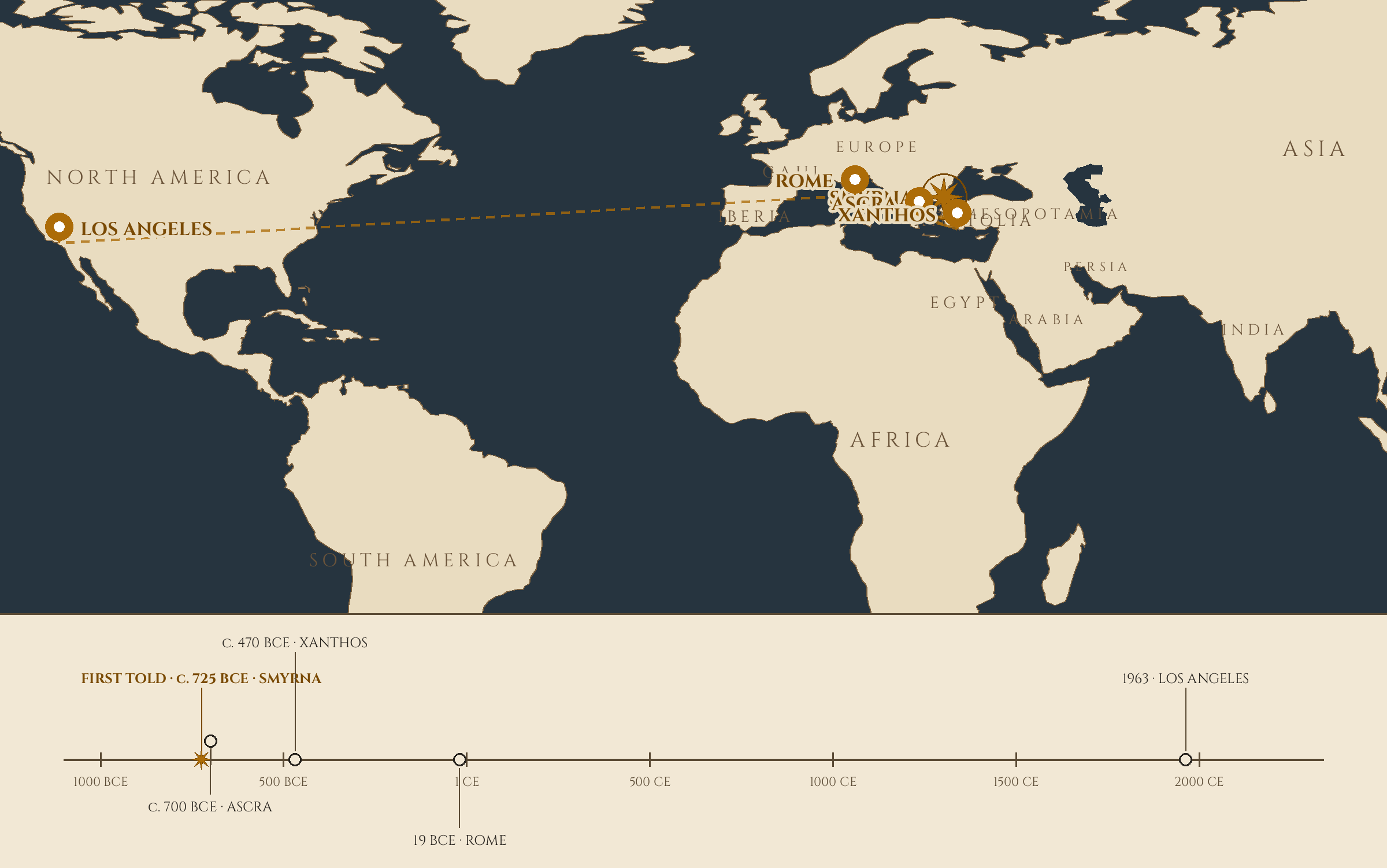
Where this lesson travels — on the harpies' map, for the map is theirs. Smyrna, about 725 BCE, Homer's city by tradition, where the Odyssey's harpies snatch the daughters of Pandareus; Ascra, about 700 BCE, where Hesiod named the sisters Aello and Ocypetes — Storm-Swift and Swift-in-Flight; Xanthos, about 470 BCE, where the Harpy Tomb carried its winged women in tender relief; Rome, 19 BCE, where Virgil gave Celaeno her prophecy of the tables; and Los Angeles, 1963, where the harpies flew in stop-motion over a film Phineus. The tengu and the sirens travel in this lesson's prose, as the bunyip traveled in Lesson 19's: one map per lesson is the class's rule, and honesty about whose map it is, is the rule's other half. The starred pin is the first record; the dashed line is the telling, traveling.
Lesson Objectives
By the end of this lesson, you will be able to:
- Name the three families this lesson files together, and state their shared pattern.
- Give the harpies' first records: Homer's snatching and Hesiod's two named sisters, with their names' meanings.
- Tell the tale of Phineus and Celaeno's prophecy of the tables, and name the beings who ended the torment.
- Tell the tengu's record: the name that crossed the sea and changed its kind, the teaching at Kurama, and the folklorist who printed the mountain country in 1910.
- State the sirens' original form, and trace their documented slide into mermaids — the case that closes the unit's argument.
- Tell Pegasus's record whole: the birth and the name in Hesiod, Athena's golden bridle, the Chimera, his rider's fall, and the stall and the constellation that close his file.
- Name the three watched birds filed with this lesson, state what each was watched for — and date the Tower ravens' fall-legend honestly, to its modern record rather than to antiquity.
- Give this lesson's watched-for custom with its source and date, and mark a four-file entry T, S, or F.
Your Assignment Packet
This lesson's work lives in its packet: the Lexicon Handout (every term, the core terms marked with the keeper's diamond ◆), Materials, Guided Practice, the Assignment Manual written out whole, the Scholar's Entry Page, the Reflection Questions, the Workbook Checklist, and the Keeper's Notes, for whoever teaches the lesson. Download the packet before you begin and keep it beside you as you read. The packet's assignment is Rookmere's own word for the work: Entry No. 28 — Winged Peoples (both) ◐. The Unit IV Quiz is not printed in the packet; it closes the unit, and it stands at the end of this very lesson, below.
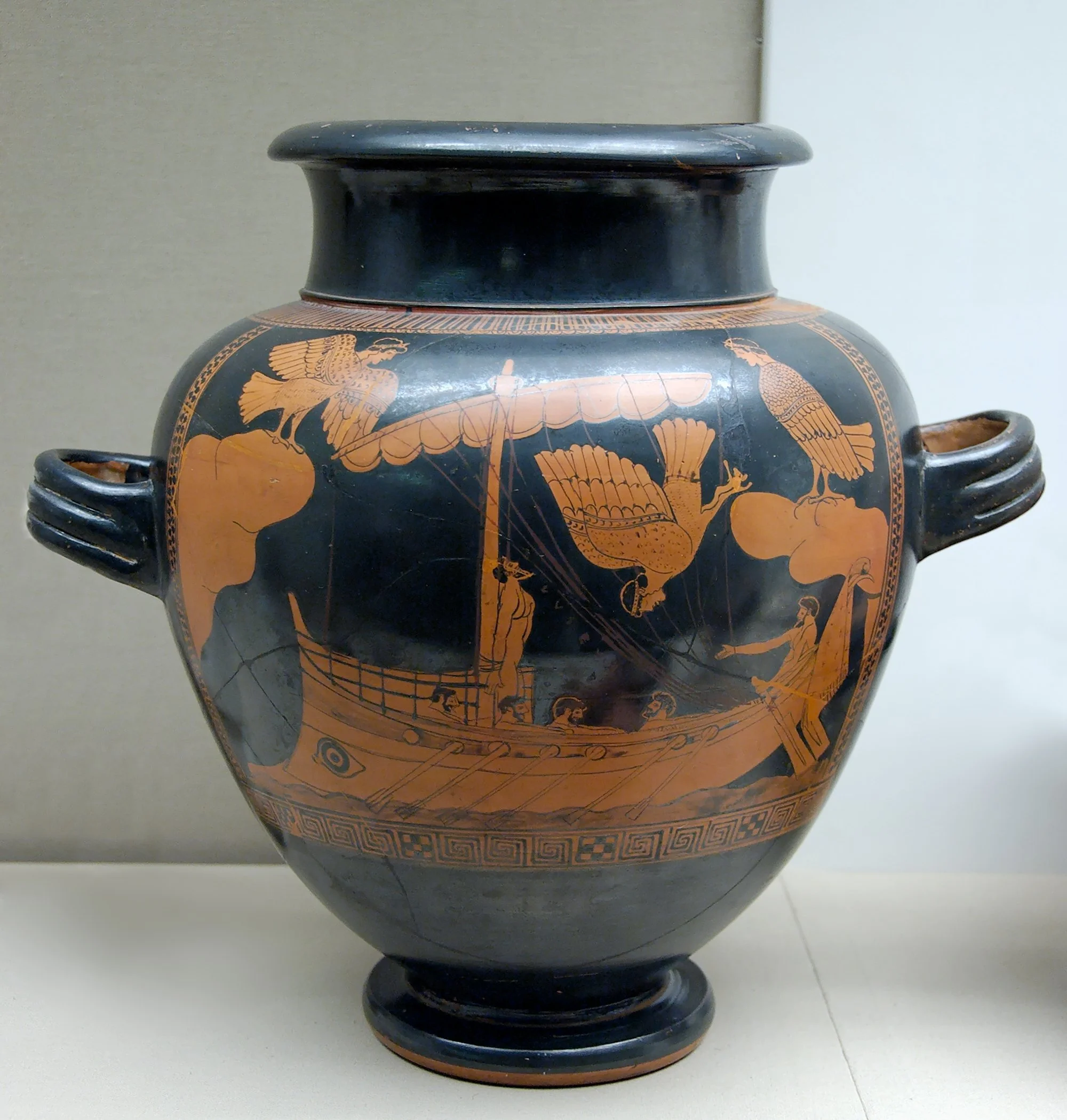
The Siren Painter's stamnos (about 480–470 BCE; British Museum): Odysseus bound to the mast while the bird-bodied sirens sing about his ship — and one, at the picture's edge, already falling dead into the sea. In this file the image is the older witness. Public domain, via Wikimedia Commons.
The Creature
Three families stand in this lesson, and they share one pattern: a person's face and intentions, carried on wings. The harpies of Greece are snatchers — storm-swift winged women who take food, goods, and sometimes people, and are gone. The tengu of Japan are mountain bird-goblins: winged, beaked or long-nosed, proud, and in the tales the teachers of swordsmanship to heroes. The sirens of the Greek sea-lanes are bird-women whose song draws sailors — bird-bodied in the early record, whatever they later became. No sizes are given for any of the three in their early records, and the entry invents none. These are peoples, not specimens: the record treats them as persons with wings, and that is the pattern to watch.
Pegasus stands in this lesson as a single, not a people — the file's one winged horse, and the only being in it with a name of his own rather than a kind's. He is a horse entire, with a horse's body and a horse's work, and the wings are the whole of his difference: no size is given for him in the early record, and no mate, herd, or kind. Where the three families are what peoples imagined, again and again, Pegasus is what one poet imagined once — and every later record kept him.
A third company rides with the lesson, smaller than either: three real birds — the owl, the raven, and the magpie — who enter the record not as peoples and not as wonders, but as birds people watched. Nobody invented them. They flew over real country, and watchers read meaning into their coming, their crying, and their number. The lesson files them where the watching is filed, in the Spotted section below: they are the unit's omen birds, and their record is a record of belief, marked T, laid over birds that are entirely real.
The plates show the pattern three ways — and one plate shows it changing. The Siren Vase (about 480–470 BCE) gives the sirens feathered and taloned, with women's heads, wheeling around Odysseus's ship, one already falling dead into the sea. The little Britannica plate of 1911, drawn from an Attic vase, gives the harpies as winged women snatching as they fly. Kuniyoshi's tengu is a man whose face is half a bird's, teaching a small boy the sword among the pines of Mount Kurama. And the new plate — the siren of the Harley Bestiary (1230–1240) — shows a siren already fish-tailed like a mermaid, holding a fish, looming over a boat whose sailor stops his ears: the bird-woman of the vase, seventeen centuries on, halfway to the mermaid. The Guided Observation reads the vase, the harpy plate, and the tengu closely; keep the Harley siren beside them, as the record of the change.
Two new plates are the horse's, and they are a before and an after. The Getty kylix (570–565 BCE) shows Pegasus rearing over the Chimera with Bellerophon on foot beneath him, spear in hand — the horse fighting, not yet a mount. The Autun mosaic (second to third century CE) shows the settled picture seven centuries later: the rider mounted, the spear going down, the horse white and calm in the air. The Guided Observation closes with the pair of them.
First Told
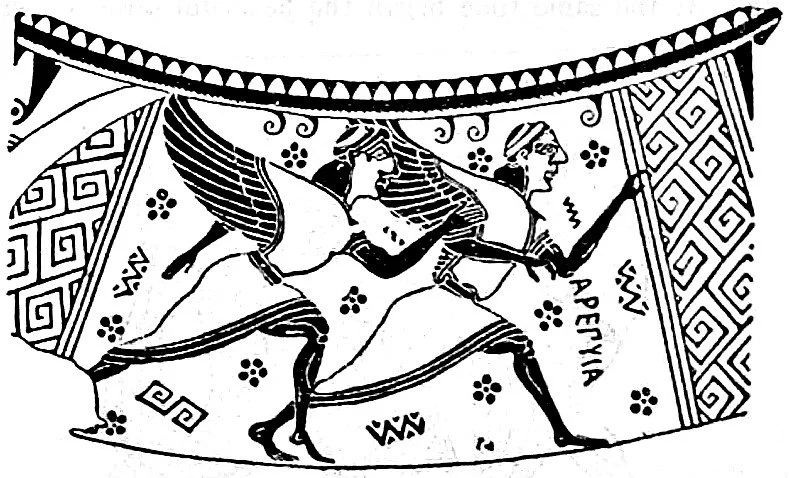
The harpies as the Encyclopaedia Britannica (1911) drew them from an Attic vase: winged women snatching as they fly — the Greek harpy in her vase-painting form, a woman winged at the shoulders, snatching with human hands. Public domain, via Wikimedia Commons.
The harpy carries her nature in her name, and Isidore's old doctrine — a name explains the nature — has no cleaner case in the class. The Greek word is harpyia, from harpazein, to snatch. A harpy is a snatching, before she is anything else.
Her first record is the Odyssey, written down in the eighth century BCE — about 725, by the map's dating, with Homer's city given as Smyrna by tradition, a hedge the map prints and the entry keeps. In the poem's twentieth book, the harpies snatch away the daughters of Pandareus and give them to the Furies to serve. And the snatching is already proverbial in the poem: twice elsewhere, a man vanished without trace is said, simply, to have been snatched by the harpies. The being enters the record as the explanation for the emptiest of human experiences — someone was here, and is gone, and nothing shows how.
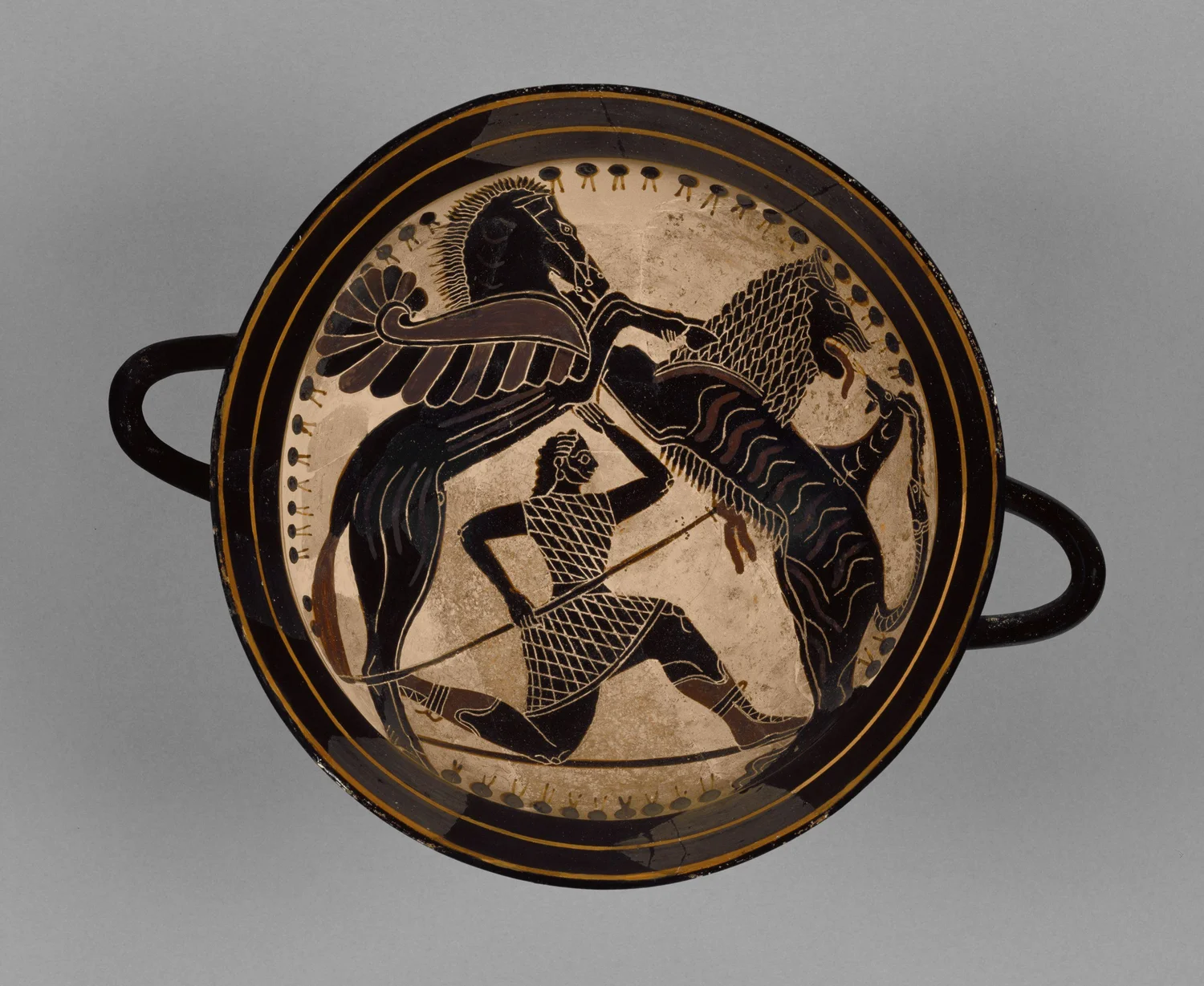
The Lakonian black-figure kylix attributed to the Boreads Painter (570–565 BCE; Getty Museum, 85.AE.121): inside the cup, the bridled Pegasus rears over the Chimera — lion body, goat's head rising from her back, serpent tail — striking at her with his hooves, while Bellerophon stands on foot beneath him with spear and reins. The earliest picture of the pair in this lesson: the horse fighting, not yet a mount. Public domain — digital image courtesy of the Getty's Open Content Program, via Wikimedia Commons.
A generation later, about 700 BCE, Hesiod of Ascra gives the snatchers names and faces, and the faces surprise every reader who meets the later record first. His harpies are two sisters, Aello and Ocypetes — the names are weather: Storm-Swift, and Swift-in-Flight. Daughters of Thaumas and the ocean-nymph Electra, sisters of Iris of the rainbow, they are in Hesiod lovely-haired: swift maidens on wings, keeping pace with the winds and the birds. Nothing foul. The ugliness is a later century's work, and the growth section of this entry is its manufacture.
Read the map as the harpies' own, for it is theirs: Smyrna starred at about 725 BCE; Ascra beside it, about 700, where Hesiod named the sisters; Xanthos, about 470 BCE; Rome, 19 BCE, where Virgil gave them their most famous speech; and Los Angeles, 1963, where they flew in stop-motion over a film Phineus. Five stops, all one family. The tengu and the sirens travel in this lesson's prose, as the bunyip traveled in Lesson 22's. One map per lesson is the class's rule, and honesty about whose map it is, is the rule's other half.
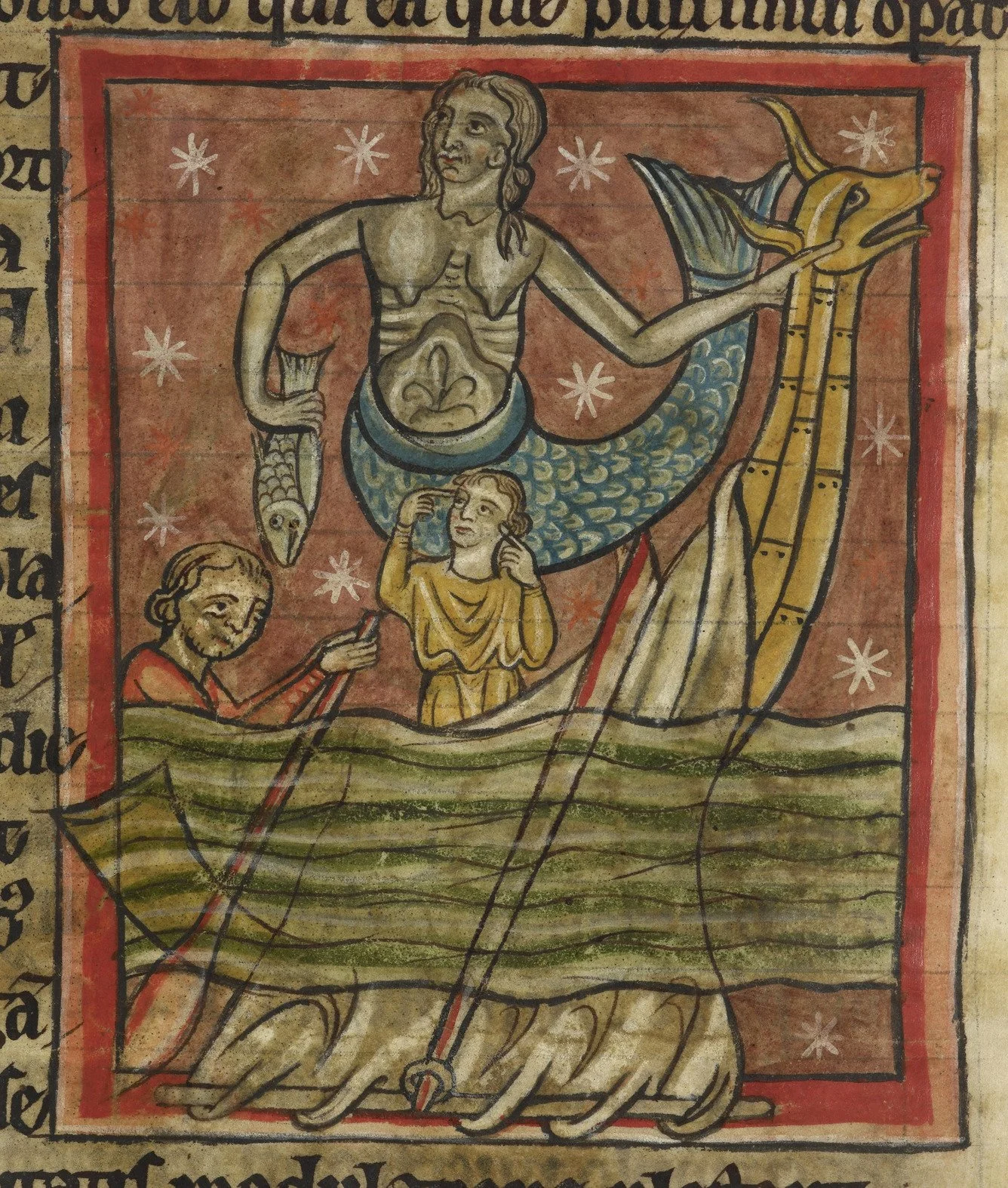
The siren of the Harley Bestiary (British Library, Harley MS 4751, f. 47v, 1230–1240): already fish-tailed like a mermaid, holding a fish, looming over a boat whose sailor stops his ears — the medieval slide of the siren out of her bird shape, pictured at the exact point this lesson's text describes it. CC0 1.0, via Wikimedia Commons.
The harpy hardened as she traveled. At Xanthos, in Lycia, the great tomb of about 480–470 BCE — the monument the record calls the Harpy Tomb — carried her in relief: winged women bearing small figures gently in their arms. What the small figures are, scholars argue to this day — souls of the dead, or the dead man's children — and the entry files the argument rather than a choice; what is not argued is the tenderness of the carving. These are not tormentors. They are carriers. Somewhere between the tomb and the epic stage, the record turned her face.
The turn is complete by the time of Apollonius of Rhodes, in the third century BCE, whose Argonautica gives the harpies their defining employment — the torment of the blind king Phineus, whose every meal they snatch or foul — and their defining chase, by the winged sons of the North Wind. Virgil gave the foulest of them a voice and a prophecy, in 19 BCE, and Dante set the brood in the wood of the suicides, feeding on the leaves of men. By the Middle Ages the lovely-haired sisters have become the record's standing picture of rapacity with a woman's face — a transformation no single author ordered, and therefore one of the unit's best documents of how tellings grow: by appetite, century by century, each copyist finding the fouler version the better story.
Pegasus enters the record in the same poem that named the harpy sisters, and from the same poet's hand. In Hesiod's Theogony (about 700 BCE), Poseidon had lain with Medusa, the mortal Gorgon; and when Perseus cut off her head, two children sprang from her at once — Chrysaor, a warrior born with a golden sword in his hand, and the horse Pegasus. Hesiod derives the name himself, in Isidore's manner before Isidore: Pegasus, he says, because the horse was born near the pegai, the springs of Ocean, at the edge of the world. A name explains the nature here too — the nature is a birth at the springs, and the springs follow this horse through his whole file.
Hesiod's telling does not leave him at the birth. In the same passage the horse flies up from the earth, comes to Zeus, dwells in Zeus's house, and brings him the thunder and the lightning. The ending every later age gives Pegasus — the stall in heaven, the god's own service — stands in his first record already, before any hero rides him. And when Hesiod reaches the Chimera, a few dozen lines on, his line is flat: the Chimera was killed by Pegasus and gallant Bellerophon. The pair enter the record together, in one sentence, with no taming told.
Homer tells the hero's story otherwise, and the difference is this file's growth in miniature. The Iliad's Bellerophon kills the Chimera, fights the Solymi and the Amazons, and ends hated by the gods, wandering alone — and no winged horse appears anywhere in his story. The most famous rider in the record began without his horse. How the horse came under him no early record says; the painters show the fight by about 570 BCE, and the taming itself is not told until Pindar, in 464 — it stands in the Tales, where it belongs.
One city took the horse for its own. Corinth — Bellerophon's city, and the city of the spring where the taming is set — struck Pegasus on its silver staters from the sixth century BCE and kept him there, with Athena's head for company, through the fifth and fourth centuries and much of the third: the coins were nicknamed pōloi, colts (Head, Catalogue of Greek Coins: Corinth, 1889). Corinth's colonies copied the type across the sea. For most people who ever handled his picture in the ancient world, Pegasus was not a poem. He was small, silver, and spent.
The tengu grew by a different road: he is what a word becomes on a journey. His name comes from China's tiangou, the heavenly dog — a sky-omen, a fiery falling thing. Carried to Japan, the word changed its kind and settled on the mountain bird-goblins: by the tale-collections of about 1120, the Konjaku Monogatari, tengu walk the hills as winged beings of the high forests. The medieval centuries added a second root in plain sight: the tengu as the proud monk punished — the cleric whose arrogance in life grew feathers in death — a satire the monasteries told on themselves. And the tengu's signature grew last of all: the long nose, by which every schoolchild in Japan knows him, became standard only in the art of the Edo centuries. Name from a dog-star, body from the mountains, face from the print shops: three records braided into one being.
The sirens grew by sliding. In the Greek record they are bird-women — this lesson's opening vase, painted about 480–470 BCE, shows them exactly so, feathered and taloned, with women's heads — and Isidore, as late as the seventh century CE, still files them with wings and claws. But the medieval centuries, copying them in manuscript after manuscript, slid them seaward: the wings shrink, the tail forks into a fish's, until in the French tongue sirène means simply the mermaid. Lesson 17 met the mermaid from the other side of the merge; the two entries are one document seen from two shelves. The sirens are the class's cleanest proof of its central law: beings obey their records. Change the pictures, generation by generation, and the being changes — in the only place beings of this shelf have ever lived.
The new plate shows the slide at its midpoint. In the Harley Bestiary (1230–1240), the siren is already fish-tailed, holding a fish, leaning over a boat while a sailor stops his ears against the song. The wings of the vase are gone; the song is still at work. When a being changes in the pictures, generation by generation, the being changes — the Harley miniature is the moment a keeper can point to and say: here.
The Tales
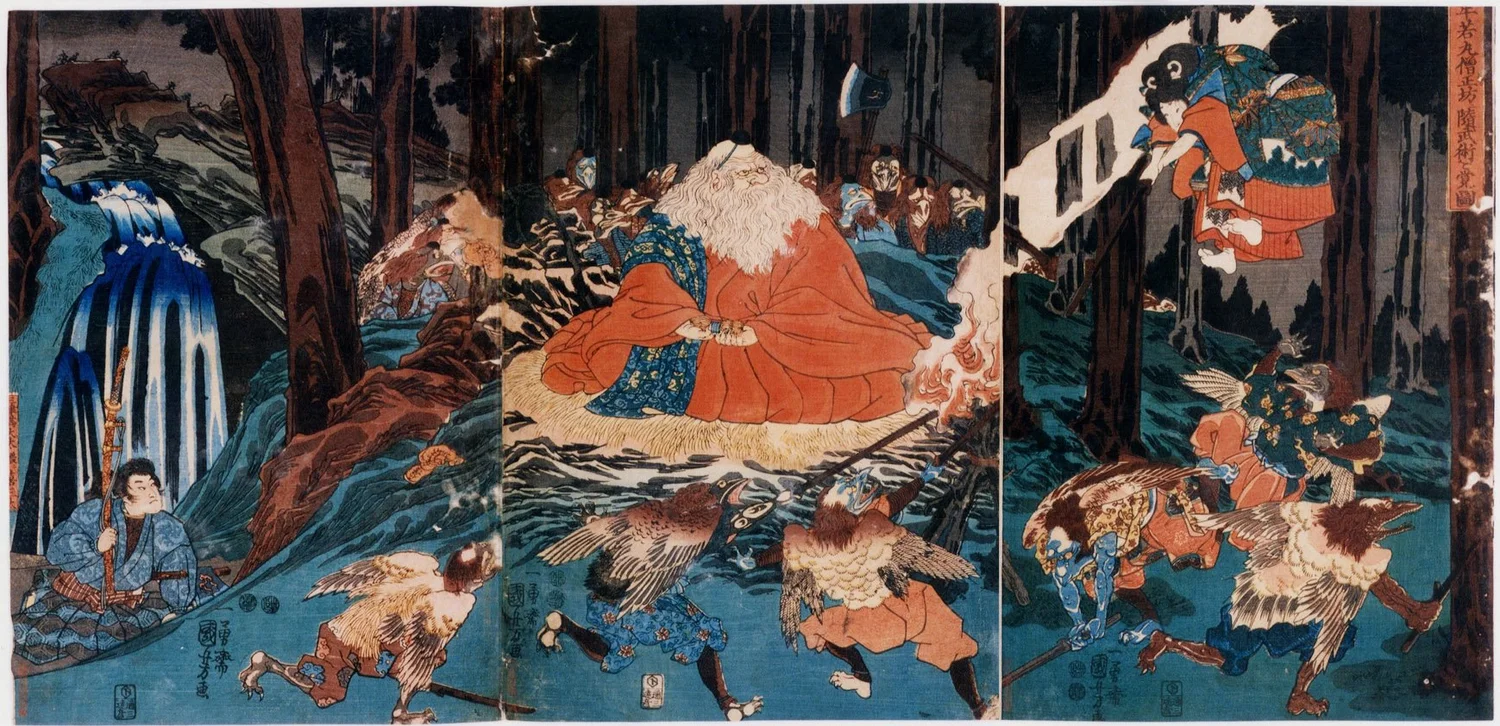
Utagawa Kuniyoshi's triptych of the young Ushiwakamaru at sword-practice with Sōjōbō, the long-nosed king of the tengu of Mount Kurama — Japan's winged teachers of the sword, putting the small boy through his paces among the pines. Public domain, via Wikimedia Commons.
The harpies' tale is Phineus. The blind king of Thrace sat down to every meal under siege: the harpies swept in, snatched what they could carry, and left the rest fouled past eating, so that the king starved at a full table. His deliverance came with the Argonauts: Zetes and Calais, the winged sons of Boreas the North Wind, rose after the harpies with swords drawn and chased them across the sea — until Iris, the harpies' own sister, stopped the chase at the islands thereafter called the Strophades, the Turning-Back Isles, and swore the great oath: the harpies would trouble Phineus no more, and their lives were spared. The tale's shape is a keeper's lesson in itself. The torment ends not in a killing but in a settlement — an oath, a boundary, a turning-back place named on the map. Even the snatchers, in the end, are filed.
Virgil took the brood up for the sequel. Wrecked Trojans, feasting on the Strophades, are harried mid-meal as Phineus was, and the harpy Celaeno, perched above them, delivers the record's most famous prophecy: the Trojans will wander until hunger drives them to eat their very tables. Books later, the prophecy lands as a joke — the Trojans, eating the bread trenchers under their food, laugh that they are eating their tables — and the old men remember Celaeno and know the curse has discharged itself harmlessly. File the arc entire: a prophecy is a tale with a delayed punchline, and the harpies carry the class's best one.
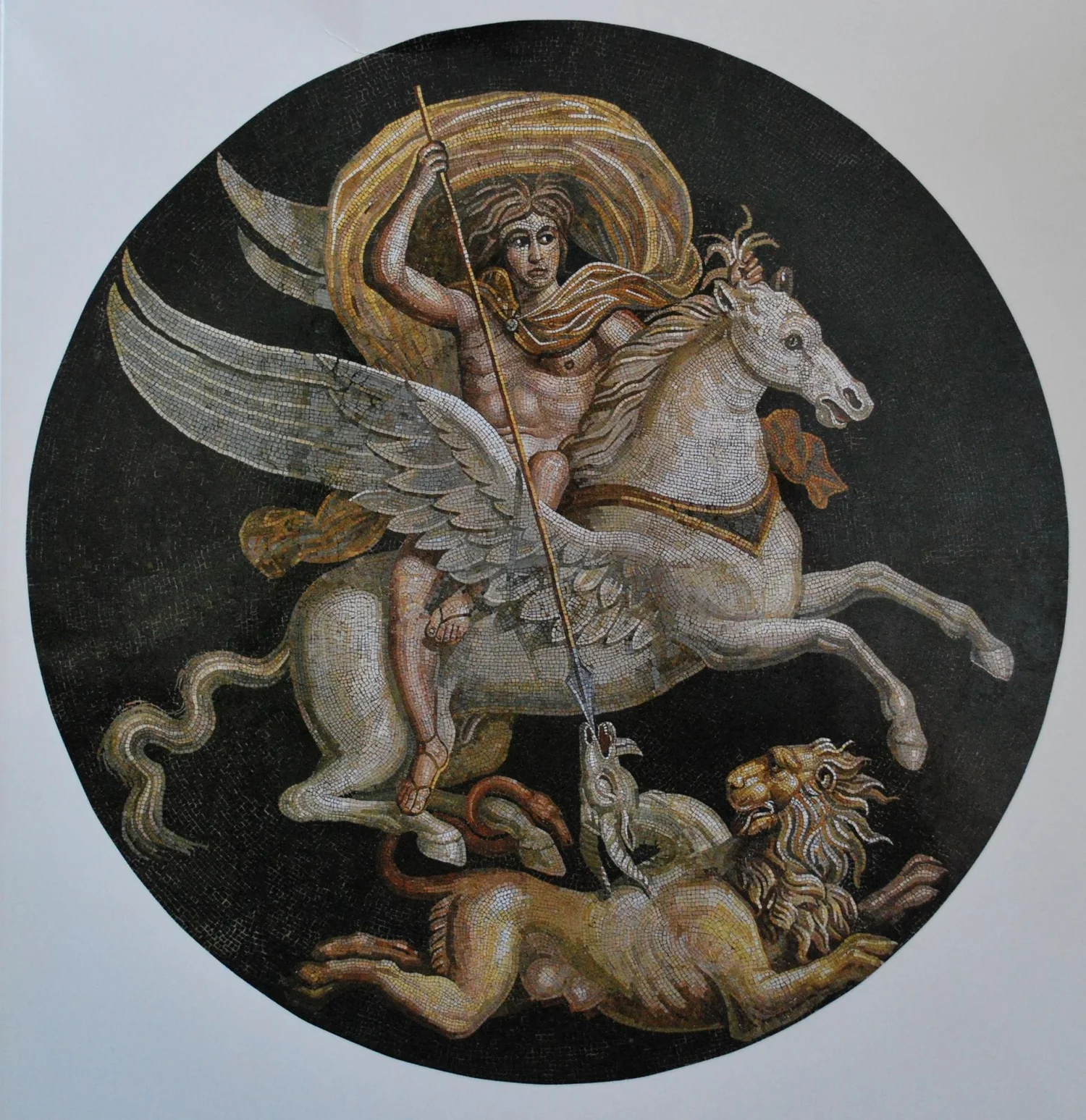
The central medallion of the Gallo-Roman mosaic from Autun (second to third century CE; Musée Rolin, discovered 1830): Bellerophon mounted on the white winged Pegasus, cloak billowing, driving his spear down into the Chimera below — the settled, mounted picture of the pair, seven centuries after the kylix. Public domain, via Wikimedia Commons.
The tengu's tale is a schoolroom. At Mount Kurama, above Kyoto, the child Ushiwakamaru — the boy who would become Minamoto no Yoshitsune, the most beloved hero of Japan's warrior tales — climbed by night, as the later chronicles and plays tell it, to where the tengu held their court, and was taught the sword by their king, Sōjōbō: the long-nosed master of this lesson's Kuniyoshi plate, putting the small boy through his paces among the pines. The tale mirrors Phineus's: the Greek winged people steal food from a king's table; the Japanese winged people give skill to a king-to-be in the dark. What a record fears from the air, and what it hopes from it, stand side by side in this lesson.
The sirens' tale you know from Lesson 17's harbor, but its first telling belongs here, in the bird-form. Odysseus, warned by Circe, has his crew stop their ears with wax and binds himself to the mast, under orders that no plea of his will loose the ropes; the ship rows past the singing island with one man listening, bound — the only safe hearing of the song in the record. And this lesson's vase adds what Homer does not say: at the picture's edge a siren is already falling dead into the sea. The painters, and after them the ancient commentators, held that when a mortal passed the song unharmed, a siren died of it. The picture knew the rule before the prose wrote it down: in this file, the image is the older witness.
The last tale is the horse's, and its set text is a victory ode. Pindar's Olympian 13, sung in 464 BCE for Xenophon of Corinth, tells how Bellerophon of Corinth longed to bridle Pegasus, who came to drink at Peirene, the spring on Corinth's own height, and suffered much in the trying. The seer Polyidus told him to sleep in Athena's temple. In the dream the goddess came to him carrying a bridle with a golden headband — take this charm of steeds — and bade him show it to the Horse-Tamer, Poseidon his father, with the sacrifice of a white bull. He woke, and the bridle was in his hand. He made the sacrifice, raised Athena an altar, and with the golden bridle caught the horse at the spring. Read the mechanics as the moral: the wildest thing in the sky was not taken by strength. It was taken by a gift, a ritual, and the right tool — the only taming in this class worked by equipment.
From that back, the aerial career runs. Hesiod's line has the pair kill the Chimera together; Apollodorus, in his handbook of the first or second century CE, gives the how: Bellerophon mounted his winged steed Pegasus, offspring of Medusa and Poseidon, and soaring on high shot down the Chimera from the height — the one foe whose fire could not reach a rider in the air. (The Chimera's own file stands among the Greek singles of Unit II; her death is filed here, from the horse's side.) Pindar adds the Solymi and the Amazons, struck from the sky in the same campaigns. Then the rider asked the horse for one flight too many.
Pindar's Isthmian 7 tells the end in a breath: winged Pegasus threw his master Bellerophon, who had wished to enter the dwellings of heaven and join the company of Zeus. The later record fills in the how — Zeus sent a gadfly, and the stung horse reared and shook the rider off: file the fly as the later record's machinery, and Pindar's plain throw as the earlier word. Homer's ending for the man needs no horse at all: Bellerophon wanders the Aleian plain alone, eating his own heart, shunning the paths of men. The rider's file ends on a plain. The horse's does not: Pindar leaves him where Hesiod had already put him — Pegasus dwells in the ancient stalls of Zeus upon Olympus.
One more spring belongs in his tale, because springs are his signature. On Mount Helicon, Aratus writes, the Horse struck the rock with his forefoot, and the water of Hippocrene — the Horse's Fountain — welled up, where herdsmen first drank of it; Strabo and Pausanias keep the same story of the same spring. Born at the springs of Ocean, caught at a spring of Corinth, stamping a spring out of the Muses' mountain: the name Hesiod gave him is the map of his life — the only map this file gives him.
KEEPER'S CHECK-IN
Celaeno prophesied that hunger would drive the Trojans to eat their very tables — how does the prophecy actually come true?
Spotted
No sighting-reports stand in these files, and the section says so in a line rather than padding it. Nobody in the record files a dated claim to have seen a harpy, a tengu, or a siren, the way travellers reported the roc or newspapers reported the thunderbird — nor a winged horse over Corinth. What the record holds instead is poems, a tomb, coins, tale-collections, and — for the tengu — a folklorist's notebook of what mountain people did about the beings, which stands in the box below. The absence is itself a datum about these files: the winged peoples lived in story and custom, not in reports.
The omen birds are the opposite case, and that is why they are filed here, in the watching section. Their sightings were never the marvel: owls, ravens, and magpies are real birds, seen every week. The marvel was the meaning watchers read off them — off a cry, an appearance, a number. What follows is belief-record, marked T throughout; the print dates and the named books are record, and the entry keeps the two apart.
The owl carries the darkest file of the three, and it is Rome's. Pliny the Elder, in Book 10 of the Natural History, calls the horned owl, the bubo, "especially funereal, and greatly abhorred in all auspices of a public nature" — the monster of the night, whose voice is a shriek rather than a song, and whose appearance in a city is a direful omen. He records the working of it: when a horned owl entered the sanctuary of the Capitol, in the consulship of Sextus Palpelius Hister and Lucius Pedanius, Rome was purified by lustration on the Nones of March. The poets keep the same reading. Virgil sets the owl's death-howl before Dido's death in Book 4 of the Aeneid, and in Book 12 a Fury takes owl shape to beat against Turnus's face before the final duel. Ovid, in Book 5 of the Metamorphoses, makes Ascalaphus into the screech owl, "an ill-omened bird." But the classical record does not file the owl one-sidedly, and neither does this lesson: the same world that feared the bird at Rome kept her at Athens as Athena's own bird and the city's emblem. One bird, two readings, both in the record.
The raven was watched with the opposite expectation, and the distinction is the point of his file. In the Norse record he is not an ill omen at all; he is intelligence. Odin's two ravens, Huginn and Muninn — Thought and Memory — fly every day over the whole world and report what they see and hear. The Grímnismál, stanza 20, in the Poetic Edda (the poem survives in the Codex Regius, about 1270), gives Odin's own anxiety for them: he fears for Huginn's return, "yet more anxious am I for Muninn." Snorri Sturluson's Prose Edda, in Gylfaginning chapter 38, sets the pair on Odin's shoulders to whisper all news into his ear, and says that is why he is called hrafnaguð, raven-god. A watcher did not ask what a raven foretold. A watcher asked what a raven knew.
The magpie was watched by counting, and her record is a rhyme that grew. Its earliest printed form is 1780, in Samuel Henley's note on "magot-pies" — four lines, from the west of England: "One for sorrow, / Two for mirth, / Three for a wedding, / Four for death." From there the count grows by accretion, and the versions contradict each other, as growing things do. A Lincolnshire form in John Brand's tradition gives three for a funeral and four for a birth. Robert Chambers's Scotland, in The Popular Rhymes of Scotland (1826), runs the top of it backwards — "Ane's joy; twa's grief; three's a marriage; four's death." The count reaches seven in Lancashire print by 1849, in Halliwell's Popular Rhymes and Nursery Tales, with "seven for a witch"; silver, gold, and the secret arrive in Michael Aislabie Denham's North of England tracts, issued about 1850–58 and counting to ten, ending at "the deevil's awn sell." "Two for joy" itself is first found in print only in 1887, in Ireland, in Notes and Queries — and the familiar full modern form, with joy, girl, boy, silver, gold, and secret all in place, first appears together in 1922, as the epigraph to Mary Webb's novel Seven for a Secret. The single magpie was the bad sign, and the record keeps the counter-customs watchers used against her: doffing the hat and bowing to the bird — Halliwell, in 1849, had "more than once seen [it] quite seriously performed" — crossing oneself, spitting, and the polite greeting, "Good morning, Mr Magpie," which is in print by 1926. Count the birds, then mind your manners to them: that is the whole of the magpie's file, and it is a belief about a bird anyone could see from the lane.
KEEPER'S CHECK-IN
No dated sighting-report stands in this lesson's files for a harpy, a tengu, a siren, or a winged horse — what does the Spotted section hold instead, and for which real birds?
What People Watched For — the Mountain Nobody Climbed
This lesson's custom belongs to the tengu, and it is the quietest in the class: a thing people did not do, kept for generations, and written down at last by a folklorist with a notebook.
In the mountain country of Tōno, in Japan's Iwate district, the folklorist Yanagita Kunio collected the district's tales from the telling of Sasaki Kizen, a native of the valley, and published them in 1910 as the Tōno Monogatari — the founding book of Japanese folklore study. Tale 29 of the collection concerns the peak called Mt. Keito, which the villagers knew as Mae-Yakushi. The people at its foot climbed Mt. Hayachine, its great neighbor, freely. Keito they did not climb. In fear of the tengu that live there, Yanagita records, even those who climb Mt. Hayachine do not climb Mt. Keito — and the reason the peak had a second, holy name, and the reason the path up it stayed empty. Tale 90 of the same book gives the pattern its local habitation: a hill in Matsuzaki village called Tengu-mori, the tengu's forest, where the red-faced master of the wood might meet a drowsing workman standing astride his path.
So what people watched for, in the Tōno country, was a mountain to stay off. The custom the belief produced was an absence on the paths: generation after generation of mountain people walking around one peak, in full sight of it — their abstention as regular and as legible as the alicorn cup on a king's table, and recorded by the same instrument that records half the customs in this class: one careful collector, a named informant, a dated book. Yanagita, 1910, from the mouth of Sasaki of Tsuchibuchi. The box is filled, and its filling shows its working.
What It Actually Is
Composite beings have composite roots, and this lesson files one per family — noting, first, that for winged peoples the roots are more often verbs than animals: snatching, teaching, singing.
For the harpies, the root stands in their names. Aello and Ocypetes are not women's names borrowed for birds; they are the names of winds — the storm-squall and the swift flight — given faces. Greece knew sudden winds that snatched: gear from decks, men from ships, leaving exactly the emptiness the Odyssey already uses the harpies to explain. The keeper files it so: the harpy is a storm that learned grammar — the snatching came first, the feathers after. Whether carrion birds fed the picture, as has been proposed, the entry leaves as proposal; the names need no help.
For the tengu, the root is braided like the being. Part is linguistic: the tiangou crossing — a word for a sky-dog landing on mountain bird-men shows the root of a being can be a mistranslation that took. Part is social: the proud-monk tengu is monastic satire with feathers, a community's picture of its own worst fault. And part may be zoological — it is often proposed that the bold black kite of the Japanese hills, which snatches food from travelers' hands to this day, stands behind the tengu's beak and manners; the lengthening of beak into nose is then the artists' slow work. Filed as proposal, named as proposal. The kite itself is a medium-sized hawk, about a metre and a half across the wings, with a forked tail it twists in flight like a rudder. Kites are scavengers and opportunists, quick enough to take food out of a picnicker's fingers, and bold enough to try it in front of a crowd. A bird like that, working the mountain paths and the temple roofs, would be known to every traveler in the hills — known the way the tengu is known in the tales, as a presence you allowed for.
For the sirens, the root is sound itself. The Greek record gives them no animal and needs none: what they embody is the pull of a beautiful voice across water — the way song carries farther and stranger over a calm sea than any listener expects, arriving disembodied, from an island that looks empty. Keepers have proposed the crying of seabird colonies, heard from ships at dusk, as the seed; the entry files it as a proposal beside the surer root: a being made of hearing, feathered because everything that comes out of the air in the old records wears feathers.
For the omen birds, the root — where the record offers one — is close watching of the birds themselves. Humphry Davy offered a natural root for the magpie count in Salmonia (1828): in spring the female incubates while the male forages alone, so one magpie out means cold weather and poor fishing, and a pair means mild. An observation under an omen — this class's usual shape — and the entry files it as Davy's proposal, in his name. For the owl's Roman omen and for Odin's pair the dossiers file no such root, and the entry leaves them as they stand: belief and story, laid over real birds.
For Pegasus, the root is the plainest in the lesson, and the entry files it without apology: a horse. No storm, no satire, no sound — a real animal entire, worked on by exactly one impossible addition, the wings. Everything else in his file grows from the real horse's real place in the Greek world: the mount that carries a hero above danger, the stall in the great house, the city's badge on its money. Even his springs are a horse's fact before they are a wonder — a horse at a spring is the oldest picture in a dry country, and the record simply lets the water answer his hoof. Where the harpy is a verb that grew feathers, Pegasus is a noun that grew wings. The lesson's pattern holds both ways.
Still With Us
The unit's last pin is Los Angeles, 1963, and it is a good place to take the modern faces family by family, as the assignment will ask you to file them.
The harpies fly in Ray Harryhausen's Jason and the Argonauts, harrying the blind Phineus at his table in stop-motion — Apollonius restaged in a new medium, which is to say the late harpy, Hesiod's lovely-haired sisters quite forgotten. English completed the forgetting in the dictionary: in everyday speech harpy shrank into an insult, a word for a scolding woman, and a being who began as a named wind ends her modern face as a slur. Keepers record that too, without flinching: a being's modern face is whatever the record is doing with her now. The name went one other place, and a keeper should know it: zoologists gave it to a real bird, the harpy eagle of the Central and South American rainforests — a big forest eagle, about two metres across the wings, with talons as long as a grizzly bear's claws, that hunts monkeys and sloths in the canopy. Hesiod's storm-maidens lent their name to the strongest eagle on their continent's other side of the world. The record does that sometimes, when nobody is watching it.
The tengu's face is the healthiest of the three: the long nose looks out from festival masks and temple carvings in Japan still, and the tengu stands in popular art as he stood for Kuniyoshi — the red-faced master of the mountain schoolroom. Of the lesson's three families, his record never broke; it only changed hands, from chronicle to woodblock to screen, with the nose intact.
And the siren completed the strangest journey of any being in the unit: she gave her name to a machine. The sounding siren — the wailing instrument on ambulances and factory roofs — was christened in 1819, by its inventor, for the bird-women of this lesson: the voice that carries, that cannot be ignored, that means attend or be wrecked. The woman-bird is gone from the ambulance. The warning is hers still. That is the modern face at its purest: the being dissolved into a word the whole world obeys daily.
And Pegasus — the single — kept the largest face of all, because his is still overhead. Hyginus, in his star-book of the second century CE, records that the horse, riderless, flew up and was placed among the constellations by Zeus, and that Aratus and many others called the star-horse Pegasus. The astronomers kept him as simply the Horse: Aratus had described him in the Phaenomena (about 275 BCE), hoof, spring, and all, and Ptolemy's Almagest, in the second century CE, catalogued his twenty stars among the forty-eight constellations, wings noted. He stands there still, one of the eighty-eight — the seventh largest figure in the sky, drawn as the old books drew him: a horse cut off at the middle, all front and wings. His body is the Great Square of the autumn sky — Markab, Scheat, and Algenib at three of its corners, and the fourth corner borrowed from Andromeda next door, Alpheratz; his head runs out westward to Enif, his brightest star, at his nose. On any clear autumn night he is up there doing what he did in Hesiod: dwelling in the house of the sky, in plain sight of everyone who looks up. Celestial Studies reads that sky with its own instruments; this class files the face. Of every being in Unit IV, he alone can still be visited.
The watched birds have one modern face of their own, and it is a custom still kept. At least six ravens are kept at the Tower of London today, under a Ravenmaster, and the standing story says the Crown and the Tower will fall if they leave. Keep the story — and date it honestly, as this class dates everything. There is no contemporary record of the famous decree behind it, the tale of Charles II reversing himself when the astronomer John Flamsteed complained of the ravens at the White Tower: not one paper of that reign tells it. The earliest known references to captive Tower ravens are 1883, an illustration, and 1885, a picture in The Pictorial World. Geoffrey Parnell, the Tower's official historian, judges the raven mythology "likely to be a Victorian flight of fantasy," the birds probably brought in to dramatise the execution site for visitors; and Boria Sax's study, "How Ravens Came to the Tower of London" (Society and Animals 15, 2007), dates the specific legend — that the kingdom will fall — to autumn 1944. An older British raven layer does stand behind the place: Brân the Blessed of the Welsh record, whose head was buried under the White Hill in London to protect the island — brân is Welsh for raven. But the Tower's birds themselves are a modern custom, documented as modern, and kept anyway. That is the strand's teaching jewel, and it is not softened here into antiquity: a custom does not need a false old birthday to be a real custom. File the fall-story T, for belief; file its dates as record.
Which returns the unit to its argument, here at its close. The sirens merged into the mermaids when the pictures changed; the harpies fouled when the appetite changed; the tengu crossed the sea in a word and changed his species; the horse outlived his rider, his city, and his poems, and hangs in the sky. Records make beings. Keep them honestly, and the beings stay honest with you. Unit V waits — the Changed, beings who were people — and your entries go with you.
Guided Observation
Begin with the vase: the Siren Painter's stamnos, painted about 480–470 BCE, now in the British Museum. Odysseus stands bound to the mast at the picture's spine; the sirens wheel about the ship; and one — find her — is already falling, head down, into the sea. Read the painting as the older witness it is. Homer gives the song and the ropes; the rule — that a siren dies when a man passes unharmed — is here in paint before any surviving prose says it. What else does the painter tell you that the poem does not? Count the feathers. Note the talons. This is the being entire, in her first shape.
Then set the little Britannica plate of the harpies beside Kuniyoshi's tengu, and do the keeper's arithmetic of the composite: in each figure, what is bird, and what is person — wing, feather, beak or nose, against face, hand, and intention? The harpy is a woman winged at the shoulders, snatching with human hands. The tengu is a man whose face is half a bird's, teaching with a master's patience. Three records, three solutions to one problem — and the solutions confess what each people feared or wanted from the air. Write the three confessions down, one line each.
Then the Harley siren of the new plate (1230–1240): fish-tailed, holding a fish, leaning over the boat while a sailor stops his ears. Set her beside the vase's sirens and name what seventeen centuries of copying took away, and what they left untouched. The song survived the change of body. Say what that tells you about which part of a being its record cannot afford to lose.
Last, the kylix — Pegasus's own plate, painted about 570–565 BCE, a century and more before Pindar told the taming. Look at who is fighting. Bellerophon stands on the ground with his spear; the horse, bridled already, rears over the Chimera and strikes with his hooves. The painter's Pegasus is not transport. He is a combatant — and the hero's part, in the earliest picture of the pair, is to hold the reins and stay underneath. Set the Autun mosaic beside it, where the rider sits mounted and level, spear going down, and you have the whole growth of the tale in two pictures: the horse's fight, becoming the hero's ride.
Assignment Manual
✎ WRITTEN · ⚒ HANDS-ON · ◐ BOTH
◐ Both · Entry No. 28: Winged Peoples.
- Rule your entry page. Turn to the Scholar's Entry Page in this packet and rule the next page of your journal to match it, as you did for your earlier entries. This entry runs long; rule a second page if your hand needs it, and mark it Entry No. 28, continued.
- Write the winged peoples' entry, to the standard. Give the harpies the entry's spine, as the lesson does. First Told: Homer's snatching (with Smyrna marked by tradition) and Hesiod's sisters, their names translated. How the Telling Grew: the Harpy Tomb, its argument filed as an argument; Apollonius and the chase; Virgil; the slow fouling. The Tales: Phineus and the settlement of the Strophades; Celaeno and the tables. What It Actually Is: the names of the winds. Still With Us: the film of 1963 and the dictionary's insult. Then, under the head The Pattern in Other Records, file the tengu and the sirens in two short files of your own, each with its first record, its fixed tale, and its modern face: Kurama and Sōjōbō for the tengu, Tōno's unclimbed mountain for his custom; the vase and the mast for the sirens, the slide into sirène for their growth, the ambulance for their face. Then, under the head The Single, file Pegasus in a short file of his own: Hesiod's birth and the name from the springs; the golden bridle at Peirene; the Chimera, shot from the height; the throw, and the plain the rider ended on; the stalls of Zeus; and the Square in the autumn sky. Then, under the head The Watched Birds, file the omen birds in three short files of your own: the owl, Rome's dire omen, with Athena's counterweight kept beside it; the raven, thought and memory rather than ill omen, with the Tower custom dated to its modern record and its fall-legend to 1944; and the magpie, counted from Henley's four lines of 1780 to Webb's assembled form of 1922. The Keeper's Line closes the whole: your judgment on the unit's argument, in one or two lines.
- Three solutions to one problem. ◐ On a fresh page, draw — in outline, in your own hand, skill no object — the three winged figures of this lesson's plates side by side: the vase's siren, the Britannica harpy, Kuniyoshi's tengu. Label what is bird and what is person in each, down to the feet. Beneath the three, write one line per figure: what this solution says about what its record feared, or wanted, from the air. The drawing is the point: a keeper who has built the three composites with his own pencil will never read "winged woman" as though it were one thing.
- Mark every line. Go back through your entry — all three files of it — and mark every line in the margin, F for record or T for belief, as always. The special discipline of this entry: watch the merges. Wherever your pen has quietly let the siren grow a fish's tail before her medieval centuries, or let Hesiod's sisters be foul before the record fouled them, you have merged what the record kept apart. The red pencil lives for exactly this. A being out of her century is a being misfiled.
Materials
· Your creature-guide journal, with your earlier entries in it
· Pencils, and a pen you like — and the red pencil from Lesson 15
· A ruler, for ruling your entry pages
· This lesson's packet (the Scholar's Entry Page is in it)
· For Step 3: a fresh page, and the lesson's three plates open before you
Reflection
Hesiod's harpies are lovely-haired; the later record makes them foul, and no author ordered the change. What, in a record, does the work of an author when no author is there — and does it work on records today?
The siren merged into the mermaid; the tengu's name changed its species crossing one sea. What, in the end, holds a being together — the name, the shape, or the story? Answer from the evidence of this one lesson.
Yanagita's villagers kept their belief as an absence: a road not taken, a peak not climbed. What does your own household keep that way — and would a collector, two centuries from now, be able to prove it from anything you will leave behind?
Bellerophon's file ends on a plain; Pegasus's ends in a stall and a constellation. The record kept the horse and let the hero go. What decides, in a record, who is the being — and who is only an episode in the being's file?
A Closing Note
Twenty-eight entries, and the skies are filed: hoards and rains, a bird of ashes, a bird of measures, a bird of carved ranges, and the peoples of the air. Keep the journal shut against the weather and open for the quiz, which waits at the unit's end, as always. Next we come down from the skies to the strangest file in the school — the Changed, who were people, or were said to be, and whose records walk into courtrooms. Bring your marks sharp.
The Bestiary
Bestiary Keeper
Further Reading & Sources
Homer, Odyssey — the daughters of Pandareus (book 20) and the sirens (book 12); Emily Wilson's translation keeps the snatching plain.
Hesiod, Theogony, lines 265–269 — Aello and Ocypetes, the sisters of Iris.
Apollonius Rhodius, Argonautica, book 2 — Phineus, the Boreads, and the oath at the Strophades.
Virgil, Aeneid, books 3 and 7 — Celaeno's prophecy, and the eating of the tables.
The Harpy Tomb reliefs, from Xanthos (c. 480–470 BCE) — British Museum; the small figures' identity argued in the museum's own notes.
Utagawa Kuniyoshi, Ushiwakamaru's sword-practice with the tengu of Mount Kurama — the triptych at this lesson's head.
Yanagita Kunio, Tōno Monogatari (1910) — tales 29 and 90 for the tengu's mountain country; Ronald A. Morse's translation, The Legends of Tono.
Hesiod, Theogony, lines 270–286 and 319–325 — Pegasus's birth, his name from the springs, the house of Zeus; and the Chimera's death in one line.
Pindar, Olympian 13 (464 BCE) and Isthmian 7 — the golden bridle at Peirene and the stalls of Zeus; and the throw.
Apollodorus, Library 2.3.2 — the Chimera shot down from the height.
Hyginus, Astronomica 2.18, with Aratus, Phaenomena 205–224 — the horse placed among the stars, and the spring he struck from Helicon.
Pliny the Elder, Natural History, book 10, chapter 16 — the horned owl, funereal in public auspices, and the lustration of Rome; read with Virgil, Aeneid books 4 and 12, and Ovid, Metamorphoses book 5.
Poetic Edda, Grímnismál, stanza 20, with Snorri Sturluson, Prose Edda, Gylfaginning chapter 38 — Huginn and Muninn, thought and memory on Odin's shoulders.
Boria Sax, "How Ravens Came to the Tower of London," Society and Animals 15 (2007) — the Tower ravens' short paper trail, and the fall-legend dated to autumn 1944.
Samuel Henley's note on magot-pies (1780) and Mary Webb, Seven for a Secret (1922) — the magpie rhyme's first four printed lines, and the familiar form assembled at last as a novel's epigraph.
The Unit IV Quiz
The Unit IV Quiz checks the whole of the unit — Lessons 23–28, from the dragons of two skies to the winged peoples — and its answers and self-check stand at the back of the quiz packet, so you can mark your own work the keeper's way. Take it with your bestiary beside you, Entries No. 23–28 open: everything it asks for is work your own hand has already done.
Download the Unit IV Quiz (PDF)
Submit your work for this lesson using the form below.
CONTINUE IN THE BESTIARY HALL
← Previous · Lesson 27: The Thunderbird Next · Lesson 29: Werewolves →
Unit IV — Wings and Skies The Bestiary Hall — All 41 Lessons
The rest of Unit IV: Lesson 23 · Dragons of the West · Lesson 24 · Dragons of the East · Lesson 25 · The Phoenix · Lesson 26 · The Roc · Lesson 27 · The Thunderbird