

THE BESTIARY
Unit V · Lesson 29Werewolves
Professor Sable Rookmere
Bestiary Keeper
The Bestiary Hall • School of Evershade
Professor's Introduction

Unit V studies the changed: beings that were people, or were said to be. We open with the fullest file in the unit, and I have been saving it for you. The werewolf has been written down for nearly two and a half thousand years. A historian who did not believe what he was reporting wrote him down. So did a Roman novelist, a traveling churchman, courts of law, pamphlet-sellers, and at last a film studio. Almost every kind of record this class handles stands somewhere in this one file, which makes it a good place to learn how each kind behaves.
Part of the file is made of courtrooms, and that part needs steady reading. Men and women were put to death as werewolves, on confessions the courts themselves had manufactured. Read those pages the way you would read any account of real harm done to real people: the trials are records of what was done, in named places, on named dates, and the werewolf in them is the charge, not the finding. Keep the two apart and the whole file stays honest.
The Bestiary
Bestiary Keeper
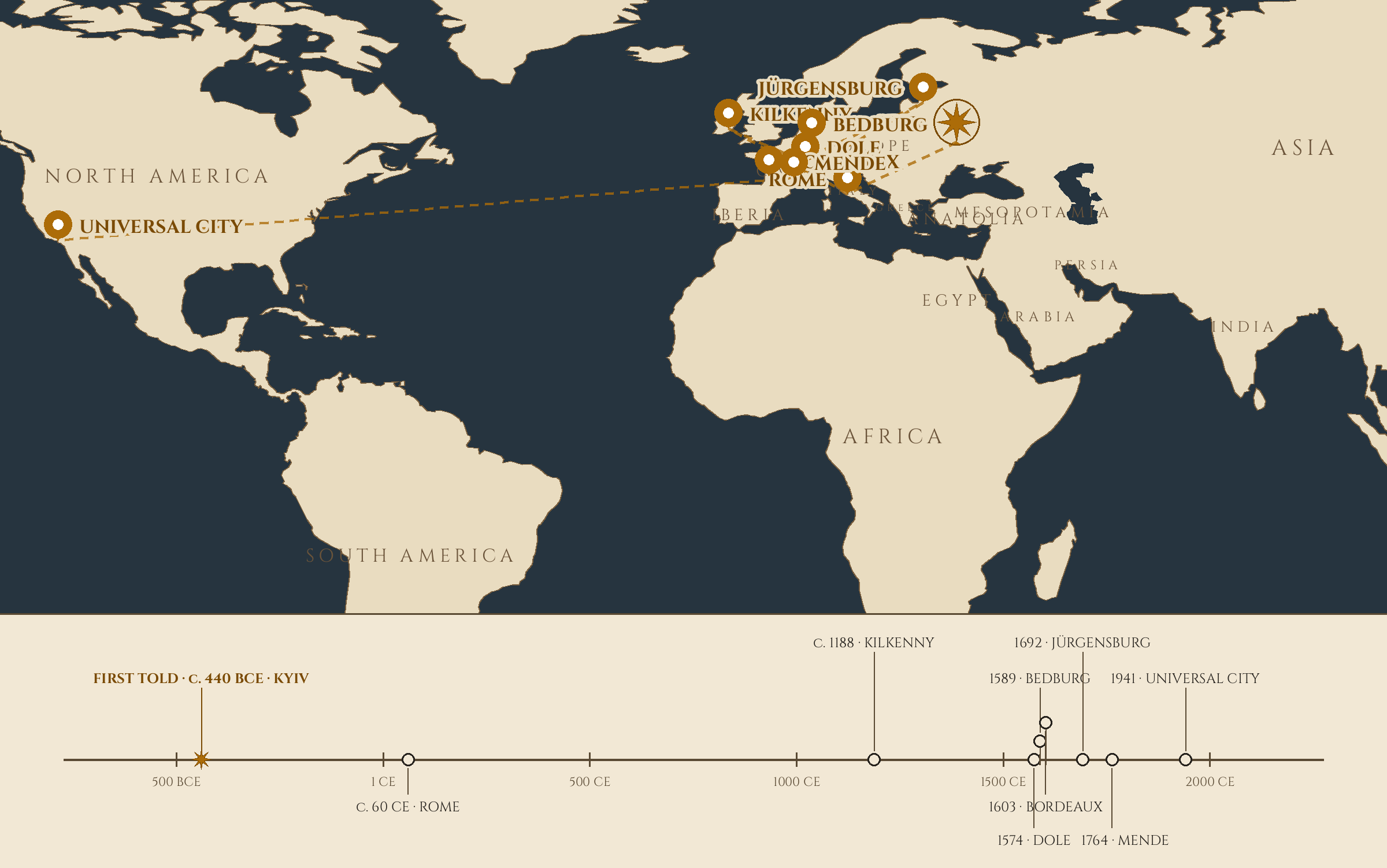
Where this lesson travels: the middle Dnieper (the map labels the pin Kyiv), among the Neuri, where Herodotus set down the first werewolf record about 440 BCE — the pin is approximate, as the map says, for the Neuri's exact land is debated; Rome, about 60 CE, where Petronius set the first full werewolf tale at a dinner table; Kilkenny in Ireland, about 1188, where Gerald of Wales recorded the Werewolves of Ossory; then the trial stops added in the reframe — Dole in France, 1574, where Gilles Garnier was burned; Bedburg in Germany, 1589, where Peter Stumpp was tried and put to death; Bordeaux, 1603, where the court confined the boy Jean Grenier in a monastery instead of killing him; and Jürgensburg in Livonia, 1692, where Thiess of Kaltenbrun was flogged and banished; the country around Mende in France, 1764, where the hunt for the Beast of Gévaudan began; and Universal City, California, 1941, where Universal's The Wolf Man rebuilt the being for the modern world. The starred pin is the first record; the dashed line is the telling, traveling.
Lesson Objectives
By the end of this lesson, you will be able to:
- Say what the word werewolf is built from, and what lycanthropy names.
- Give the first record — who wrote it, roughly when, about whom — and repeat the doubt its own author attached to it.
- Read this lesson's map: six stops from the Dnieper to a Hollywood studio, and say what kind of record each pin stands for.
- Tell the two great tales of the file: the Werewolves of Ossory and the Beast of Gévaudan, each with its dates.
- Explain what a trial record and a pamphlet can and cannot prove, using the Bedburg case of 1589.
- State the Danish cure the collectors recorded, and name the real roots the class sets beside the record.
Your Assignment Packet
This lesson's work lives in its packet: the Lexicon Handout (every term, the core terms marked with the keeper's diamond ◆), Materials, Guided Practice, the Assignment Manual written out whole, the Scholar's Entry Page, the Reflection Questions, the Workbook Checklist, and the Keeper's Notes, for whoever teaches the lesson. Download the packet before you begin and keep it beside you as you read. The packet's assignment is Rookmere's own word for the work: Entry No. 29 — Werewolves (written) ✎. The Unit V Quiz is not printed in the packet; it waits at the end of the unit, with Lesson 33.
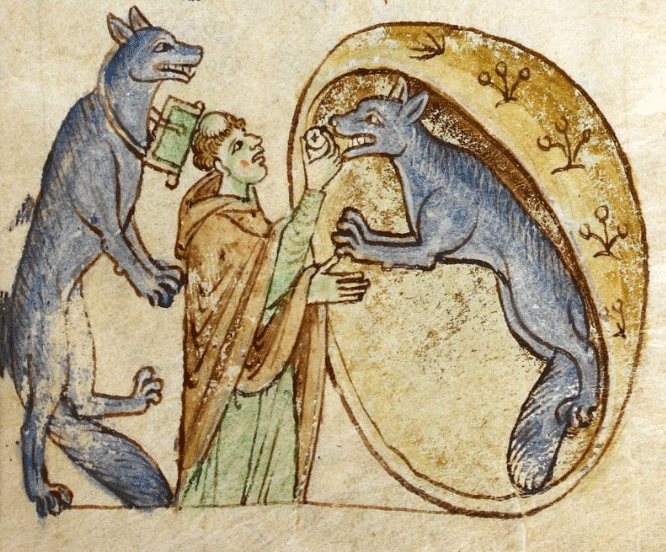
The miniature of the Werewolves of Ossory, in a manuscript of Gerald of Wales's Topographia Hibernica (British Library, Royal MS 13 B VIII, c. 1196–1223): the priest gives the communion wafer to the dying she-wolf, and her mate stands behind her, reared up on his hindquarters like a man at prayer. Public domain, via Wikimedia Commons.
The Creature: The Man-Wolf, and His Pictures
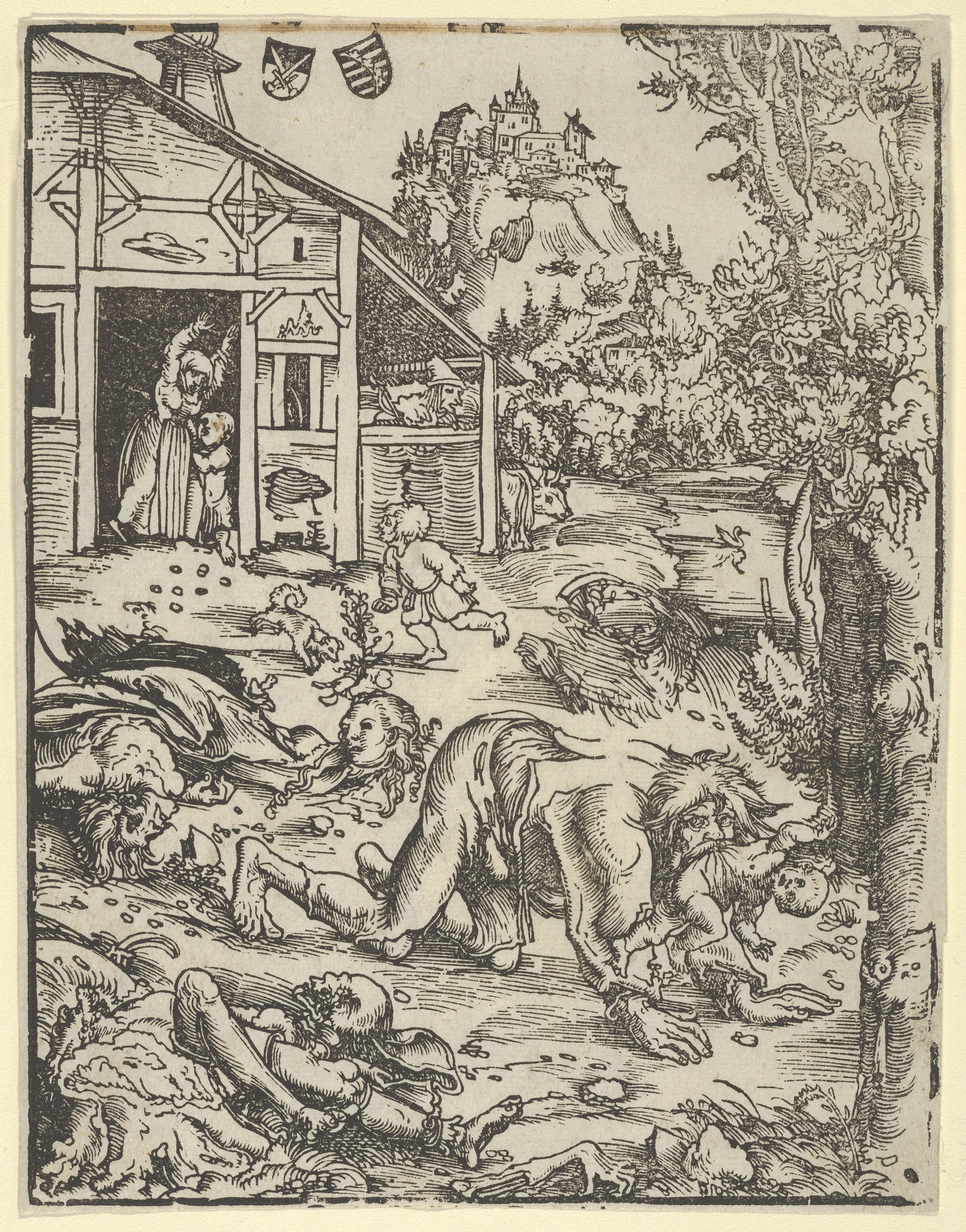
Lucas Cranach the Elder's Werewolf (c. 1512): the wolf-man on all fours with a child in his jaws, the cottage family rushing out too late — the being as the sixteenth century would come to fear him, fixed by print. Public domain, via Wikimedia Commons.
A werewolf is a person who becomes a wolf — or who is believed to become one. The word is plain Old English: wer, a man, and wulf, a wolf. The man is in the word from the start, and he stays in it all the way through the record. Whatever else the tellers do with him, they keep having to reckon with the person inside the shape.
The learned name is lycanthropy, from the Greek lykanthropos, wolf-man. Greek myth had its own wolf-king — Lycaon of Arcadia, changed for his crimes — but the word outgrew the story. It became the general term, first for the belief and much later, in medical writing, for a sickness of the mind in which a person believes the change has happened to them. Keep the two uses apart; this lesson will need both.
One wolf must be filed here precisely because he does not belong in this entry, and a keeper learns as much from a correct exclusion as from a filing. Fenrir — Fenris-Wolf in Snorri Sturluson's Gylfaginning, in the Prose Edda of about 1220 — is not a werewolf at all. He was never a man. He is a wolf born: one of the three children Loki had with the giantess Angrboda, brought up among the gods, who grew so fast, and of whom the prophecies spoke so ill, that the gods resolved to bind him. His set tale is a binding, not a changing. Twice they laid iron fetters on him as a trial of strength — first Lædingr, then Drómi, stronger by half — and twice he snapped them. So the dwarves made Gleipnir: a fetter soft and smooth as a silken ribbon, made of six things that are not to be found in the world — the noise a cat makes in foot-fall, the beard of a woman, the roots of a rock, the sinews of a bear, the breath of a fish, and the spittle of a bird. Fenrir, suspecting cunning in so slender a band, would let it be laid on him only if one of the gods put a hand in his mouth as a pledge of good faith. Týr laid his right hand there. The band held, and tightened the harder the wolf struggled; the gods would not loose him; and Týr lost the hand. There the wolf lies, Snorri says, bound to a rock sunk deep in the earth, until the Weird of the Gods. No transformation, no curse, no skin or belt or ointment — none of this lesson's machinery is anywhere in his file. He is kin to the werewolf by shape only: a god-born wolf, a personage of the gods' own story, named here so that the shape alone never again earns a being a place in this entry.
How does a person become a werewolf, in the record? The answers vary by country and century, and the variation itself is worth filing. Some werewolves are cursed — the change is a sentence, served for a term of years. Some are said to change by craft: a wolf-skin, a belt, an ointment. Some, in the northern tales, are born to it. The old record hardly ever uses the bite. The werewolf who makes more werewolves by wounding is a latecomer, and §6 will show you the studio that installed him.
Now read his pictures, because this being's picture line is nearly as long as his text line — and it starts late. Nobody drew the Neuri's wolf-man: Herodotus and Petronius, in §2 and §3, are words only. The first picture in the file is the hero plate of this lesson, the miniature of the Werewolves of Ossory painted in a manuscript of Gerald of Wales's Topographia Hibernica (British Library, Royal MS 13 B VIII, made around 1196–1223) — some sixteen centuries after the first text. Look at it closely. A priest in a wood gives the communion wafer to a dying she-wolf; her mate stands behind her reared up on his hind legs, front paws raised, in the posture of a man at prayer. The painter has given the wolves almost nothing of the wolf except the shape: the pleading, the attendance, the reverence are human behavior wearing fur. The medieval picture of the werewolf is a parishioner.
Three centuries on, print fixes a different picture. Lucas Cranach the Elder's woodcut Werewolf of about 1512 — the second plate in this lesson — shows the wolf-man on all fours with a child in his jaws, a cottage family rushing out too late. Cranach has set the horror in an ordinary yard, with ordinary people arriving a moment after they were needed. This is the being as the sixteenth century feared him: a predator at the door of a house like your own.
The third plate is new to this lesson, and it is the picture of a trial rather than of a wolf: the composite woodcut of Peter Stumpp's execution in 1589. In its top corner a wolf attacks a child and a man lops off the wolf's left forepaw; the rest of the sheet is the wheel, the beheading, and the burning. Keep the proportions in view: in the trial's own picture, the werewolf takes one corner. The punishment takes the page.
The line closes, for the old record, with the coloured broadsheet of the Beast of Gévaudan (1760s), read in §4. After that the pictures go quiet for the length of the nineteenth century in this class's archive — no lawful nineteenth-century plate was secured — and the being's next great picture is a film, which §6 takes up in words, since a 1941 studio still is not ours to hang.
First Told: The Neuri, c. 440 BCE — and the Map
The starred pin on this lesson's map stands up the river Dnieper, among a people called the Neuri, and the record is a single paragraph of Herodotus, the Greek historian, written around 440 BCE in his Histories (Book IV). Picture him at work, collecting the reports that travelers brought him about the peoples beyond the Greek world. The Neuri, he reports, follow Scythian customs — and then he writes the sentence that opens this file: it is said that once every year each of the Neuri becomes a wolf for a few days, and then returns to his former shape.
Then Herodotus does something a keeper should honor. He adds, in his own voice, that these tales do not convince him — but that the people who tell them swear to them all the same. The first werewolf record in the world arrives with its doubt already attached, signed by the man who filed it. The telling is F: a dated fact about a book. The belief it carries is T, a tale, and Herodotus himself holds the two apart on the page. This class's whole method is older than the class.
The pin is approximate, and the map says so: the Neuri's exact land is debated, and the star marks the region of the middle Dnieper, not a village. From there the record travels. Rome, around 60 CE, where the werewolf becomes a story told at a dinner table. Ireland, around 1188, where he becomes a soul in trouble, asking for the sacrament. Bedburg in Germany, 1589, where he becomes a charge in a court. The country around Mende in France, 1764, where a whole province hunts him as a beast. And Universal City, California, 1941, where a film studio rebuilds him for the modern world. Six pins: a history, a novel, a churchman's travel book, a trial, a hunt, and a film. The dashed line joins them in time order, as always. Look at what it is joining, though. The line runs through documents — books, a court file, a pamphlet, a strip of film. Sightings are what the documents claim. Documents are what we actually have.
The Tales
The Roman stop is Petronius, whose Satyricon (written in the 60s CE) sets the first full werewolf tale in literature at Trimalchio's dinner table, told by a freedman named Niceros. It is a story told the way such stories still are: late, over the remains of a meal, by a man who swears it happened to him. Niceros was walking a night road with a companion, a soldier, "brave as a lion." Among the tombs outside the town the soldier stopped, stripped off his clothes, and before Niceros's eyes became a wolf and ran howling into the woods. The clothes, when Niceros went to pick them up, had turned to stone. That night a wolf raided the flocks of the farm where Niceros was bound, and a servant drove a spear into its neck. In the morning Niceros found his friend in bed, with a doctor dressing a wound — in his neck.
Every later werewolf tale lives in that story's house. The clothes set aside and guarded by a charm. The wolf's wound found on the man. The witness who cannot stop swearing it is true. Notice especially the wound. Petronius invented it, or first wrote it down: the test by which centuries of neighbors would afterwards examine one another. If the wolf was cut, look for the cut on the man.
The Irish stop is the hero plate of this lesson, and it is a stranger and sadder document. Gerald of Wales, traveling in Ireland, recorded in his Topographia Hibernica (around 1188) what a priest told him of the Werewolves of Ossory. The priest, journeying through a wood in Meath, was called out of the dark by a wolf who spoke with a man's voice, begging him to come and give the last rites to his mate, who was dying. He found the she-wolf near death; and when he still hesitated, her mate drew back the skin from her head with his paw, and beneath it was the face of an old woman. The priest gave her the viaticum — the communion given to the dying — and the pair, when the priest reported the matter, were understood to be people of Ossory living under a curse laid on their race by St. Natalis, an abbot of old: two of them, a man and a woman, must every seven years leave their human shape and their country for seven years, and if they live out the term, return, and two others take their place.
The painter of the manuscript miniature at the head of this lesson understood the tale exactly. Look at his picture before you hurry on. The priest holds the communion wafer out to the dying she-wolf, who lies as a patient lies, and her mate stands behind her reared up on his hind legs, front paws raised, in the posture of a man at prayer. The painter has given the wolves almost nothing of the wolf except the shape. Everything that matters in his scene — the pleading, the attendance, the reverence — is human behavior wearing fur. Hold that beside Petronius for a moment. The Roman werewolf is a marvel for a dinner party, told to make the table shiver. The Irish werewolf is a parishioner. The medieval record, at its most characteristic, spends less time asking whether the wolf-shape is real than asking what is owed to the soul inside it.
KEEPER'S CHECK-IN
In Petronius's tale, what test did later centuries take from the story — and what did Niceros find in the morning that seemed to prove it?
Spotted: The Trial Records, and a Beast in the Hills
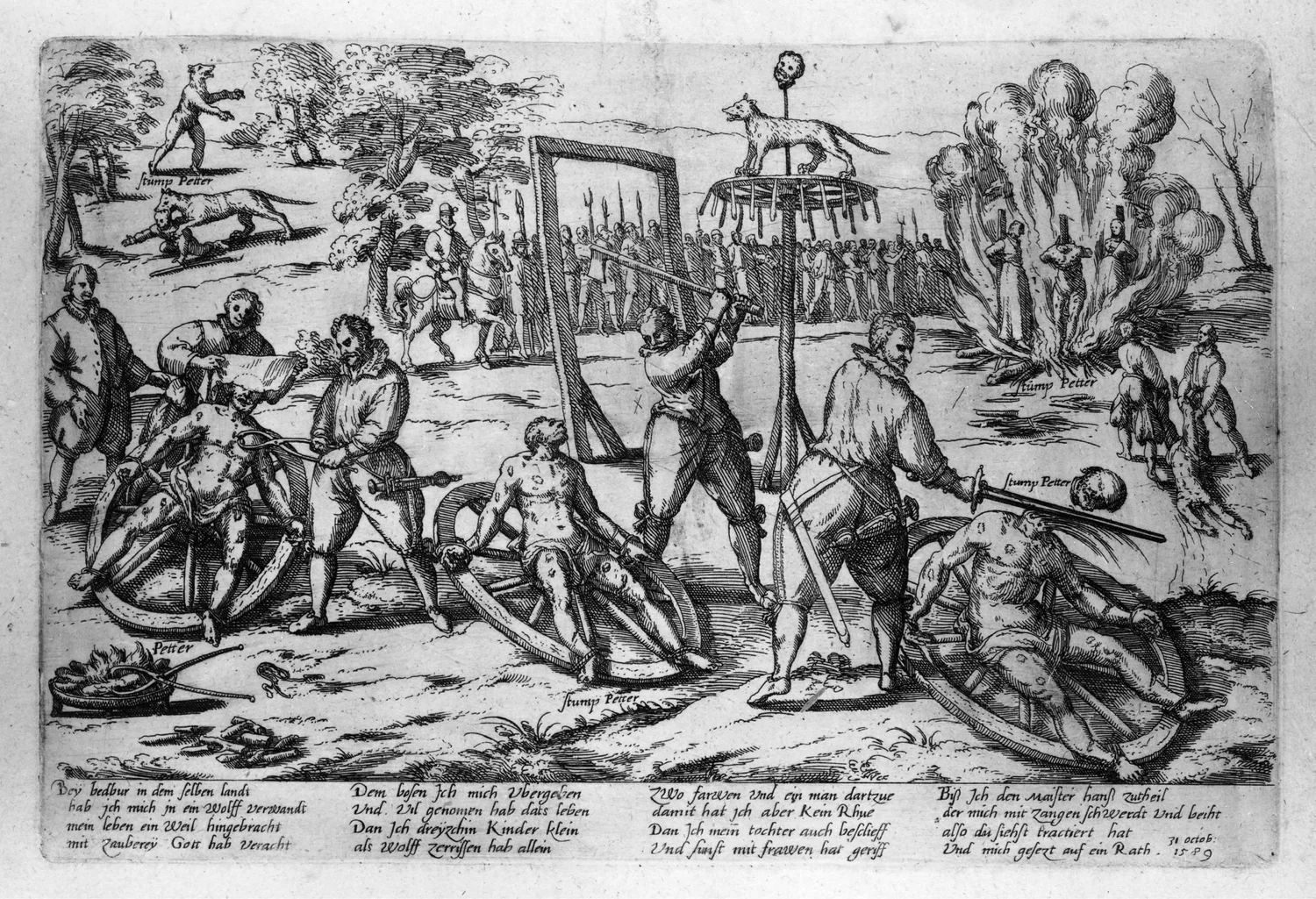
The composite woodcut of Peter Stumpp's execution (1589): in its top corner a wolf attacks a child and a man lops off the wolf's left forepaw; the rest of the sheet is the wheel, the beheading, and the burning. In the trial's own picture, the werewolf takes one corner — the punishment takes the page. Public domain (PD-Art), via Wikimedia Commons.
Read Stumpp's file the keeper's way, in two columns. The record — F — is solid: a man named Peter Stumpp was arrested, tried at Bedburg, and put to death on 31 October 1589, and his case was printed and sold, in German and then in an English pamphlet of 1590 whose title promises "a most true and exact relation." The belief — S, a report of what was said — is everything the pamphlet reports him confessing: that the Devil had given him a girdle of wolf's skin, that wearing it he became a wolf, and that over twenty-five years he had killed and eaten children and livestock. Between the two columns stands the fact the pamphlet does not hide and the keeper must not soften: the confession was taken under testimony conditions no court today would allow — Stumpp was put to the rack, and a confession drawn out by torture tells us what the torturer asked, not what the prisoner did. The pamphlet, for its part, was a commercial object, printed to be bought; horror was its selling point, and its numbers serve its market. So the keeper's verdict on Bedburg is a narrow one, and it should be kept narrow: a trial happened, a man was killed by law, a pamphlet profited — and what Peter Stumpp was, the record cannot now tell us. That narrowness is the method working as it should.
The Bedburg file is the fullest, not the only one. The trial record, kept across two centuries, gives this being a spotted history written by courts, and three more of its stops belong in the entry. At Dole in France, Gilles Garnier, a hermit, was convicted by the Parlement of Dole of killing children as a wolf — his confession, taken under torture, said a spectre had given him an ointment — and he was burned in January 1574; the court's printed judgment survives. At Bordeaux in 1603 the accused was Jean Grenier, about thirteen years old, who confessed to a wolf-skin and salve given him by a "Lord of the Forest"; that court judged the boy not responsible for his acts and sentenced him instead to lifelong confinement in a Franciscan monastery, where he died about 1610 — a court declining, on the record, to kill its werewolf. And at Jürgensburg in Livonia in 1692, Thiess of Kaltenbrun, about eighty, told his judges freely and without torture that he was a werewolf and proud of it: a "hound of God" who went down to Hell three times a year to fight witches and win back the grain they had stolen. The court of 31 October 1692 called it delusion and sentenced him to a flogging and banishment for superstition. Three courts, three endings — burning, confinement, a whipping — and in every file the werewolf is the charge or the confession, never the finding. (The Garnier judgment is printed in Cimber and Danjou's Archives curieuses de l'histoire de France; Thiess's transcript is translated in Ginzburg and Lincoln, Old Thiess, a Livonian Werewolf, 2020.)
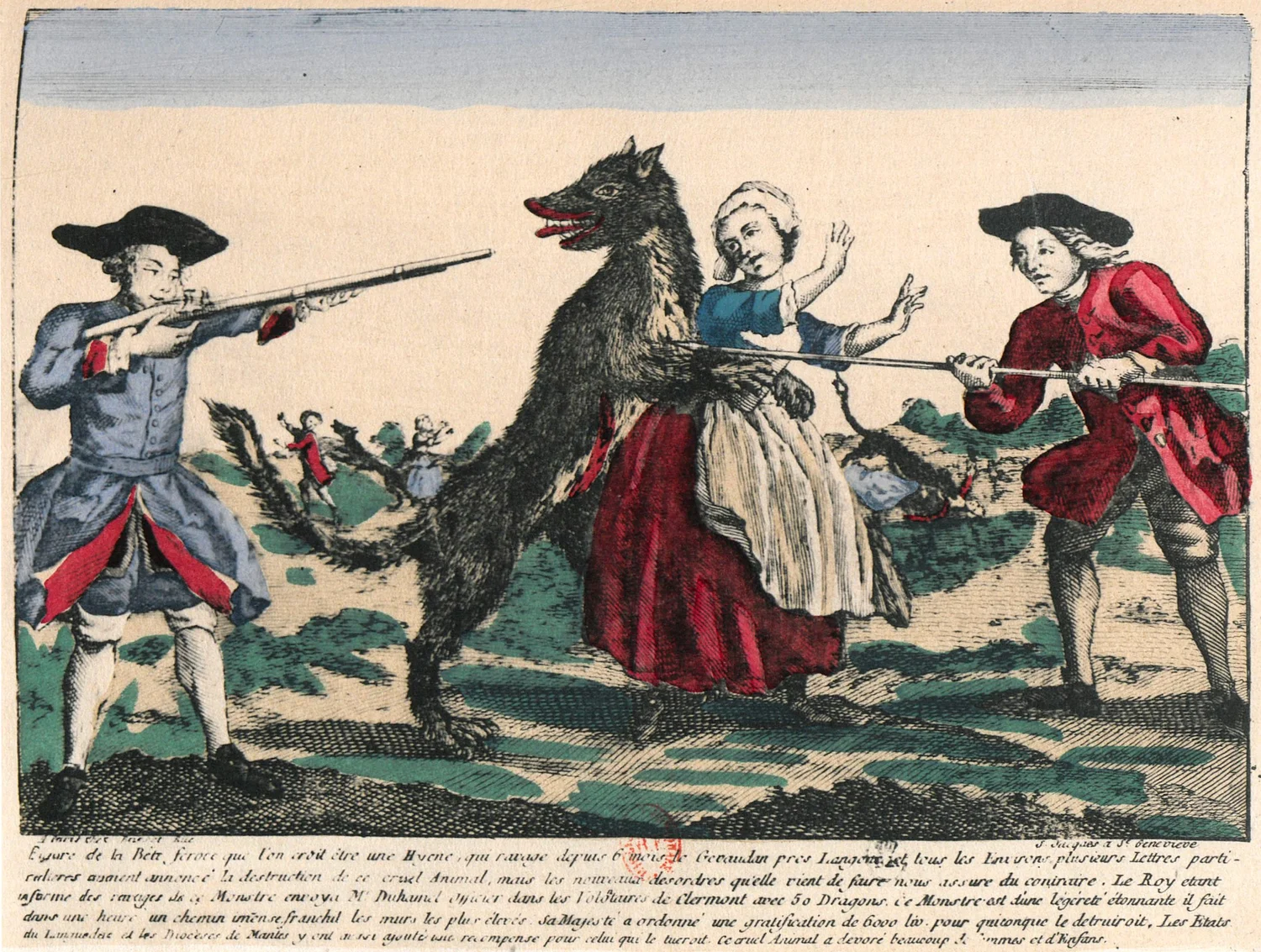
A colored broadsheet of the Beast of Gévaudan seizing a woman while men fire and thrust at it: what the print-shops sold to a frightened countryside while the hunt was happening — the fear, like Stumpp's, was a product. Public domain, via Wikimedia Commons.
The hunt that closes the old record belongs here too, as the century's greatest reported sighting: the Beast of Gévaudan. From 1764 to 1767, in the poor hill country around Mende in southern France, something killed — around a hundred people, by the usual count, most of them women and children working alone in the fields — and the countryside named it simply la Bête, the Beast. The attacks are F, filed in parish registers and official correspondence; the dead were real, and their names survive. What the Beast was is S layered on S — sighting-report upon sighting-report: a giant wolf, a hyena escaped from a menagerie, a man in a beast's skin, a werewolf. The King sent his own gun-bearer; a great wolf was shot in September 1765 and declared the Beast, and the killings went on. A second animal was killed in June 1767 by a local man, Jean Chastel, and the attacks stopped. The colored broadsheet in this lesson shows the Beast seizing a woman while men fire and thrust at it — muskets going off, blades out, everybody arriving at once, which is roughly how the hunt felt to the people living through it. The print-shops sold that picture to a frightened countryside while it was happening. The fear, like Stumpp's, was a product with a price on it.
Later tellings gilded Chastel's shot with a silver bullet blessed at mass. The record does not contain it. Watch for that moment in this file, because the whole history of the werewolf sits inside it in miniature. The document ends. The embroidery begins. If the keeper does not mark the seam where the one stops and the other starts, posterity files them together and quotes the embroidery as evidence.
KEEPER'S CHECK-IN
At Bedburg in 1589, what can the trial record and the pamphlet actually prove happened — and what can they not tell us about Peter Stumpp?
What People Watched For — the Name That Frees
Every box in this class so far has held a defense: a bowl set out, a line sounded, a horse kept off a grave. The werewolf's box holds a defense of another kind. In the Danish tradition gathered by Sabine Baring-Gould in The Book of Were-Wolves (1865), the way to free a werewolf is to name what he is. Baring-Gould tells of a husband who warned his wife only to strike at whatever came at her with her apron; the thing came, she struck, it tore a piece of the apron and fled — and the man came home with the torn cloth in his mouth. She cried out in fright: "Good Lord, man, why, thou art a werewolf!" And he answered: "Thank thee, wife — now I am free." And from that time, the tale says, he was no more afflicted. Baring-Gould states the rule plainly: it is only when another person tells him that he is a werewolf, or reproaches him with being such, that a man can be freed from the ban. In Schleswig and Holstein, he records, the form was stricter: address the werewolf three times by his Christian name, and he is disenchanted.
So what people watched for, in the country of this belief, was not a stranger. It was a neighbor. The defense required knowing the wolf — his name, his household, his human face — which means the community watched one another with the same attention the Gévaudan turned on its hills, and the naming, when it came, was not an accusation but a rescue: the werewolf could not free himself, and the word had to come from someone who knew him. File the rule T, as the tale-tradition of the districts Baring-Gould collected it from. File the collecting F: a named book, a dated page, 1865. The distance between those two marks is exactly where this class lives.
What It Actually Is
Start with the animal, because the file starts there whether it means to or not. The gray wolf is a real and considerable beast. A grown wolf stands about 80 centimeters at the shoulder — knee-to-hip height on most of us — and runs about a meter to a meter and a half from nose to tail. Adults commonly weigh somewhere between 30 and 50 kilograms, and a large northern male can weigh more, up to about 80 kilograms. Wolves live as families: a breeding pair and their young of one or more years, traveling and hunting together, the pups born in a den in spring. They howl to keep in touch across distance and to announce that a territory is occupied, and a wolf's track is roughly a large dog's track, each print about ten centimeters long, running in the straight, economical lines of an animal that covers ground for a living. Sheep and cattle are easy prey compared with deer, and wolves have always taken livestock where the two were left together. Attacks on people are rare, and modern studies find that a share of the historical attacks involved rabid animals. Rare will still fill a file, though, across a thousand winters and a continent of villages that kept their herds in wolf country.
So the root of this file is not hidden. Wolves were the standing danger of European country life for most of the record's life — to sheep and cattle constantly, and to people, in hard winters and broken country, often enough that the fear needs no curse to explain it. Baring-Gould noticed the negative proof himself: English folklore, he wrote, is singularly barren of werewolf stories, because wolves had been wiped out in England early. Where the animal went, the being thinned. Where the animal stayed — France, Germany, the northern and eastern forests — the file grew thick.
Against that ground, set the file's three human machines. First, the charge: once a court will prosecute "werewolf," and will torture, the court will be supplied with werewolves, confessing in the shape of the questions. Second, the press: pamphlet and broadsheet turned each case into a saleable wonder, and wonders outsell acquittals. Third, the mind itself: clinical lycanthropy is a real, rare diagnosis in modern psychiatry — a fixed belief, in a person suffering other illness, that one has become or is becoming an animal. It explains some first-person testimony in the record, perhaps including some of what the courts heard. It explains no wolves. And rabies — the disease that makes animals foam, wander, and bite — has often been proposed as a seed for the whole tradition; a keeper files it as proposed, not proven, and notes that the transformation at the file's heart is the one thing rabies cannot carry.
The sober sum: real wolves, real deaths, real courts, real print — and fear doing the joinery between them.
Still With Us
The werewolf the modern world knows was built, mostly at one address: Universal City, California, where Universal Pictures released The Wolf Man in 1941. The film's writer, Curt Siodmak, assembled the being the way a compiler builds a bestiary entry — from older parts — and then added the fittings now mistaken for folklore: the change compelled by the full moon, the silver bullet as the certain cure, the pentagram appearing in the palm of the next victim, the little verse ("Even a man who is pure in heart…") that audiences now quote as an old rhyme. It is a rhyme of 1941, written for the film. The bite that transmits the curse, the center of a thousand later films, is likewise largely the cinema's contribution; the old record's werewolf was cursed, equipped, or born — seldom contagious.
One more modern placement, the oldest of all. The werewolf also stands in the sky. Lupus, the Wolf, is a constellation of the southern heavens, catalogued by Ptolemy, lying beside Centaurus, the Centaur; in the Greek star-picture the beast was held out in the Centaur's hand, an offering or a quarry. When you reach the constellation lessons elsewhere in this school, the keeper's point will already be familiar: the wolf was set among the stars as the Centaur's burden — the man-shape and the wolf-shape fixed together in the oldest map there is.
And the file is not closed. Courts no longer prosecute the charge, but clinical lycanthropy still appears in the medical journals, and every few years a frightened district somewhere renames its beast. Each new century re-files the werewolf under its own paperwork. The fear underneath it has kept the same shape since Herodotus.
Guided Observation
Look at the hero plate slowly: the miniature of the Werewolves of Ossory, painted in a manuscript of Gerald's Topographia Hibernica (British Library, Royal MS 13 B VIII, made around 1196–1223). A priest in the wood gives the communion wafer to the dying she-wolf; her mate stands behind her, reared up on his hindquarters like a man. What has the painter given the wolves that wolves do not have — posture, gesture, a place at a rite? What has he given the priest that the tale's frightened man might not have had, and why does the picture put the sacrament, and not the transformation, at its center? Then set the plate beside Cranach's woodcut of about 1512 — the same being, three centuries on, all jaws and errand. Write down two things the miniature tells you that Gerald's words do not, and one thing the words tell you that no picture in this lesson can. This is how a keeper reads a plate: as a record of what its century needed the being to be.
Assignment Manual
✎ WRITTEN · ⚒ HANDS-ON · ◐ BOTH
✎ Written · Entry No. 29: Werewolves.
- Rule your entry page. Turn to the Scholar's Entry Page in this lesson's packet and rule a page of your journal to match it.
- Write the werewolf's entry, to the standard. The Creature: what werewolf and lycanthropy name, and the depiction line read — Ossory, Cranach, the Stumpp woodcut, the broadsheet. First Told: Herodotus on the Neuri — his place, his rough date, and the doubt he attached, in his substance. The Tales: Petronius's tale and the wound-test it set; Gerald's Ossory account told whole; Gévaudan, with its dates. Spotted: Bedburg 1589 in two columns, and one more trial — Garnier, Grenier, or Thiess — with its ending. What It Actually Is: three lines — the real wolves, the courts and the press, the mind's own share. Still With Us: the 1941 codification in two or three lines, and the wolf among the stars. The Keeper's Line: your own judgment, in a line or two.
- Try the naming box. In your entry, write out Baring- Gould's Danish rule as the collectors give it, marked T, and beneath it the collecting itself, marked F. One custom, two marks.
- Mark every line. Go back through the entry with the keeper's marks: T for a tale, S for a sighting-report, F for a fact. Take special care at Bedburg: the trial, the date, and the pamphlet are F; everything Stumpp is reported to have confessed is S — what a pamphlet says a tortured man said — file it exactly that way, no shorter.
- File the seam. Underline, in your Gévaudan paragraph, the one detail the later telling added (the silver bullet), and write in the margin: not in the record. Keepers mark seams.
The printable packet for this lesson — the Lexicon Handout, the Guided Practice, this manual, and the Scholar's Entry Page — is linked on this page.
Materials
· Your bestiary journal or notebook — kept for the whole class
· Pencils, and a pen you like writing with
· A ruler, for ruling your entry pages
· The lesson page, for the map and the plates
· This packet
Reflection
Herodotus printed what he did not believe, and said so in the same breath. What does a keeper owe a story they doubt — and what would the file lose if he had simply left the Neuri out?
The Bedburg court asked its question with torture and received the answer torture gives. What question should it have asked instead — and who in the record asks the better question?
The Danish cure had to be spoken by someone who knew the werewolf's name. What does that tell you about whom the old record feared — and whom it pitied?
A Closing Note
You have read the unit's fullest file, and its hardest: a being who is, in every century, somebody's neighbor. Keep the two columns of Bedburg in mind as we go on — the record of what was done, and the belief of what was feared — because the next lesson turns entirely on the difference. At Kisiljevo and Medvedja the being does not run on four feet at all. He lies in a grave, in an inspected, measured, signed-for grave, and the whole file is paperwork: reports, commissions, signatures. The tale becomes a document. Bring your sharpest pencil; we are going to read the paperwork line by line.
The Bestiary
Bestiary Keeper
Further Reading & Sources
Herodotus, Histories, Book IV (§105) — the Neuri; any standard translation.
Petronius, Satyricon (§§61–62) — Niceros's tale, the first full werewolf story in literature.
Gerald of Wales, Topographia Hibernica — the Werewolves of Ossory.
Sabine Baring-Gould, The Book of Were-Wolves (Smith, Elder & Co., 1865) — the collectors' volume for this lesson's naming custom; free at Project Gutenberg.
"A most true and exact relation of a most cruel and bloody murder committed by Peter Stump" (London, 1590) — the Stumpp pamphlet in English; read as evidence of the pamphlet trade.
Jay M. Smith, Monsters of the Gévaudan: The Making of a Beast (Harvard University Press, 2011).
Submit your work for this lesson using the form below.
CONTINUE IN THE BESTIARY HALL
← Previous · Lesson 28: Winged Peoples Next · Lesson 30: The Vampire of Record →
Unit V — The Changed The Bestiary Hall — All 41 Lessons
The rest of Unit V: Lesson 30 · The Vampire of Record · Lesson 31 · The Vampire in Print · Lesson 32 · Ghouls · Lesson 33 · The Zombie