

THE BESTIARY
Unit V · Lesson 30The Vampire of Record
Professor Sable Rookmere
Bestiary Keeper
The Bestiary Hall • School of Evershade
Professor's Introduction

The werewolf left footprints, tales, and a trial. The being of this lesson left something rarer: a file. In two villages on the Habsburg military frontier, in 1725 and again in 1731, the dead were accused through official channels — investigated by imperial officials, examined by army surgeons, and reported on, over signatures, to Vienna. I have read a great many strange documents in my years on this shelf, and I keep coming back to these, because everything about them is ordinary except the thing they describe. The vampire of this lesson is not the one in the novels; the next lesson takes up that creature. This one comes with paperwork, and the paperwork is the lesson: who signed it, what they wrote, what they could not have known, and what a keeper does with an official record of an impossible thing.
Read it soberly. The people in these reports — the dying villagers, the surgeons with their probes, the dead in the opened graves — were not characters. They were neighbors in a hard winter, doing the best diligence they knew how to do. The keeper's respect is part of the evidence.
The Bestiary
Bestiary Keeper
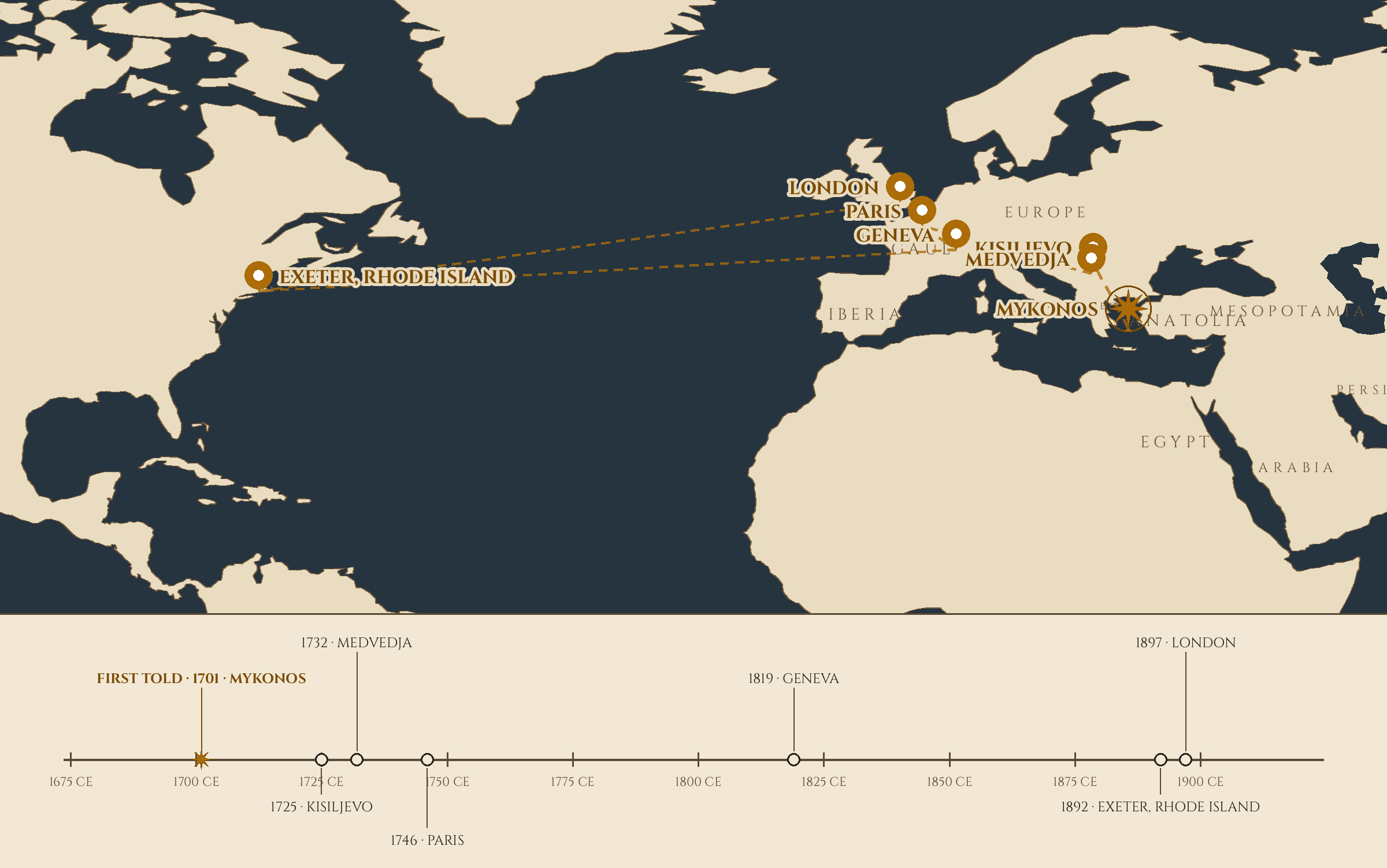
Where this lesson travels: Mykonos, 1701 — the starred pin, moved here in the reframe — where Joseph Pitton de Tournefort watched an island exhume a murdered peasant blamed for walking at night, the eyewitness account he printed in 1717; Kisiljevo, on the Habsburg military frontier in what is now Serbia, where Peter Plogojowitz died in 1725 and Frombald's report opened the first official investigation; Medvedja, likewise on the frontier, where the commission of surgeons signed the Visum et Repertum in January 1732; Paris, where Dom Calmet gathered both cases into his Dissertations of 1746 and the vampire passed from administration into European debate; and Exeter, Rhode Island, 1892, where Mercy Brown's exhumation repeated the frontier procedure a hundred and sixty years on. Two further pins on this shared sheet — Geneva, 1819, and London, 1897 — belong to the next lesson, where print rebuilds him. The starred pin is the first telling; the dashed line is the telling, traveling.
Lesson Objectives
By the end of this lesson, you will be able to:
- Say where the word vampir comes from, and how it traveled into European print.
- Tell the Kisiljevo case of 1725: who died, who investigated, what the report says was found, and what was done.
- Tell the Paole case in its two acts (1727 and 1731–32), and name the signed document that closes it.
- Explain what a commission's report can and cannot establish, and how Calmet handled the same evidence in 1746.
- Describe the watch kept at the wake, with its named sources, and say what custom the belief produced.
- Set out, without mockery, what an exhumed body actually does — the real root of the record's central finding.
- Name the vampire's classical ancestors — the strix and the lamia — with a dated text for each, and say how each differs from the vampire of record.
Your Assignment Packet
This lesson's work lives in its packet: the Lexicon Handout (every term, the core terms marked with the keeper's diamond ◆), Materials, Guided Practice, the Assignment Manual written out whole, the Scholar's Entry Page, the Reflection Questions, the Workbook Checklist, and the Keeper's Notes, for whoever teaches the lesson. Download the packet before you begin and keep it beside you as you read. The packet's assignment is Rookmere's own word for the work: Entry No. 30 — The Vampire of Record (written) ✎. The Unit V Quiz is not printed in the packet; it waits at the end of the unit, with Lesson 33.
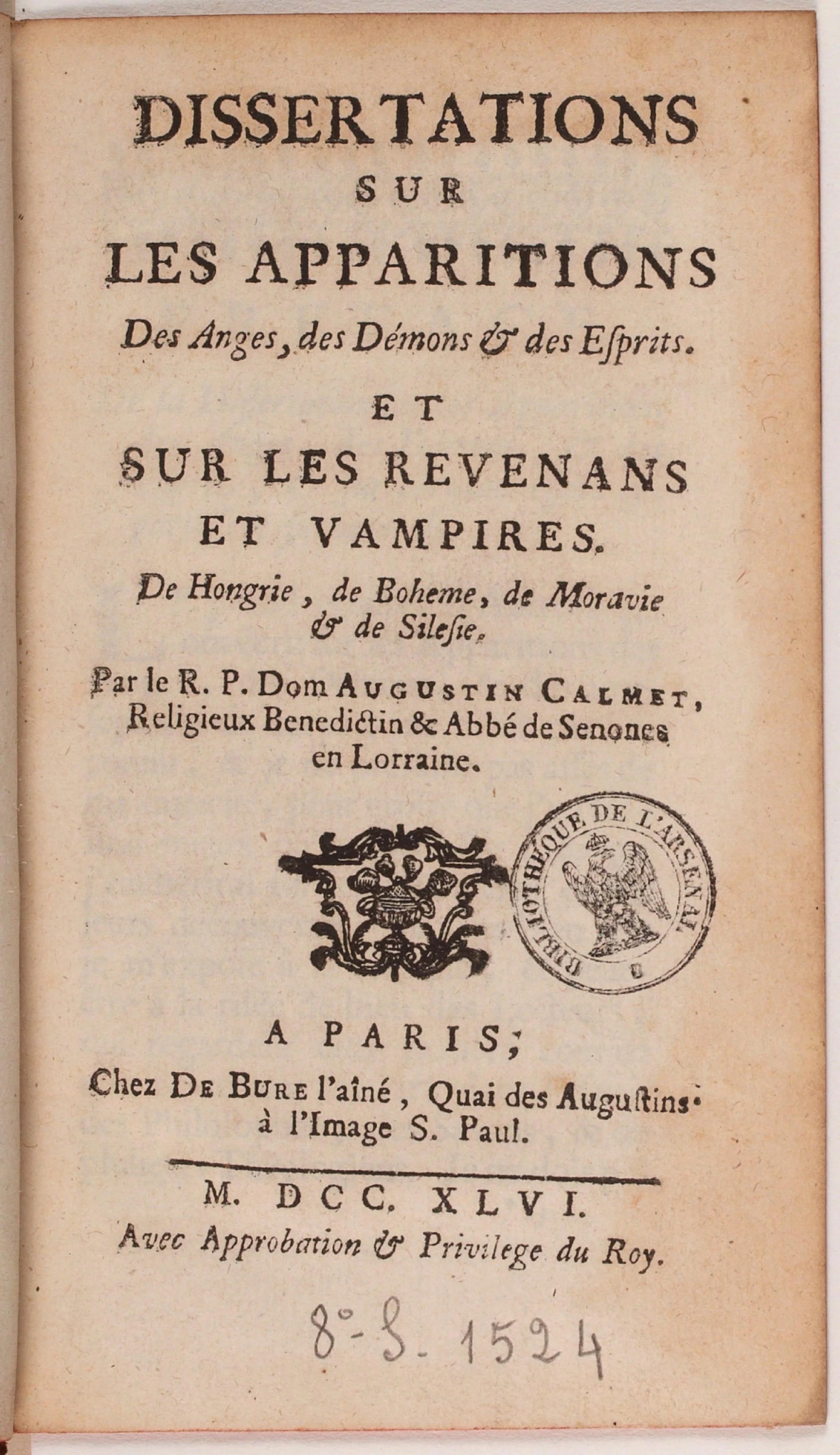
The title page of Dom Augustin Calmet's Dissertations sur les apparitions… et sur les revenans et vampires (Paris, 1746): the long title names the frontier geography of the reports — Hungary, Bohemia, Moravia, Silesia — from a scholar in Paris who never left his abbey for the frontier. Public domain, via Wikimedia Commons.
The Creature: The Dead Who Do Not Rest, and a Picture That Does Not Exist
The being of this lesson is the dead person who does not rest: buried, then blamed — for sickness in the house, for deaths among kin and livestock, for a presence felt at night — and found, when the grave is opened, not decayed as a corpse should be, but whole, ruddy, and (the reports say) full of fresh blood. The next lesson will meet the vampire of literature. This lesson's being is earlier and narrower: the vampire of record, the one who exists because officials wrote him down.
His name is the first exhibit. Vampir is a Serbian word — the villages of this lesson spoke Serbian, and their word for the being their grandparents feared was already old when the officials arrived. It traveled west not in a storybook but in administrative German: the reports of 1725 and 1732 were copied and argued over in the newspapers of Vienna, Leipzig, London, and Paris, and the word rode with them. Within a decade a village word from the frontier had become a European keyword. You can watch this name cross the map in dated print, issue by issue, which is more than most beings on our shelf can show. The crossing was the record — the map of this lesson has only three pins, and one of them is a book.
A word on the ground itself, because the record cannot be read without it. Kisiljevo and Medvedja were villages of the Military Frontier, the Habsburg Empire's border belt against the Ottomans, settled by soldier-farmers and administered from Vienna. That is why there is paperwork at all. When a frontier village reported that its dead were killing, it did not hire an exorcist; it petitioned an administration — and the administration, in the person of district officers and regimental surgeons, came, looked, and filed. The file is an artifact of empire as much as of belief.
One picture question must be answered before anything else, because students always ask it: what did this vampire look like? The honest answer is that nobody drew him. The folk vampire — the Serbian and Greek revenant of belief — has no picture line at all. No medieval artist drew him, no early-modern print-shop sold him; the reports describe a buried neighbor, swollen and ruddy in his grave, and description is all the record ever gives. The drawn vampire is the literary one, and he does not arrive until the next lesson, a century later. What this lesson can hang is the paperwork and its first great reader: the two plates at the head of the lesson are the title page and Preface of Calmet's treatise of 1746, read in §6 and the Guided Observation. They are pictures of the debate about the being. The being himself was never pictured by the people who feared him, and the entry should say so plainly: for the vampire of record, the empty picture-frame is a fact.
The Wider Family — The Ancestors: Two Beings Older Than the File
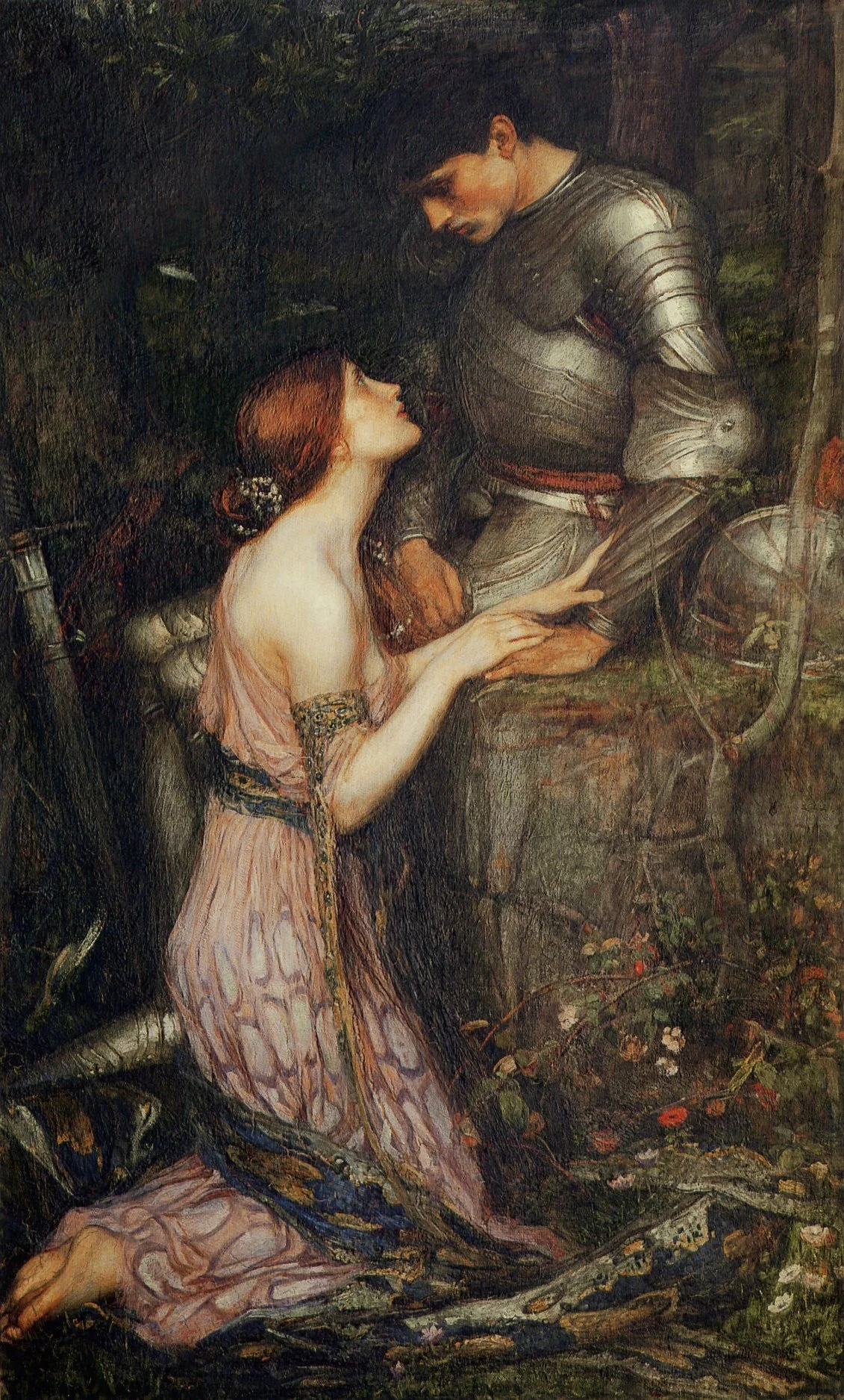
John William Waterhouse's Lamia and the Soldier (1905), painted from Keats's poem Lamia (1820): Lamia kneeling before her Lycius, the shed snakeskin still at her arm and waist — the classical lamia given a face by print at last, down the chain Philostratus, Burton (1621), Keats, Waterhouse. Public domain (PD-Art), via Wikimedia Commons.
The file of 1725 did not invent its fear, and a keeper who files only the file will misunderstand it. Long before any Serbian village had a word an empire could copy, the classical world kept two night beings of its own who fed on the living — one at the cradle, one at the marriage bed. Neither is a vampire. Neither ever lay in a grave, rose from one, or was investigated by anyone. But the shape of the fear is already complete in them, more than a thousand years before Kisiljevo: something comes in the night to the most defenseless person in the house, and takes blood, or flesh, or both. They are filed here, before the record opens, as what they are — the vampire's classical ancestry, known the way this lesson knows everything: by dated texts, read in order.
### The Strix — The Screech-Owl at the Cradle The strix (plural striges) takes her name from the Greek word for a screech-owl, and Ovid gives the reason himself: they are called screech-owls for the horrible screeching they make at night. His account, in Book 6 of the Fasti (published in AD 8), is the only thorough description of the being in all classical literature, and it deserves to be read as the set text it is. Their heads are large, their eyes stick out, their beaks are fit for tearing, their feathers grey, their claws hooked. They fly by night and attack children whose nurses are absent, snatching them from the cradle; they are said to rend the flesh of infants with their beaks, their throats full of the blood they drink, and to suck at the infant's chest with greedy tongues.
The tale inside the description is the attack on Proca, a prince of Alba Longa, the city that stood before Rome. The striges came to his cradle when he was five days old. His nurse, running to his cry, found his cheeks slashed by their sharp claws and his face the colour of late leaves nipped by an early frost. The goddess Carna saved him, and Ovid gives her rite in full: she touched the doorposts three times with arbutus leaves and marked the threshold, sprinkled the entrance with water, and held out the entrails of a two-month-old sow with the words a keeper should hear plainly — "Birds of night, spare his entrails: a small victim is offered here for a small child. Take a heart for a heart, I beg, flesh for flesh." A whitethorn rod, Janus's gift, was set where the little window let in light. After that, the birds avoided the cradle, and the boy recovered his colour. The episode even carries its own custom, as this class likes a custom to be carried: Ovid closes it by explaining why Romans ate bacon and beans together on the Kalends of June.
Mark what Ovid does next, because it is this lesson's own posture wearing classical dress. He does not decide what the striges are. Whether they are born as birds, he writes, or made so by spells — old women transformed to birds by Marsian magic — he leaves both standings open and answers neither. It is Calmet's suspension, seventeen centuries early, in verse.
The rest of the record is shorter, and a keeper files it short. The first Latin mention is a joke: in Plautus's comedy Pseudolus (191 BC), a bad cook's cooking is compared to the striges devouring the diners' innards while they still live — which tells us the audience of 191 BC already knew the striges as man-eaters, two centuries before Ovid described them. Pliny the Elder, in his Natural History (completed AD 77), gives the being not a description but a dismissal: the tale that the screech-owl ejects milk from its teats onto the lips of infants he looks upon, in his own words, as utterly fabulous; the name strix, he notes, was used of old in maledictions, as a curse — and what bird is actually meant, he says, cannot be determined. Petronius, in the Satyricon (late first century AD), has Trimalchio tell of striges who snatched away the body of a boy already dead and left a straw doll in its place. And by the time of Sextus Pompeius Festus (late second century AD), the word has slipped its feathers entirely: he glosses striges as women who practice witchcraft. Isidore of Seville still carries the being in his Etymologiae (Book 12) in the seventh century, and with that the strix passes into the Middle Ages — a word looking for its next body.
It found several, and the family resemblance is in the names. From Latin striga come the Italian strega, a witch; the Albanian shtriga, a hag who drinks the blood of sleeping children; the Polish strzyga; and, in the very country this lesson's wake watch comes from, the Romanian strigoi — to this day the Romanian word for the vampire kind. The screech-owl's name crossed two thousand years and landed, at last, on the grave-revenant himself. F for every text in this section, each dated and placed. T for the being at the cradle, held by parents who had every reason to fear the night.
Her real root can be stated briefly, because it is brief. Real owls — the screech-owls among them — cry harshly in the dark, fly without sound, and hunt around the barns and houses where infants slept. The ancient world buried a great many of its babies, and a death that came silently in the night, to a child who had seemed well at evening, wanted a name and a shape. The strix is the shape Rome gave it: a bird, because the night already had wings; a blood-drinker, because the loss felt taken, not given. Pliny's doubt is part of the root too — the record contains its own skeptic from the first century, which is another way of saying the fear was never only ignorance. It was grief, doing its work with the materials at hand.
### The Lamia — The Queen, the Bogey, and the Bride of Corinth The second ancestor begins as one woman. Lamia, in the Greek telling, was a beautiful queen of Libya who bore children to Zeus; Hera, in jealousy, robbed her of them — the versions differ on whether they were hidden, killed, or destroyed by their own mother's forced hand — and the loss drove Lamia out of her mind. In her grief she began snatching and devouring the children of others, and her anguish, or her cannibalism, made her monstrous. Read the root inside the myth before going further: this is a bereaved mother turned, by the telling, into the thing bereaved mothers most feared. The lamia is grief wearing the mask of its own worst night.
The dated record runs as follows. The historian Diodorus Siculus, in the first century BC (Library of History, Book 20), already treats her as history to be explained rather than a tale to be believed: his Lamia is a real Libyan queen, born in a cave, who ordered her soldiers to snatch children from their mothers and kill them, and whose beauty curdled into a bestial face through her savagery — and Diodorus also records the use every Greek nursery knew, the lamia invoked by mothers and nurses to frighten children into behaving. Horace, in the Ars Poetica (about 19 BC), reaches for her as the example every reader would know: a play, he warns, must not ask us to believe just anything — it must not draw a live boy out of a lamia's belly on stage. The warning only works because the tale behind it was common property: the lamia who swallowed a child whole, and the child, in the nurse's version, who might yet be got back alive. By Horace's lifetime she is no longer only a queen. She is becoming a class — lamiai, in the plural — the bogey of the nursery and a name for any night-haunting female phantom.
Then the class produced the tale that makes her this lesson's business. Philostratus, in his Life of Apollonius of Tyana (Book 4, chapter 25; written in the early third century AD, of events set in the first), tells of the lamia of Corinth, and it is the closest classical kin the later vampire bride will ever have. Menippus of Lycia, a young philosopher of twenty-five, handsome as an athlete, met on the road to Cenchreae a beautiful foreign woman — a Phoenician, she said, rich, and long in love with him — and became her constant visitor. The sage Apollonius looked the youth over as a sculptor looks at a statue and told him: you are cherishing a serpent, and a serpent cherishes you. At the wedding breakfast, before the assembled guests, Apollonius asked to whom the gold and silver and the fine furnishings of the hall belonged — to the lady, Menippus answered; all he had of his own was his philosopher's cloak. "Have you heard of the gardens of Tantalus," Apollonius said, "how they exist and yet do not exist? As such you must regard this adornment, for it is not reality but the semblance of reality. And that you may realize the truth of what I say, this fine bride is one of the vampires — that is to say, of those beings whom the many regard as lamias." The word vampires there is the 1912 translator F. C. Conybeare's own, set down for Philostratus's empousai; a keeper files the translation as translation, and the Greek beneath it as the record. What the phantom confessed, when the goblets of gold proved as light as air and the servants vanished at the sage's rebuke, needs no translator's help: she admitted she was fattening Menippus up with pleasures before devouring his body, for it was her habit to feed on young and beautiful bodies, because their blood was pure and strong. Set that confession beside everything Lesson 31 will show you — the foreign bride, the splendid illusory house, the wedding that is a feeding arranged in advance — and the ancestry stops being a metaphor. Carmilla and the Count's brides have a grandmother, and she was unmasked at a wedding breakfast in Corinth some sixteen centuries before Stoker wrote.
The word kept travelling after Corinth. Apuleius, in The Golden Ass (second century AD), calls his Thessalian witches Meroe and Panthia lamiae in passing — and those witches, raiding the bed of the man Meroe had seduced, cut his throat and caught his blood in a skin: human witches, doing with a knife what the phantom did by nature, under the lamia's name. In the early Middle Ages the name becomes a glossator's term for a whole class of beings: Hesychius of Alexandria's lexicon (about AD 500) explains lamiai as apparitions; the Latin Vulgate Bible uses lamia in Isaiah 34:14 where the Hebrew had named Lilith; Pope Gregory I (died 604) reads the lamia in his commentary on Job as a figure of heresy or hypocrisy; Isidore of Seville defines lamiae as beings that snatch babies and tear them apart; and Hincmar, archbishop of Reims, in a ninth-century treatise on divorce, lists lamiae among the supernatural dangers that threaten marriages — the Corinth bride, still at work in canon law's century, filed now as a risk to husbands. One name, three trades across a thousand years: the devourer of other women's children, the seducer who fattens a bridegroom for the table, and the witch who takes blood by hand. She was never buried and never rose. She did not need to. She was invited in.
Her print afterlife belongs, in strictness, to the next lesson's century, but the chain is short enough to file here where the record is open. Robert Burton retold the Corinth tale in The Anatomy of Melancholy (1621), in what is nearly a direct translation of Philostratus; John Keats found it in Burton and made of it his poem Lamia, written in the summer of 1819 and published in 1820 — the very season in which Lesson 31's vampire enters print. This lesson hangs one picture of her, and it comes from that afterlife: John William Waterhouse's Lamia and the Soldier (1905), painted from Keats's poem — Lamia kneeling before her Lycius, the shed snakeskin still at her arm and waist. The classical world, which described the strix in full, left the lamia almost no picture at all. Print gave her a face at last, as print would give the vampire his. F for the texts and the painting, each dated. T for the queen, the bogey, and the bride.
Her real root, briefly, is three ordinary things wearing one name. A story of maternal grief so complete it turns outward — the myth says so itself. A nursery's working tool: Diodorus attests the lamia used, in plain terms, to frighten children into obedience, and a bogey that can be named at bedtime is a guardian of sorts, however rough. And a standing fear of the beautiful stranger — the foreign bride whose wealth is semblance and whose love is appetite — which Greek Corinth told as a phantom, and which had not stopped being told when Hincmar filed it against marriages nine centuries later. Note, before you close the section, the precise shape of her kinship to this unit's being. The lamia is a flesh-devourer first; the blood in her record is the reason she chooses the young and strong, in Philostratus, and a thing taken by hand, in Apuleius. She is the vampire's ancestor not because she kept his customs but because she kept his situation — the night visit, the trusted face, the household opened from inside — and situations, on this shelf, are inherited more faithfully than rules.
### Two Shorter Filings — The Upyr and the Ekimmu Two further members of the family earn a named paragraph each, and no more; a keeper gives a thin file a thin filing, and says so. East of the classical ancestors, the Slavic record keeps this lesson's own word-family under an older spelling. The upyr — Old East Slavic upir' — is the earliest recorded form of the word-family that later gives Serbian vampir, and its forms run across the Slavic languages: Russian upyr', Ukrainian upyr, Czech and Slovak upír. Its first recorded use is a paper oddity, and it should be filed exactly. In a manuscript dated 1047, a priest who had transcribed the book from Glagolitic into Cyrillic for the Novgorodian prince Volodymyr Yaroslavovych signed his colophon with the name Upir' Likhyi — "Wicked Upyr," or "Foul Upyr." That is a man's nickname standing in a scribe's signature: not a case, not a sighting, not a grave opened. The word caught being used is not the being caught being seen, and the entry keeps the two apart. The word's next early appearance is as a thing worshipped: the anti-pagan treatise called the Word of Saint Grigoriy, dated variously to the eleventh to thirteenth centuries, reports pagan worship of upyri and condemns it. A signature and a rebuke — that is the upyr's whole early file, and it is enough for the naming: seven centuries before Kisiljevo, the word that would name this lesson's being was already old enough to sign a book and to be preached against.
Older than any of them — older, on paper, than the strix — is Mesopotamia's filing. The ekimmu, in the Akkadian incantation texts R. Campbell Thompson translated as The Devils and Evil Spirits of Babylonia (1903), is the departed spirit that cannot rest: the ghost of a person left unburied, prowling the earth while its body lies above ground, or of a dead person whom nobody cares for. In the Fourth Tablet of Thompson's "Evil Spirits" series the exorcist addresses it in a list, as keepers of lists will recognise: "Whether thou art a ghost unburied, or a ghost that none careth for, or a ghost with none to make offerings to it." Thompson's account gives the mechanism in plain words. The dead lived on the offerings and libations their descendants paid them; when those attentions ceased and the spirit was forgotten, hunger and thirst drove it out of the underworld to seek on earth the food and water that no longer reached it, and, roaming up and down, it fastened on the luckless living — plaguing and tormenting them until a priest drove it away with exorcisms. The Epic of Gilgamesh, in the lines Thompson quotes, gives the uncared-for ghost its diet: "the dregs of the vessel, the leavings of the feast, and that which is cast out into the street are his food." No blood-drinking stands in this file, and a keeper does not add it. What stands here, long before Medvedja, is the family's oldest shape: the dead who do not rest because the living did not do their part — burial, offerings, remembrance — returning to the living to collect the debt. One paragraph is what its surviving record supports, and one paragraph is what it gets.
First Told: Kisiljevo, 1725 — and the Map
The revenant had been told of in print before Kisiljevo, and the entry should carry the earlier telling honestly. The Greek form of the being, the vrykolakas, received a systematic Latin treatment in Leo Allatius's De Graecorum hodie quorundam opinationibus (1645), and in January 1701 the French botanist Joseph Pitton de Tournefort stood on Mykonos and watched an island exhume a murdered peasant blamed for walking at night — heart cut out and burned, then, on 1 January 1701, the whole corpse burned — and wrote it up, skeptical and detailed, in his Relation d'un voyage du Levant (1717). Those are tellings and a traveler's eyewitness account. Kisiljevo is something narrower and stronger: the first official investigation of a vampire, and the case that carried the Serbian word itself into Europe.
The starred pin stands at Kisiljevo (then written Kisilova), a village near the Danube in what is now Serbia. In 1725 a man named Peter Plogojowitz died and was buried. Within the weeks that followed — the report's own count is nine deaths in a short span — villager after villager died, several of them saying, on their deathbeds by the report's account, that Plogojowitz had come to them in the night and pressed at their throats. Read that slowly. A small village buried nine of its own in a matter of weeks, and the dying were naming the same visitor. Whatever a keeper makes of the name, the grief and the fright in that village were real, and they were growing. The village demanded an official inquiry, and threatened — the officer notes it — to abandon the village altogether if the dead man were not dealt with.
The officer was Frombald, the district's imperial administrator, and his report is the first official record of this lesson: an administrative document, written by a man who tells his superiors plainly that he attended the exhumation under protest and under pressure. What he writes that he saw, the keeper reports as the report's claims: Plogojowitz's body, some ten weeks buried, was found undecomposed; the old skin and nails had shed and new ones grown beneath; fresh blood stood at the mouth. The assembled villagers drove a stake through the body — it is the report that says the corpse groaned and bled — and burned it, and the deaths, the village held, ceased.
Mark the layers as you were taught. That a man died, that nine more deaths followed, that an exhumation was held and a report filed to Vienna and afterwards printed in the Vienna press: F, fact — the record of the record. What the opened grave meant — that Plogojowitz had left it by night to throttle his neighbors: S, a sighting-report's claim, held by a village in mourning. And Frombald himself stands between the marks, neither believer nor scoffer, but an official with a signature. Remember that posture. The whole lesson is about it.
The map's other two pins complete the shape. Southeast to Medvedja, 1732, where the second and greater investigation signs its famous report. Then northwest off the frontier entirely, to Paris, 1746, where a Benedictine scholar gathers both cases into a book and the vampire passes from administration into European debate. Three pins: a village, a village, a library. It is the shortest journey in this class, and one of the best documented.
The Tales
The tale inside this file is the testimony itself, and its shape is worth learning, because it recurs wherever this being is recorded. The dead come first to their own. Plogojowitz, by the deathbed accounts in Frombald's report, came to the people of his own village and household circle; Paole's night visits, in both acts, fell on neighbors who knew his face. The vampire of record keeps turning up in the wrong bedroom because it is the bedroom he knew in life. He is a husband, a father, a fellow-soldier, whose grave the village itself dug. The testimony returns to that point again and again: the household's own dead, coming back along the paths of the household's own love and duty, to the beds of kin.
The second tale is Paole's own — the only one told by the accused himself. A young soldier, frightened by something the record never specifies, takes the folk cure in earnest: grave-earth eaten, a dead man's blood smeared on living skin. It is F that the officials recorded the story as the village told it. It is T — his own tale, sincerely believed — that the cure he took was medicine. And the file holds a hard irony for him, which a keeper records without enjoying it: the man who protected himself most carefully against the vampires became, in his village's telling, the vampire they exhumed twice over. Belief protected no one in this record. It only assigned the parts.
KEEPER'S CHECK-IN
Paole told his neighbors he had cured himself of a vampire's trouble years before anyone accused him — what had he done, and what hard irony does the file hold for him?
Spotted: Paole, in Two Acts
✦ On the class test
The Medvedja file concerns Arnold Paole, a soldier-farmer of Medvedja on the Morava river, and it comes in two acts five years apart. It is told here the way the file tells it, because the file's order is part of the evidence.
Act one. Paole had served as a soldier in the south, and he told his neighbors — they repeated it afterward, and the officials wrote it down — that in those years he had been troubled by a vampire, and had cured himself as the country people advised: he had eaten earth from the vampire's grave and smeared himself with its blood. In 1727 Paole fell from a hay cart, broke his neck, and died. Within a month, four people of the village said he had come to them in the night, and all four died. The authorities opened his grave — some forty days buried, by the account — found the body in what the record calls the vampire condition, and dealt with it as Kisiljevo had: the stake, the fire. Pause over what act one establishes. The accused vampire was himself a believer, who had taken the country cure in earnest, years before anyone accused him of anything. The record contains no skeptic in the village. The belief was the village's common sense, and the officials were administering a world in which it was true.
Act two. In the autumn and winter of 1731 the deaths returned to Medvedja, worse than before — seventeen deaths in about three months, by the report's list, among them people who had eaten the meat of sheep the earlier vampire was blamed for killing. Vienna this time sent not one officer but a commission: the regimental surgeon Johann Flückinger, with a second surgeon and officers, who arrived in January 1732, took testimony from the village headmen and the local surgeon, and opened the graves one by one in the winter churchyard.
Their report is the most famous document in this class's whole archive, and it must be taught as a document, since no page of it can hang in this lesson: the class's archive holds no verifiable public-domain scan of the 1732 original, and a keeper does not hang a picture they cannot warrant. Its title is its method: Visum et Repertum — Latin, "seen and described." Flückinger and his colleagues signed it at Medvedja in January 1732. Grave by grave it records what the surgeons wrote they found: some bodies honestly rotted, filed without remark; others — among them the woman Stana, who had told the surgeons before her death that she had smeared herself with a vampire's blood as a protection and died anyway — found, in the report's phrase, "in the vampire state": undecayed, ruddy, with fresh blood in the mouth and the body's cavities. Those bodies were staked, beheaded, and burned by the local executioner, their ashes thrown into the Morava. Then the commissioners signed, and rode back, and the report went up the chain to Vienna and out, within months, into the newspapers of Europe.
What had the commission established? Exactly what its title claims: what was seen and described — the state of certain corpses on a January morning, by the lights of 1732. What it could not establish is everything the village asked of it. The surgeons had no science of decomposition; no one alive then did. They measured a panic with honest instruments and an empty toolbox, and their signatures have been carrying more weight than signatures can bear ever since.
The report tradition did not end at the frontier. Its last great chapter in the folk record is American: Exeter, Rhode Island, 1892, in the long New England vampire panic that the folklorist Michael E. Bell documented case by case in Food for the Dead. Mercy Brown, nineteen, died of consumption in January 1892, one of a family dying of it one by one. On 17 March 1892 her body was exhumed before the local doctor, Harold Metcalf, and a newspaper reporter; the Providence Journal of 19 March 1892 reported the examination under the headline "Testing a Horrible Superstition in the Town of Exeter." Her heart and liver were burned, and the ashes given to her sick brother Edwin as a cure. He died that May. Set the two files side by side — Medvedja 1732, Exeter 1892 — and the procedure is the same procedure, a hundred and sixty years and an ocean apart: the dead kin blamed, the grave opened, the heart burned, the ashes given to the living. Print had long since taken the vampire to the drawing room. In Exeter the village vampire was still at work, and still leaving paperwork.
KEEPER'S CHECK-IN
The commission's report is titled Visum et Repertum — 'seen and described.' What exactly had Flückinger's commission established, and what could it not establish?
What People Watched For — the Watch at the Wake
This lesson's custom is a watch kept over the dead themselves, and it is documented a century and more after Medvedja in the collections of the same frontier world. The belief, as the Romanian record gives it: a corpse that an animal — above all a cat — leaps over before burial will not rest; it will become a vampire and return to its own household. The custom the belief produced was therefore a guard duty. In the nights between a death and the burial, while the body lay in the house, the family and neighbors kept the wake watch beside it — and among their duties, recorded in plain words by the collectors, was keeping the animals from the room, and the cat from the corpse. Picture the room as the collectors describe the duty: a body laid out at home, mourners taking turns through the night, candles, grief — and somebody always awake enough to shoo the cat. The watch was mourning and sentry work at the same time, done by the same tired people.
The sources stand where this class requires them: named and dated. Artur Gorovei printed the belief among the superstitions of the Romanian people in 1915, drawing on collections going back to S. Fl. Marian's work of the 1890s; Agnes Murgoci carried it into English in "The Vampire in Roumania," Folklore 37 (1926), still the standard account, where the cat over the corpse stands in her list of the ways a person may become a vampire through no fault of their own. Mark it carefully, as geography requires: the watch is documented for Romania, collected in the later nineteenth and early twentieth centuries from older oral tradition — not in the Serbian villages of §2 and §3, whose officials left different paperwork. The keeper files it as what it is: the custom this belief produced, kept across the region and the century, by the same household logic the Medvedja testimony obeys — the dead are dangerous at home, and the home must watch. T for the belief, held and handed on; F for the collecting; and the watch itself, a real practice kept by real families on real nights of grief, is the record's human remainder.
What It Actually Is
Begin with the grave, since the record does. The commissioners of 1732 were not lying and they were not fools; they described, accurately in the main, what a buried body does — and read it with no science to read it by. Set the findings beside the modern account, one by one. A corpse in the first weeks of burial often swells with the gases of decomposition, so that a thin man is exhumed "plump and whole." The same process drives a dark fluid of decay to the mouth and nose — the reports' "fresh blood." The outer skin loosens and sheds, and the smooth skin beneath shows like "new skin"; the nails seem to have grown because the flesh around them has retreated. A stake driven into a gas-filled chest can force air past the vocal cords, and the body groans. Every central wonder of the Visum et Repertum is in that paragraph, and none of it requires the dead to have walked. It requires only that the living of 1732 had no forensic medicine.
Modern forensic work adds the conditions that made such findings commoner then than a modern reader expects. Decay runs at very different speeds from one grave to the next. A body buried deep, in a closed coffin, in cold ground — and Medvedja's graves were opened in January — can change far more slowly than a body in warm, shallow, air-filled soil. Two neighbors buried a month apart can be dug up in states that look a generation apart, and the slower one will look, to an observer with no timetable of decay to consult, like the one who has somehow not died properly. The commissioners had no such timetable. Nobody did. They were comparing corpses against an expectation — that the dead rot promptly and evenly — which the ground itself does not keep.
Then the deaths, which were also real. Kisiljevo's nine and Medvedja's seventeen died of something, in winter villages eating stored food, breathing indoor smoke, and burying their own at a pace no community absorbs calmly. The record names no disease and a keeper invents none. What the pattern shows — deaths clustering after a death, falling on kin and neighbors, read by the frightened as a single agent moving bed to bed — is the shape of contagion and grief seen from inside, by people whose best available theory was the one their grandparents had used. The commissions were the empire's answer, and in their own terms they worked as remedies do: they gave the village a procedure, an ending, and ashes in the river. The deaths in such outbreaks stopped, as outbreaks do. The record credits the stake. The keeper credits the calendar, and writes both down.
Still With Us
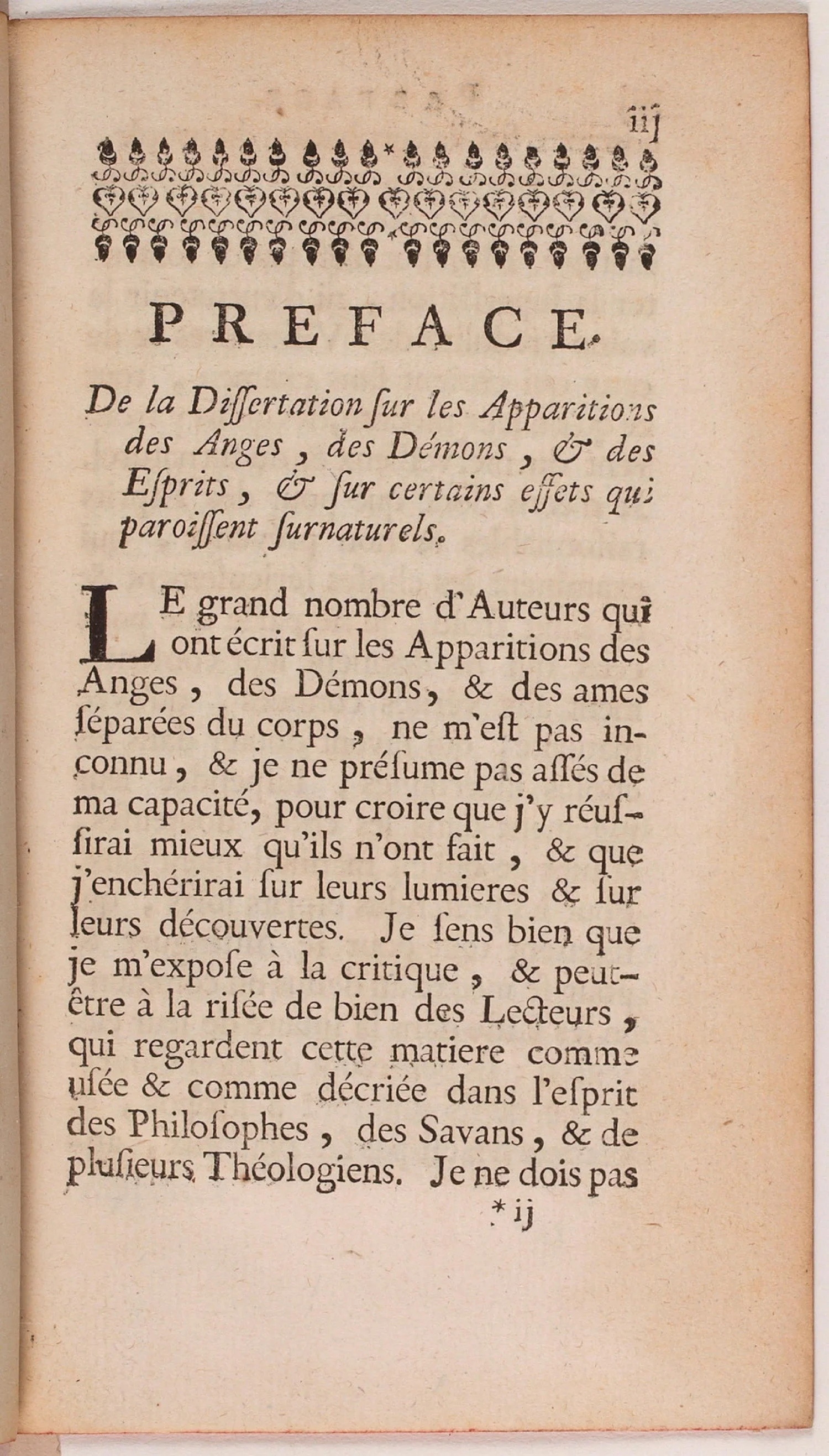
The Preface of Calmet's Dissertations (1746), page iij: his statement of method — he will examine the vampire reports as historian, philosopher, and theologian, and suspend judgment where the evidence is doubtful. The keeper's charter, in another man's French. Public domain, via Wikimedia Commons.
The vampire of record's modern face takes the shape of a form: the signed investigative report. Every later "case file" in the literature of strange beings — the commission, the testimony taken in order, the findings over signatures — descends from the paperwork of 1725 and 1732, and the Visum et Repertum is still read today, in translation, as a founding document of forensic reporting: the moment a government tried to settle a haunting with a measuring instrument. Scholars of medicine and of administration now mine these reports for what they hold about their writers — exactly the turn this class teaches: the record ends up documenting the recorders.
The word completed its journey too. Vampir settled into every European language within the century, and the being it named was about to be taken from the administrators by the poets — the next lesson follows him into print, to Polidori's villa and Stoker's count, where the grave-earth and the paperwork fall away and the aristocrat rises. Keep this lesson's vampire in view as you go: a peasant, a neighbor, a name in a report. The distance between him and the Count is the distance between a file and a novel, and it is measured in this lesson.
The belief itself is still with us, in the plain sense that the places are still visited: Mercy Brown's grave in Exeter is sought out to this day and left offerings, and the Kisiljevo and Medvedja reports are still read, argued over, and filmed about. The keeper files that as what it is — the record's afterlife among the living.
And the standard of proof survives closest to home. When the reports reached Paris, Dom Augustin Calmet — whose title page heads this lesson — read the whole dossier and declined, in print, to decide it: he would examine the accounts as historian, philosopher, and theologian, and suspend judgment where the evidence was doubtful. Look at his title page as the lesson's first plate. The title runs long, in the manner of his century, and it reads like an itinerary: apparitions, revenants, and vampires of Hungary, Bohemia, Moravia, and Silesia — the whole frontier geography of the reports, gathered onto one Parisian page by a Benedictine who worked from his abbey. Then turn to the second plate, the Preface, page iij, where he tells you in his own words what he means to do with all of it, and what he means not to do. His preface is the keeper's charter in another man's French. The courts signed findings; the newspapers signed certainties; the old Benedictine signed a suspension — and it is his page, of all of them, that this class keeps.
Guided Observation
This lesson's plates are two pages of one book: Dom Calmet's Dissertations sur les apparitions… et sur les revenans et vampires (Paris, 1746). Read the title page first, as evidence. The long title is a table of contents and a map at once — Hungary, Bohemia, Moravia, Silesia: the frontier geography of the reports, named by a scholar in Paris who never left his abbey for the frontier. What kind of book claims this subject? Who is its author, and what does his cloth promise the reader about the treatment inside?
Then the Preface, page iij: Calmet's own statement of method — he will examine the vampire reports as historian, philosopher, and theologian, and suspend judgment where the evidence is doubtful. Find the sentences where he says what he will not do. This is the standard of proof of the whole lesson, in its author's own page.
One absence must be stated plainly, because a keeper states absences. The document this lesson most concerns — the Visum et Repertum itself, signed at Medvedja in January 1732 — does not hang here. No verifiable public-domain page image of it could be secured for the class's archive; the report survives and can be read in translation, but the class hangs only what it can warrant. If a lawful page is ever secured, it will take the head of this lesson. Until then, the empty place is itself part of the record: even the most documented being in Unit V reaches us, at the last step, through other men's summaries.
Assignment Manual
✎ WRITTEN · ⚒ HANDS-ON · ◐ BOTH
✎ Written · Entry No. 30: The Vampire of Record.
- Rule your entry page. Turn to the Scholar's Entry Page in this lesson's packet and rule a page of your journal to match it.
- Write the vampire's entry, to the standard. The Creature: the dead who do not rest, and the picture that does not exist — nobody drew the folk vampire. First Told: the earlier print telling (Allatius 1645; Tournefort's Mykonos, 1701, printed 1717), then Kisiljevo 1725 — Plogojowitz, the nine deaths, Frombald's report and his protest, the exhumation as the report gives it. The Tales: the dead returning to their own households, and Paole's own story of the cure he took. Spotted: Paole in two acts; the 1732 commission; the word vampir traveling into European print; and Exeter 1892 in two lines. What It Actually Is: three lines — the exhumed body's true behavior, disease in a winter village, procedure as remedy. Still With Us: the signed report as the being's lasting form, and Calmet's suspension. The Keeper's Line: your judgment, in a line or two.
- Try the wake watch. Write out the Romanian custom as the collectors give it, with Gorovei (1915) and Murgoci (1926) named, marked T for the belief and F for the collecting — and add the geography line: where the custom is documented, and where it is not.
- Mark every line. This lesson is the class's drill in the report says, with the keeper's marks: T for a tale, S for a sighting-report, F for a fact. A claim taken from a report is F as a claim about the report; what the report asserts about the dead is S. Go through your entry and make sure no sentence borrows the commission's authority for the commission's belief.
- File the absence. At the foot of your entry, write one line recording that the Visum et Repertum hangs in no plate in this class's archive, and why. Keepers record what is missing as carefully as what is present.
- File the ancestors. Beneath your entry, add the wider family in four lines. The Strix: Ovid, Fasti Book 6 (AD 8) — the screech-owls at Proca's cradle, and Pliny's dismissal beside it. The Lamia: Diodorus's Libyan queen and Horace's warning, then Philostratus, Life of Apollonius Book 4 — the bride of Corinth and her confession. Mark the texts F and the beings T, as always. Then one line of your own on the word strigoi: where the strix's name ended up, and what it names there.
The printable packet for this lesson — the Lexicon Handout, the Guided Practice, this manual, and the Scholar's Entry Page — is linked on this page.
Materials
· Your bestiary journal or notebook — kept for the whole class
· Pencils, and a pen you like writing with
· A ruler, for ruling your entry pages
· The lesson page, for the map and the plates
· This packet
Reflection
Frombald attended the Kisiljevo exhumation under protest, and signed anyway. What is an official's duty inside a belief he does not share — and did he do it?
Flückinger's commission signed findings; Calmet, with the same evidence, signed a suspension of judgment. Which of the two is the keeper's model — and is the answer the same for every document?
The dead of Medvedja were exhumed by due process, with surgeons, forms, and signatures. What protects a record from its own procedures — and who, in this lesson, does the protecting?
A Closing Note
Two lessons in, Unit V has shown you its range: a tale told by a skeptic at the dawn of history, and a form signed by surgeons in the age of reason — and the same fear wearing both. You have also met this class's severest test: a record can be official, unanimous, footnoted, and still be a record of belief. Hold on to Calmet's suspension; you will need it. Next lesson the paperwork falls away and the vampire stands up in evening dress: we follow the word into print, to a villa on Lake Geneva in the year without a summer, and watch literature rebuild a village fear into an aristocrat. Bring your marks. The T, S and F of a novel are trickier than those of a report.
The Bestiary
Bestiary Keeper
Further Reading & Sources
Johann Flückinger et al., Visum et Repertum (Medvedja, January 1732) — the signed report; read in English translation in Paul Barber's Vampires, Burial, and Death.
Frombald's report on the Kisiljevo case (1725) — likewise translated and discussed in Barber.
Dom Augustin Calmet, Dissertations sur les apparitions des anges, des démons et des esprits, et sur les revenans et vampires de Hongrie, de Bohême, de Moravie et de Silésie (Paris, 1746) — the title page and Preface are this lesson's plates; an English translation followed in 1751.
Paul Barber, Vampires, Burial, and Death: Folklore and Reality (Yale University Press, 1988) — the standard real-root study of the whole record.
Agnes Murgoci, "The Vampire in Roumania," Folklore 37 (1926) — the wake watch and the cat over the corpse, from Romanian collections.
Artur Gorovei, Credinți și superstiții ale poporului român (1915) — the belief in print, in Romanian.
Ovid, Fasti, Book 6 (AD 8) — the striges and the infant Proca; the classical vampire's first full description, read in the Wider Family section.
Philostratus, Life of Apollonius of Tyana, Book 4, chapter 25 (early 3rd century AD) — the lamia of Corinth; F. C. Conybeare's 1912 translation is the one quoted in this lesson, translator's word "vampires" and all.
Submit your work for this lesson using the form below.
CONTINUE IN THE BESTIARY HALL
← Previous · Lesson 29: Werewolves Next · Lesson 31: The Vampire in Print →
Unit V — The Changed The Bestiary Hall — All 41 Lessons
The rest of Unit V: Lesson 29 · Werewolves · Lesson 31 · The Vampire in Print · Lesson 32 · Ghouls · Lesson 33 · The Zombie