

THE BESTIARY
Unit V · Lesson 33The Zombie
Professor Sable Rookmere
Bestiary Keeper
The Bestiary Hall • School of Evershade
Professor's Introduction

Unit V was closed, and this entry reopens it — properly, at the end, where it belongs. Every other being in this unit was a person changed: a man into a wolf, a corpse into a case file, a desert terror into a graveyard tenant. The being in this lesson was changed twice over, and the second change was done to the idea itself, by people who never met it. In Haiti, the zonbi is a figure of a real people's history and a living religion, and we shall treat it with the care that fact requires: from the published record, respectfully, at the record's own distance. In America, the zombie is a film creature wearing the zonbi's name. This lesson keeps the two apart on every page, and dates the road between them. Mind your T, S and F here more than anywhere: no lesson in the class has more need of them.
The Bestiary
Bestiary Keeper
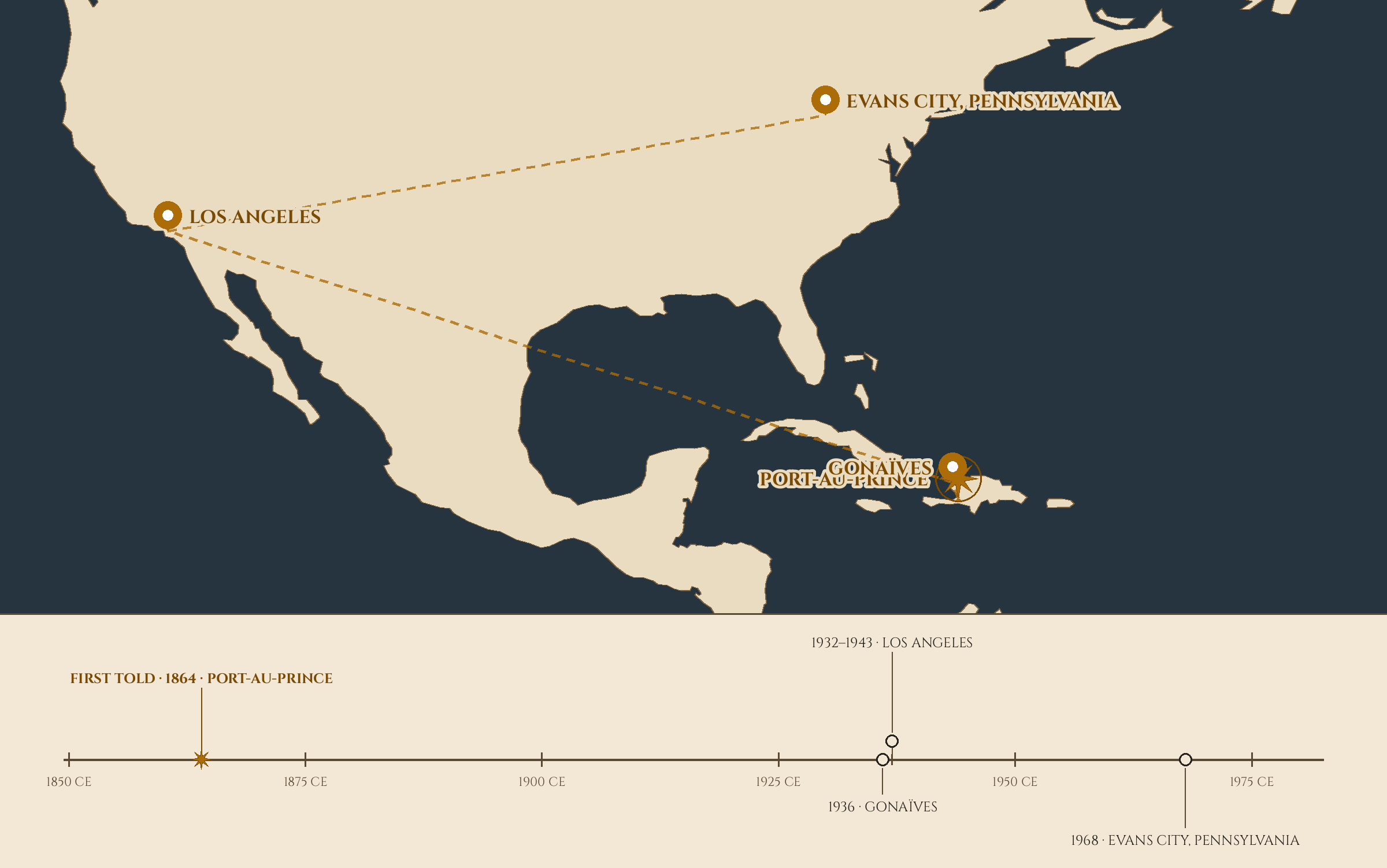
Where this lesson travels: Port-au-Prince, Haiti, 1864 — the starred pin — where Article 246 of the Haitian Penal Code was expanded to count poisoning a person into a prolonged lethargy, and burying them as a consequence, as murder: the zonbi's first dated official trace, written into Haitian law by Haitians, sixty-five years before any American travel writer arrived; Gonaïves, Haiti, 1936, where the woman identified as Felicia Felix-Mentor was held in the government hospital and photographed by Zora Neale Hurston; Los Angeles, 1932–1943, where White Zombie (1932) and I Walked with a Zombie (1943) carried the Haitian figure to American screens; and Evans City, Pennsylvania, 1968, where Romero's ghouls were renamed zombies by their audience — the pin this lesson shares with Lesson 32. The starred pin is the first dated record; the dashed line is the telling, traveling.
Lesson Objectives
By the end of this lesson, you will be able to:
- Give the being's own name in its own home — zonbi — and say what the Haitian figure is, and what it is not.
- Trace the word's proposed road from the Kongo region to Haiti to American print, carrying every hedge the scholars carry.
- Name the two books that carried the figure to America — Seabrook's and Hurston's, with their dates — and state the standing of each as a witness.
- Tell the Felix-Mentor case as a reported case: the report, the photograph, and the published correction, in that order.
- State the name-slide of 1968 exactly: what Romero called his creatures, and who renamed them.
- Give the verdict this class files on the tetrodotoxin claim, and name the study that stands against it.
Your Assignment Packet
This lesson's work lives in its packet: the Lexicon Handout (every term, the core terms marked with the keeper's diamond ◆), Materials, Guided Practice, the Assignment Manual written out whole, the Scholar's Entry Page, the Reflection Questions, the Workbook Checklist, and the Keeper's Notes, for whoever teaches the lesson. Download the packet before you begin and keep it beside you as you read. The packet's assignment is Rookmere's own word for the work: Entry No. 33 — The Zombie (written) ✎. The Unit V Quiz is not printed in the packet; it closes the unit, and it stands at the end of this very lesson, below.
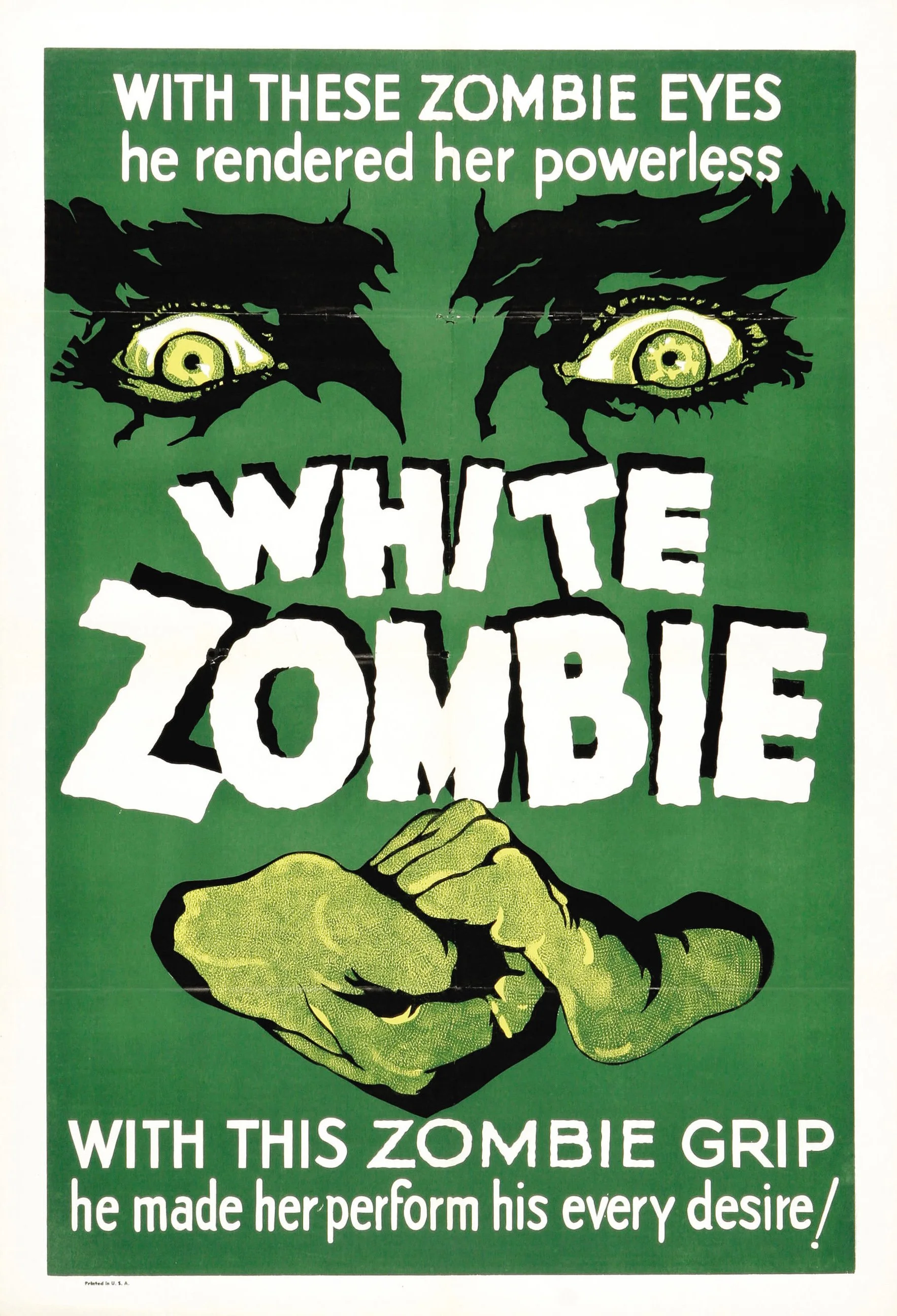
The theatrical poster for White Zombie (United Artists, 1932), the first feature-length zombie film: green paper, staring eyes, clasped hands, and sales copy — 'WITH THESE ZOMBIE EYES he rendered her powerless' — selling control, the Haitian figure's own centre, in an advertisement. Public domain in the United States (published without a copyright notice), via Wikimedia Commons.
The Creature: The Zonbi, and the Pictures It Never Sat For
✦ On the class test
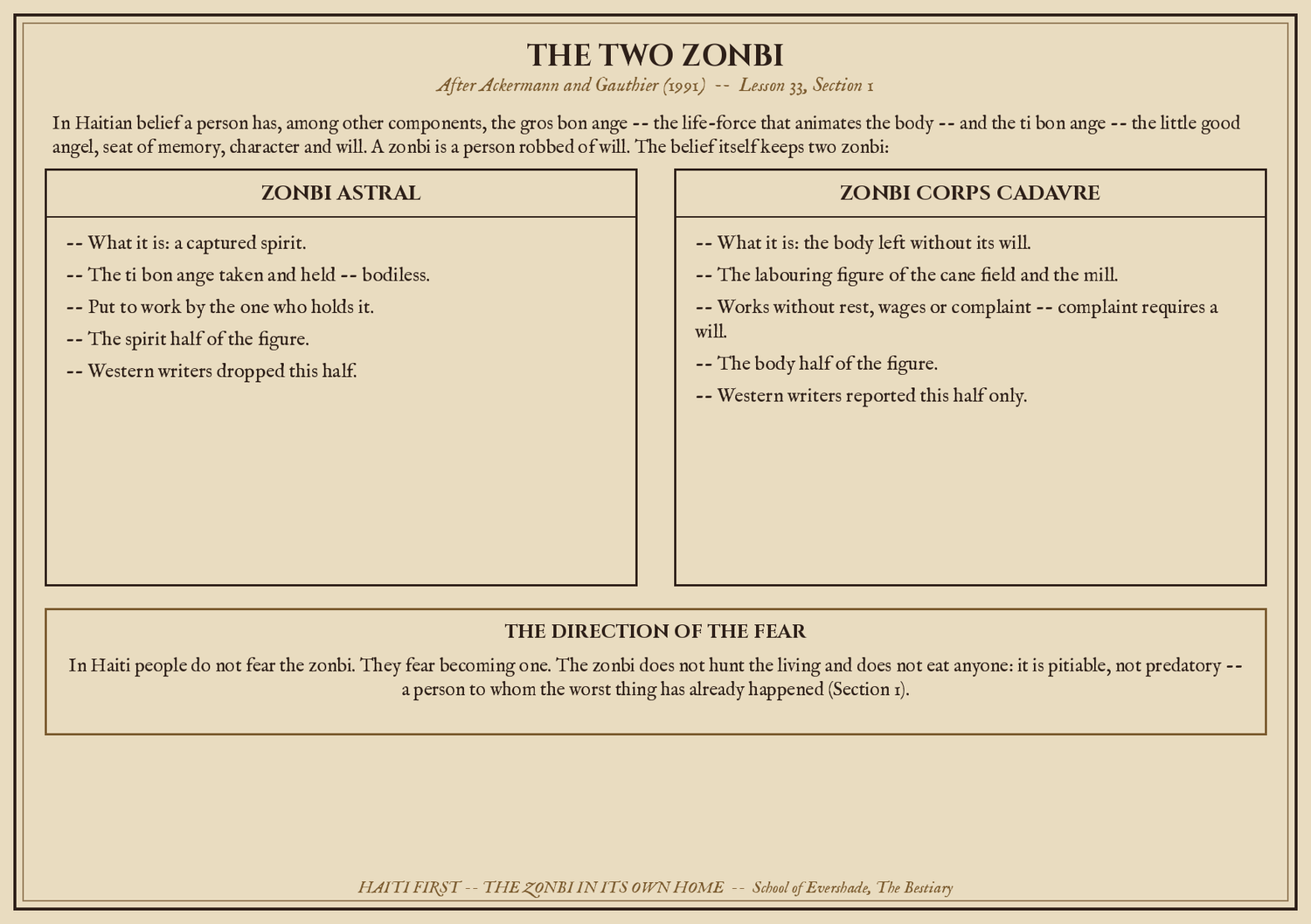
The two zonbi, typeset for this class after Ackermann and Gauthier (1991): the zonbi astral — the captured ti bon ange, bodiless, put to work by the one who holds it — beside the zonbi corps cadavre, the body left without its will. Western writers reported the second and dropped the first; the whole later history is one half travelling and the other staying home.
Begin with the name in its own home. In Haitian Creole the being is the zonbi (Haitian French zombi); the spelling zombie, with its final e, is the English dress the word put on later, in American print. Hold the two spellings apart in your notes. They are the lesson in miniature: same word, two beings.
The Haitian zonbi, as the ethnographic record describes it, is a person robbed of will. In the belief the scholars document, a human being is more than a body: among the components the Haitian accounts name are the gros bon ange, the life-force that animates the body, and the ti bon ange, the little good angel — the seat of memory, character and will. A zonbi is what is left, or what is taken, when the will is gone. The figure belongs to the margins of Vodou, the living religion of Haiti — and the margin is the correct address. The ethnographers are plain: the zonbi is found on the religion's fringes, in the realm of secret societies and of the bokor, the sorcerer who in the published accounts works for hire — not in the everyday devotion of the houngan, the priest, the mambo, the priestess, and the congregations who serve the lwa, the spirits. A lesson that placed the zonbi at Vodou's centre would repeat the error of the travel writers examined below.
And the figure has a second half the outside world almost never heard. Ackermann and Gauthier, gathering the Haitian record in the Journal of American Folklore in 1991, set out the two zonbi the belief itself keeps: the zonbi astral, a captured spirit — the ti bon ange taken and held, bodiless, put to work by the one who holds it; and the zonbi corps cadavre, the body left without its will, the labouring figure of the cane field and the mill. Western writers reported the second and dropped the first. Keep both, labelled: the packet's diagram draws them side by side, because the whole later history is one half travelling and the other staying home.
What the zonbi does, in its own record, is work — without rest, wages or complaint, because complaint requires a will. It does not hunt the living. It does not eat anyone. And it is not feared — the point on which every film you have seen is wrong about it: the accounts agree that in Haiti people do not fear the zonbi. They fear becoming one. The zonbi is pitiable, not predatory — a person to whom the worst thing has already happened.
Its pictures must be read with the same care, because here the line is wholly absence, and then an advertisement. No Haitian picture of the zonbi is in this class's archive, and none was sourced for it: the being lived in belief, in law and in oral report, and Haiti's own painter of the subject, Wilson Bigaud (his Zonbi dates to 1939), remains in copyright. The one famous photograph in the file — Hurston's, of a real woman in a hospital yard in 1936 — is described in §3 and never reproduced in this class: it is not ours to use, and its subject was a person, ill and unable to consent to her fame. So the hero plate is the poster for an American film of 1932: green paper, staring eyes, clasped hands, and sales copy about a woman rendered powerless. It is the first lawful picture this lesson can show you, and it is a sales pitch. The map and the diagrams, typeset for this class, carry the rest — and the lesson counts that as evidence, not as a shortage.
First Told: A Word Before a Being
Most beings in this class begin with a text. This one begins with a word looking for its being, and the map's first pin wears no date, because the literature offers none. That pin stands in the Kongo region of Central Africa, in what is now Angola, and it stands for a proposal.
The proposal, as the scholars state it: the Haitian word descends from words of the Kongo language area — nzambi, "god," a word that also names a spirit of the dead and forms the name of the creator deity Nzambi a Mpungu; and zumbi, "fetish," glossed also as a spirit, and as one raised from the dead. The Oxford English Dictionary gives the English word a Central African origin and compares it to those Kongo words, deriving it through French and Creole from the related Kimbundu nzumbi, "ghost, spirit." Ackermann and Gauthier list the whole family of proposed candidates — words for corpse, spirit, a body without a soul, from Gabon to Angola to the Bight of Benin — and record the honest position: there is no consensus, and the African line is the most probable of the proposals. Sarah Juliet Lauro, whose The Transatlantic Zombie (2015) is the fullest modern history, begins with "a probable ancestor" in seventeenth-century Kongo and Angola. Probable is her word. Keep it.
Note what those African words named: chiefly spirits — gods and ghosts, nearer to the zonbi astral than to any walking corpse. The walking corpse was not waiting in Africa to be shipped. What crossed the Atlantic, in the keeping of the enslaved, was a word and a spirit-belief. What it became was made on the other side.
The other side was Saint-Domingue, the French colony that became Haiti. Enslaved Africans carried the religions of West and Central Africa into a plantation colony of legendary brutality, where those religions met Roman Catholicism under compulsion and became Haitian Vodou. And there, in a society built on the ownership of human bodies, the spirit-belief acquired a body: the zonbi, the person whose will has been taken and whose labour continues without it. In 1804 the enslaved of Saint-Domingue completed the only successful slave revolution of the modern era and founded Haiti. The zonbi is a figure of the world slavery made and of the nation that overthrew it, and it has never been separable from either.
Scholars have said plainly what the figure carries, and the lesson attributes the reading to them, as a reading. Kyle William Bishop calls the zonbi an allusion to slavery itself: a being deprived of freedom and will is slavery's condition made into a person — the ultimate form of loss. Lauro argues the figure holds both halves of the history at once: enslavement and rebellion, the stolen soul that labours forever and the dead who would not stay down — she traces it through the poison-resistance traditions of the 1750s and a fighter of the revolution actually named Jean Zombi. Roger Luckhurst (Zombies: A Cultural History, 2015) files the being as formed "in transit," inside the slave trade and the occupation that followed it. And the ethnographic summaries record the plain version Haitians themselves give: the zonbi as a figure for hard life without reward — and, above all, the fear not of the zonbi but of becoming one, of a slavery that even death does not end. File the reading as S. It is a strong reading because the history underneath it is F.
The first dated official trace of the Haitian figure is not a tale. It is a law. Article 246 of the Haitian Penal Code defined poisoning; in October 1864, under President Fabre Geffrard, it was expanded: to use substances that, without causing death, produce a more-or-less prolonged lethargic state, is also poisoning — and if the person is buried as a consequence of that lethargy, the act is counted as murder. The Law Library of Congress, examining the codes in 2014, is exact: the word zombie appears nowhere in the article, and the code does not "outlaw making zombies." It outlaws poisoning a person into apparent death and burying them — the very process Haitian belief described, written into Haitian law by Haitians, sixty-five years before any American travel writer arrived. The map's second pin stands at Port-au-Prince, 1864, for the law. The formation it answers is older, and the map says so.
One book-stop belongs in the margin, un-pinned: the English word is first recorded in 1819, in Robert Southey's History of Brazil, spelled "zombi" — naming not a creature but a man, Zumbi, the Afro-Brazilian rebel leader whose name derived from nzambi.
The Tales: Two Books Cross the Water
The zonbi has no Sidi Nouman, no single tale the centuries agreed on. What it has is two American books, nine years apart, that carried it across the water — tellings about the being, by two very different witnesses, in the years when the United States occupied Haiti (1915–1934) and American readers were hungry for the island's supposed secrets.
The first is William B. Seabrook, The Magic Island (1929). Its zombie chapter, "…Dead Men Working in the Cane Fields," gave America its definition: the zombie is "a soulless human corpse, still dead, but taken from the grave and endowed by sorcery with a mechanical semblance of life." Seabrook reported being taken to see supposed zonbi at work in an American sugar company's fields — vacant-eyed labourers, plodding like automatons — and backed his account with the Haitian Penal Code. He cited it wrong: his "Article 249" is the Article 246 of §2, and the error passed into a film's script and advertising within three years (§6). File the telling whole, including its ending, which the legend dropped: Seabrook himself concluded that the "supposed zombies" shown to him were "nothing but poor, ordinary demented human beings… forced to toil in the fields." The man who sold America the zombie did not, in the end, claim to have met one. His standing: the book sold over half a million copies and was praised in the daily press — and the anthropologist Melville Herskovits, founder of Haitian ethnography in America, reviewed it as "a work of injustice," a shallow performance that fastened on a sensational fringe and called it a country. The modern histories (Luckhurst; Gary D. Rhodes) agree on the double verdict, and this class adopts it: Seabrook was the first major English-language author to publish zombie as the name of the living dead — a carrier of the first importance — and he is not an authority on Haiti. Cite him for what America received. Never for what Haiti believed.
The second book is Zora Neale Hurston, Tell My Horse (1938). Hurston was a novelist of the Harlem Renaissance and a trained anthropologist, and she came to Haiti in September 1936 on a Guggenheim fellowship to study its religion from inside sympathy rather than inside a thrill. Her zombie chapter must be told as she told it, and then corrected as the record corrects it — in that order, both halves F: the report happened; the correction happened.
In November 1936, Dr. Rulx Léon, Haiti's Director-General of health, told Hurston of a woman found that October on a road near Ennery: naked, lame in her left leg, her eyelashes gone, her face wrapped in a rag against the light, taken to the government hospital at Gonaïves and identified there by her family as Felicia Felix-Mentor — who had died and been buried in 1907, twenty-nine years before. Hurston went to Gonaïves, found the woman in the hospital yard — ragged, shielding her face, making, in her words, only "broken noises" in her throat — and did the thing no one had done: she photographed her. Her chapter holds two sentences side by side, and a keeper should too. "What is the whole truth and nothing else but the truth about Zombies? I do not know, but I know that I saw the broken remnant, relic, or refuse of Felicia Felix-Mentor in a hospital yard" — and: "in Haiti there is the quick, the dead, and then there are Zombies." The photograph ran in LIFE magazine on December 13, 1937, presented as the first photograph of a zombie. Its subject could not speak for herself in it, or anywhere. That is why this class describes the picture and does not print it.
The correction came from Haiti's own medicine. In 1945 the Haitian psychiatrist Louis P. Mars published his re-examination in the journal Man. The X-rays told the story first: the found woman had no fracture in either leg — but the real Felix-Mentor's lameness had come from a fractured left leg. The found woman's limp was muscle wasted by undernourishment; her lost eyelashes and horror of light were an eye disease; her apparent age was deprivation, and it lifted with feeding. Mars's diagnosis was schizophrenia; his conclusion was that the identification was a mistake, made in a country where the belief stood ready to receive it — and that Hurston had not gone beyond the first telling to verify it. File it exactly so: a reported case, a famous photograph, a published refutation. The woman in the hospital yard was somebody. The record does not give us her name, because the record took Felix-Mentor's name for her and never gave her one of her own. A keeper writes that sentence down.
Hurston left one more thing in the file: a guess. Pursuing rumours of a drug, she wrote that if science ever got to the bottom of Vodou, it would find that "some important medical secrets, still unknown to medical science, give it its power, rather than gestures of ceremony." Mark it S, with her name and date on it. §5 is what happened when science took her up on it, fifty years later.
KEEPER'S CHECK-IN
Tell the Felix-Mentor case in its proper order — the report, the photograph, and the published correction: what was reported in 1936, what did Hurston do that no one had done, and what did Mars's 1945 re-examination find?
Spotted: The Dead Who Came Back to Court
The zonbi's later appearances are not sightings of a creature. They are cases — named people, found living after a recorded death, brought before families, doctors and in one instance a journal of medicine. The class files them as cases, with the evidence graded as the record grades it.
The fullest case is Clairvius Narcisse. The record's firm points: admitted to the Albert Schweitzer Hospital at Deschapelles on April 30, 1962, ill and spitting blood; pronounced dead on May 2, 1962, by two attending physicians; buried near his home village of L'Estère. In 1980 a man approached Narcisse's sister Angelina in L'Estère, gave a childhood nickname only the family used, answered the family's questions — the Haitian psychiatrist Lamarque Douyon, who had spent years investigating such reports, helped design them — and was accepted by family and village as Clairvius Narcisse. His account: conscious but paralysed through his apparent death and burial; taken from the grave and worked, with others, on a northern sugar plantation; the quarrel behind it a family land dispute; free only when the master died. Grade the file as the literature grades it. The death, burial and return are documented events. The identification rests on family recognition and his own testimony: no fingerprint or DNA confirmation was ever published. The years between rest on his account alone. F for the frame, T for the middle — and the frame, by itself, was enough to send Harvard to Haiti (§5).
The second exhibit is a study, and it is the strongest paper in the lesson. In 1997 Roland Littlewood and Chavannes Douyon published in The Lancet their clinical findings in three cases of zombification — three living people in southern Haiti, each identified by a community as a returned dead relative. Examined with scans and, in two cases, DNA and fingerprint checks, the three resolved into medicine: catatonic schizophrenia; brain damage consistent with oxygen starvation, with epilepsy; a developmental learning disability. Two of the three were shown not to be the people they were taken for. The authors' conclusion is the sentence this section exists to carry: the likeliest explanation of such returns is the mistaken identification of a wandering, mentally ill stranger by bereaved relatives. File the study beside Narcisse, not beneath him. It does not disprove a word of his testimony. It demonstrates the mechanism by which a community can acquire a returned dead person without any sorcery at all — and a keeper prefers the mechanism that has been seen working.
KEEPER'S CHECK-IN
Littlewood and Douyon's 1997 Lancet study examined three living people identified by their communities as returned dead relatives — what did the three cases resolve into, and what did the authors conclude is the likeliest explanation of such returns?
What People Watched For — the Grave-Watch, and the Salt
This box is filled, and narrowly, to the class's standard: a named ethnographer, a dated publication, a real practice. The source is Alfred Métraux, Voodoo in Haiti (1959; French original 1958), the classic mid-century ethnography of Haiti, as his account is preserved and quoted in the later literature.
Métraux records that families who feared a newly dead relative would be taken and made a zonbi acted on the fear at the grave. In the most extreme accounts he was given, the corpse was given a second death before burial — an associate, Monsieur Bernot, told him he had witnessed the strangulation of a dead youth for exactly this purpose; other accounts in the same literature describe corpses shot before burial, graves weighted and sealed under heavy cement, and the dead buried near the house or a busy road where the grave could be watched — watched until the body decayed past use, since a rotted corpse, the belief held, could no longer be raised to labour. And Métraux records the belief that completes the box from the other side: that a zonbi must never taste salt — that salt eaten, even by accident, breaks the state and sends the zonbi back to its grave. He retells, with that belief attached, a story dated in the telling to 1918, of zonbi labourers fed salted food by mistake who rose, ignored their master, walked to their own graves and fell into them.
Mark the box with care. That families watched graves, weighted tombs and, in the reported extreme, destroyed corpses is F — what the ethnographer recorded them doing; the law of 1864 stands in the same file, answering the same fear from the state's side. Why the watching worked, and what the salt did, belong to the belief, and are filed T, with respect. The practice is the saddest in the unit's boxes: every other custom in this class watches for a being coming in. This one watches a grave to keep a person from being taken out.
What It Actually Is
The zonbi's roots are not hidden, and finding them honours the people who made the figure. It was made, first, out of slavery's own logic, stated by the scholars of §2: a colony that worked human beings as instruments produced, in the beliefs of the worked, the perfect instrument — a body that works forever, wants nothing, and cannot even die out of its service. The zonbi is what slavery looked like from inside, with the one mercy removed: under slavery, death at least ended the term. The zonbi's term does not end. That is why the fear is of becoming, and why the figure survived emancipation: the condition it names — labour without will, reward or end — did not retire when the law changed.
It was made, second, out of a community's need for a sanction heavier than prison. The ethnographic literature, Davis's own later work included, describes zombification in the accounts as a punishment — imposed, in the tellings, through Haiti's secret societies on people judged to have violated their community's deepest rules: Narcisse's story turns on stolen inheritance land. Robert Farris Thompson, introducing Davis's scholarly book, praised exactly this: that it taught scholars to take the zonbi seriously "as a social sanction of the greatest import." A belief does not need a single verified making to function as a court. The threat, universally understood, is the court in session.
And it was made, third, out of apparent death and mistaken identity, which §4's Lancet study caught in the act. In a countryside with thin medicine, deaths are misread; people with schizophrenia, brain injury or learning disability wander, speechless and strange, far from anyone who knows them; and a grieving family, meeting such a stranger where the returned dead are a standing possibility, may know them again. Add the grave-watch customs of the box above — proof of how live the fear was — and the record needs no powder to explain why Haiti had zonbi cases. It had them the way it had the law of 1864: because the belief, the fear and the occasional dreadful coincidence were all real.
Against that ground stands the one claim this lesson must judge in full, because half-judging it is how it survived. In 1982 the Harvard ethnobotanist Wade Davis, sent to Haiti by the psychiatrist Nathan Kline to investigate the Narcisse case, proposed a pharmacological root: that a powder whose active agent was tetrodotoxin — the nerve poison of pufferfish, which can, in genuine poisoning cases, bring a living person to a state indistinguishable from death — could account for the apparent death; and that a second preparation, from the deliriant plant Datura, could account for the compliant state after. His paper appeared in the Journal of Ethnopharmacology in 1983; his bestseller, The Serpent and the Rainbow, in 1985. (This class reports the claim at the level the journals reported it. It gives no preparation, no proportions and no method, here or anywhere.)
The published response is the lesson's verdict, and it is not close. Davis sent his samples to the two leading tetrodotoxin authorities of the day, C. Y. Kao and Takeshi Yasumoto. Their assays, as Davis himself reported them in print in 1989, found in one sample no tetrodotoxin at all, and in the other a trace — about 1.1 micrograms per gram — "an amount too small to result in significant pharmacological activity," in his own letter's words. Kao and Yasumoto's published conclusion, in 1986, was that the claim was "without factual foundation." Science magazine's investigation, William Booth's "Voodoo Science" (1988), carried Kao's judgment that the affair raised an issue of fraud in science, and other assessors' milder verdict of negative results withheld; Davis answered in Science and the journals, arguing the variability of folk preparations and citing one higher reading from another laboratory. The argument ended where such arguments end when the replications fail: later analyses found no tetrodotoxin in such preparations, the primary literature let the subject drop after the early 1990s, and the Datura half of the claim was never independently established in any named case either.
So the class files it, in the words the literature leaves us: the tetrodotoxin hypothesis is unproven. Not disproven in the absolute — a keeper does not deal in absolutes the record has not earned — but unproven after forty years, against the testimony of its own chosen analysts, and unnecessary beside the roots above. Hurston guessed in 1938 that a medical secret held the power (§3). Davis went to find it. The finding did not hold. What held was what Métraux, Herskovits and the Haitian scholars had said all along: the power was never in a powder. It was in a history.
Still With Us
✦ On the class test
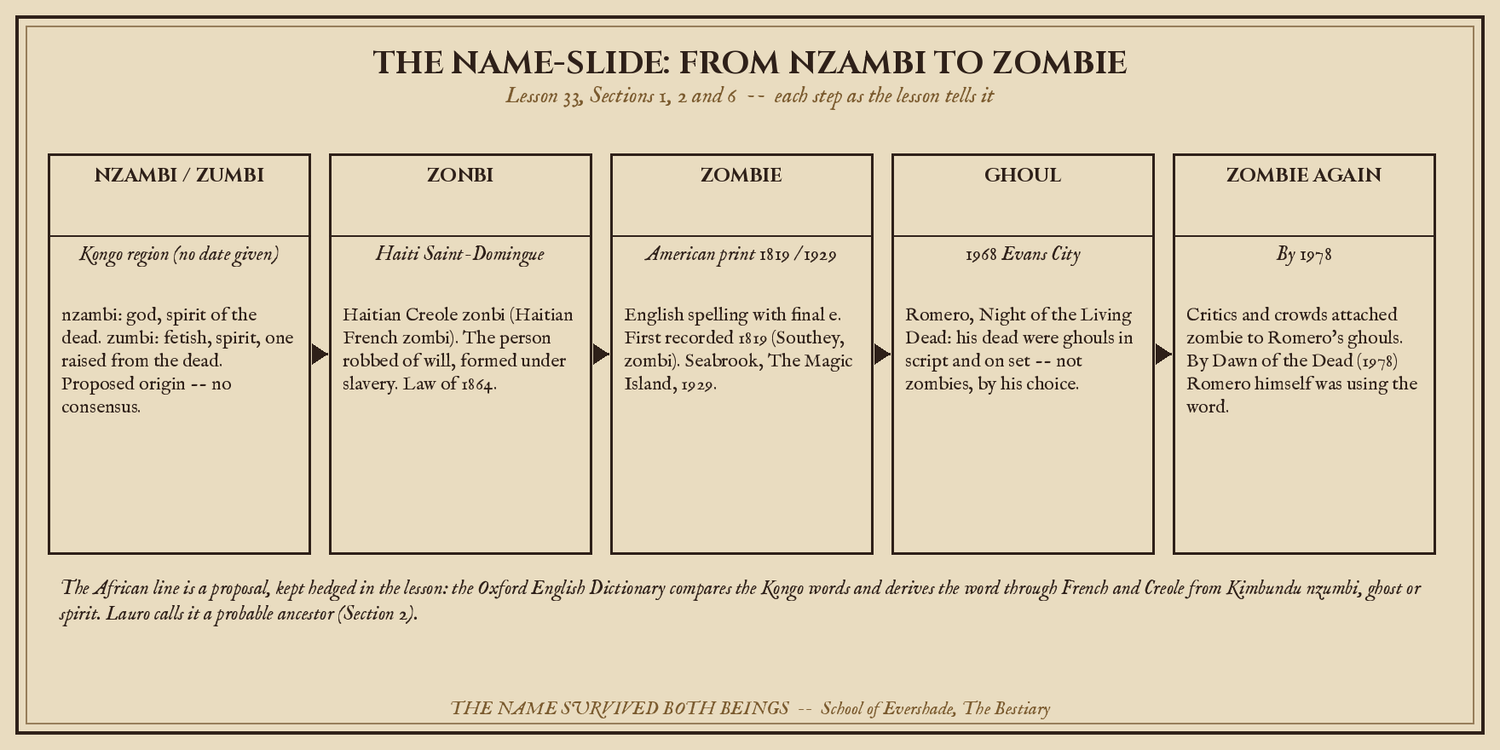
The name-slide, typeset for this class: nzambi / zumbi (proposed, and hedged as proposed) → zonbi in Haiti → zombie in English print → the ghoul label Romero himself used in 1968, with zombie slid back over his creatures by their audience. The name survived both beings — which is why this class files names so carefully.
The twentieth century took the zonbi travelling, and the lesson ends with the itinerary, because the itinerary is now most of the world's whole knowledge of the being.
The first crossing kept the figure's shape. White Zombie (1932), directed by Victor Halperin with Bela Lugosi as the mill-owner "Murder" Legendre, is the first feature-length zombie film: Haiti, a sugar mill worked by will-less labourers, a master whose power is in his eyes and his grip. The hero poster, with its lines about a woman rendered powerless to perform a man's every desire, is not a corruption of the figure; it is the figure, sold as melodrama. The film's paperwork brandished Seabrook's mis-cited "Article 249" as proof, with the word zombie inserted by Hollywood into a statute that never contained it — the law of §2, conscripted as advertising. Note what the film kept (master, island, labour, spell) and what it centred (a white heroine in the zonbi's place): the crossing preserved the outline and reassigned the suffering, which is the whole American history of the being in one casting decision.
The second crossing was the thoughtful one. I Walked with a Zombie (1943), produced by Val Lewton and directed by Jacques Tourneur at RKO, rebuilt a studio order for "something about zombies" on Charlotte Brontë's Jane Eyre: the great house, the planter, his wife suspended in a living death, and the young nurse who carries her to Vodou's "better doctors." Its makers did the research the decade usually skipped — screenwriter Ardel Wray's work gave it a respectful treatment of Vodou for its time, and a setting, the fictional San Sebastian, whose wealth the film states plainly was built by slavery: the figurehead in the garden came off a slave ship. It never settles whether its zombie is spellbound, fever-wrecked or both. For 1943, in a B-picture, that refusal is the most Haitian thing in American film: the record, filed unresolved.
Then the name slid. In 1968 George Romero filmed Night of the Living Dead around Evans City, Pennsylvania — the fifth pin, which this lesson shares with Lesson 32. His besieging dead had no master, no island, no religion and no spell; they ate the living, which no zonbi in any record had ever done; and Romero did not call them zombies. In his script and on his set they were ghouls — he said they were something completely new, too unlike the Haitian figure to borrow its name. The audience borrowed it for him. Critics and crowds attached zombie to the ghouls of Evans City, and by Dawn of the Dead (1978) Romero himself was using it. Stand the two lessons side by side and the exchange is complete: in that one farmhouse, the ghoul lost her modern face (Lesson 32) and the zombie gained a body that was never its own (this lesson). The name survived both beings. Names usually do. It is why this class files them so carefully.
The flood after needs one paragraph, not ten. Romero's sequels; The Return of the Living Dead (1985), which — not Romero — invented the cry of "Brains!"; a thin 1990s; then 28 Days Later (2002), whose infected are not dead at all and who run, breaking the walk the word had kept for two hundred years; Shaun of the Dead (2004); and The Walking Dead — comic of 2003, television's from 2010 — which made the modern zombie the default dead of the planet's imagination. Contagion replaced the bokor. The horde replaced the labour gang. The apocalypse replaced the plantation. Of the Haitian figure there remains, in the flood, exactly one word and one walk — and the walk, since 2002, is optional.
And in Haiti the zonbi never became any of that. It remains what the record made it: a figure of belief and of history, feared in the becoming and pitied in the being, filed in a living religion's margins and a nation's memory. Two modern faces, then, and the entry's last duty is the usual one: file them in the order the being lived them. Haiti first. Evans City last. The name-slide marked on the road between.
Guided Observation
Study the hero plate slowly: the theatrical poster for White Zombie (1932). It shows no corpse, no grave and no monster — only staring eyes, clasped hands, and words. Read the words as evidence: "WITH THESE ZOMBIE EYES he rendered her powerless" — "WITH THIS ZOMBIE GRIP he made her perform his every desire!" What does the poster say a zombie is? Notice that its answer — a person under another's control, made to perform his desires — is the Haitian figure's own centre, carried across intact. What has it quietly replaced: whose body is threatened in its copy, and whose labour built the mill in the film behind it? And what does it refuse to show — where is the zonbi himself, the labourer of the cane fields, in this advertisement for his own first film? Write three lines: one for what the poster records, one for what it believes, one for what it cannot help confessing.
Assignment Manual
✎ WRITTEN · ⚒ HANDS-ON · ◐ BOTH
✎ Written · Entry No. 33: The Zombie.
- Prepare the page. Rule a fresh page of your bestiary to the Scholar's Entry Page in this lesson's packet. Head it: Entry No. 33 — The Zombie. Under the head, write the being's name in its own form — zonbi — before you write the English word. Order is evidence.
- Write the entry to the standard. The Creature: the zonbi's nature (a person robbed of will), its two halves (astral and corps cadavre), its address at Vodou's margin — and its picture line: no Haitian picture, a barred photograph, an American poster. First Told: the word's proposed Kongo home, kept hedged; Saint-Domingue and the formation under slavery; the law of 1864, stated exactly. The Tales: Seabrook and Hurston, with dates and standing; Felix-Mentor told whole — report, photograph, Mars's correction. Spotted: Narcisse, graded (frame F, middle T, no laboratory confirmation); the Lancet three and their authors' conclusion. What People Watched For: the grave-watch and the salt, Métraux named, the marks kept apart. What It Actually Is: slavery's logic, the social sanction, apparent death and mistaken identity — and the Davis claim with its verdict. Still With Us: 1932, 1943, the slide of 1968, the flood in one breath, Haiti lastingly itself. The Keeper's Line: your own judgment, in one or two lines.
- The name-slide audit. List three traits of the modern screen zombie (risen corpse, flesh-eating, masterless horde, contagion, the run — take any three). For each, write the Haitian record's verdict: present, transformed, or absent — with the stop on the map where the trait entered, or the honest note that it never left Evans City. This audit is the entry's heart; it is §3's translation audit from Lesson 32 aimed at a second word, and the pair of audits together are Unit V's whole method.
- Mark every line. F for the dated fact — words recorded, laws passed, books, films, journals, assays. T for what the tellers held true of the being itself — the zonbi's nature and the beliefs around it, reported with respect and without adoption: this class files a living religion's beliefs exactly as it files the hadith of Lesson 32, as the record of what is held, by the people who hold it. S for the scholars' claims and readings — the slavery reading with its authors named, Hurston's medical guess, and the Davis hypothesis, which carries its verdict with it wherever it is written: unproven.
- Close the entry facing home. End your entry with the Haitian zonbi in one line, before the American zombie. A keeper files a being's homes in the order the being lived them.
The printable packet for this lesson — the Lexicon Handout, the Guided Practice, this manual, and the Scholar's Entry Page — is linked on this page.
Materials
· Your bestiary journal or notebook — kept for the whole class
· Pencils, and a pen you like writing with
· A red pencil, for marking
· A ruler, for ruling your entry pages
· This lesson's packet (the Scholar's Entry Page is in it)
Reflection
Seabrook carried the zonbi to America and Herskovits called the carrying an injustice, in the same season. Can a book be both a genuine first record and a harm? What, exactly, would Seabrook have had to do differently for the record to stand without the injustice?
Hurston wrote "I do not know" and "I know that there are Zombies in Haiti" in the same chapter. The Mars correction answered the second sentence. What should a keeper do with the first?
The tetrodotoxin claim was believed for a decade by readers who would never have believed in the zonbi. What made the powder more credible to them than the belief — and what does the claim's failure teach about the difference between a scientific form and a scientific result?
A Closing Note
Unit V now truly closes, with the being who travelled farthest and was changed most: a spirit-word out of Africa, a stolen will in Haiti, a law in a code-book, a chapter in a bestseller, a woman in a hospital yard whose name we do not know, a poster, a farmhouse, a horde. You have followed the changed across five lessons now — the wolf that was a man, the corpse that was a case file, the lord that was a literary invention, the desert terror that was a mistranslation, and the labourer who was a name, reassigned. One method carried all five: whose words are these, and what did they keep? Unit VI turns to those who linger — ghosts first — and the question changes again: not what the being was, but what the witnesses were doing when they saw it. Keep your journal dry, and your T, S and F honest.
The Bestiary
Bestiary Keeper
Further Reading & Sources
Hans-W. Ackermann & Jeanine Gauthier, "The Ways and Nature of the Zombi," The Journal of American Folklore 104:414 (1991) — the survey this lesson's two zonbi stand on.
Sarah Juliet Lauro, The Transatlantic Zombie: Slavery, Rebellion, and Living Death (2015) — the fullest modern history.
Roger Luckhurst, Zombies: A Cultural History (2015) — the being formed "in transit."
Alfred Métraux, Voodoo in Haiti (1959) — the classic ethnography; the grave-watch box stands on it.
Zora Neale Hurston, Tell My Horse (1938), Chapter 13 — the Felix-Mentor report; read it beside Mars.
Louis P. Mars, "The Story of Zombi in Haiti," Man 45:22 (1945) — the correction.
Anne Guha (with Nicolas Boring), "Does the Haitian Criminal Code Outlaw Making Zombies?", Law Library of Congress (2014) — Article 246 from the codes.
Roland Littlewood & Chavannes Douyon, "Clinical Findings in Three Cases of Zombification," The Lancet 350 (1997) — the only clinical study.
Wade Davis, The Serpent and the Rainbow (1985), with William Booth, "Voodoo Science," Science 240 (1988), and Davis's letter, Journal of Ethnopharmacology 25 (1989) — the claim and its answer, read as a pair.
### Images
Hero: White Zombie theatrical poster (United Artists, 1932) — `be-rf-zombie-white-zombie-poster.jpg`, public domain (US; published without copyright notice), verified on its own Wikimedia Commons page; see `MANIFEST-zombie.md` in the reframe art folder.
Map–timeline (typeset for this class): five pins — the Kongo region (undated, hedged) · Port-au-Prince, 1864 · Gonaïves, 1936 · Los Angeles, 1932–43 · Evans City, 1968.
Diagrams (typeset for this class): the name-slide (nzambi/zumbi → zonbi → zombie → ghoul, 1968 → zombie again) and the two zonbi (astral / corps cadavre), after Ackermann & Gauthier (1991).
Not reproduced, by ruling: Hurston's 1936 photograph of the woman identified as Felix-Mentor (rights; a real patient) — described in §3 only. Wilson Bigaud's Zonbi (1939) and all film imagery after 1932 remain in copyright and appear in prose only; no Night of the Living Dead still was sourced under the class's own-page verification rule.
The Unit V Quiz
The Unit V Quiz checks the whole of the unit — Lessons 29–33, from the werewolf to the zombie — and its answers and self-check stand at the back of the quiz packet, so you can mark your own work the keeper's way. Take it with your bestiary beside you, Entries No. 29–33 open: everything it asks for is work your own hand has already done.
Download the Unit V Quiz (PDF)
Submit your work for this lesson using the form below.
CONTINUE IN THE BESTIARY HALL
← Previous · Lesson 32: Ghouls Next · Lesson 34: Ghosts →
Unit V — The Changed The Bestiary Hall — All 41 Lessons
The rest of Unit V: Lesson 29 · Werewolves · Lesson 30 · The Vampire of Record · Lesson 31 · The Vampire in Print · Lesson 32 · Ghouls