

THE BESTIARY
Unit V · Lesson 31The Vampire in Print
Professor Sable Rookmere
Bestiary Keeper
The Bestiary Hall • School of Evershade
Professor's Introduction

Last lesson the vampire belonged to officials: surgeons, administrators, men with seals and forms, writing down what the graveyard gave them. This lesson he changes keepers. He passes to the writers — and the writers rebuild him, as thoroughly as any being on our shelf has ever been rebuilt. The corpse in the shroud becomes a lord in evening dress. Watch the joinery. A keeper who can see exactly where the folk record ends and the literature begins can never be fooled by either again.
The Bestiary
Bestiary Keeper
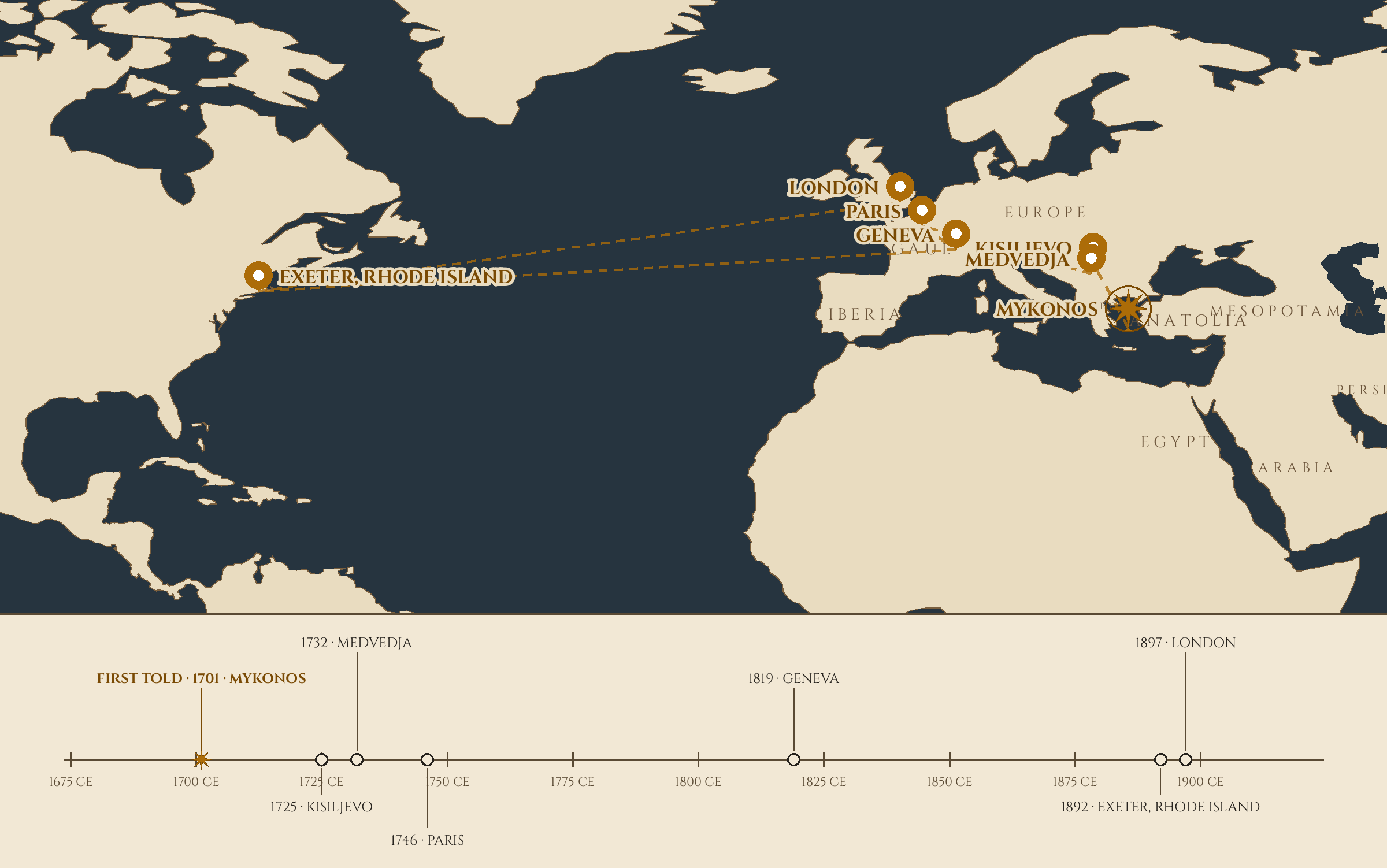
Where this lesson travels — on a shared sheet, and the sharing is the point. This is Lesson 30's map, kept deliberately: Mykonos, 1701, starred, where Tournefort's eyewitness account opened the telling in print (1717); Kisiljevo, 1725, where the imperial investigation opened the file; Medvedja, 1732, where the Visum et Repertum was signed; Paris, 1746, where Calmet carried the reports into European debate; and Exeter, Rhode Island, 1892, where the folk procedure was still at work in the years print was rebuilding the being. This lesson claims the last two pins: Geneva, where in the storm-bound summer of 1816, at the Villa Diodati, Polidori took up Byron's fragment, and The Vampyre followed in 1819; and London, where Bram Stoker's Dracula was published in 1897. One sheet, two keepers: the officials who filed the being, and the writers who rebuilt him. The starred pin is the first telling; the dashed line is the telling, traveling.
Lesson Objectives
By the end of this lesson, you will be able to:
- Name the vampire's first record in print: the tale, the year, the man whose name stood on it, and the man who actually wrote it.
- Follow the map Lesson 30 left behind, and say which of its pins belong to the record and which to the rebuilding.
- Trace the rebuilding through its three great stations — the penny serial, Carmilla, and Dracula — with a date and a fact for each.
- Say what print changed in the being: his class, his manners, his weapons, and his address.
- File the one great real-world watch the literary vampire produced, as record of behavior and not of any being.
- Meet the vampire's wider family on its parallel line: the jiangshi of Qing-dynasty China — its record, its rules, and the corpse-driving trade at its root — and say why it is kin, and why it is not a copy.
Your Assignment Packet
This lesson's work lives in its packet: the Lexicon Handout (every term, the core terms marked with the keeper's diamond ◆), Materials, Guided Practice, the Assignment Manual written out whole, the Scholar's Entry Page, the Reflection Questions, the Workbook Checklist, and the Keeper's Notes, for whoever teaches the lesson. Download the packet before you begin and keep it beside you as you read. The packet's assignment is Rookmere's own word for the work: Entry No. 31 — The Vampire in Print (written) ✎. The Unit V Quiz is not printed in the packet; it waits at the end of the unit, with Lesson 33.
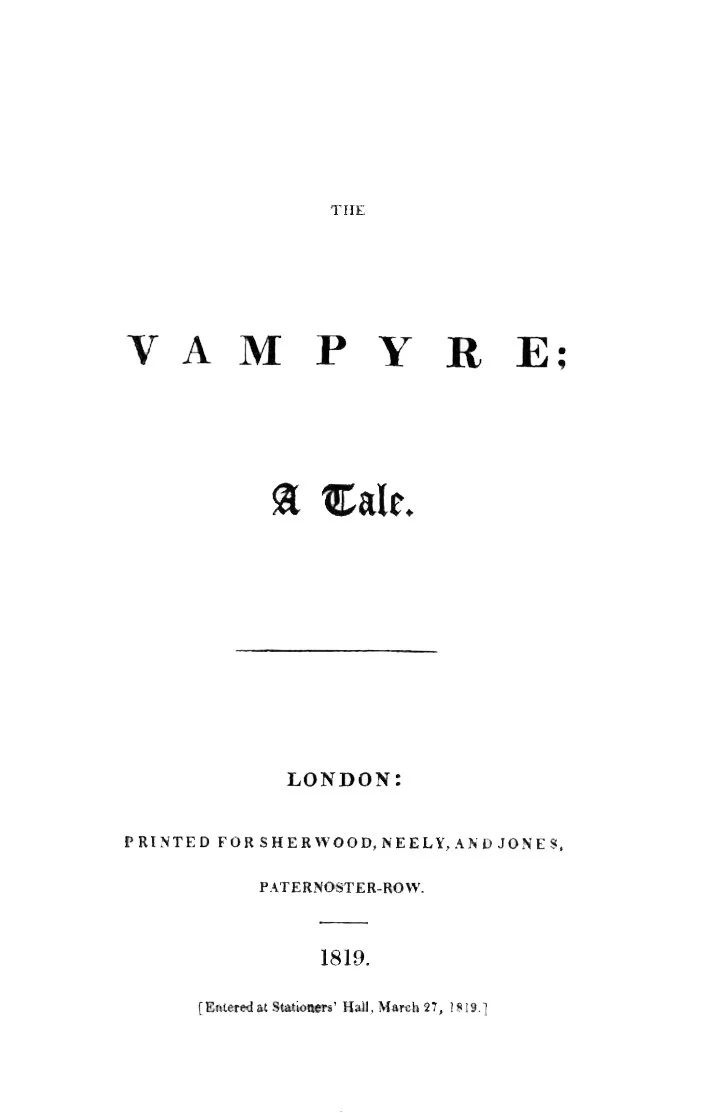
The title page of The Vampyre: A Tale (London, 1819) — the vampire's first record in print, published under Lord Byron's name; the tale was John William Polidori's, and the correction never caught up with the first impression. Public domain, via Wikimedia Commons.
The Creature: The Lord in Evening Dress, and His Pictures
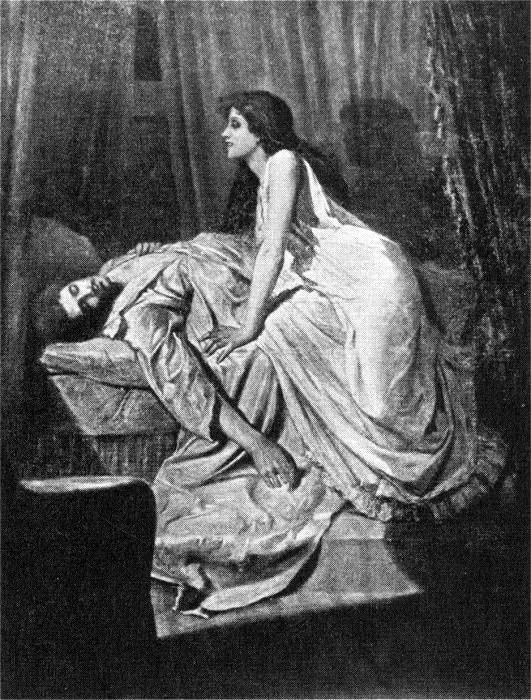
Philip Burne-Jones's The Vampire (1897): a woman vampire bending over her dead victim — the literary vampire as fine art in Dracula's own year, famous enough to draw a poem out of Rudyard Kipling. Public domain (PD-Art), via Wikimedia Commons.
Begin with the word, as this class always begins. Vampire — in the spelling of the first English reports, vampyre — reached English print in the early 1730s, riding the newspaper translations of the Serbian cases you filed in Lesson 30. For nearly a century it stayed a word of the reports: a thing officials investigated and villagers feared, a word out of Kisiljevo and Medvedja.
Then, in a single generation, the word changed trades. It left the report and entered the tale — and a tale plays by different rules than a report does. A report must name its witnesses. A tale must only please its readers. Everything in this lesson follows from that one change of keepers, and the entry you write will hold both kinds of line: what the writers made, which is record, and what they made of him, which is the modern belief entire.
Read his pictures in order, because they are this lesson's plot in advance. The literary vampire's first picture is not a portrait at all: it is the title page of 1819, the hero plate of this lesson — a page of type carrying another man's name. The first picture of the vampire in action is the Varney plate of the 1840s, a sword-fight sold for a penny. The third plate is new to this lesson: D. H. Friston's illustration for Carmilla in The Dark Blue (1872), the vampire at the bedside, drawn twenty-five years before Dracula — the Countess before the Count. The Dracula cover of 1897 refuses a picture altogether: yellow cloth, red lettering, nothing else. And the last plate answers it in the same year: Philip Burne-Jones's painting The Vampire (1897), a woman bending over her dead victim — the vampire as fine art in the year of the novel, famous enough to draw a poem out of Rudyard Kipling. One absence is part of the line. The silent film Nosferatu (1922) gave the being his most plague-like face, Count Orlok; but no still from it hangs here, because the stills' own archive pages do not carry the public-domain warrant this class requires, and the famous 1931 face — Lugosi's — is a copyrighted studio portrait. The lesson describes both. It hangs what it can warrant.
First Told in Print: *The Vampyre* (1819)
The map at the head of this lesson is the same sheet as Lesson 30's — deliberately. Its first three pins are the record's: Kisiljevo, 1725, starred, where the imperial investigation opened the file; Medvedja, 1732, where the Visum et Repertum was signed; Paris, 1746, where Calmet's dissertation carried the reports into European debate. This lesson's pins are the last two, and the first of them stands at Geneva.
The story of how the vampire got there is worth telling slowly, because it shows a book being born the way beings usually are: in company, in bad weather, with a challenge in the air. In the summer of 1816 — the Year Without a Summer, when the eruption of Tambora had darkened the skies of Europe and storms kept travelers indoors — Lord Byron rented the Villa Diodati on Lake Geneva. His personal physician, a young man of twenty named John William Polidori, traveled with him. On the famous storm-bound nights, the company read ghost stories aloud and challenged one another to write one. Mary Shelley, a guest in the same circle, began the tale that became Frankenstein. Byron began a fragment about a dying man, Augustus Darvell, and laid it down. Polidori took the fragment up.
Byron's own piece was real but unfinished; Byron published it himself in 1819, appended to his poem Mazeppa, where it sits to this day — two pages that stop in a graveyard, mid-sentence, as if the pen had been taken from the hand. Polidori took the fragment's situation — the traveling companion, the deathbed secret — and finished it in his own direction. The summer's other famous product worked the same way: a beginning made under pressure, in company, that its maker then carried far beyond the room.
What he made of it was published in London on 1 April 1819, in the New Monthly Magazine, under the title The Vampyre: A Tale. The hero plate at the head of this lesson is its title page, and the page is worth a keeper's slow look before we go any further. It promises A Tale. It gives the work a London publisher and a date. And it sets a great name over the whole thing — Byron's — in the place where a reader looks for the author. Polidori's name is nowhere on it. The tale was published as Byron's, and it was not Byron's. The name sold the magazine; the correction, printed afterward, never caught up with the first impression. A keeper files both lines: F, the book exists, dated and placed; and beneath the title, a belief the reading public held for a season — that a lord had written it — which the record itself corrects.
The tale's vampire is the rebuilding's foundation stone. Lord Ruthven — the name came ready-made from Lady Caroline Lamb's novel Glenarvon (1816), where a Ruthven had already stood for Byron himself — is no peasant corpse. He is an aristocrat: cold, polished, welcome in every drawing room in London, and dead behind the eyes. He does not rise from a village grave; he arrives by invitation. Print had taken the graveyard revenant of the reports and given him a title, a tailor, and a seat at the table. He has worn them ever since.
The Tales: The Penny Press, the Long Shelf, and the Stories Themselves
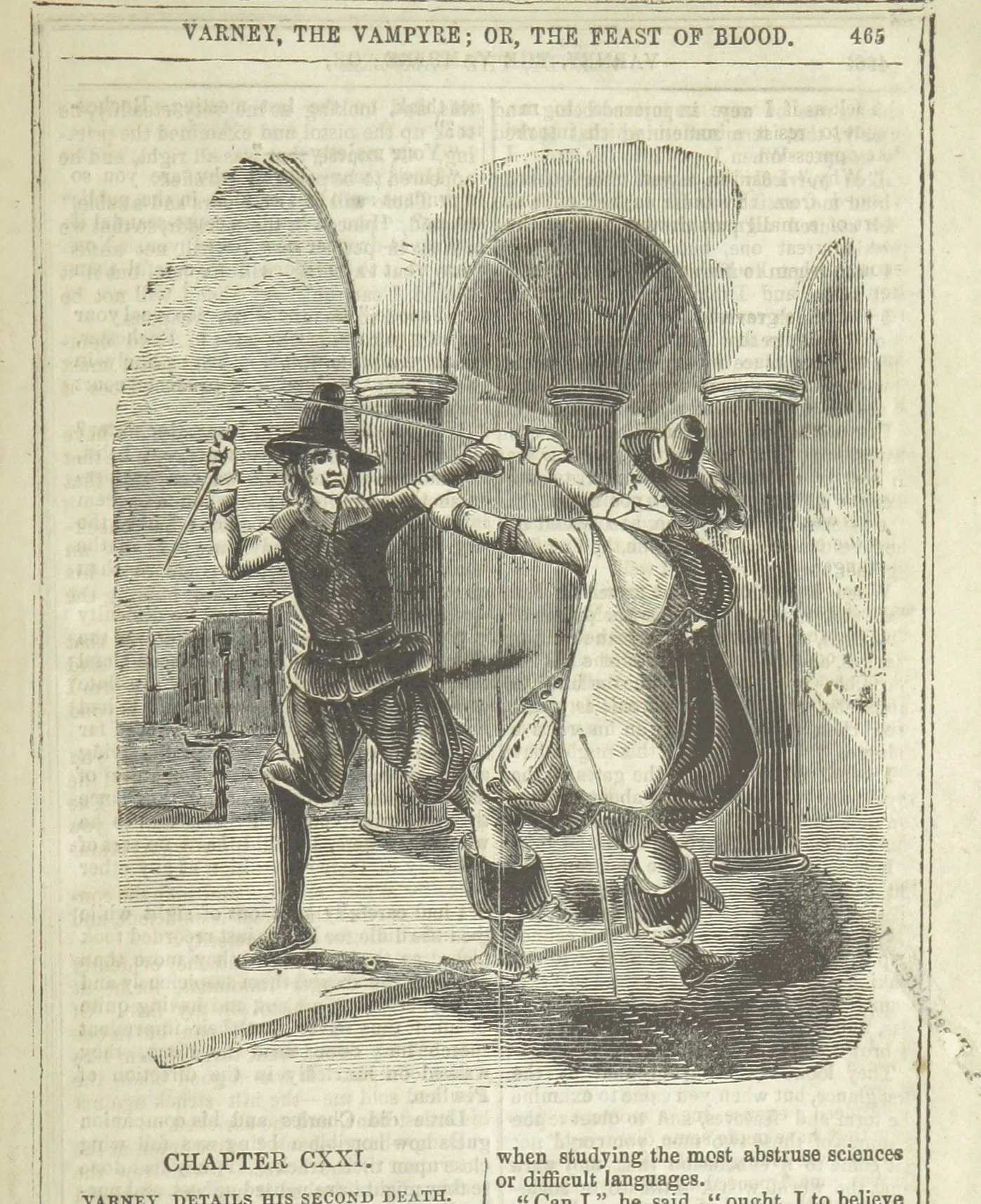
A plate from Varney the Vampire; or, The Feast of Blood (1845–47): a vampire sword-fight under the running head of Chapter CXXI — the penny serial at full gallop, built for the first mass readership the being ever had. Public domain, via Wikimedia Commons.
Polidori's tale was short. The nineteenth century made the vampire long.
The second station is the penny press. Varney the Vampire; or, The Feast of Blood ran in London as a penny serial from 1845 to 1847 — weekly numbers at a penny each, the cheap fiction the papers called penny dreadfuls and penny bloods — and gathered at last into a book of more than eight hundred pages. The plate in this lesson comes from deep inside that long run: a vampire sword-fight, blades crossed in mid-stroke, under the running head of Chapter CXXI. Notice what the picture is doing. It is an advertisement as much as an illustration — a penny's worth of promise, printed where a working reader flipping the number in a shop would land on it. One hundred and twenty chapters in, the serial is still fighting at full gallop. Authorship is usually given to James Malcolm Rymer, a professional of the penny press; Thomas Peckett Prest, another penny-press professional, also claimed it, and modern scholarship leaves the credit shared and unsettled — the record is not tidy, and the entry should say so. Varney matters to a keeper for two reasons. He is the first vampire built for a mass readership — hundreds of thousands of working readers met the being here, not in any report — and he is the first to be sorry: a tormented, reluctant monster who at last, in the serial's most retold stroke, destroys himself. The sympathetic vampire, who fills the modern shelf entire, begins as a pennyworth.
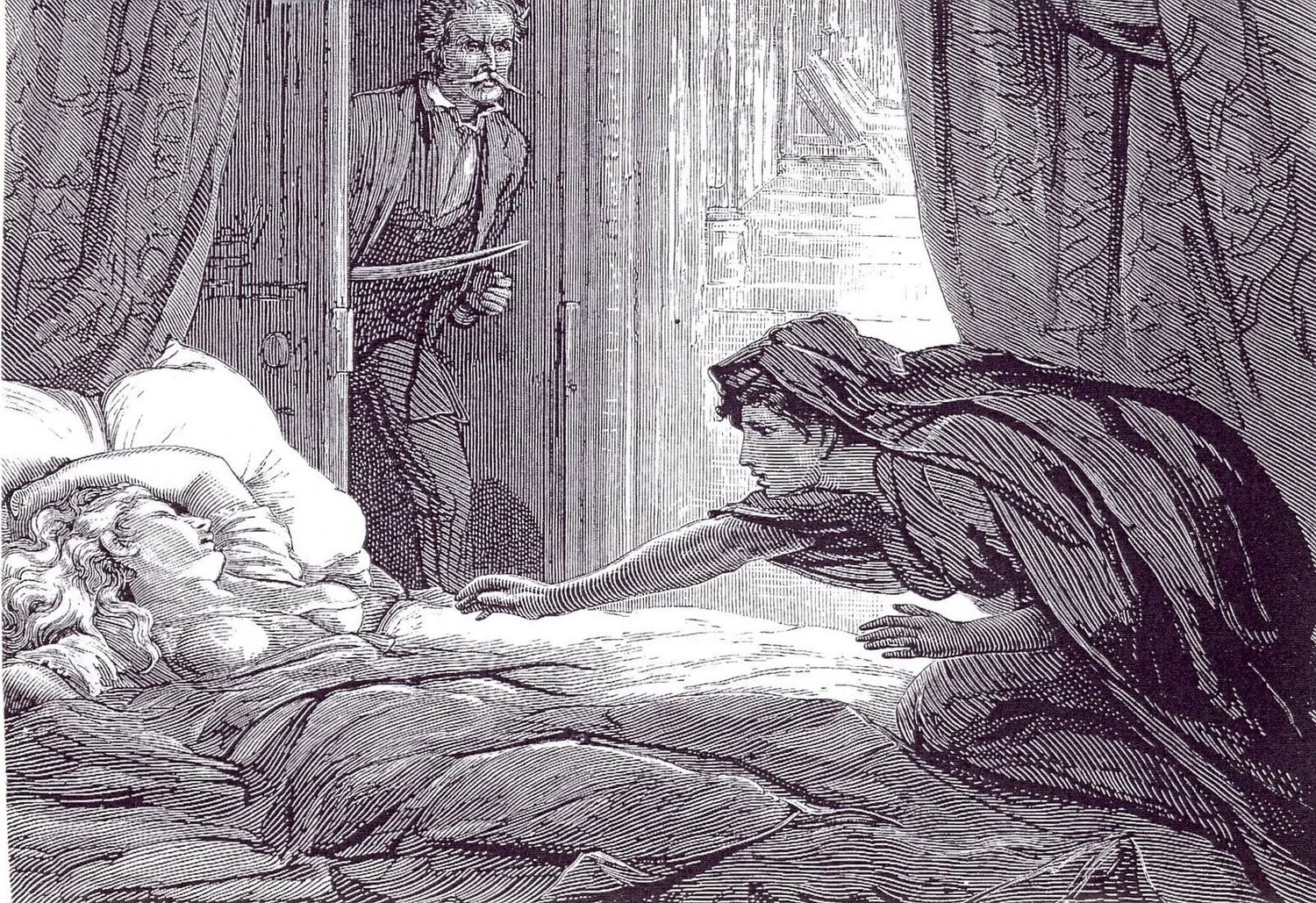
D. H. Friston's illustration for Carmilla in The Dark Blue (1872): the vampire at the bedside — the first dated picture of Le Fanu's vampire, drawn twenty-five years before Dracula: the Countess before the Count. Public domain, via Wikimedia Commons.
The third station is a refinement. In 1871–72 the Irish writer Joseph Sheridan Le Fanu published Carmilla in the magazine The Dark Blue (it appeared between hard covers in 1872, in In a Glass Darkly). His vampire is the Countess Mircalla Karnstein, who comes as a guest into a Styrian household and fastens on its daughter, Laura, who tells the tale. Carmilla stands a full twenty-five years before Dracula, and much of what readers take to be Stoker's furniture — the foreign castle country, the wasting young woman, the learned doctor marshaling the evidence — is already standing in Le Fanu's rooms. The chain back to Lesson 30 is a document, not an impression: Le Fanu adapted one of Carmilla's central episodes — the stranger who traps and decapitates a vampire troubling a town — from a case reported in Calmet's treatise. The Benedictine's dossier of 1746 is standing inside the novella of 1872.
And so to the last pin: London, 1897. On 26 May of that year Archibald Constable published Bram Stoker's Dracula — in the famous first dress your second support plate shows: yellow cloth, the title stamped in red. Look at that cover a moment, because it is a plainer object than the book's fame suggests. There is no castle on it, no bat, no face at a window — just yellow boards and red lettering, the dress of a respectable novel. The sensation is all inside, which was rather the point of the binding: a book a clerk could carry on a train. Stoker, an Irish theater manager writing at the end of his working days, built the book as an epistolary novel: no narrator, only documents — Jonathan Harker's journal, Mina's letters, Dr. Seward's diary kept on phonograph cylinders, a ship's log. It is the folk report rebuilt as a novel's machinery: where the Serbian officials filed their Visum et Repertum, Stoker's English party files its diaries, and the evidence accumulates the same way. His working notes survive, and they show the book first called The Un-Dead, its count renamed Dracula after Stoker read, in a Whitby library, William Wilkinson's Account of the Principalities of Wallachia and Moldavia (1820), which told him the name meant "devil" in the Wallachian tongue. The fuller biography of Vlad the Impaler that now clings to every retelling was argued into the book's company much later — most influentially in 1972 — and a keeper files it as growth, not as Stoker's source.
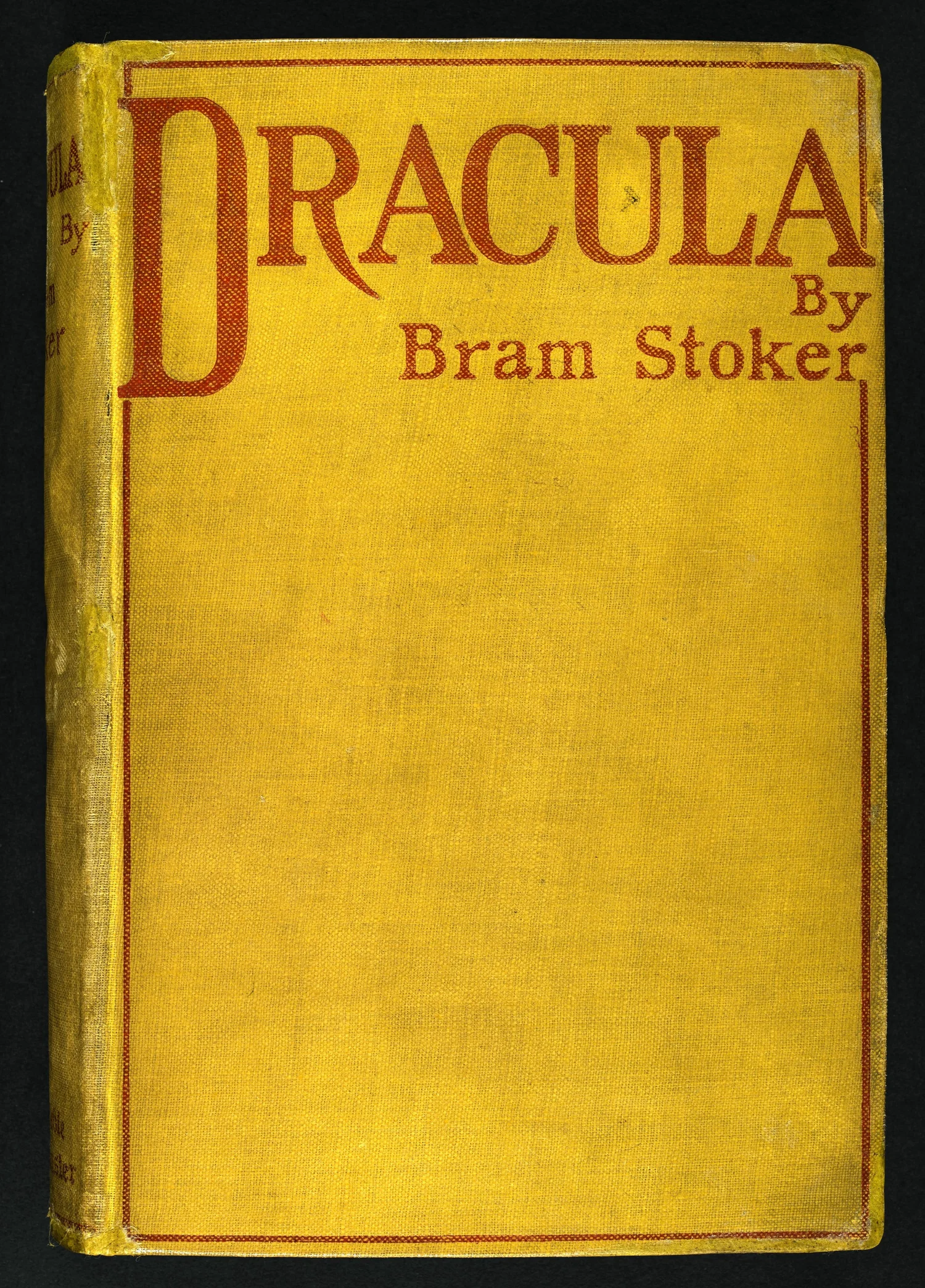
The first edition of Bram Stoker's Dracula (Archibald Constable, London, 1897), in its famous first dress: yellow cloth, the title stamped in red. Public domain, via Wikimedia Commons.
Two tellings carry the lesson, and both should be recounted plainly.
Polidori's Vampyre, in brief: the young gentleman Aubrey falls in with the fascinating, hollow Lord Ruthven, and travels with him to Greece, where Ruthven's attentions destroy the girl Ianthe, who had told Aubrey the local vampire lore he laughed at. Ruthven, mortally wounded on the road, exacts from Aubrey an oath: for a year and a day, say nothing of Ruthven's crimes or his death. Ruthven dies — and returns, alive in London society, beyond the reach of an oath-bound witness, and becomes engaged to Aubrey's own sister. The oath holds. The wedding proceeds. The tale ends at the threshold of the marriage chamber, with the sister gone and Aubrey broken. Notice the engine of the thing. Ruthven's sharpest weapon is a promise extracted at a deathbed — a social instrument, wielded in drawing rooms. The stake belongs to the old file. Print gave him etiquette, and etiquette turns out to be harder to break.
Dracula, in brief: a solicitor's clerk travels to a castle in Transylvania to sell its master an English estate; the Count comes to Whitby by a ship whose crew dies to the last man; a sleepwalking girl wastes on the cliffs; and a small party — a doctor, a lawyer, a lord, a Texan, and Mina Harker, whose shorthand and typewriter bind the evidence together — hunts the Count back across Europe to his castle and ends him. Every schoolchild of the print tradition knows the furniture now: the castle, the coach, the three brides, the garlic, the crucifix, the Count's strength and his rules. Lesson 30's file teaches you to ask of each piece: report, or rebuilding? Nearly all of it is rebuilding — which does not make it less real as record. The record of what 1897 believed is as dated, as placed, and as checkable as the record of what 1732 feared.
### Why the Bat? The Answer in Four Links
One question follows the Count out of this lesson and into every Halloween that has come since, and a keeper should be able to answer it in full: why do stories say vampires turn into bats? The answer is not in the graveyard file. It is a chain of four links, and every link can be dated.
The first link is the oldest, and the bat is not in it. The revenant of the folk record was already a shape-shifter, long before print rebuilt him. The Romanian material collected by Emil Petrovici and printed in Jan Perkowski's casebook gives the forms plainly: a person who dies in pain and regret turns into a cat or a dog and torments his relatives in the night; a dead person can turn into a moroi in the form of a dog, a horse, a sheep, or a man. Slavic vampires, in the record Felix Kanitz gathered in the Balkans, could appear as butterflies — the butterfly being an older figure for the departed soul, which had to be caught and burned or the vampire was not destroyed. Wolf, dog, cat, horse, sheep, butterfly: those are the record's animals, and the list is the point. The bat does not stand in it, and the Serbian reports of Lesson 30 never mention one.
The second link is a real animal, met on another continent. The blood-drinking bats live only in Central and South America; no bat of Europe drinks blood, and none was known in Europe before Spanish explorers observed the American bats in the sixteenth century. When the animal got its English name, the borrowing ran from the monster to the animal, not the other way round: the Oxford English Dictionary records vampire for the folkloric being in English from 1734, and for the zoological bat not until 1774. The bat was named for the legend. By the nineteenth century the famous animal was print matter in its own right. Charles Darwin's Voyage of the Beagle (1839) tells of a vampire bat caught in the act on a horse's back near Coquimbo, in Chile — a circumstance, Darwin notes, that had lately been doubted in England. Stoker knew the real bat as a real bat, and put it in his novel as one: Quincey Morris, in Dracula itself, remembers a mare on the Pampas pulled down in a night by "one of those big bats that they call vampires." That is the animal in the book, named and separate. The Count's bat is a different thing, and it is the third link.
The third link is Stoker's choice, and the novel's own text is the warrant. Again and again in Dracula a great bat attends Lucy Westenra: Mina, at Whitby, watches one flit in whirling circles against the moonlight while Lucy sits up in her sleep and points to the window; Dr. Seward records a great bat buffeting its wings against Lucy's window in London. In Chapter 18 Van Helsing gathers the sightings into the vampire's catalogue of powers, and the bat stands in both halves of it. The vampire, he says, can command "the rat, and the owl, and the bat — the moth, and the fox, and the wolf"; and stronger still, "he can be as bat, as Madam Mina saw him on the window at Whitby, and as friend John saw him fly from this so near house, and as my friend Quincey saw him at the window of Miss Lucy." Even as he speaks, a big bat settles on the window-sill outside, and Morris goes out to shoot at it. One neighbouring scene must be filed exactly, because later pictures blur it: when Harker watches the Count leave the castle, the Count is not a bat. He crawls down the castle wall in his own shape, face down, his cloak spreading out around him "like great wings," moving "just as a lizard moves along a wall." A bat-like vampire had already appeared once in Gothic print — as an illustration in Varney the Vampire, fifty years before Dracula — but the Dracula scholar Elizabeth Miller states the fixing plainly: Stoker's major contribution was the idea that a vampire could shape-shift into the form of a bat, as well as a wolf and mist, and it is his novel that cemented the connection between bats and the vampires of folklore. Of all the record's animal forms, print had chosen one, and chosen the one the folklore list did not contain.
The fourth link is film, which carried Stoker's bat where the novel alone could not. The first Dracula film, Nosferatu (1922), did not use bats at all — its animal company was rats, and plague. Universal's Dracula of 1931, with Bela Lugosi, used them from its first scenes: the innkeeper warns that Dracula and his wives take the form of wolves and bats and feed on the blood of the living; the coachman vanishes and a great bat flaps above the horses, guiding the carriage to the castle; a bat beats at Mina's window before the Count appears in her room. Miller's judgment on that film is the one the record since has borne out: it provided the twentieth century with its most memorable and lasting images of Count Dracula, the bats among them, and the images survive. Decade after decade of screens repeated the shorthand — a bat at the window, a cape gathered like wings, a man where the bat had been — until the transformation no longer needed explaining to any audience, and a late literary fixing came to look like ancient folklore.
Hold the four links apart, then, as this class holds all its lines apart. A shape-shifting revenant is folklore. A small American bat named for that revenant is zoology, and its true paragraph — how Desmodus rotundus actually feeds, and what it does not do — is filed where it belongs, in Still With Us below. The vampire who becomes a bat is literature: Stoker, 1897. The bat transformation as the standard picture, known to people who have read nothing, is film: 1931 and everything that copied it. Stories say vampires turn into bats because a novelist chose the bat, and the cinema taught the choice to the world.
KEEPER'S CHECK-IN
Trace the rebuilding through its three great stations — the penny serial, Carmilla, and Dracula — giving a date and one fact that belongs to each station alone.
Spotted: The Vampire on Stage, in Court, and in the Papers
The stage took him first. Polidori's tale was dramatized within a year, in Paris and in London — the London version of 1820, by James Planché, is credited by theater historians with a piece of stage machinery, the "vampire trap," a trapdoor through which Ruthven could vanish under the audience's eye. In the 1920s the stage Dracula (Hamilton Deane's, then John Balderston's) put the Count into evening dress and a opera cloak, and Universal's film of 1931, with Bela Lugosi in the part, fixed that dress — and the accent — as the being's public uniform for a century.
Print kept one more grip on him even in the cinema's century, and the episode reads like one of Stoker's own courtroom chapters. In 1922 a German company, Prana Film, released Nosferatu, a Dracula retelling made without the Stoker estate's permission — the names changed, the story unmistakable. Bram Stoker's widow Florence sued, and the court ordered every copy of the film destroyed. The order stands in the record; so does its failure, for prints survived in hiding, and the condemned film is now accounted a masterpiece of the silent screen. A keeper files the whole sequence without blinking: the rebuilding of a folk being by print had become property, defended in court like a house — which, by 1922, is exactly what the vampire had become.
KEEPER'S CHECK-IN
In 1922 the rebuilt vampire had become property defended in court: what did Florence Stoker's lawsuit order done to Nosferatu, and what happened anyway?
What People Watched For — The Watch at Highgate
Print's vampire produced one great real-world watch, and it is filed here because the class files behavior as carefully as books.
In February 1970 the Hampstead and Highgate Express, a London local paper, printed letters describing a tall figure seen among the tombs of Highgate Cemetery. A local investigator, Sean Manchester, announced that the figure was a vampire and that he would perform an exorcism on Friday, 13 March 1970. Television interviewed the claimants that evening; within hours, a crowd of would-be hunters — many carrying homemade stakes, in the best print tradition — swarmed over the locked cemetery's walls despite the police, and the paper reported the hunt to the city. The folklorist Bill Ellis studied the episode in the journal Folklore (1993) and named the pattern: legend-tripping, the acting-out of a story at the place the story points to.
File it precisely. The watchers were real; the damage to a working cemetery was real; the vampire was Ruthven's and Lugosi's heir, assembled by print and film, watched for in a graveyard by people carrying the books' own tools. That is what print built — and a keeper records the building and the watching with the same pen, and believes neither the stake nor the wearer of it.
What It Actually Is
Why did print rebuild the vampire so completely? The root is not mystery; it is the economics and the appetite of a new reading world.
The reports gave literature a being with a peculiar vacancy in him: a dead man who walks, about whom the folk record said almost nothing of character. He had no speeches, no motives, no drawing room. Each new keeper supplied the vacancy from his own century's stock. Byron's circle supplied the aristocrat — the vampire as the fascinating, ruinous great man, a portrait from life. The penny press supplied length, sensation, and at last remorse: a monster who could carry eight hundred pages had to be given an inside. Le Fanu supplied intimacy and dread in a minor key. Stoker supplied the paperwork of an empire — typewriters, telegraphs, phonographs, railway timetables — turned against an ancient thing traveling the other way.
Underneath all four runs the same current as Lesson 30's panics, running the other direction. The villagers of Kisiljevo looked at early death and saw a neighbor not resting. The readers of London looked at their own polished, predatory, fascinating world and saw a lord not dying. Both are the belief doing its work; print simply gave the work its largest audience in the being's history. A keeper does not rank the two. A keeper records both, and keeps the dates straight.
The Wider Family — The Parallel Line: The Jiangshi, China's Stiff Corpse
One family member remains, and he does not belong to the line you have been following. While Europe was turning its grave-revenant into a lord, another civilization, in complete independence, grew the same figure from entirely different roots — and then, in our own century, fixed him for the world by film, exactly as this lesson has shown film fixing the Count. He is placed here, in the print lesson, because print and film are his keepers too. But hear the keeper's caution first, because the English language will try to mislead you: he is called, in English, the Chinese "hopping vampire." That name is a borrowed label, fitted to him afterwards by comparison. His own name says nothing about blood at all. Jiangshi (殭屍, jiāngshī) means, plainly, stiff corpse — and stiffness, not thirst, is where his tradition begins.
His record is a record of books, and it can be dated as firmly as anything in Lesson 30. The tale to start with is Pu Songling's "Corpse Transformation," in Strange Tales from a Chinese Studio (Liaozhai zhiyi) — tales Pu (1640–1715) gathered across the late 1600s and early 1700s, circulated in manuscript among his friends, and saw printed only after his death, in 1766. Four travellers take lodging for the night in a house where a dead woman lies awaiting burial. In the night the corpse rises, comes to the beds, and bends over each sleeper in turn, breathing on him — three times over each. Three of the men do not wake. The fourth, awake and terrified, pulls the quilt over his head and holds his breath; the corpse breathes over the covered head, three times, and passes on. When she comes again he flees, and she pursues him — running, mark you, not hopping — until, lunging at him around the trunk of a white poplar, she drives her fingernails so deep into the wood that she cannot pull free, and stiffens there against the tree. In the morning the county magistrate comes in person to conduct an inquest, finds her hands fixed in the trunk like an awl's holes, and gives the survivor a certificate to take home — the tale ends, as Lesson 30's cases end, in an official's paperwork. File the shape of it: a corpse that kills by breath, defeated for one night by a held breath, and closed by a magistrate's certificate. The breath is the weapon and the telltale both, and the logic is the tradition's own: what the corpse takes and what it hunts by is bound up with breath — with qi, the vital breath-energy that animates the living.
The two great Qing collectors then did for the jiangshi what Calmet, in his different way, did for the vampire: they gathered the accounts and tried to say what the thing was. Yuan Mei's Zi buyu — What the Master Would Not Discuss — first appeared in print in 1788, a collection of more than seven hundred supernatural anecdotes gathered over years. Yuan Mei states the soul mechanics directly, and a keeper reports them as the texts' own belief system, which is how this class reports any people's account of their dead: a person is governed, in the traditional account Yuan Mei is working from, by three hun souls and seven po souls, and "a person's hun is good but the po is evil, the hun is intelligent but the po is not so good." When the hun leaves the body after death but the po remains and takes control of it, the dead person becomes a jiangshi — a body still animated, but by the lower soul alone. Ji Xiaolan, compiling his Yuewei caotang biji between 1789 and 1798, classified the causes of reanimation into two great categories: a recently deceased person returning to life, and a corpse long buried that does not decompose. Around those two poles the accounts gather their causes: a corpse absorbing enough yang qi from sun and moon to return to life; the dead left unburied after the funeral; a bolt of lightning striking the coffin; a cat leaping across it. The keeper notes that last cause and files no connection — the Romanian record of Lesson 30 fears the cat over the corpse for its own reasons, in its own country. Two traditions, one household fear, arrived at separately: that is what a parallel line means, and it is more interesting than any borrowing would be.
The rules, as the texts give them, are these. The body is stiff — the name is the description — and the accounts describe greenish-white skin, great strength, and a being that may run in pursuit and, grown old and full of absorbed yang energy, may even fly: the sinologist J. J. M. de Groot's great study of China's religious system preserves the account of a jiangshi that "came from the hills, soaring through the air, to devour the infants of the people." What it feeds on, in the tradition's own terms, is qi — the life force of the living — not blood; the blood-drinking jiangshi arrives later, and a keeper will meet him below, wearing film clothes. The counters Yuan Mei records are equally the tradition's own: evil spirits withdraw at a rooster's call, because the call comes with the sunrise; seven jujube seeds nailed into the points of a corpse's back; and fire, of which Zi buyu says, in the flat tone of a man filing an observation, that when a jiangshi is set alight there is a sound of crackling, blood rushes forth, and bones cry. Breath, sunrise, stiffness, flight: hold those four, and you hold the Qing jiangshi as his own record gives him — before any camera touched him.
His real root stands in the mountains of western Hunan, and it is a trade, not a monster. The practice is called corpse-driving — Xiangxi ganshi (湘西趕屍), "driving corpses in Xiangxi" — and it answers a duty this class has met before in other dress: the dead must be buried at home. In the Qing centuries, labourers from across China went to work in the backwaters of Xiangxi, and the mortality among them was high; a man who died there was owed burial beside his family, in his ancestral ground, lest his soul feel homesick in a strange place. So a profession arose to carry the dead home, over distances the accounts measure in thousands of li. The method the record describes most often is carpentry, not sorcery: the corpses were arranged upright in single file and tied to long bamboo rods at their sides, and two men — one at the front, one at the back — carried the ends of the rods on their shoulders and walked. Bamboo flexes. As the carriers walked, the rods bounced, and the upright dead, seen from a distance, appeared to be hopping in unison. The drivers travelled by night — to avoid the crowds of the day, and because cooler air is kinder to the work — and in the legendary version of the trade they rang bells as they went, to warn the living out of the way, since it was ill luck to set eyes on the procession. The ethnographic record keeps a second method beside the first, and a keeper files both: Liao Yiwu's The Corpse Walker (published in English in 2008) preserves two oral accounts of corpse transport, in one of which a two-man team works differently — one man carrying the corpse on his own back beneath a large robe that covers them both, a mourning mask set on top, while his partner walks ahead with a lantern to call out the obstacles, since the carrier beneath the robe cannot see. Two methods, one duty. But stand at a distance on a mountain road at night, as a villager stood, and watch the lantern come and the line of the dead bounce past on their poles, and the jiangshi needs no inventor. He was seen, nightly, by people who did not know what they were looking at — and what they were looking at was love doing heavy work: sons and brothers paying professionals to bring their dead home. De Groot adds the darker soil the belief also grew in: unburied corpses were a common sight in imperial China, and a culture with strong taboos about postponing burial had reasons of its own to imagine what an unburied body, left to soak up the sun's and moon's energy, might do. The hopping corpse of the films is a joke with a funeral inside it. Keep both in view, as this class keeps both.
His modern face was made the way the Count's was: by a fixing. Hong Kong had already tried the figure on screen — Sammo Hung's Encounters of the Spooky Kind (1980) built much of the pattern — and then, on 7 November 1985, came Mr. Vampire, directed by Ricky Lau and produced by Sammo Hung, with Lam Ching-ying as Master Kau, a Taoist priest whose unibrowed gravity anchors the film: hired to oversee the reburial of a rich man's father — the corpse-driving duty, turned into a plot — he finds the body twenty years buried and undecayed, and the reburial goes wrong. The film was a breakthrough success, the defining work of the jiangshi genre; four sequels followed from Lau between 1986 and 1992, and a whole wave of hopping-vampire films ran across Hong Kong and East Asia before subsiding in the mid-1990s. The cinema standardized him as the century had standardized Dracula, and a keeper files the standardization precisely, because half of what the internet calls ancient jiangshi lore is this film's wardrobe: the Qing official's robes and round-topped hat as his standard dress; the yellow paper talisman — the fulu, a sealing spell — pasted to his forehead to hold him still; sticky rice among his counters; and the held breath as the way to escape him, since the film's jiangshi is blind and finds the living by their breathing. Even that last rule keeps one foot in the older record: Pu Songling's traveller held his breath under a quilt a century and more before the Qing fell, and the film's Taiwan release title was, literally, Hold Your Breath for a Moment. The blood-drinking, by contrast, is the traffic running the other way — the Western vampire's habit, taken up by the modern jiangshi under Hong Kong cinema's Western influence, where the tradition's own texts had fed him on qi. Two vampire lines, separate for millennia and centuries respectively, meet at last in the twentieth century's cinema and trade costumes. The meeting is modern. The lines are not. As with Nosferatu and Lugosi in §1, this lesson hangs no still from Mr. Vampire: the film is in copyright, and the class hangs what it can warrant. It describes the hopping corpse in his robes and talisman, and that description is the plate.
So file the parallel line beside the main one, and let the comparison do the teaching. Kin: a corpse that does not rest, feared at night by the households that knew it, bound by strict rules the living can learn, gathered at last into dated books by scholars who half-believed what they filed, and fixed for the modern world by a single famous film. Not kin: everything underneath. The Western vampire grew from decomposition misread in winter graves and deaths that clustered like contagion; the jiangshi grew from a soul that leaves in parts and a duty that carries the dead home over mountains. One feeds, in his first record, on the blood in an opened grave's mouth; the other, in his, on breath and qi. The same figure, invented twice, from different griefs — that is the widest fact in this unit, and the keeper writes it down without needing either line to have borrowed from the other. The tradition is a living one, reported here from its published records with the respect this class gives every people's account of their dead; the jiangshi walks on today in games, toys, and Halloween dress on the far side of the world from Xiangxi, most of it still wearing the wardrobe a 1985 film gave him. The corpse-drivers' lantern is out. The figure it lit is still travelling.
Still With Us
The name also traveled in the opposite direction, into zoology, and the real animal deserves its paragraph. The common vampire bat, Desmodus rotundus, is a small bat of Central and South America — about 30 grams in weight, with a wingspan of roughly 35 centimeters — that feeds at night on the blood of sleeping animals, usually livestock. It makes a shallow cut with sharp front teeth and laps the blood rather than sucking it, and an anticoagulant in its saliva keeps the meal flowing while it feeds. Naturalists gave the bat the being's name in the nineteenth century, working backward from the legend; the bat itself is a much older and entirely unliterary creature, and it explains none of the Serbian file — no bat of Europe drinks blood, and the reports never mention one. File the bat where it belongs: a real animal wearing a borrowed name, the reverse of everything else in this lesson.
The later twentieth century finished Polidori's work and Varney's together: the vampire became a protagonist. Anne Rice's Interview with the Vampire (1976) let him tell his own tale in the first person, rueful and gorgeous, and the shelf since then — novels, films, games, a whole section of every bookshop — is built on the doubled inheritance: Ruthven's manners, Varney's remorse. He is now, by a distance, the most famous being in this unit, and the least like his first record. The peasants in his grave at Kisiljevo would not know him. That distance, measured honestly, is the lesson.
Guided Observation
Study the hero plate: the title page of The Vampyre (1819). Read it as a keeper reads any title page — as evidence arranged by its makers. The title promises A Tale. Beneath it stands a name that is not the author's. What does the page tell you truly (the publisher, the place, the year, the form of the work)? What does it tell you falsely, and for whose benefit? Then look at what the page cannot tell you at all: that the tale began as another man's fragment, in a villa in Switzerland, three years earlier. Write down one line this title page earns as record, one it earns as belief, and one question it cannot answer — the three kinds of line you will meet on every title page you ever file.
Assignment Manual
✎ WRITTEN · ⚒ HANDS-ON · ◐ BOTH
✎ Written · Entry No. 31: The Vampire in Print.
- Prepare the page. Rule a fresh page of your bestiary to the Scholar's Entry Page in this lesson's packet, as always. Head it: Entry No. 31 — The Vampire in Print. Beneath the head, note in one line that this entry shares its map with Entry No. 30, and why.
- Write the entry to the standard. The Creature: the lord in evening dress, and his depiction line read — title page, Varney plate, Friston's Carmilla, the pictureless Dracula cover, Burne-Jones's painting. First Told: The Vampyre — where it was published, when, under whose name, and by whose hand; the villa, the lake, the summer, and the fragment it grew from. The Tales: the three stations — the penny serial, Carmilla, Dracula — each with its date and one fact that belongs to it alone; then Ruthven's oath and Dracula's documents, three or four lines each, in your own words. Spotted: the stage vampire and the Nosferatu case, dated. What It Actually Is: the vacancy the reports left, and what each new keeper filled it with. Still With Us: the bat, the first-person vampire. The Keeper's Line: your own judgment, in one or two lines.
- The comparison. From your Entry No. 30, take three traits of the vampire of record — his station, his investigators, his ending, or others you filed. Set each beside its print rebuilding from this lesson, trait for trait. This small table is the heart of the entry: it is the exact place where one being becomes two.
- Mark every line. F for the making — books, dates, publishers, performances. T for the made — everything the tales hold to be true of the vampire himself. The Highgate watch, if you include it, marks F for the watchers and S for what they reported seeing: the watchers are record, whatever they watched for is not.
- File the title page. Beneath your entry, copy the title page of The Vampyre as a keeper files it: title, name as printed, and then, in brackets, the truth the page omits. A title page is a witness; this step teaches you to cross-examine one.
- File the parallel line. Add the jiangshi beneath your entry, in the same standard. The name and what it means. One Qing text, dated — Pu Songling's "Corpse Transformation" (printed 1766), Yuan Mei's Zi buyu (1788), or Ji Xiaolan's classification (1789–98) — with its rule: stiffness, breath and qi, the counters the texts name. The real root in two lines: the corpse-drivers of Xiangxi, the bamboo rods, the night road home. The fixing in one line: Mr. Vampire (1985), and one item of film wardrobe the older record does not contain. Then the Keeper's Line for the family entire: why the jiangshi is the vampire's kin, and why he is not a copy. Mark the books and the film F, the being T.
The printable packet for this lesson — the Lexicon Handout, the Guided Practice, this manual, and the Scholar's Entry Page — is linked on this page.
Materials
· Your bestiary journal or notebook — kept for the whole class
· Pencils, and a pen you like writing with
· A red pencil, for marking
· A ruler, for ruling your entry pages
· This lesson's packet (the Scholar's Entry Page is in it)
Reflection
Polidori's tale wore Byron's name into the world, and the correction never caught it. What does the entry owe a reader when a famous error is itself part of the record?
The reports made the vampire a neighbor; print made him a lord. What does each version let its audience fear — and which fear is closer to home?
At Highgate in 1970, the watchers carried the books' tools into a real cemetery. Where exactly is the line between studying a record and acting it out?
A Closing Note
Two vampire lessons, two keepers, one being — and you can now watch him change hands without losing the thread: a Serbian graveyard, a Geneva villa, a London bookshop, a London cemetery, in that order, every step dated. Next lesson the shelf turns east and older, to a being print did not invent but mistranslated — the ghoul, who was a terror of the desert road long before Europe dug him a graveyard. Keep your dates straight, and your R and B honest.
The Bestiary
Bestiary Keeper
Further Reading & Sources
John William Polidori, The Vampyre: A Tale (1819) — the first record in print; free in facsimile and transcription at Project Gutenberg and the Internet Archive.
Bram Stoker, Dracula (1897) — read it as the lesson reads it: a file of documents, in order.
J. Sheridan Le Fanu, Carmilla (1872) — the refinement before Stoker.
Bill Ellis, "The Highgate Cemetery Vampire Hunt," Folklore 104 (1993) — the scholarly record of the 1970 watch.
James Malcolm Rymer (attrib.), Varney the Vampire; or, The Feast of Blood (1847) — the penny serial whole, free at Project Gutenberg Australia and the Internet Archive.
Bram Stoker's notes for Dracula, Rosenbach Museum & Library, Philadelphia — the book under construction, The Un-Dead and all.
Pu Songling, Strange Tales from a Chinese Studio (Liaozhai zhiyi, printed 1766) — "Corpse Transformation," the jiangshi's breath and the held breath, in Herbert A. Giles's translation (1880) and later ones.
Yuan Mei, Zi buyu (1788), in English as Censored by Confucius: Ghost Stories by Yuan Mei, trans. Kam Louie and Louise P. Edwards (1996) — the hun and the po, in the collector's own statement; and Liao Yiwu, The Corpse Walker (English edition, 2008) — the corpse-drivers' trade in oral account.
Submit your work for this lesson using the form below.
CONTINUE IN THE BESTIARY HALL
← Previous · Lesson 30: The Vampire of Record Next · Lesson 32: Ghouls →
Unit V — The Changed The Bestiary Hall — All 41 Lessons
The rest of Unit V: Lesson 29 · Werewolves · Lesson 30 · The Vampire of Record · Lesson 32 · Ghouls · Lesson 33 · The Zombie