

THE BESTIARY
Unit V · Lesson 32Ghouls
Professor Sable Rookmere
Bestiary Keeper
The Bestiary Hall • School of Evershade
Professor's Introduction

Every other being in this unit was rebuilt by its later keepers. The ghoul was something rarer: mistranslated. She begins — for she is very often she in the old record — as a terror of the desert road, a being of distance and darkness and the fear of being lost. Europe received her through a French translation, and the translation quietly moved her address: out of the desert, into the graveyard. This lesson walks her home again, one dated stop at a time. It is the finest example in the whole class of why a keeper asks, of every line: whose words are these, and what did they keep?
The Bestiary
Bestiary Keeper
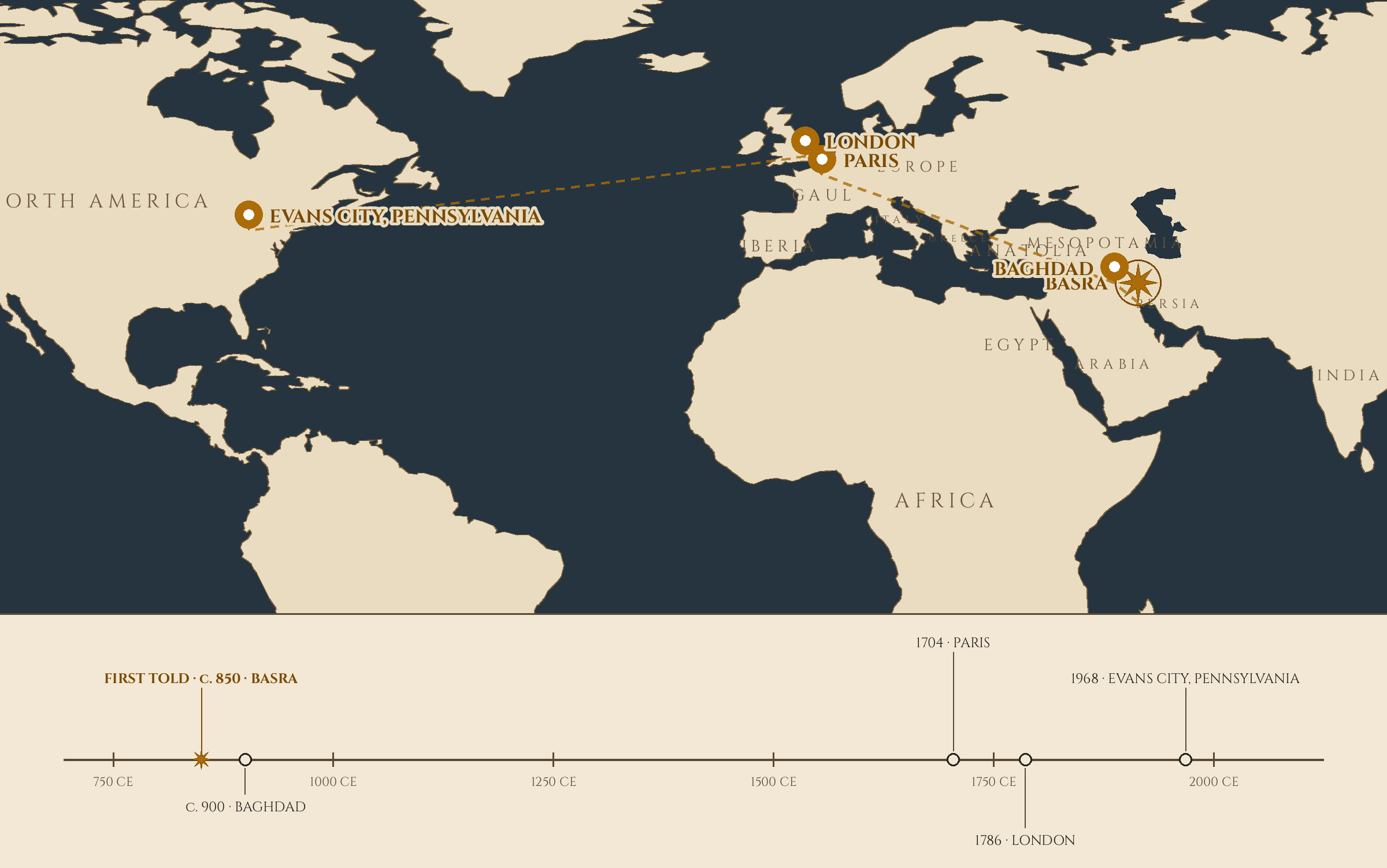
Where this lesson travels: Basra, in what is now Iraq, where al-Jāḥiẓ catalogued the ghūl in his Book of Animals about 850 — the pin wears its hedge on its face, for the map marks both the date and the place approximate; Baghdad, where from about 900 the collection that became the Thousand and One Nights began its centuries of assembly; Paris, where Galland's Les mille et une nuits (1704–1717) carried the ghoul into Europe; London, where Beckford's Vathek was published in 1786; and Evans City, Pennsylvania, where George Romero filmed Night of the Living Dead in 1968 and the ghoul's modern face was renamed by its audience. The starred pin is the first record; the dashed line is the telling, traveling.
Lesson Objectives
By the end of this lesson, you will be able to:
- Give the ghoul's own name in its own language, and say what the name itself claims the being does.
- Name the first record: the author, his city, his book, and the approximate date — and carry the hedge the map carries.
- Tell the tale of Sidi Nouman as Europe received it, and say whose telling carried it west.
- State the great correction of this lesson: what the Arabic ghūl chiefly was, and what the Western ghoul was made into instead.
- Follow the being's modern face to a Pennsylvania film set, and say what name it lost there.
Your Assignment Packet
This lesson's work lives in its packet: the Lexicon Handout (every term, the core terms marked with the keeper's diamond ◆), Materials, Guided Practice, the Assignment Manual written out whole, the Scholar's Entry Page, the Reflection Questions, the Workbook Checklist, and the Keeper's Notes, for whoever teaches the lesson. Download the packet before you begin and keep it beside you as you read. The packet's assignment is Rookmere's own word for the work: Entry No. 32 — Ghouls (written) ✎. The Unit V Quiz is not printed in the packet; it waits at the end of the unit, with Lesson 33.
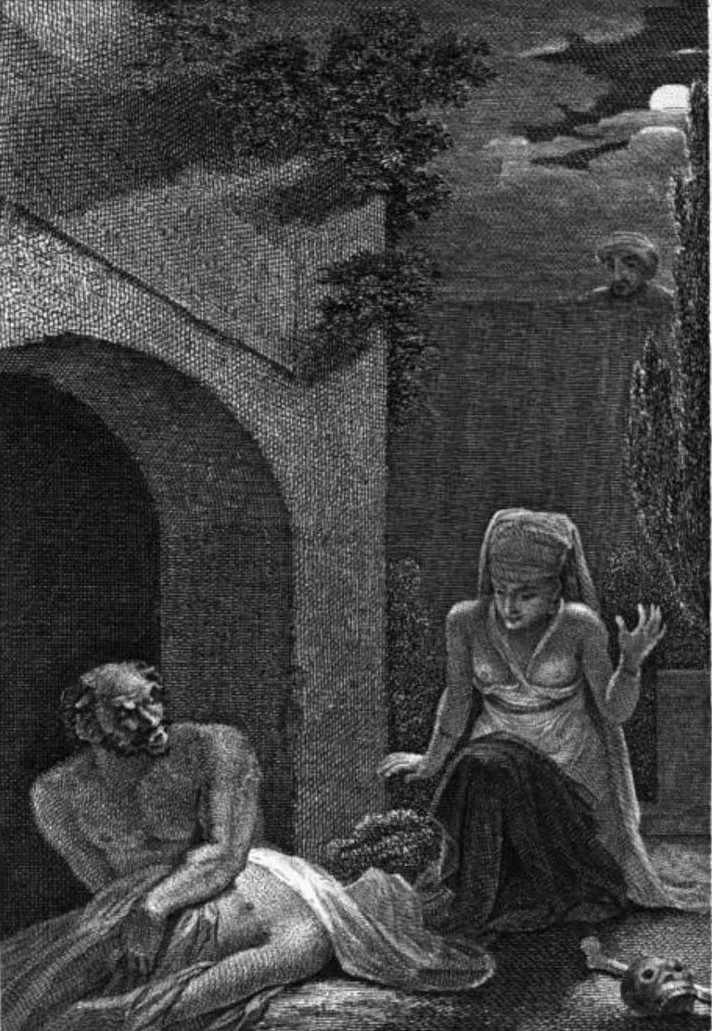
R. Smirke's engraving Amine Discovered with the Goule, for an early English Arabian Nights: Sidi Nouman watches from the shadows as his wife keeps her graveyard company — the graveyard doing the work the desert did in the older strain of tales. Public domain, via Wikimedia Commons.
The Creature: The Ghūl, and the Pictures She Never Sat For
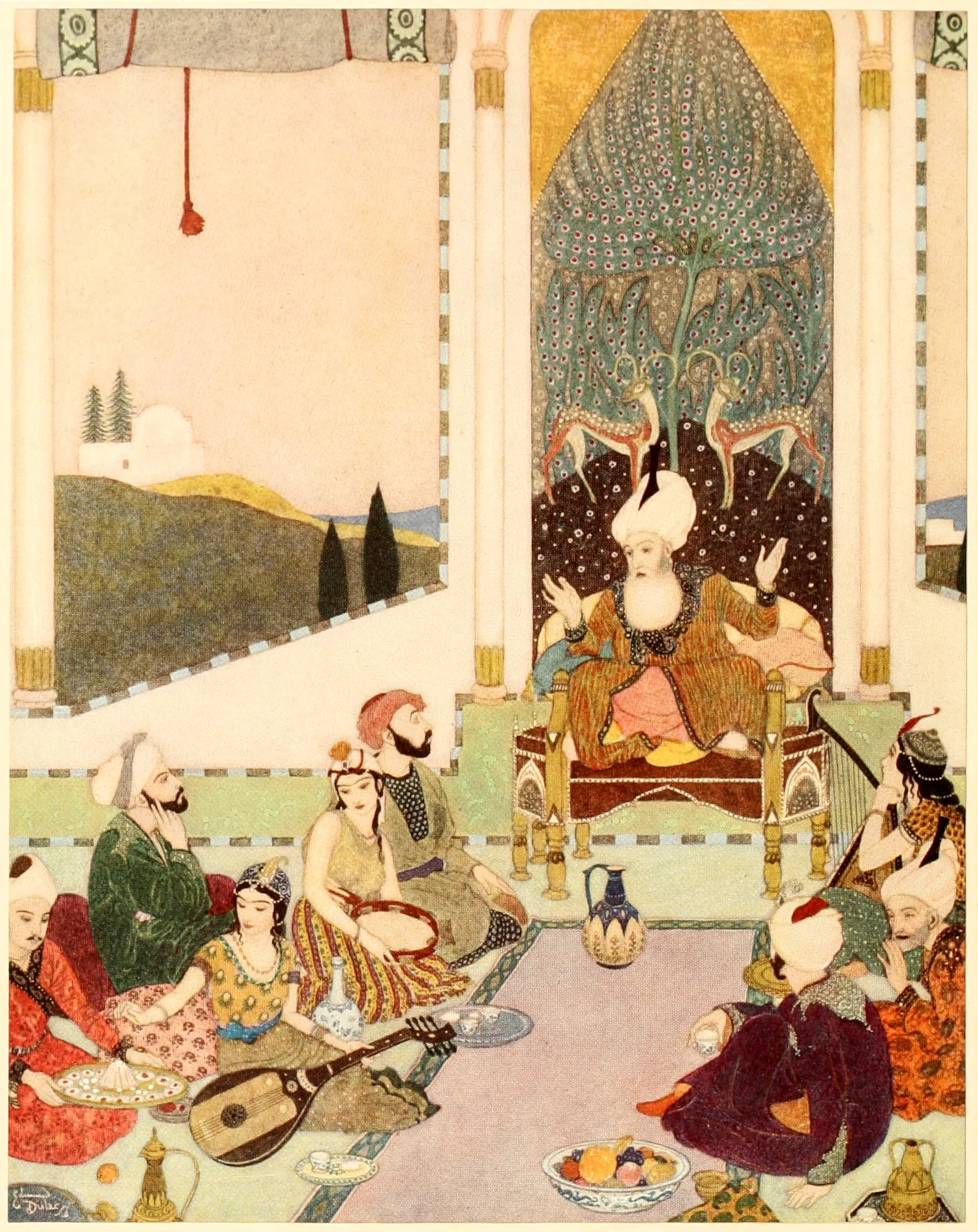
Edmund Dulac's frontispiece to Sinbad the Sailor & Other Stories from the Arabian Nights (1907): a sultan holding court — the storybook East of the golden-age illustrated editions, which carried the ghoul tales to generations of new readers. Public domain, via Wikimedia Commons.
The being's own name is the Arabic ghūl (غُول), feminine ghūlah; a company of them are ghūlān. The great medieval dictionary Lisān al-ʿArab derives the word from a verb meaning to seize, to take by surprise, to destroy — so the name itself files the being's whole nature: the ghūl is that which seizes the traveler. In the oldest stratum of the tradition she belongs to the jinn, the unseen peoples of Arabic belief, and she is herself almost always a desert being: a shape-shifter of the waste places, appearing as a woman, as a hyena, as a traveler on the road, kindling a false light at night to draw the lost toward her. Her country is not the grave. It is the road between wells, in the dark, three days from anywhere.
Hold that picture firmly, because the lesson is the story of its replacement. The English word ghoul is the same word twice-traveled: it came into English in the early eighteenth century through the French goule of Antoine Galland's translation of the Thousand and One Nights. One consonant's journey — Arabic to French to English — and at the end of it the being has changed her diet, her dwelling, and her meaning. The name survived the translation better than the being did.
Her pictures must be read with the same care, because the line is mostly absence. No Arabic picture of the ghūl is in this class's archive, and none was sourced for it: for roughly nine hundred and fifty years after al-Jāḥiẓ catalogued her, she is a being of words only. Her first picture in the file is the hero plate, Smirke's graveyard engraving, read with its tale in §3 — already Western, already moved indoors to a burial ground.
The second plate in this lesson shows you where that long gathering ended up in English hands. It is Edmund Dulac's frontispiece to Sinbad the Sailor and Other Stories from the Arabian Nights (1907): a sultan holding court, in the rich color and pattern of the golden-age gift books. Notice who is missing from it. There is no ghoul in the frontispiece, because the frontispiece belongs to the frame — the court, the storytelling, the splendid East the gift books sold. The ghūl reached most of her English readers exactly as she is placed in such a volume: one tale among hundreds, deep inside a book whose cover promised palaces. Keep the plate beside Smirke's engraving in §3 and you hold the being's whole English career between two pictures — the terror in the graveyard, and the court that framed her.
First Told: Al-Jāḥiẓ and the Book of Animals
The starred pin stands at Basra, in what is now Iraq, about the year 850 — and the pin wears its hedge on its face, for the map marks both the date and the place approximate, and the entry must keep them so.
The record is the work of al-Jāḥiẓ (c. 776–868), the great prose writer of Basra, whose Kitāb al-Ḥayawān — the Book of Animals — gathered everything his world knew and believed about living things: their habits, their poetry, their proverbs, their lore. It is an enormous, digressive, argumentative book. Hundreds of creatures pass through it, and the writer argues about nearly all of them, weighing poets against observers and report against report, in the century when Arabic prose was inventing itself. Reading him feels less like consulting a reference work than like sitting in a room with a man who has heard everything and intends to test most of it before supper. In that room, the ghūl of the Arabs is catalogued among the beings of belief — what the desert people said of her, how she appeared, what she did to travelers who met her. Al-Jāḥiẓ is this class's kind of witness: a cataloguer, not a convert. He files the belief with its tellers attached, which is all a keeper ever asks of a first record.
Note what the cataloguing itself proves. By about 850 the ghūl was not a rumor at the edge of the record; she was an entry in its most ambitious animal book, with a literature around her — verses, reports, arguments — large enough to summarize. Beings do not get into the Book of Animals on the strength of one campfire. Whatever the desert believed, it believed in writing, in quantity, and early.
The belief itself is older than the book — how much older, no pin can say. The poets of pre-Islamic Arabia were already boasting of ghoul encounters; the most famous, the brigand-poet Ta'abbata Sharran, left a celebrated poem of meeting a ghoul in the desert and killing her. File the poems as the map files al-Jāḥiẓ: the telling is older than its first surviving catalogue, and a keeper writes about 850 and moves on, saying so.
The Tales: The Book Meets the Faith, and Sidi Nouman
Two growths carry the ghoul from Basra to Paris, and the entry must keep them apart.
The first is what happened inside her own tradition. The belief in ghouls was old Arabia's; Islam, arriving in the seventh century, took the belief seriously enough to answer it. A saying of the Prophet preserved in the collection of Muslim — one of the tradition's most authoritative books of hadith — runs: "There is no contagion, no safar, and no ghoul." The commentators glossed the denial for later readers: by ghoul the Arabs meant that which waylays and destroys travelers, and it is that power the saying refuses. This class takes no side in any faith's teaching; it files the sequence, which is remarkable in itself. A belief so strong that a new religion must name it to dismiss it has been measured by its enemies — the dismissal is itself a dated record of the belief's strength.
The second growth is the gathering of the tales. From about 900, in Baghdad (the map's second pin), the story-collection that became the Thousand and One Nights began its centuries of assembly — frame tale, travelers' tales, and among them Sidi Nouman's, of which more below. The collection traveled as the centuries turned: copied, enlarged, translated into Persian and Turkish and at last, in the hands of the French scholar Antoine Galland (1646–1715), into a European tongue. Galland's Les mille et une nuits appeared at Paris from 1704 to 1717 — the map's third pin — and Europe met the ghoul in his pages. The English Arabian Nights' Entertainments followed within a few years, translated from the French rather than the Arabic — the ghoul arriving in England, already, at two removes from her desert. Edward William Lane's great scholarly English version (1839–41), made from the Arabic with a commentary as large as the tales, came more than a century later; by then the goule of the first crossing had long since settled the English imagination, and Lane's notes argue with her on page after page.
And here the record turns, and the modern scholar's work lets us watch it turn. Ahmed K. Al-Rawi, studying the ghoul's migration in the journal Folklore (2009), set the Arabic sources beside the Western ones and showed the join: in the Arabic record the ghūl is first and always a being of the desert and the road, who misleads and kills the living; the grave-digging, corpse-eating ghoul of the West is a selection — Galland's telling leaned on the burial-ground tales, and Europe, meeting only the selection, took it for the whole. The Western ghoul is not an invention. He is an excerpt, mistaken for the book.
The tale Europe received is the tale of Sidi Nouman, and it should be recounted as Galland gives it — it is a story about eating, told at a table.
Sidi Nouman, newly married, watches his wife Amine at dinner and is troubled: she serves herself rice and eats it a grain at a time, picked up with the tip of a small bodkin, as if food were an unpleasant duty. He says nothing. One night he follows her out of the darkened house, across the city, to the burial ground, where a female ghoul — a goule, in the French his readers met — awaits her beside a freshly opened grave. The two fall to their meal. The plate at the head of this lesson, R. Smirke's engraving for an early English Nights, shows the discovery as the story's first English illustrators staged it: the husband in the shadows, the wife surprised in her company, the graveyard doing the work that the desert did in the older strain of tales. Look at how Smirke arranges his three figures. Nouman stands apart, in darkness, at the picture's edge — the reader's place. Amine and the goule are together in the lit ground between the tombstones, caught mid-meal, and the engraver shows you their company and their posture while keeping the meal itself out of plain sight. What an illustrator refuses to draw tells you as much about his readers as what he draws.
The tale's second half answers appetite with craft. Amine, discovering she has been followed, sprinkles her husband with water and words, and turns him into a dog. His adventures in that shape end in a kind household and a counterspell; restored to himself, he returns home — and in Galland's telling the same sprinkled water, turned back on Amine, makes her a mare, and there the tale leaves her, kept and fed in his stable, a ghoul's appetite answered with a horse's diet. The Caliph, to whom the tale is told, approves the justice of it. A keeper notes what the tale is for, in its European dress: it is a story about a wife's secrecy and a husband's surveillance that happens to carry, in its luggage, the oldest desert terror in this unit.
Beside it, file the older strain the tale partly replaced: the ghoul of the road, who in the Arabic collections lights her fire where no camp should be, calls in a familiar voice, takes the shape of the traveler's own company — and is gone with him by morning. No grave, no meal of the dead: the horror is distance itself, wearing a face. The collections know her weaknesses, too, and they are a traveler's weaknesses answered: she can be struck down, the tales agree, but a man must do it in a single blow — for the struck ghoul begs, in her sweetest voice, strike me again, and the second blow, the tellers warn, would undo the first and raise her whole. It is a perfect road-rule disguised as a marvel: commit, once, and do not be talked out of it by anything that speaks to you in the dark.
KEEPER'S CHECK-IN
What did Al-Rawi's comparison of the Arabic and Western sources show — what was the ghūl chiefly in her own record, and what had Europe made of her instead?
Spotted: A Being Reported in Books
The ghoul has no sighting-reports of the vampire's kind — no commissions, no exhumations, no signed findings. Her later appearances are textual, and the entry files them as such: she is spotted where books spot her. The fourth pin is London, 1786: William Beckford's Vathek, written in French and published in English that year, stalked its cemetery scenes with ghouls in the Western, Galland-made manner — the excerpt now doing duty for the whole in the hands of a brilliant young English author.
KEEPER'S CHECK-IN
The ghoul has no commissions, exhumations or signed findings in her file — how is she 'spotted' instead, and which London book of 1786 is this beat's pin?
What People Watched For — a Box Left Empty, on Purpose
Scholars of this class will look for the customary box here, and its absence is the lesson's own teaching, so it stands in print. The ghoul's tradition offers sayings in plenty — the Prophet's "no ghoul" stands in §3, filed where it belongs, as a verdict upon the belief from inside the tradition that inherited it. But this class could tie no household custom, no watched-for practice with a name and a date, to the ghoul: nothing people did, season by season or road by road, that the record lets us date as we dated the kelpie's warning or the loch-watchers' roster. A box built anyway would be furniture, not record. It is left empty, and the emptiness is marked F.
What It Actually Is
✦ On the class test
The root of the Arabic ghūl is not hard to find, and finding it honors the tellers instead of mocking them. Desert travel, before engines, was done at the edge of survival: by night to escape the heat, by stars and memory across country that offered no landmarks, with water counted in hours. To be lost was not an inconvenience; it was the commonest death the road held. A being whose whole nature is the road deceives you, leads you off it, and takes you is the desert's danger given a face and a name — and the face was well chosen. The waste places had their real night population besides: hyenas and jackals, bold around camps and shallow graves, whose calls and eyeshine a frightened watch would not have needed to invent, only to interpret.
The hyena of her country deserves a closer look, because the tales give the ghūl a hyena's shape among her shapes, and the animal earns it. The striped hyena is the hyena of Arabia and the lands around it: a night animal, roughly the size of a large dog, standing about 60 to 80 centimeters at the shoulder and weighing, in most accounts, about 25 to 55 kilograms. It travels alone or in small family parties, eats carrion readily, and has jaws strong enough to crush bone that other scavengers leave. Around camps and burial grounds it is a bold and patient presence, and hyenas digging at shallow graves are a recurring complaint in the region's older records. Follow such an animal's eyeshine away from your fire on a moonless night, in country where a wrong turning costs water you do not have, and you have met most of what the road-ghoul was built from. The golden jackal, smaller and commoner, filled in the chorus — a yelping, shadow-shaped company at the edge of every camp.
The Western ghoul's root is different, and it is a record about readers. Europe's burial grounds were crowded, shallow, and close to its houses; its imagination of horror was furnished accordingly. Given an excerpt that mentioned graves, European readers built the whole being out of graves — and then, in the way of this class's modern faces, forgot the excerpt had ever been a selection. Two beings, two landscapes, one word. The keeper's entry holds both, labeled, and lets neither evict the other.
Still With Us
The nineteenth century made the word common English property: ghoulish settled into the language as the adjective for a morbid appetite, needing no desert and no grave at all.
The fifth pin is the strangest on the map: Evans City, Pennsylvania, 1968, where George Romero filmed Night of the Living Dead. In the production's own language, the walking dead who besiege its farmhouse were ghouls — flesh-eating, risen, relentless. The audience renamed them. What the world now calls the zombie took the ghoul's modern face in that farmhouse, and the ghoul, in the West, receded into games, comics, and the adjective drawer of the dictionary — H. P. Lovecraft's ghouls of "Pickman's Model" (1927), a subterranean people exchanging their young with ours, standing as the last great literary keeping of the older name. In the Arabic world the ghūl never left home: she is still the desert's own, told to children and travelers in her first landscape, un-graved. Two modern faces, then, like two roots — and the entry's last duty is to file them in the order the record gives: Basra first, Evans City last, and the translation marked on the road between.
Guided Observation
Study the hero plate slowly: R. Smirke's Amine Discovered with the Goule, from an early English Arabian Nights. Smirke worked in London, for London readers, illustrating a French retelling of a Baghdad tale about an Arabic being — count the translations standing between the engraver and the desert. Then look at what the plate actually shows: the graveyard, the two women, the watcher in shadow. What has the picture kept of the tale (the meal, the discovery, the night)? What has it quietly replaced (a landscape of sand and distance with a landscape of tombstones a Londoner could walk to)? And what does the plate refuse to show — where does the engraver draw the line of the meal itself, and why is that restraint itself evidence about his readers? Write three lines: one for what the plate records, one for what it believes, one for what it cannot help confessing.
Assignment Manual
✎ WRITTEN · ⚒ HANDS-ON · ◐ BOTH
✎ Written · Entry No. 32: Ghouls.
- Prepare the page. Rule a fresh page of your bestiary to the Scholar's Entry Page in this lesson's packet. Head it: Entry No. 32 — Ghouls. Under the head, write the being's name in its own form — ghūl — before you write the English word. Order is evidence.
- Write the entry to the standard. The Creature: the ghūl's name and nature, and her picture line — nine centuries of words, then the Western graveyard. First Told: al-Jāḥiẓ — his city, his book, its approximate date, and the hedge the map carries, kept whole. The Tales: the two growths kept apart — the faith's answer to the belief, and the gathering of the tales — then Galland, with his dates; Sidi Nouman in your own words, and beside it, in two lines, the older road-ghoul of the Arabic strain. Spotted: her appearances in books, Vathek first among them, filed as textual sightings. What It Actually Is: the desert road and its dangers; then, separately labeled, the European excerpt and what it built. Still With Us: the adjective, Evans City, and her Arabic home. The Keeper's Line: your own judgment, in one or two lines.
- The translation audit. List three traits of the Western ghoul from this lesson. For each, write the Arabic record's verdict: present, selected, or absent — with the stop on the map where the trait entered. This audit is the entry's heart; it is the class's whole method aimed at a single word.
- Mark every line. F for the dated fact — books, collections, translations, films. T for what the tellers held true of the being herself. The hadith line marks with particular care: that the saying was said and recorded is F; what it rules about the ghoul belongs to the faith that keeps it, and the entry files it as such, with respect and without adoption.
- Close the entry facing east. End your entry with the being's modern Arabic face in one line, before the Western one. A keeper files a being's homes in the order the being lived them.
The printable packet for this lesson — the Lexicon Handout, the Guided Practice, this manual, and the Scholar's Entry Page — is linked on this page.
Materials
· Your bestiary journal or notebook — kept for the whole class
· Pencils, and a pen you like writing with
· A red pencil, for marking
· A ruler, for ruling your entry pages
· This lesson's packet (the Scholar's Entry Page is in it)
Reflection
The Western ghoul is an excerpt mistaken for the whole. Where else in this class has a selection done the same work — and how would a reader who never saw the full record know?
Galland translated faithfully, tale by tale, and still the being changed. What does that teach about translation itself: what is lost when nothing is added and nothing is taken away, but much is left behind?
The ghoul's own tradition answered her with a sentence: "no ghoul." Is a belief weakened or strengthened when its own house formally denies it? What does the record show?
A Closing Note
This lesson files the oldest record in Unit V — a ninth-century catalogue from Basra, holding a belief older than the book that filed it. You have now followed the changed across four lessons: the wolf that was a man, the corpse that was a case file, the lord that was a literary invention, the desert terror that was a mistranslation. One method carried all four. Keep your journal dry, and your T, S and F honest.
The Bestiary
Bestiary Keeper
Further Reading & Sources
Ahmed K. Al-Rawi, "The Arabic Ghoul and its Western Transformation," Folklore 120:3 (2009) — the study this lesson's correction stands on.
Ahmed K. Al-Rawi, "The Mythical Ghoul in Arabic Culture," Cultural Analysis 8 (2009) — the pre-Islamic and poetic record.
Antoine Galland, Les mille et une nuits (1704–1717) — Sidi Nouman in the telling Europe received; English versions as the Arabian Nights' Entertainments.
Al-Jāḥiẓ, Kitāb al-Ḥayawān (The Book of Animals), c. 850 — the first catalogue, in translation selections.
William Beckford, Vathek (1786) — the Western ghoul at her most literary.
H. P. Lovecraft, "Pickman's Model" (1927) — the older name's last great literary keeping.
Submit your work for this lesson using the form below.
CONTINUE IN THE BESTIARY HALL
← Previous · Lesson 31: The Vampire in Print Next · Lesson 33: The Zombie →
Unit V — The Changed The Bestiary Hall — All 41 Lessons
The rest of Unit V: Lesson 29 · Werewolves · Lesson 30 · The Vampire of Record · Lesson 31 · The Vampire in Print · Lesson 33 · The Zombie