

THE BESTIARY
Unit VI · Lesson 34Ghosts
Professor Sable Rookmere
Bestiary Keeper
The Bestiary Hall • School of Evershade
Professor's Introduction

We have come to the last shelf of the class, the shelf of those who linger, and I have kept the most reported being in the whole archive to open it: the ghost, the dead person perceived. I have read the reports by the hundred, across twenty-seven centuries of them, and I will tell you plainly at the start what you will find in this lesson, and I ask you to hold two things in view at once while you read it. Some of it is fraud, documented fraud with names and dates on it, and you will meet those cases whole. But stay a moment with the people who paid the frauds. The men and women who sat in the dark at the séance tables were mourners, most of them. They had buried someone they loved, and they wanted one more word from them, and they would have paid a great deal more than a ticket price to get it. File the trick when you find it, and file it plainly. Leave the mourners out of the mockery. Grief is not the joke in this lesson, and it never will be in my class.
The Bestiary
Bestiary Keeper

Where this lesson travels: Smyrna, where the Odyssey's nekyia was composed about the eighth century BCE — Homer's city by tradition, the place approximate, the hedge carried as the map carries it; Athens, where Pliny the Younger's letter (about 100 CE) set Athenodorus to face the chained ghost — the haunted house's founding document; Byland Abbey in Yorkshire, where a monk wrote down twelve local ghost tales about 1400; London, where the Cock Lane ghost drew its crowds, and Dr. Johnson, in 1762; and Hydesville, New York, where the Fox sisters' rappings of 1848 opened the Spiritualist era. The starred pin is the first record; the dashed line is the telling, traveling.
Lesson Objectives
By the end of this lesson, you will be able to:
- Say what a ghost is in this class's filing — and how it differs from the revenant of the next lesson.
- Retell the first record: the nekyia of the Odyssey, with its date and its hedges.
- Tell Pliny the Younger's haunted-house letter as the set text it is, and say what Athenodorus did about his haunting.
- Follow the telling through Byland Abbey and Cock Lane, and file the Cock Lane exposure fairly.
- Describe the answered raps of the séance, with the Fox sisters' record in both its halves — the demonstrations and the confession.
- Set out what it actually is without mockery: grief, expectation, and the double exposure.
- Read the ghost's depiction line — and say why its pictures start late.
Your Assignment Packet
This lesson's work lives in its packet: the Lexicon Handout (every term, the core terms marked with the keeper's diamond ◆), Materials, Guided Practice, the Assignment Manual written out whole, the Scholar's Entry Page, the Reflection Questions, the Workbook Checklist, and the Keeper's Notes, for whoever teaches the lesson. Download the packet before you begin and keep it beside you as you read. The packet's assignment is Rookmere's own word for the work: Entry No. 34 — Ghosts (both) ◐. The Unit VI Quiz is not printed in the packet; it waits at the end of the unit, with Lesson 40.
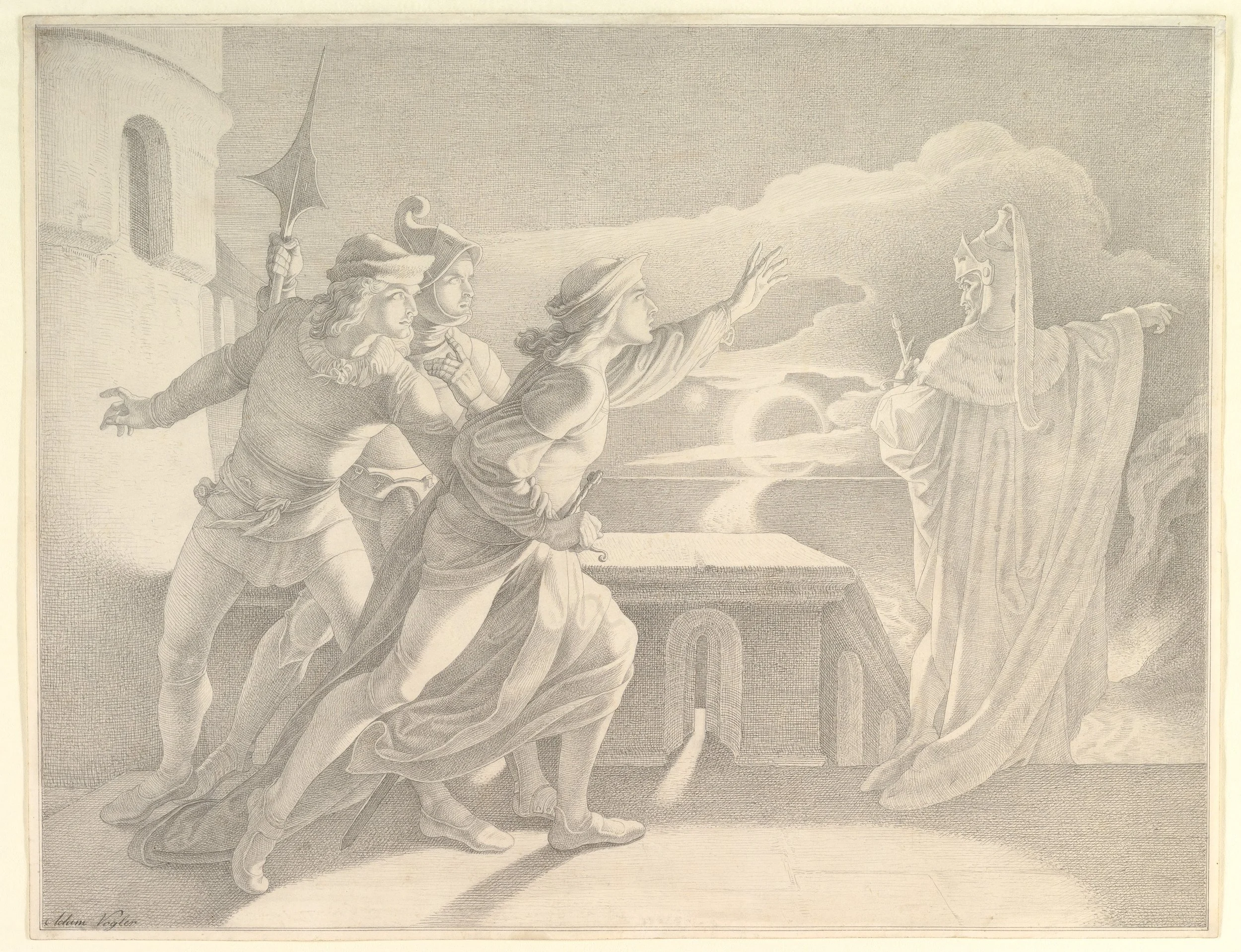
Hamlet and the Ghost of his Father (19th-century print, after Shakespeare): Hamlet and his companions recoil on the battlements as the crowned Ghost comes through the mist — the ghost who wants something done, in the picture everyone knows. CC0, Metropolitan Museum of Art, via Wikimedia Commons.
The Creature: A Shade, and Its Pictures
The being of this lesson is the dead person perceived: seen, heard, or felt present, after burial, by the living. Our word is old and plain. Ghost comes from the Old English gāst — breath, spirit, the animating thing that leaves a body when the breath does. A ghost, in this class's filing, is a shade: the dead without a body in play. Nobody in these records digs up a ghost. There is nothing to dig. That is exactly what separates this lesson from the next, where the dead come back in the body, heavy enough to carry their own coffins, and a whole parish has to deal with them.
The records blur that line constantly, so un-blurring it is the first piece of work in this lesson. When a chronicle tells you a dead man was seen, stop and ask what sort of seeing it means. A figure standing in a road at dusk, gone when the cock crows, is one kind of file. A corpse out of its grave and lying in its widow's bed is quite another, and it belongs to the next lesson, with the revenants. English once had the word haunt for the in-between of it — from the French hanter, to frequent a place, to visit it often — and the word still earns its keep. Ask where a ghost keeps returning to and you have usually described the haunting better than any description of the ghost.
Read the ghost's depiction line next, because it is the shortest in this unit and the most instructive. The earliest records have no pictures at all: the Odyssey's shades are words, and the Byland monk's ghosts, fourteen centuries later, are words in the blank leaves of a manuscript — nobody drew them. The ghost is first pictured in numbers by the print trade: this lesson's new plate is a London satirical engraving of February 1762, English Credulity, or the Invisible Ghost, drawn while the Cock Lane knockings of §3 were the town's talk — the ghost enters art as a joke about the people who believed in it. The nineteenth century gave it the stage's crowned king, in the Hamlet print at this lesson's head, and then, in the 1860s, the photograph — the Mumler cartes-de-visite of §5, which claimed to be not pictures of the ghost but the ghost itself, developed in silver. Poem, casebook, satire, stage, photograph: the line starts late and stays thin because a ghost, unlike a lion, gives a painter nothing to copy except what the living already imagine.
First Told: the Nekyia, and the Map
✦ On the class test
The starred pin stands at Smyrna, on the coast of what is now Turkey, and it carries this class's usual honesty at full strength: Smyrna is Homer's city by tradition, the place approximate. The record itself is not a place but a poem — the Odyssey, composed in the eighth century BCE, and its eleventh book, the nekyia, the calling-up of the dead.
Odysseus sails to the edge of the world, digs a pit, and pours the offerings — honey and milk, wine, water, and the blood of sheep. And the shades come up out of the dark in crowds, pressing to drink, for in the poem's hard rule the dead cannot speak clearly until they have drunk the blood. Among them comes his own mother, Anticleia, who died of grief for him while he was at war and did not know it. Three times, the poem says, he moved to embrace her; three times she slipped through his arms like a shadow or a dream. Her answer is the record's first statement of its subject: this is the law of mortals, when one dies. The flesh is gone; what remains cannot be held.
Sit with that scene a moment, because nearly everything written about ghosts in the twenty-seven centuries after it is already hiding inside it. The dead can be reached. They cannot be held. They know things the living want to know — the shades in the nekyia speak of home, of what is coming, of how they themselves ended — and yet they come up out of the dark diminished, weaker than they were, and the meeting has a price. Odysseus pays it in a journey to the edge of the world and in blood poured into a pit. Later centuries will pay in other coin: a night's watching, a letter to a friend, a ticket to a séance. The shape holds.
The map's other pins take the telling down the centuries. Athens, about 100 CE: Pliny's letter, the subject of the next section. Byland Abbey in Yorkshire, about 1400: a monk writes down his neighbors' ghosts. London, 1762: the Cock Lane ghost, investigated like a crime. And Hydesville, New York, 1848: two sisters and a rapping spirit open the Spiritualist era. Poem, letter, casebook, courtroom, séance — the ghost's record is the history of the forms the living invented to file it.
The Tales: a Letter, a Casebook, a Courtroom
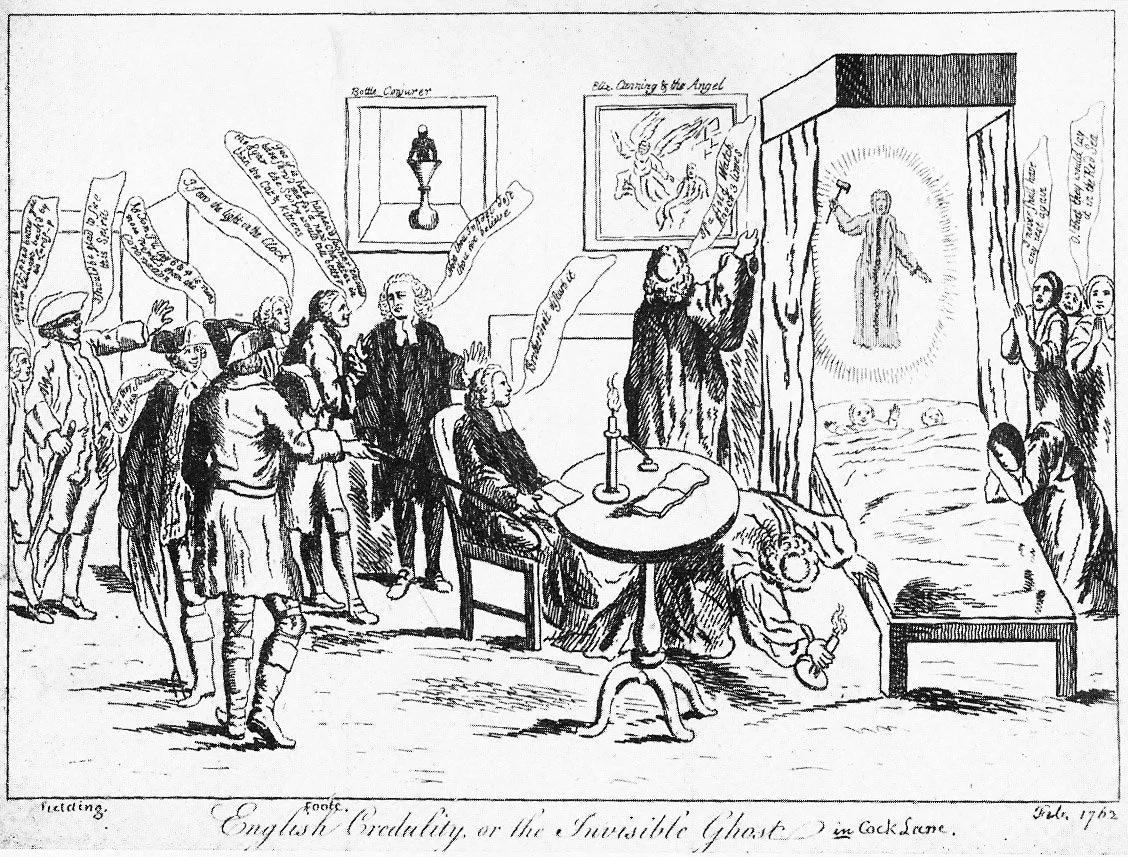
English Credulity, or the Invisible Ghost (London, February 1762): the ghost as satire — a London print laughing at the Cock Lane investigation even while the town queued to hear the knockings. The first picture in the ghost's line made to sell a judgment about a haunting rather than the haunting itself. Public domain, via Wikimedia Commons.
The set text of this lesson is a letter. About 100 CE the Roman lawyer Pliny the Younger wrote to his friend Sura (Letter 7.27) asking, with real politeness and real uncertainty, whether Sura believes ghosts exist — and offering evidence. His best exhibit is Athens. There was a large, cheap house in the city, shunned because at night the clanking of chains was heard, and then a figure appeared: an old man, wasted, bearded, wearing fetters on his legs and chains on his wrists, which he shook. The philosopher Athenodorus, intrigued rather than frightened by the low rent, took the house, sat up late writing, and when the chains sounded and the figure stood beckoning in the courtyard, he followed it, watched it sink into the ground, and marked the spot. Next day the magistrates dug there, and found bones, tangled in chains. The city gave them public burial with the proper rites — and the house was quiet.
Keep Pliny's posture in view, because it is the posture this class asks for. He does not jeer at the story. He does not swallow it whole, either. He sets down what was reported, weighs it the way a lawyer weighs anything, and writes to a friend to ask what the friend makes of it. And look at how Athenodorus actually settles his haunting. No exorcism, no heroics. He notices. He marks the spot. The magistrates dig. The city buries what it finds, properly and in public. The ghost, it turns out, had wanted a burial the city had failed to give him the first time. Two thousand years of ghost stories grow out of that shape, and most of them are still following it without knowing the letter exists.
Fourteen centuries on, the record is a Yorkshire casebook. About 1400, a monk of Byland Abbey — Cistercian, careful, anonymous — wrote twelve local ghost tales into the blank leaves of a manuscript. These are not wonders imported from books; they are his neighbors: a tailor, a servant, a woman of the parish, dead and not at rest, met on roads and in churchyards, speaking when conjured to speak, and asking, almost always, for help — for masses, for absolution, for a wrong to be put right. The Byland ghosts are parish business. Their tellers file them the way a parish files anything: with names, places, and what was done.
Then, London, 1762 — and the record changes its clothes again. At a house in Cock Lane, Clerkenwell, knockings and scratchings began around a girl of about twelve, Elizabeth Parsons, and were announced as the spirit of a dead woman with a murder to report. Crowds came. A committee of gentlemen — among them Dr. Samuel Johnson — resolved to test the ghost at its own challenge: it had promised to knock upon the coffin in the vault of St. John's, Clerkenwell. The party went down at night, prayed, waited, and listened. Nothing knocked. Johnson's published account is this class in one sentence of posture: the gentlemen concluded the matter deserved exposure rather than belief, and exposure came. The girl was caught at her tricks; her father, William Parsons, was tried at the Old Bailey for a conspiracy to cheat and was convicted, pilloried, and imprisoned. File it whole: the haunting was a fraud, the investigation was genuine, and the crowd had included, as crowds at wonders always do, the merely curious and the quietly bereaved.
KEEPER'S CHECK-IN
In the Tales, how was the Cock Lane ghost of 1762 investigated — and how was the haunting finally exposed?
Spotted: Where the Reports Cluster
Strip the records down and the tales agree with a stubbornness that is itself evidence — of something, and the keeper's question is, of what. The ghost, in tale after tale, wants something done. Athenodorus's chained man wants burial. The Byland dead want masses and absolutions. Hamlet's father — the hero of this lesson, from the stage's most famous ghost — wants to be remembered and avenged: Remember me. The ghost is the dead with an unfinished errand, and the living are its only hands.
Notice, too, who does the seeing, and where the reports cluster. Odysseus must voyage and pay. Athenodorus must sit up all night, alone, on purpose. The Byland ghosts meet travelers on roads, at dusk, in the parish's in-between places. Athens about 100 CE, Byland about 1400, London in 1762, Hydesville in 1848: the map's pins are the places the reports were written down, and the pattern in them is the tale's rule — the dead are perceived at edges: night, roads, thresholds, grief, by people in passage themselves. That pattern matters in §5, where the photographs that were supposed to end the argument are taken up. First, the custom the reports grew, which belongs to the next pin on the map.
KEEPER'S CHECK-IN
In Spotted, where do this lesson's ghost reports cluster — at what kinds of places, and at what times, are the dead perceived?
What People Watched For — the Answered Raps
On the last night of March 1848, in a farmhouse at Hydesville, New York, the Fox family kept hearing raps they could not account for, and the younger daughters — Kate, about eleven, and Margaretta, about fourteen — began, by their mother's account, to answer: snapping fingers, asking questions, and getting knocks in reply. A way of working settled at once, and it is the custom this box exists to file: the company put questions to the unseen, and the unseen replied by raps — one rap for yes, two for no, or the alphabet called letter by letter until a rap stopped it. The watching, in other words, turned listening into a procedure, and any parlor could hold one. Neighbors crowded the Fox house to sit and hear it. In November 1849 the sisters demonstrated publicly at Corinthian Hall in Rochester, before a paying crowd of hundreds — the séance had become a ticketed evening, and then an era: within a few years the tables were set in thousands of homes, and the rappings had spread to Britain and beyond.
The sources stand where this class requires them, and the record has two halves, both filed. The first half is the demonstrations themselves, documented in the newspapers of Rochester and New York from 1849 onward — F, the sittings truly happened, the crowds truly came. The second half is Margaret Fox's signed confession, printed in the New York World on October 21, 1888: the first nights' noises, she wrote, had been an apple on a string; the raps were made by cracking the joints of toes and knees; and that night at the Academy of Music, before some two thousand people, with her sister Kate present and doctors from the audience holding her foot, she made the raps sound through the hall and called Spiritualism a fraud of her own making. A year later, poor and pressed, she retracted the confession. The keeper files all of it: the beginning, the demonstration, the confession, the retraction. The belief itself — that the dead were answering — is S, a sighting-report's claim, believed by the sitters and filed as their report. But notice what no retraction can touch: the tables were set, more and more of them after the American Civil War, by the bereaved, who were not fools for wanting the dead to answer in some code, even raps. The custom outlasted its founders because it was never really theirs. It belonged to grief.
What It Actually Is
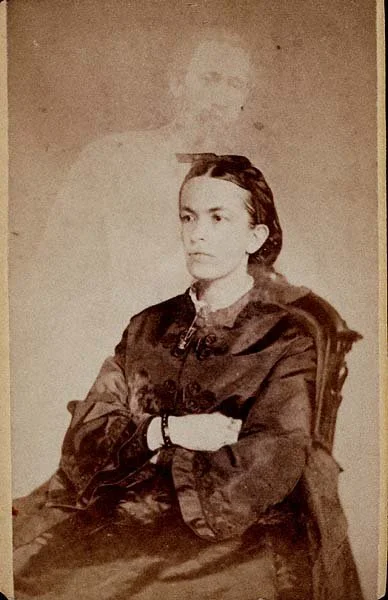
William H. Mumler's spirit photograph of Mrs. Conant (Boston, 1860s–70s): the sitter in hard light, and behind her shoulder the faint face of a “spirit” — spirit photography as its first famous practitioner sold it. Public domain, via Wikimedia Commons.
Begin with the grief, because the record does. The sensed presence of the dead is among the commonest experiences of the bereaved, and it has been measured rather than merely marveled at: the Welsh physician W. D. Rees, studying the widowed of a Welsh town and publishing in the British Medical Journal in 1971, found that nearly half of them reported sensing, seeing, or hearing the dead spouse — sane, ordinary people, who mostly had told no one. A keeper writes that down before writing anything about fraud. The ghost's deepest root is not a trick. It is that the dead go on being expected — in their chair, on the stair, at the door — by minds that housed them for a lifetime, and expectation, in the dark, has a voice.
The second root is the house itself. Old buildings contract and settle as the temperature drops at night. They tick. They knock. Water pipes hammer in the walls, and wind finds every loose thing a house owns and worries at it. Ask any keeper of an old building and they will tell you the place has a night voice of its own, no dead required.
The third root is a workshop, and this lesson's two support plates come straight out of it: spirit photography. In Boston in the 1860s and 1870s the engraver William H. Mumler sold portraits in which the sitter was joined by a faint, pale "spirit." Look at the two cartes-de-visite hanging in this lesson and you can see the goods exactly as his customers received them. In one, a woman's face hovers behind Mrs. Conant's shoulder, fainter than the sitter and smaller than life, like someone remembered rather than someone present. In the other, a tall lady stands behind a seated gentleman, turned obligingly toward the camera, posed the way a living sitter poses. The method behind them was the young art's own flaw: the double exposure — a plate bearing one image, used again, or a figure stepping briefly into the frame during a long exposure. In 1869 Mumler was tried for fraud in New York; showman P. T. Barnum testified how such pictures could be made, and had one made of himself with the "ghost" of Abraham Lincoln to prove it. And then the record keeps its keeper honest: Mumler was acquitted, because the prosecution, though it showed a dozen ways the thing could be faked, could not prove which way he had used. File both halves. The acquittal is F. It is not evidence the spirits were real. It is evidence about evidence — about how hard it is to prove a method from a result — and a keeper who cannot tell those apart will fail Exam questions and séances alike.
Still With Us
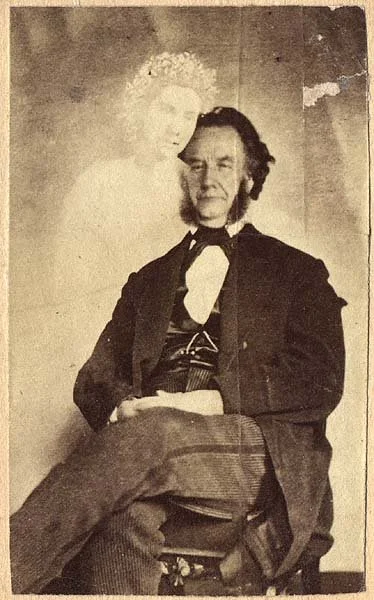
A second Mumler carte-de-visite: a seated gentleman, and standing behind him a tall female “spirit” with her face turned to the camera — the double-exposure trade in a single card. Mumler was tried for fraud in 1869 and acquitted: the prosecution could show how such pictures were made, but not that he had made this one so. Public domain, via Wikimedia Commons.
The ghost has never needed reviving; it is the one being in this class that every generation inherits without instruction. Its institutions became formal: the Society for Psychical Research, founded in London in 1882, set scholars to filing ghost reports the way this class files them — dated, witnessed, weighed — and its archives remain a model of the keeper's paperwork, whatever one concludes from them. Its literature is the world's: the ghost story became a form masters practiced, from the Christmas numbers of Dickens to M. R. James, who read his aloud to friends and also, not incidentally, edited the Byland tales for print. Its modern commerce — ghost hunts, night-vision television, haunted-house tours — replays the séance with new instruments, and its instruments find, as the raps did, exactly what the dark and the company supply.
People still report ghosts, and an industry still receives the reports: ghost-hunting television (the American Ghost Hunters ran from 2004), night-vision tours of old houses, and societies that keep taking dated statements. The instruments change; the sitting does not.
And the first famous ghost of them all still holds the stage. Look at the print at the head of this lesson before you close the entry. It is the battlements scene from Hamlet, the moment every schoolchild in the English-speaking world once knew by heart. The artist has given you a castle wall high above the sea, a hard cold you can almost feel in the men's cloaks, and the dead king standing in the mist in his crown, tall and still, while the living draw back from him with their hands half raised. Shakespeare wrote him as a king in armor, and the print keeps him royal. What the figure wants, in the play, is what Anticleia's company wanted in the poem: to be heard, and to be remembered. Four centuries stand between the print and Shakespeare, and twenty-seven between Shakespeare and Homer, and the errand has not changed in all that time, because the living go on owing the dead a hearing and knowing that they owe it.
Guided Observation
This lesson's support plates are two of Mumler's cartes-de-visite — small photographs, about the size of a calling card, meant to be held in the hand and passed around a parlor. Look at the "spirits" first, as evidence. Where are their edges sharp, and where do they wash out? Does the light on the spirit match the light on the sitter? In the portrait of Mrs. Conant, the face behind her shoulder is fainter than she is, and smaller than life. In the second, the standing lady is tall and turned obligingly toward the camera, as a living sitter would be — ghosts arranged for the lens by the living. This lesson's fourth plate is the Cock Lane engraving of February 1762, English Credulity, or the Invisible Ghost — the ghost as satire, drawn for a London that was laughing at the investigation even while it queued to hear the knockings. File it beside the Mumler cards: it is the first picture in the line that was made to sell a judgment about a haunting rather than the haunting itself.
These are not pictures of anything in this class's sense. They are pictures of what the sitters were buying: a sitting with the dead, developed in silver. Set them beside the hero plate — Hamlet on the battlements, an honest stage picture of an imaginary moment — and ask the keeper's question: which of the three plates is pretending to be a record, and what does its pretending prove?
Assignment Manual
✎ WRITTEN · ⚒ HANDS-ON · ◐ BOTH
◐ Both · Entry No. 34: Ghosts.
- Rule your entry page. Turn to the Scholar's Entry Page in this lesson's packet and rule a page of your journal to match it.
- Write the ghost's entry, to the standard. The Creature: the shade defined, and its depiction line read — no pictures, then the 1762 satire, the stage print, the photographs. First Told: the nekyia — where the poem was composed, roughly when, and the hedge the map carries about Homer's city. The Tales: Pliny's letter and the Athenodorus procedure; the Byland casebook; Cock Lane, with the exposure filed fairly; the ghost who wants something done, and Hamlet as the example everyone knows. Spotted: the report places and their pattern — edges, night, grief. What It Actually Is: three lines — grief and the sensed presence, the noises of houses, the double exposure. Still With Us: the institutions, the literature, the stage. The Keeper's Line: your judgment, in a line or two.
- Make an honest ghost. Produce a deliberate spirit photograph of your own: a long exposure from which a friend steps out halfway, two photographs layered, a reflection caught in glass — any method you like, provided it is yours. Print it or paste it in your bestiary beside the entry, and caption it with exactly how it was made, under the word MADE. A keeper who can make the effect owns the argument about it.
- Mark every line. This lesson's drill: the sittings are F; the answers are S, sighting-reports; the tales retold are T. Go through your entry and make sure no sentence borrows the séance's authority for the séance's belief — and none borrows Mumler's acquittal for his photographs.
- File both halves. At the foot of your entry, write two dated lines: October 21, 1888, the confession; 1889, the retraction. Keepers record what is missing and what is reversed as carefully as what is present.
The printable packet for this lesson — the Lexicon Handout, the Guided Practice, this manual, and the Scholar's Entry Page — is linked on this page.
Materials
· Your bestiary journal or notebook — kept for the whole class
· Pencils, and a pen you like writing with
· A ruler, for ruling your entry pages
· A camera or phone, for the honest ghost of Step 3
· The lesson page, for the map and the plates
· This packet
Reflection
Pliny asks Sura, politely, whether ghosts exist, and offers a haunting solved by a burial as his best evidence. What does the letter's posture — report, weigh, ask — have that both the jeer and the creed lack?
The séance tables were set, decade after decade, mostly by the bereaved. What does that do to how a keeper judges the sitters — and how a keeper judges the sellers?
Athenodorus cured his haunting by giving the dead a public burial. The tales agree, across two thousand years, that a ghost wants something done. Why might the living need the dead to want that?
A Closing Note
Unit VI is open. You have filed a being who is only ever perceived — seen at a window, heard on a stair, developed on a photographer's plate — and you have kept the record and the grief and the fraud all in the one entry, which is the whole method of this unit in miniature. Next lesson the record gets heavier, and I mean that in the plain physical sense. The dead of twelfth-century England did not drift through walls in mist. They came out of their graves in their bodies, knocked on their neighbors' doors, and had to be dealt with by parishes and bishops, and sometimes, at the end of a long parish argument, by fire. Bring your marks. Sorting the T, S and F of a walking corpse is harder work than sorting a voice in the dark, and the neighbors who filed those reports deserve your care as much as the mourners did.
The Bestiary
Bestiary Keeper
Further Reading & Sources
Homer, Odyssey, Book XI — the nekyia; any standard translation (Emily Wilson's, 2017, is plain and exact).
Pliny the Younger, Letters, 7.27 — the Athenodorus letter; the set text of this lesson.
M. R. James, "Twelve Medieval Ghost-Stories," English Historical Review 37 (1922) — the Byland Abbey tales, edited and translated.
The Cock Lane ghost: the pamphlet record of 1762 and the Old Bailey trial of William Parsons (1762) — the investigation and the exposure.
Margaret Fox, confession, New York World, October 21, 1888 — and her retraction of 1889; both halves are the source.
W. D. Rees, "The Hallucinations of Widowhood," British Medical Journal (1971) — the grief study behind §5.
"English Credulity, or the Invisible Ghost" (London, February 1762) — the Cock Lane satire; this lesson's new plate, public domain via Wikimedia Commons.
The Mumler trial, New York, 1869 — spirit photography examined in court; Barnum's testimony and the acquittal.
Submit your work for this lesson using the form below.
CONTINUE IN THE BESTIARY HALL
← Previous · Lesson 33: The Zombie Next · Lesson 35: Revenants →
Unit VI — Those Who Linger The Bestiary Hall — All 41 Lessons
The rest of Unit VI: Lesson 35 · Revenants · Lesson 36 · The Mummy · Lesson 37 · The Banshee & the Washer at the Ford · Lesson 38 · Will-o'-the-Wisp · Lesson 39 · The Poltergeist · Lesson 40 · New Beings, Old Pattern · The Capstone · The Unfinished Page