

THE BESTIARY
Unit VI · Lesson 36The Mummy
Professor Sable Rookmere
Bestiary Keeper
The Bestiary Hall • School of Evershade
Professor's Introduction

Every other being on this shelf was reported by people who met it, or thought they had. This one was made — first by embalmers who intended a person to last forever, and then, century by century, by translators, merchants, showmen, newspapers and film studios, who intended something else. A person was prepared for eternity by people who loved them. Strangers later ground that person into medicine, unrolled them for ticket-holders, and finally invented a curse to explain why disturbing them might be dangerous — a danger the strangers had themselves created and profited from. File the whole of it: the embalmers' care and the merchants' arithmetic belong in the same entry, because they happened to the same dead.
The Bestiary
Bestiary Keeper
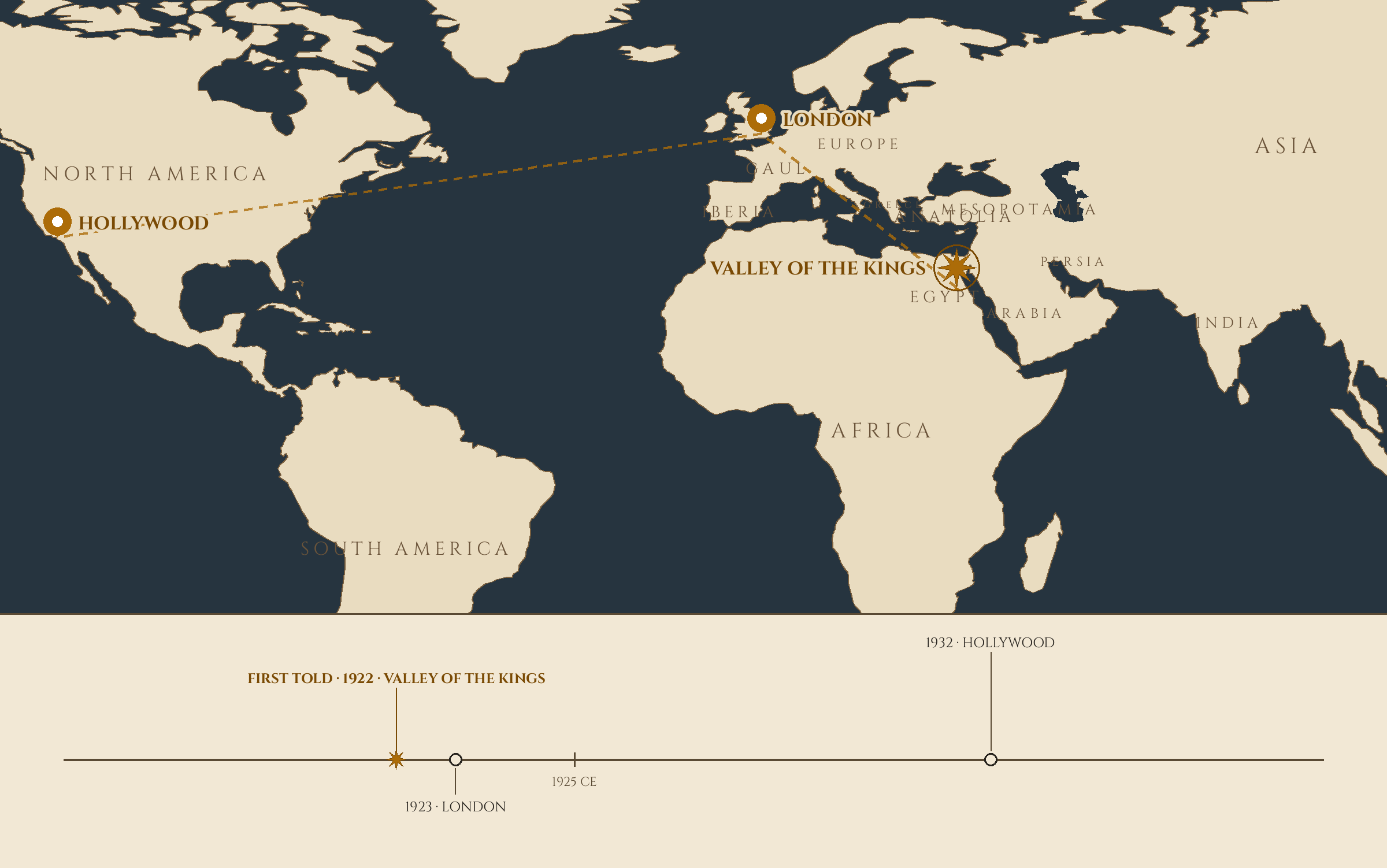
Where this lesson travels: the Valley of the Kings, where Howard Carter opened Tutankhamun's tomb in 1922; London, in 1923, the year of the journalism that built the curse; and Hollywood, in 1932, where the film gave the mummy its bandaged modern face. Three stops only, and none of them in Egypt's deep past — a keeper files this creature where its record as a monster actually happened: in a tomb doorway, a newsroom, and a studio. The starred pin is the first record; the dashed line is the telling, traveling.
Lesson Objectives
By the end of this lesson, you will be able to:
- Say what a mummy is — a body prepared to stay — and how it differs from the revenant of Lesson 35, a body that would not stay.
- Retell Herodotus's account of embalming in Book II as what it is: a text, by an outsider, with three grades and seventy days.
- Tell the Letters to the Dead from the bowls that carry them — the Qau bowl and the Cairo bowl — and say what an akh was expected to do.
- Set out the real tomb warnings, in their own words, and say how rare they are.
- Follow the dead body through the mummia trade and the unwrapping parties, with the sources named.
- Walk the Tutankhamun file in its two halves: the excavation, and the curse the newspapers built — and file Nelson's 2002 count beside both.
Your Assignment Packet
This lesson's work lives in its packet: the Lexicon Handout (every term, the core terms marked with the keeper's diamond ◆), Materials, Guided Practice, the Assignment Manual written out whole, the Scholar's Entry Page, the Reflection Questions, the Workbook Checklist, and the Keeper's Notes, for whoever teaches the lesson. Download the packet before you begin and keep it beside you as you read. The packet's assignment is Rookmere's own word for the work: Entry No. 36 — The Mummy (written) ✎. The Unit VI Quiz is not printed in the packet; it waits at the end of the unit, with Lesson 40.
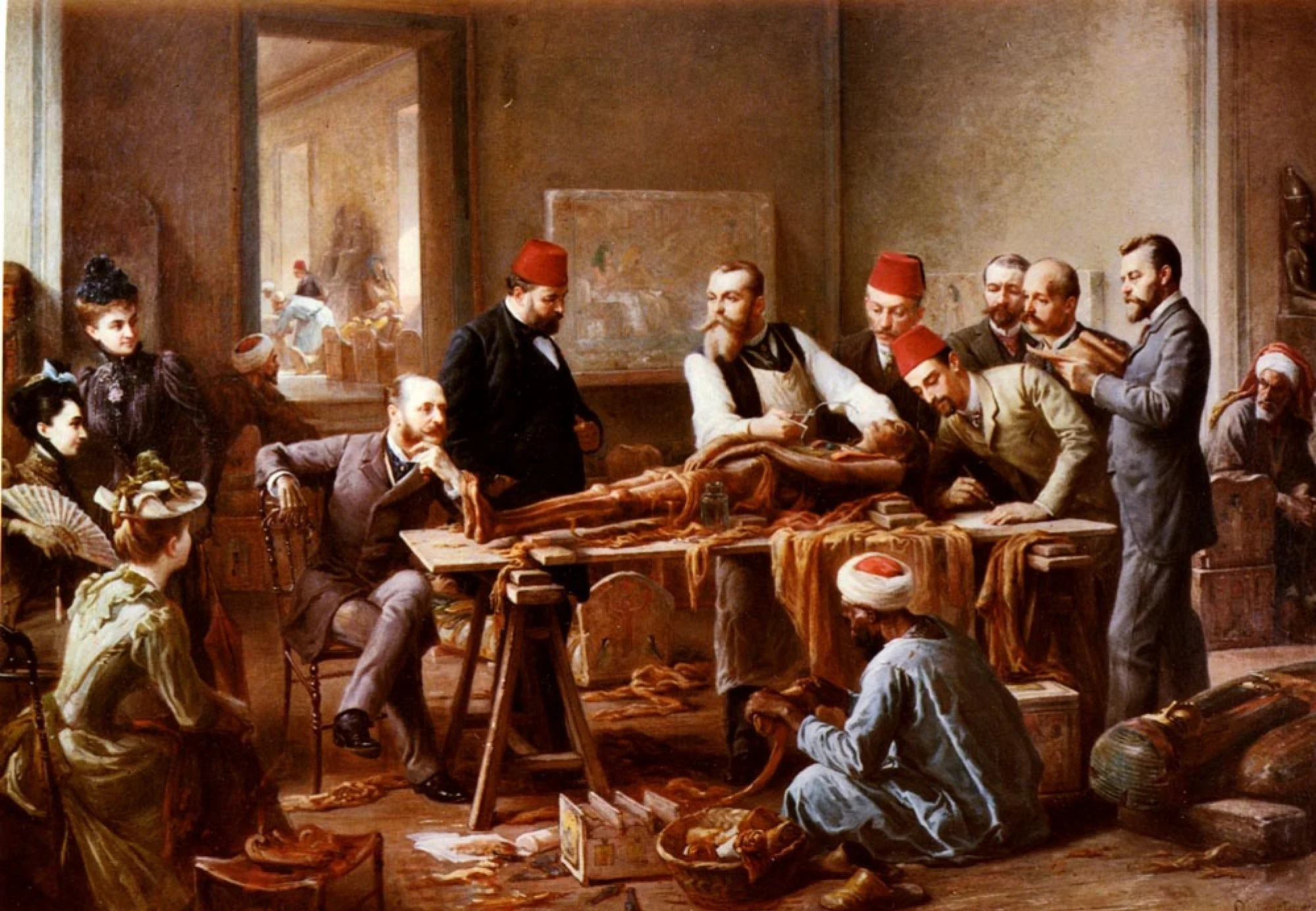
Paul Dominique Philippoteaux, Examination of a Mummy (c. 1891): scholars unwrapping a mummy in a museum setting — the nineteenth-century examination pictured by a painter. A painting, not a photograph, of an examination. Public domain, via Wikimedia Commons.
The Creature: A Body Prepared to Stay
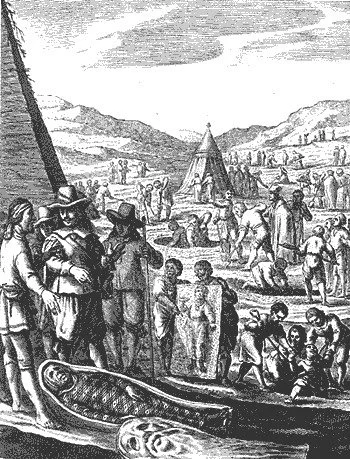
Two mummies found at Saqqara, engraved for Pietro Della Valle's Reiß-Beschreibung (Geneva, 1674) — this lesson's earliest plate, and a fanciful one: its own catalogue page calls it fanciful rather than authentic, and the lesson labels it so. Public domain, via Wikimedia Commons.
Begin with the word, because the word contains the lesson's first accident. Mummy reaches English through medieval Latin mumia, from Arabic mūmiyā — a word that originally named not a body at all but a substance: a dark, prized mineral pitch, a kind of bitumen, valued as a medicine. How the word slid from the pitch to the corpse is the grim trade of §3. Hold the plain definition: a mummy is a dead body whose soft tissues have been preserved — in the Egyptian case deliberately, by embalming and drying — so that it does not decay as an untreated body decays.
Set it against its neighbors: the ghost of Lesson 34 is the dead perceived without a body; the revenant of Lesson 35 is the dead back in the body, walking. The mummy is neither. Nobody in the Egyptian record prepared a body in order for it to walk. They prepared it in order for it to stay: intact, recognizable, and provided for, while the parts of the person that did move — the ba, the akh of §2 — went about their business. The walking mummy, arms out, bandages trailing, is not an Egyptian idea at all. It is a nineteenth- and twentieth-century invention laid over an Egyptian practice.
The depiction line teaches the same separation. The Egyptians pictured their dead constantly — tomb paintings, coffin portraits, statues of the ba-bird — but always as persons in the order of things, never as horrors. The mummy's first European pictures are already strangers' work: this lesson's earliest plate is a 1674 engraving of two mummies "found" at Saqqara, printed in Pietro Della Valle's travel account, and its own catalogue page calls it fanciful rather than authentic. The nineteenth century pictured the examination: Philippoteaux's painting of scholars unwrapping a priestess of Amun hangs at this lesson's head. And the image the world now carries, the bandaged Karloff, is a film still: copyrighted, described in this lesson, and not reproduced in it.
Keep this lesson's map in view. It has three pins, and they are not in Egypt's deep past: the Valley of the Kings, for 1922; London, for 1923, the year of the journalism; Hollywood, for 1932, the year of the film. A keeper files the creature where its record as a monster actually happened: in a tomb doorway, a newsroom, and a studio.
First Told: Herodotus Writes the Workshop
The first full written account of mummification that survives is not Egyptian. It is Greek, and it is a text before it is anything else: Book II of the Histories of Herodotus, who lived in the fifth century BCE and described the Egypt of his own day, the Late Period. Sections 85 to 88 are this lesson's set text: observant, orderly, and openly incurious about what the practice meant, which Herodotus largely declines to discuss.
He begins with mourning: on a death in a house of standing, the women of the family plaster their heads, sometimes their faces, with mud, and process through the city beating their breasts; Then the body is carried to the embalmers. Embalming, he says, is a hereditary craft, and the craftsmen show the bearers wooden models of corpses, painted to resemble nature, and offer the work in three grades. The most perfect: the brain drawn out through the nostrils with a crooked iron hook, the rest cleared with drugs; a cut along the flank with a sharp Ethiopian stone; the abdomen emptied, cleansed with palm wine and pounded aromatics, filled with bruised myrrh, cassia and other spices — every spice, he notes, except frankincense — and sewn up; the body covered in natron, the natural salt that does the drying, for seventy days, "and no longer"; then washed, wrapped in fine linen bandages smeared with gum, returned to the family, and enclosed in a wooden case made in the shape of a person, set upright in the tomb chamber. The second grade skips the incision — cedar oil, natron, skin and bones returned; the third, for the poor, is a purge and the seventy days in natron, and nothing more.
File Herodotus as this class files any first record. That he wrote this, in Greek, in the fifth century BCE, and that his book survives: F. That Late Period embalmers worked substantially as he describes is supported in outline by the bodies themselves — but his tidy sorting of bodies by price does not survive that examination intact, and modern studies of actual mummies find the practice messier and less class-bound than his catalogue. He does not tell you what the family at the workshop door believed they were buying. For that, the Egyptians' own documents speak, in §3.
What they believed, in brief: a person was not one thing but several — a body, a name, a shadow, a ka, the life-force that stayed with the tomb and needed food offerings, and a ba, the mobile part of the person, pictured as a human-headed bird. And after death, provided the proper rites were performed, the dead person could be transformed into an akh: an effective, transfigured spirit, endowed with knowledge and agency, able to act among gods and living alike. The seventy days were not cosmetics. They were the body's side of a transaction in which the dead person was expected to remain a person. In the record, the dead acting was not the nightmare. It was the plan.
The Tales: Letters, Warnings, Powder, Tickets
The dead, written to. The Egyptians left a small, extraordinary archive called by modern scholars the Letters to the Dead: petitions from the living to their own deceased, known from the late Old Kingdom to the Late Period — the latest example dates to the seventh century BCE — written on papyrus, linen, stelae, and, in about half the surviving cases, on pottery offering bowls. Only a few dozen are known. Their business is household business: inheritance, illness, fertility. The dead are asked to act because, as akhu, they can — to plead and to litigate in an afterlife imagined as a court with scribes.
Two bowls carry the lesson. The Qau bowl (Petrie Museum UC 16163), found behind the head of a burial at Qau el-Kebir, bears two letters from Shepsi — inside, to his dead father; outside, to his dead mother. His inheritance is being stolen and his fields seized by a rival named Henu, and he wants his father to take the case up among the dead, where the scribes are. To his mother he applies the contract's other lever, and nothing in it is a curse: her offerings come through him, and if he is ruined — who will pour out water for you? The Cairo bowl (Cairo CG 25375) carries a letter from Dedi to the dead priest Intef, asking him to protect a woman named Imau, who is ill, and to rescue her from whatever unseen agency afflicts her. The letters are F — inscribed objects in museums, published by Gardiner and Sethe in 1928; what they ask for is the petitioners' belief, filed as belief.
The warnings, in their own words. Some tombs carried inscriptions for unwanted visitors, and the truth about them is more interesting than the legend. They are rare: roughly forty to fifty among the thousands of tombs discovered, most in private tombs of the Old Kingdom. They are legal in shape — do this, and that will follow — and scholars who work on them prefer warnings to curses: no one calls a "No Trespassing" sign a curse. The tomb of Khentika, a sixth-dynasty official at Saqqara, holds the fiercest of the early set: whoever enters "impure" will face judgment — "I shall seize his neck like a bird." A New Kingdom limestone from Sheikh Abd el-Qurna begs visitors not to take "even a pebble," on pain of being reproached by the lords of the west "very very very very very very very very much." That is the record: judgment, disinheritance, disgrace, misery — sanctions inside a legal and religious order, No Egyptian text known to scholarship sentences a tomb's disturber to be hunted down and killed by the occupant.
The body, ground. Recall the word of §1: mūmiyā, the Persian pitch that Arabic physicians praised as a drug. When those medical texts were translated into Latin in the eleventh and twelfth centuries, translators misidentified the substance — as Karl Dannenfeldt showed in his 1985 study — taking it to be a material found in, and then simply of, the embalmed bodies in Egyptian tombs. By the thirteenth century European medicine had redefined the drug: the cure was the corpse. From the twelfth century, and at its height in the sixteenth, Egyptian tombs were ransacked for bodies as cargo; apothecaries across Europe stocked mummia in pieces and as powder, It never had any shown efficacy at all — this lesson gives no preparation and no dose, because this file is history, not instruction. Supply failed, so the market manufactured its goods: in 1564 Guy de la Fontaine, physician to the King of Navarre, was shown an Alexandria dealer's forty "mummies" the dealer admitted making himself from recently dead bodies of enslaved people and others. The trade dwindled through the eighteenth century. Europe did not fear the Egyptian dead. Europe ate them, on prescription, for six hundred years. Any curse in this story was being earned, not cast.
The body, unrolled. The nineteenth century changed the method of consumption from the pharmacy to the drawing room. After Napoleon's invasion of Egypt in 1798, Egyptomania ran through European and American architecture, fashion and collecting. In 1821 the excavator and former strongman Giovanni Belzoni drew over two thousand people on his London exhibition's opening day and staged a public mummy unwrapping beside Piccadilly. The surgeon Thomas Pettigrew made the format his: a lecture, a body on a table, then the bandages separated layer by layer, amulets lifted out as they appeared — at the Royal College of Surgeons on 15 January 1834, in lecture halls, and then at private parties in great houses, where an invitation to "Mummy" Pettigrew's unrollings was a social prize. He wrote the first book-length study, A History of Egyptian Mummies (1834), in the same years. By about 1900 the fashion had curdled, and a professionalizing archaeology closed the era. Hold Pettigrew whole: the same hands wrote the period's most serious mummy scholarship and unrolled the dead for ticket-holders. A keeper files both facts together.
KEEPER'S CHECK-IN
In the Tales, what did the mummia trade and the unwrapping parties each do to Egypt's dead?
Spotted: A Tomb Door, a Newsroom, a Studio
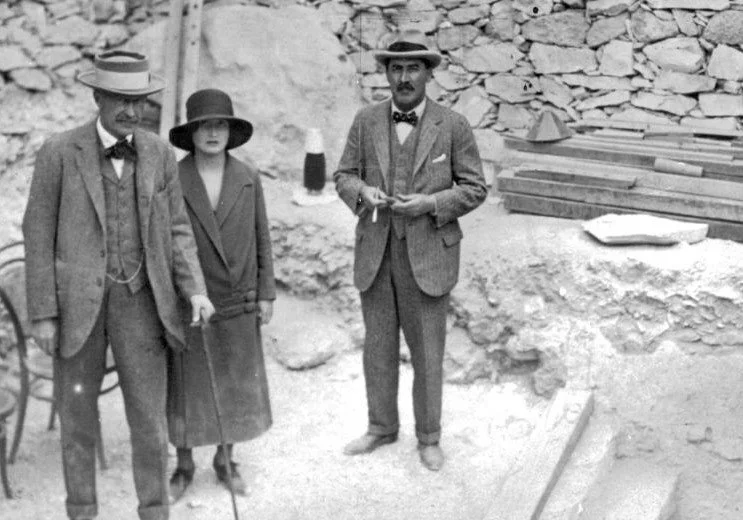
Harry Burton, Howard Carter, Lord Carnarvon and Lady Evelyn Herbert at the steps of KV62, November 1922. Three living people in daylight, in hats — that is what the mummy's modern story actually looked like at its start; the dead king is not in the picture at all. Public domain, via Wikimedia Commons.
Ask where the mummy of the modern record is actually spotted, and the honest answers are three rooms.
The tomb door, November 1922. Howard Carter found a flight of steps cut in the floor of the Valley of the Kings. The patron was George Herbert, 5th Earl of Carnarvon, who had financed years of unproductive digging. What the steps led to — tomb KV62, the burial of the boy-king Tutankhamun, raided twice in antiquity but essentially intact: the antechamber entered in late November 1922 ("Can you see anything?" — "Yes, wonderful things"), the burial chamber formally opened in February 1923. This lesson's third plate is Harry Burton's photograph of Carter, Carnarvon and Lady Evelyn Herbert on the tomb's steps in November 1922: three living people in daylight, in hats. That is what the mummy's modern story actually looked like at its start.
The newsroom, spring 1923. In January 1923 Carnarvon sold the exclusive reporting rights to The Times of London — £5,000 down, and three-quarters of the syndication proceeds. Every other newspaper was locked out of the story of the decade, with correspondents gathered at Luxor. What they filled them with, when Carnarvon fell ill, was the curse. On 24 March 1923 the novelist Marie Corelli — among the best-selling authors alive — published her warning: quoting an obscure book she said she owned, she declared that "the most dire punishment follows any rash intruder into a sealed tomb," spoke of secret poisons enclosed in boxes, and asked whether a mosquito bite had really done all this to Lord Carnarvon. On 5 April 1923 Carnarvon died in Cairo. On 6 April the papers carried Arthur Conan Doyle, spiritualism's most famous convert, suggesting that "elementals" — guardian forces set by Tutankhamun's priests — had caused the death. They also printed that a curse inscription had been found over the tomb, and that the lights of Cairo failed at the moment of the death. In Spotted, a keeper records the sighting conditions: the mummy-as-avenger was observed exclusively in newsprint, by a press denied the tomb, in the weeks around one real and explicable death.
The studio, December 1932. Universal Pictures, fresh from Dracula and Frankenstein (1931), took the Tutankhamun furore as its brief for a third monster. The Mummy, released 22 December 1932, directed by Karl Freund and written by John L. Balderston, is not the shambles of later Halloweens. Boris Karloff plays Imhotep, a high priest buried alive for trying to raise his dead love, the princess Anck-es-en-Amon, Revived when a young archaeologist reads the scroll aloud in 1921, Imhotep appears wrapped for only a few minutes. Thereafter, in modern dress as "Ardeth Bey," he spends a decade patiently engineering his reunion with the princess reincarnated. The horror of 1932 is stillness: a man three thousand years patient. The slow pursuer the culture remembers was built by the sequels: Universal's Kharis films of the 1940s made the mummy a mute, bandaged strangler who walks at one unhurried pace and cannot be outrun in the only sense that matters — he does not stop. Hammer's The Mummy (1959), directed by Terence Fisher, fused the inheritances in colour: Christopher Lee's Kharis, mummified alive for Ananka's sake, revived in 1890s England to murder the Banning expedition one by one — Peter Cushing, as John Banning, on the other side of the doors he smashes through. Stephen Sommers's The Mummy (1999) inverted the gait: Arnold Vosloo's Imhotep, woken by Brendan Fraser's and Rachel Weisz's expedition, regenerates from corpse to leading man in an action-adventure. 1932 waits. The forties and 1959 walk. 1999 runs. The walking one is the one the culture kept — the exact shape of the fear the newsrooms had already taught it: consequences that arrive slowly, and arrive.
KEEPER'S CHECK-IN
In Spotted's Tutankhamun file, what did Carter actually find in 1922 — and what did the newspapers build on top of it in 1923?
What People Watched For — the Appeal and the Letter at the Tomb
What did people do, at an Egyptian tomb, in expectation that the dead would act? The record answers with two customs, both published, both named, and neither of them a haunting.
The first is the Appeal to the Living. From the Old Kingdom onward, tomb chapels and stelae carried a formal address that begins, in the standard rendering, "O you who live upon earth" — and speaks to anyone who will pass by this tomb: priests, scribes, travellers, the literate few. The dead person asks the passer-by to do one small, specific thing aloud: speak the offering formula — "a thousand of bread and beer, a thousand of oxen and fowl, a thousand of every good thing" — and to pronounce the dead person's name. Scholars of the texts are plain about the mechanism: reading the formula aloud activated it. The voice did the work. The dead, through the stone, watched for a living voice, and the living who entered were expected to supply it, because the ka beyond lived on what was spoken and offered in the chapel. Mark it: the custom, the inscriptions, the chapels are F. The efficacy the Egyptians believed in is their belief, filed as such.
The second custom stands on the same threshold, facing the other way. When the living needed the dead to act, they came to the tomb and delivered a letter in person: the Letters to the Dead of §3 open, several of them, as "an oral reminder," and an instruction text directs that the petition be recited before him at the tomb. The written sheet or bowl was left at the tomb — the Qau bowl behind a burial's head. The Egyptians did not wait at tombs for a monster. They went there to speak, and they watched for an answer in the only court they thought could hear the case.
What It Actually Is
✦ On the class test
Take the curse first, because it can be taken apart completely. Its foundation document does not exist. No curse inscription was found in Tutankhamun's tomb — not over the door, not on the shrines, not among the thousands of objects Carter's team catalogued over ten years. The famous sentence — "Death shall come on swift wings to him who disturbs the peace of the king," — appears in no Egyptological record of KV62. What the tomb does contain, as working Egyptologists have identified, is protective equipment for the king: spells from the Book of the Dead on the burial shrine, written to secure his eternal life — rewritten by the press into threats. The first root of the curse is therefore journalism's economics: an exclusive sold to one paper, a world's press locked out and billing by the column, a novelist's letter that arrived a fortnight before a death and read thereafter as prophecy, a detective-writer's "elementals" offered the day after it. Roger Luckhurst's The Mummy's Curse (2012) traces the manufacture in detail.
The second root is grief, and it cuts two ways. Carnarvon died at fifty-six of a real infection, in the last years before antibiotics made such deaths uncommon: a mosquito bite on the cheek, nicked open by his razor as he shaved, turned to blood poisoning and then pneumonia. His Nature obituary gives that chain in one sentence; it needed no tomb to explain it in 1923. A sudden death in a blaze of publicity asks the mind for a shape, and the press had one ready. But the deeper grief is older: the people in the tombs were persons, with families who had paid embalmers and poured water for them.
Which is the third root: empire. KV62 was excavated in an Egypt under British occupation and British antiquities administration, and a British lord could sell the story of an Egyptian king's burial to a London newspaper as his property. Luckhurst files the curse tales as "saturated with questions of empire": the fantasy of the dead pharaoh's revenge flourished precisely among the people doing the taking, in the decades when the taking was beginning to be questioned. A curse is a conscience with the names filed off. The men who found the steps and cleared the rubble were Egyptian, their names largely unprinted; no newspaper asked whether they feared the tomb they entered daily.
And then, because this class counts, somebody counted. In 2002 the epidemiologist Mark R. Nelson published the formal version in the BMJ: a retrospective cohort study of the 44 Westerners Carter recorded in Egypt at the relevant dates, 25 of them exposed. The exposed died at a mean age of 70 years, the unexposed at 75; survival after exposure averaged 20.8 years against 28.9 — and neither difference was anywhere near significance (P = 0.87 and P = 0.95), with no association between exposure and death within ten years. Nelson filed his limits with his result: small numbers, wide confidence intervals, a study that "may have been underpowered to show a more subtle adverse effect." His conclusion stands as written: "There was no significant association between exposure to the mummy's curse and survival and thus no evidence to support the existence of a mummy's curse." Mark the layers: the deaths are F; the curse said to explain them is T — a telling with dates, bylines and a price.
Still With Us
The mummy never left. It changed custody.
In the cinema it became a permanent resident — the one Universal monster with no literary original, invented whole by journalism and a studio between 1922 and 1932, and re-wrapped by every generation since, down to Halloween costumes whose bandages owe more to Kharis than to any embalmer. The costume keeps the linen — the one true Egyptian detail in the inheritance — and drops the person: no name, no family, no offerings, no case to plead. The record's mummy had all of those. The costume's has a walk.
In the museums, the argument the unwrapping parties began has finally become an argument about the dead themselves, and it is live, documented, and unresolved. The standing framework in Britain is the Department for Culture, Media and Sport's Guidance for the Care of Human Remains in Museums (2005): remains are to be held and displayed with respect, and display justified. The British Museum's policy follows it — a written justification for any display, weighing public benefit against the feelings of communities with cultural continuity with the dead — Other institutions have landed elsewhere, in the open, within the last year of this lesson's writing: Manchester Museum, following public consultation, removed from display the remains of an ancient Egyptian woman exhibited for some two hundred years; Glasgow's Kelvingrove took down the mummified priest Nekht, in "the absence of consent" from the dead or their descendants; the Hunterian covered the open sarcophagus of Lady Shep-en-Hor — she "deserves privacy in death" — while keeping the sarcophagus itself on view; The question the Victorians never asked at their parties — by what right do we look? — is now asked in consultation documents, and the Egyptian dead are at the centre of it.
This lesson's own plates observe the rule the argument is feeling toward: an engraver's fancy, a painter's scholars, and three excavators on a stair — no photograph of an ancient person's body hangs in it, because the lesson can teach everything it has to teach without one. The dead in this class are filed as persons first, evidence second, and spectacle never. The mummy began, in the embalmers' workshop, as a person being kept; the whole long record since is that keeping interrupted by people who wanted the body for something else.
Guided Observation
This lesson's plates are a fancy, a painting and a photograph, and the exercise is to keep them apart. Study the Della Valle engraving of 1674 first: two mummies at Saqqara, presented upright like exhibits, in a landscape arranged for a European reader who would never see Egypt. What in the picture tells you that? Now the Philippoteaux painting, Examination of a Mummy (c. 1891): a woman of ancient Egypt on a table in a museum room, a semi-circle of gentlemen in dark suits leaning over her unwrapped body with the instruments of their professions. It is a painting, not a photograph: every figure in it was placed. Ask whose dignity the composition is arranged for. Now the Burton photograph: Carter, Carnarvon and Lady Evelyn on the steps of KV62, November 1922, in daylight, in hats, looking at the camera. It is the only one of the three that is a record in this class's sense — and the dead king, the subject of the whole lesson, is not in it at all. He is below the steps, in the dark, in his boxes, exactly where his embalmers and his family intended him to be. Write down what that absence does that no picture of him could.
Assignment Manual
✎ WRITTEN · ⚒ HANDS-ON · ◐ BOTH
✎ Written · Entry No. 36: The Mummy.
- Rule your entry page. Turn to the Scholar's Entry Page in this lesson's packet and rule a page of your journal to match it.
- Write the mummy's entry, to the standard. The Creature: the preserved body defined, the word's road from mūmiyā the pitch to mummy the person, and the depiction line read. First Told: Herodotus, Book II — the visitor, the three grades, the seventy days, and the hedge his price list requires. The Tales: the Letters (Qau, Cairo) and what an akh was asked to do; the real warnings in their own words, with their rarity; the mummia trade and its mistranslation; Pettigrew's unrollings. Spotted: the tomb door, the newsroom, the studio — and the three gaits, 1932, Kharis, 1999. What It Actually Is: three lines — an exclusive sold and a press locked out, a death from blood poisoning, an empire's conscience with the names filed off; and Nelson's count. Still With Us: the costume, and the museum argument in its present, unresolved state. The Keeper's Line: your judgment, in a line or two.
- Weigh a sentence. "Death shall come on swift wings to him who disturbs the peace of the king." Write one paragraph tracing this sentence as an object: where it is found (1923 newspapers), where it is not found (KV62, in ten years of cataloguing), what real tomb texts it was likely rewritten from, and what work it did for the papers that printed it. Then write one line on what a keeper may honestly call it.
- Mark every line. This lesson's drill is the full set at speed. Herodotus's writing is F; his grades are a craftsman's claim, filed as report. The letters are F as objects; their petitions are the petitioners' belief. Corelli's letter and Doyle's elementals are F as things said in 1923, and evidence about 1923 only. The curse is T — a telling, with bylines. Go through your entry and make sure no sentence borrows a newspaper's authority for a newspaper's invention.
- File the count. At the foot of your entry, write Nelson's table — 44 in the cohort, 25 exposed, 70 against 75, 20.8 against 28.9, no significant association — and beneath it, in one line, his own stated limit. Keepers file the caveat with the result.
The printable packet for this lesson — the Lexicon Handout, the Guided Practice, this manual, and the Scholar's Entry Page — is linked on this page.
Materials
· Your bestiary journal or notebook — kept for the whole class
· Pencils, and a pen you like writing with
· A ruler, for ruling your entry pages
· The lesson page, for the map and the plates
· This packet
Reflection
Herodotus gives eternity a price list, in three grades. What does his catalogue tell you about the embalmers, about his Greek readers, and about what a visitor can and cannot learn from a workshop's sales talk?
The Egyptian dead of this lesson were ground for medicine, unrolled for guests, and finally accused of a curse by the industries that disturbed them. At which of those three moments does the record most change your judgment — and what, exactly, changed it?
A museum must now write down its justification for displaying a mummified person. Write the two strongest sentences of that justification, one for display and one against, as fairly as you can. Which did you find harder to write honestly?
A Closing Note
You have now filed the dead perceived, the dead returned in the flesh, and the dead preserved — three lessons, three relations between the living and their dead, and in every one the record rewarded the same discipline: read what is actually written, count what can be counted, and refuse to let a good story bill itself as a document. Hold on to that refusal a little longer. Bring your marks, and your patience. And if you visit a museum before we meet again, and stand before a person in a case, you might speak their name aloud, if it is given. It is an old custom. The stone asked for exactly that.
The Bestiary
Bestiary Keeper
Further Reading & Sources
Herodotus, Histories, Book II.85–88 — the embalming account; Rawlinson's translation is reproduced by the Spurlock Museum, University of Illinois, and Godley's is at Perseus.
Alan H. Gardiner & Kurt Sethe, Egyptian Letters to the Dead (Egypt Exploration Society, 1928) — the first publication of the bowls and letters.
Julia Troche, "Letters to the Dead," UCLA Encyclopedia of Egyptology (2018) — the modern catalogue; the American Research Center in Egypt's "The Social Contract of the Afterlife" tells the Qau and Cairo bowls for general readers.
Daniel Potter, "Ancient Egyptian tomb warnings, curses, and ghosts," National Museums Scotland — the real warnings and the curse's press history.
Karl H. Dannenfeldt, "Egyptian Mumia: The Sixteenth Century Experience and Debate," The Sixteenth Century Journal 16 (1985) — the mistranslation and the trade; Richard Sugg, Mummies, Cannibals and Vampires (2011) carries it to the Victorians.
Thomas J. Pettigrew, A History of Egyptian Mummies (1834) — the unroller's own book.
Roger Luckhurst, The Mummy's Curse: The True History of a Dark Fantasy (Oxford University Press, 2012) — the curse as journalism and empire.
Mark R. Nelson, "The mummy's curse: historical cohort study," BMJ 325 (2002): 1482–1484 — the count; free in full at PubMed Central (PMC139048).
Department for Culture, Media and Sport, Guidance for the Care of Human Remains in Museums (2005), and the British Museum's Human Remains in the Collection policy — with the Museums Association's 2026 reporting on the Glasgow, Hunterian and Manchester decisions.
### Images
Hero: be-rf-mummy-philippoteaux-examination.jpg — Paul Dominique Philippoteaux, Examination of a Mummy (c. 1891), public domain via Wikimedia Commons. A painting, not a photograph, of an examination.
be-rf-mummy-della-valle-saqqara.jpg — engraving of two mummies found at Saqqara, from Pietro Della Valle, Reiß-Beschreibung (Geneva, 1674), public domain via Wikimedia Commons; fanciful, and labelled so.
be-rf-mummy-carter-carnarvon-steps-1922.jpg — Harry Burton, Howard Carter, Lord Carnarvon and Lady Evelyn Herbert at the steps of KV62, November 1922, public domain via Wikimedia Commons.
Map: be-u6l36-map-timeline.png — three pins: Valley of the Kings (1922) · London (1923) · Hollywood (1932).
Not used, by rule: any still from The Mummy (1932), the Hammer films or The Mummy (1999) — copyrighted; and any photograph of an ancient person's body — see §6. Full audit in MANIFEST-mummy.md.
Submit your work for this lesson using the form below.
CONTINUE IN THE BESTIARY HALL
← Previous · Lesson 35: Revenants Next · Lesson 37: The Banshee & the Washer at the Ford →
Unit VI — Those Who Linger The Bestiary Hall — All 41 Lessons
The rest of Unit VI: Lesson 34 · Ghosts · Lesson 35 · Revenants · Lesson 37 · The Banshee & the Washer at the Ford · Lesson 38 · Will-o'-the-Wisp · Lesson 39 · The Poltergeist · Lesson 40 · New Beings, Old Pattern · The Capstone · The Unfinished Page