

THE BESTIARY
Unit VI · Lesson 38Will-o'-the-Wisp
Professor Sable Rookmere
Bestiary Keeper
The Bestiary Hall • School of Evershade
Professor's Introduction
Every being so far has had a shape, even if the witnesses argued about it afterward. This one never did. The will-o'-the-wisp is a light, and that is the whole of the inventory: a brightness over wet ground after dark, seen by a great many people across a great many centuries, and explained by every one of them with whatever story their parish kept in stock. I will be honest with you at the door, the way I hope you are learning to be in your entries. This is the thinnest file in the whole class. Our first record is a line of poetry. I keep the lesson anyway, and keep it gladly, because a thin file with its labels showing teaches the keeper's trade at least as well as a fat one nobody has to be careful with. Watch how this lesson holds its hedges. You will need the same grip, on the same kind of evidence, at the capstone.
The Bestiary
Bestiary Keeper
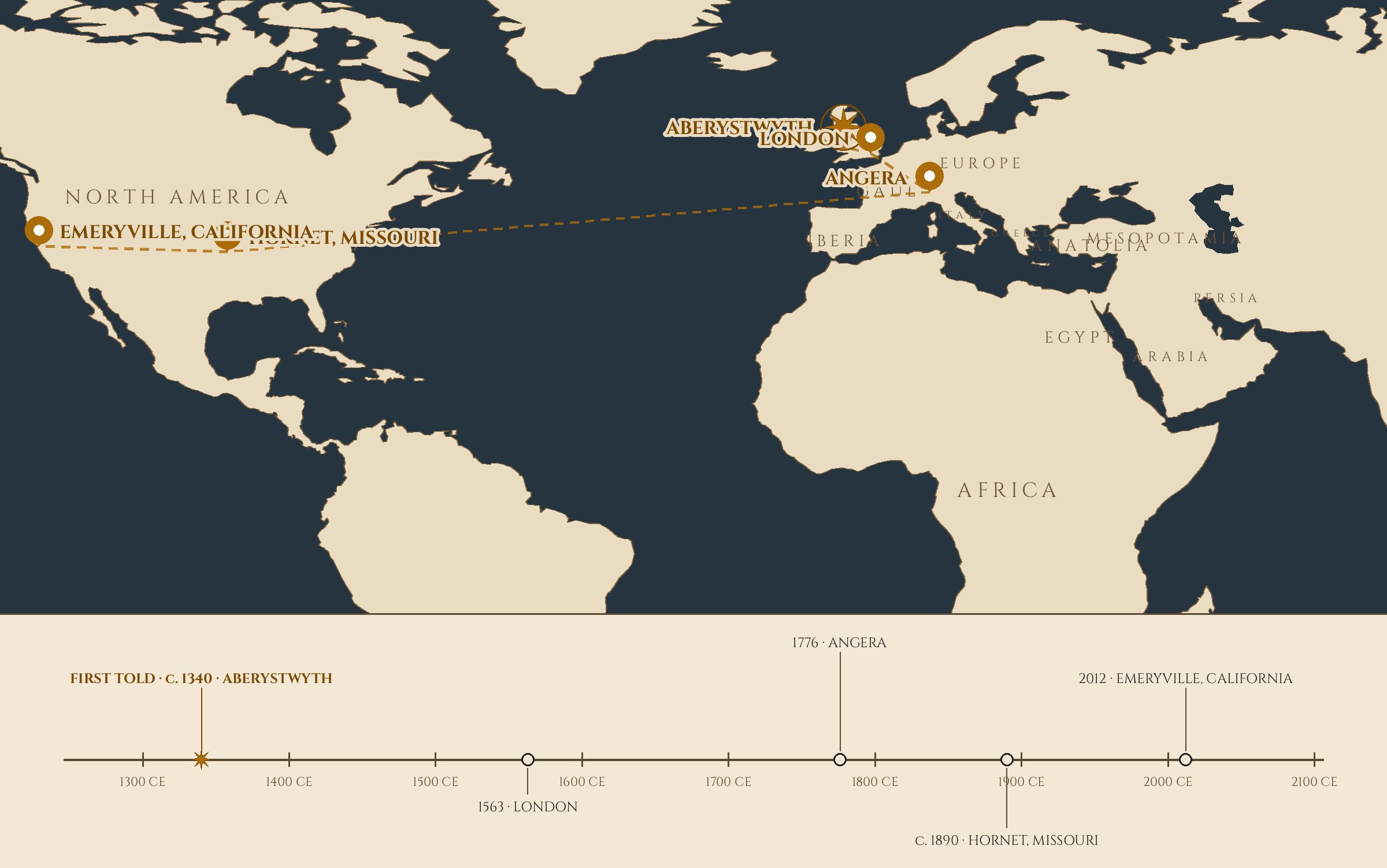
Where this lesson travels: Aberystwyth, in the Welsh poet Dafydd ap Gwilym's home country, where his poem of about 1340 names the corpse candles in every hollow — the thinnest first record in this class: a literary mention, not a report, and the place approximate, both hedges carried whole; London, where William Fulke's Book of Meteors (1563) first set the term ignis fatuus in English; Angera, on Lake Maggiore, where Alessandro Volta collected flammable marsh air in 1776 and the wisp's chemistry began; Hornet, Missouri, where reports of the Spook Light begin about 1890, the dates approximate; and Emeryville, California, where Pixar's Brave (2012) sent its blue wisps through the forest — the modern face. The starred pin is the first record; the dashed line is the telling, traveling.
Lesson Objectives
By the end of this lesson, you will be able to:
- Give the wisp's several names, and say what each name claims the light is.
- Name the first record — the poet, the place, the rough date — and carry both hedges the map carries, whole.
- Tell what the light was said to do to travelers, and to the dying.
- State the real root as what it honestly is: a strong proposal, not a settled proof.
- Recount the corpse-candle custom of Wales with its named source and its date.
Your Assignment Packet
This lesson's work lives in its packet: the Lexicon Handout (every term, the core terms marked with the keeper's diamond ◆), Materials, Guided Practice, the Assignment Manual written out whole, the Scholar's Entry Page, the Reflection Questions, the Workbook Checklist, and the Keeper's Notes, for whoever teaches the lesson. Download the packet before you begin and keep it beside you as you read. The packet's assignment is Rookmere's own word for the work: Entry No. 38 — Will-o'-the-Wisp (written, with a dusk watch) ◐. The Unit VI Quiz is not printed in the packet; it waits at the end of the unit, with Lesson 40.
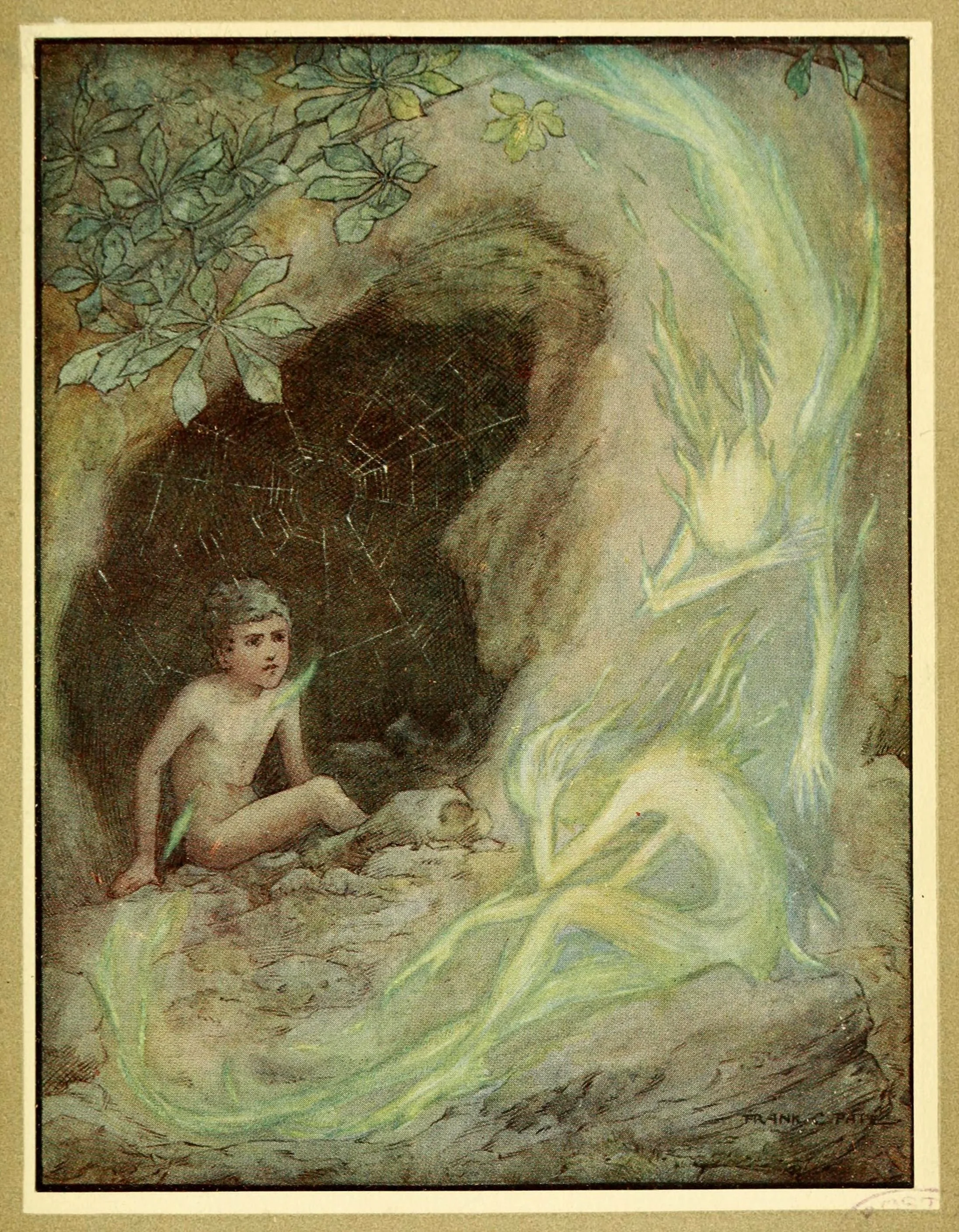
Frank C. Papé's plate for The Story Without an End: a child in a dark hollow watching the green flames of the will-o'-the-wisps rise and curl — the wisp as storybook wonder. Public domain, via Wikimedia Commons.
The Creature: A Shelf of Lanterns, and Three Pictures
The being has no single name because it has no single nature; it has a shelf of names, and each name is an interpretation wearing a label. Will-o'-the-wisp is Will with his wisp — a wisp being a twist of straw lit for a torch — so the English name already makes the light a lantern carried by somebody. Jack-o'-lantern, in its older use before it belonged to carved pumpkins, names the same carrier. The friar's lantern makes him a monk astray. In the East Anglian fens, collectors in the twentieth century recorded the Lantern Man, a light with a temper, to be neither followed nor mocked. Latin gave the shelf its learned entry: ignis fatuus, the foolish fire — foolish because it seems to lead and always flees, and because the traveler who chases it is the fool of the story. And in Wales the light is something else again: the corpse candle, canwyll corff, a light with an errand, which §3 and the box below take up.
The wisp's depiction line belongs here too, and the Guided Observation reads the plates in full: no picture exists from the record's first five centuries — the light was reported, never drawn — and when pictures come, they come as filings, not portraits: the science annual's experiment page, the personified lady of the marsh, the storybook's green flames. Three pictures of a light nobody could hold, each showing what its own century filed the light as.
Notice what the names agree on and what they do not. All of them were given to a light seen at night over wet ground. None of the oldest names gives it a body, a voice, or a history. The being of this lesson is the record of a happening — a brightness that moved, or seemed to move, where no lantern should be. That is why its file is built differently from the unicorn's or the kelpie's: there are almost no descriptions of the wisp itself, only sightings, sightings' settings, and the uses people made of what they saw.
First Told: A Poet's Line, Honestly Hedged
The starred pin stands near Aberystwyth, in Wales, about the year 1340, and the map says plainly what kind of pin it is: the thinnest origin in this whole class — a poetic mention, hedged as such. The Welsh poet Dafydd ap Gwilym, writing about 1340, speaks of wisps and corpse candles in every hollow. That is among the earliest literary mentions of the marsh light that survive. The hedges travel with it, and your entry will carry both: it is a poem, not a report — a poet's image, not a witness's deposition — and the place is the poet's home country, approximate, pinned where the man lived, not where any one light was seen. The telling behind the poem is certainly older than the poem. How much older, the record does not say, and neither do we.
The rest of the map is short, and its shortness is the lesson. London, 1563: William Fulke's Book of Meteors names the ignis fatuus in English — the first English record of the term, as the dictionaries file it — and notice the shelf Fulke files it on: a book of meteors, of weather and the upper air, not of spirits. Angera, on Lake Maggiore, 1776: Alessandro Volta collects the marsh's flammable air — the wisp's chemistry begins there, and §5 takes it up. Southwest Missouri, about 1890: reports of the Hornet Spook Light begin — with the map's own caution, dates approximate. And Emeryville, California, 2012, where a film studio gentled the wisp into a guide. Five pins, six and a half centuries, and the first of them a line of verse. A keeper does not apologize for such a map. A keeper labels it.
The Tales, and How the Telling Grew
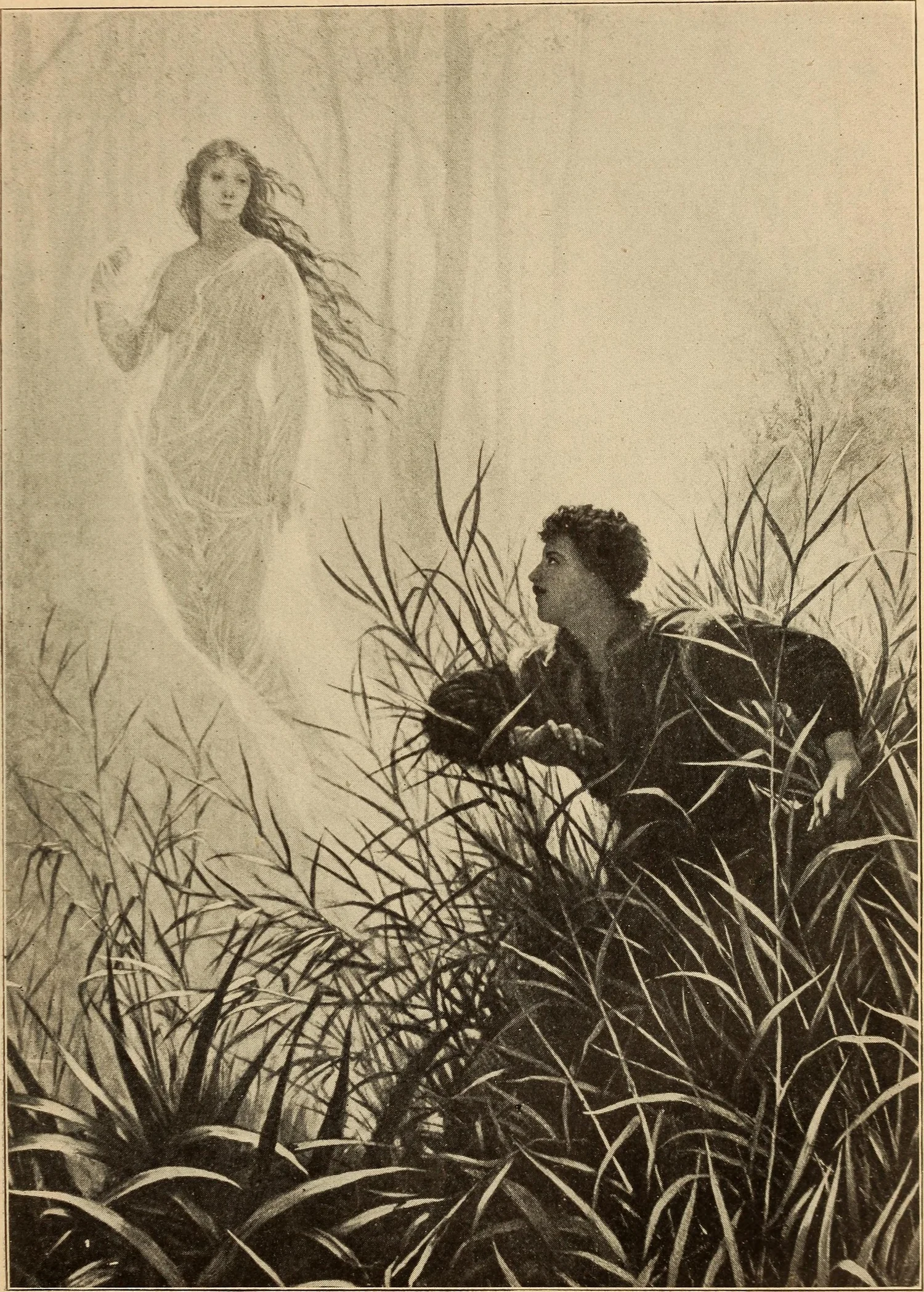
E. Spangenberg's Will o' the Wisp: the wisp given a shape — a pale lady of the marsh, appearing before a traveler among the reeds at dusk, a shape and a company the light itself never offered. Public domain, via Wikimedia Commons.
The telling grew by interpretation, since there was so little else to grow. The same light, watched from different doorways, became different beings. To the traveler on a night road it was a leader astray: the tale told all over Europe, of the light that hovers just ahead, draws the walker off the path into the bog, and vanishes — a story whose moral is written into the Latin name, foolish fire, foolish follower. To the Welsh parish it was a messenger: the corpse candle, walking beforehand the road a funeral would soon walk, so that a death in the house could be read in the yard the week before it happened. To the fen country it was a neighbor with rights: the Lantern Man was not to be whistled at, mocked, or struck at. The journal Folklore in 1894, gathering the corpse-candle accounts, recorded the rule's teeth: anyone who tried to stop or interfere with the candle was struck down. Lights that are only lights do not usually acquire rules of etiquette. These did, because people met them on real roads, in real dark, with real funerals to arrange.
Print also gave the light a body, slowly, because print has always been uncomfortable selling a picture of a glow. The names had promised a carrier all along — Will with his wisp, the friar with his lantern — and the chapbooks and ballad sheets obliged, drawing him as a boy or a monk with a torch held high and mischief in his face. Look at Spangenberg's plate in this lesson, the third of the lesson's pictures, and you can watch the same impulse dressed in finer clothes: a pale lady of the marsh rising up among the reeds in front of a traveler, robed, lamplit, her whole figure built out of the one thing the witnesses actually reported, which was light. She is beautiful, and she is a fine piece of evidence about the tellers. The oldest record knows nothing of her, or of any lady. She belongs in the growth of the telling, and your entry files her there, with the boy and the monk for company.
The nineteenth century picked the wisp up twice, and carried it to two very different shelves. The science annuals took it as a puzzle of gases. This lesson's second plate is one of those pages, and it repays a slow look: dense columns of print, an engraving of the apparatus, the marsh light explained by the phosphuretted-hydrogen experiment of the day with the confidence of a page that has never stood in a bog at midnight. The storybooks took the same light the other way, into the nursery. Frank C. Papé's plate, our hero, shows a child standing in a hollow at night watching green flames rise and curl around her, and the picture is all wonder. The terror the old tales carried — the rising water, the path gone — has been drained out of it on purpose. The twentieth century put the wisp on the road: the spook lights of straight highways, Hornet's among them, watched from parked cars by generations of courting couples and curious families with the headlights off. Follow the pins and you will see that no age added much in the way of facts about the light itself. They re-filed it. Omen, weather, gas, wonder, roadside attraction — the telling's growth, for this being, is a history of the cabinets it has been filed in.
KEEPER'S CHECK-IN
In the Tales, what was the light said to do to travelers — and what different errand did it run for the dying?
Spotted: Where the Light Was Seen
The tales are few, because the being does so little; but they are told everywhere the ground is wet. The master tale is the leading astray: a traveler, benighted, sees a light, takes it for a window or a lantern ahead, follows, and finds the path gone — the light always a field further on, the water rising at his boots. In some tellings the light is a soul, unbaptized or unshriven, condemned to carry its lantern; in others a miser who moved his neighbor's boundary stone and must walk the bounds forever; the explanations vary by parish, but the shape of the tale does not: the light recedes exactly as fast as it is followed. File that shape carefully. It is the one detail every telling shares, and §5 will ask what in the world behaves like that.
The second tale belongs to Wales, and it is less a tale than a household scene, repeated in the record for centuries: a light is seen to leave a house where someone lies ill, or to pass along the lane in the form of a small candle flame with no candle under it, traveling the road to the churchyard. Those who saw it did not chase it. They read it, the way one reads a letter delivered early. The box below gives the custom its full keeping, with its sources; here it is enough to mark the tale's difference from the master tale: the same light, on the same kind of road, is in one country a trap and in the next a tidings. The being did not change at the border. The watchers did.
KEEPER'S CHECK-IN
In Spotted, what settings do the wisp's reports share — what kind of ground, and what kind of road?
What People Watched For — the Corpse Candle
In Wales the watching had a name and a rule. When a light was seen to issue from a house — sometimes, watchers said, from the very bed of the sick person — and to travel toward the churchyard along the road, households read it as the funeral rehearsing its route: the corpse candle, canwyll corff, going the way the corpse would soon be carried. The watchers read its size as they read its road: a small light for a child, a larger for a grown person. And the rule of the road was to let it pass: to stand in its way, or to try to stop it, was held dangerous.
The custom stands in print with a name and a date. The Reverend Edmund Jones, in his Relation of Apparitions of Spirits in the County of Monmouth and the Principality of Wales (1767; reprinted 1780), records the corpse candles as an infallible sign of a coming death: they "never fail going the way that the Corps will go to be buried." The Cambrian Register for 1796 gives the same account for the diocese of St David's — a light seen a short space before a death, proceeding from the house, sometimes from the very bed, "precisely in the same track in which the funeral is afterwards to follow." The belief is S, a reported belief, and the entry marks it so. That Welsh households watched for the light, and ordered their mourning by it, is F — and it is the most complete custom any light-being ever produced.
What It Actually Is
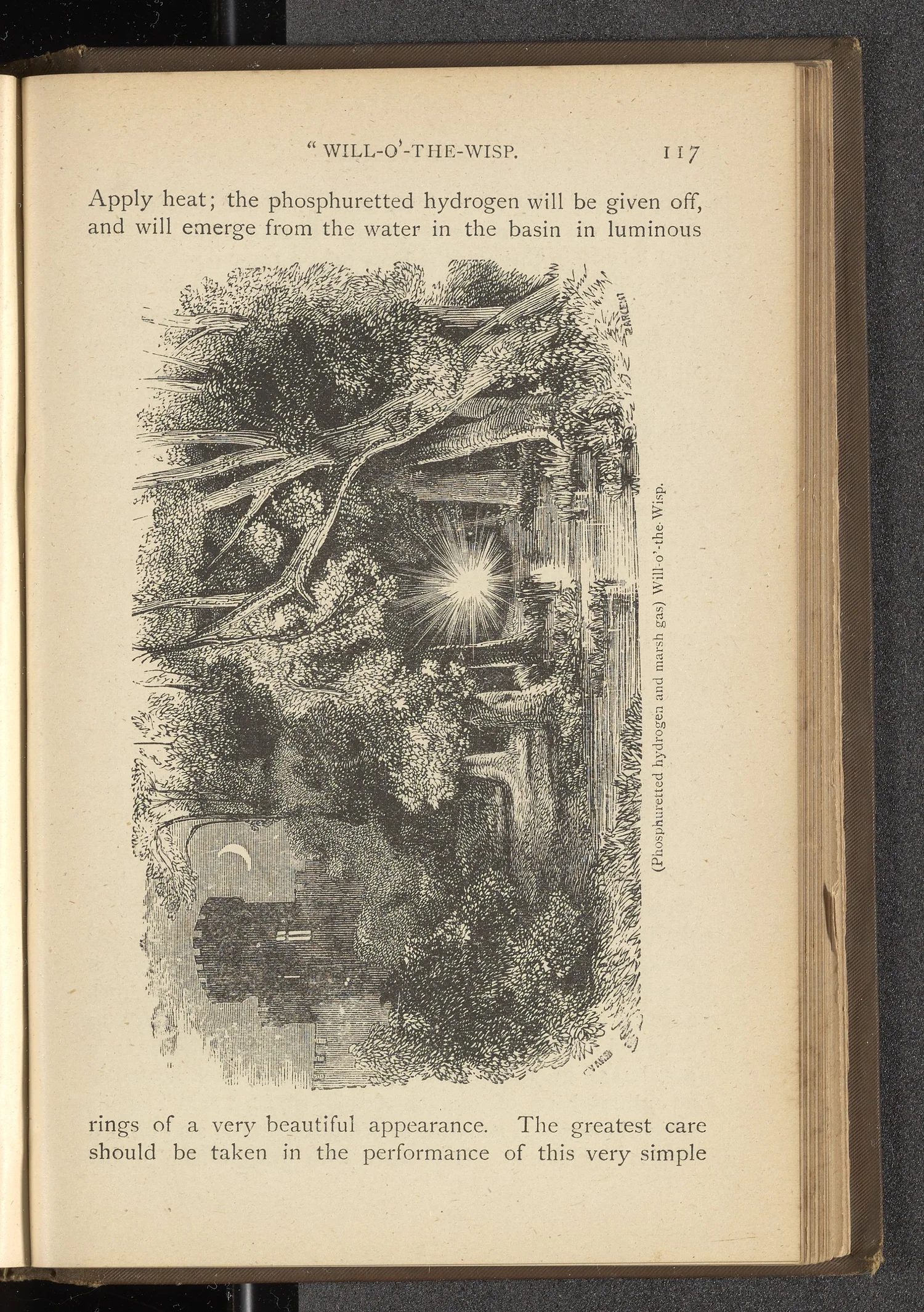
The real root in print: a nineteenth-century popular-science page — an engraving of the marsh light above, and below it the phosphuretted-hydrogen experiment by which the science annuals explained the ignis fatuus away. The lesson files that explanation as a strong proposal, not a settled proof. Public domain, via Wikimedia Commons.
The root begins at the map's third pin. In 1776 Volta, working on the shore of Lake Maggiore at Angera, collected the air that bubbles up through marsh water and showed it would burn; he named it the marsh's own flammable air — what chemistry now calls methane, the gas of decay in wet, airless ground. Marshes, bogs, and churchyards over old graves are exactly the ground the wisp was seen on, and decay there gives off more than methane: among its trace gases are the compounds of phosphorus, and one of them — diphosphane, the companion of phosphine — catches fire by itself on meeting the air. A bubble of marsh gas, lit by its own companion as it breaks the surface, would burn with a small cool flame, drifting as the gas drifts, sinking and flaring as new bubbles rise. That is the proposal the nineteenth century's science annuals were already teaching with their phosphuretted-hydrogen experiments, and it remains the explanation science reaches for first.
Now the keeper's label, and it must be written as carefully as the proposal: proposed, not proven. The mixture can be made to flame in a laboratory. But no wild wisp has ever been caught in the act and measured, and reported sightings have thinned to almost nothing as the marshes were drained and the nights filled with electric light — the phenomenon faded before the instruments arrived. The road lights are a separate file with a firmer ending: lights of the Hornet kind have repeatedly been traced to distant headlights on a straight road, their beams bent and steadied by layers of night air — a different light wearing the wisp's outline. And under both files stands the human root, which no chemistry dissolves: a single light in pathless dark draws the eye and then the feet, and bogs are genuinely dangerous at night. The belief was the danger's map. The root of the wisp, as this class files it, is a strong proposal about gases, standing beside a certain fact about people.
Still With Us
The wisp's modern face is mostly a grandstand. At Hornet, Missouri, the Spook Light is still watched for from its stretch of road — the map's dates for its first reports are approximate, but its present is not: people drive out at night, park, and wait for the light, which is the corpse-candle watch with the mourning taken out of it. In 2012 Pixar's Brave finished the gentling the storybooks began: its wisps are small blue flames that appear in a line to lead the heroine — guides to her fate, kindly, where the old light led travelers into the moss. And the name survives where no marsh is anywhere near: a will-o'-the-wisp in today's newspapers is any goal that recedes as it is chased, any hope that will not be caught. The phrase outlived the phenomenon.
So the unit's slightest being closes with the file to hand a stranger who asks what this class is for. A first record that is a poem, and is labeled a poem. A root that is a proposal, and is labeled a proposal, in a lesson that could easily have got away with calling it an answer. A funeral custom documented better than the creature it was practiced for. Nothing in the file is missing, and nothing in it pretends to be more than it is. A scholar who can keep a file this thin this straight can keep any file in this book, and most files outside it.
Guided Observation
Study the hero plate first: Frank C. Papé's child in the hollow, watching the green flames of the wisps rise and curl. The plate is a twentieth-century storybook picture, and it shows the being exactly as its century wanted it — wonderful, not dangerous. Now hold the second plate beside it: the science annual's page, engraving and dense print, explaining the same light by experiment. Two plates, two filings of one light. Write down: what does each plate do with the traveler's danger? What has Papé given the flames that no witness ever reported — a shape, a company, a dance? And what does the science page promise that it does not, on its own page, actually show? Then turn to the third plate, Spangenberg's pale lady of the marsh, the wisp personified as a woman appearing to a traveler among the reeds. Three pictures: the wisp as wonder, as chemistry, as a person. The record under all three is a light no one could hold. Note which of the three comes closest to the oldest accounts — and what that tells you about what pictures do to beings.
Assignment Manual
✎ WRITTEN · ⚒ HANDS-ON · ◐ BOTH
◐ Both · Entry No. 38: Will-o'-the-Wisp.
- Prepare the page. Rule a fresh page of your bestiary to the Scholar's Entry Page in this lesson's packet. Head it: Entry No. 38 — Will-o'-the-Wisp. Under the head, write the being's shelf of names before anything else. In this entry the names are the description.
- Write the entry to the standard. The Creature: the shelf of names, and the three late pictures read as filings. First Told: Dafydd ap Gwilym — the place as the map gives it, the rough date, and both hedges (a poem, not a report; the place approximate) written out whole, not shortened away. The Tales: the leading astray, and the Welsh candle's errand, in your own words, with the re-filings — omen, meteor, gas, wonder, road attraction — each with its stop on the map. Spotted: the settings the reports share — wet ground, night roads, the churchyard road. What It Actually Is: the marsh-gas proposal, labeled as a proposal, and the headlights file kept separate. Still With Us: the Hornet watch, Brave, and the phrase in the newspapers. The Keeper's Line: your own judgment, in one or two lines.
- The candle-road audit. Take the map of your own home ground. Find the oldest churchyard you know of, and the road from the nearest houses to it. That road — walked by every funeral for centuries — is the road a corpse candle would have traveled. Write three lines: what the watchers on such a road would actually have seen at night, in the years before street lighting; what else besides a candle could have moved along it; and why a community might keep such a custom even while doubting it. File the audit under your Tales.
- The dusk watch. On a clear evening, walk — in company, on a path you have first walked in daylight — to the edge of the lowest, wettest ground near your home, and stand until full dark. Do not chase anything. Simply keep the watch the lesson describes: note every light you see, and file each one with its true name as you identify it (a window, a car, a star through trees, a reflection). Write the log in your entry, dated. A watch in which every light is accounted for is a successful watch. That sentence is the lesson.
- Mark every line. F for the dated fact — the poem, the meteor book, the experiment, the film. S for the sighting-reports, and what the watchers held: that the light led, warned, or fetched. T for the tales retold. Mark the root's lines with particular care: the proposal is F — Volta did collect the gas, the annuals did teach the experiment — while the claim that any given light was that gas remains unproven for every sighting in the file.
- Close with the hedges showing. End the entry by copying its two first-record hedges once more, exactly as the map gives them. An entry that ends with its uncertainties visible is finished. One that hides them is not.
The printable packet for this lesson — the Lexicon Handout, the Guided Practice, this manual, and the Scholar's Entry Page — is linked on this page.
Materials
· Your bestiary journal or notebook — kept for the whole class
· Pencils, and a pen you like writing with
· A red pencil, for the keeper's marks
· A ruler, for ruling your entry pages
· A map of your own home ground, paper or printed
· This lesson's packet (the Scholar's Entry Page is in it)
Reflection
The wisp's first record is a poem. What can a poem prove, and what can it never prove? Where else in this class does the record rest on a work of art?
Volta collected his marsh air in 1776, and the proposal built on it is still only a proposal. What would it take to close this file — and is the file weaker for staying open?
The corpse candle told a household that a death was coming, and the household found that useful. What did the custom give the watchers that the truth — no warning at all — could not?
A Closing Note
One light, five pins, and a file kept straight by its labels. Next lesson the record grows loud: the poltergeist, the being who is never seen and always heard, whose keepers traded poems for logbooks and logbooks for tape recorders. You will find the method unchanged — only the volume rises. Keep your journal dry, and your T, S and F honest.
The Bestiary
Bestiary Keeper
Further Reading & Sources
Edmund Jones, A Relation of Apparitions of Spirits in the County of Monmouth and the Principality of Wales (1767; reprinted Trefeca, 1780) — the corpse candle's fullest early keeping.
The Cambrian Register (1796) — the St David's account of the corpse candle's road.
M. J. Walhouse, "Ghostly Lights," Folklore 5:4 (1894) — corpse candles and marsh lights gathered from many countries.
William Fulke, A Goodly Gallery with a Most Pleasant Prospect into the Garden of Natural Contemplation (the Book of Meteors) (1563) — the ignis fatuus filed among the meteors.
Katharine M. Briggs, The Fairies in Tradition and Literature (1967) — the lantern beings of British tradition, carefully sourced.
Dafydd ap Gwilym's poems, in translation — for the first record in its own dress: a poem, not a report.
Submit your work for this lesson using the form below.
CONTINUE IN THE BESTIARY HALL
← Previous · Lesson 37: The Banshee & the Washer at the Ford Next · Lesson 39: The Poltergeist →
Unit VI — Those Who Linger The Bestiary Hall — All 41 Lessons
The rest of Unit VI: Lesson 34 · Ghosts · Lesson 35 · Revenants · Lesson 36 · The Mummy · Lesson 37 · The Banshee & the Washer at the Ford · Lesson 39 · The Poltergeist · Lesson 40 · New Beings, Old Pattern · The Capstone · The Unfinished Page