

THE BESTIARY
Unit VI · Lesson 35Revenants
Professor Sable Rookmere
Bestiary Keeper
The Bestiary Hall • School of Evershade
Professor's Introduction

The ghost of the last lesson could be seen through, in every sense. The being of this lesson has to be carried. The revenant is the dead person back in the body: buried properly, mourned properly, entered in the parish's memory as finished — and then up again, walking the lanes after dark, strong enough to ride a roof-beam, and heavy enough, when the grave is finally opened, to need two men to lift. I have read this record for years and it still sobers me, because a revenant was never one traveler's vision on a dark road. Whole villages met these beings. Villages took counsel about them, asked their bishops for leave, opened graves in daylight, and wrote down what they did. A neighborhood emergency leaves minutes, and those minutes are most of what this lesson owns. Read them in the company of the neighbors who kept them. They had to go on living next door to their dead when the writing was done.
The Bestiary
Bestiary Keeper
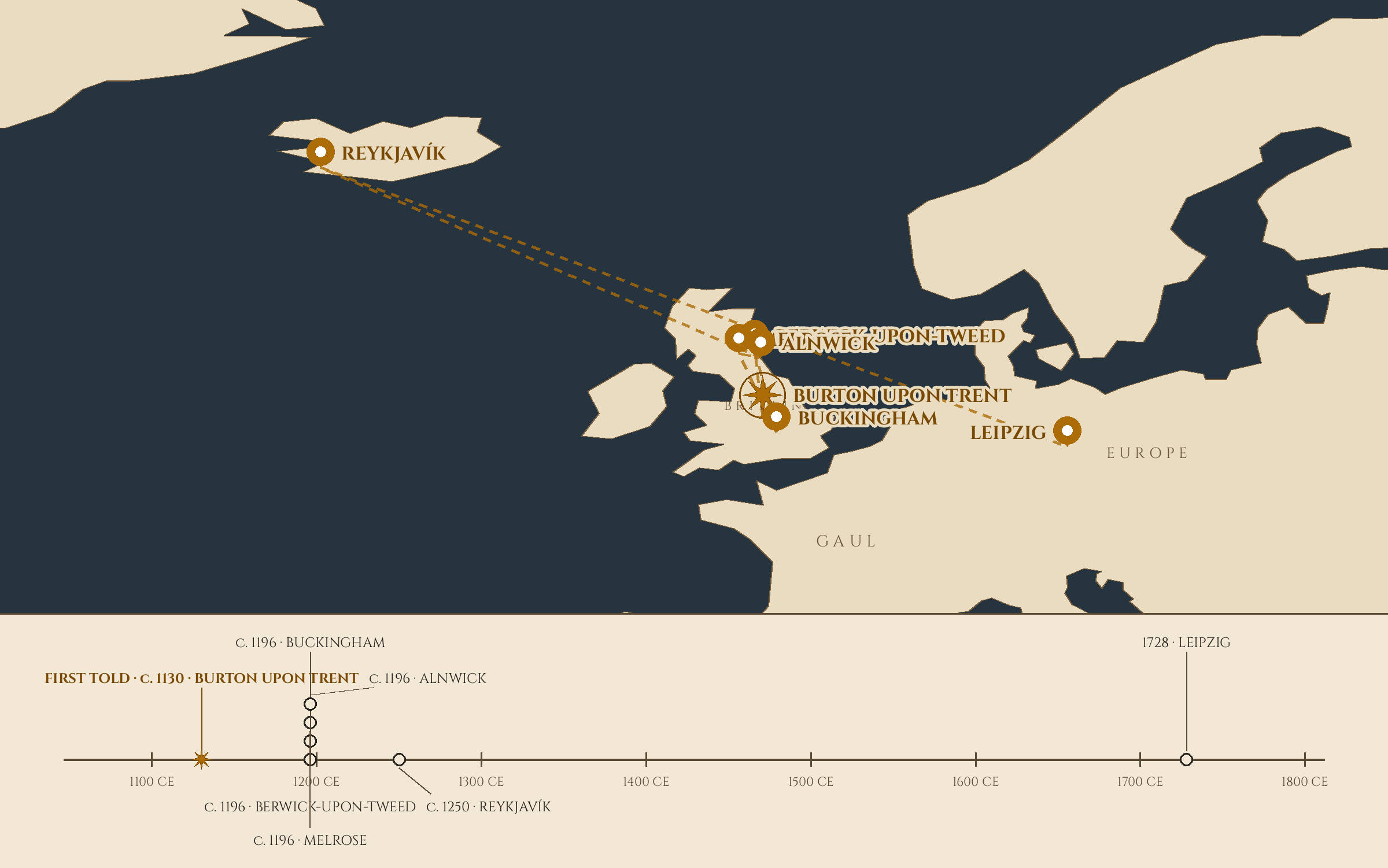
Where this lesson travels — a short journey, and the map says so: the revenant's surviving record clusters tight, in twelfth-century England and saga Iceland. Burton upon Trent, where Geoffrey of Burton wrote the Drakelow runaways into his Life of St Modwenna — written about 1118–1135, the events a generation earlier, about 1085–1094, the two dates kept apart; Berwick-upon-Tweed, standing here for William of Newburgh's casebook towns — Berwick, Buckingham, Melrose, Alnwick — about 1196; Reykjavík, for Eyrbyggja saga's Þórólfr bægifótr, who would not stay quiet in his howe (about 1250, the date approximate); and Leipzig, where Michael Ranft's dissertation of 1728 made the chewing dead a scholarly question. Four stops only: where the record is thin, the map says so rather than inventing waypoints. The starred pin is the first record; the dashed line is the telling, traveling.
Lesson Objectives
By the end of this lesson, you will be able to:
- Say what a revenant is, and how it differs from the ghost of Lesson 34.
- Retell the first record — the Drakelow runaways — keeping its two dates apart: the events and the writing.
- Walk William of Newburgh's casebook: Berwick, Buckingham, Melrose, Alnwick, and the two remedies the record shows.
- Tell Þórólfr bægifótr's story from the Eyrbyggja saga, with Glámr named as the draugr's other great file.
- Describe the crossroads burial and its end in 1823, with the sources named, and hold the sober reading of it.
- Set out the real root: sickness mapped onto a story, bodies that keep their own schedule, and communal fear met communally.
Your Assignment Packet
This lesson's work lives in its packet: the Lexicon Handout (every term, the core terms marked with the keeper's diamond ◆), Materials, Guided Practice, the Assignment Manual written out whole, the Scholar's Entry Page, the Reflection Questions, the Workbook Checklist, and the Keeper's Notes, for whoever teaches the lesson. Download the packet before you begin and keep it beside you as you read. The packet's assignment is Rookmere's own word for the work: Entry No. 35 — Revenants (written) ✎. The Unit VI Quiz is not printed in the packet; it waits at the end of the unit, with Lesson 40.
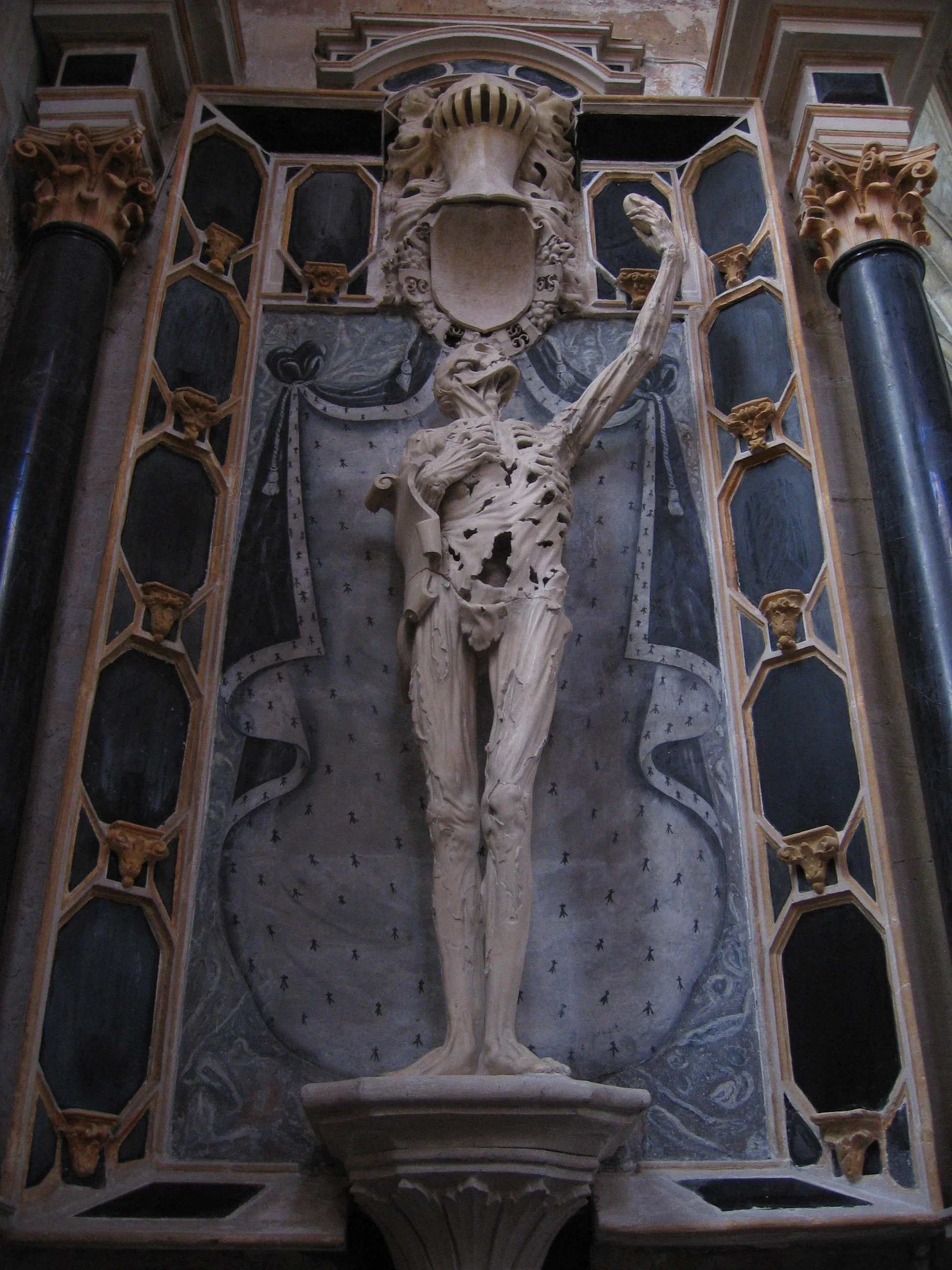
The Transi of René de Chalon (Ligier Richier, 1544–47, church of Saint-Étienne, Bar-le-Duc): the Prince of Orange carved as the grave would make him — a standing corpse, one hand raised with his own heart. The most famous cadaver tomb in Europe. Public domain, via Wikimedia Commons.
The Creature: A Word for the Walking Dead
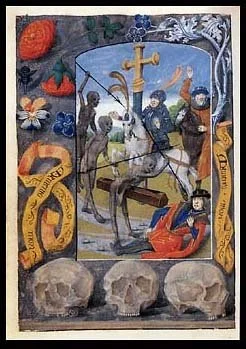
The Three Living and the Three Dead (medieval manuscript miniature): three living men meet three corpses who were themselves — the period picturing the idea of the dead returned, in the moral imagery it had. It illustrates no case in this lesson, and the entry labels it so. Public domain, via Wikimedia Commons.
Our word is French and late: revenant, from revenir, to come back. The beings it names are older than the word and blunter than the ghost. A ghost is seen; a revenant is met — in the lane, on the roof, in the widow's own bed — by people who did not ask to see anything and would gladly have stopped. He keeps his body, and the body is the problem: it does not rest, it does not rot on schedule, and it does not stay where the parish put it. Where the ghost wants something said, the revenant must be dealt with — with spades, with letters, with prayer, and, when those failed, with fire.
The revenant's depiction line is as bare as the ghost's, and for a plainer reason: the communities that met him were busy dealing with him, not drawing him. No medieval picture of a draugr survives (§4), and no chronicle case was illustrated in its own time. What the period did picture, in manuscript miniatures, is the returned dead as a warning — the Three Living and the Three Dead, living men meeting their own corpses on the road — and a small miniature of that meeting hangs in this lesson as evidence about the idea, labeled as no case's portrait. The corpse's great pictured age comes later and in church stone: the transi tombs of §6.
Keep this lesson's map in view while you read. It has four pins, and the spareness is worth a keeper's attention in itself. The surviving record huddles in two places — twelfth-century England, saga Iceland — and then leaps five hundred years to a dissertation at Leipzig. The map does not invent waypoints to fill the gaps, and neither should your entry. Four pins is what survives. File the shape of the evidence along with the evidence, and let the empty centuries sit there empty.
First Told: the Runaways of Drakelow
The starred pin stands at Burton upon Trent, and the document is Geoffrey of Burton's Life and Miracles of St Modwenna, written about 1118–1135. Mind the double date, because this class lives by it: Geoffrey wrote around 1130; the events he tells were already a generation old, set about 1085–1094. The first record is a writing, and what it records had happened before the writer took up his pen.
Two villeins of Stapenhill, having run away from their lord's labor, took refuge at Drakelow — and died there abruptly, and were buried in the churchyard. Then, by Geoffrey's account, they began to walk: by day and by night, about the village, carrying their wooden coffins on their shoulders, knocking on walls and doors, calling their neighbors by name — and sickness followed where they went, and villagers began to die. The community appealed to its bishop, Roger of Lichfield, who gave leave for the graves to be opened. The bodies were found, the account says, undecayed. Their hearts were cut out and burned, the bodies laid in consecrated ground under the church's care — and the walking, and the sickness, stopped.
Mark it as you were taught. That two men died, that a village believed its dead were walking, that a bishop authorized an exhumation and a remedy, and that a monk wrote it all down a generation later: F, facts about the record and its makers. That the dead men carried their coffins by night: S, a sighting-report the record carries — a report held, notice, not by one frightened witness but by a whole village, its priest, and its bishop, acting together and in form. The revenant's record is communal from its first page. Nobody in it is alone with what they saw, and that is precisely what makes it hard to file and necessary to file carefully.
The Tales: Newburgh's Casebook, and After
Two generations later the record gets its casebook. William of Newburgh, an Augustinian canon writing his Historia Rerum Anglicarum about 1196–98, set down a chapter of wonders that he plainly wished he could leave out — he files such things with apology, as a serious historian embarrassed by his own century — and it is the fullest file this lesson owns.
Berwick-upon-Tweed. A wealthy man died and was buried, and then, Newburgh writes, came out of his grave by night and wandered the streets, followed by the barking and howling of every dog in the town, while the people barricaded their doors in terror of meeting him. The townsfolk took counsel together. Fearing worse — Newburgh names the fear that the very air might be corrupted by the wandering corpse and breed pestilence — they exhumed the body, cut it in pieces, and burned it. The town was quiet after.
Buckingham. A dead man came by night to his own widow's bed, more than once, and lay upon her with a weight that nearly crushed her. Then he began visiting his brothers. Picture the parish argument that followed, because the record preserves its shape: men proposed the remedy they knew, exhumation and burning, and the archdeacon of Buckingham carried the case instead to Hugh, bishop of Lincoln — the future St. Hugh, and about the most respected churchman in England. The bishop, the record says, found the proposed remedy unfitting. What he sent was a letter of absolution. It was taken to the grave, opened there, and laid upon the corpse's breast. The visits stopped. This case stands at the center of the lesson, because it stands in the same decades and the same kingdom as the fires and answers them: a horror settled by paper and prayer, by a bishop who thought burning a parishioner's husband was the wrong tool for the work.
Melrose and Alnwick. Newburgh's file closes with a monk of Melrose whose corpse visited a woman of his former household until the brothers of the abbey dealt with it in prayer and watchfulness, and with Alnwick, where a dead man's wanderings were blamed for a pestilence that emptied houses — until two young men, having lost father and kin to it, dug the corpse up, dragged it outside the town, hacked it apart, and burned it, and the sickness, the record says, eased. Four towns, two remedies — fire and the letter — and one historian filing both without quite believing either.
From England the record crosses the sea and changes its dress. In thirteenth-century Iceland the sagas were being written down, and they carry the same being in heroic form — §4 gives him his tales. And in 1728, at Leipzig, the file lands on a scholar's desk: Michael Ranft's treatise De masticatione mortuorum — On the Chewing Dead — takes up the reports of corpses heard gnawing in their graves in time of plague and gives the walking dead a Latin dissertation, with arguments. The revenant had become a scholarly question. That is where the record's journey ends: not in a laboratory, but in a library — which is where, this class would say, it was always headed.
KEEPER'S CHECK-IN
In William of Newburgh's casebook in the Tales, what two remedies does the record show communities using against a revenant?
Spotted: The Draugr's Country
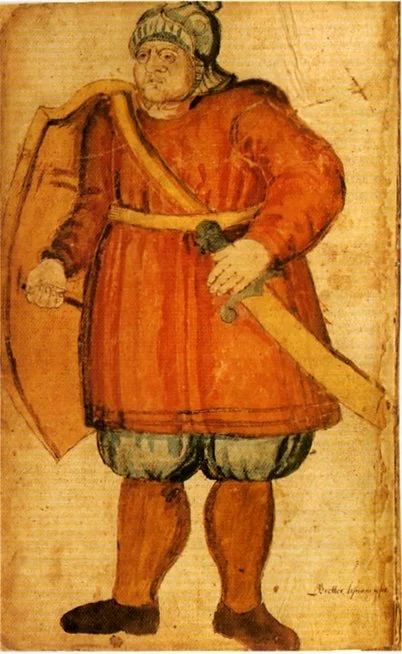
Grettir the Strong, drawn in the Icelandic manuscript AM 426 fol.: sword, shield, and the red tunic of the saga hero who wrestled the draugr Glámr and took his curse. The picture is of the hero — Glámr does not appear in it, and no medieval image of a draugr survives; the absence is part of the record. Public domain, via Wikimedia Commons.
The Icelandic form of the being has a name of its own: draugr — the mound-dweller, the dead man strong in his howe, the grave-mound, and stronger for every year he sits in it hoarding his strength and his ill temper. The Eyrbyggja saga, written in the thirteenth century about people three hundred years dead, gives the class his fullest portrait in Þórólfr bægifótr — Thorolf Twist-Foot — a violent, quarrelsome old farmer who died seated upright and was buried in his howe, and would not stay in it. After his death the hauntings worsened: men and beasts died near the mound; the district's people abandoned their farms; the dead man was seen abroad. His son Arnkell, a patient man driven past patience, had the howe opened and the body dug up — found, the saga says, heavy and undecayed and blackened, looking more like a troll than a grandfather — and carried it far off and buried it above a shore, with a wall built across so nothing would pass. Years later, after Arnkell himself had been killed, Thorolf walked again — the saga's driest horror is that the second walking surprised nobody — until the howe was opened a last time and the body burned and the ashes scattered on the sea.
Beside him stands the other great file, and the census names it here: Glámr, of the Grettis saga — a shepherd found dead in a Christmas storm, who rose and rode the roof-beams and broke men and beasts, until the hero Grettir wrestled him in the dark of the farmhouse hall and cut off his head and laid it between his thighs — and took away with him the draugr's curse, spoken as they grappled, that shadows him to his own death. This lesson's third plate is a manuscript drawing of Grettir himself. Glámr does not appear in it. No medieval picture of a draugr survives; the absence is part of the record, and the Guided Observation will make you look at it properly.
Step back from the tales and the pattern is communal again. The revenant terrorizes a district — farms empty, roads close, trade stops — and he is ended by a district's work: counsel taken, graves opened by leave, bodies carried, walls built, fires lit, letters laid on breasts. Only Grettir acts alone, and the tale itself fines him for it for the rest of his life.
KEEPER'S CHECK-IN
In Spotted's draugr country, why is Grettir pictured in a medieval manuscript while Glámr — the draugr he wrestled — is pictured nowhere?
What People Watched For — the Crossroads
What did this belief make people do? In England its most durable product was a burial of disgrace, kept by law for centuries. When a coroner's jury brought in the verdict felo de se — that the dead had been a "felon of himself," a self-murderer — the churchyard was closed to the body. It was buried instead by night, at a crossroads, with no rite and often with a stake driven through it. The reasons the record itself gives are this lesson's own: the stake would pin the restless dead in the grave, and the crossroads, with its several ways, would confuse the spirit if it tried to walk home. The being of this lesson, legislated against at the crossroads of every parish: that is what a belief looks like when it becomes a custom with a budget and a jury.
The custom's end is dated, named, and shameful, and a keeper tells it soberly, because the people under those crossroads were the despairing dead, and their families stood by in silence. In June 1823 a young man named Abel Griffiths, who had killed his father in a fit of madness and then himself, was buried with a stake at the crossroads where Eaton Street meets Grosvenor Place and the King's Road in Chelsea, before a crowd so large it stopped the traffic — on ground now underneath Victoria Station. The spectacle scandalized the city, and Parliament answered within the year: the Burial of Suicides Act 1823 (4 Geo. IV c. 52) forbade interment "in any public highway" and, in the statute's own words, "with any stake being driven through the body," ordering churchyard burial instead — without rites, at night, a mercy in stages, but a mercy with an Act's authority. Mark the layers: S for the belief behind the pinning and the confusing; F for the verdicts, the burials, the statute. And file beside them the historian's correction — Jeremy Harte, writing in Time & Mind in 2011, argues the disgrace was made routine mostly in the Tudor age as moral discipline, not inherited whole from deep antiquity. Keepers do not inherit even their customs unexamined.
What It Actually Is
The first root is the one Geoffrey and the Alnwick file both name without knowing it: sickness. Two of this lesson's records accuse the walking corpse of spreading disease — the Drakelow pair bring sickness house to house; the Alnwick revenant is blamed for a pestilence. A corpse in its grave carries nothing door to door. But a village watching its people sicken in sequence, in a hard season, will draw the only map it has — and the map's shape, one visit, one death, moving through households, is precisely the shape of contagion seen from inside it. The revenant is, among other things, epidemiology drawn by the frightened, with the vector given a name they knew.
The second root is the grave's own behavior. Bodies do not decay on a parish timetable: cold, wet, sealed, winter-buried corpses keep terribly well, and a body exhumed after weeks in a cold grave can look — to men with no science of decomposition, and honest eyes — undecayed and heavy, as the records keep saying in the same words. The third root is the community itself: grief, guilt, debt, and quarrel do not end at a burial in a small place, and the returned dead of these tales are, to a man, people the parish had unfinished business with — runaways, a rich man, a violent old farmer. The remedies the record shows are communal because the fear was: counsel, leave asked and given, the grave opened in daylight, and either a bishop's letter or a fire. Procedure again, as with Athenodorus — the revenant file is the ghost file with the body left in, and dealt with by committee.
Still With Us
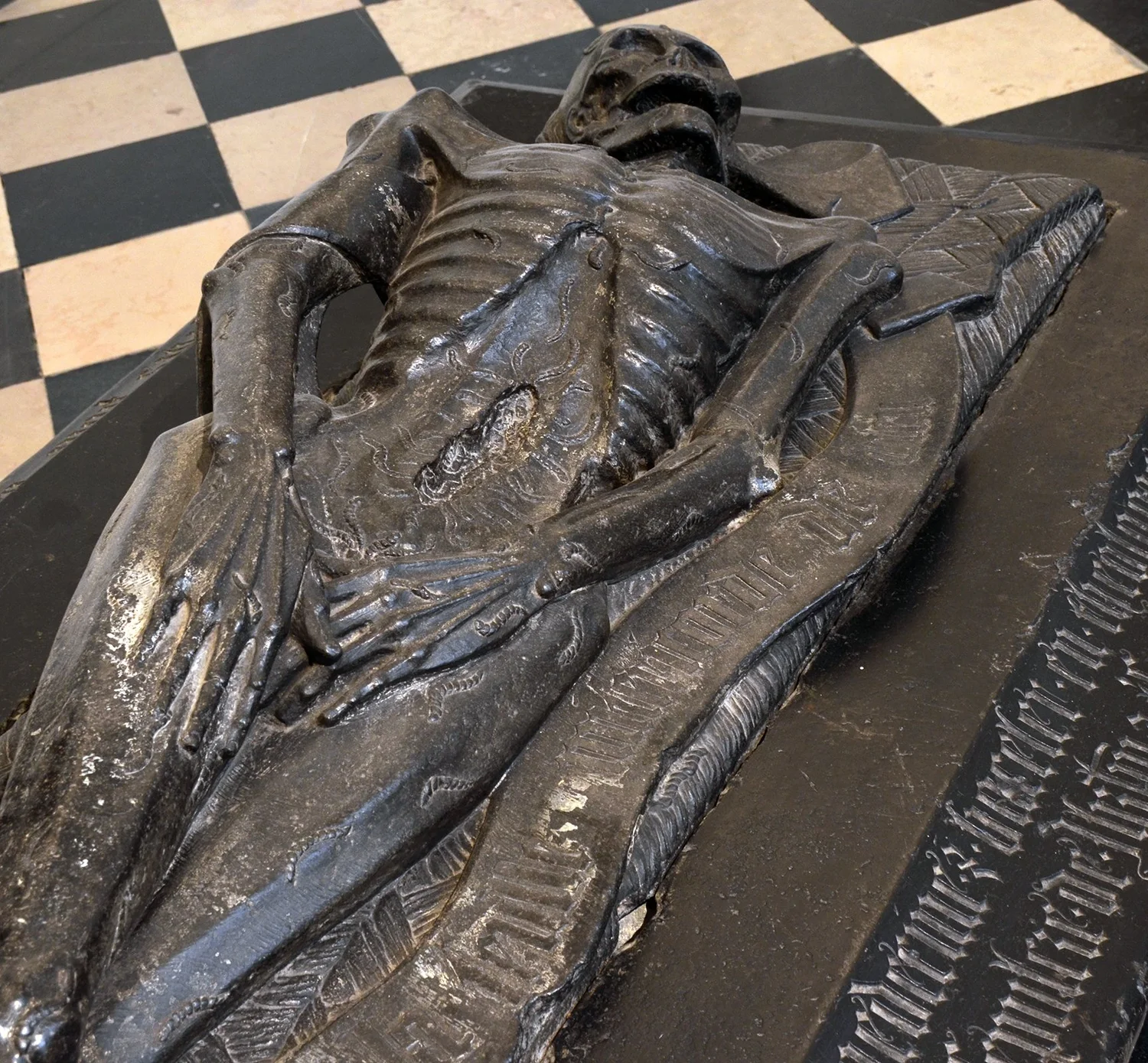
The transi of Guillaume Lefranchois at Arras: the dead man carved as he would lie in the grave, flesh gone to bone and inscription — the revenant's mirror image in church stone, the dead displayed at rest. CC0, via Wikimedia Commons.
The age that feared walking corpses also carved them, in stone, and set the carvings up in church where everyone had to look at them. This lesson's hero plate is the most famous of them all: the Transi of René de Chalon, Prince of Orange, sculpted by Ligier Richier in 1544–47 for the church of Saint-Étienne at Bar-le-Duc. Spend a minute with the figure before you read on. Richier had a prince to glorify and every convention of his trade told him to carve the man in armor, reclining in state. He carved a corpse instead — standing upright, which is the detail that stops visitors in the aisle to this day. The skin is drawn back from the ribs. The body is wasted to the anatomy lesson underneath. One hand is raised, and in it, held aloft where a sword hilt ought to be, is the prince's own heart. The transi tombs did this work all over the churches of the period — the Arras effigy in this lesson belonged to a much humbler man, Guillaume Lefranchois, and lies flat as the grave arranges a man, flesh gone, inscription doing the talking — and their sermon needed no preacher: you too will be this. The centuries that produced the revenant record did not hide from the corpse. They put it on public view, on purpose, for the instruction of everyone who walked past. Read the transi as the record's one orderly exhibit of a dead man out of his rest: displayed by the living, in the open, with its papers entirely in order.
Beyond the church, the descendant who changed the terms is the walking corpse of the last century's print and film — reached, by way of the Caribbean word zombie, for a body-horror the old files would recognize in shape if not in scale. The belief culture also survives in miniature: local revenant and vampire legends are still told, and still occasionally reported, in the regions that produced the old files — reported now to newspapers and folklorists rather than to bishops, and filed, by this class's method, exactly the same way. The scale is the difference. The record's revenant is one named neighbor, one grave, one parish, one remedy. The descendant comes in hordes and is ended by no bishop's letter. Keep the entry's proportion: the class files the ancestor, in his parish, with his paperwork — and notes the descendant in a line, as this paragraph does, without handing him the lesson.
Guided Observation
This lesson's plates are stone and parchment. Study the Transi of René de Chalon first. The sculptor had a prince to glorify and chose instead to show the prince as the grave would leave him — and then set him standing, upright, in the posture of the living, holding his heart where a sword should be. What does the standing posture do to the corpse that lying down would not? Beside it, the Arras transi — Guillaume Lefranchois, a churchman of no great fame — lies as the grave arranges a man, flesh gone to bone and inscription. Together they are the two grammars of the dead in stone: the corpse displayed active, and the corpse displayed at rest. Now the small medieval miniature: the Three Living and the Three Dead — three living men meeting three corpses who were themselves. It illustrates no case in this lesson, and the entry must label it so; it is the period picturing the idea of the dead returned, in the moral imagery it had. Now the manuscript page: Grettir, sword, shield, red tunic, drawn in an Icelandic manuscript — the hero, in color, in the record. Glámr, whom he wrestled, is nowhere in the picture, because he is nowhere in any picture: no medieval image of a draugr survives. Write down one thing the empty place tells you that a drawing could not — about what a culture draws, and what it only describes.
Assignment Manual
✎ WRITTEN · ⚒ HANDS-ON · ◐ BOTH
✎ Written · Entry No. 35: Revenants.
- Rule your entry page. Turn to the Scholar's Entry Page in this lesson's packet and rule a page of your journal to match it.
- Write the revenant's entry, to the standard. The Creature: the returned body defined, and its bare depiction line — no draugr pictured, the Three Living miniature labeled as the idea's portrait, not a case's. First Told: Drakelow — Geoffrey of Burton, the two dates kept apart (events about 1085–1094; the writing about 1118–1135), the coffins on the shoulders, the bishop's leave, the remedy. The Tales: Newburgh's four towns; the writing-down of the sagas; Ranft's dissertation of 1728. Spotted: Twist-Foot's two walkings, and Glámr named, with Grettir's price. What It Actually Is: three lines — sickness mapped onto a story, the undecayed body, communal fear and communal remedy. Still With Us: the transi in the church, and the descendant in one line. The Keeper's Line: your judgment, in a line or two.
- Weigh the two remedies. Write one paragraph on Buckingham's letter against Berwick's fire: what each remedy assumes about the dead, about the living, and about who may act — and which of the two the record shows working, with what "working" can possibly mean in such a file.
- Mark every line. This lesson's drill is the double mark of all report: Newburgh writes that the corpse walked — the writing is F, the walking is S, and a tale retold from the sagas is T. Go through your entry and make sure no sentence hands the chronicler's authority to the chronicler's belief.
- File the correction. At the foot of your entry, note Harte's argument (2011) beside the crossroads custom: one line for the custom, one for the historian's caution. Keepers file the argument with the exhibit.
The printable packet for this lesson — the Lexicon Handout, the Guided Practice, this manual, and the Scholar's Entry Page — is linked on this page.
Materials
· Your bestiary journal or notebook — kept for the whole class
· Pencils, and a pen you like writing with
· A ruler, for ruling your entry pages
· The lesson page, for the map and the plates
· This packet
Reflection
This lesson's record clusters in twelfth-century England and saga Iceland. Is the clustering in the walking — or in the writing and the keeping? What would each answer do to the map?
The dead under the crossroads were, most of them, the despairing, and their families were punished with them. What does a keeper owe those dead that the crossroads did not give — and how does a keeper pay it, six centuries on, in an entry?
Bishop Hugh chose a letter over a fire, and his remedy is the one the record praises. What protected the Buckingham corpse — the absolution, the bishop's authority, or the parish's willingness to stop? Can the record tell you?
A Closing Note
Two lessons into the last unit, you have filed the dead perceived and the dead returned in the flesh, coffins, roof-beams, bishops' letters and all. What remains on the shelf announces itself differently. First comes a body prepared to stay; then come beings with no grave to walk out of and no house to haunt. They belong to families, and they arrive ahead of the death they report: a woman keening on an Irish shore for a household not yet bereaved, and her darker sister at a Scottish ford, washing the clothes of men who are still alive to wear them. Bring dry shoes, and your T, S and F. Much of that record reached paper by way of singing and telling, and filing a song takes a steadier hand than filing a chronicle.
The Bestiary
Bestiary Keeper
Further Reading & Sources
Geoffrey of Burton, Life and Miracles of St Modwenna, ed. Robert Bartlett (Oxford Medieval Texts, 2002) — the Drakelow runaways in the first record.
William of Newburgh, Historia Rerum Anglicarum, Book V — the casebook: Berwick, Buckingham, Melrose, Alnwick (Stevenson's translation, 1856, is free online).
Eyrbyggja saga, trans. Hermann Pálsson and Paul Edwards (Penguin) — Þórólfr bægifótr's walkings.
Grettis saga, trans. Jesse Byock (Oxford World's Classics) — Glámr, and the curse Grettir carried away.
Michael Ranft, De masticatione mortuorum (Leipzig, 1728) — the chewing dead, promoted to a dissertation.
The Burial of Suicides Act 1823 (4 Geo. IV c. 52) — the statute that names the stake, and ends the crossroads.
Jeremy Harte, "Maimed Rites: Suicide Burials in the English Landscape," Time & Mind 4(3) (2011) — the historian's correction, filed beside the custom.
Submit your work for this lesson using the form below.
CONTINUE IN THE BESTIARY HALL
← Previous · Lesson 34: Ghosts Next · Lesson 36: The Mummy →
Unit VI — Those Who Linger The Bestiary Hall — All 41 Lessons
The rest of Unit VI: Lesson 34 · Ghosts · Lesson 36 · The Mummy · Lesson 37 · The Banshee & the Washer at the Ford · Lesson 38 · Will-o'-the-Wisp · Lesson 39 · The Poltergeist · Lesson 40 · New Beings, Old Pattern · The Capstone · The Unfinished Page