

THE BESTIARY
Unit VI · Lesson 40New Beings, Old Pattern
Professor Sable Rookmere
Bestiary Keeper
The Bestiary Hall • School of Evershade
Professor's Introduction

Every other being in this book had centuries to grow in, most of them growing in the dark, by mouth, between the pages we happen to have kept. These had no such luck, or no such cover. They had decades. Years. In one case, a single week of newspapers. That is why I keep them for last, and why, as teaching, I love them best of anything on the shelf: the pattern of the whole class runs here fast enough for a keeper to stand and watch it happen. First record. Growth. A shape that fixes. A root. A modern face. The unicorn took about two thousand years over that course. The chupacabra took five, in public, with dates on every stage. Nothing in this lesson asks you to believe anything, and nothing in it asks you to disbelieve anything either. It asks the keeper's question one final time, at modern speed: what is the record, what has been added to it, and by whom, and when?
The Bestiary
Bestiary Keeper
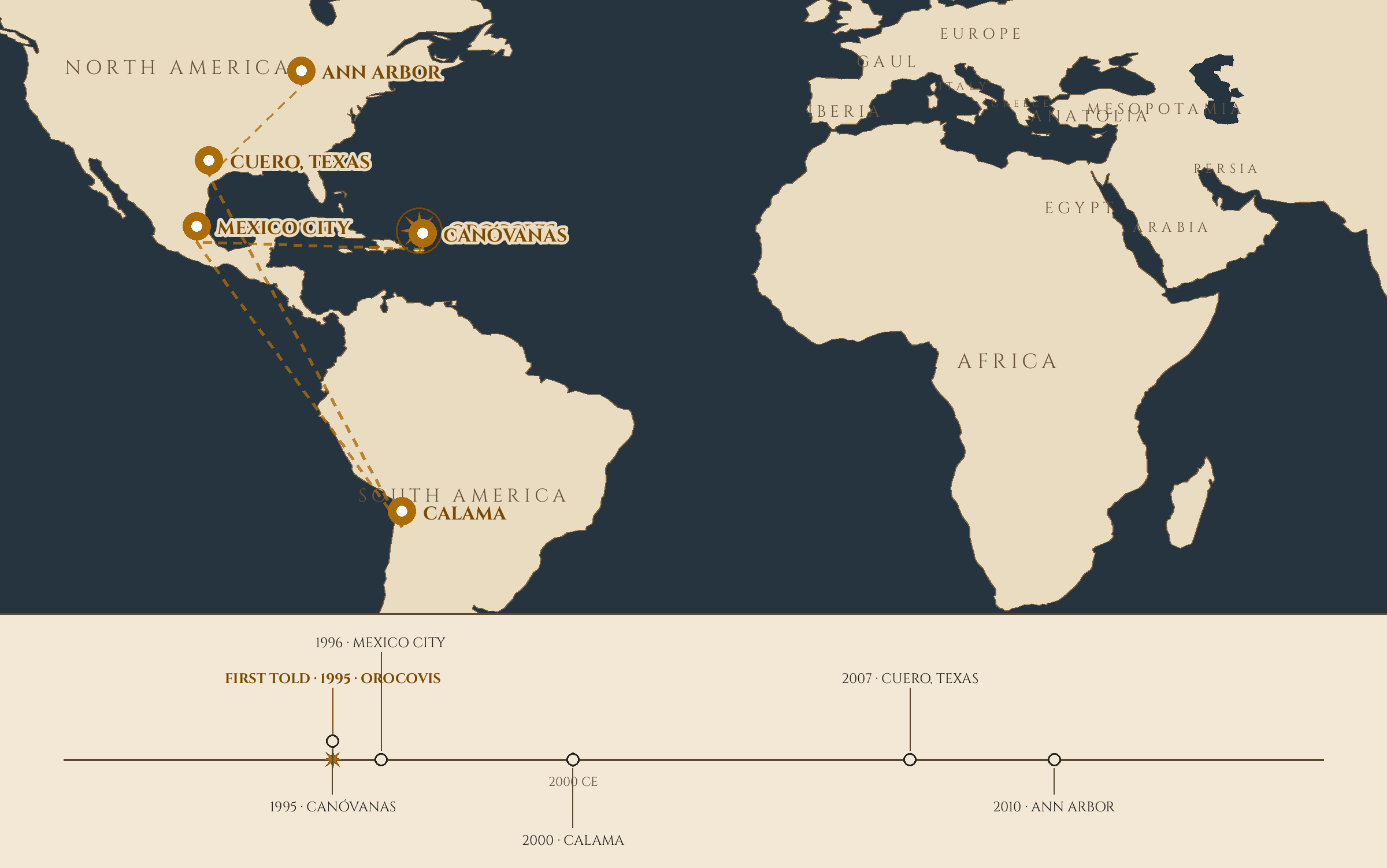
Where this lesson travels — and where it honestly does not. The map is the chupacabra's: Orocovis, Puerto Rico, where the first reports came in March 1995 — animals found drained of blood, and the being not yet named, the youngest starred pin in this book; Canóvanas, where Madelyne Tolentino's sighting that August gave the being its classic shape, and Silverio Pérez coined its name; Mexico City, as the reports and the name spread through 1996; Calama, in northern Chile, where reports clustered in 2000; Cuero, Texas, where Phylis Canion's carcass of 2007 went to a laboratory and came back a coyote with mange; and Ann Arbor, where Barry O'Connor named sarcoptic mange the engine of the sightings in 2010. The Jersey Devil and the Mothman have no pins: their records — a legend first printed in the nineteenth century, a year of Point Pleasant newspapers — are carried in the lesson's prose, each with its place named. The starred pin is the first record; the dashed line is the telling, traveling.
Lesson Objectives
By the end of this lesson, you will be able to:
- Name this lesson's three beings, its grouped newspaper predecessor, and its one admitted invention, and give each a first record with a date.
- Distinguish, for the Jersey Devil, between the date of the story and the date of the record — and say why the distinction governs the whole entry.
- Follow the chupacabra's map and say what changes at its last three pins: the specimens go to laboratories.
- State what each being actually is, severally — mange, the crane proposal, the corroded eyebar, the press itself — and file each as fact or proposal.
- Argue, from the record, whether the pattern of this class needs centuries — or only a printing press.
Your Assignment Packet
This lesson's work lives in its packet: the Lexicon Handout (every term, the core terms marked with the keeper's diamond ◆), Materials, Guided Practice, the Assignment Manual written out whole, the Scholar's Entry Page, the Reflection Questions, the Workbook Checklist, and the Keeper's Notes, for whoever teaches the lesson. Download the packet before you begin and keep it beside you as you read. The packet's assignment is Rookmere's own word for the work: Entry No. 40 — New Beings, Old Pattern (written) ✎. The Unit VI Quiz is not printed in the packet; it closes the unit, and it stands at the end of this very lesson, below.
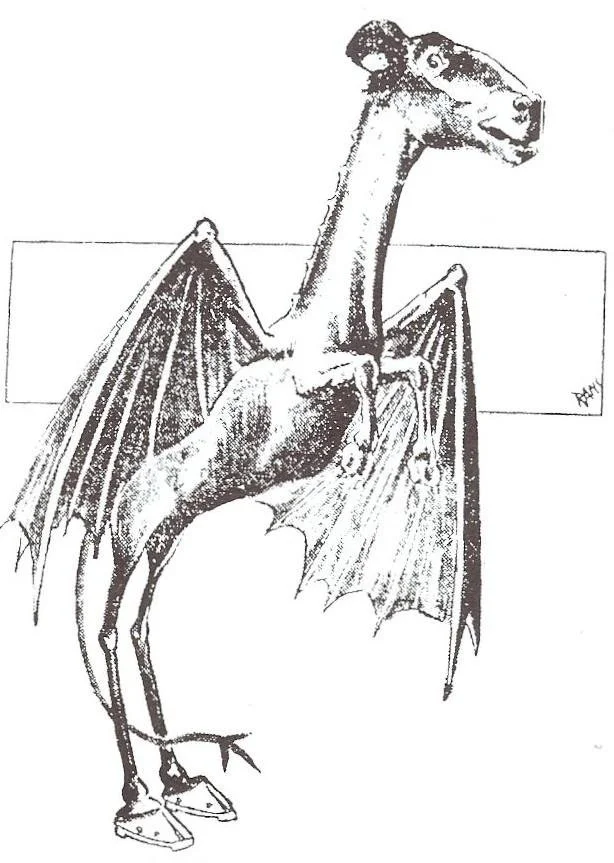
The Jersey Devil as a Philadelphia newspaper drew it in January 1909, the week of the sightings: long neck, horse's head, bat wings, cloven hooves — the sketch that fixed the creature's shape for a century. Public domain, via Wikimedia Commons.
The Creature
Three beings share this lesson, and a fourth is named inside it, and the four together make the argument. The Jersey Devil carries an eighteenth-century legend out of the New Jersey Pine Barrens, given its fixed shape by one week of newspapers in 1909. The Mothman of Point Pleasant, West Virginia, was reported for thirteen months in 1966–67, and named — as new beings now are — by the newspapers that carried him. The chupacabra, Spanish for goat-sucker, was born in Puerto Rico in 1995, a being with a birthday, watched forming in the press in real time. And named beside them, honestly and by its own keepers' confession, stands the drop bear of Australia: a deliberate hoax for tourists, the one being in this entire class whose file says invented on its face. It is here as the control in the experiment. A pattern that explains the drop bear explains anything; a pattern that cannot, explains nothing.
Grouped beside them, and older than them all, stands Spring-heeled Jack of London — a being with a birthday in the newspapers of 1837–38, grouped here because his file is one panic, two set cases, and a long tail of echoes rather than a lesson of his own. Named in this lesson's margins, honestly and at paragraph length, are three more American kin: the jackalope of Douglas, Wyoming, a second admitted invention to stand beside the drop bear; and the snallygaster of Maryland and the hodag of Wisconsin, two newspaper hoaxes that became town emblems. They are not extra beings smuggled in at the back of the book. They are the pattern's own family, arriving — as this lesson's beings always do — in print.
Their depiction lines run at the same speed, and the Guided Observation reads them in full: a newspaper sketch that fixed a shape in one week (1909), a civic statue 37 years after a first report (2003) — and, for the chupacabra, no lawful picture at all, because its first reports live in copyrighted 1995 newspapers. No Patterson–Gimlin frame, no film still, no press photograph is used anywhere in this lesson, on the same rule.
The census grouped these beings in one lesson because their lesson is the same: the stages this class has traced since Lesson 1 — first record, growth of the telling, the tales, the real root, the modern face — do not require the Middle Ages. They require people, print, and a little darkness. What speed changes is not the pattern. It is the keeper's luck: for these beings, the whole growth lies inside dated, checkable paper, much of it within living memory.
First Told
The chupacabra carries this lesson's map, and its starred pin is the youngest star in the book: Orocovis, Puerto Rico, March 1995, where the first reports came in — sheep and other animals found dead and drained of blood — and the being had no name yet, and no fixed shape. Hold that pin in mind. Every other first record in this class arrives with a description attached; this one arrives with only dead animals and a question. The shape came five months later, at Canóvanas (August 1995), where Madelyne Tolentino's sighting gave the being its classic description — and the comedian Silverio Pérez coined its name, chupacabra, that year. A first record in two acts: the event, then the description. Keepers of older beings will recognize the anatomy. It is Ctesias and the tapestry, compressed into a single summer.
Spring-heeled Jack's first record is a panic learning its name in public. Reports of a leaping, clawed figure around London's villages reached print in late 1837, and in January 1838 the matter reached the Lord Mayor of London, Sir John Cowan, who disclosed at the Mansion House an anonymous letter signed a resident of Peckham: it claimed that men of rank had wagered they could frighten villagers in the disguises of a ghost, a bear, and a devil. The Times carried the disclosure, more letters followed, and the Penny Satirist soon fixed the name the papers would keep: Spring-heeled Jack. Note the order, because it is this lesson's order in an earlier coat: reports first, an authority's desk second, a name last — and the name was given, as the Mothman's would be a century later, by the press that carried him.
The Mothman's first record is a small-town newspaper doing a keeper's work without knowing the trade existed. The Point Pleasant Register of 16 November 1966 reported the previous night's encounter under a headline I would not change a word of, because it preserves the witnesses' own uncertainty instead of tidying it away: Couples See Man-Sized Bird… Creature… Something. The Jersey Devil's first record teaches the opposite lesson, and it is the distinction this whole lesson turns on, so get it into your hand before you write anything. The birth tale is set in 1735. The tale itself was first printed in the nineteenth century. A story's date and its record's date are two different dates, and an entry that merges them has failed at the first fence. You met the same honesty in Lesson 7, where the unicorn's first record was a report of reports and the entry said so in plain words. The Devil's entry says its version: a legend, printed a hundred years after the scene it describes. Newer paper. Same rule.
The Tales
Spring-heeled Jack grew in a season of print, then in decades of echoes. The set cases stand eight days apart in February 1838, and the entry keeps them as cases — named, dated, and deposed — not as atmosphere. On 19 February, Jane Alsop of Old Ford answered a caller who claimed to be a policeman who had caught Spring-heeled Jack in the lane and asked her to bring a light; when she brought a candle he threw off his cloak, breathed blue and white flame, and tore at her with what felt like metal claws, before her sister drove him off — her account went to the magistrates and into The Times of 2 March under the headline The Late Outrage at Old Ford. On 28 February, Lucy Scales, walking with her sister through Green Dragon Alley in Limehouse, met a cloaked figure who breathed blue flame into her face; she fell in fits that lasted hours, and her deposition stands beside Alsop's. After those two cases the reports widen and thin: copycats were caught, imitators were suspected even at the time, and the name kept surfacing for decades — sentries at Aldershot reported a figure that slapped them and bounded away in 1877, and the last report commonly cited comes from Liverpool in 1904. The penny dreadfuls then did what print does: they kept him, and changed him, recasting the terror of 1838 as a masked hero. No identification was ever established. The Marquess of Waterford, named ever since as the man inside the cloak, is filed here as he must be: an unproven tradition, not a solution. Jack's file closes the way it opened — in newspapers, without a name for the man.
The Jersey Devil grew first in print, then in a week. The tale as told: at Leeds Point in 1735, a woman the record calls Mother Leeds, facing a thirteenth child, cried that this one might be the devil — and the child was born wrong, and flew up the chimney into the pines. Under the tale stands one archival plank: Japhet Leeds of Leeds Point named twelve children in his will of 1736 — a real family, a real count, and no thirteenth child in the document. Modern historians Brian Regal and Frank J. Esposito, in The Secret History of the Jersey Devil (2018), propose the tale's true seed: the almanac-maker Daniel Leeds, branded "Satan's harbinger" by his Quaker opponents in a colonial feud, whose family crest bore a winged dragon. File it as they file it — a proposal with documents behind it, not a proof. Then the week: 16–23 January 1909, when hundreds of reports swept the Delaware Valley — tracks in the snow crossing yards, fences, and rooftops; schools and mills closed as workers stayed home; police firing at shapes in the dark; the Philadelphia Inquirer's front page asking WHAT-IS-IT over all South Jersey. Inside the week stands a documented fake: a kangaroo fitted with false wings, exhibited as the captured Devil, and exposed. The fake does not dissolve the week. It documents what such weeks do to evidence — which is why the lesson keeps it.
Two more beings ride in the Devil's own weather, named here at the length their files earn. The hodag of Rhinelander, Wisconsin, came first: in 1893 the newspapers reported timber cruiser Eugene Shepard's party killing a beast with "the head of a frog, the grinning face of a giant elephant, thick short legs set off by huge claws, the back of a dinosaur, and a long tail with spears at the end" — killed, they said, with dynamite, photograph and all; in 1896 Shepard exhibited a second hodag, captured alive, at the first Oneida County Fair — a thing of wood, ox hide, and cattle horns built with woodcarver Luke Kearney, worked by wires in a dim tent, and confessed as a hoax when Smithsonian scientists announced they would come and inspect it. The snallygaster of Frederick County, Maryland, followed the Devil by a matter of weeks: through February and March 1909 the Middletown Valley Register ran reports of a winged beast with enormous wings, a long pointed bill, claws like steel hooks, and an eye in the center of its forehead — a run later revealed as a hoax by the paper's editor, George C. Rhoderick, and reporter Ralph S. Wolfe, worked up to lift circulation in the Devil's slipstream. The entry files the run's ugliness with its nonsense: the Register's first headlines aimed the fear at Black residents, a documented threat wearing a monster's coat. Neither file has a specimen. Both beings hold civic office anyway — the hodag is Rhinelander's official symbol, and the snallygaster is Frederick County's resident dragon — which is the 1909 week's lesson repeated at town scale: a shape fixed in print does not need a body to keep its job.
The Mothman grew in a year of print. After the first night — 15 November 1966, in the TNT area, the abandoned wartime munitions works outside Point Pleasant, where two couples met a tall, winged, red-eyed figure by the old power plant and drove to town and reported it the same night — the reports ran for thirteen months, a hundred and more, with the local reporter Mary Hyre keeping the town's log of them. John Keel arrived, collected, and in 1975 published The Mothman Prophecies, binding the sightings into one great pattern — and binding them, fatefully, to the town's disaster. For the bridge has its own record, complete and separate: on 15 December 1967 the Silver Bridge fell into the Ohio River in the evening rush, killing forty-six people, and the official investigation found the cause in a single corroded eyebar of its chain. The telling joined the figure and the falling bridge into one story of warning. The records never joined them. A keeper files the joining as an event in the telling's history — 1975, Keel's book — and the eyebar in the bridge's own file, and lets neither migrate.
The chupacabra grew at the speed of its century: from Puerto Rico across Latin America within a year (the map's Mexico City pin, 1996), reports clustering as far as Calama in Chile by 2000 — and then the telling met the laboratory. From the map's Cuero pin (2007) onward, the reports increasingly came with carcasses, and carcasses can be tested: the Cuero animal, found by rancher Phylis Canion, went to DNA and came back a coyote. The last pin, Ann Arbor 2010, is a professor of entomology and parasitology, Barry O'Connor of the University of Michigan, naming the engine: sarcoptic mange. The growth of this telling runs record → description → name → spread → specimens → verdicts, and every stage is dated. No being in the bestiaries grew so fast, and none left so checkable a trail.
KEEPER'S CHECK-IN
For the Jersey Devil, what is the difference between the date of the story (set in 1735) and the date of the record — and why does that distinction govern the whole entry?
Spotted
✦ On the class test
Three tales, told as the record gives them. The thirteenth child: the Leeds Point birth, above — kept here as tale, its print birthday noted, the way Lesson 34 kept its stories: the tale is evidence about its tellers and its century, whatever else it may be. The night at the TNT area: two couples, a figure standing by the power plant in the headlights, wings folded; the chase to town at speed, the eyes still in the mirror; and then — the detail a keeper underlines — they went straight to the authorities and the newspaper, that night. The record's speed is the tale's modern signature: no generations of oral carrying stand between this event and its paper. The description at Canóvanas: Tolentino's account fixed the chupacabra's shape — by her later telling, a figure standing upright, large-eyed, with a row of spines down its back, resembling (she said so herself) a creature from a film of that same year. Compare Lesson 17's Fiji mermaid, the manufactured being whose picture became a species: here, one named witness's description became a species, and every later report described her being. That is how fixed shapes are born, in 1795 or 1995: somebody describes, everybody copies.
KEEPER'S CHECK-IN
Following the chupacabra's map in Spotted, what changes at its last three pins, when the specimens start going to laboratories?
What People Watched For — the Festival
The watch, in the modern world, becomes a gathering. Every year since 2002, Point Pleasant has held the Mothman Festival: the town fills, the record is retold from the stage and the museum, and crowds walk out to the TNT area to stand where the reports were made and look at the dark where the figure stood. Nobody at the festival is required to believe anything; that is not what the gathering is for. It is the corpse-candle watch of Lesson 38 and the loch-watchers' roster of Lesson 20 grown old and honest — a community keeping an appointment with its own record, on the record's own ground.
File the custom beside its ancestors and mark the difference: the Welsh watchers watched because a death might be coming; the Enfield watchers watched because something might happen; Point Pleasant watches because something was reported, and the reporting is now the town's history and its living. The belief is S; the festival is F; and a keeper who has followed the watch through this whole unit — candle, vigil, festival — has watched the watchers become the record themselves. That is where this class came in: the record is people, all the way down.
What It Actually Is
The roots here are several, and the entry files them severally — the pattern's final refinement. For the chupacabra's later wave, mange: O'Connor's 2010 reading, standing on the Cuero DNA, is that the hairless, gaunt, strange-backed animals of the 2000s reports were coyotes and dogs in the grip of sarcoptic mange — a burrowing mite that takes the coat, thickens and ridges the skin, and weakens the animal until it hunts livestock it would never face in health. That root is as firm as roots get: specimens, tests, a named mechanism. But file the chronology honestly: mange explains the animal reports of the later wave. The 1995 Puerto Rican reports began with drained livestock and a described figure, and their roots are several — ordinary predation, fear moving through a hot summer's news, and the description that taught a hemisphere what to see. One being; roots in the plural; the entry keeps them in their years. For the Mothman, a proposal: the standing candidate, offered at the time by police and wildlife men, is the sandhill crane — a tall grey bird with red skin about the eyes, blown off its course; the witnesses rejected the reading, no specimen was ever filed, and the root stands in the entry labeled proposed, beside the darker root that needs no bird at all: an abandoned explosives works, unlit, at midnight, is a place built to be misread. For the bridge, a fact: one corroded eyebar — filed here because the telling so often misfiles it under the being. And over all three, the press itself: each being grew at its medium's speed — the pamphlet-and-daily week of 1909, the local paper and the paperback of 1966–75, the television summer of 1995. The pattern's engine was never the centuries. It was always the copying.
For Spring-heeled Jack, no root of that kind can be filed: no specimen, no laboratory, no single mechanism — only the record's own shape. A wager story in an anonymous letter, two deposed cases, caught copycats, and sixty years of reports that grow thinner as they grow later: the honest root is the panic and the papers that carried it, and the entry leaves the man — if there was one man — unnamed, because the record does.
Still With Us
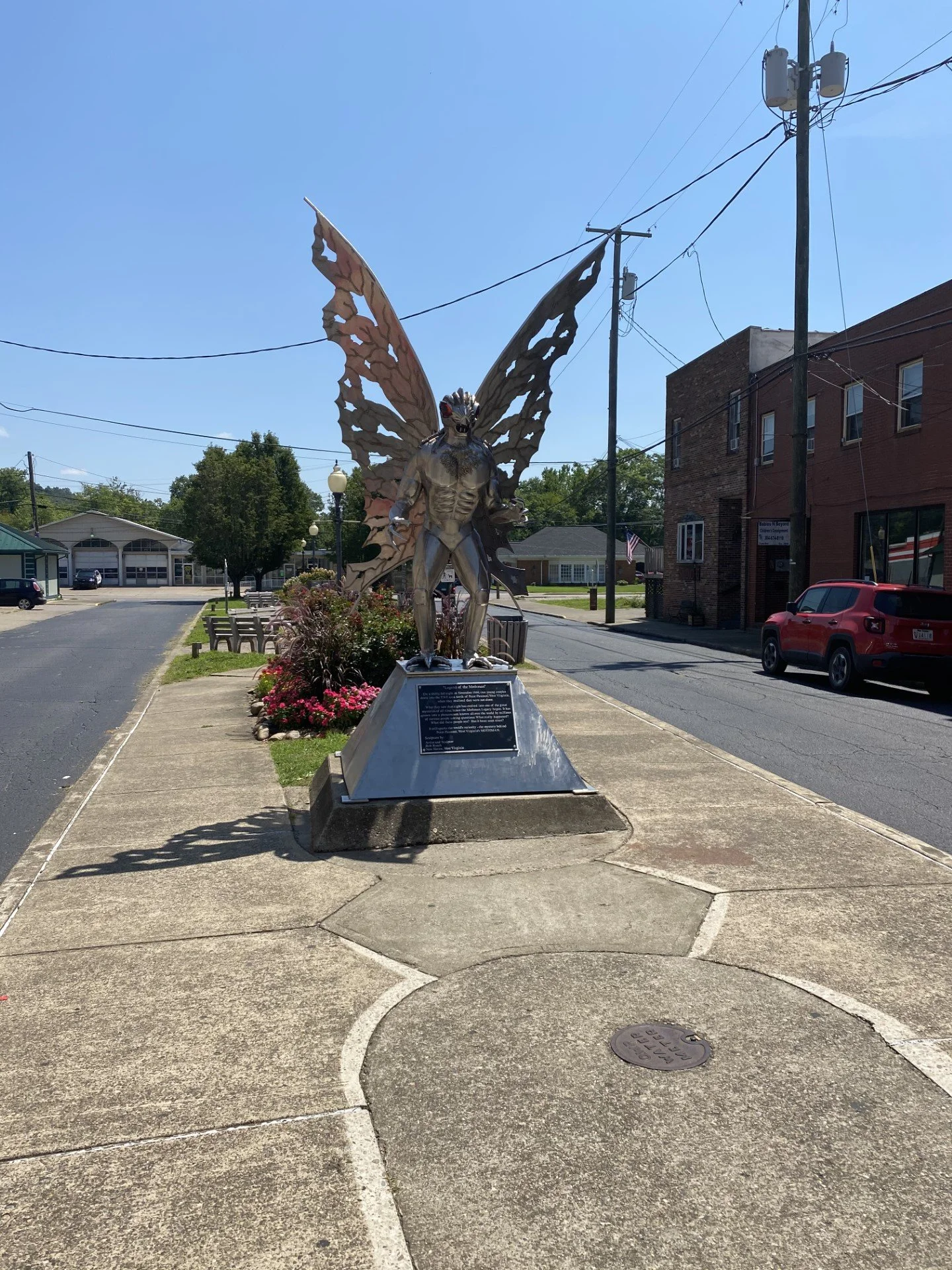
The Mothman statue in Point Pleasant, West Virginia (Bob Roach, 2003): the winged figure on its plinth in the middle of the town the 1966–67 sightings made famous — a modern being already cast in metal, not a century after a newspaper sketch fixed the Jersey Devil's shape the same way. CC0, via Wikimedia Commons.
The modern face of a new being, it turns out, is a statue. The searching is organized now, too: for Sasquatch — the being also called Bigfoot — the proper name comes from the Halkomelem Salish sasq'ets, carried into English in the 1920s by J. W. Burns's published accounts of Sts'ailes (Chehalis) traditions. You met that name's line in Lesson 13, the wild men lesson. The Bigfoot Field Researchers Organization, founded in 1995, keeps a public database of dated, placed sighting reports for a being this lesson does not cover — the keeper's file format, kept by believers — and the International Cryptozoology Museum in Portland, Maine (founded by Loren Coleman in 2003), exhibits the modern beings' record to visitors. Searches, societies, and databases are where a new being's file now lives. Look at this lesson's second plate: Bob Roach's twelve-foot Mothman, stainless steel, standing in Point Pleasant since 2003 with its wings up and its red eyes on the street, thirty-seven years after the first report. The bestiarists' lion took about two thousand years to work his way into bronze. The Mothman managed it in under four decades, and the difference between those two numbers is the whole history of the press in one comparison. The Jersey Devil, standardized by newspapers in 1909, lends its name today to a professional hockey team, and still draws flap weeks in miniature whenever strange tracks photograph well. The chupacabra's reports now arrive pre-answered. Each new carcass goes to a laboratory, the laboratories keep answering coyote, and the name goes on being used anyway, because a name with work to do — a name tied to festivals and teams and a town's living — can outlive the root it grew from. And the drop bear presides over the whole lesson's ending, grinning down from its museum page: a being invented on purpose, protected by no belief at all, told nightly to strangers with a perfectly straight face. The class's own control animal, still running its experiment.
Beside the drop bear, at the lesson's end, stands its American cousin, named at the length its honest file earns: the jackalope of Douglas, Wyoming. In 1932, by the New York Times' account of the family, Douglas Herrick and his brother Ralph, teenage taxidermists, came home from hunting and tossed a jackrabbit carcass down beside a pair of deer antlers in their shop — and mounted it as it lay. The first jackalope sold for ten dollars to Roy Ball and hung in Douglas's La Bonte Hotel until it was stolen in 1977; the brothers never hid what it was, and Douglas still issues its hunting licenses, for 31 June only, midnight to 2 a.m. The shape they joked into being had an older paper life behind it: the horned hare, lepus cornutus, stands in European natural histories from Conrad Gessner's Historiae animalium in the sixteenth century onward, drawn and described as a real animal before science withdrew it. And it may have had a real root under that — may, filed as the literature files it: researchers have suggested that some horned-hare tales were inspired by rabbits infected with the Shope papillomavirus, whose keratinous growths can stand like horns on a rabbit's head, described by Richard E. Shope in the Journal of Experimental Medicine in 1933, a year after the Herricks' mount. A virus is not an antlered species, and the suggestion explains, at most, some of the old pictures. The jackalope itself needs no root at all. It is taxidermy, confessed — the drop bear with antlers, still running the same experiment on every traveler who stops in Douglas.
Six units are behind you. Forty beings stand in your bestiary, every one of them marked. The next page is blank, and it is yours.
Guided Observation
This lesson's hero plate is the January 1909 Philadelphia newspaper sketch of the Jersey Devil — long neck, horse's head, bat wings, cloven hooves — drawn in the very week of the sightings. Study it as an instrument: before that week, the Devil had a story and no settled picture; after it, the being has this shape, and every later report describes the sketch. Write down which of the sketch's features come from the birth tale, which from the week's tracks and glimpses, and which from the draughtsman's own menagerie of older beasts — the wings of Lesson 23's dragon sit on this body, and a keeper should be able to see the join. Then the second plate: Roach's statue, the Mothman in stainless steel, photographed in the town that reported him. A newspaper sketch and a statue, ninety-four years apart, doing the same work — fixing a shape so that memory has somewhere to stand. Which of the two does the record support better, and what does support even mean for a plate? End with the plate that does not exist: no lawful image of the 1995 Puerto Rican reports could be printed in this lesson — the newspapers of that year are in copyright, and the class prints only what it may. The chupacabra's entry must carry its first summer in words alone. Note what that absence does to the being's file beside its two pictured companions.
Assignment Manual
✎ WRITTEN · ⚒ HANDS-ON · ◐ BOTH
✎ Written · Entry No. 40: New Beings, Old Pattern.
- Prepare the page. Rule a fresh page of your bestiary to the Scholar's Entry Page in this lesson's packet. Head it: Entry No. 40 — New Beings, Old Pattern. This entry holds three beings and one confession; rule a margin wide enough for four files.
- Write the entry to the standard. The Creatures: three beings, one confession, and their depiction lines — sketch, statue, and the chupacabra's lawful absence. First Told: all three, each with its date and its kind — a legend printed late (the Devil, with the story's date and the record's date kept apart), a next-day newspaper (the Mothman), a two-act birth (the chupacabra: event, then description) — and, grouped beside them, Spring-heeled Jack's season in print (1837–38: reports, the Lord Mayor's desk, the name last). The Tales: the thirteenth child, the TNT night, the Canóvanas description — each in your own words, each labeled with what kind of evidence it is — with the growth filed beside them: the 1909 week with its exposed fake inside it; the thirteen months and Keel's 1975 binding; the five-year run from Orocovis to the laboratories. Spotted: the report clusters themselves, dated and placed. What They Actually Are: severally — mange (with its years marked), the crane proposal (labeled), the eyebar (in the bridge's file), the press (over all). Still With Us: statue, team, answered carcasses, searches and databases, and the drop bear presiding. The Keeper's Line: your own judgment, in one or two lines.
- The pattern audit. Rule four columns, one for each stage of the class pattern: Record, Growth, Root, Face. Enter all four beings of this lesson, the drop bear included, with a date in every cell. Where a cell is empty or a date is a confession — as the drop bear's first-record cell must be — write what the emptiness means. This table is the class's thesis drawn to one page; keep it for the capstone, where you will be asked to build a fifth row of your own.
- Mark every line. F for the dated fact — newspapers, wills, investigations, DNA results, books. S for the sighting-reports. T for the tales — the curse, the warning figure, the blood-drinker as told. Mark the historians' proposals (Regal and Esposito's feud) as proposals: a reading with documents behind it files between F and S, and the entry must say whose reading it is.
- Close at the blank page. End your entry with one line: the name of the newest being you yourself have watched forming in the news of your own lifetime — no research, only your own memory of its first record. You will meet that line again at the Unfinished Page. It is nearer than you think.
The printable packet for this lesson — the Lexicon Handout, the Guided Practice, this manual, and the Scholar's Entry Page — is linked on this page.
Materials
· Your bestiary journal or notebook — kept for the whole class
· Pencils, and a pen you like writing with
· A red pencil, for the keeper's marks
· A ruler, for ruling your entry pages
· This lesson's packet (the Scholar's Entry Page is in it)
Reflection
The chupacabra's first record has no description in it — only dead animals and a question. What does a being consist of, in its first summer: an event, a description, or a name? Which of the three arrived last, and why does the order matter?
Keel's book joined the Mothman to the bridge; the official record keeps them apart. What does a keeper owe a joining that the whole world now believes — correction, labeling, or silence? Which did this lesson choose?
The drop bear is the only being in the class whose makers confess. Is its file stronger or weaker than the others — and what does your answer imply about the ones whose makers never could confess, because they never knew they were making?
A Closing Note
The class is complete: forty entries in your bestiary, every one of them marked. One thing remains, and it is not, strictly, a lesson — the Unfinished Page, where the next being gets documented by the only keeper whose hand has not yet written in this book. Bring everything you have gathered. Bring the marks and the hedges, the labeled proposals, the roots filed severally in their years, and the kindness this unit kept asking for toward the people inside the files. The record is still being written out there, in newspapers and laboratories and small towns. After the capstone, you are one of the people writing it.
The Bestiary
Bestiary Keeper
Further Reading & Sources
John A. Keel, The Mothman Prophecies (1975) — the collector's book that bound the Point Pleasant year into one pattern; read the joining as an event in the telling.
Brian Regal & Frank J. Esposito, The Secret History of the Jersey Devil (Johns Hopkins University Press, 2018) — the documentary seed of the Leeds legend, proposed with its evidence shown.
James F. McCloy & Ray Miller Jr., The Jersey Devil (1976) — the standard gathering of the birth tale and the 1909 week.
The Point Pleasant Register, November 1966 — the Mothman's first record in its own dress, uncertainty and all.
Benjamin Radford, Tracking the Chupacabra (2011) — the 1995 reports and the mange verdict, investigated end to end.
Mike Dash, "Spring-heeled Jack: To Victorian Bugaboo from Suburban Ghost," Fortean Studies 3 (1996) — the survey of the 1837–38 reports that separates the deposed cases from the later fakelore grown around them.
Michael P. Branch, On the Trail of the Jackalope (2022) — the Herrick mount, the older horned hare, and the Shope suggestion, each kept in its own file.
The Australian Museum's drop bear page — the confession itself, kept with a straight face: read it and admire the filing.
The Unit VI Quiz
The Unit VI Quiz checks the whole of the unit — Lessons 34–40, from the ghost to the newest beings on the shelf — and its answers and self-check stand at the back of the quiz packet, so you can mark your own work the keeper's way. Take it with your bestiary beside you, Entries No. 34–40 open: everything it asks for is work your own hand has already done.
Download the Unit VI Quiz (PDF)
Submit your work for this lesson using the form below.
CONTINUE IN THE BESTIARY HALL
← Previous · Lesson 39: The Poltergeist Next · The Capstone: The Unfinished Page →
Unit VI — Those Who Linger The Bestiary Hall — All 41 Lessons
The rest of Unit VI: Lesson 34 · Ghosts · Lesson 35 · Revenants · Lesson 36 · The Mummy · Lesson 37 · The Banshee & the Washer at the Ford · Lesson 38 · Will-o'-the-Wisp · Lesson 39 · The Poltergeist · The Capstone · The Unfinished Page