

THE BESTIARY
Unit VI · Lesson 39The Poltergeist
Professor Sable Rookmere
Bestiary Keeper
The Bestiary Hall • School of Evershade
Professor's Introduction

The ghost of Lesson 34 appears, and the revenant of Lesson 35 walks about in his body for the whole parish to deal with. This being does neither of those things. Nobody in its record ever describes it, because nobody ever saw it. It is heard. It knocks in the walls, it throws things in empty rooms, it drums, it speaks out of the air, and it is gone before anyone gets the door open. So the record it leaves is different in kind from everything before it in this unit: a stack of case files, kept by magistrates and priests, and in the modern cases by electricians, telephone engineers, physicists, and two very tired families. Read the lesson the way the best of its own investigators learned to read. Be kind toward the people inside the files. None of them chose their year of noise, and some of them are still alive to be written about, which should govern your pen. Be exact toward the paper. The paper is all that survives, and it is what the class is actually studying.
The Bestiary
Bestiary Keeper
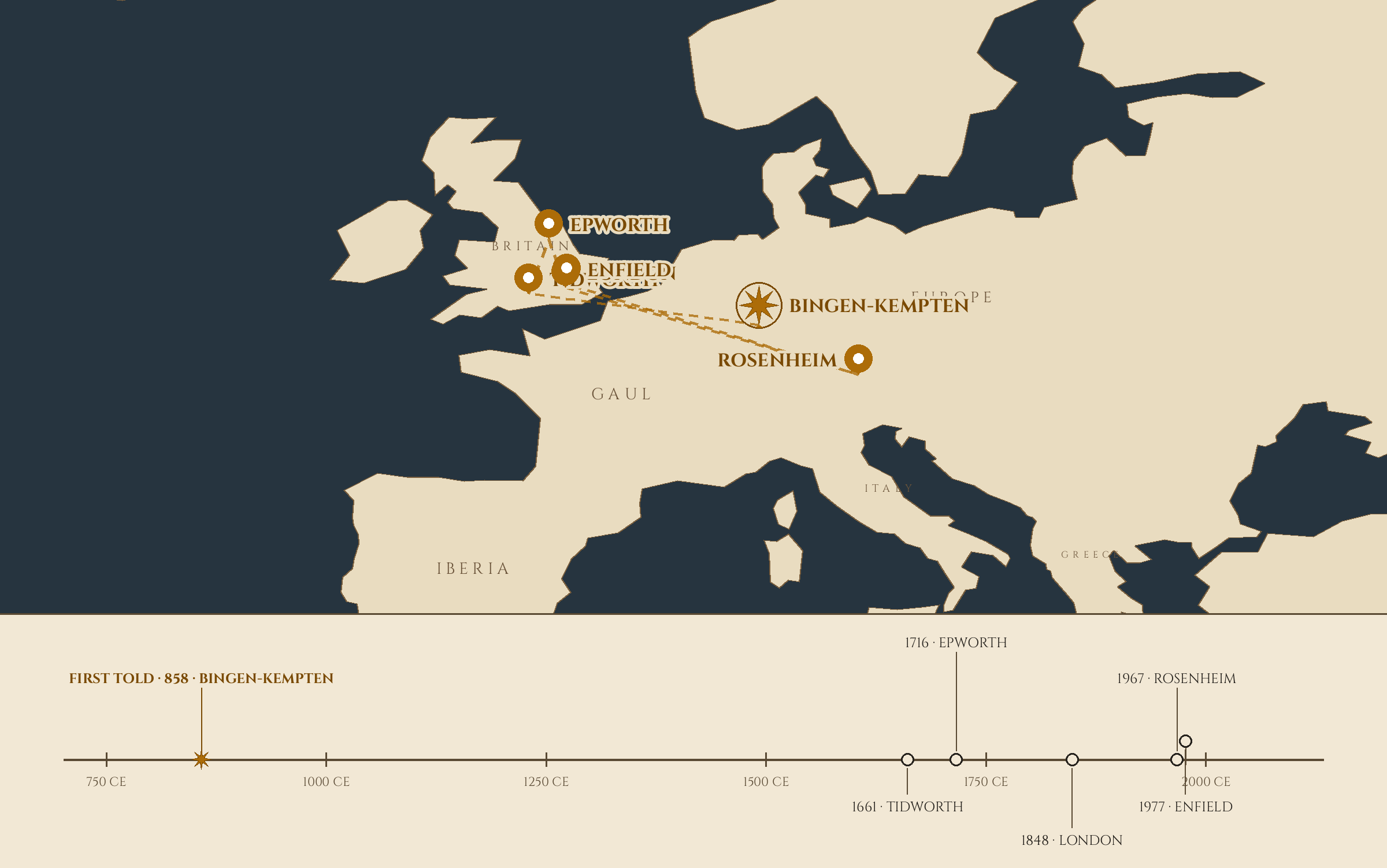
Where this lesson travels: Bingen-Kempten on the Rhine, where the Annals of Fulda, under the year 858, file the first full case — stones thrown, walls hammered as if with a hammer, a voice, and fires, over three years at Caput Montium; Tidworth in Wiltshire, where the Drummer drummed in John Mompesson's house in 1661 and Joseph Glanvill made the case famous; London, where Catherine Crowe's The Night Side of Nature (1848) gave English the word poltergeist itself; Rosenheim, where the disturbances in lawyer Sigmund Adam's office were investigated in 1967; and Enfield, where the Hodgson family's case was watched through 1977. The starred pin is the first record; the dashed line is the telling, traveling.
Lesson Objectives
By the end of this lesson, you will be able to:
- Say what the word poltergeist means in its own language, who carried it into English, and when.
- Name the first record: the annal, its year, and the place — and say why this class calls it a case file, not a tale.
- Tell the two set cases, Rosenheim and Enfield, as documents: what was filed, by whom, and what each file also contains against itself.
- State what it actually is as this record honestly allows: an inventory of causes, not a single answer.
- Describe the vigil — the watching custom this being produced — with its institution and dates.
Your Assignment Packet
This lesson's work lives in its packet: the Lexicon Handout (every term, the core terms marked with the keeper's diamond ◆), Materials, Guided Practice, the Assignment Manual written out whole, the Scholar's Entry Page, the Reflection Questions, the Workbook Checklist, and the Keeper's Notes, for whoever teaches the lesson. Download the packet before you begin and keep it beside you as you read. The packet's assignment is Rookmere's own word for the work: Entry No. 39 — The Poltergeist (written, with a household log) ◐. The Unit VI Quiz is not printed in the packet; it waits at the end of the unit, with Lesson 40.
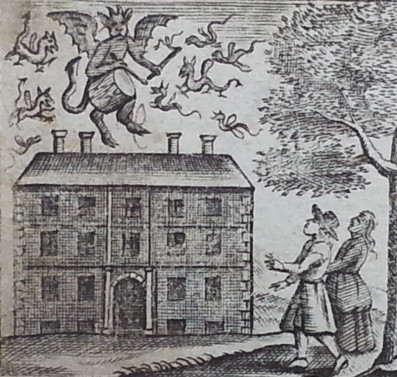
The Drummer of Tedworth in the frontispiece tradition of Joseph Glanvill's Sadducismus Triumphatus (1681): the devil himself drumming on the roof of John Mompesson's house amid a swarm of flying demons, the household watching below — the first famous poltergeist case in English print, drawn as its keeper argued it. The plate survives small; it is the genuine 1681 image. Public domain, via Wikimedia Commons.
The Creature: The Noisy Ghost, Never Seen
The word is German and it is a job description. Poltern is to make a racket — to bang, bluster, and knock about; Geist is a spirit or ghost. A poltergeist is the racket-ghost: the being defined not by what it is but by what it does. The word itself is young. It reached English in 1848, when Catherine Crowe used it in The Night Side of Nature, her gathering of the century's strange reports — the map's London pin marks the naming, not a haunting. But the thing the word names is more than a thousand years older than the word, as §2 will show. This class has met that pattern before — a being older than its name — but never with so clean a date on the name itself.
Its depiction line is the unit's strangest: there is none, from life. A being that is only heard gives art nothing to copy, so its two plates are both arguments — Glanvill's 1681 frontispiece, which supplies a devil the case never contained, and the chapbook drummer who stands in for the noise. The Guided Observation reads both as evidence about the telling, not the event.
Set the poltergeist beside its unit-mates and its shape sharpens. The ghost is seen, at a place. The revenant is met, on a road or in a churchyard. The wisp is a light with no agent. The poltergeist is an event with an address: disturbances in one house or office, over weeks or months, witnessed in company, and — this is its signature — centered, again and again, near one living person. The record gives it no face. It gives it a file number.
First Told: The Annals of Fulda, 858
✦ On the class test
The starred pin stands at Bingen-Kempten, in Germany, under the year 858, and the record is the Annals of Fulda — the year-by-year chronicle kept by the monks of Fulda, among the most sober paperwork of the early Middle Ages. Under 858 the annalist files a disturbance at Caput Montium, present-day Kempten near Bingen: an evil spirit, he writes, that threw stones, banged on the walls as if with a hammer, spoke aloud, and set houses afire, and kept it up for three years. Stones, blows, a voice, fire — the whole later catalogue of the poltergeist, complete in its first full case file, eleven centuries before the word existed.
Read the map as this being's biography, and notice what the pins actually mark: not sightings but recording technologies. 858, the monastic annal. 1661, Tedworth in Wiltshire, where the case is made famous by a printed book. 1848, London, where the being gets its English name from a bestseller. 1967, Rosenheim in Bavaria, where the file gains physicists, telephone engineers, and monitoring instruments. 1977, Enfield in London, where it gains tape recorders, cameras, and a policewoman's signed statement. The poltergeist's map is a history of how Europe learned to take notes. Each age filed the same noises in its newest paperwork, and the paperwork is what a keeper can still check.
The Tales, and How the Telling Grew
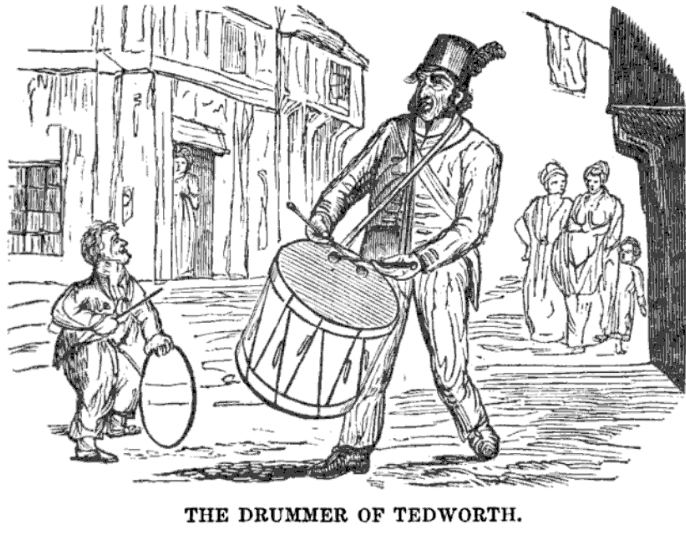
“The Drummer of Tedworth”: a later chapbook-style engraving of the drummer in the street with his drum — the case as popular print kept retelling it, long after Glanvill's argument was forgotten. Public domain, via Wikimedia Commons.
The case that taught print to love the poltergeist is the Drummer of Tedworth, 1661 — a story worth telling slowly, because every keeper's lesson in this class is hiding somewhere inside it. John Mompesson, a Wiltshire magistrate, had a wandering drummer arrested, and the man's drum was confiscated and sent to Mompesson's house. Then the noises began: drumming in the walls and in the air, scratching, panting, the sound of money being counted, objects moving — and crowds of the curious arriving at the gate to listen for themselves, the way crowds do. The case became famous because Joseph Glanvill, chaplain to Charles II, came down, heard what he reported hearing, and printed the whole affair in Sadducismus Triumphatus (1681). This lesson's hero plate comes out of that book's frontispiece tradition, and the engraver's work repays a close look: see what he did with a case that consists, in the file, entirely of sounds. He could not draw a noise, so he drew a drummer: the devil himself, up on the Tedworth roof, beating the stolen drum with his own hands, demons swarming round him and the household peering up from below. The case file contains no devil. The picture supplies one, cheerfully, because a frontispiece has a job to do. Now file the book's purpose beside the case, as a keeper must. Sadducismus Triumphatus means Sadducism Triumphed Over. It is an argument aimed at people who denied the spirit world, and Glanvill printed the Drummer as evidence in that controversy. The case is real as a record. What the record was mustered to prove is part of the record, and your entry carries both.
Between Tedworth and the naming stands the case that taught the eighteenth century the pattern: the rectory at Epworth in Lincolnshire, in the winter of 1716–17, where the Wesley household — the Reverend Samuel Wesley, his wife Susanna, and their children, among them the young John Wesley — endured weeks of knockings, groanings, and sounds of money counted and bottles dashed, and kept the record in family letters that survive. The Wesleys named their unseen tenant "Old Jeffrey," after a man who had died in the house's earlier days — the old ghost-reading, applied to noises — and John Wesley, grown and famous, printed the family's account late in the century, in 1784, still unwilling to let the file close. Tedworth had shown print a case; Epworth showed it a household, writing its own case up as it happened, in dated letters by named people. The poltergeist's literature is letter-shaped ever after.
After Crowe's naming in 1848, the watching professionalized. The Society for Psychical Research, founded in London in 1882 to examine such claims in a scientific spirit, turned the haunted-house visit into a procedure: dated logbooks, witnesses' signatures, watches kept through the night (§5's box keeps this custom in full). The twentieth century added the laboratory's furniture and the laboratory's doubts in equal measure, and parapsychology coined its own reading of the pattern: recurrent spontaneous psychokinesis — the disturbances read not as a dead person's work but as a living person's, the centered person of case after case, acting without knowing it. That reading belongs to the investigators who proposed it, and the entry files it under their names. What no age has yet filed is a poltergeist that performs on demand. The being's growth is the growth of its paperwork; its nature is still argued from the paper, by everyone, including this lesson.
KEEPER'S CHECK-IN
In the Tales, what did Glanvill's 1681 frontispiece add to the Tedworth case — a drummer, a devil, an audience of demons — that the case file itself never witnessed?
Spotted: Two Case Files
This lesson's tales are set cases, told as the documents give them — soberly, because real households stand inside them.
Rosenheim, 1967. In the law office of Sigmund Adam, in the Bavarian town of Rosenheim, the autumn of 1967 brought swinging and bursting light fixtures, furniture shifted, copying fluid spilled — and telephone bills showing the speaking-clock number dialed again and again at rates no rotary dial could reach, calls the staff denied making. The telephone company and Siemens engineers found no fault to explain it. Two physicists from Munich's Max Planck Institute, Friedbert Karger and Gerhard Zicha, measured the disturbances and published their conclusion that some unknown form of energy was at work; Hans Bender of Freiburg's Institute for Border Areas of Psychology opened the formal investigation. The file's most famous pattern is its centering: the events, by the investigators' dated logs, happened in office hours, tracked the presence of the firm's nineteen-year-old secretary, Annemarie Schaberl, and stopped when she left the firm. And the file carries its other side in the same folder: later critics, the physicist John Taylor among them, argued that the celebrated meter-deflections had been mechanically produced and that Bender's published account left out inconvenient details. Both reports are the record. Rosenheim is this class's set case because its paper is thick on both sides — a keeper does not thin it to one.
Enfield, 1977. At 284 Green Street, Enfield, in north London, the household of Peggy Hodgson — a mother and her children — reported, from the last day of August 1977, knocking, moving furniture, objects flying, and in time a rough voice claiming to be a man who had died in the house. The file begins unusually well: a policewoman, WPC Carolyn Heeps, signed a written statement dated 31 August 1977 recording that she had watched a chair slide across the floor with no one touching it. The Society for Psychical Research sent Maurice Grosse and Guy Lyon Playfair, who kept the watch for months and logged incident upon incident; Playfair's This House Is Haunted (1980) is the case's book. But this file, like Rosenheim's, corrects itself from inside: the children were caught adding tricks of their own, more than once — and Janet Hodgson, the eleven-year-old at the case's center, said so herself on the record, telling ITV in 1980 that they had faked things "once or twice, just to see if Mr Grosse and Mr Playfair would catch us — they always did," and in later interviews putting the faked share at about two percent, while standing by the strangeness of the rest. Another SPR researcher, Anita Gregory, worked the same house and filed a dissenting conclusion. The keeper's verdict is the file itself: the most documented poltergeist case ever kept is also, on its own paper, not a clean one — and both of those facts are the lesson.
KEEPER'S CHECK-IN
In Spotted's two modern case files, Rosenheim and Enfield, what does each file also contain against itself?
What People Watched For — the Vigil
The custom this being produced is a watch, and it has an institution and dates. From the founding of the Society for Psychical Research in 1882, the proper answer to a house that turned noisy was to go and sit up with it: investigators kept the vigil — dated logbooks opened, watches relieved in shifts, doors and objects marked and sealed, and in the instrument age cameras and tape recorders left running through the night. Householders copied the form all over Britain and beyond: when the noises came, you did not only endure them; you watched, in writing, with witnesses.
The vigil's fullest keeping is the Enfield watch of 1977–78, where Grosse and Playfair sat the Green Street house for months and Playfair's This House Is Haunted (1980) published the log to the world. File the custom whole, including its effect on the evidence: a watched house behaves differently from an unwatched one — the Enfield children tested their watchers, by their own later account, precisely because the watchers were there. The belief is S; the watching is F; and the two changed each other, which is why this box belongs to this lesson above all others in the unit.
What It Actually Is
No single root can be honestly written for this being, and the entry says so in its first line. What the record itself shows, filed in order, is an inventory. First, fraud — not suspected from outside but documented from inside the set cases themselves: admitted at Enfield, alleged with specifics at Rosenheim. Some part of some files is trickery; the files prove it, and a root that omits this is flattery, not keeping. Second, the ordinary house: pipes, settling timbers, draughts, animals in the fabric, the hundred noises a building makes — the standing first suspect in every investigator's own handbook, from Glanvill's century to Bender's. Third, the pattern of the center: case after case arranges itself around one person, very often young and under strain — Bender's own account has Schaberl unhappy in her work and her engagement broken; the Enfield file centers on two girls in a stretched household. The investigators read that pattern as psychokinesis; their critics read it as the signature of trickery plus attention. The pattern is F. Both readings are filed as readings, under their makers' names. Fourth, the watchers themselves: once a house is famous, expectation does work — Tedworth drew crowds to listen, Enfield drew cameras to film, and crowds and cameras are also causes, of reports if not of noises.
So the root a keeper writes is procedural: the poltergeist is not, in the end, a creature but a kind of event — and events are explained one by one, in their files, or not honestly at all. The unit of truth in this lesson is not the being. It is the case.
Still With Us
The word now works far from any case file. Any unexplained household racket is a "poltergeist" in the newspapers, and the being's public face is dramatization: Enfield retold for the screen again and again, each retelling smoother than the file it came from, the admissions quietly trimmed away. You know the keeper's response by now, because this class has practiced it since Lesson 17's honest fraud. Go back to the paper. Playfair's book before the films. The signed statement before the book. Meanwhile the quieter modern face goes on much as the old one did. The SPR and its sister societies still open files, still sit up through the night with logbooks, and still file a dissenting conclusion in the same folder as a convinced one when the evidence splits that way. No case since 1977 has gathered paper to match the two set cases of this lesson, and none has settled the argument those two keep alive. The poltergeist opened its file in 858 with a monk writing down noises he could not explain, and the file is open still, on better paper.
Guided Observation
This lesson's plates are both Tedworth, three centuries apart in keeping. The hero is the frontispiece tradition of Glanvill's Sadducismus Triumphatus (1681): the devil drumming on the roof of Mompesson's house, demons swarming, the household below. It is small in its surviving size — the genuine 1681 plate, not a later illustrator's enlargement — and it argues as hard as it pictures: look at what the engraver has added to a case of noises. The case file said drumming, scratching, moving objects. The picture supplies a drummer, a devil, and an audience of demons. Write down three things the plate claims that the case, as Glanvill reports it, never witnessed. Then the second plate: the chapbook drummer, the case as cheap print retold it for the street — one man, one drum, no demons at all. Between the argument's frontispiece and the street's chapbook, the case itself has not changed by one knock. Note which plate a keeper files as evidence about the event, and which as evidence about the telling — and whether either is evidence about the noises.
Assignment Manual
✎ WRITTEN · ⚒ HANDS-ON · ◐ BOTH
◐ Both · Entry No. 39: The Poltergeist.
- Prepare the page. Rule a fresh page of your bestiary to the Scholar's Entry Page in this lesson's packet. Head it: Entry No. 39 — The Poltergeist. At the head of the page, before anything else, write the sentence this lesson files first: the unit of truth here is the case.
- Write the entry to the standard. The Creature: the racket-ghost defined by what it does, with its two argument-plates. First Told: the Annals of Fulda — the year, the place, and the four instruments of the disturbance (stones, hammering, voice, fire) in the annalist's own inventory. The Tales: Tedworth and its book's argument; the naming of 1848; the professional watch. Spotted: Rosenheim and Enfield, told as documents — who filed what, and what each file holds against itself. What It Actually Is: the four-item inventory, in order, with the readings filed under their makers' names. Still With Us: the word at large, the screen retellings, the files still opened. The Keeper's Line: your own judgment, in one or two lines.
- The two-column audit. Choose one incident from either set case. Rule two columns. In the left, write only what the filed record states: dates, names, instruments, signatures. In the right, write everything the famous retellings add: motives, faces, dialogue, certainty. Measure the right-hand column honestly. This audit is the entry's heart — it is the whole method of this class performed on a single page of paper.
- The household log. For one week, keep the small notebook by the kitchen door as your house's case log. Every unexplained noise — knock, bang, rattle, hum — gets a dated line: the time, the room, who heard it, and its found cause when you find it (the fridge's ice, the pipe's hammer, the branch at the window). Any line still unexplained at the week's end stays in the log, blank cause and all. File the log's summary — how many lines, how many causes found — at the foot of your entry. Investigators from Glanvill to Playfair kept no other instrument than this, at bottom: a dated list, kept honestly.
- Mark every line. F for the dated fact — annals, books, statements, published reports, and published criticisms of them. S for the sighting- and disturbance- reports, and what the participants held: that a spirit made the noises, that a living mind did. T for the tales retold. Mark the investigators' own conclusions with their names attached: a conclusion without its maker's name is a belief wearing a uniform.
- Close soberly. End the entry with one line about the people inside your chosen case — the secretary, the mother, the girls — written as you would write of any household in a hard year. The files are the subject of this class. The people were never its exhibits.
The printable packet for this lesson — the Lexicon Handout, the Guided Practice, this manual, and the Scholar's Entry Page — is linked on this page.
Materials
· Your bestiary journal or notebook — kept for the whole class
· Pencils, and a pen you like writing with
· A red pencil, for the keeper's marks
· A ruler, for ruling your entry pages
· A small notebook for the household log, kept by the kitchen door
· This lesson's packet (the Scholar's Entry Page is in it)
Reflection
Glanvill printed the Drummer of Tedworth as evidence in an argument about the spirit world. Does knowing a record's purpose weaken the record, or strengthen your reading of it?
Janet Hodgson's admissions are part of the Enfield file itself. Is a case with confessed trickery in it worth more or less to a keeper than a case with none admitted — and what does your answer assume about the cases that admit nothing?
The poltergeist's record is a history of recording technologies, annal to tape recorder. What has each new instrument actually settled — and what has each merely recorded better?
A Closing Note
Two files, kept whole, contradictions and all, filed inside the folders where they belong instead of smoothed away. One lesson of beings remains, and it is the strangest turn in the class: beings younger than some of the scholars reading this book. They were born in the full light of newspapers and cameras, and two of them have something no bestiary being ever had — a birthday you can point to. If the old pattern runs there too — first record, growth, tales, root, modern face — then it runs anywhere a record is kept, and your capstone has no excuses left. Keep your journal dry, and your T, S and F honest.
The Bestiary
Bestiary Keeper
Further Reading & Sources
Joseph Glanvill, Sadducismus Triumphatus (1681) — the Drummer of Tedworth in its first famous keeping; read the argument with the case.
Catherine Crowe, The Night Side of Nature (1848) — the book that carried "poltergeist" into English.
Guy Lyon Playfair, This House Is Haunted: The True Story of a Poltergeist (1980) — the Enfield watch, published by one of its watchers.
Hans Bender, "Der Rosenheimer Spuk," Zeitschrift für Parapsychologie und Grenzgebiete der Psychologie (1968), with Karger & Zicha's physical report of 1967 in the same journal — the Rosenheim file's founding papers.
Harry Price, Poltergeist Over England (1945) — three centuries of cases gathered by the century's most famous watcher; read his certainties as exhibits too.
Submit your work for this lesson using the form below.
CONTINUE IN THE BESTIARY HALL
← Previous · Lesson 38: Will-o'-the-Wisp Next · Lesson 40: New Beings, Old Pattern →
Unit VI — Those Who Linger The Bestiary Hall — All 41 Lessons
The rest of Unit VI: Lesson 34 · Ghosts · Lesson 35 · Revenants · Lesson 36 · The Mummy · Lesson 37 · The Banshee & the Washer at the Ford · Lesson 38 · Will-o'-the-Wisp · Lesson 40 · New Beings, Old Pattern · The Capstone · The Unfinished Page