

THE BESTIARY
Unit VI · Lesson 37The Banshee & the Washer at the Ford
Professor Sable Rookmere
Bestiary Keeper
The Bestiary Hall • School of Evershade
Professor's Introduction

I did not pair this lesson's two beings. The record paired them itself, centuries before this class existed, and in the very first surviving scene they are already one figure, standing at a lake, washing. One of them reaches you as a sound: a keen raised over a family that has not been bereaved yet. The other reaches you as a sight: a woman alone at the water in the last of the light, wringing blood out of clothes whose owners are still alive to wear them. The dead of this unit have walked and knocked and appeared, and now, in this lesson, they are reported in advance by a messenger who brings no death with her — only the news that one is coming. Read her kindly, keeper. I have read every account of her I could find, and in the record she is never the enemy. She is the family's oldest mourner. She simply arrives early to her work, the way the best mourners do.
The Bestiary
Bestiary Keeper
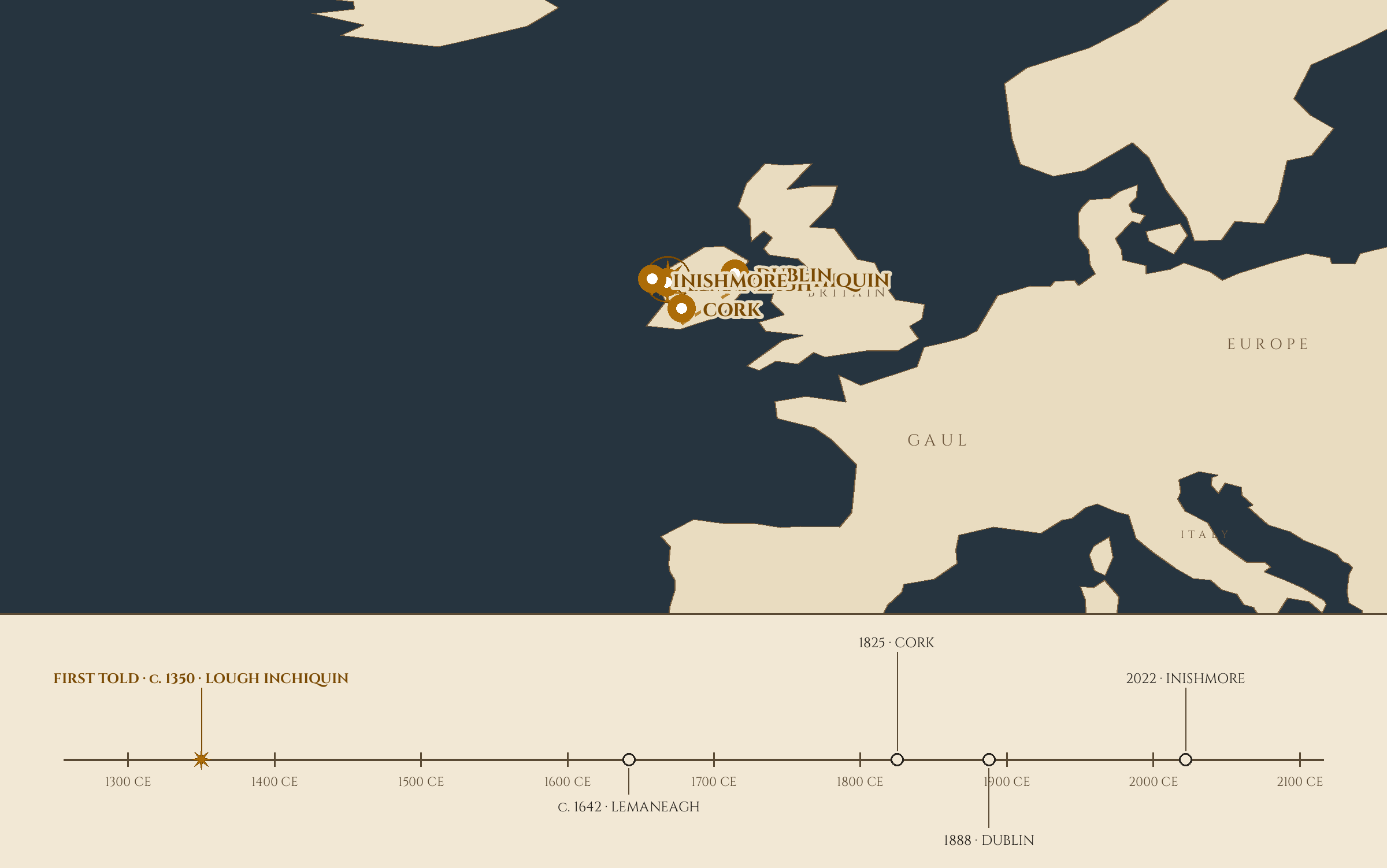
Where this lesson travels: Lough Inchiquin in County Clare, where the Cathreim Thoirdhealbhaigh (about 1350) sets Aibhill and her twenty-five banshees washing blood-stained clothes at the lake before a chief's fall — the washer and the death-messenger already one figure; Lemaneagh, a few miles off, where Lady Anne Fanshawe saw the woman at the window — the visit dated variously, often 1642, the castle “in all probability” Lemaneagh, and Fanshawe never wrote the word banshee; Cork, where Thomas Crofton Croker gathered the banshee from Munster tradition for his Fairy Legends of 1825 — this lesson's plate comes from that book; Dublin, where W. B. Yeats's Fairy and Folk Tales of the Irish Peasantry (1888) carried her into the Irish literary revival; and Inishmore, where The Banshees of Inisherin was filmed in 2022 — the name traveled, almost none of the folklore with it. The starred pin is the first record; the dashed line is the telling, traveling.
Lesson Objectives
By the end of this lesson, you will be able to:
- Give both beings their names in Irish and Scottish Gaelic, and say what each name means.
- Retell the first record: Aibhill and her twenty-five at the lake, about 1350, and say what the washer and the messenger already are in it.
- File the Fanshawe sighting with all of its hedges attached — the date, the naming, the castle — and say who applied the word "banshee," and when.
- Follow the telling into print: Croker (1825) and Yeats (1888), and name the families the collections say she follows.
- Place the black dogs beside her as her fellow death omens: Fleming's pamphlet of 1577 with the name "Shuck" filed at its own later date, the Yorkshire barghest and gytrash, the Moddey Dhoo, and the guardian dogs the omen-only filing cannot hold.
- Describe the comb rule and its sources, marked S for the belief-report and F for the collecting.
- Set out the real root: the keening women and the washing work — the two halves of women's mourning labor, heard and seen.
Your Assignment Packet
This lesson's work lives in its packet: the Lexicon Handout (every term, the core terms marked with the keeper's diamond ◆), Materials, Guided Practice, the Assignment Manual written out whole, the Scholar's Entry Page, the Reflection Questions, the Workbook Checklist, and the Keeper's Notes, for whoever teaches the lesson. Download the packet before you begin and keep it beside you as you read. The packet's assignment is Rookmere's own word for the work: Entry No. 37 — The Banshee & the Washer at the Ford (written) ✎. The Unit VI Quiz is not printed in the packet; it waits at the end of the unit, with Lesson 40.
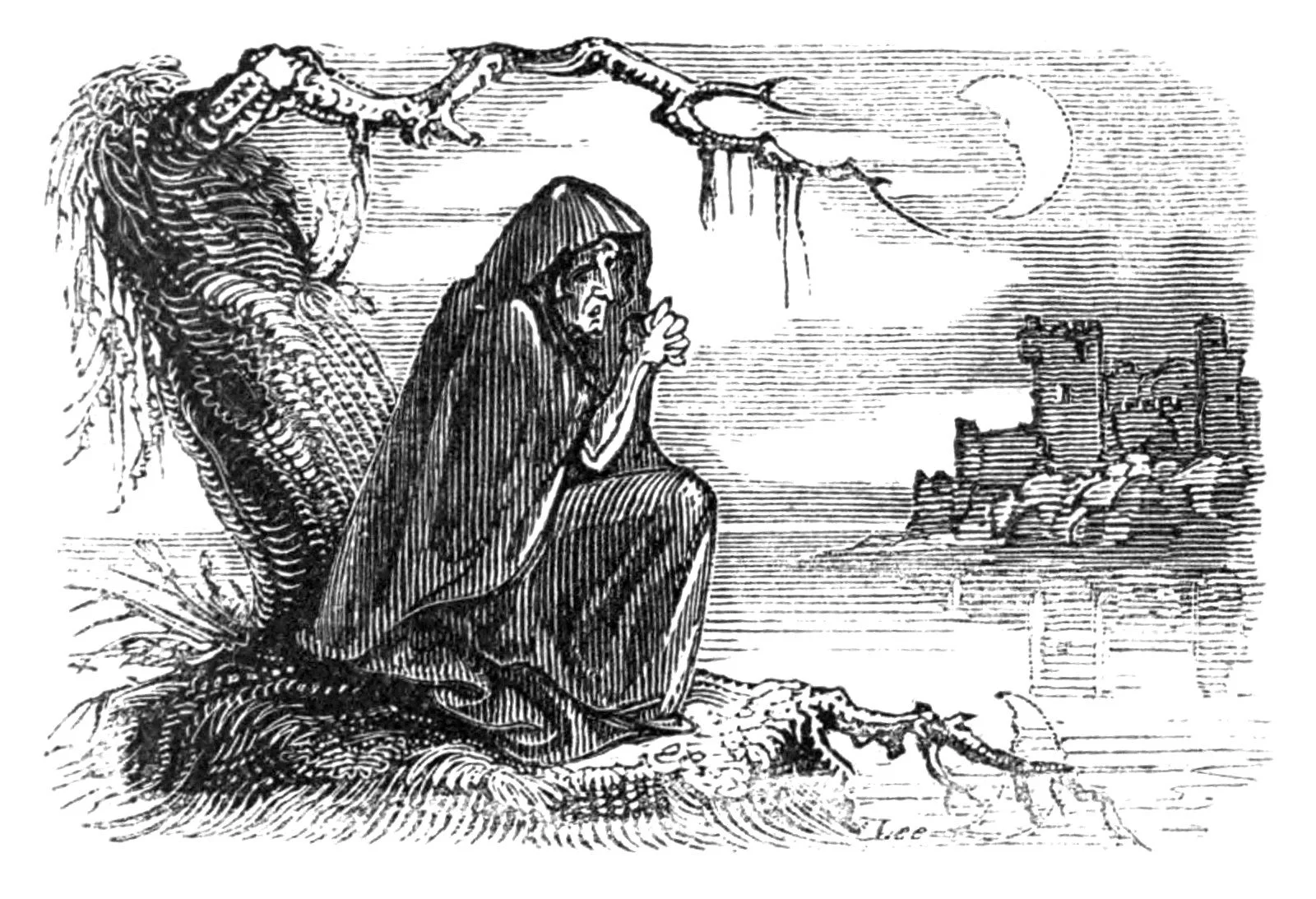
W. H. Brooke's plate for T. C. Croker's Fairy Legends and Traditions of the South of Ireland (1825): the banshee hooded and keening on the shore at night, a ruined castle across the moonlit water. This lesson's one plate — no lawful period plate of the Washer at the Ford exists for the class's archive, and the lesson says so plainly rather than substitute an unrelated picture. Public domain, via Wikimedia Commons.
The Creature: Two Names for One Shadow
The English word is banshee, and it is Irish wearing English spelling: bean sídhe, woman of the fairy mound — the sídhe being the hollow hills, the ancient mounds of the Irish fields, and their people. She is, in the record's own terms, a death-messenger: she does not kill, curse, or carry off. She announces, with a cry the Irish language names exactly — caoineadh, the keen, the formal lament raised over the dead — raised by her, uniquely, before the death as well as after it. She belongs not to a place but to families: the collections agree that certain old Irish families have their own banshee, who has followed them for centuries and keens when one of the line is about to die.
Her depiction line can be read in one sentence, and §3 and the Guided Observation read it in full: she was not pictured at all until print collected her — Brooke's engraving of 1825 is this lesson's only plate — because the being is a sound, and the washer who shares her lesson was never pictured in her own centuries at all.
Her paired figure is darker and quieter. The washer at the ford is found at streams and fords and lake edges, at dusk, washing — and what she washes is the bloody clothing and gear of people who are going to die. To see her is bad. To recognize your own shirt in her hands is the whole sentence. In Scotland she is the bean nighe, the washerwoman, and the Highland record keeps her at the fords of the glens long after print reached Ireland's figure. Two countries, two postures of the same labor: one woman mourns aloud at the house; one woman washes in silence at the water. The first record, next, shows you them already fused — and older than either name's first surviving writing.
First Told: Aibhill at the Lake, and the Map
The starred pin stands at Lough Inchiquin in County Clare, and the document is the Cathreim Thoirdhealbhaigh — The Triumphs of Torlough — a history of the wars of Thomond written by Seán mac Craith about 1350. In it appears Aibhill, the banshee of the O'Briens, the ruling line of Thomond — and she does not appear alone or keening. She is at the lake the record calls Rath Lake, with twenty-five banshees under her rule, washing blood-stained clothes on the eve of the fall of a chief of the line. Washer and messenger, in the first dated scene the class owns, are already a single figure, and she is already attached to a named family and already at her water.
Mark the map's shape, as you have learned to do. Five pins, four of them Irish soil: the lake in Clare; a castle window, also in Clare, three centuries on; Croker's Cork, where she was collected into print; Dublin for Yeats's edition — which the map's note files honestly as published in London; and Inishmore in 2022, where her name went round the world on a film. No being in this class has a smaller country. She does not travel, because she does not need to: the families do the traveling, and she follows the families.
The Tales: a Memoir, the Collectors, the Poet
✦ On the class test
The second pin is a window. Lady Anne Fanshawe, an English royalist gentlewoman traveling in Ireland in the troubled 1640s, stayed at an O'Brien house — and wrote, in the memoir she composed in 1676, that she woke in the night to a sighing voice and saw at her window a woman with red hair and a pale, ghastly countenance, who vanished; and that in the morning she was told a cousin of the family of the house had died that night. Now file the hedges, because this lesson's integrity lives in them, and the map itself carries them: Fanshawe never uses the word "banshee." The visit's date is given variously — often 1642. The castle is identified as Lemaneagh only "in all probability," an identification made by the folklorist Elliot O'Donnell some two and a half centuries later. The naming of her sighting as a banshee is the collectors' work, not hers. What she left is a dated, placed, signed memoir of a thing seen at a window before a death in the house — and the tradition that received it did the rest. That is not a flaw in the record. It is a picture of how the record is made, and this class keeps the picture whole.
In 1825 the telling passes to the collectors. Thomas Crofton Croker's Fairy Legends and Traditions of the South of Ireland, gathered from the tellers of Munster, carried the banshee into print in full dress — her families named in the collections as the great old lines: the O'Neills, the O'Briens, the O'Connors, the O'Gradys, the Kavanaghs — and carried her portrait too. This lesson's single plate is W. H. Brooke's engraving for Croker's book, and it is worth standing in front of before you read another word of the lesson. Brooke has set her on a shore at night, hooded, caught in the middle of the keen itself, with a ruined castle across moonlit water behind her. Everything the picture gives her is setting and posture: shore, ruin, moonlight, grief. The one thing it cannot give her is the thing she is — a sound — and the Guided Observation will ask you to sit with that gap properly. In 1888 W. B. Yeats edited Fairy and Folk Tales of the Irish Peasantry and set her in literature's front room, where the Irish revival kept her. Meanwhile the washer kept her own counsel in Scotland: the Highland collectors of the nineteenth century wrote down the bean nighe at her fords, and the rules the tales give her — that she sings as she washes, that the clothes are those of the coming dead, that a watcher who could creep up and seize her before she saw him might compel her to name whose they were. File the rule as the tales give it: it is the only place in this lesson where the messenger can be questioned, and it costs the questioner a drenching in the ford of the doomed.
The black dogs — the banshee's English company. She does not keep the death-messenger's office alone, and England keeps the other half of the watch. Across the Irish Sea the announcement comes on four feet: a black dog, unnaturally large — calf-sized in report after report — shaggy, with fiery eyes, met on a lonely road, at a bridge, in a churchyard, at a church door. To meet him, in the standard filing, is to be warned: your death, or the death of someone near you, is coming before the year is out. The likeness to this lesson's work is exact in everything but the species. He announces rather than acts — with one great, terrible exception, filed next. He is attached, as she is: not to everywhere, but to a road, a churchyard, a bridge, a family. And his tales, like hers, are told backwards from the death that followed them. File the company here, in the Tales, because print is where England filed him too.
The exception is this class's earliest dated English wonder in print. On Sunday 4 August 1577, between nine and ten in the morning, a tempest of rain, lightning and thunder fell on Bungay in Suffolk, and the congregation of St Mary's was at prayer in a church gone so dark that no one could see anyone except by the lightning — and a black dog was seen among them. The London pamphlet that carried the news is Abraham Fleming's A Straunge and Terrible Wunder (1577), and it must be filed as Fleming wrote it: the dog ran "all along down the body of the church with great swiftnesse," passed between two persons kneeling in prayer and "wrung the necks of them bothe at one instant clene backward," so that both died where they kneeled; it gripped a third man on the back, who shrank "as it were a peece of leather scorched in a hot fire" — and lived; and claw-marks, the pamphlet says, remained in the stones and the church door. The same pamphlet, on the same day, sets the same shape seven miles off at Blythburgh, swung down from the rood beam, where it slew two men and a lad and burned another man's hand. Mark the layers as this lesson has taught you: the pamphlet, its date, its storm, its named towns — F, a printed wonder of 1577, framed by its maker as God's warning to a sinful people, and drawn, Fleming tells you himself, from a written copy and the mouths of eyewitnesses, for he was not one. The dog, and the deaths at its paws — S, a sighting-report, however early and however printed. Fleming's dog kills, and the keeper notes the difference plainly: the banshee has never harmed anyone in her whole record. This dog is her fellow in office, not in conduct.
And file his name where the Fanshawe rule has trained you to file it. Fleming never calls the dog Shuck — he writes "a black dog, or the divel in such a likenesse," and no name at all. Black Shuck enters print in 1850, in the Reverend E. S. Taylor's note "Shuck the Dog-fiend" in Notes and Queries: a phantom many persons in East Norfolk and Cambridgeshire described as "a black shaggy dog, with fiery eyes and of immense size, and who visits churchyards at midnight." Fleming recorded a black dog is what 1577 supports. Fleming recorded Black Shuck is a name the collectors added later — the same naming, by the same kind of later hands, that this lesson caught at Fanshawe's window.
Yorkshire keeps the file's fullest local names. The word barghest is in print early and plainly: William Carr's Dialect of Craven (1828) glosses it as a sprite that haunts towns and populated places — a sprite, mark, before the collectors settled him into a dog. A ballad of the barghest of Troller's Gill, the limestone gorge in the Dales, was recorded in William Hone's Every-Day Book (1830). The collecting itself is William Henderson's Notes on the Folk-Lore of the Northern Counties of England and the Borders (1866; second edition 1879), and Henderson files the dog under two of his names at once. The Padfoot of the Leeds country: about the size of a small donkey, black and shaggy, eyes like saucers, following the night traveller with a soft padding and then a roar no earthly animal makes — a death omen, the Reverend J. C. Atkinson of Danby told him. The Barguest proper haunted waste ground near Leeds, and at the death of any notable person in the district would appear followed by all the dogs of the district, howling — Henderson's informant remembered, from his own childhood, the terror of that procession passing before the death of Squire Wade of New Grange. Sit with that procession a moment. It is the banshee's pattern in fur: a whole countryside's voices raised, in advance, over a death the district has not had yet.
Beside the barghest stands the gytrash, and its filing is a novel's. Charlotte Brontë, Jane Eyre (1847), chapter XII: Jane waits on a stile at dusk and remembers "certain of Bessie's tales, wherein figured a North-of-England spirit called a 'Gytrash,' which, in the form of horse, mule, or large dog, haunted solitary ways, and sometimes came upon belated travellers." What comes down the lane is Mr Rochester's horse — and his black-and-white dog Pilot, "exactly one form of Bessie's Gytrash — a lion-like creature with long hair and a huge head," which passes her, Jane writes, "quietly enough." The collectors' later citations build on Brontë's page, and the keeper files the scene with pleasure, because it is this class's whole method in one lane at dusk: the omen expected, the ordinary dog arriving, both kept. In the wider northern filing the gytrash leads travellers astray on solitary ways — and can also guide the lost back to the right road. Hold that second half. The file is about to turn on it.
The Isle of Man keeps one dog in one castle, on one man's word — and the lesson sizes him to his source, as it sized Fanshawe. George Waldron's History and Description of the Isle of Man (1731) is the sole written authority for the Moddey Dhoo — Manx for "black dog," which Waldron spelled Mauthe Doog — of Peel Castle: "an apparition… in the shape of a large black spaniel with curled shaggy hair," seen in every room but "particularly in the guard-chamber, where, as soon as candles were lighted, it came and lay down before the fire in presence of all the soldiers," until the soldiers grew used to it. Waldron also gives the close: a soldier who followed it alone down the castle passage came back unable to tell what he had seen, and died three days after; the passage was sealed, and the dog was seen no more. Sir Walter Scott carried Waldron's dog to the world — the "spectre hound in Man" of The Lay of the Last Minstrel, and, grown in the telling to a great shaggy mastiff, the Manthe Dog of Peveril of the Peak (1823), with Waldron candidly credited in Scott's notes. A resident dog, a fireside kept nightly, a death only for the man who followed it where he should not: the Moddey Dhoo already stands halfway out of the omen file, toward the guardian's.
The church grim stands there wholly, and comes home to the banshee's ground — the churchyard itself. In Henderson's collecting the grim is a large black dog set over a particular church and its dead, guarding the yard against all who would profane it: thieves, vandals, witches, warlocks, the Devil himself. The collectors report the belief beneath him, and the keeper files it as a belief and nothing more: that a dog had been buried alive under a church's cornerstone so that its ghost might keep the watch, and that where a new churchyard's first burial would have owed that guard-duty to the Devil, a black dog was buried in the yard's north part as a substitute, to spare a human soul the office. Mark it S for the belief-report and F for Henderson's recording of it — a reported belief is evidence the belief was held, not that churchyards were stocked by cruelty. And the grim keeps both natures in one body, which is why he belongs in this lesson: in Yorkshire tradition he also tolls the church bell at midnight before a death in the parish, and at a funeral the clergyman may see him looking from the church tower and judge the departed soul's fate from his aspect. The guardian is the omen. The watch and the warning are the same dog.
So the counter-record stands in the file in full, not as a correction pasted over it. The Gurt Dog of Somerset — gurt is the dialect word for great — walks the Quantock Hills as a protector: mothers, it is said in the collected tales, let their children play on the hills unwatched because the Gurt Dog would guard them, and the dog accompanied lone travellers on the dark roads as guide and protector, asking nothing and harming no one. Ethel Rudkin's Lincolnshire survey, "The Black Dog," Folklore (1938), found the same double nature in her own county: Hairy Jack of the lanes round Hemswell, reported from Brigg to Spalding — and Rudkin, who claimed to have seen the dog herself, formed the impression that Lincolnshire's black dogs were mainly of a gentle nature, looked on as a spiritual protector, even while her own file keeps dogs said to attack passers-by in lonely waste places. Both halves are hers; the lesson keeps both. The modern filing that holds the whole kennel at once is Theo Brown's "The Black Dog," Folklore (1958), which sorts the reports into three loose types — the shape-shifting barguest kind, the true black dog who is always a dog and bound to a place, a road or a family, and the dogs who come only at set times of the year — and warns, in words this class could take for its own, that the divisions exist for our convenience and overlap everywhere.
Bring the company back to the lesson's own two figures and the pairing explains itself. The banshee keens over a family before its death; the washer wrings the shirts of men not yet fallen; the black dog pads down the lane, tolls the bell, heads the howling procession, or is seen, once, in 1577, inside a storm-struck church among the congregation. All three are the same mercy and the same fright, in the shapes three countries gave it: death announced, in advance, by a neighbour — heard, seen at the water, or met on the road and known by his eyes. And all three keep the guardian reading folded inside the omen: the banshee is the family's oldest mourner, the grim is the churchyard's sworn watchman, the Gurt Dog is the hill children's guard. A keeper who files only the terror has filed half the record. The next section takes up how these reports were put together — backwards, from the death — and the dogs' tales are assembled no differently from the keen's.
KEEPER'S CHECK-IN
In the Tales, who applied the word “banshee” to Lady Fanshawe's window sighting — Fanshawe herself, or the collectors who came later?
Spotted: Told Backwards
The tales themselves are told, almost always, backwards — and learning to see that is the lesson's quiet skill. A keen is heard in the night, thin and high over the fields, by people who half wake and half dismiss it; a washer is seen at the ford by a traveler who thinks her some poor woman about her work and is troubled without knowing why. And then the death comes — in the family, on the road, in the battle the washer's shirts foretold — and the hearing and the seeing are dated by it, told ever after as the warning they became. No family in the record tells of the keen that was followed by nothing. The keeper does not sneer at this. The keeper writes down that this is how such records are always assembled, in every lesson of this class — and that the tellers knew it too, and told them anyway, because the warning was not the point. The point was that the family's dead were attended: someone had kept the old office and raised the cry, and no one of the line died unannounced, unwept-in-advance, alone.
Behind both figures stands an older shadow, and the keeper files it with its hedge on. In the early Irish texts — a ninth-century hostel tale, Bruiden Da Choca, among them — the Badb, the crow-spirit of battle, is met at a ford washing a king's chariot and harness until the water runs red, chanting her explanation: I wash the harness of a king who will perish. The washer at the ford was old, and royal, and terrible, before she was a poor woman at a Highland stream. The record gives her a goddess for a grandmother, at several removes and through much retelling — file it as the telling's deep root, not as the bean nighe's birth certificate.
And the census requires one name spoken here, the family's other messenger: the dullahan, the headless rider of the same Irish roads, who carries his head under his arm and whose horse stops at the door of the house where a death is owed. He has no cry and no errand of comfort; where the banshee mourns, he collects. A paragraph is his portion — named, as the census directs, in his kinswomen's lesson.
KEEPER'S CHECK-IN
In Spotted, why are the banshee's tales almost always “told backwards” — the death known first, and the keen or the washer dated by it afterwards?
What People Watched For — the Comb She Leaves
The banshee, in account after account from Croker's tellers onward, is combing her hair — the long hair, white or red, drawn through with a comb as she keens, as though the mourning had its toilet and she would not be caught unready. The sight produced a rule, and the rule is this box's business: a comb found lying on the ground is not to be picked up. It may be hers. The stories of those who took one home end alike: in the night she is at the window, crying for her comb, and the wise among the household hand it back on the tongs, or on a spade — never in the bare hand, for what takes hold of the hand that passes it may keep it. It is a small rule, and a kind one under its fright: it teaches children to leave strange things where they lie, and to respect a grief that is not theirs.
The sources stand where this class requires them — named, dated, and checkable tonight. The rule and its stories were gathered by the thousand in the Schools' Collection of the Irish Folklore Commission (1937–39), in which schoolchildren copied the tellings of their grandparents and neighbors; the manuscripts are free to read at duchas.ie, and the comb stories recur across the counties — at Lickerrig in Galway, at Strang's Mills near Kilmacow in Kilkenny, where she takes the comb off the tongs with words to the effect of it's well for you that you didn't put out your hand. The standard modern study of the whole tradition is Patricia Lysaght's The Banshee: The Irish Supernatural Death- Messenger (1986). Mark it: S for the belief-report — the comb is hers, she will come for it; F for the collecting — dated, placed, signed by schoolchildren and their teachers, in an archive anyone may open.
What It Actually Is
The keen was work before it was ever a wonder, and this section asks for it to be heard as work first. For centuries an Irish death set employed voices going: the keening women — the bean chaointe, the mourning woman — whose lament over the corpse was a skilled office of the funeral, expected by the family, and in many places paid. A good keener improvised the dead person's life into the crying: who he was, who he left, what the house would do without him. She did the family's grief aloud, at full strength, so the family could get through the day underneath it. Everybody in the parish knew that sound, and a lone woman's voice raised in the dark, carrying over fields from the next farm, surprised nobody. It was sorrow at the next farm, on an ordinary night of the year. The banshee, as the record builds her, is that familiar voice with two things changed: the body is gone from it, and the timing has moved. The office still keeps its rounds. It has simply started coming before the death instead of after it.
The washer is the same root's other half. Women washed at fords and lake edges, at dusk, by the cartload, in every parish in Ireland and Scotland, for as long as there have been parishes: a figure seen stooping over red-brown water in the last light, sleeves wet, at work that never ended. Set beside her the night's other voices — the fox's scream, which the country people have always said is like a woman's; the barn owl's cry over the fields — and the death that so often followed somewhere in a district, in centuries when death came to every house in its turn, and the record assembles itself without a single lie in it: real voices, real work, real deaths, and a meaning laid over them by people who needed the deaths announced rather than merely suffered. That is the root, and it is not small. It is the whole lesson: grief, professionalized into a mercy.
Still With Us
Print made her literature; the twentieth century made her an archive. The Irish Folklore Commission, founded in 1935, collected her by the hundredweight — the Schools' Collection of this lesson's box is only the most famous shelf of it — and she stands today among the most completely documented beings in this entire class, told by named people in named townlands into the living memory of the state that filed her. In 2022 her name went around the world: The Banshees of Inisherin, filmed on Inishmore and Achill, the map's last pin. The keeper files the film honestly: it holds almost none of her folklore — no keen is raised in it, no family warned. What traveled was the name, and under it a film about a friendship ending on an island, which is its own kind of grief and needs no wailing woman to deepen it. The name was enough. It usually is, at the end of a record: what survives of a being, when the belief has done its work, is a word the whole world can pronounce, and a shore, and a sound it half remembers hearing.
Guided Observation
This lesson has one plate, and the lesson will tell you why before it asks you to look. Study Brooke's banshee, made for Croker's Fairy Legends of 1825: the hooded figure on the shore, mid-keen, a ruined castle across moonlit water. Read the picture as the record's portrait and find what it gives her: a shore, a ruin, a moon, a posture of grief. Then find what it cannot give her — her sound. The whole being is a cry, and print is silent; every picture of the banshee is a portrait of a voice with the voice left out, and the picture knows it, and gives her the shore and the moonlight to stand for the hearing. Now the empty place beside her. The Washer at the Ford does not hang in this lesson. Searches of the public collections found no lawful period plate of her that the class may use — the school hangs only what it can warrant — and so the washer stands here in words, as she stood for most of her record: seen at dusk, described after, never pictured in her own centuries. A keeper does not fill an empty place with a substitute that lies. A keeper labels the place, and goes on. Write down, for your entry, one sentence on what her absence from the wall teaches that her presence could not.
Assignment Manual
✎ WRITTEN · ⚒ HANDS-ON · ◐ BOTH
✎ Written · Entry No. 37: The Banshee & the Washer at the Ford.
- Rule your entry page. Turn to the Scholar's Entry Page in this lesson's packet and rule a page of your journal to match it.
- Write the entry, to the standard, for both figures. The Creature: both names, both postures, and the one-plate depiction line. First Told: the Cathreim Thoirdhealbhaigh, about 1350 — Aibhill, her twenty-five, the washing at the lake, the chief about to fall. The Tales: Fanshawe, with all her hedges; Croker's collection and this lesson's plate; Yeats's edition; the black dogs in their company — Fleming (1577), with the name Shuck filed at 1850; Henderson's barghest and padfoot, with the howling procession; Brontë's gytrash; Waldron's Moddey Dhoo; the church grim; and the guardians, the Gurt Dog and Rudkin's Lincolnshire dogs, kept beside the omens and not instead of them; the Badb behind both, the dullahan named in his line. Spotted: the keen told backwards, the ford at dusk. What It Actually Is: the keening women's office, the washing at the fords, the night voices. Still With Us: the archive of 1935 onward, and the name on a film of 2022 — with what the film did and did not carry. The Keeper's Line: your judgment, in a line or two.
- Write the comb rule as the collectors give it, with the Schools' Collection (1937–39) and Lysaght (1986) named, the tongs and the bare hand distinguished, marked S for the belief-report and F for the collecting — and add the geography line: where the rule is documented, and that the washer's half of it belongs to the Scottish fords.
- Mark every line. This lesson's drill is the naming: Fanshawe saw a woman at the window is what her memoir supports; Fanshawe saw the banshee is a name the collectors added later. Go through your entry and make sure every naming in it is filed at the right date, by the right hands.
- File the absence. At the foot of your entry, write one line recording that no plate of the Washer at the Ford hangs in this class's archive, and why no substitute was hung. Keepers record what is missing as carefully as what is present.
The printable packet for this lesson — the Lexicon Handout, the Guided Practice, this manual, and the Scholar's Entry Page — is linked on this page.
Materials
· Your bestiary journal or notebook — kept for the whole class
· Pencils, and a pen you like writing with
· A ruler, for ruling your entry pages
· The lesson page, for the map and the plate
· This packet
Reflection
Fanshawe never wrote the word "banshee." Later collectors named her sighting for her. What does that do to the record — and is the naming a correction, a completion, or a theft?
The banshee belongs to families, not places: she preserves a lineage's memory of itself, in the form of a mourner who never misses a death. What does a family gain from believing its dead are announced — and what does it cost?
The washer's picture is missing, and the lesson keeps the empty place on the wall. When is an absence the honest exhibit — and what, in your own bestiary so far, stands in an empty place you have not yet labeled?
A Closing Note
Four lessons of the last unit are filed: the dead perceived, the dead returned in the body with their coffins on their shoulders, the dead preserved, and the dead announced ahead of time by a voice at a window and a washer at a ford. You may have noticed your eyes doing less of the work as the unit goes on and your judgment doing more. A photograph you had to catch lying. A chronicle a whole village believed together. A memoir that never used the being's name at all, named for it afterward by other hands. Next lesson the being shrinks to a light: the will-o'-the-wisp, seen by everyone and described, in any way you could draw, by no one. Its first record is a line of Welsh poetry. Its real root can be bottled in a laboratory — or nearly. Keep your marks sharp for it. A light gives a keeper almost nothing to hold except the marks, and we will hold them honestly.
The Bestiary
Bestiary Keeper
Further Reading & Sources
Seán mac Craith, Cathreim Thoirdhealbhaigh (c. 1350) — Aibhill at the lake; translated by Standish Hayes O'Grady in Silva Gadelica (1892).
The Memoirs of Lady Fanshawe (written 1676; first published 1829) — the window at the O'Brien house, in her own words and without the word "banshee."
Thomas Crofton Croker, Fairy Legends and Traditions of the South of Ireland (1825) — the banshee collected from Munster tellers; Brooke's plate is this lesson's hero.
W. B. Yeats (ed.), Fairy and Folk Tales of the Irish Peasantry (1888) — the banshee enters the literary revival.
Patricia Lysaght, The Banshee: The Irish Supernatural Death-Messenger (1986) — the standard study of the whole tradition.
The Schools' Collection (1937–39), National Folklore Collection — free to read at duchas.ie; search "banshee" and "comb."
Bruiden Da Choca, ed. Whitley Stokes, Revue Celtique 21 (1900) — the Badb washing at the ford.
Abraham Fleming, A Straunge and Terrible Wunder (1577) — the black dog at Bungay and Blythburgh, in the pamphlet's own words; the name "Shuck" is not in it. British Library copy C.27.a.4 (ESTC S119672).
George Waldron, The History and Description of the Isle of Man (1731; 2nd ed. 1744) — the Moddey Dhoo of Peel Castle, the file's sole written authority.
William Henderson, Notes on the Folk-Lore of the Northern Counties of England and the Borders (1866; 2nd ed. 1879) — the Padfoot, the Barguest and its procession, and the church grim, collected.
Charlotte Brontë, Jane Eyre (1847), chapter XII — the Gytrash, in Bessie's tales and in Pilot's arrival.
Ethel H. Rudkin, "The Black Dog," Folklore 49 (1938), and Theo Brown, "The Black Dog," Folklore 69 (1958) — the Lincolnshire survey and the modern three-type filing; the guardian dogs stand in both.
Submit your work for this lesson using the form below.
CONTINUE IN THE BESTIARY HALL
← Previous · Lesson 36: The Mummy Next · Lesson 38: Will-o'-the-Wisp →
Unit VI — Those Who Linger The Bestiary Hall — All 41 Lessons
The rest of Unit VI: Lesson 34 · Ghosts · Lesson 35 · Revenants · Lesson 36 · The Mummy · Lesson 38 · Will-o'-the-Wisp · Lesson 39 · The Poltergeist · Lesson 40 · New Beings, Old Pattern · The Capstone · The Unfinished Page