
THE BESTIARY
Unit IV · Lesson 24Dragons of the East
Professor Sable Rookmere
Bestiary Keeper
The Bestiary Hall • School of Evershade
Professor's Introduction
Yesterday's dragon is this lesson's first exhibit — as a warning. English gives both beings one word, and the word lies about one of them. Cross the world and the dragon is not fought, not feared, and not coiled on stolen gold: it is petitioned, thanked, blamed, and occasionally arrested by magistrates, because it holds the rain. This lesson opens the second dragon file — older than the first, and kept by a civilization that wrote things down early and threw little away.
The Bestiary
Bestiary Keeper
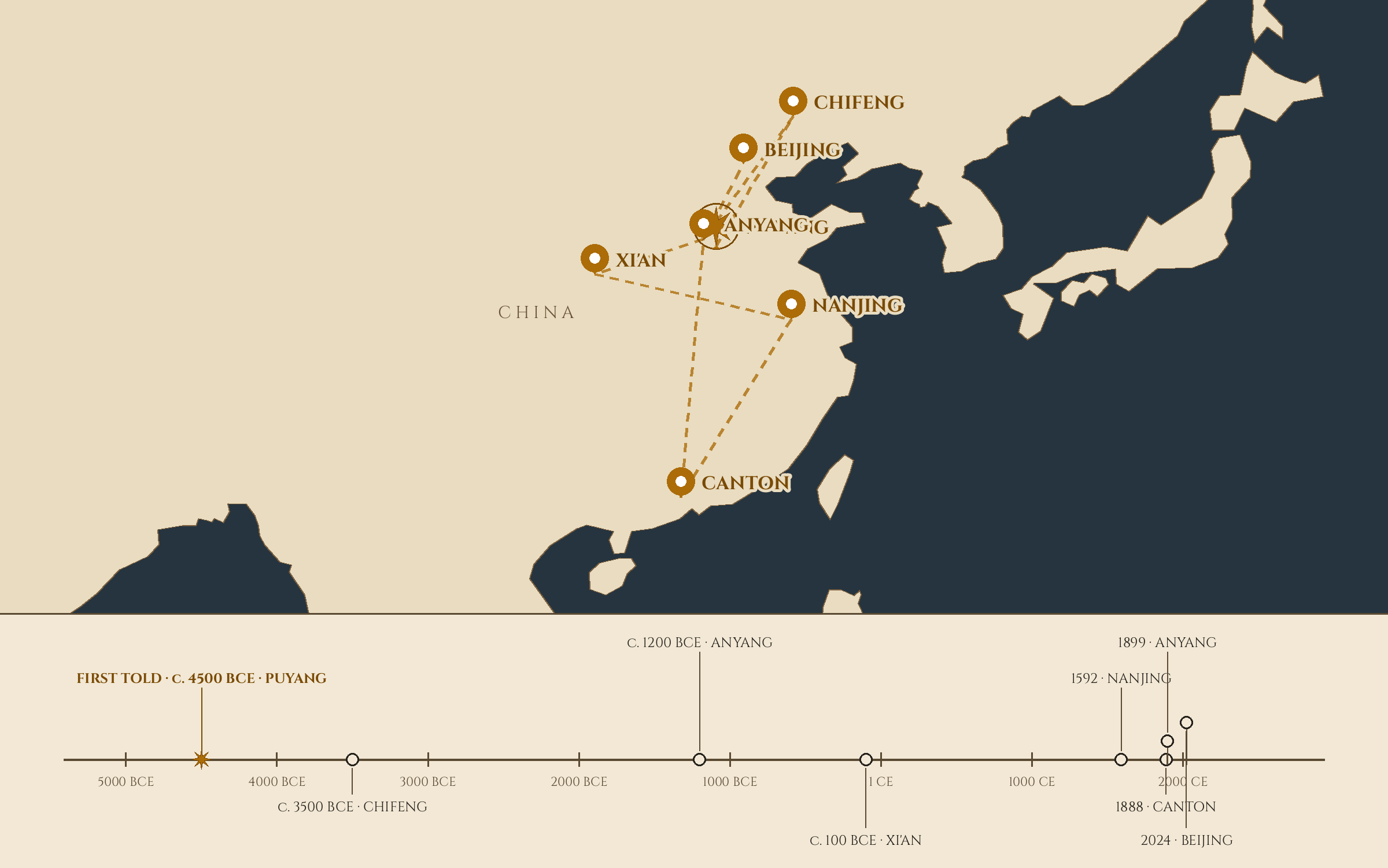
Where this lesson travels: Puyang, in Henan — Xishuipo — about 4500 BCE, where a dragon laid out in clam shells was set beside the dead in a Yangshao tomb, a power worth traveling with (the date is approximate, as the record itself marks it); the Chifeng region, where the Hongshan culture carved its jade pig-dragons about 3500 BCE; Anyang, about 1200 BCE, where the character for lóng stands in the Shang kings' oracle-bone inscriptions — the dragon become a written word; Xi'an, where under the Han the dragon settled as the emperor's own beast (the date approximate); Nanjing, 1592, where Journey to the West carried the Dragon Kings into print; and Beijing, 2024, a Year of the Dragon. The starred pin is the first record; the dashed line is the telling, traveling.
Lesson Objectives
By the end of this lesson, you will be able to:
- Say how the eastern dragon differs from the western: water, not fire; blessing, not enemy; a ruler, not a hoard-thief.
- Name the first record — the clam-shell dragon of Xishuipo — and keep its approximate date honestly marked.
- Follow the telling: the oracle-bone character, the nine resemblances, the emperor's beast, the Dragon Kings, and the dragon in print in 1592.
- Retell: Lord Ye and his dragons, the carp at the Dragon Gate, and Sun Wukong borrowing the sea's measuring iron.
- Give the real roots: dragon bones that were fossils, the alligator proposal, and the composite the record itself confesses.
- State the rain custom and the escalation it allowed, with Frazer's and Hutton's dated accounts.
Your Assignment Packet
This lesson's work lives in its packet: the Lexicon Handout (every term, the core terms marked with the keeper's diamond ◆), Materials, Guided Practice, the Assignment Manual written out whole, the Scholar's Entry Page, the Reflection Questions, the Workbook Checklist, and the Keeper's Notes, for whoever teaches the lesson. Download the packet before you begin and keep it beside you as you read. The packet's assignment is Rookmere's own word for the work: Entry No. 24 — Dragons of the East (both) ◐. The Unit IV Quiz is not printed in the packet; it waits at the end of the unit, with Lesson 28.
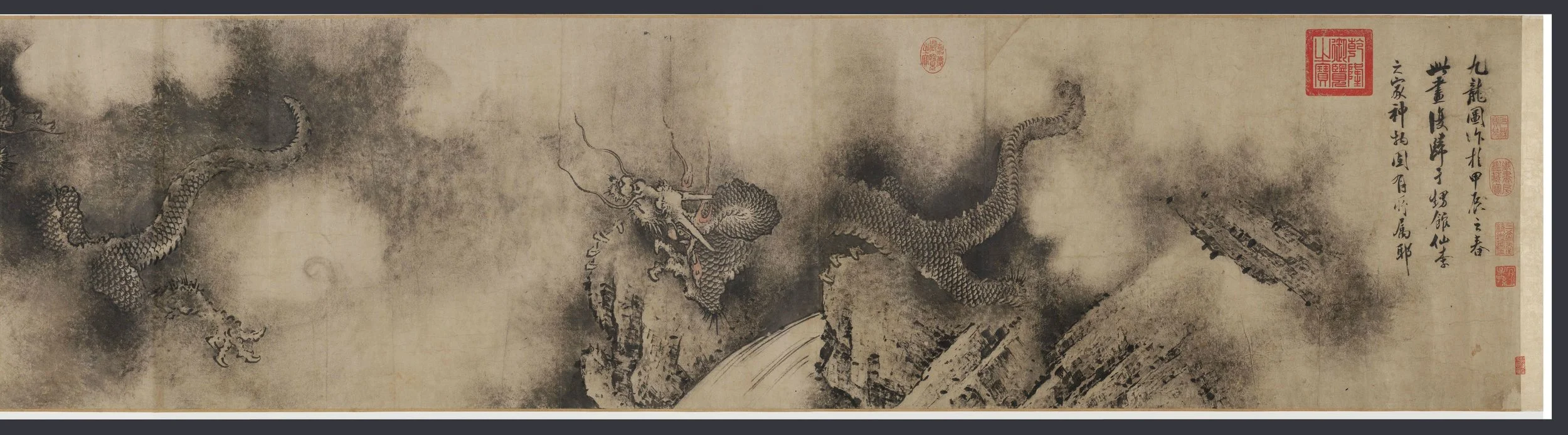
The opening of Chen Rong's Nine Dragons handscroll (1244; Museum of Fine Arts, Boston): the first dragon coiling over black rocks in mist, beside the artist's own inscription — a handscroll is read by unrolling, a length at a time, so the dragon is never seen all at once. Public domain, via Wikimedia Commons.
The Creature
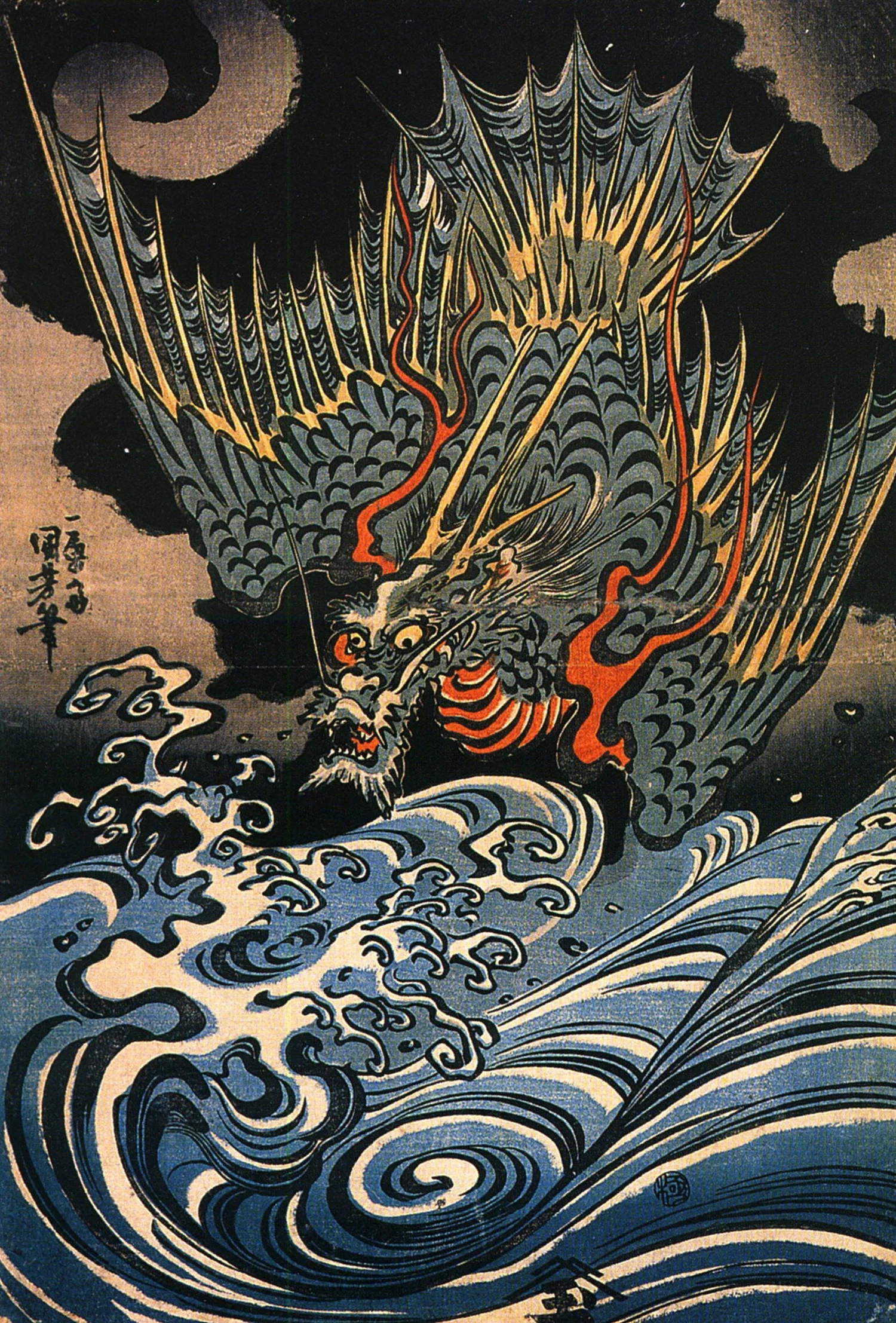
Utagawa Kuniyoshi's dragon rearing out of breaking waves, whiskers flying: the Japanese dragon as a storm made visible. Public domain, via Wikimedia Commons.
The Chinese word is lóng — the character 龍 — read ryū in Japanese and yong in Korean as the script traveled, one written dragon wearing several tongues. English translators reached for the nearest word they had, dragon, and the two beings have been filed together ever since. They should not be. The eastern dragon is a being of water: it lives in rivers, lakes, and the deep sea; it rises with the spring; the rain is its work and its gift. It is long-bodied and horned, whiskered like an old official, usually wingless — it flies because flying is what it does, not because it has the equipment — and in the whole of its long record it is almost never an enemy. Nobody's saint fights it. People sue it, feast it, and apply to it for weather.
Learn to read one in a picture, because this lesson's plates are full of them. The body runs long and low, like a snake carried on four short legs. The head is long-jawed, with horns swept back, a mane down the neck, and whiskers at the snout. The back carries a ridge of spines, and the tail ends in a tuft or a flourish. In imperial pictures you can count the claws, because the count was regulated: five for the emperor's dragon, fewer for everybody else's. No single painting has all of it at once, and the list in the next section will tell you why. The parts were never a portrait. They were an assembly, and every artist assembled them a little differently.
This lesson's plates span the dragon's whole picture-line. The oldest object is the new plate: a Hongshan jade pig-dragon (about 3500 BCE) — a C-shaped curl of green jade with a pig-like snout and a drilled eye: no legs, no wings, no fire. Then Chen Rong's Nine Dragons handscroll (1244), ink dragons coiling through mist and water over black rocks. Then the print shops of Edo Japan: Hokusai's dragon coiled into a circle against a red ground, ringed by waves, and Kuniyoshi's dragon rearing out of breaking waves, whiskers flying. Read in that order, the line never passes through an enemy: from jade to ink to woodblock, the dragon is weather and rule, pictured by people who petitioned it.
First Told
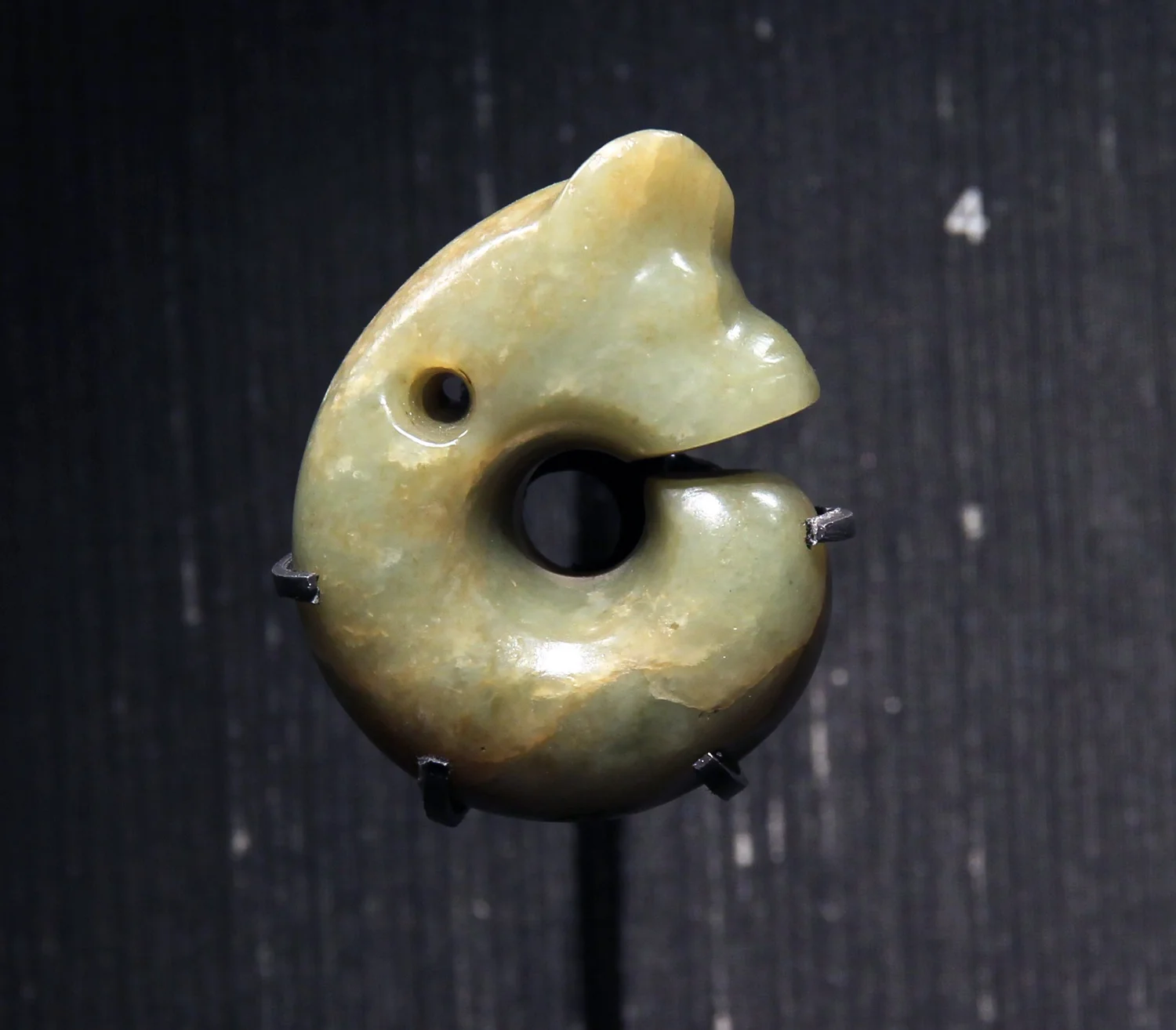
A Hongshan culture jade pig-dragon (zhulong), about 3500 BCE, in the British Museum: the C-shaped coiled body, pig-like snout, and drilled eye, photographed on its museum mount — no legs, no wings, no fire: the dragon as weather and rule from the start. CC0 1.0, via Wikimedia Commons.
The map's starred pin is Puyang, in Henan — Xishuipo — and the date is about 4500 BCE, marked approximate in the record itself. In 1987, excavators opened a tomb of the Yangshao culture there and found the buried man flanked by pictures laid out in clam shells on the tomb floor: a tiger on one side of him, and on the other a dragon — long, legged, horned, already itself, some six and a half thousand years ago. It is the earliest dragon image the record can date, and notice the company it keeps: it is laid beside the dead like a power worth traveling with, not a monster worth a sword. The eastern dragon begins in the file the way it continues — a presence, not a villain.
From Puyang the dashed line runs north to the Chifeng region, where the Hongshan culture carved its jade pig-dragons about 3500 BCE — C-shaped curls of green jade with a pig-like snout, among the most prized objects their world made (the name is modern; their makers left no labels). Then Anyang, about 1200 BCE, where the dragon does the most Chinese thing in its whole record: it becomes a written word. The character for lóng stands in the oracle-bone inscriptions of the Shang kings — a horned, long-bodied sign among the earliest Chinese writing that survives. Then Xi'an, where under the Han dynasty the dragon settles as the emperor's own beast (the map marks the date approximate); then Nanjing in 1592, where it reaches print in the most-read novel in the language; and last Beijing in 2024 — a Year of the Dragon, the blessing-dragon dancing on New Year streets worldwide.
The eastern dragon's anatomy is on record, and it is a confession. A list later writers credit to Wang Fu, of the Han dynasty, gives the dragon's nine resemblances: it is assembled from other animals — the horns of a deer, the head of a camel, the eyes of a demon, the neck of a snake, the belly of a clam, the scales of a carp, the claws of an eagle, the soles of a tiger, the ears of an ox. (A keeper may notice the clam, and remember Xishuipo's shells; the record invites the notice but does not insist on it.) No observer reports such an animal. A tradition builds one, deliberately, out of the strong parts of everything it knows — exactly as Babylon had built the mušḫuššu (Lesson 23), an ocean away and doing the same work.
Under the Han the dragon was drawn into the state: the founding emperor's legend made much of his dragon-like aspect, and the dragon settled on banners, seals, and roofs as the emperor's own beast. In later dynasties the state regulated the image itself; by Ming times the five-clawed dragon was reserved to the emperor, his officials making do with fewer claws. Meanwhile the dragon was acquiring an administration. Buddhism, traveling from India, brought the nāga kings with it — serpent rulers of the waters, keepers of treasure and rain — and scholars trace how the Chinese dragon absorbed them into something new: the Dragon Kings (lóngwang), four brothers ruling the four seas from crystal palaces, with courts, ledgers, households, and jurisdiction over every river and well in between. The Chinese dragon ends up, uniquely in this class, a civil servant: a god with paperwork, responsible for the rainfall of a district, and answerable — as this lesson's box will show — to complaints.
Through Japan the dragon became Ryūjin, king under the sea, whose palace a fisherman visits in the old tale of Urashima Tarō; through Korea it keeps the yeouiju, the wish-fulfilling jewel it holds in its claws or under its chin, and the Koreans tell of the imugi, the great serpent that may become a true dragon only after a thousand years of discipline. In Vietnam the dragon is an ancestor: Lạc Long Quân, the Dragon Lord, stands at the head of the people's own account of where they come from. One character, four countries, and everywhere the same office: water, weather, and legitimate rule.
The Tales
Three tales, a keeper should hold.
The first is a warning in nine words of title: Lord Ye loved dragons. The story is told in a Han-dynasty collection. Lord Ye had dragons carved on his beams, painted on his walls, embroidered on his clothes, worked into every object he owned. A true dragon, hearing of such devotion, was flattered, and came down to visit — thrust its head in at Lord Ye's window and its tail into his hall. Lord Ye fled in terror and very nearly lost his mind. He did not love dragons, says the record. He loved dragon-shapes, and mistook the two. Every keeper in this class should have the story by heart. It is about us.
The second is the carp. At Longmen, the Dragon Gate, where the Yellow River forces through a gorge of falls, an old story says the carp that fight the current and leap the falls are transformed into dragons. The story became the language's standing proverb: the student who passes the great examinations has leaped the Dragon Gate. In a country where the examinations were the one road up, the dragon is what effort itself turns into — the beast you may become. The western dragon guarded a hoard and died on it. This one is what a fish earns.
The fish itself deserves a sentence, because it earned its place in the tale honestly. A common carp is a strong river fish, deep- bodied, with large scales and small whiskers — barbels — at the corners of its mouth. A big one can grow to about a metre in good water. Carp push upriver against hard currents and can leap clear of the water at a fall, and a fisherman at Longmen would have seen them trying, season after season, at exactly the place the story sets the gate. The tale did not invent the effort. It watched the fish make it, and paid the ones that succeeded in the only coin that mattered there.
The third tale is a burglary, from the Nanjing pin. In Journey to the West (published 1592) the monkey Sun Wukong, needing a weapon worthy of him, goes down under the Eastern Sea to the palace of Ao Guang, Dragon King of that sea, and is shown the palace's treasure: an enormous iron pillar, the rod by which the sea's depth had once been measured and fixed. Wukong takes it — it shrinks at his word to the staff he carries through the whole novel — and the Dragon Kings, robbed in their own treasury, do what officials do: they file a formal complaint with Heaven. From the same shelf of Ming fiction, the child hero Nezha, in the Investiture of the Gods, kills Ao Bing, a Dragon King's son, and the kings go to law for justice. Dragons as plaintiffs, treasurers, and kings — the eastern dragon's tales are about government, and every keeper should notice the difference in kind from Lesson 23, where the tales are about combat.
KEEPER'S CHECK-IN
Lord Ye loved dragons until a real one came to his window — what does the record say he actually loved?
Spotted
Of the eastern dragon there are no sighting-reports of the kind the Western file holds — no chronicle entry claiming the beast was seen, on a named day, by named men. The record reports this dragon differently: by its work. A drought was a report about the Dragon King, filed by a whole district; a flood was another — and the box that follows this section holds the most documented of them, Canton's in April 1888. The dragon was also reported by its remains: the "dragon bones" dug across north China and sold in medicine shops, whose recognition in 1899 is told in §5. File the section as it stands, then: this being was spotted in its effects and its leavings, never in a traveller's tale — which is itself a fact about the kind of being it was. An office is not sighted. It is petitioned, and its work is watched.
KEEPER'S CHECK-IN
The eastern dragon was never spotted in a traveller's tale — in what two kinds of evidence was it reported instead?
What People Watched For — When the Rain Failed
No being in this class has been watched for as literally as this one. China's farms run on the rains; the Dragon King held the rains; so when the rains failed, everyone — farmers, priests, and the county magistrate himself — attended to the dragon. The custom had stages, and the keepers have them from named men writing at dated times.
J. G. Frazer gathers the record in The Golden Bough: "when rain is wanted they make a huge dragon of paper or wood to represent the rain-god, and carry it about in procession" — the dragon carried through the streets in the drought, petitioned in public. If the rain came, the god was thanked and, in the old imperial system, could be promoted in rank by decree. If it did not come, the petition escalated. Frazer records that in a drought the Dragon King had been "chained and exposed to the sun for days in the courtyard of his temple, in order that he might feel for himself the urgent need of rain"; and in April 1888, when the mandarins of Canton prayed to Lung-wong — the Dragon King — to stop a flood of rain and he "turned a deaf ear," they locked him up for five days. The god who would not govern the water was imprisoned by the men who could not.
What it looked like at street level, James Hutton saw and set down in Chinese Life in the Tibetan Foothills (1914). In drought, he writes, an altar is raised at the Dragon King temple; each home sets up a tablet beseeching the dragon's help; "the water dragon is brought out" — a frame of plaited bamboo covered in sackcloth, paraded through the streets by young men, while every house keeps a bucket and a ladle ready, and drenches the dragon as it passes. Officials went barefoot to pray for rain, suffering in public for their districts.
Mark it carefully. The belief — that a Dragon King apportions the rain — is T, and it was held by an empire. The practice is F: processions, buckets, chains, a lock-up, an April in 1888, and two books with dates on their title pages. The custom the belief produced is one of the best-documented in this whole class, and it flows directly from the being's office: you do not chain a god you merely admire. You chain a god whose work is late.
What It Actually Is
✦ On the class test
Begin with the medicine shops. For centuries, Chinese apothecaries sold dragon bones — lónggǔ — ground to powder against fevers and wounds. The bones were real bone: fossils, the mineralized remains of extinct animals, dug from the ground across north China. In 1899, as the story is usually told, the scholar Wang Yirong, sick and buying medicine in Beijing, noticed that the "dragon bones" in his prescription bore marks that looked like writing. They were writing — the oracle bones of Anyang, the Shang kings' own archive, the earliest Chinese script that survives: the third pin on this lesson's map arrived in scholarship through a pharmacy. The dragon's bones were nobody's bones. They were better: they were records.
Other roots have been proposed, and a keeper files them as proposals. The Chinese alligator of the Yangtze — a real water beast, heard drumming in the rain season — has been suggested as one living seed of the dragon image; it is the right size of wonder for a river civilization, and no more than a suggestion. The animal itself is smaller than its American cousin: about a metre and a half to two metres long, heavily armoured, broad-snouted, living in the slow waters and marshes of the lower Yangtze. The males bellow in the breeding season, and the sound carries over water. It is a shy, now very rare animal, and nothing about it breathes fire or grants rain. If it fed the dragon at all, it fed it a shape low in the water and a voice out of the marsh — which is why the entry files the idea as a suggestion and stops there. The nine resemblances themselves are the record's own confession that this dragon, like Babylon's, was assembled rather than observed: deer, camel, snake, clam, carp, eagle, tiger, ox — a parliament of animals in a single office. And behind the office stands the sky of a monsoon land, where the year's rice hangs on whether the summer rains come on time. A being who apportions the rain, and can be petitioned, promoted, or chained for it, is exactly the size of the stakes. That is reasoning, and the entry marks it as a keeper's reasoning, not as a found fact — but the reasoning explains why this dragon, alone on the shelf, has a desk and a jurisdiction instead of a hoard.
Still With Us
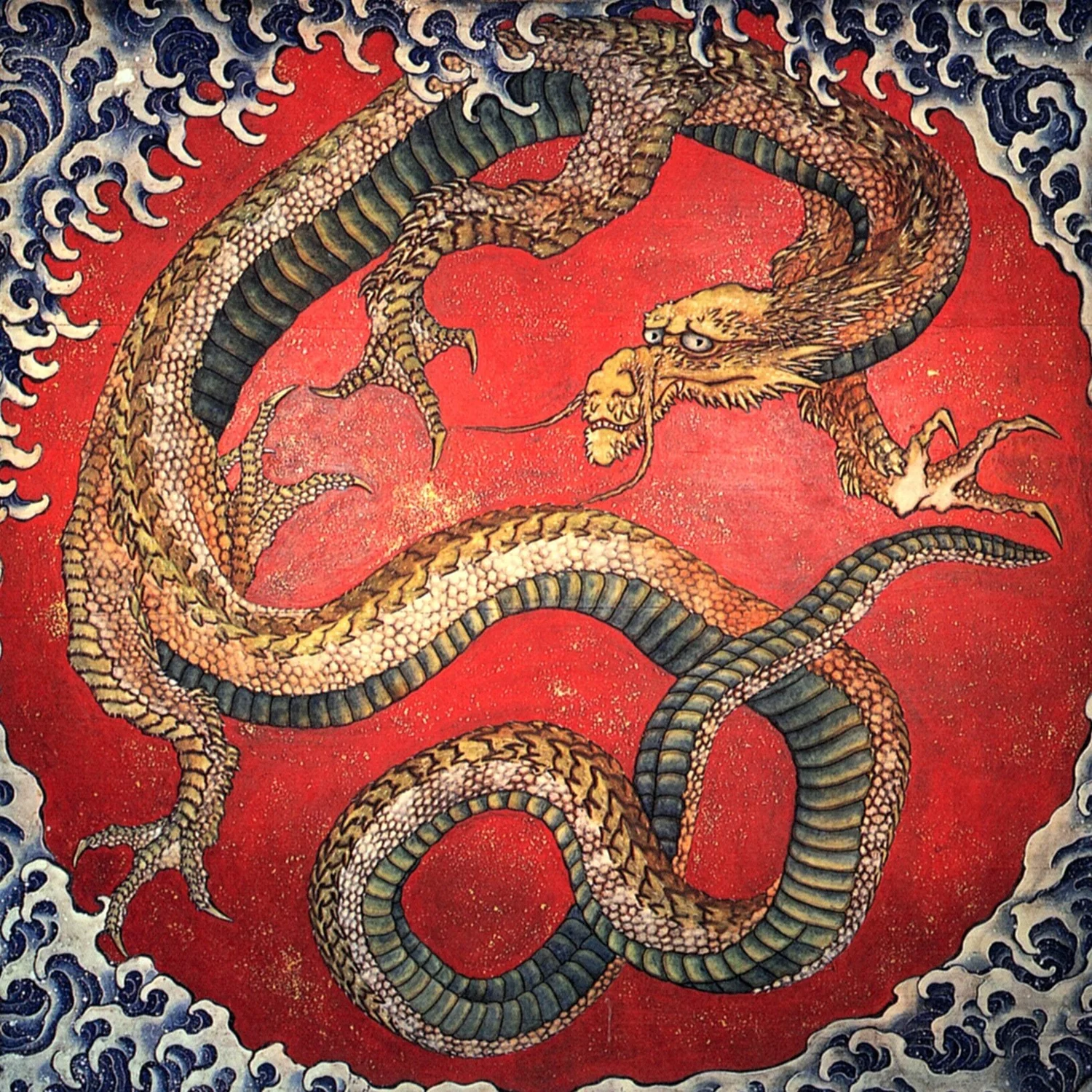
Hokusai's dragon coiled into a circle against a red ground, ringed by waves — a complete weather system in one round frame. Public domain, via Wikimedia Commons.
The eastern dragon never left office. It stands in the Chinese zodiac as the fifth of the twelve year-animals — the only one of the twelve that no farmer has ever herded — and its years are the prized ones: 2024, the map's last pin, was a Year of the Dragon, danced in on New Year streets from Beijing to every Chinatown on earth. The drought processions of this lesson's box have descendants: the dragon dance, carried by teams through festival streets, drenched now in applause instead of bucket-water, and the dragon boats racing in summer — both of them the old rain-dragon out in public, doing its rounds. The dragon still signs the state as well: from the emperor's robe it passed to the emblem-language of China itself, the one being in this class that a modern nation uses as a portrait of itself.
And the two dragon files now sit open on the same desk in every bookshop in the world, both labeled dragon in English. One is an enemy with a hoard; the other is a magistrate with the rain. This class keeps them in separate lessons for a reason, and you are it: the next time a single word hands you two beings, split the file.
Guided Observation
Open the hero plate first: Chen Rong's Nine Dragons handscroll (1244, now in Boston). The first dragon coils over black rocks in mist, the artist's own inscription beside it. Chen Rong had read the nine resemblances; everyone had. What has he taken from the list, and what has he taken from horses, from rivers, from the behavior of ink itself? A handscroll is read by unrolling, a length at a time: the dragon is never seen all at once, which is also how weather arrives.
Then Hokusai's dragon, coiled into a circle against a red ground, ringed by waves — our manifest calls it a complete weather system in one round frame, and the description earns itself. And Kuniyoshi's dragon rearing out of breaking waves, whiskers flying: a storm with a face. Set all three beside Lesson 23's plates. The western dragon in its pictures strangles, threatens, submits, dies. The eastern dragon in its pictures moves through water and air like the thing it governs. Say, in your entry, what told you so.
Last, the smallest plate and the oldest object: the Hongshan jade pig-dragon of the new plate (about 3500 BCE). Set it beside Chen Rong's dragon. The jade gives you a curl, a snout, and an eye; the scroll gives you a storm with a face. Between those two pictures lie four thousand years of the same office. What did the later picture add — and is there anything the jade has that the scroll has lost?
Assignment Manual
✎ WRITTEN · ⚒ HANDS-ON · ◐ BOTH
◐ Both · Entry No. 24: Dragons of the East.
- Rule your entry page. Turn to the Scholar's Entry Page in this packet and rule the next page of your journal to match it, as you did for your earlier entries.
- Write the dragon's entry, to the standard. First Told: Xishuipo — the tomb, the clam shells, the date with its approximation honestly marked. How the Telling Grew: the oracle-bone word; the nine resemblances; the emperor's beast; the nāga kings becoming Dragon Kings; print in 1592. The Tales: Lord Ye; the carp at Longmen; Wukong at Ao Guang's palace. What It Actually Is: the dragon bones and 1899; the alligator proposal, marked as a proposal; the composite. Still With Us: the zodiac, the dragon year, the dance. The Keeper's Line: your own judgment, in one or two lines.
- The two-dragon spread. ◐ Rule a double page of your journal. On the left, the Western dragon of Lesson 23; on the right, this lesson's dragon. Draw each one small, from the plates of its own lesson, or describe each in a ruled column if your hand prefers words. Beneath them, in five paired lines, set the two records side by side: element; temper; what humans do about it; its oldest record, with date; its modern face. Mark every paired line T or F. Then head the spread with the one sentence English gets wrong, corrected: two beings, one word.
- Mark every line. Go back through your entry and mark every line in the margin — T for a tale or telling, S for a sighting-report, F for a checkable fact — as always. This entry holds a trap of a new kind: "dragons bring rain" is T wherever it stands; "in April 1888 the officials of Canton locked the Dragon King up" is F. The same dragon, two marks, sometimes in the same sentence. Sort them.
Materials
· Your creature-guide journal, with your earlier entries in it
· Pencils, and a pen you like
· A ruler, for ruling your entry pages
· This lesson's packet (the Scholar's Entry Page is in it)
· For Step 3: your journal opened to a double page, and both dragons' lesson pages at hand
Reflection
One English word covers both dragons of Unit IV. What does the mistranslation cost a reader — and what, if anything, does it give?
Lord Ye loved dragons faithfully until one came to his window. Which other entry in your bestiary holds something people prefer at a distance — and what happened, in its file, when it came close?
A Dragon King could be promoted by decree, chained in the sun, or locked up for five days. What does that tell you about what the belief was for?
A Closing Note
Two dragon files, and the word is the only thing they share. Next lesson shrinks from an empire's weather-office to a single bird — and to the most honest first paragraph on this shelf, written by a man who had never seen his subject and said so. Herodotus is waiting, and he doubts beautifully. Keep your T, S, and F honest, and your dates approximate where the record makes them so.
The Bestiary
Bestiary Keeper
Further Reading & Sources
J. G. Frazer, The Golden Bough (abridged edition, 1922) — the rain-dragon processions, the chained god, and Canton in April 1888.
James Hutton, Chinese Life in the Tibetan Foothills (1914) — drought altars and the drenched bamboo dragon, from a resident's notebook.
Wu Cheng'en, Journey to the West (1592) — Sun Wukong at the Dragon King's palace; Anthony C. Yu's translation (University of Chicago Press) is the complete one.
Chen Rong, Nine Dragons (1244), Museum of Fine Arts, Boston — the hero plate, viewable in the museum's online collection.
Li Chaowei, "The Tale of Liu Yi" (Tang dynasty) — the scholar who carried a letter to the Dragon King of Dongting; in The Dragon King's Daughter: Ten Tang Dynasty Stories (trans. Yang Hsien-yi and Gladys Yang).
The Xishuipo tomb and the Hongshan jade dragons — the excavation record is summarized in the standard references on early Chinese art; dates are approximate and are given as ranges there too.
Submit your work for this lesson using the form below.
CONTINUE IN THE BESTIARY HALL
← Previous · Lesson 23: Dragons of the West Next · Lesson 25: The Phoenix →
Unit IV — Wings and Skies The Bestiary Hall — All 41 Lessons
The rest of Unit IV: Lesson 23 · Dragons of the West · Lesson 25 · The Phoenix · Lesson 26 · The Roc · Lesson 27 · The Thunderbird · Lesson 28 · Winged Peoples