

THE BESTIARY
Unit IV · Lesson 26The Roc
Professor Sable Rookmere
Bestiary Keeper
The Bestiary Hall • School of Evershade
Professor's Introduction
Here is the largest bird on the shelf, and the one that arrives with the least that anyone can touch: a captain's book of sailors' wonders, an envoy's feather at a foreign court, an egg in a museum case. No bones of the roc itself. No nest, no skin, no certain feather. And yet the file is nine centuries long and crosses three oceans.
So this lesson is a training in scale. Again and again the record will hand you a number — sixteen paces, eight paces, an egg like a dome — and a keeper's work is to ask the keeper's question of every one of them: whose number is this, and how far has it traveled to reach the page? Size is where records exaggerate first and confess last. Learn to weigh a measure here, and you can weigh one anywhere.
The Bestiary
Bestiary Keeper
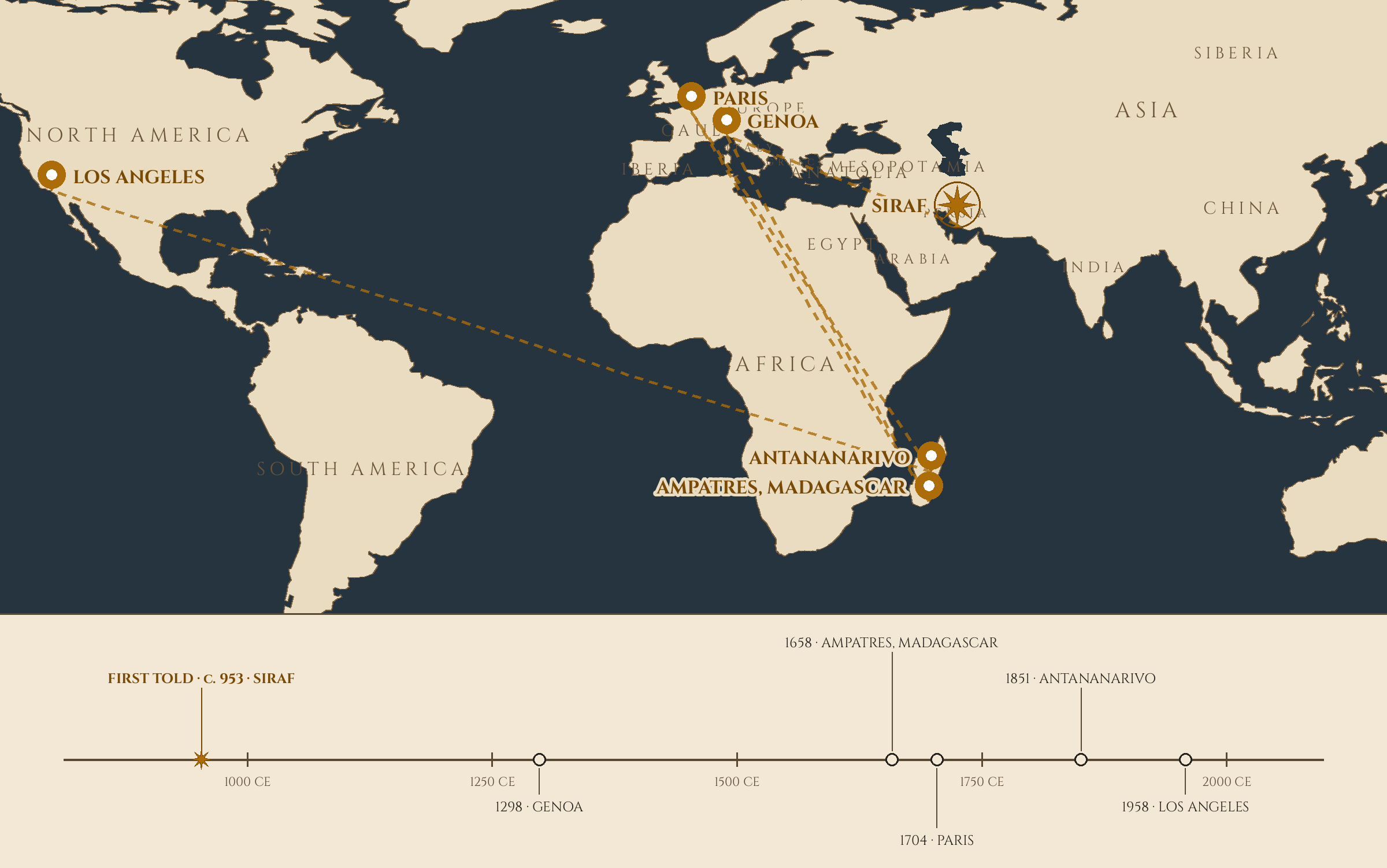
Where this lesson travels — and where it honestly begins. The starred pin stands at Siraf, the Persian Gulf port, about 953, where Buzurg ibn Shahriyar gathered the sailors' reports for his Book of the Wonders of India — and the place is kept approximate, in words, because Siraf is where the reports landed, not where the bird lived: a port is where tellings arrive by ship. From Siraf the line runs to Genoa, 1298, where Marco Polo's dictated book carried the rukh into European print; to Paris, 1704, where Galland's Thousand and One Nights gave Europe Sindbad's voyages; to Antananarivo, Madagascar, 1851, where the bones and eggs of the real giant reached science and Isidore Geoffroy Saint-Hilaire named it Aepyornis maximus; and to Los Angeles, 1958, where the roc flew through a cinema. The starred pin is the first record; the dashed line is the telling, traveling.
Lesson Objectives
By the end of this lesson, you will be able to:
- Give the roc's name in its first language, and name its first record: the author, the book, the date, and the hedge that travels with its place.
- Tell Marco Polo's account, including the question he asked about the bird — and the correction the record makes to itself.
- Tell the roc's two great tales from Sindbad's voyages, and name the fixed detail every later picture keeps.
- Explain why this lesson's What People Watched For box stands empty, and what the nearest miss was.
- State the real root's facts — the bird, the island, the egg, the dates — and say plainly which parts of the roc the root cannot explain.
- Mark every line of the entry T, S, or F, with special care for measures: every measure in this file is somebody's claim.
Your Assignment Packet
This lesson's work lives in its packet: the Lexicon Handout (every term, the core terms marked with the keeper's diamond ◆), Materials, Guided Practice, the Assignment Manual written out whole, the Scholar's Entry Page, the Reflection Questions, the Workbook Checklist, and the Keeper's Notes, for whoever teaches the lesson. Download the packet before you begin and keep it beside you as you read. The packet's assignment is Rookmere's own word for the work: Entry No. 26 — The Roc (both) ◐. The Unit IV Quiz is not printed in the packet; it waits at the end of the unit, with Lesson 28.
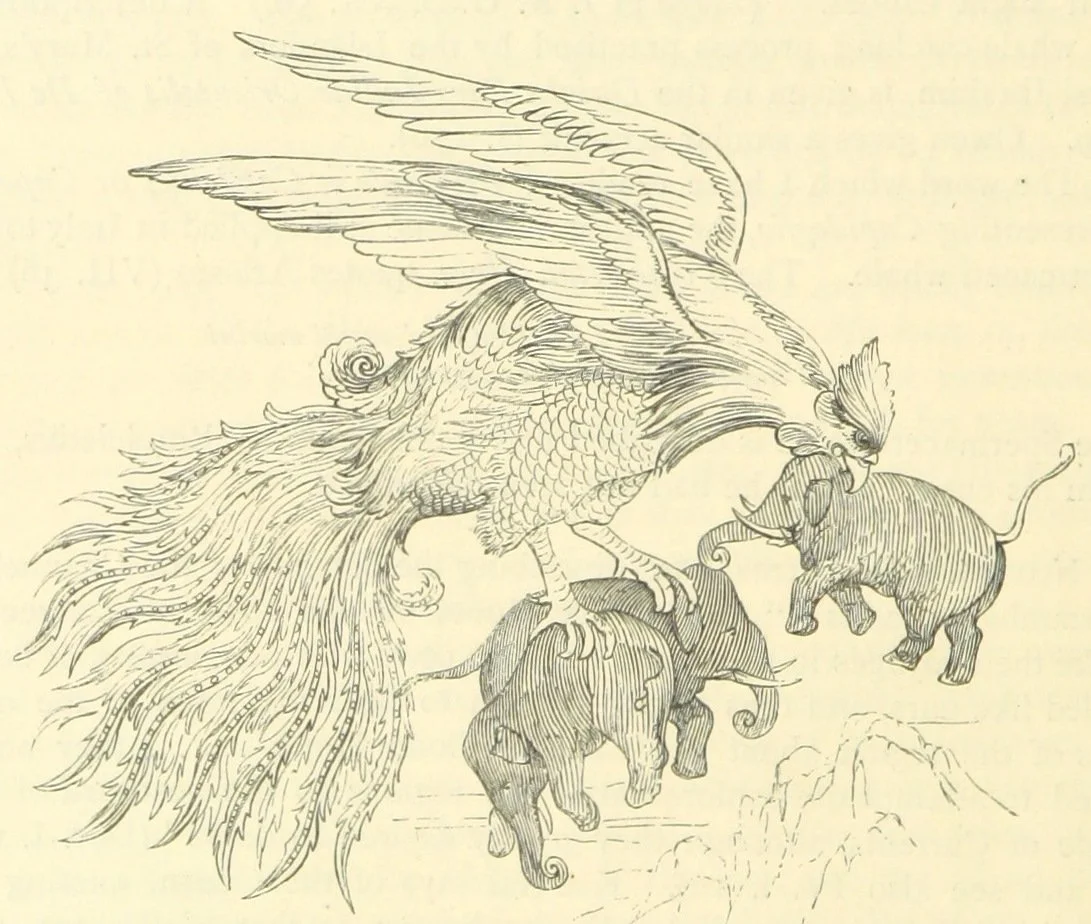
The roc carrying off elephants — one in its talons, one in its beak — the detail from Marco Polo's account that every later picture repeats: a nineteenth-century book engraving. The elephants are the scale bar; without them the bird is merely large. British Library; no restrictions, via Wikimedia Commons.
The Creature
The being's own name is Arabic: rukh. It reached English as roc through the travel books that carried it west, and it is worth pausing on the word before the bird, because this file holds a trap of exactly the kind Lesson 1 warned about. The rook of chess is no relation: that word comes from the Persian rukh meaning a chariot, and the two words — the bird and the chariot — met in European mouths and have been confused ever since. A keeper files the name as carefully as the nature. Half the errors in this hall began as somebody's mishearing.
What the record says the roc is: a bird in form like an eagle, but incomparably greater. The fullest early account is Marco Polo's (§2): the islanders of Madagascar told him the bird came at a certain season from the southern regions, strong enough to seize an elephant in its talons, lift it, and let it fall to feed on the carcass; its wings, spread, measured sixteen paces, and its feathers eight paces. Those measures are Polo's, reporting the islanders — every measure in this file has an owner, and the assignment will ask for the owners' names.
The lesson's plates show what pictures did with that description. The opening engraving gives the roc an elephant in its talons and another in its beak: Polo's fixed detail, the one every later picture repeats, because a number cannot be drawn and an elephant can. Edmund Dulac's plate of 1907 draws the other great scene — Sindbad bound to the bird's leg as it rises — and gives no elephant and no number at all: distance itself does the measuring. And the photograph of an elephant bird's egg in its museum case, a hand beside it for scale, shows the real thing the tale's size grew from. §5 takes up that bird; the Guided Observation reads all three pictures closely.
First Told
The first record is a book of the sea. Around the year 953, a Gulf sea captain named Buzurg ibn Shahriyar set down the Book of the Wonders of India — the Kitab 'Aja'ib al-Hind — a collection of reports gathered from the sailors of Siraf, the great Persian Gulf port of the Indian Ocean trade. Buzurg's method is the reason this class loves him: he names his informants. Captain after captain steps forward in his pages and tells what he saw, or what was told to him, on the routes to India, East Africa, and the islands beyond. Among their reports stands the rukh: a bird of the far islands so great that its egg was like a dome, and its quills — the sailors said — could be cut and used as vessels to hold water.
Read the map at the head of this lesson with Buzurg's method in mind, because this map is honest about what a port is. The starred pin stands at Siraf, about 953 — and the map itself marks the place approximate, and the entry must keep that hedge in words: Siraf is where the reports landed, not where the bird lived. A port is a place where tellings arrive by ship. The bird belongs to the islands at the line's far end; the record begins on the dock.
From Siraf the line runs to Genoa in 1298, where a Venetian's book carried the bird into European print; to Paris in 1704, where Sindbad's voyages reached Europe in French; then — and this map is one of the few in the class that does it — the line lands on the root: Antananarivo, Madagascar, 1851, where the bones and eggs of a real giant reached science. The last pin is Los Angeles, 1958, where the bird flew through a cinema. A port, two capitals of print, an island of bones, and a film studio. That is the roc's whole country, and every pin of it is a place where the record changed hands.
In 1298, in a Genoese prison, the Venetian merchant Marco Polo dictated the book of his travels, and in it the rukh receives its fullest early account. The people of Madagascar, Polo reports, say that at a certain season of the year the bird comes to the island from the southern regions: in form like an eagle, but incomparably greater — so strong that it seizes an elephant in its talons, lifts it into the air, and lets it fall to earth to feed on the carcass. The wings, spread, measure sixteen paces. The feathers are eight paces long.
Then Polo does the thing that makes this lesson's file a keeper's treasure: he checks. Conceiving that these creatures might be griffins — the half-lion, half-eagle beings of Lesson 8 — he questioned the islanders closely on the point, and they maintained that the shape was altogether that of a bird. The correction stands in the same book as the marvel, made by the marvel's own reporter. Polo also reports the record becoming an object: the Great Khan, hearing the tale, sent messengers to the island, and a feather of the rukh was brought back to his court — a quill so long that the court marveled at it as the islanders' proof. File that feather carefully. You will meet it again in the root.
The telling's western growth came through print. In 1704, in Paris, Antoine Galland began publishing the Thousand and One Nights in French, and Sindbad the Sailor's voyages — with the roc full-grown in them — entered Europe's libraries and nurseries, which is how the bird of the Gulf sailors became a fixture of the European imagination without a single European seeing anything at all.
One elder kin must be named here, under the census's rule, before the tales: the simurgh of Persia, the roc's senior by the same eastern roads. In Ferdowsi's Shahnameh, completed in 1010, the simurgh is a great wise bird who raises the hero Zal and comes to the aid of his line. In Attar's Conference of the Birds, around 1177, the Simurgh is the goal of the birds' pilgrimage — and the poem's Persian pun turns the key: si morgh, thirty birds, arrive and find that they themselves are the Simurgh. The simurgh is named in this lesson, and given her paragraph, as kin — the same imagination of the immense and beneficent bird — but she is not the roc, and the file does not merge them. The roc is a sailors' bird of report. The simurgh is a poets' bird of meaning. This class keeps the difference.
The Tales
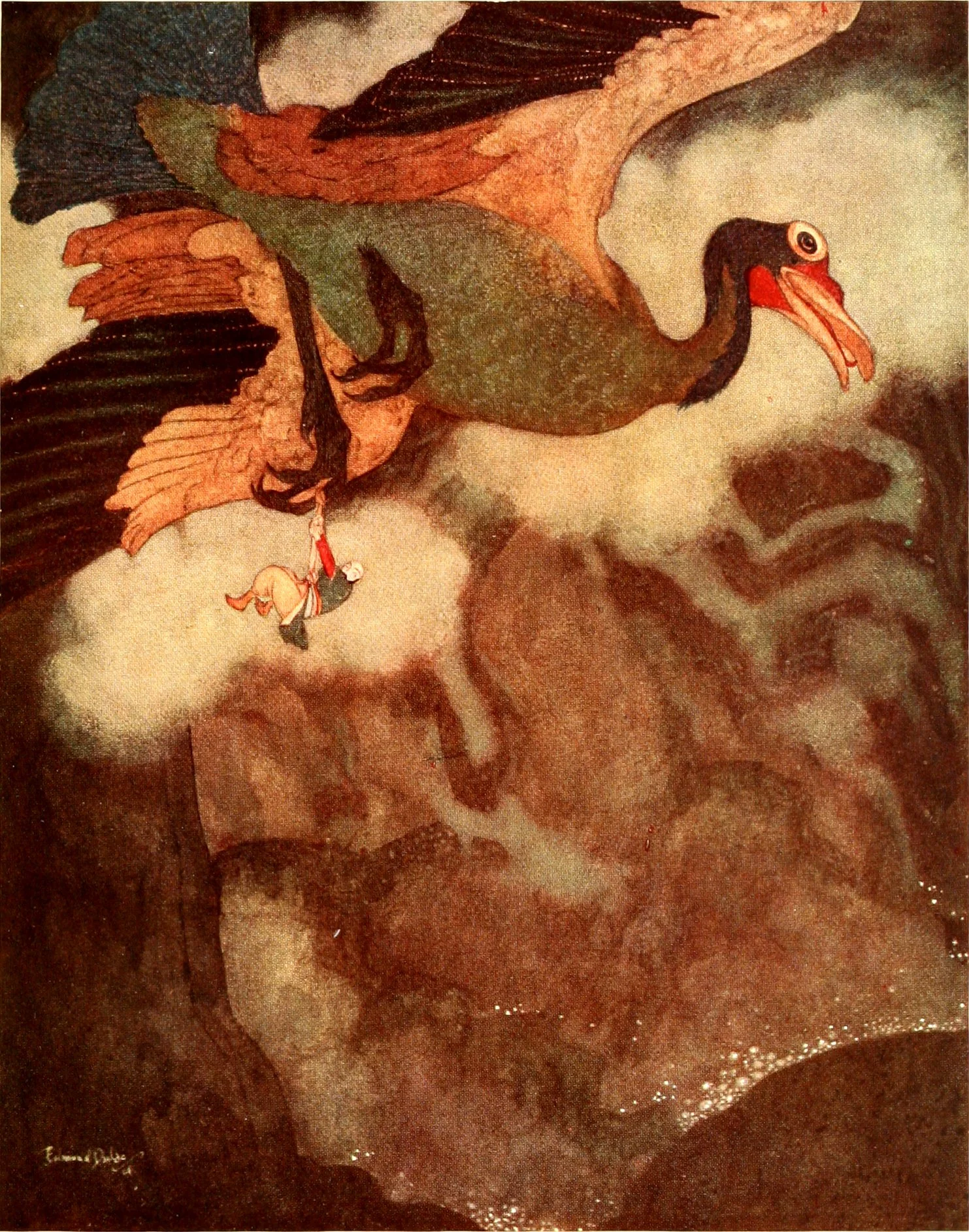
Edmund Dulac's roc (1907, for Stories from the Arabian Nights): Sindbad bound to the bird's leg as it carries him up from the island of the second voyage — no elephant and no number at all; distance itself does the measuring. Public domain, via Wikimedia Commons.
The roc's fixed tale is Sindbad's, and it comes in two voyages.
In the second voyage, Sindbad, marooned on an island, finds a great white dome with no door, smooth and enormous — and a shadow falls across the sun as the dome's owner returns: the dome is the roc's egg, and the bird settles over it to brood. Sindbad binds himself, with the cloth of his turban, to the bird's leg, and at dawn is carried — half terrified, half calculating — to a valley whose floor is strewn with diamonds and whose depths writhe with serpents great enough to swallow elephants. There the merchants of the valley harvest their stones by throwing down joints of meat, which the valley's eagles carry up to their nests with diamonds sticking to them. Notice the division of labor the tale keeps: the roc carries the man; the eagles carry the meat. Even a wonder-tale files its birds separately.
In the fifth voyage, the tale turns on the sailors' folly. Coming to an island where a roc's egg lies, Sindbad's companions — against his warning — break the egg and roast the half-grown chick. The parent rocs return, find the ruin, and take their revenge with the weapons their size provides: each bird lifts a rock the tale likens to a mountain crag and drops it on the ship, and then another, until the ship is broken and sunk. It is the only tale in this file where the being wins outright, and the moral is the sailors' own, older than any printed page: do not break what you cannot answer for.
And over both voyages stands Polo's elephant: the bird seizing the greatest beast of the land, lifting it, letting it fall, and feeding at leisure. That single image — one elephant in the talons, one in the beak, in this lesson's opening engraving — became the roc's fixed detail, the one every later picture repeats, because Polo's prose measure (sixteen paces, eight paces) needed a picture and the elephant supplied the scale. When a record's number cannot be drawn, an animal is drawn instead. Keepers will meet that exchange again in this class.
KEEPER'S CHECK-IN
Polo's own account gives the roc's size in paces — so why does every later picture keep his elephant instead?
Spotted
A generation later, in the 1340s, the Moroccan traveler Ibn Battuta filed the file's most vivid report — a sighting, told by the man himself. Crossing an unfamiliar sea toward China, his ship saw a mountain where no mountain should be; at sunrise the mountain rose into the air, with light between it and the sea. The sailors wept and bid each other farewell: what we took for a mountain is the rukh; if it sees us, we shall perish. A fair wind turned the ship away. Ibn Battuta prints the terror and — mark this — no measurement of the bird at all. The closest witness in the file is the one who gives no numbers.
There is an older paper trail to the root, and it carries a hedge the entry must not drop. In 1658 the French governor Étienne de Flacourt, in his History of the Great Island of Madagascar, described the vouron patra — a great bird of the Ampatres country that "lays eggs like the ostriches" and seeks the most lonely places. Flacourt's bird is often read as the elephant bird still living; it has also been argued that he repeated folk tales already generations old. The radiocarbon evidence from eggshells puts the bird's end at about a thousand years ago — some two centuries before Polo wrote. So the honest filing is this: by Polo's time the elephant bird was most likely gone, and what reached the Gulf sailors and the Khan's court was its remains and its memory — eggs, bones, and stories — which is exactly the cargo a tale needs.
KEEPER'S CHECK-IN
Ibn Battuta is the closest witness in the roc's file — what does he pointedly give no word of, where Polo gave plenty?
What People Watched For — a Box Left Empty, on Purpose
Every lesson in this class carries this box when a documented saying or custom can be produced from a named source with a date: something real people did, because of the being, that a keeper can point to. For the roc, the keepers made the search, and this lesson leaves the box empty — and tells you what the nearest miss was, because the nearest miss here is instructive.
The nearest miss is Ibn Battuta's crew. When the mountain rose into the air, the sailors of his ship resorted — his own account says — to devotion and repentance, and the merchants aboard swore plentiful alms if they were spared. That is a real reaction, recorded by a named man in a dated book, and it is still not a custom. It happened once, on one ship, in one telling: it is a moment in a tale, not a practice anybody kept at a table, a churchyard, or a harbor wall. The customs in this class belong to beings who shared people's houses, tables, and working years. The roc shared only their talk and their horizon — a being of the dock and the deck, never of the household.
Record the emptiness as the selkie's lesson taught you to record it: the empty box is evidence about the record, not a gap in the scholar's work. If a dated source for a roc custom ever reaches this hall — a sailors' rite, a port's practice, with a name and a year on it — the box will be filled, and the filling-in dated too.
What It Actually Is
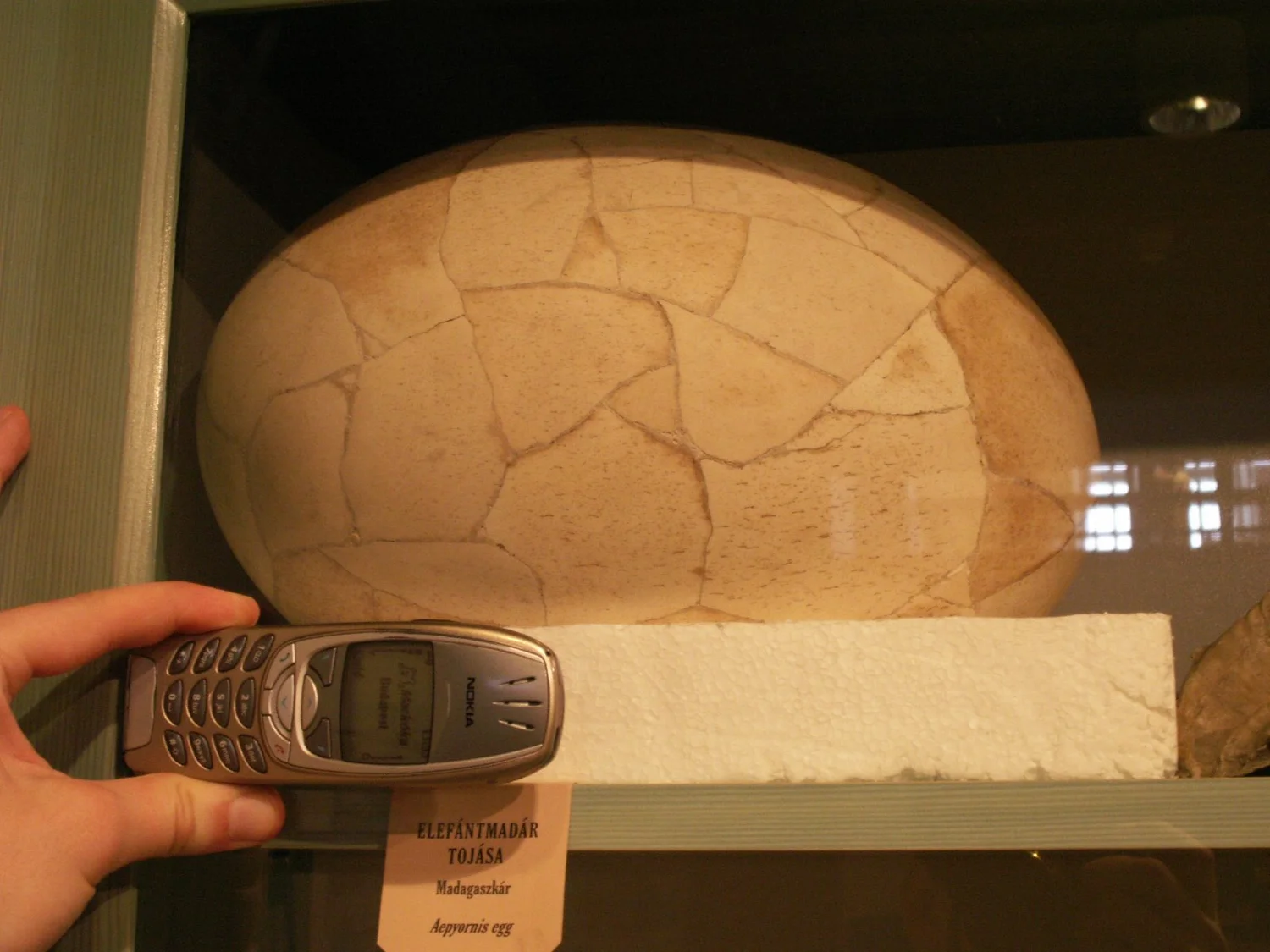
The real root, to scale: an elephant bird's egg in its museum case, a hand laid beside it — thirty-four centimetres of egg, the largest known for any animal, from the roc's own island of Madagascar. The photograph shows the number the engraving only claims. Public domain, via Wikimedia Commons.
The root, when it came, came from the very island Polo named — and it came as the map's fourth pin shows: as bones and eggs, in science's hands, in 1851. In that year, in Paris, the zoologist Isidore Geoffroy Saint-Hilaire presented to the Academy of Sciences the bones and eggs lately arrived from Madagascar and gave the great bird its scientific name: Aepyornis maximus — the elephant bird.
The facts, and they need no enlarging. The elephant birds were flightless giants of Madagascar, kin to the ostrich's family. The largest stood over three metres tall and weighed, by the usual estimates, some four hundred kilograms — among the heaviest birds that ever lived. Their eggs are the largest known for any animal: up to thirty-four centimetres long, more than a metre around, with a volume some hundred and sixty times a hen's egg. The photograph in this lesson is one such egg in its museum case, with a human hand laid beside it — the keeper's ruler in the picture, doing the work Polo's paces did, honestly.
For scale: the ostrich lays the largest egg of any living bird, about fifteen centimetres long, and keepers treat it as enormous. The elephant bird's egg runs to more than twice that length. The bird that laid it was built on the same plan as an ostrich — long legs, long neck, small wings it could not fly with — and stood taller than the tallest man who ever hunted it, on legs thick enough to carry four hundred kilograms of bird through the scrub. It ate plants, not elephants. Everything about the real animal is large except its weapons, which it did not have.
And the feather? The giant quill carried to the Khan, the quill the islanders' measure made famous — scholars have argued that such court "feathers" were the great fronds of the raffia palm, whose leaflets fall away leaving a shaft like a vast quill. The argument is filed here as an argument, not a fact. But weigh what it teaches either way: a court that received a palm frond as a feather was not necessarily deceived. It received the largest feather-shaped object its world contained, from the island of the largest bird its world remembered, and the record closed over it like water.
Set the root beside the being and mark the join honestly, then. The root explains the size and it explains the egg — the dome on Sindbad's island is an Aepyornis egg at tale-scale, and no other real thing is close. The root does not explain the flight, the talons, or the elephants: elephant birds could not fly at all. A keeper's entry says exactly that and no more. The roc is what a record does when a real giant dies out of reach and its eggs keep arriving in other people's harbors.
Still With Us
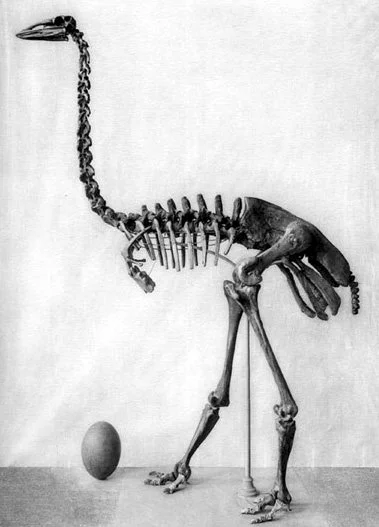
The mounted skeleton of Aepyornis maximus, the elephant bird, as printed in Monnier's Quaternary of Madagascar (1913) — the roc's real root standing at full height: over three metres of bird that could not fly. Public domain, via Wikimedia Commons.
The roc's modern face flies in two skies at once, and the map's last pin shows the louder one. In 1958, in Ray Harryhausen's The 7th Voyage of Sinbad, the roc returned to the island — two-headed in the film, as cinema liked its wonders doubled — carrying off a lamb and menacing Sinbad with all the old apparatus: the egg, the nest, the parent birds' vengeance. The film is the fifth voyage restaged for a new century's children, and it carried the roc further in one decade than the sailors had in nine centuries.
The quieter sky is the museum's. Aepyornis stands reassembled in the great natural history collections, its eggs in their cases, and in 2010 scientists reported reading DNA from its eggshells — the root itself now legible in a laboratory, six centuries after the tale of it reached Genoa. The DNA carried a surprise worth the wait. The elephant bird's closest living relatives turned out to be the kiwis of New Zealand — small, brown, night-walking birds no bigger than a hen. Size, the root's own family tree says, is the least reliable thing about a bird. The roc's file could have told the scientists that. It had been saying it for nine centuries. And the bird's name keeps the old join visible: elephant bird is said to descend from Polo's account itself — the bird named for the elephant it was reported to lift, though the real animal never lifted anything heavier than its own four hundred kilograms.
One correction the museums have made since the lesson's file was first gathered: in 2018, Hansford and Turvey moved the largest elephant-bird specimens out of Aepyornis into a new genus, Vorombe titan, now counted the largest bird known. Aepyornis maximus — the bird of the 1851 naming, and of Monnier's 1913 skeleton plate, this lesson's new plate — keeps its own figures: over three metres, some four hundred kilograms. Only the "largest bird" title changed hands. The root's file is still being kept, which is what a root's file is for.
That is the roc's file: a captain's book of wonders with named sailors, an island bird checked against a griffin by its own reporter, an egg mistaken for architecture, an empty box where no custom could be proven, and a root that explains the egg and the size and declines — being flightless — to explain the flying. The largest bird on the shelf, and the lesson it teaches is the smallest tool in the keeper's kit: ask of every number whose it is.
Guided Observation
Study the opening engraving first: the roc with an elephant in its talons and another in its beak — the detail from Polo's account that every later picture repeats. Ask the keeper's question of it: what in this picture is a measurement wearing feathers? The elephants are the scale bar. Without them the bird is merely large; with them it is sixteen paces of large. Notice, too, what the engraver could not draw from Polo — the season, the southern coming, the islanders' insistence that the shape was altogether a bird's. Pictures keep the detail and drop the hedges, which is why this class makes you read the text after the plate.
Between the two, look at Edmund Dulac's roc, drawn for Stories from the Arabian Nights in 1907 — this lesson's second plate. Dulac draws the second voyage: Sindbad bound to the great bird's leg as it carries him up, the land fallen away far below. Notice what Dulac does with the scale problem. He gives you no elephant and no number. He gives you distance itself — a small man, a huge leg, and empty air — and lets your stomach do the measuring.
Then turn to the photograph: an elephant bird's egg in a museum case, a hand and an old telephone beside it for scale. This is the same lesson taught by the opposite instrument. The engraving asks you to believe a number; the photograph shows you one — thirty- four centimetres of egg, against a hand you can measure against your own. Write down what each picture proves, what each merely claims, and which of the two you would rather have in a court of keepers. The space between your two answers is this lesson.
Beside the egg, set the new plate: Monnier's 1913 print of the mounted skeleton of Aepyornis maximus, the whole bird standing at its full height in a museum of science. The engraving claimed a number, the photograph showed one, and the skeleton is one — three metres of bird that could not fly. Write down, in one line, what the skeleton proves that neither of the other two pictures could, and what it cannot prove at all.
Assignment Manual
✎ WRITTEN · ⚒ HANDS-ON · ◐ BOTH
◐ Both · Entry No. 26: The Roc.
- Rule your entry page. Turn to the Scholar's Entry Page in this packet and rule the next page of your journal to match it, as you did for your earlier entries.
- Write the roc's entry, to the standard. First Told: Buzurg ibn Shahriyar and the Book of the Wonders of India, about 953 — with the map's hedge written out: Siraf is the port where the reports landed, marked approximate. How the Telling Grew: Polo's account and his griffin question; Ibn Battuta's mountain that rose; Galland's Paris of 1704; the simurgh named as kin, in her own lines, not merged. The Tales: the dome that was an egg; the fifth voyage's broken egg and the boulders; Polo's elephant as the fixed detail. What It Actually Is: the elephant bird — its size, its egg, Flacourt's vouron patra with its hedge, the naming of 1851, and the honest sentence about what the root cannot explain. Still With Us: Harryhausen's roc of 1958; the museum bird; the DNA of 2010. The Keeper's Line: your own judgment, in one or two lines.
- Lay out the measures. ◐ This lesson is weighed in other men's numbers, so take them outdoors or to a clear floor and make them physical. With chalk, tape, or a paced count, lay out Polo's wingspan — sixteen paces across — and inside it, one feather of eight paces. Stand at the centre and look along the measure. Then, on the same ground, mark the length of the real egg: thirty-four centimetres. Write, beneath your entry, what the two measures do to each other — what the sixteen paces do to the tale, and what the thirty-four centimetres do to the sixteen paces. The laying-out is the point: a keeper who has stood inside a reported number reads every later number differently.
- Mark every line. Go back through your entry and mark every line in the margin, F for record or T for belief, as always. The special discipline of this entry: every measure gets its owner's name. Sixteen paces is Polo reporting the islanders; eight paces the same; thirty-four centimetres is a museum measuring an egg. A measure without an owner is a number pretending to be a fact, and in this entry, of all entries, it does not pass.
Materials
· Your creature-guide journal, with your earlier entries in it
· Pencils, and a pen you like
· A ruler, for ruling your entry pages
· This lesson's packet (the Scholar's Entry Page is in it)
· For Step 3: chalk, tape, or open ground for pacing; a tape measure if you have one
· For Step 3, if one is at hand: a hen's egg, to lay beside your marked thirty-four centimetres
Reflection
Polo checked the griffin question and printed the correction inside the same book as the marvel. What does it change, for a keeper, that the checking and the wonder stand between the same covers?
The root of the roc cannot fly. How much of a being may its root fail to explain before the entry must confess that the root is a seed and not a solution — and does the roc pass your test?
Every measure in this file belongs to somebody: a sailor, a merchant, a court, a museum. Which owner's numbers do you trust most, and what — exactly — makes them trustworthy?
A Closing Note
Twenty-six entries in, and your bestiary has taught you to weigh a number — the least glamorous and most necessary of a keeper's skills. Next lesson the record itself changes substance: from ink to stone. We take the method to the thunderbird, whose first record is carved, whose dates are ranges, and whose file this class keeps with more care than any other in the unit. Bring your ruler. You will need it for a different kind of span.
The Bestiary
Bestiary Keeper
Further Reading & Sources
Buzurg ibn Shahriyar, The Book of the Wonders of India (c. 953) — the captains' reports from Siraf; English translation by G. S. P. Freeman-Grenville (East-West Publications, 1981).
Marco Polo, The Travels — the rukh of Madagascar and the griffin question; Ronald Latham's Penguin translation is the keeper's copy.
Ibn Battuta, Travels — the mountain that rose into the air; the abridged translation by Tim Mackintosh-Smith (Picador).
The Thousand and One Nights — the second and fifth voyages of Sindbad; Antoine Galland's French edition (1704–1717) first carried them into European print.
Ferdowsi, Shahnameh, and Attar, The Conference of the Birds — the simurgh, named in this lesson as the roc's Persian elder.
Étienne de Flacourt, Histoire de la grande isle Madagascar (1658) — the vouron patra, in the Ampatres country.
Isidore Geoffroy Saint-Hilaire, "Note sur des ossements à Madagascar" (Comptes rendus, Paris, 1851) — the naming of Aepyornis maximus.
Submit your work for this lesson using the form below.
CONTINUE IN THE BESTIARY HALL
← Previous · Lesson 25: The Phoenix Next · Lesson 27: The Thunderbird →
Unit IV — Wings and Skies The Bestiary Hall — All 41 Lessons
The rest of Unit IV: Lesson 23 · Dragons of the West · Lesson 24 · Dragons of the East · Lesson 25 · The Phoenix · Lesson 27 · The Thunderbird · Lesson 28 · Winged Peoples