

THE BESTIARY
Unit IV · Lesson 27The Thunderbird
Professor Sable Rookmere
Bestiary Keeper
The Bestiary Hall • School of Evershade
Professor's Introduction

This is the most careful file in the unit, and I will tell you why before we open it. Every being so far has reached us through the papers of the people who believed in it, or feared it, or sold prints of it. The thunderbird reaches us the other way: through the records of visitors — a missionary's journal, an agent's printed volumes, two newspapers — set down about a being who belongs to the living peoples of this continent, whose ancestors carved him in stone centuries before any visitor arrived.
So the keeper's discipline doubles here. We file what the published record holds: who wrote, who carved, when, and how the writing has been hedged by the record-keepers themselves. We do not reach past the record into what is not ours. This school's census keeps closed living traditions with their people, and this lesson is where that rule stops being a sentence in a list and becomes a practice. Read slowly. The hedges in this file are not weakness. They are the lesson.
The Bestiary
Bestiary Keeper
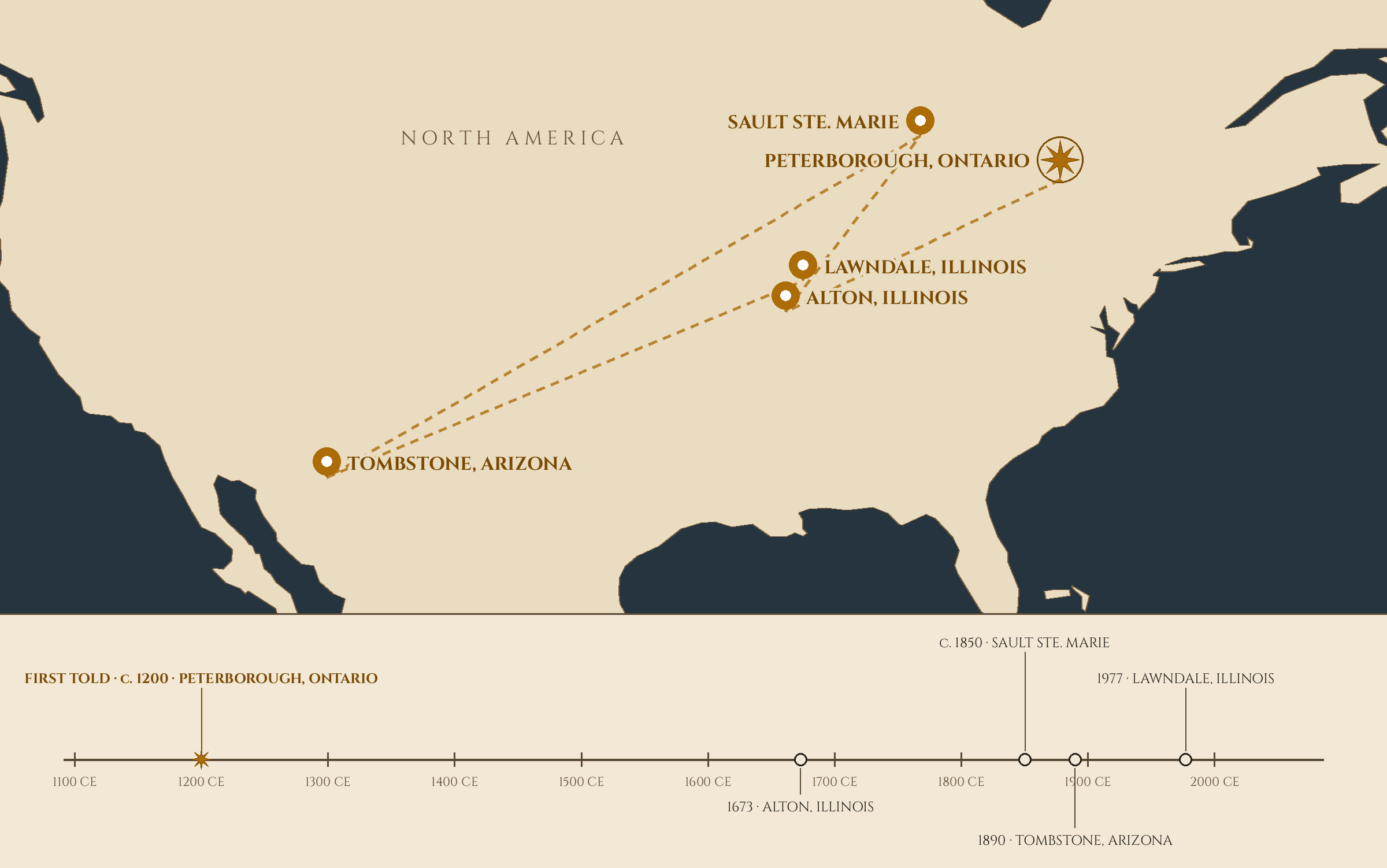
Where this lesson travels: Peterborough, Ontario — the Teaching Rocks, Kinomagewapkong — where Algonquian-speaking peoples carved more than nine hundred images into the white stone, six thunderbirds among them by the published surveys' count, dated about 900–1400: a range, because stone carries no scribe's date, and the range is the honest form of this record's age; Alton, Illinois, 1673, where Jacques Marquette described the great figures painted on the bluff — the Piasa, filed here as a near relation, its kinship to the thunderbird debated; Sault Ste. Marie, about the 1850s, where Henry Rowe Schoolcraft printed Ojibwe accounts of the Animikii; Tombstone, Arizona, 1890, where a newspaper printed two cowboys' giant bird; and Lawndale, Illinois, 1977, where a family's report of two great birds reached the newspapers within days. The starred pin is the first record; the dashed line is the telling, traveling.
Lesson Objectives
By the end of this lesson, you will be able to:
- Say what the English word thunderbird gathers together, whose names the beings carry in their own languages, and why this file holds a family and not a single creature.
- Name the first record: its substance, its place, its date given as a range — and say why a range, here, is the honest form of a date.
- Tell what Marquette recorded in 1673, and carry the hedge that travels with his pin.
- Describe what kind of record Schoolcraft's books are, and how a keeper cites a witness he cannot wholly trust and cannot do without.
- File the two newspaper cases of 1890 and 1977 as records of reports, and say exactly what such a record proves and what it does not.
- Explain why this lesson's What People Watched For box stands empty by rule — a different emptiness from Lesson 26's — and mark every line T, S, or F with the ranges kept as ranges.
Your Assignment Packet
This lesson's work lives in its packet: the Lexicon Handout (every term, the core terms marked with the keeper's diamond ◆), Materials, Guided Practice, the Assignment Manual written out whole, the Scholar's Entry Page, the Reflection Questions, the Workbook Checklist, and the Keeper's Notes, for whoever teaches the lesson. Download the packet before you begin and keep it beside you as you read. The packet's assignment is Rookmere's own word for the work: Entry No. 27 — The Thunderbird (both) ◐. The Unit IV Quiz is not printed in the packet; it waits at the end of the unit, with Lesson 28.
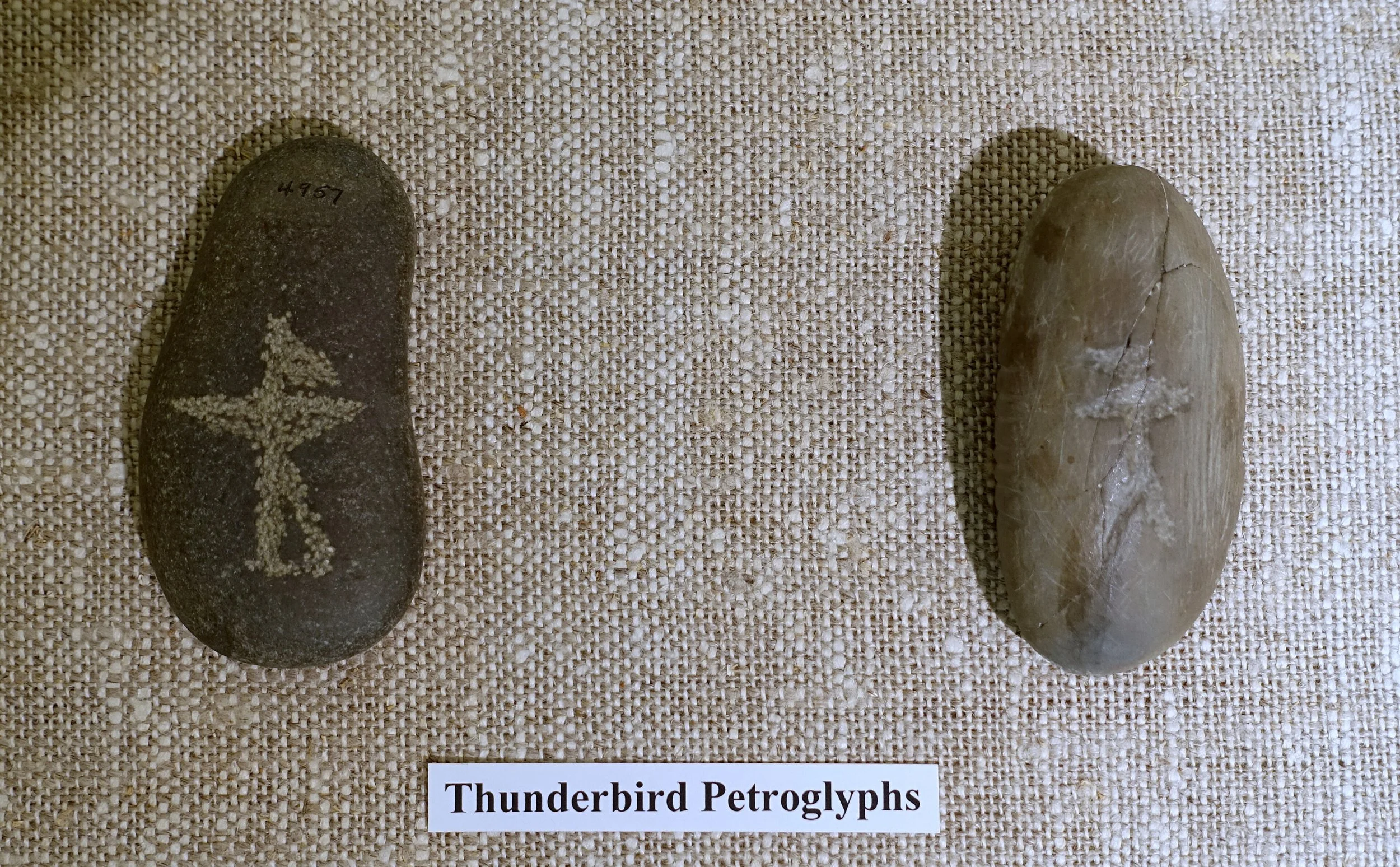
Two thunderbird petroglyph stones of the Wapanucket site (Middleborough, Massachusetts), as they stand in the Robbins Museum — published museum documentation of the carved birds themselves, chosen under this lesson's strict rule. Public domain, via Wikimedia Commons.
The Creature
Begin with the name, because here the name itself is a filing decision and the entry must confess it. Thunderbird is an English umbrella word. It is used in the printed record for the great beings of the upper world in the traditions of many Indigenous nations of North America — beings who have their own names in their own languages, and who are not one creature but kindred figures in many houses. In Anishinaabe (Ojibwe), the name the published record gives is Animikii — the thunderer. The published accounts describe such beings, in their general outline, as immense birds of the sky whose wingbeats are thunder and whose glances are lightning. This class files the family under the English word because its archive is English print and published carving, and it writes the confession into the entry, here at the top: the word is the archive's, not the beings'.
The lesson's pictures are the two the published record can show, and both are read closely in the Guided Observation. The hero plate is a photograph of two thunderbird petroglyph stones from the Wapanucket site in Massachusetts, as they stand in the Robbins Museum — carved birds, documented by the museum that keeps them. The second plate is William Dennis's sketch of 1825, drawn from the painted cliff figure called the Piasa as it then stood. Stone and sketch: that is the whole published picture-line of this file, and its shortness is part of the record.
First Told
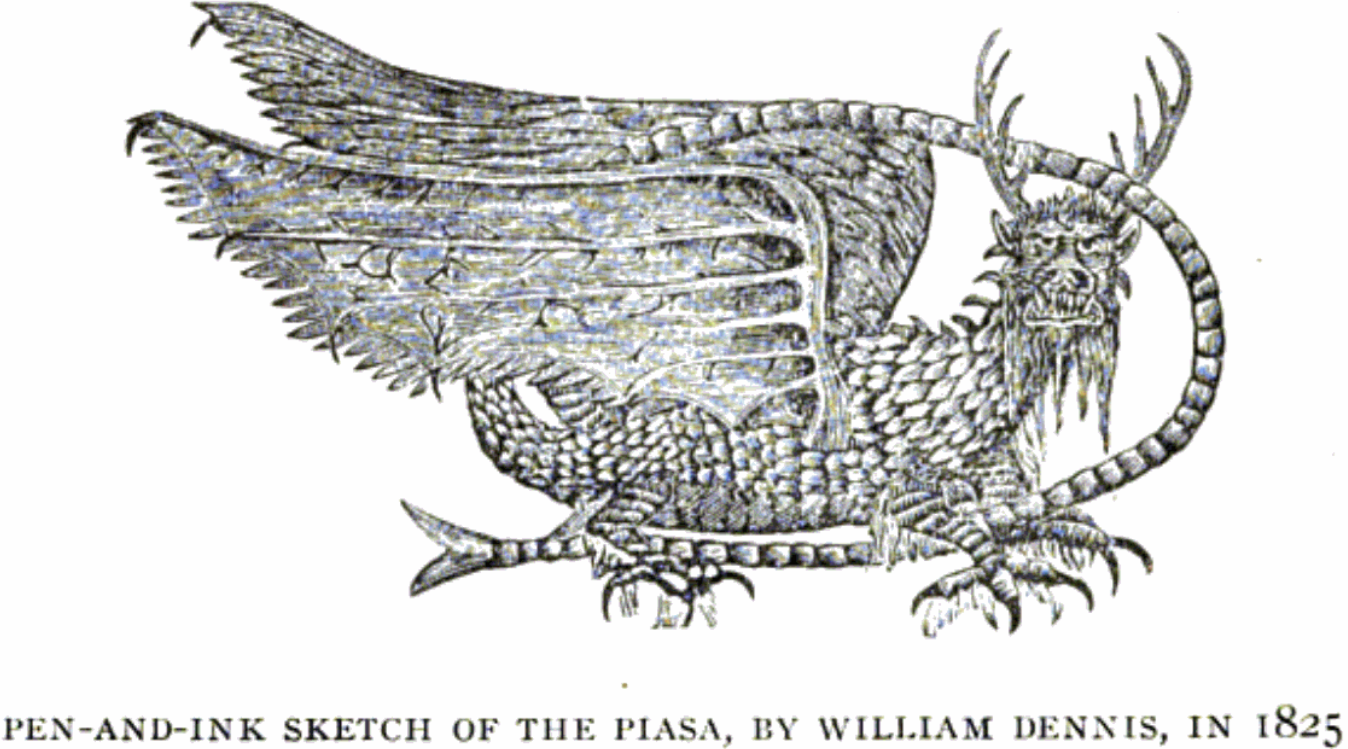
William Dennis's sketch of the Piasa (1825), drawn from the painted cliff as it then stood and reproduced in 1908: the winged, antlered figure of the Mississippi bluffs as the early written record preserves it — a copy of a painting, and every copy a small rescue and a small loss at once. Public domain, via Wikimedia Commons.
The first record, then, is not a book. It is a carving. On a broad shelf of white stone near present-day Peterborough, Ontario, lies the site the Anishinaabe call Kinomagewapkong — the Teaching Rocks: more than nine hundred images carved into the rock by Algonquian-speaking peoples, among them — the class's map-keeper counts them from the published surveys — six thunderbirds. Scholars date the carvings to about 900–1400 CE.
Read the map at the head of this lesson now, and read it the way its own keeper graded it: this is the most estimate-heavy map in the class. The starred pin stands at Peterborough with a date that is a range, and the entry must carry it as a range. Stone cannot be dated like a book: a manuscript has a scribe, a place, sometimes a year on its last page; a carving has weathering, style, and the testimony of the people whose place it is. A range is not a failed date. It is the true shape of this record's age, and a keeper who writes "1200" where the record says "900 to 1400" has not sharpened the record — he has falsified it, neatly.
The line from the star tells the file's whole story in five stops. Alton, Illinois, 1673: a missionary describes paintings on a bluff — a near relation, the map says, its kinship debated. Sault Ste. Marie, about the 1850s: an agent writes down Ojibwe accounts of the Animikii. Tombstone, Arizona, 1890: a newspaper giant. Lawndale, Illinois, 1977: a newspaper giant again. Stone, paint, print, newsprint, newsprint. No other file in the class changes substance so often, and a keeper reads each stop in the substance it is made of.
The second stop is the file's most famous document. In 1673, the French missionary Jacques Marquette, descending the Mississippi with Louis Jolliet, recorded in his journal two figures painted on the high bluffs near present-day Alton — the being the record calls the Piasa. Marquette's description is a keeper's gift, because he describes what he saw and not what he concluded: the figures were, he wrote, as large as a calf, with horns like a deer's, red eyes, a beard like a tiger's, a face like a man's, a body covered in scales, and a tail so long it passed around the body, over the head, and between the legs, ending like a fish's tail. He added, with the honesty this class has learned to prize, that the work was so well done he could hardly believe it was the painting of the peoples of that country — a compliment and a prejudice in one sentence, and the entry keeps both, because both are the record.
The paintings themselves are gone. The painted ledge was quarried away in the nineteenth century, and what survives is words and copies: above all the sketch made on the spot's tradition in 1825 by William Dennis — this lesson's second plate — drawn from the cliff as it then stood, a century and a half weathered. And here the map's hedge must be carried in the text, word for word: the Piasa stands in this file as a near relation; its kinship to the thunderbird is debated. Horns, scales, and a fish's tail read to some scholars toward the powers under the water rather than the lords of the sky. The class files the debate, not a verdict. A being's cousins are not chosen by the keeper's convenience.
Print took the file up in the nineteenth century through one industrious and difficult witness. Henry Rowe Schoolcraft, United States Indian agent at Sault Ste. Marie, gathered Ojibwe accounts of the Animikii and printed them for a wide readership — in his Algic Researches of 1839 and in the great government volumes of 1851–57. His knowledge came substantially through his wife, Jane Johnston, and her Ojibwe family, and his books are records of what he was told, written down and arranged by his hand. Later scholars caught his hand at work — smoothing, borrowing, improving — and the keeper's citation follows from that: Schoolcraft is F as a fact about printing, a dated and named record that these accounts were set down then and there; the content he prints is cited as his hearing of it, no more and no less. You will meet witnesses like him again — the indispensable and the unreliable in one coat — and the citation habit you build on Schoolcraft is the one to use on them all.
The Tales
The tales, in this file, come in two kinds, and the entry keeps the kinds apart. A third kind of record — the newspaper's — stands in §4, where this class files sighting-reports.
The first kind stands in the published accounts of the Animikii, and it is filed as published account, in the record's own general terms: the printed volumes tell of a standing war between the powers of the upper world and the powers under the water — the thunderbirds against the great underwater panther and the horned serpents of the lakes, whose name in the Ojibwe accounts is given as Mishipeshu — and the storms of the lake country read, in those accounts, as the sound and flash of that war passing overhead. Beyond that outline, this lesson does not go. The stories themselves belong to the people whose stories they are; the class records that the published record holds them, who printed them, and when — which is the history of the telling, and is this school's whole commission.
The second kind of tale is a picture's: the Piasa's. It has no plot and needs none. Two great figures on a cliff above the river, painted by hands the record does not name, seen and described by a passing missionary, weathered for a century and a half, copied in 1825, quarried away, repainted in our own time on a neighboring bluff. The tale is the biography of the image, and it teaches the keeper what a record looks like when it is made of paint and stone instead of paper: it fades in place, and every copy is a small act of rescue and a small loss at once.
KEEPER'S CHECK-IN
The thunderbird's tales come in two kinds, and this lesson keeps them apart — what are the two kinds?
Spotted
The newspaper file stands here, where this class files sighting-reports — and with it the file rejoins the class's usual weather. On April 26, 1890, the Tombstone Epitaph printed the report of two cowboys who said they had shot a winged creature in the Arizona desert: a being, the paper reported, resembling a huge alligator, with an immense pair of wings — the paper's figures ran to a body of ninety-two feet and a wingspan of a hundred and sixty. No skin, no bone, and no photograph was ever produced; the photograph of men posing with a vast nailed-up bird that many people remember was never printed in 1890, and pictures claiming to be it surfaced a century later, none of them genuine. File the Epitaph story as the class files all such: a record of a report, dated and named — which proves the report was printed, and nothing about the bird.
The modern case is smaller, closer, and better witnessed, which is why keepers set the two side by side. In July 1977, at Lawndale, Illinois, ten-year-old Marlon Lowe was playing in his own yard when two great birds came down; one seized at him, caught hold, and carried him a short way before his mother's running and shouting made it let go, and the boy fell unhurt while the second bird watched from a tree. The report was the family's, printed in the newspapers within days. What it proves is the same thing the Epitaph proves — that a report was made, by named people, at a dated place — and its lesson is in the difference of scale: ninety-two feet in 1890, a boy's height in 1977. The closer a case stands to our own time, the smaller the bird gets. File that sentence. It describes more of this shelf than this lesson.
KEEPER'S CHECK-IN
The Tombstone report of 1890 and the Lawndale report of 1977 prove exactly the same thing — what is it, and what does neither of them prove?
What People Watched For — a Box Left Empty, by Rule
Lesson 26 left this box empty because no custom could be proven. This lesson leaves it empty for a different reason, and the difference is itself part of the class.
The customs this box has carried — the alicorn cup watched at a king's table, the fairy bush unshifted on an Irish road, the peak unclimbed in Tōno — are the practices of the peoples whose books fill this shelf: documented doings of the record-makers' own households. The thunderbird's people are not the visitors who wrote this file. Their traditions are living, and they are theirs: this school's census states the principle outright, where it rules the skin-walkers and the wendigo out of the class — closed living traditions stay with their people. Where old journals describe regard paid to the paintings on the bluff, that belongs to the record of the paintings, and it stands in Lesson 27's telling, in its place. It does not get lifted into a specimen box.
So the box stands empty on purpose, and its reason is written in full, because a keeper's silences — like a keeper's dates — should always be able to show their working.
What It Actually Is
This file holds two records of different kinds, and the root section keeps them apart as strictly as the tales did.
For the carved and painted beings, no animal root is filed, and the entry says so without embarrassment. The thunderbirds of the Teaching Rocks are a people's record of their own beings, carved by their ancestors in a place that is theirs. To hunt that file for a mis-seen animal would not be keeping; it would be the exact error, in modern dress, that this class exists to retire — the insistence that every being on the shelf must dissolve into a bird, a bone, or a weather event before it may be taken seriously. The record is the root here. It is enough, and the entry closes that half of the question.
For the newspaper birds, roots are plentiful and the entry files them at their proper strength. Real wings fly over this continent at sizes honest witnesses misjudge: the golden eagle spreads more than two metres; the California condor nearly three — at dusk, at distance, above a frightened ten-year-old, either can grow in the telling to a size no tape will confirm. Both birds are worth knowing at their true size, because their true size is already impressive. A golden eagle is a heavy, broad-winged hunter that takes rabbits and ground squirrels and can kill larger prey on a slope. A condor is a vulture: it barely flaps, riding rising air for hours over open country, looking for carcasses. Seen from below, against a bright sky, with nothing near it to measure against, either bird is mostly wing — and a witness judging size with no landmark to help him will judge it wrong, honestly, and usually upward. And print does the rest of the growing: a hundred and sixty feet is not an ornithologist's number but a typesetter's. Fossil giants are sometimes proposed for the older reports — the teratorns of the Americas spread three metres and more, and Argentina's Argentavis, the greatest flying bird known, perhaps seven — and the entry files the proposal as a proposal: no teratorn has flown for thousands of years, and a proposal is not a sighting. The keeper's verdict on the modern file, then, is double and plain: real birds and real print explain the newspapers; nothing explains the carvings, because the carvings were never a report of an animal, and treating them as one is the mistake.
Still With Us
The thunderbird's modern face looks in two directions, and the entry ends by holding both steadily.
Toward the deep record: the Teaching Rocks are today a National Historic Site, in the care of the Curve Lake First Nation, and the place remains what it has been — a sacred place of the Anishinaabeg. The published record about it is open to any reader; the place itself is a living one, and visitors stand there as guests of a record that was never theirs. At Alton, the Piasa flies again: a modern repainting, raised on a neighboring bluff in 1998, keeps the figure over the river as a landmark — a new picture of an old record, valuable exactly as Dennis's sketch is valuable, as a copy that says this mattered enough to make again.
Toward the shallow record: the thunderbird is the standing word of the newspaper shelf — the name settler print reaches for whenever a great bird is reported over American farmland, so that the beings of Lesson 27's first half lend their English name, year after year, to the birds of its second. The keeper notes the borrowing without confusing the borrowers with the owners.
That is the thunderbird's file: a name that is an archive's umbrella, a first record carved in ranges, a missionary's honest paragraph, an agent's indispensable and unreliable volumes, two newspapers eighty-seven years apart, an empty box kept empty by rule, and a root section that knows which half of the file a root belongs to. It asks a great deal of a keeper's judgment, and it is worth the care it asks for.
Guided Observation
Study the photograph first: two thunderbird stones of the Wapanucket site, in Middleborough, Massachusetts, as they stand in the Robbins Museum — published museum documentation of carved birds, chosen for this lesson under its strict rule: published, licensed, and already given to the public by the museum that keeps them. Read the carving as a keeper reads any carving. What can stone hold that paper cannot — and what can it never hold? It holds the shape across a thousand years without a copyist's hand drifting; it cannot hold a date, a name, or a sentence of explanation. The birds look out of the photograph exactly as they were left, and the file's whole discipline is in that contrast: maximum survival, minimum commentary.
Then turn to the 1825 sketch of the Piasa. Dennis drew a painting already a century and a half weathered, and you are reading his drawing of it two centuries further on. Mark, in your journal, the chain: painted figure, weather, sketch, printed book, this page — five hands between you and the bluff. Where in that chain could the horns have sharpened, the tail lengthened, the scales multiplied? Write down one detail you trust more because Marquette's words stand behind the picture, and one you trust less because only the copy carries it. That pair of lines is the lesson in miniature.
Assignment Manual
✎ WRITTEN · ⚒ HANDS-ON · ◐ BOTH
◐ Both · Entry No. 27: The Thunderbird.
- Rule your entry page. Turn to the Scholar's Entry Page in this packet and rule the next page of your journal to match it, as you did for your earlier entries.
- Write the thunderbird's entry, to the standard. First Told: the Teaching Rocks — the place, the carvers, the count of the carvings, and the date written as the range 900–1400, with one line on why a range is this record's honest date. Open the entry with the name-confession: the English umbrella, the beings' own names where the published record gives them, Animikii among them. How the Telling Grew: Marquette's paragraph of 1673 with the Piasa hedge carried word for word; Dennis's sketch of 1825; Schoolcraft, cited by the rule this lesson teaches. The Tales: the two kinds, kept apart — the published outline of the war above and below; the biography of the Piasa's image. Spotted: the two newspaper reports, filed as reports. What It Actually Is: the double verdict, in its two halves. The Modern Face: the Site and its keepers; the repaint of 1998; the borrowed name on the newspaper shelf. The Keeper's Line: your own judgment, in one or two lines.
- Draw the timeline in spans. ◐ On a fresh page, draw this lesson's timeline as a keeper should: not a row of pins, but a chart of spans. Every ranged date is drawn as a band as wide as its range — the Teaching Rocks a band five centuries broad — and every firm date as a single line. Leave the band for the carvings unshaded at both ends, to show it is an estimate and not a fence. Beneath the chart, write one line on what the band-shape shows that a row of pins conceals. The drawing is the point: in this entry, of all entries, the shape of the dates is part of the evidence, and a keeper draws evidence honestly or not at all.
- Mark every line. Go back through your entry and mark every line in the margin, F for record or T for belief, as always. The special discipline of this entry: a date range marked R keeps its range. If any line of your entry has quietly turned 900–1400 into a single year, take the red pencil to it before anyone else does. And where the entry touches what the record cannot give — the carvers' names, the beings' own houses — let the line say the record does not say, and mark that sentence R with pride. It is one of the best sentences a keeper owns.
Materials
· Your creature-guide journal, with your earlier entries in it
· Pencils, and a pen you like — and the red pencil from Lesson 15
· A ruler — essential for Step 3
· This lesson's packet (the Scholar's Entry Page is in it)
· For Step 3: a fresh page, and the lesson's map as your model
Reflection
A range feels less satisfying than a year, and is more honest. What does that dissatisfaction reveal about readers — and what must a keeper do with it, in himself and in his entries?
Schoolcraft is a witness you cannot wholly trust and cannot do without. How should an entry cite such a source — and where else in this class have you already relied on exactly that kind of witness?
This lesson refuses a root for its carved file and supplies roots for its newspaper file. Is that one standard or two? Defend your answer in your Keeper's Line, in two sentences or fewer.
A Closing Note
Twenty-seven entries in, and your bestiary holds the file that will be opened, years from now, to test whether its keeper understood the whole class. Next lesson the unit closes with the winged peoples — three families under one cover, Greek, Japanese, and the siren who changed her shape between two lessons of this school. Keep your ranges wide and your hedges standing.
The Bestiary
Bestiary Keeper
Further Reading & Sources
Parks Canada, Peterborough Petroglyphs National Historic Site — the published history of the Teaching Rocks: the carvings, their date range, and their keepers.
Joan M. Vastokas and Romas K. Vastokas, Sacred Art of the Algonkians: A Study of the Peterborough Petroglyphs (1973) — the standard published study of the carved record.
Jacques Marquette, journal of the 1673 Mississippi voyage — the Piasa description, in The Jesuit Relations (Thwaites edition).
Henry Rowe Schoolcraft, Algic Researches (1839) and Historical and Statistical Information Respecting the Indian Tribes of the United States (1851–57) — the Animikii in print; read with this lesson's citation rule in hand.
The Tombstone Epitaph, April 26, 1890 — the flying monster of the Arizona desert, as printed.
Illinois newspaper reports of the Lawndale incident, July 1977 — the Lowe family's account, as printed.
Submit your work for this lesson using the form below.
CONTINUE IN THE BESTIARY HALL
← Previous · Lesson 26: The Roc Next · Lesson 28: Winged Peoples →
Unit IV — Wings and Skies The Bestiary Hall — All 41 Lessons
The rest of Unit IV: Lesson 23 · Dragons of the West · Lesson 24 · Dragons of the East · Lesson 25 · The Phoenix · Lesson 26 · The Roc · Lesson 28 · Winged Peoples