

THE BESTIARY
Unit III · Lesson 19The Kelpie & the Each-Uisge
Professor Sable Rookmere
Bestiary Keeper
The Bestiary Hall • School of Evershade
Professor's Introduction
Unit III has kept to the sea so far — bishops' monsters, paper mermaids, seal-folk. This lesson comes inland, to the river pool and the hill loch, and to the pair of beings this class files closest to a warning sign. The kelpie and the each-uisge are Scotland's water horses, and they divide the waters between them the way landlords divide fields. Keep them apart, as you kept the basilisk from the cockatrice: the folder is shared, the beasts are not. And read the tales the way their first collectors did — as instruments, built to do a job at the edge of deep water.
The Bestiary
Bestiary Keeper
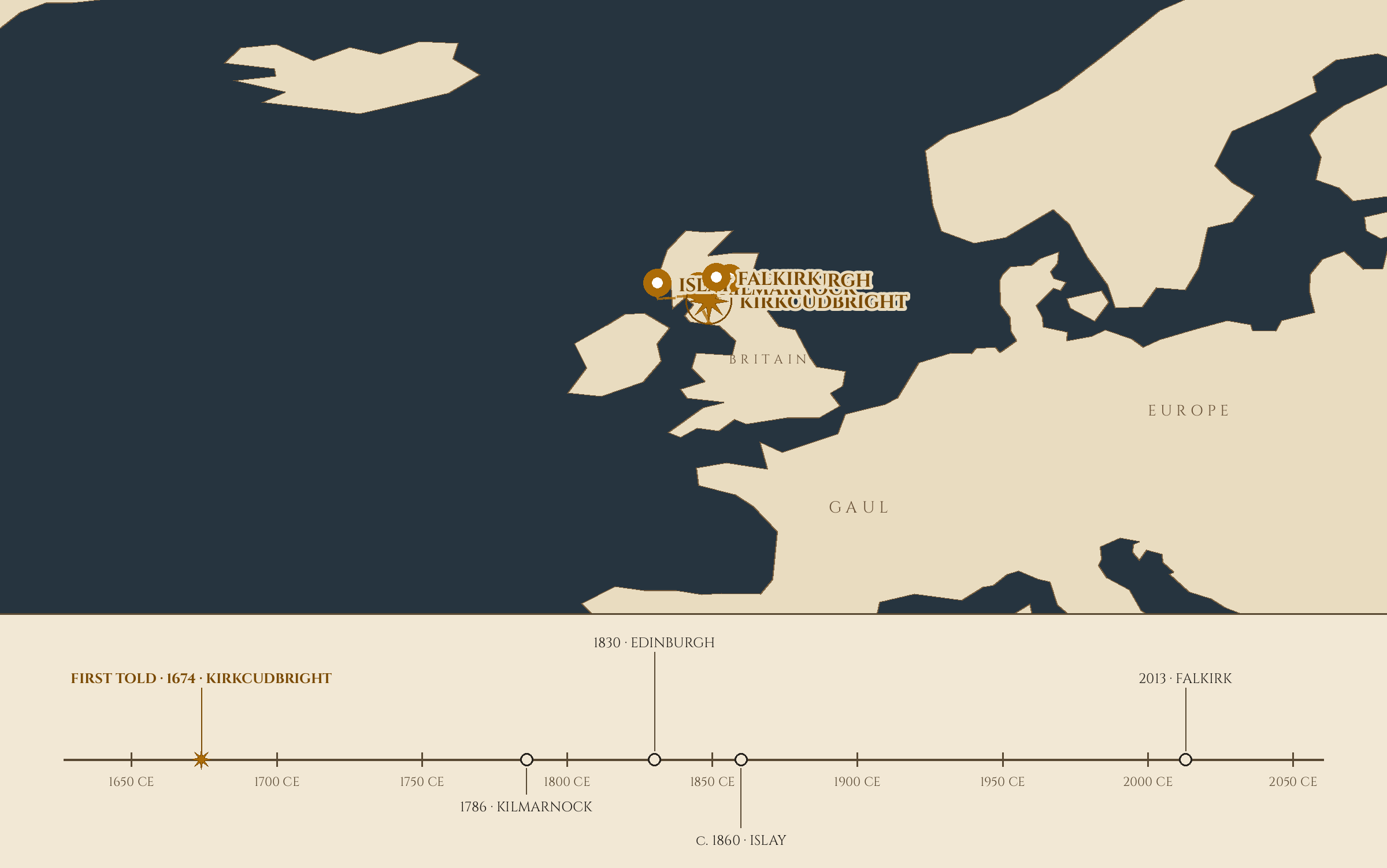
Where this lesson travels: Kirkcudbright, where “Kelpie hoall” stands in the burgh records of 1674 — the word's first surfacing, as a place-name already local enough to name a hall; Kilmarnock, where Burns's first edition (1786) set “water-kelpies haunt the foord” in print; Edinburgh, where Walter Scott's Letters on Demonology and Witchcraft (1830) took the kelpie up; Islay, where J. F. Campbell of Islay gathered the water-horse tales for his Popular Tales of the West Highlands (1860–62 — the collecting place is approximate); and Falkirk, where Andy Scott's thirty-metre Kelpies were completed at the Helix in 2013, the pair's modern face in steel. The starred pin is the first record; the dashed line is the telling, traveling.
Lesson Objectives
By the end of this lesson, you will be able to:
- Describe the pair, and tell the kelpie from the each-uisge by their waters, their tempers, and what each one leaves behind — and name the collectors who drew that line.
- Give the kelpie's first record as what it actually is: a place-name in a burgh record, dated 1674.
- Recount the two great tale-clusters of the pair — the children on the lengthening back, and the bridle that masters the horse — with their tellings kept apart.
- Explain what the tales were for, in the words of the folklorists who collected them.
- State the real root of the pair plainly: the water itself, and what a modern keeper does about it.
Your Assignment Packet
This lesson's work lives in its packet: the Lexicon Handout (every term, the core terms marked with the keeper's diamond ◆), Materials, Guided Practice, the Assignment Manual written out whole, the Scholar's Entry Page, the Reflection Questions, the Workbook Checklist, and the Keeper's Notes, for whoever teaches the lesson. Download the packet before you begin and keep it beside you as you read. The packet's assignment is Rookmere's own word for the work: Entry No. 19 — The Kelpie & the Each-Uisge ◐. The Unit III Quiz is not printed in the packet; it waits at the end of the unit, with Lesson 22.
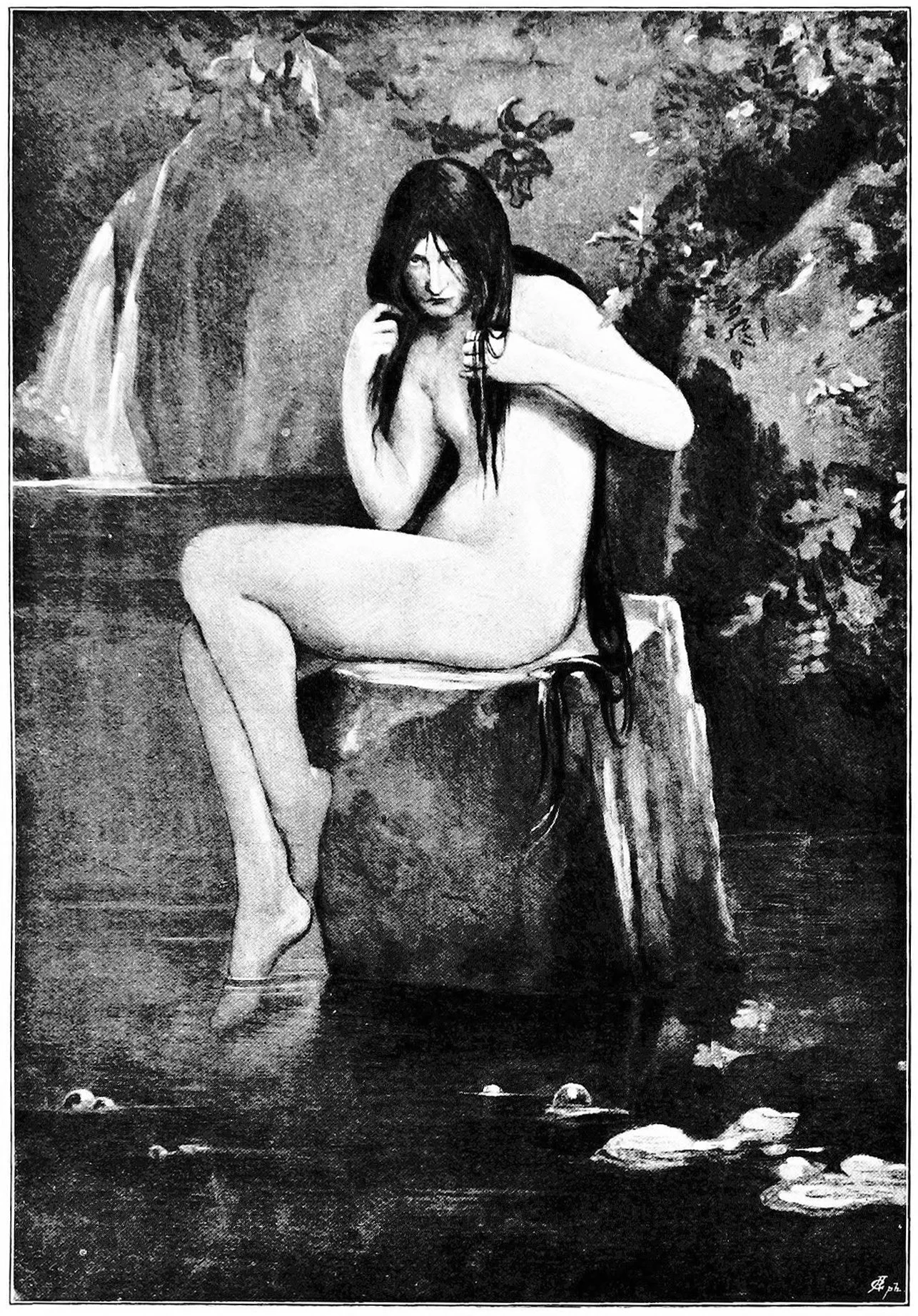
Thomas Millie Dow's The Kelpie (1895): the water-horse in woman's shape, seated alone by dark water — the being as the age of the collectors pictured her (a black-and-white reproduction of the painting). Public domain, via Wikimedia Commons.
The Creature
✦ On the class test
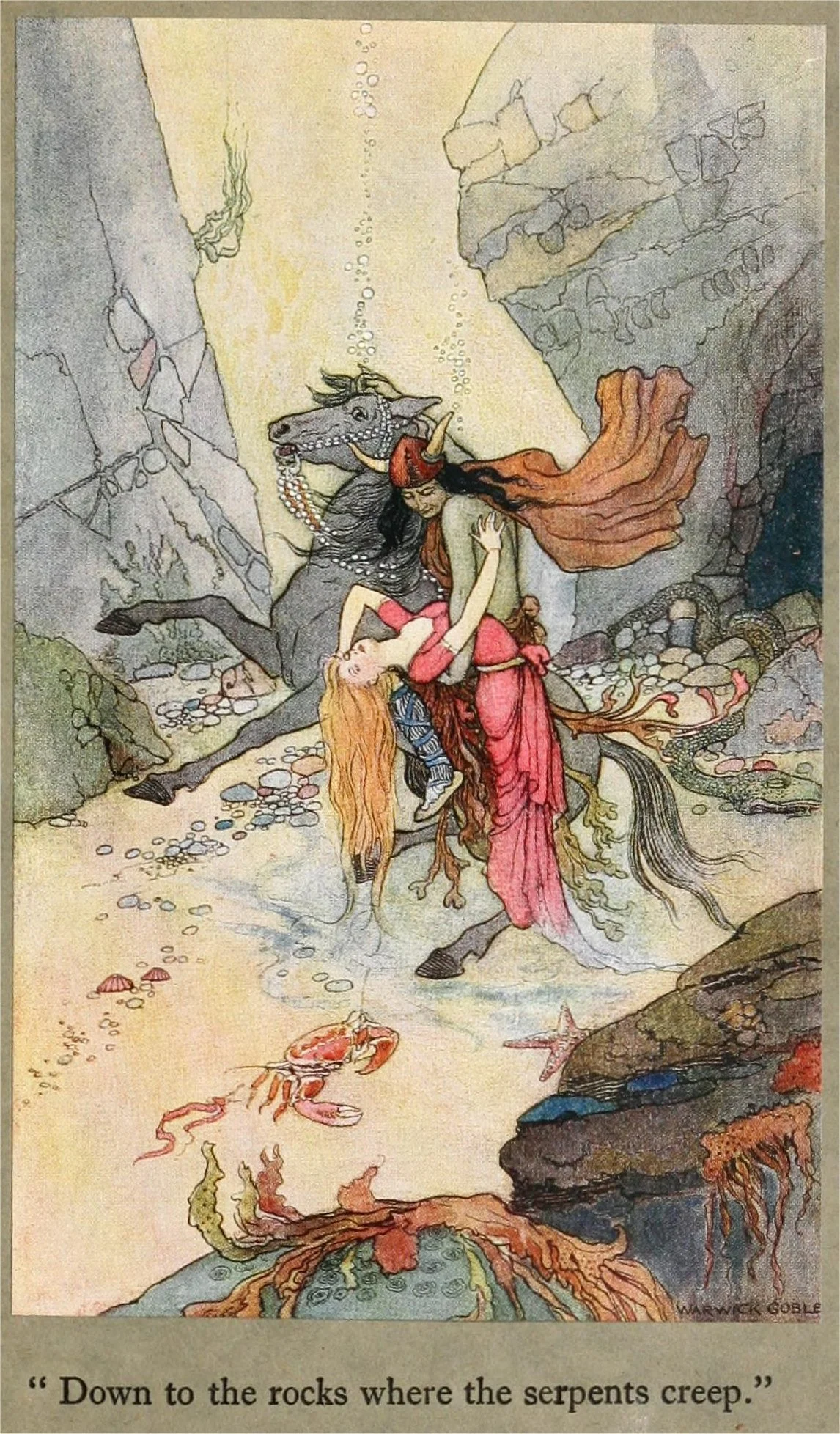
Warwick Goble's plate for “The Kelpie of Corrievreckan” (The Book of Fairy Poetry, 1920): the kelpie in horse shape, dragging its rider down toward the rocks — the tales' taking, drawn at full strength. Public domain, via Wikimedia Commons.
The kelpie — the water kelpie, in full — is the Scots name for a shape-shifting water spirit in the shape, most often, of a horse. The word's own root is honestly uncertain: it may come from the Gaelic calpa or cailpeach, a heifer or a colt, which would make the dreadful horse of the rivers a "colt" in its own name. The each-uisge carries its meaning on its face: in Gaelic, each is a horse and uisge is water — the water horse, outright, with no colt about it.
Here is the distinction the lesson exists to teach, as the great collectors of the tradition drew it. The kelpie belongs to the rivers: to streams, fords, mill-pools and running water, especially in the Lowlands. The each-uisge belongs to the lochs — the lonely hill lochs and sea-lochs of the Highlands and Islands. John Gregorson Campbell, the minister of Tiree who gathered the Highland record, kept the two apart by their waters, and Katharine Briggs kept the distinction in her Dictionary of Fairies (1976): the kelpie is the river horse; the each-uisge is the loch horse, and the fiercer of the two.
The tempers match the waters. The kelpie entices a rider, plunges, and drowns him; in some tellings it devours, and casts the entrails to the water's edge. The each-uisge does worse, and the record gives it a signature no keeper can mistake: it tears its victim apart and devours the whole body except the liver, which floats to the surface. A liver found floating on a quiet loch was, in the telling districts, the water horse's calling card. Both beings also walk in human shape — the kelpie as a handsome young man, in some tellings with hooves he cannot hide, or sand and water-weed in his hair; the each-uisge as a fine man or a beautiful pony.
Their pictures, like the selkie's, begin late — in the age of the collectors, not the age of the tales. The painting at the head of this lesson, Thomas Millie Dow's The Kelpie of 1895, shows the human shape: a woman, alone, by dark water. Spend a moment with her before the tales begin. She sits on a rock in the pool itself, her feet in the water and her long black hair drawn forward through her hands, and she looks straight out of the picture at whoever has come upon her. A small waterfall runs behind her, and that is nearly all: no horse, no bridle, no struggle, nobody drowning. Dow painted the moment every tale in this lesson turns on — a stranger at the water, beautiful and still, and you already close enough that your next step is the one that matters. The second plate, Warwick Goble's Kelpie of Corrievreckan (1920), gives the horse shape, dragging its rider down at the whirlpool. No earlier pictures exist to hang: the being's first two centuries in the record are words only — a hall's name, a poem, an essay, the collectors' notebooks.
One caution before the file opens. The tellings do not always obey the collectors' line. A tale told at one loch calls its beast a kelpie; the same tale, one glen over, names an each-uisge; and in popular use today "kelpie" covers the whole family. A keeper files each record under the name its own teller used, and notes the disagreement where it stands.
First Told
Look at this lesson's map, and notice what kind of record stars it. The starred pin stands at Kirkcudbright, in the south-west of Scotland, in 1674 — and what survives there is not a tale, a picture, or a poem. It is a phrase in the town's burgh records: "Kelpie hoall," a hall that carried the kelpie's name. The Dictionary of the Older Scottish Tongue, Scotland's great historical dictionary, reports the place-name from those records.
Think about what that means. A being whose name can be nailed to a building — used by clerks, in accounts, without explanation — is not new. Nobody names a hall after a novelty. The word was already local furniture in 1674, old enough in speech to have hardened into a street address. The kelpie's first record is a place-name because place-names are where old words go to be fossilized, and this fossil is the earliest dated trace of the being we have. The telling behind it is older, and unrecoverable; the record begins in the middle of the story.
The dashed line runs on from the fossil. At Kilmarnock in 1786 the word steps into print in Scotland's most famous book of poems: Robert Burns's first edition, the Kilmarnock volume, whose Address to the Deil has "water-kelpies haunt the foord." At Edinburgh in 1830 the kelpie gets its first essayist: Walter Scott, in his Letters on Demonology and Witchcraft, discusses the being for a reading public that now wants its folklore explained. The map's fourth pin, at Islay about 1860, is marked approximate, and the map says so: it stands for a man at work rather than a book on a shelf — John Francis Campbell of Islay, gathering water-horse tales in the West Highlands for his Popular Tales of the West Highlands (1860–62). And the line ends, for now, at Falkirk in 2013, where the record takes a form this class has not met before: not a book at all, but thirty metres of steel.
The each-uisge, notice, has no pin of its own in 1674, and no Burns. Its name is Gaelic, and its road into print runs through the collectors' notebooks of the nineteenth century — which is why this lesson teaches the pair's first records as a pair of unlike things: a Scots word caught early in a town's paperwork, and a Gaelic being who arrives in the written record when the collectors arrive with their pencils.
Between Burns and the collectors, the word surfaces once more in a form worth filing: the poet William Collins, who died in 1759, left an ode in manuscript in which the creature appears spelled kaelpie — the first recorded use of the word for the being itself, as the dictionaries give it, rather than for a hall.
Then come the Campbells, and a keeper must keep them apart as carefully as the horses. John Francis Campbell of Islay (1821–1885) published the Popular Tales of the West Highlands in 1860–62, four volumes of tales taken down from tellers across the Gaelic west, printed with the Gaelic beside the English. His net caught water-horse material by the shoal — the beings throng the tale-lists of the Highlands under their Gaelic names. John Gregorson Campbell (1836–1891), minister of Tiree, worked the same ground a generation later and left the each-uisge's fullest file: his Superstitions of the Highlands and Islands of Scotland was published in 1900, nine years after his death, and its pages on the water horse are still the account every later writer leans on. It is Gregorson Campbell who gives us both the boy and the finger, and the most keeperly judgment in this lesson, in the next section.
In the twentieth century the pair passes to the reference shelf: Katharine Briggs, in An Encyclopedia of Fairies (1976) and her Dictionary of Fairies of the same year, filed the kelpie of Glen Keltney and the each-uisge of the lochs in their separate drawers — the distinction of section 1, drawn in a modern reference book. Meanwhile the word kelpie, set loose in popular books, begins its second career as the family name for every water horse in Britain, which is why your entry must hold the line the collectors drew: river and loch, drowning and devouring, Lowland word and Gaelic name.
The Tales
The pair's tales fall into two great clusters, and a keeper should be able to tell each cluster from the other at sight.
The children on the back. A beautiful horse is found grazing at the water's edge — so gentle, so fine, that the children climb on. The back lengthens to take them all. One child, last and least, touches the horse only with a fingertip — and the finger sticks. The horse is known, too late; the stuck child takes out a knife and cuts off the finger, and so lives; the rest are carried into the water and drowned, and what the shore gives back is entrails — or, in the each-uisge's tellings, livers floating on the loch. The record keeps this tale in several filings, and the filings disagree about the beast, which is itself the lesson. At Glen Keltney in Perthshire the creature is a kelpie, as Briggs files it. At Thurso, in the far north, the teller names a water kelpie. At Sunart, on the west coast, the beast is a water horse of the each-uisge kind, the children are nine, and the boy who survives by his knife has a Bible in his pocket. John Gregorson Campbell, printing the Sunart account, adds the judgment a keeper should copy into the margin of every wonder-tale: he calls it obviously a pious fraud, to keep children from wandering on Sundays. The folklorist is telling us, in so many words, what the tale was for. Hold that sentence; the Watched-For passage builds on it.
The bridle. The second cluster runs the other way: here the human wins, by one object. Whoever takes hold of a water horse's bridle holds the horse. At Ponage Pool, a deep pool on the River North Esk, the Laird of Morphie caught the pool's kelpie with a magical bridle and set it to hauling stones for the castle he was building at Morphie. The bridle was, in time, incautiously removed, to let the creature feed; the kelpie vanished through the wall, laughing, and left its wages in a rhyme that Robert Chambers printed in his Popular Rhymes of Scotland in 1826: "Sair back and sair banes, / Drivin' the Laird o' Morphie's stanes; / The Laird o' Morphie'll never thrive / As lang's the kelpy is alive." James Mackinlay retells the capture in his Folklore of Scottish Lochs and Springs (1893), and the same book carries the bridle's other famous hour: at Loch Ness, one James MacGrigor cut the bridle from a kelpie that haunted the shore and carried it off, and the beast, for all its power, could only bargain and threaten from outside the door.
After those two clusters, the shapes deserve a paragraph of their own, because you will meet the being in both, sometimes in the same telling. In horse shape the being is too beautiful, too quiet, too ready — bridled and saddled by the roadside in some tellings, as if waiting. In human shape it is the stranger at the ford: handsome, courteous, and wrong in one detail the tales train you to spot — hooves for feet, or wet hair with the sand of the pool still in it. Dow's painting chooses the woman's shape, and the moment before anything happens.
KEEPER'S CHECK-IN
In the tale of the children on the lengthening back, how does the one child who survives get free — and what did John Gregorson Campbell say that tale was for?
Spotted
The pair has no sighting-file separate from its tales, and the lesson says so plainly: nobody dated, placed, and signed a kelpie report the way M'Quhae signed his serpent report in the next lesson. What stands in the record instead are the tale-filings of section 3 — told at named pools and lochs, collected by named men — and the grim details the tellers attached to real shores: entrails at the water's edge, a liver floating on a quiet loch. Those are tale-elements, marked T, not reports; the next lesson shows what a true sighting-file looks like, and the difference is the point of filing this one honestly.
KEEPER'S CHECK-IN
Why does this pair have no sighting-file separate from its tales — what stands in the record instead of a signed, dated report?
What People Watched For — Hands Off the Horse
Every being in this class that was believed in hard enough produced a custom — something people actually did differently. The water horses' custom is the plainest in the book: children were taught to watch for the horse, and to keep their hands off it.
The watching had a form. A strange horse at the water's edge — beautiful, riderless, patient, perhaps already saddled — was not to be touched, and above all not to be mounted; the tales were told at the very pools they belonged to, with the water in sight, and the knife in the boy's pocket was part of the instruction: if your finger sticks, you already know the price of getting free. The collectors understood the machinery and said so. It is John Gregorson Campbell, again, who writes the purpose into the record itself: the Sunart tale of the nine children was, in his words, obviously a pious fraud to keep children from wandering on Sundays. Folklore scholars of the next century note the same practical purpose across the whole water-horse file: the narratives kept children away from dangerous stretches of water, and warned the young to be wary of handsome strangers at lonely places. File the telling of the tales as F — the custom is documented, by the men who collected the tales. File the horse as T.
What It Actually Is
There is no horse in the rivers of Scotland, and no adhesive skin in nature. The roots this pair grows from are of the class's usual kinds, but one of them is the whole lesson, and it must be stated plainly.
The water is the root. The kelpie's Scotland is a country of unfenced lochs, deep mill-pools, peat-dark rivers and fords that run harmless in August and lethal in spate. In such a country, in the centuries of this record, drowning was a common accidental death, and children were its commonest victims. A tale that makes a child afraid — specifically, instructively afraid — of a beautiful horse at a pool's edge is not a failure of reasoning. It is safety equipment, built out of the only material that keeps: a story a child cannot forget, told where the danger is. The each-uisge's liver, the entrails at the water's edge, are the same equipment in its grimmest fitting: they are what drowned bodies, found late, taught the tellers to say. The record does not offer us a beast behind these details, and a keeper does not invent one.
The lesser roots are real but smaller. Stray and riderless horses do stand at water; a horse that bolts for its home pool with a strange rider is a true farmyard danger. A handsome stranger at a lonely ford was, in a world of sparse roads, a real occasion for wariness. And the bridle — the one instrument that masters the being — is the farmyard's own truth turned into a charm: the bridle is how a human being controls a horse, and the tales simply extend the fact to the horse that is not one.
One more root deserves its line, because it is standing in half the tales: the real horse. Horses swim well when they have to. A horse in deep water holds its head clear and paddles strongly, and it can carry a rider across a river. But a horse is also a creature of habit and home, and one that knows its own stable will pull for it with everything it has, rider or no rider; a frightened horse at a ford is stronger than the person on its back. Set a strange, riderless horse beside deep water in a country where horses were wealth, transport, and daily company, and the tales had all the raw material they needed before any spirit was added to the water.
The modern keeper's line beneath the whole lesson, to be written under the entry and not just thought: deep water is dangerous in exactly the plain way the tales say sideways. Swim where the water is watched, keep off strange banks and mill-races, and treat a beautiful still surface the way the children of Sunart were taught to treat a beautiful still horse — as a thing to admire from the bank, with your hands in your pockets.
Still With Us
The map's last pin is the modern face, and it is made of steel. In 2013, at the Helix park in Falkirk, the sculptor Andy Scott completed The Kelpies: two horse-heads, thirty metres tall, the largest equine sculptures in the world, standing over the canal country the water horse once haunted in story. They are named for this lesson's being — the river horse raised to the scale of a landmark — and they complete the record's longest arc in a single image: the word that named a hall in 1674 now names them, and the being that was a warning has become a welcome. (No lawful photograph of them hangs in this lesson — the pictures of the statues that circulate are under licenses this class does not use — and that absence is itself filed here, so no one mistakes it for an oversight.)
The face's other half is quieter. The pair still does its original work: the tales are told to children at Scottish waters today, and the collectors' distinction — river kelpie, loch each-uisge, and the liver that tells them apart — is kept in every serious modern telling. And the word itself has traveled past Scotland's borders: in general use now, kelpie names the whole tribe of water horses wherever English is read — which is why this lesson taught you to file by the record's own word. Out in the bookshops the pair has merged under the one family name. In your bestiary they keep their separate waters, the way the collectors left them.
Guided Observation
Study Dow's The Kelpie first — the painting at the head of this lesson, from 1895. The woman sits alone by dark water, and nothing in the picture is monstrous. So ask the keeper's question: what has the painter given you, besides the title, to tell you this is not simply a woman resting by a pool? Look at the water, the solitude, the stillness, the turned head. Then say what the painting is doing that the burgh record of 1674 could not: it assumes you already know. By 1895 the kelpie needed no explanation to its audience — the picture is evidence of the belief's commonness, two centuries after the hall got its name.
Then Warwick Goble's plate for "The Kelpie of Corrievreckan," from The Book of Fairy Poetry (1920): the horse shape now, at the whirlpool between Jura and Scarba, dragging its rider down toward the rocks. Set the two plates side by side. One being, two shapes, two centuries of illustration: the woman who waits and the horse that takes. Write down one thing each picture understands about the tales that the other does not — and notice that both painters, working in the age of the collectors, drew the kelpie as their grandparents' generation had filed it. The plates are records of belief at full strength.
Assignment Manual
✎ WRITTEN · ⚒ HANDS-ON · ◐ BOTH
◐ Written and field · Entry No. 19: The Kelpie & the Each-Uisge.
- Rule your entry page. Turn to the Scholar's Entry Page in this packet and rule the next page of your journal to match it, as you did for Entries No. 1–18.
- Write the pair's entry, to the standard. The Creature: the two beings described and kept apart — waters, tempers, the liver that tells them apart — and the late depiction line, Dow (1895) and Goble (1920). First Told: two firsts in one field, each dated, and each labeled for what kind of first it is. For the kelpie: the word's fossil — "Kelpie hoall," Kirkcudbright burgh records, 1674 — and the word for the creature in print, Burns's Kilmarnock edition, 1786. For the each-uisge: a Gaelic name older in speech than in print, whose written file opens with the nineteenth-century collectors — J. F. Campbell's Popular Tales (1860–62) gathering the water-horse tales, and J. Gregorson Campbell's Superstitions (1900) giving the each-uisge its fullest account; Collins's kaelpie and Scott's essay of 1830 belong in this field too, with Briggs keeping the drawers separate in 1976. The Tales: the children on the lengthening back, with its three filings (Glen Keltney, Thurso, Sunart) and the survivor's knife; the bridle at Morphie, with the rhyme; the stranger at the ford, and the one detail that betrays him. Spotted: one honest line — this pair's record holds tale-filings, not signed sighting-reports. What It Actually Is: the water first, plainly, in your own words; then the stray horse, the stranger, and the bridle's farmyard truth. Still With Us: Falkirk, 2013, in two or three lines. The Keeper's Line: your own judgment, in one or two lines.
- File the warning. Under your Keeper's Line, add two lines headed The Warning: the custom the belief produced — the tales told to children at the pools themselves — marked F; and Gregorson Campbell's own verdict on the Sunart tale, in his words or close to them, also F, since it is a fact about the record that he wrote it. The horse itself, wherever your entry tells of it, stands T.
- The field step. Visit a real piece of water near you — a riverbank, a pond, a canal, a reservoir — and stand where the public stands. Note, in three or four lines in your entry's margin, what the modern world posts at its water: the signs, the rails, the life-ring, the names of the drowned, if your water keeps such a memorial. You are looking at the Watched-For custom in its modern dress. Do not enter the water, and do not leave the public bank: the lesson's whole point is which side of the rail the keeper stands on.
- Mark every line. Go back through your entry and mark every line in the margin with the keeper's marks: T for tale, S for sighting-report, or F for fact. The discipline of this entry is the pair: no line about the each-uisge may wear the kelpie's river, and no line about a tale may wear a date the record gives to a book.
Materials
· Your bestiary journal, with Entries No. 1–18 in it
· Pencils, and a pen you like
· A ruler, for ruling your entry pages
· This lesson's packet (the Scholar's Entry Page is in it)
· The lesson page, for the map and Dow's painting
· For the field step: a real piece of water you can visit safely, from its public bank
Reflection
The kelpie's first record is a hall's name in a town's accounts. What does a place-name prove that a tale cannot — and what can it never prove?
Gregorson Campbell collected the Sunart tale with love and then called it a pious fraud. Can a keeper hold both of those at once? What does his sentence give the scholar that a simple "this is false" would not?
The Falkirk Kelpies are a welcome, not a warning. What is gained, and what is lost, when a being's modern face reverses its old one?
A Closing Note
Nineteen entries in, and your bestiary has learned to keep a pair apart by their waters. Next lesson the record changes its element and its character at once: we go back to the open sea, where the being is made of nothing but reports — signed, sworn, and printed — and where the witnesses, for once, write their names in full. Sharpen your marks. The sea serpents will test them as no beast of the land or river has.
The Bestiary
Bestiary Keeper
Further Reading & Sources
A Dictionary of the Older Scottish Tongue — the entry reporting "Kelpie hoall" from the Kirkcudbright burgh records of 1674; the kelpie's documentary doorstep.
Robert Burns, Poems, Chiefly in the Scottish Dialect (Kilmarnock, 1786) — "water-kelpies haunt the foord," in the Address to the Deil.
Walter Scott, Letters on Demonology and Witchcraft (1830) — the kelpie's first essayist.
John Francis Campbell, Popular Tales of the West Highlands (1860–62) — the West Highland water-horse tales, Gaelic and English side by side.
John Gregorson Campbell, Superstitions of the Highlands and Islands of Scotland (1900) — the each-uisge's fullest file, and the "pious fraud" judgment.
Robert Chambers, Popular Rhymes of Scotland (1826) — the Morphie kelpie's rhyme in print.
James Mackinlay, Folklore of Scottish Lochs and Springs (1893) — Morphie again, and MacGrigor's bridle at Loch Ness.
Katharine Briggs, A Dictionary of Fairies (1976) — the pair kept apart for the modern reader: river kelpie, loch each-uisge.
Submit your work for this lesson using the form below.
CONTINUE IN THE BESTIARY HALL
← Previous · Lesson 18: Selkies Next · Lesson 20: Sea Serpents →
Unit III — Creatures of the Waters The Bestiary Hall — All 41 Lessons
The rest of Unit III: Lesson 16 · The Kraken · Lesson 17 · Mermaids · Lesson 18 · Selkies · Lesson 20 · Sea Serpents · Lesson 21 · Lake Monsters · Lesson 22 · Kappa & Bunyip