

THE BESTIARY
Unit III · Lesson 17Mermaids
Professor Sable Rookmere
Bestiary Keeper
The Bestiary Hall • School of Evershade
Professor's Introduction

This is the longest paper trail in the class, and the slipperiest. Under the one word mermaid the record files at least four different things: a goddess with a temple and a sacred lake, a manuscript creature halfway between bird and fish, a sailor's report of an animal he had genuinely seen and honestly misnamed, and a museum exhibit sewn together in a workshop. Scholars who treat those as one being will understand none of them.
Your work in this lesson is the keeper's core skill, practiced on a hard case: keep the files separate while you keep them in one entry. Note, as you go, how often the record itself warned you — in a historian's plain telling, in an admiral's plain sentence, in an examiner's refusal to sign.
The Bestiary
Bestiary Keeper

Where this lesson travels: Ashkelon, where Diodorus Siculus set down Derceto of Ascalon (c. 50 BCE) — a woman's head on a fish's body; the record concerns Ascalon, though Diodorus himself wrote in Sicily; Rome, where Pliny's Natural History (77 CE) reported Nereids washed ashore and a triton seen off Lisbon; Rochester, where the bestiary siren (c. 1230) stands mid-change into the mermaid, fish-tailed, with comb and mirror; Monte Cristi, where Columbus's log for 9 January 1493 records three “mermaids” off Hispaniola — almost certainly manatees; Copenhagen, where Hans Christian Andersen published The Little Mermaid in 1837; and New York, where P. T. Barnum exhibited the Feejee Mermaid in 1842 — the honest-fraud chapter of the record. The starred pin is the first record; the dashed line is the telling, traveling.
Lesson Objectives
By the end of this lesson, you will be able to:
- Describe the mermaid, and read her depiction line from the manuscript siren to the painted mermaid of 1900.
- Name the oldest account in the mermaid's file, where its scene is set, and the custom that account records.
- Explain how the bird-siren of the Greek record became the fish-tailed mermaid, and name the mermaid's filed kin: the hippocamp and the nixies.
- Name the rusalka, the Slavic water-woman filed in this lesson, and say how the rusalka of the folk record differs from the fish-tailed mermaid of the books — and when her week fell, and what was not done in it.
- Tell the mermaid's tales, from the goddess of Ascalon to Andersen's little mermaid.
- Tell the Feejee Mermaid chapter whole: what the object was, who showed it, and how the fraud was built.
- Name the real animals behind the sightings, and mark every line of this long file T, S, or F.
Your Assignment Packet
This lesson's work lives in its packet: the Lexicon Handout (every term, the core terms marked with the keeper's diamond ◆), Materials, Guided Practice, the Assignment Manual written out whole, the Scholar's Entry Page, the Reflection Questions, the Workbook Checklist, and the Keeper's Notes, for whoever teaches the lesson. Download the packet before you begin and keep it beside you as you read. The packet's assignment is Rookmere's own word for the work: Entry No. 17 — Mermaids (both) ◐. The Unit III Quiz is not printed in the packet; it waits at the end of the unit, with Lesson 22.
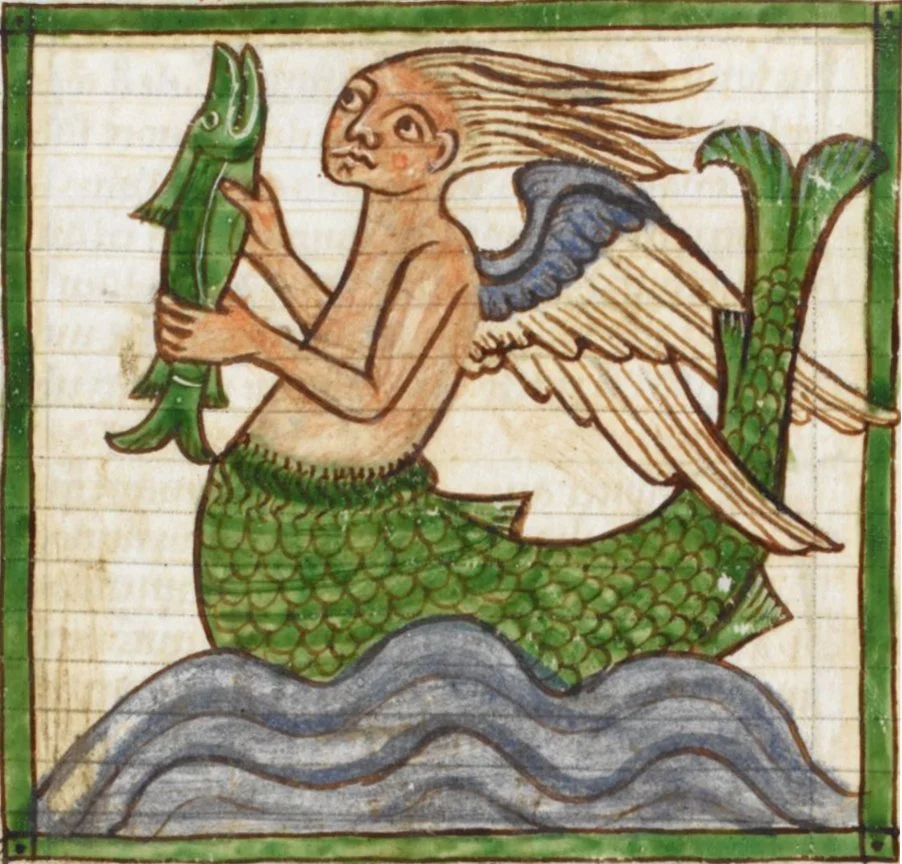
A siren from the bestiary in Harley MS 3244 (British Library): winged, fish-tailed, holding a fish — the medieval siren before she became the beautiful mermaid. Public domain, via Wikimedia Commons.
The Creature
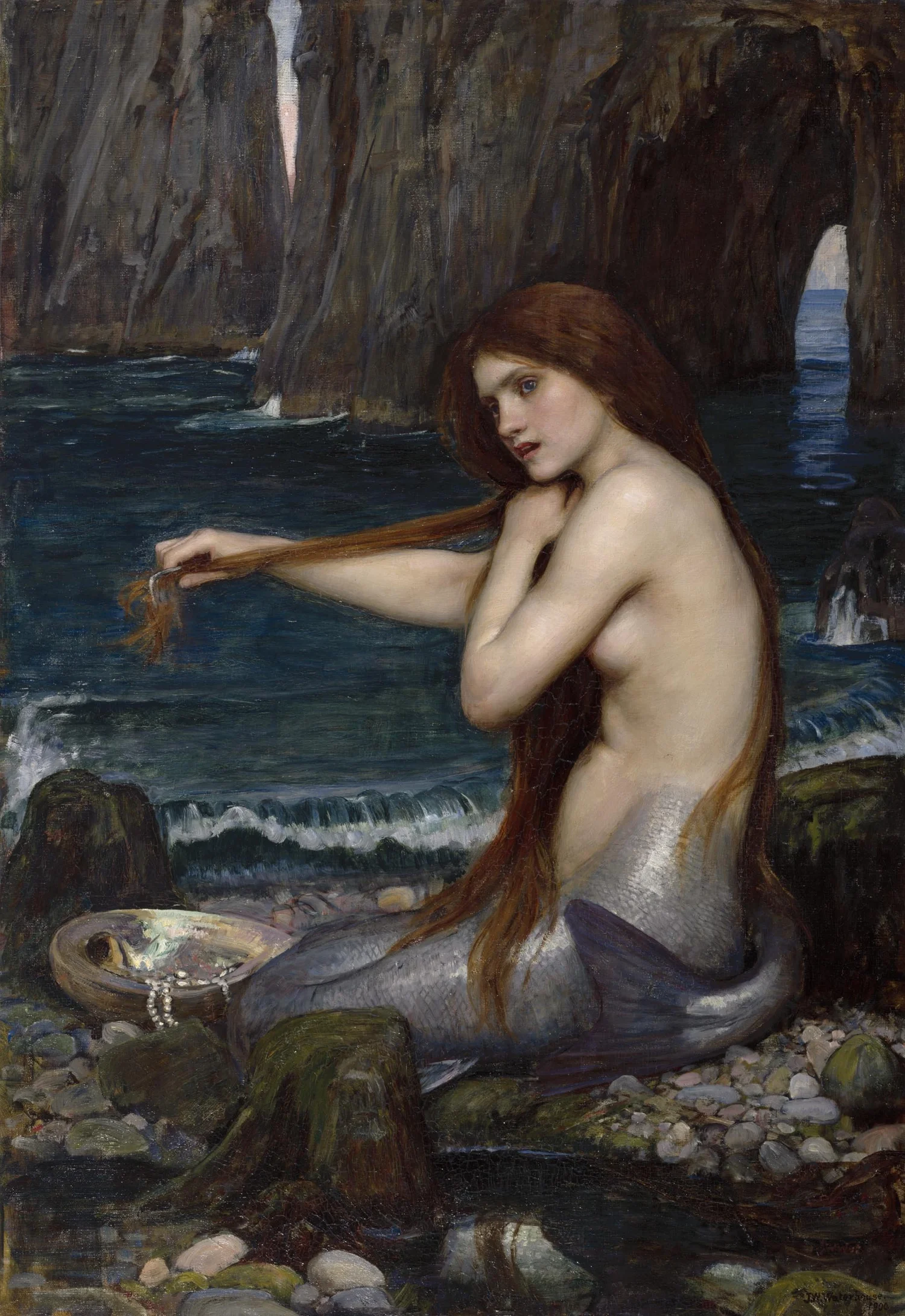
John William Waterhouse, A Mermaid (1900) — the mermaid as high Victorian art imagined her, combing her hair on the rocks. Public domain, via Wikimedia Commons.
The mermaid is the sea-maid: that is exactly what the English word says. Mere is the old word for the sea, or a lake; maid is a young woman; the mermaid is the woman of the waters, human above the waist, fish below it. The male of the kind is the merman.
Read her pictures in order, because the shape changes under your eyes. The plate at the head of this lesson, from the bestiary in Harley MS 3244, shows the creature mid-change: winged, fish-tailed, holding a fish. Look at her properly before you move on. The wings are big and feathered, blue at the shoulder; the tail below the waist is green-scaled and ends in curling fins; her hair streams backward as if she were flying through the page. The fish in her hands is nearly as long as her own body, and she holds it up in both hands like something she is offering — or showing off. She rides a band of painted waves inside a green frame, half of her in the air and half in the sea, and entirely pleased with herself. By about 1230, in the Rochester Bestiary, the change is nearly complete, and the siren has become the mermaid proper — fish-tailed, and holding the two objects that would be her standard equipment for centuries, a comb and a mirror. The painting in this lesson, John William Waterhouse's A Mermaid of 1900, shows where the line arrives: beautiful, solitary, combing her hair on the rocks — the comb of the Rochester siren, still in her hand after six hundred years. Look, too, at what Waterhouse set beside her on the shingle: a great shell holding a string of pearls, her treasure kept close while she works at her hair, and behind her the dark cliffs, with a narrow arch of open sea showing through the rock. Her pictures started far earlier than her name — as a goddess's image and on Greek vases, where the siren is still a bird — but the famous painted mermaids are a flowering of the 1800s, and the lesson keeps the line honest about that.
Two kin belong in this lesson's file, named here by the census of the class. The hippocamp is the sea-horse of classical art: a horse's forequarters and a curling fish's tail, set to draw sea-gods' chariots in mosaics, fountains, and coins, and later fixed in heraldry — a decorative and heraldic being, never a sighted one; no sailor ever filed a hippocamp report. The nixies are the water spirits of German rivers and millponds, beautiful, musical, and dangerous to the unwary — kin, across the shelf, to the undines, the water people of Paracelsus whom you met in Lesson 5.
A third kinswoman belongs in this file, and she is the one most often mistranslated into it. The rusalka (plural rusalki) is the water-woman of the East Slavic record — the Russian, Ukrainian, and Belarusian telling country of rivers, brooks, lakes, and mill-ponds. English books have called her a mermaid for two hundred years, and the folk record does not support the translation. The rusalka of that record has no fish's tail. She has legs. She comes out of the water — onto the bank, into the trees, across the rye fields and meadows — and she is almost never alone: the southern record, the fullest one, gives her in companies, young and beautiful, with long hair worn loose — green, golden, or fair in the tellings — dressed in white, sometimes in a wedding dress, sometimes in green leaves or in nothing but a white shift without a belt. Jan Máchal, summarizing the record for The Mythology of All Races in 1918, gives the dress and the company together: bevies of them at lonely places along the streams, in deep places and under rapids, rising on clear summer nights to bathe and to sit on the mill-wheel, splashing one another. Keep the picture exact, because this lesson's keeper-work depends on it: a woman, on land as much as in water, in a group, in white, with her hair down. The plate added to this lesson — Ivan Kramskoi's Rusalki of 1871, which you will meet properly in section 6 — paints exactly her.
What she was said to be sets her apart from every other being in this lesson. Derceto was a goddess. The bestiary siren was a copyists' creature. The rusalka, in the account the ethnography supports, was a dead girl. D. K. Zelenin, in his study of 1916 — Those Who Died an Unnatural Death and the Rusalki, the work every later writer on this being starts from — showed from a great body of collected evidence that the rusalki belonged to the class the Russian record calls the unclean dead: those who had died before their time, by violence, by drowning, or by their own hand, or who had died unbaptized as children, and who had therefore not been buried as the community buried its dead. Jiří Dynda, re-reading Zelenin's evidence a century later (2017), puts the conclusion plainly: in the vast majority of the ethnographic data, the rusalki are the souls of maidens who died an untimely and often unnatural death — many between betrothal and marriage, the life-stage the record returns to again and again. Máchal's 1918 summary gives the same list from the telling side: children who died unbaptized or drowned, and girls and young wives who met an unnatural death or were cursed by their parents. That is documented belief, filed as belief — what the telling districts said these beings were — and a keeper reports it in those words and no stronger ones. In the tales she is dangerous in the manner of her class: she sings, she lures, she tickles her victim or draws him down into the depths of the stream. She is also, in the same record, bound up with the flowering of the crops — a contradiction the calendar section of her file, in the box below, will explain rather than smooth away.
First Told
✦ On the class test
The earliest surviving account stands not in a bestiary but in a work of history. The Greek historian Diodorus Siculus, writing in the first century before the common era — about 50 BCE, the date this lesson's map carries — set down what was told of Derceto, the goddess of Ascalon, on the coast of Syria. At Ascalon, Diodorus writes, there is a great deep lake full of fish, and on its shore a precinct of the goddess the Syrians call Derceto, who "has the head of a woman but all the rest of her body is that of a fish." He tells her story as the Syrians told it: that Aphrodite, offended with the goddess, filled her with a violent passion for a handsome young man among those who sacrificed at the temple; that Derceto bore a daughter, killed the young man in her shame, exposed the child in a rocky desert place, and threw herself into the lake, where her body took a fish's form. The daughter, in the longer telling that traveled with the story, grew up to be Semiramis, the great queen of Babylon.
Note the shape of this first record. It is not a sighting. Nobody in Diodorus's passage claims to have met Derceto in the water. It is a telling — a historian recording, with its place and its temple attached, what a people said about their own goddess — and it carries, in the same breath, a custom those people kept because of her, which you will meet in the box after the sightings. A goddess, a lake, a rule: that is where the mermaid's paper trail begins, two thousand years before the word mermaid existed.
The map at the head of this lesson works as all our maps work. The starred pin is Ashkelon, about 50 BCE — the record concerns Ascalon, as the map notes, though Diodorus himself wrote in Sicily; a pin marks where the record points, not always where the writer sat. From there the dashed line walks to Rome in 77 CE, where a Roman natural history filed mermaids from officials' letters; to Rochester about 1230, where the bestiary siren stands mid-change into the mermaid; to Monte Cristi in 1493, where an admiral's log records three of them in a new ocean; to Copenhagen in 1837, where the being enters her most famous tale; and to New York in 1842, where she enters a museum case. No other map in the class covers so much ground under one name. That is the lesson in itself.
The medieval chapter of the telling happened in the bestiaries, and it is the change of shape you read in section 1. The sirens of the Greek record began as bird-women: women's heads on birds' bodies, whose song, in the old story, drew sailors onto the rocks. In the bestiary manuscripts the siren slowly takes the water. Some illustrators give her a fish's tail below and keep her wings above — the Harley siren is exactly that creature. Nothing was announced. Copy by copy, over generations, one being slid into another, and the bestiaries — faithful to their exemplars, as always — recorded every stage of the slide without remarking on it. Unit IV will close this case.
The rusalka's paper trail runs the other way. The mermaid's record begins with a historian and thins into tales; hers begins with a festival and thickens into scholarship. The festival came first, and it gave her the name. Franz Miklosich showed in 1864 that rusalka is derived from Rusalia — the name of the spring festival at Pentecost, itself borrowed from Latin rosalia by way of Greek — and the festival's name is on record from the twelfth century onward, while the word rusalka for the being herself is recorded only from the seventeenth. Alexander Afanasiev gathered her into the great nineteenth-century synthesis, Poetic Views of the Slavs on Nature (1865–1869), reading her, in the manner of his school, among the spirits of the dead ancestors — a reading the ethnographers who followed him tested against the villages and largely set aside. Zelenin's study of 1916 is where her modern file opens: not a first telling, but the first account built from the collected evidence whole. Linda Ivanits's Russian Folk Belief (1989) carries that file into English — the rusalki stand at pages 75 to 82 — and it is her pages, with Máchal's, that this lesson's box stands on.
The Tales
The mermaid's tales divide by the beings the name covers. The goddess's tale you have already read: Derceto's is the oldest, and it explains a temple and a lake. The bestiary siren's tale is a warning told of her song: her song is sweet, sailors sleep, and the sleeping are torn — and the comb and mirror joined her picture in the same centuries.
The coastal tales are the third kind: the mermaid on the rocks at dawn, combing her hair, seen from a boat or a cliff path; the merman who comes aboard at night, told and retold in the ports. These tales rarely have plots. They have a place, a witness, and a figure who is gone before a second witness can be called — the signature of report-folklore rather than story-folklore, and the next section takes up the reports themselves.
The rusalka's own literary tale arrived six years before Andersen's, and it keeps the folk shape his tale discarded. Nikolai Gogol's "May Night, or the Drowned Maiden," published in 1831 in Evenings on a Farm Near Dikanka, tells of a girl driven from her home by a witch stepmother, who throws herself into the pond in despair — and who thereafter leads the company of maidens drowned in that water, gathering them by night and still trying to pick the stepmother out from among them; for the witch, dragged into the pond at last, saved herself by taking a drowned maiden's shape, and the dead girl asks the young Cossack Levko to find her. Every element is the folk record's: the untimely death, the company, the water that is a home and not a tail, the wrong that keeps the dead girl at her pond. Gogol grew up in Ukraine, and the tale is a Ukrainian telling set in print — filed T, as a tale, with its author's name and its date on it.
The fourth kind is the literary tale, and it fixed the modern mermaid in a single publication. In 1837, at Copenhagen, Hans Christian Andersen published The Little Mermaid: a young mermaid who gives up her voice for legs, walks in pain on land for love of a prince who marries another, and at the end, refusing to save herself at his expense, dissolves into foam on the water. Whatever the coastal mermaid had been — warning, wonder, or report — Andersen made her a figure of longing and sacrifice, and the world has largely kept his version since. Her first illustrator, Vilhelm Pedersen, drew her for Andersen's tales from 1849 in black and white — the drawn literary mermaid begins with his wood-engraved lines, generations before Waterhouse's canvas.
KEEPER'S CHECK-IN
Gogol's “May Night, or the Drowned Maiden” (1831) came six years before Andersen's little mermaid — what folk shape does Gogol's drowned maiden keep that Andersen's tale discards?
Spotted
The mermaid was also reported, and the Roman growth of the file is official. Pliny the Elder's Natural History (77 CE), in its book on the creatures of the sea, reports the mermaid's Greek kinsfolk — the Nereids, sea-nymphs in women's form, and the triton, the merman who blows a conch. Pliny does not tell these as tales. He files them as reports, with sources. An embassy from Olisipo — Lisbon — reported to the emperor Tiberius that a triton had been seen and heard in a certain cave, blowing his shell, in exactly the form in which tritons are usually represented. A Nereid had been seen on the same coast, and the people along the shore had heard its mournful song as it died. The governor of Gaul wrote to the emperor Augustus that a considerable number of dead Nereids had been found washed up on his shore. Pliny adds, on the word of men of rank, a sea-man in the Ocean of Gades that climbed aboard ships at night and settled his weight on one side until the vessel listed. What Pliny files is paperwork — an embassy reporting, a governor writing his letter, a named ocean attached to every claim. Pliny's filing tells you what was reported, and by whom. Whether the reports were true he leaves, mostly, standing. Mark them S: sighting-reports, carried by a dated book.
The last great report of the old record is a logbook. Christopher Columbus's journal for January 9, 1493 — the original log is lost, and the entry survives as the historian Bartolomé de las Casas abstracted it — records that off the north coast of Hispaniola, near Monte Cristi, the admiral saw three sirenas rise well out of the sea. And then the most valuable sentence in the mermaid's whole file: they "were not as beautiful as they are painted, for in some way they have the appearance of men in the face." He added that he had seen some before, off Guinea. Here is a firsthand report, by a named man, of animals he had actually watched — described honestly against the picture in his head, and found plainer. The real root of this lesson stands behind it.
KEEPER'S CHECK-IN
Columbus wrote that his three sirenas “were not as beautiful as they are painted” — why does this lesson treat that plain sentence as the most valuable one in the mermaid's whole file?
What People Watched For — the Sacred Fish of Ascalon
This lesson's custom is the oldest in the class, and it is recorded in the same passage as the first record. Diodorus, having told Derceto's story, adds the consequence plainly: "it is for this reason that the Syrians to this day abstain from this animal and honour their fish as gods." At Ascalon the fish of the goddess's lake were not eaten. The great deep lake by her temple was, in effect, protected water, and the rule at its shore was a food rule — kept, in a real city, as part of ordinary religious custom, for the fish-bodied goddess's sake.
So what people watched for, in this lesson, was not the water. It was their own tables. The other customs in this class's boxes have been watchings of the world — a sounding line, a bowl set out, a bush left standing. This one is a watching of oneself: a thing not done, daily, for a being no one claimed to have met. Keepers record it as Diodorus presents it — a documented practice reported by a named writer of the first century BCE, whatever swam in the lake of Ascalon.
A second custom stands in this box, and it belongs to the rusalka's file. It meets this class's standard — a named source, a date, a practice real people kept — and in form it is the Ascalon custom's mirror: not a food not eaten, but a week not swum in. The rusalki were believed to walk the earth freely in one demarcated season: Rusalka Week (Rusalnaya nedelya), the week before or after Trinity Sunday — Pentecost — in early summer, when the crops were in flower. In that week, the ethnographic record assembled by Zelenin (1916) and summarized by Ivanits (1989) and Dynda (2017) is plain about what was not done. Bathing in natural waters was forbidden — to bathe, to do laundry in the river, even to wash children there — because the rusalki might seize whoever came close to the water. Women's handwork was forbidden too, weaving above all, and field work with it. What was done instead was offering and dismissal. Bread, pancakes, milk, and honey were left for them at field borders, at crossroads, and on the burial mounds of the unclean dead; wreaths were woven and hung on houses and on trees in the forest, or thrown into the river. Máchal (1918) records the Whitsuntide form of the same care: women hanging strips of linen, shreds torn from their own dresses, on the branches as a sacrifice to propitiate the rusalki, and bread, cheese, and butter set out on the banks of rivers and brooks. And at the week's end the rusalki were ritually seen off, in the provody rusalok: a procession of girls, wreaths on their heads, carried one rusalka — a chosen girl, or an effigy of straw or wood — out of the village, and there buried her, tore her apart, or cast her into the river, with a mock funeral. Ivanits records that the banishment or burial of the rusalka remained a kept custom in Russia, Belarus, and Ukraine into the 1930s. File the week F: the prohibitions, the offerings, and the seeing-off are documented practice, reported by named ethnographers from collected evidence. File the rusalki themselves T.
What It Actually Is
The mermaid's real root is two animals, and this time the science kept the receipts in the name. Manatees and dugongs — large, slow, plant-eating sea mammals — form the zoological order Sirenia, named for the sirens by the naturalist Johann Karl Wilhelm Illiger in 1811. The dugong of the Indian Ocean and the manatees of the Atlantic and the great rivers are the sirens of the record books now.
A female manatee nurses her calf at her chest, holding it with a flipper — a figure, at a distance, across water, in poor light, that answers to a woman with a child at the breast. The dugong carries a forked, fluked tail, divided like a fish's. "Dugong" itself comes from the Malay duyung, which means "mermaid" — the people of its own waters named it for the being. "Manatee" came through Spanish from a Carib word, possibly connected with the word for "breast." And the geography agrees with the testimony: the sighting reports cluster exactly where sirenians live — warm, shallow, coastal water — which is why Columbus, who had watched them off Guinea, met them again off Hispaniola and wrote the file's most honest line about their faces. An animal seen at the surface, rearing up to breathe, a calf at its chest, a divided tail below: the admiral's "not as beautiful as they are painted" is what a mermaid report looks like when the reporter describes the animal instead of the picture.
The rusalka has no part in that root, and her file shows why a keeper must say so. No sirenian swims in the rivers of the southern record, and no manatee climbs a birch or runs in the rye. The folk rusalka was never a mis-seen animal, because she was never an animal-shaped report at all: she was a belief with a calendar attached — the community's account of its untimely dead, kept in the week when those dead were commemorated. The fish tail she wears in English books is a translator's and illustrator's addition of the nineteenth century; Dynda (2017) notes that the ethnographers went looking for the fish-tailed rusalka of the dictionaries in East Slavic folklore and did not find her. Where the mermaid's reports have an animal behind them, the rusalka's tales have a burial rule behind them — the rule about who could be buried in consecrated ground, and who was set aside instead at the crossroads, at the field's edge, in the woods and the swamps.
Meet the animals themselves for a moment, since the sailors met them only in glimpses. A manatee is a big, slow, gray-brown grazer, commonly about nine or ten feet long, with small eyes, a round paddle of a tail, and a mouth built for cropping plants; it spends its days eating seagrass and other water plants, and it rises to breathe at the surface, which is when a watcher in a boat sees it at all. The dugong is its cousin in the Indian Ocean, slimmer in the body, with a snout bent down for feeding along the bottom and a tail split into flukes like a small whale's — the tail in the old pictures. Neither animal sings, plots, or combs anything. Both are gentle, curious, and very easy to misread at a distance across bright water.
The keeper's caution, and it matters: the real root explains the sightings. It does not explain the whole file. Derceto was not a manatee mis-seen; she was a goddess with a temple, and no dugong ever held a precinct. The bestiary siren was a book-creature, born in copying, who never swam anywhere. A root is an explanation of part of a record, and the discipline of this class is to say which part — the reports of sailors in sirenian waters — and to leave the goddess and the manuscript to theirs.
Still With Us
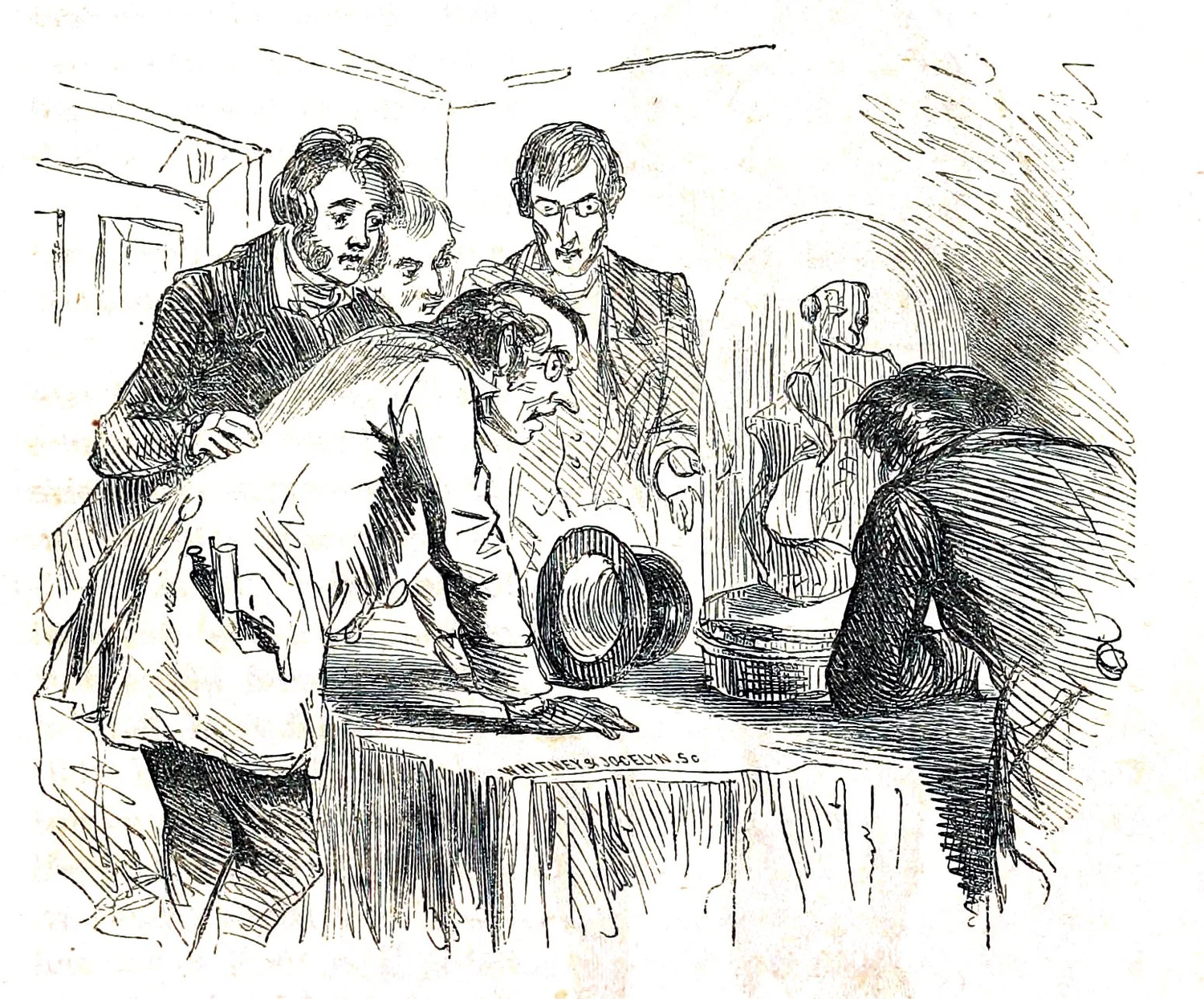
The honest fraud: an engraving of gentlemen examining the Feejee mermaid exhibit — the stitched monkey-and-fish showpiece toured by P. T. Barnum's American Museum. Public domain, via Wikimedia Commons.
The mermaid's modern face begins, oddly, with her most dishonest chapter — and the class keeps it in the record on purpose, under its census name: the honest fraud. In 1842 the showman P. T. Barnum exhibited in New York the Feejee Mermaid. Barnum did not own the thing. He leased it, at twelve dollars and fifty cents a week, from Moses Kimball of Boston, who had bought it that year from the estate of an American sea captain, Samuel Barrett Eades; Eades had bought it from Dutch merchants, and it had been displayed in Japan and elsewhere before it ever reached America. What it was, under the show bills' talk of a captured sea-maiden, was a manufactured object — a gaff, in the showmen's own word: the head and torso of a small monkey sewn to the back half of a fish, in an established East Asian tradition of fabricated mermaids made for display. Barnum described it afterward without romance: "an ugly, dried-up, black-looking, diminutive specimen, about 3 feet long."
The fraud was not only the object; it was the paperwork. Barnum brought forward a "Dr. J. Griffin," presented as an English naturalist of the British Lyceum of Natural History — an institution that did not exist, and a doctor who was in fact Barnum's associate Levi Lyman. Letters praising the specimen were planted in newspapers. And the one genuinely scientific act in the episode cuts the other way: the real naturalist Barnum asked to examine the mermaid declined to attest that it was genuine. The exhibit drew crowds first at Concert Hall and then at Barnum's American Museum — the engraving in this lesson shows gentlemen examining the case — and the original object was afterward lost, most likely in one of the museum fires of the era; a Feejee mermaid that came to Harvard's Peabody Museum from Kimball's heirs in 1897 has been suggested as the same object, but the identification is not certain. Why does this chapter stay in the file? Because it is the class's cleanest specimen of a manufactured record: every element — the object, the expert, the letters, the institution — fabricated, and every fabrication documented. It is what a false first record looks like when you catch it young.
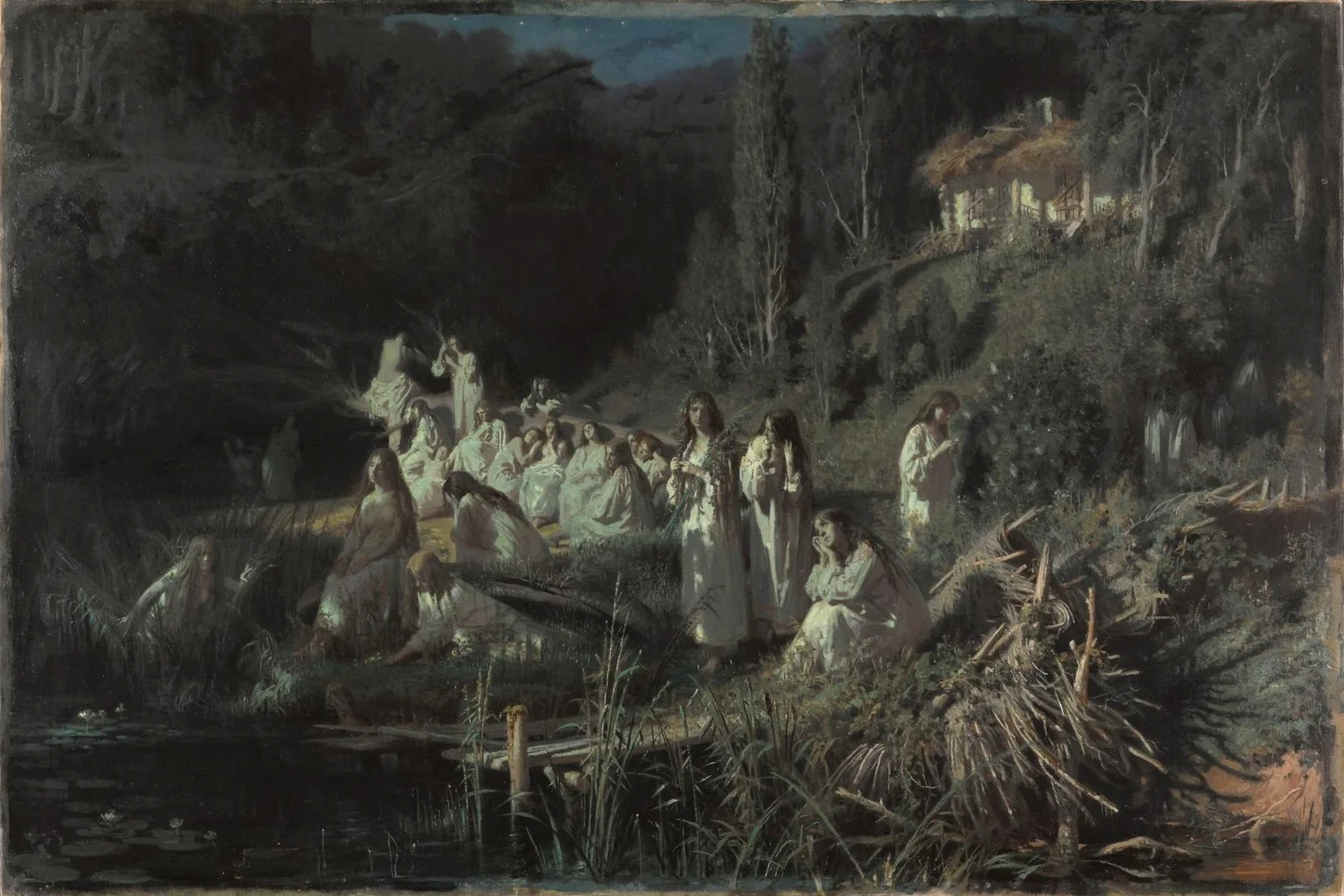
Ivan Kramskoi, The Mermaids (Rusalki), 1871, painted from Nikolai Gogol's “May Night, or the Drowned Maiden” (1831): nineteen rusalki on a riverbank at night — a company of young women in white with long loose hair, below a thatched village cottage. No fish tails, no sea: the folk form, not the dictionary mermaid. Public domain, via Wikimedia Commons.
Against the fraud stands the same era's other modern face: the painted mermaid. Waterhouse's canvas of 1900 gives her the rocks, the comb, the solitude, and the beauty Columbus said the real animals lacked — the mermaid as the imagination chose to keep her. Between the museum case and the canvas, the modern record holds both: what the being was made of, and what she was made into.
The rusalka's modern face is operatic, and it is the face by which the English-speaking world knows her name. Antonín Dvořák's Rusalka, Op. 114 — a "lyric fairy tale" to a Czech libretto by Jaroslav Kvapil, drawn from the fairy tales of Karel Jaromír Erben and Božena Němcová — was first performed at the National Theatre in Prague on 31 March 1901, with Růžena Maturová in the title role. Kvapil's Rusalka is a water spirit of a lake who loves a prince, gives up her voice to become human, and is betrayed — a plot that owes as much to Andersen and to Fouqué's Undine as to the villages, and a keeper files it so: the opera is the literary rusalka at her most beautiful, not the folk record in costume. Its "Song to the Moon," the Act I aria in which Rusalka asks the moon to tell the prince of her love, carried her name into the standard repertoire worldwide, where the opera remains. The painted rusalka had arrived a generation earlier, and she is this lesson's added plate: Ivan Kramskoi's The Mermaids — Rusalki — of 1871, painted from Gogol's "May Night." Look at what Kramskoi paints, because he paints the record and not the dictionary: nineteen rusalki on a riverbank at night, in white, their hair loose, a thatched cottage on the hill above them — no tails, no sea, no comb, no mirror. Between Kramskoi's bank and Dvořák's stage, the modern world received both rusalki: the folk one, kept accurately by a painter who had read his Gogol, and the operatic one, remade for the theatre and loved ever since. Today she is a standard figure of story, picture, and emblem everywhere — and strandline reports still get filed under her name, to be sorted by some keeper: F for the report's printing; the animal gets its own mark. The sirenians themselves are still with us too, carrying the sirens' name in the order of nature, and both manatees and dugongs stand on modern conservation lists as vulnerable — the real animals now needing the protection the goddess's lake once gave its fish.
The file is long because the one name did so much work. A goddess kept her fish uneaten at Ascalon. A bird in the copyists' hands grew a fish's tail. An admiral looked at three animals off Hispaniola and wrote down that they were plainer than the paintings. And in warm water on two sides of the world the manatee and the dugong go on nursing their calves, carrying the sirens' name in the order of nature, unaware they were ever accused of singing.
Guided Observation
Study the Harley siren at the head of this lesson: the siren from the bestiary in Harley MS 3244, winged, fish-tailed, holding a fish. This is the merger caught in the act. List what belongs to the Greek bird-siren — the wings, the woman's head and breast. List what belongs to the mermaid she is becoming — the fish's tail. Then answer the keeper's question: if you met this picture with no text at all, which being would you file it under — and what does your hesitation tell you about how the slide happened?
Turn to Waterhouse's A Mermaid (1900). The comb is in her hand; the rocks and the shore are painted from nature; the figure is painted from the imagination at its most accomplished. Note what the painting assumes you already carry in your head — the whole file of this lesson, compressed into one figure a child could name at sight.
Then study the added plate, Kramskoi's Rusalki (1871). Count the figures. Note where they are — not in the water, but on its bank, in a group, at night, below a village cottage — and what they wear, and how their hair is worn. Then answer the filing question this lesson has been building toward: if this picture reached you titled only The Mermaids, what in the picture itself would tell you that these are not this lesson's mermaids? List the absences as carefully as the presences.
Last, the Feejee engraving: gentlemen in a museum, examining the exhibit. Look at the size of the case against the size of the men. Look at what the examiners are doing — leaning, pointing, conferring: belief being inspected, in public, with hats on. Write down one thing the engraving tells you that Barnum's description does not, and one thing his description tells you that no picture could.
Assignment Manual
✎ WRITTEN · ⚒ HANDS-ON · ◐ BOTH
◐ Both · Entry No. 17: Mermaids.
- Rule your entry page. Turn to the Scholar's Entry Page in this packet and rule the next page of your journal to match it, as you did for your earlier entries. This entry is the longest file in the class so far; leave it room.
- Write the mermaid's entry, to the standard. The Creature: the description, and the depiction line read in order — the Harley siren, the Rochester comb and mirror, Waterhouse's painted mermaid. First Told: Derceto of Ascalon as Diodorus gives her — the lake, the temple, the fish's body — with the caution that the record is a telling, not a sighting; then the siren's slide in the bestiaries. The Tales: the goddess's story; the siren's song; the coastal combing tales; Andersen's little mermaid. Spotted: Pliny's official reports; Columbus's log of 1493. The kin filed here (hippocamp, nixies) get one line each; the rusalka gets her own short paragraph — her form without a tail, the unclean-dead account of what she was said to be, Gogol's drowned maiden, and her week, with what was not done in it. What It Actually Is: the sirenians — the nursing posture, the dugong's tail, the two names — and the caution about which part of the file the root explains. Still With Us: the Feejee Mermaid and how its fraud was built; the painted mermaid of 1900; Kramskoi's rusalki of 1871 and Dvořák's Rusalka of 1901; the sirenians today. The Keeper's Line: your own judgment, in one or two lines.
- The merger in three panels. ◐ On a fresh page, draw the slide in three panels — skill is not the point; the record is. Panel one: the Greek bird-siren, woman's head on a bird's body. Panel two: this lesson's Harley siren — wings above, fish's tail below, a fish in her hand. Panel three: the Rochester mermaid, fish-tailed, with comb and mirror. Label each panel with its date and its source, as the lesson gives them, and beneath the strip write one line: what did each stage keep, and what did it drop? This is hands-on record work — the merger, which took copyists three centuries, laid out where you can see it at once.
- Mark every line. Go back through your entry and mark every line in the margin with the keeper's marks: T for tale, S for sighting-report, F for fact. This entry will test the marks harder than any before it: a goddess's story is T held in an F frame — the book and its date are fact, the story is a tale; Columbus's report is S, a sighting-report about an animal misnamed; Barnum's mermaid is F as an exhibit and false as a being. Mark what each line actually is, not what it is about.
Materials
· Your bestiary journal, with your earlier entries in it
· Pencils, and a pen you like
· A ruler, for ruling your entry pages
· This lesson's packet (the Scholar's Entry Page is in it)
· For Step 3: a fresh page, and the lesson's plates as your models
Reflection
Pliny filed mermaids from embassies and governors' letters. What is the difference between reporting a thing and believing it — and can an entry, yours included, do the first without sliding into the second?
Columbus wrote that his mermaids were "not as beautiful as they are painted." Why might that be the most valuable sentence in the whole file — and what does it suggest about every other sighting in it?
Barnum's mermaid was a fraud, and this class keeps the fraud in the record instead of striking it out. What would be lost if keepers deleted the false entries? What does a kept, labeled fraud teach that a clean file cannot?
A Closing Note
Seventeen entries in, and your bestiary has filed a being who was four beings — which is seventeen entries' worth of the class's real subject: not creatures, but records, and the care they take. Next lesson the waters give us the gentlest file in the unit, from the seal coasts of the far north, where the print record arrives centuries late and the tales were carried by mouths the whole while. Bring your marks. A late record is not a weak one, and you are about to learn why.
The Bestiary
Bestiary Keeper
Further Reading & Sources
Diodorus Siculus, Library of History, Book II — the Derceto passage (the Loeb translation by C. H. Oldfather is the standard English text).
Pliny the Elder, Natural History, Book IX — the Nereids, the triton of Lisbon, and the sea-man of Gades, filed as reports.
The Rochester Bestiary (c. 1230) — the siren with comb and mirror, mid-slide into the mermaid.
The Journal of Christopher Columbus — the entry for January 9, 1493, surviving in Bartolomé de las Casas's abstract of the lost log.
Hans Christian Andersen, "The Little Mermaid" (1837).
P. T. Barnum, The Life of P. T. Barnum, Written by Himself (1855) — the Feejee Mermaid in its showman's own words.
The Peabody Museum of Archaeology and Ethnology, Harvard — the Feejee mermaid specimen from Moses Kimball's heirs, and its documented history.
Jan Máchal, "Slavic Mythology," in The Mythology of All Races, Vol. III (1918) — the Rusalky chapter: the unbaptized and the drowned, the Whitsuntide linen, and the food set out on the banks, in an early English summary of the record.
D. K. Zelenin, Those Who Died an Unnatural Death and the Rusalki (1916; reprinted Moscow, 1995) — the study that grounded the rusalka in the unclean dead; read in this lesson through its modern summaries.
Linda J. Ivanits, Russian Folk Belief (1989), pp. 75–82 — the rusalki and Rusalka Week in English: the offerings, the prohibitions, and the seeing-off kept into the 1930s.
Jiří Dynda, "Rusalki: Anthropology of Time, Death, and Sexuality in Slavic Folklore," Studia Mythologica Slavica 20 (2017) — Zelenin's evidence re-read, with the calendar and the provody rusalok set out whole.
Nikolai Gogol, "May Night, or the Drowned Maiden" (1831), in Evenings on a Farm Near Dikanka.
Antonín Dvořák, Rusalka, Op. 114 (premiere, National Theatre, Prague, 31 March 1901) — libretto by Jaroslav Kvapil after Erben and Němcová; the "Song to the Moon" is in Act I.
Submit your work for this lesson using the form below.
CONTINUE IN THE BESTIARY HALL
← Previous · Lesson 16: The Kraken Next · Lesson 18: Selkies →
Unit III — Creatures of the Waters The Bestiary Hall — All 41 Lessons
The rest of Unit III: Lesson 16 · The Kraken · Lesson 18 · Selkies · Lesson 19 · The Kelpie & the Each-Uisge · Lesson 20 · Sea Serpents · Lesson 21 · Lake Monsters · Lesson 22 · Kappa & Bunyip