

SCROLLWORK
Unit V · Lesson 18GOLD LEAF & GILDING
Professor Quillberry Nocturne
Master Scribe & Illuminator
The Scrollwork Library • School of Evershade
Professor's Introduction
Mind the gold, scholars, and welcome to the brightest lesson of our course.
In our last lesson, you learned how the page is organized: hierarchy, margins, the architecture that tells the reader where to look. Tonight we give the reader something worth looking at. We take gold, the most incorruptible metal known to the medieval world, and we lay it upon the page so thin that a breath can lift it, and so bright that five hundred years of darkness in a closed book have not dimmed it.
Understand what you are about to attempt. Gilding — laying gold on a prepared ground, by the raised road, the flat road, or the painted road — is not painting. Paint sits in color upon the page. Gold leaf sits in light. A painted initial is seen. A gilded initial is seen twice: once in its shape, and once in the flash it throws back at the candle. The medieval illuminator did not decorate the page. He lit it.
★ And the word is exact. "Illuminated" comes from the Latin illuminare, to light up. On the strictest definition, a manuscript is not illuminated at all unless gold is present somewhere on the page: gold leaf, shell gold, or at least gold specks brushed across the color. Everything else is decoration. Gold is illumination.
You will learn three roads to the same brightness: the raised road, the flat road, and the painted road. Each has its own ground, its own glue, and its own kind of light. Choose carefully which road your own work will take, because gold forgives nothing and remembers everything.
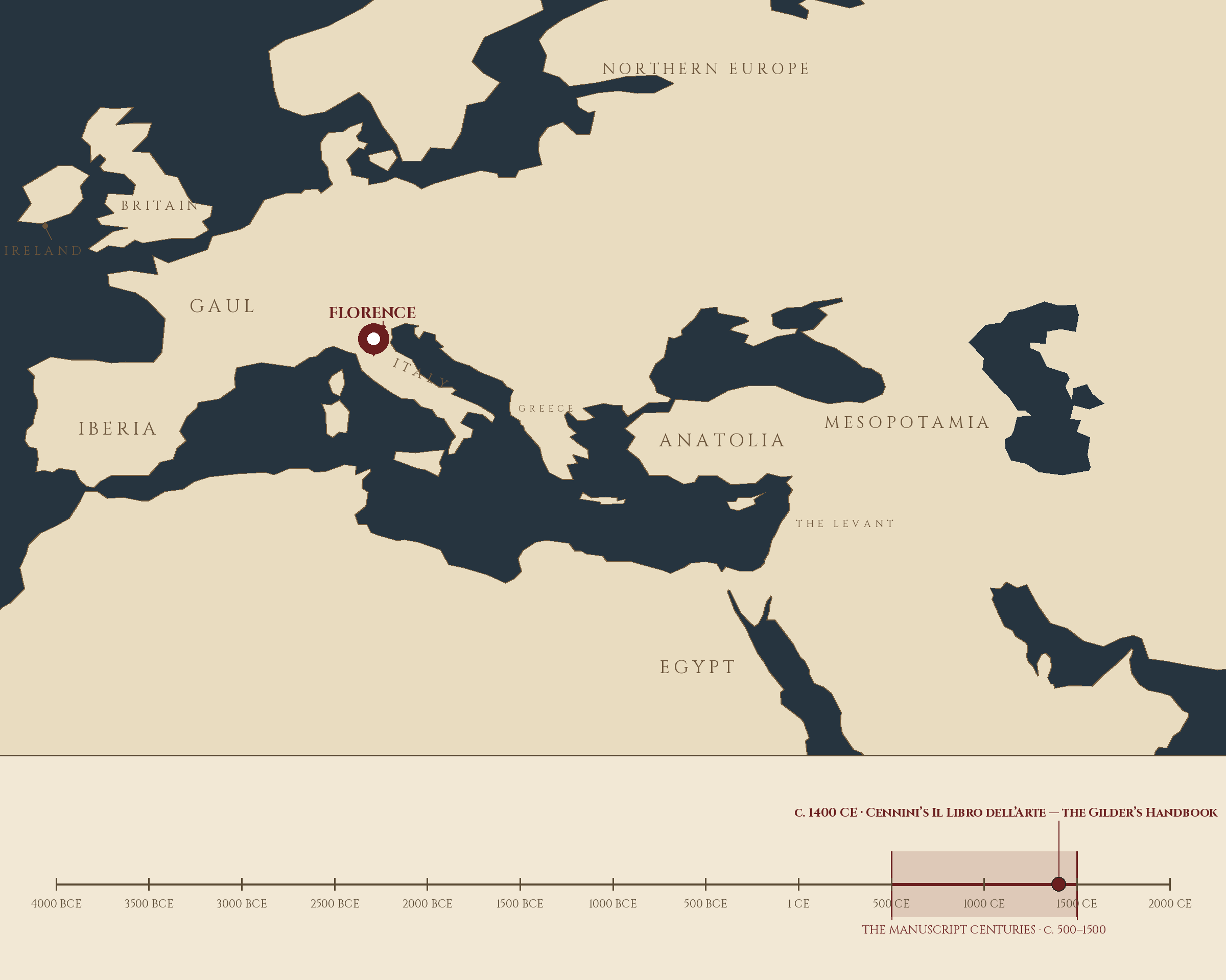
Where and when: Florence, Italy, c. 1400 CE — Cennini's Il Libro dell'Arte — the Gilder's Handbook. The pin is this lesson. The line beneath the map is our road: every stop a place where writing changed, every lesson a pin.
Lesson Objectives
By the end of this lesson, students should be able to:
- Define gold leaf and describe how it is made, including its approximate thickness.
- Distinguish raised gilding from flat gilding and name the ground used for each.
- Define gesso and explain why it was applied at a flat desk.
- Describe the burnishing process and name the tools used.
- Define shell gold and explain when an illuminator would choose it over leaf.
- Explain the symbolism of gold in medieval manuscripts and the origin of the word "illuminated."
- Gild a simple initial using household materials and evaluate the result honestly.
Reading this lesson: ★ marks the passages to remember. They return on the unit quiz and the class test. Check in questions ask the material back as you go; answer them in your workbook when you meet them.
Working this lesson: Your assignment packet is the first download on this page. Work in it as the lesson moves along, answering each assignment as its subject is taught — or read the lesson through for your notes and take the assignments as homework afterward. Both are proper ways to sit this class. Signposts in the reading tell you where each assignment belongs. Written answers are short answers in your own words; a few honest lines are worth more than a filled page.
Your Assignment Packet
This lesson's assignments live in its packet: the Lexicon Handout (every term, course terms marked ◆), Materials, Guided Practice, the Assignment Manual with its answer key for self-checking, the Reflection Questions, and the Workbook Checklist. Download the packet before you begin and keep it beside you as you read.
The Leaf Itself
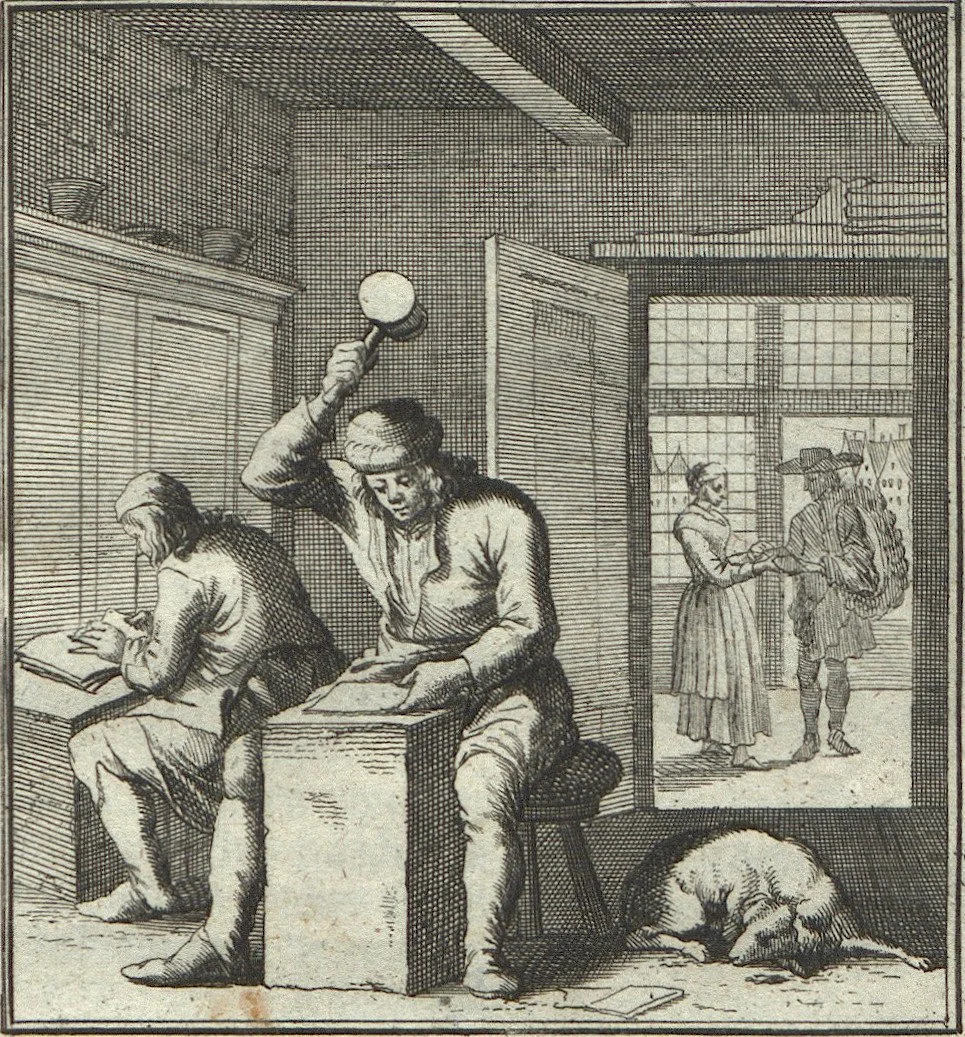
Making the leaf. A goldbeater at his beating block, hammer raised over the packet (Weigel's book of trades, 1698); beside him the finished leaves are made up into the little books of twenty-five that illuminators bought. Hours of this rhythm took gold from ribbon to a film a hundred nanometres thin — too light, almost, to feel.
The Goldbeater, from Christoph Weigel, Abbildung der Gemein-Nützlichen Haupt-Stände (Regensburg, 1698). Via Wikimedia Commons.
★ Before there is gilding, there is the leaf, and before the leaf there is an extraordinary act of patience. Gold is the most malleable of all metals. This is goldbeating. A goldbeater takes a small bar of gold, rolls it to a ribbon, cuts it into inch squares, and interleaves each square between fine skins in a packet. The beating goes through three packets in turn — the cutch, the shoder, and at last the mold. In the mold he beats it with a hammer weighing eight pounds, striking the packet for three to four hours, turning and folding, until each square has spread into a continuous sheet about six inches across and roughly one two-hundred-and-fifty-thousandth of an inch thick. At that thinness the gold transmits green light. A single ounce of gold can be beaten into more than a thousand leaves.
★ The finished leaves are trimmed on a leather cushion with a cane cutter and slipped into little books of twenty-five, interleaved with tissue rubbed with red ochre so the gold will not cling to the paper. That is how gold leaf still arrives today, and it is how it arrived in the medieval illuminator's workshop: twenty-five whisper-thin squares, each one capable of flying away on a breath.
Hold that image while you work. Everything difficult about gilding follows from it. The leaf cannot be gripped, pinched, or pressed. It can only be coaxed: lifted with a brush, breathed upon not at all, and laid onto a surface that is exactly tacky enough to catch it and exactly dry enough everywhere else to let the surplus be brushed away. The illuminator's whole art is the management of tackiness.
One more fact, and it is worth sitting with. Gold does not tarnish. Silver blackens, copper greens, iron rusts, and every pigment fades a little with the centuries. Gold, laid down in 1400 and closed in a book ever since, shines today exactly as it shone for the eyes that first saw it. When the illuminator laid gold on the page, he was laying down the one material in his whole workshop that time could not touch. Remember that when we come to what the gold meant.
Check in: How thick is a finished leaf, how heavy is the hammer that makes it, and how many leaves can one ounce of gold become?
❦ In your workbook: record the leaf's making in your own way: the ribbon, the skins, the hammer, the book of twenty-five, and the one fact about gold that time cannot touch — copy, sketch, or note what matters.
The Raised Road
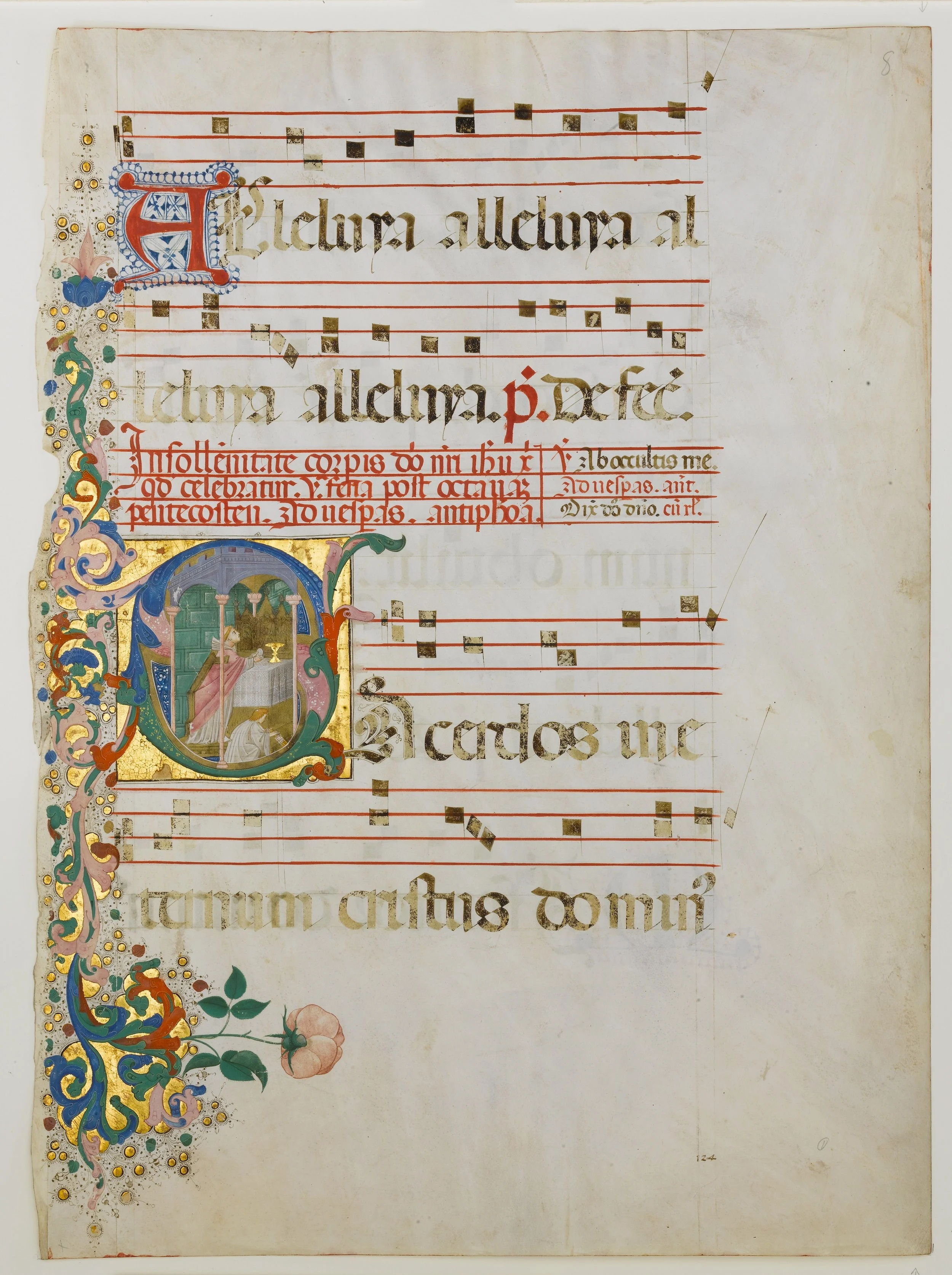
The raised road, finished. A choir-book initial (Italy, late 1400s) standing on a solid panel of burnished gold: leaf laid over its raised gesso cushion and polished with the burnisher until the surface stops looking like paint and starts behaving like metal — which is what it is.
Manuscript Leaf with the Celebration of a Mass in an Initial S, from an Antiphonary. Master of the Riccardiana Lactantius, Italian, second half of the 15th century. The Metropolitan Museum of Art, New York (96.32.8).
★ The grandest gilding — raised gilding — stands up from the page. For backgrounds, haloes, and the great historiated initials, the illuminator built a cushion first, and the cushion has a name you already half know from panel painting: gesso.
★ Manuscript gesso was a compound of plaster, white lead, and glue, often tinted a warm salmon pink so the gold laid over it would glow with extra warmth. The illuminator painted it onto the page in a damp blob, building it up to a soft mound, and left it to dry into a firm pad. Here is a detail I want you to keep, because it tells you how seriously the craft took its physics: this work had to be done at a flat desk. Writing was done at the sloped desk you studied in Lesson 1, but wet gesso would have run downhill before it dried, so for gilding days the illuminator worked flat. The desk itself changed shape for the gold.
★ When the gesso was completely dry, the illuminator breathed on the gesso to wake the glue in it, laid the gold leaf roughly cut to shape, and smoothed it into place with a scrap of silk. Then came the burnisher: a dog's tooth, or a polished stone of agate or flint, set in a handle. Rubbed over the gold with steady pressure, the burnisher compressed the leaf onto its cushion and polished it until it shone like a mirror. The edges of the leaf settled down onto the gesso pad, and the burnisher nipped off the surplus, which was gathered up with a soft brush to be used again. Nothing was wasted. Gold was wealth, and the workshop swept its benches like a treasury.
Look at a burnished initial in a manuscript, the great gold B of a psalter or the blazing ground behind a saint, and you are looking at light that has been waiting six hundred years for your eyes. The burnisher's work does not fade. That is the raised road: the most labor, the most gold, and the most light.
Check in: What is manuscript gesso made of, why did its work demand a flat desk, and what does the burnisher do to the leaf?
❦ In your workbook: record the raised road in order in your own way: the gesso cushion, the flat desk, the leaf, the silk, and the burnisher's mirror — copy, sketch, or note what matters.
Professor Nocturne
Wait, scholars, and consider what you have just read with a craftsman's suspicion.
The raised road sounds like the best road. The brightest gold, the grandest effect, the mirror shine. So why did the illuminator not gild everything raised? Ask the question properly and the answer teaches you the whole economy of the medieval workshop.
Raised gilding costs time, and time was the workshop's true currency. The gesso must be mixed, laid, and dried. The leaf must be cut, laid, and burnished. Each stage waits on the last, and a book of hours might hold a hundred gilded initials. A workshop that raised every one of them would never finish the book.
So the illuminator kept three roads open and chose among them the way a scribe chooses scripts: the grandest effect where the eye must stop, the quieter effect where the eye must only rest, and the painted gold where the hand must draw a line no leaf could follow.
Learn all three roads. Then choose like a professional.
In your packet: Assignment III — The Burnish Test ◐ begins here. Work it now, or mark the place and take it as homework — your choice.
The Flat Road
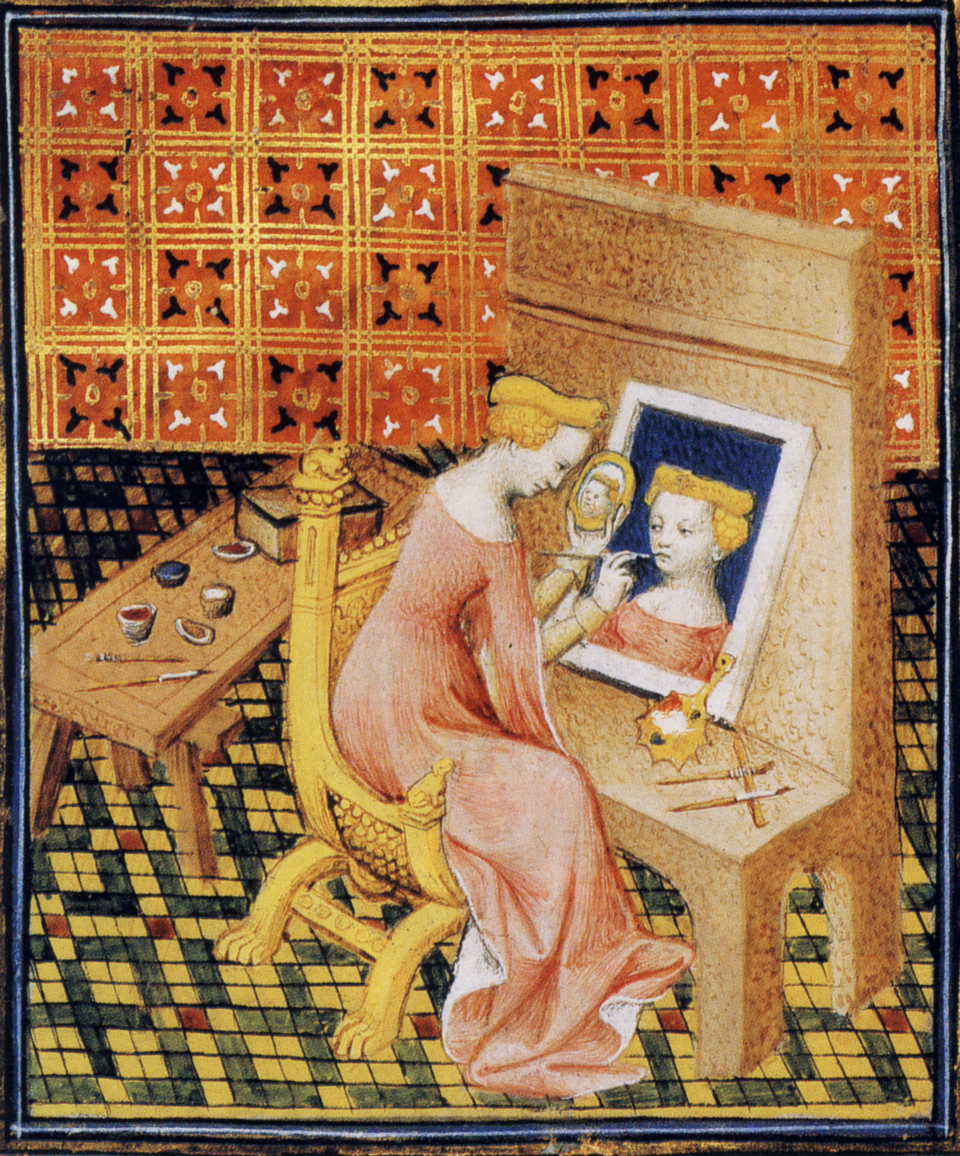
Gold from a shell. A painter at work in a French miniature of the 1400s, her colours kept in little shells on the table beside her. Shell gold — real gold, ground fine and bound with gum — was kept and used in just this way, painted on with a brush. It could glow, but it could never be burnished to the mirror of the raised road.
Marcia painting her self-portrait, from Giovanni Boccaccio, De mulieribus claris. French, 15th century. Bibliothèque nationale de France. Via Wikimedia Commons.
★ Not every golden thing on the page stands up from it. For smaller ornaments, fine gold lines, the diaper patterns on robes, and delicate border work, the illuminator took the flat road: gold leaf laid directly onto the page over a thin size of gum arabic, fish glue, or glair — beaten egg white, strained clear — with no gesso cushion beneath.
★ Flat gilding was quicker and used less gold, and it gave a different light: softer, matte, often left unburnished. Cennino Cennini, who wrote the great craftsman's handbook Il Libro dell'Arte around 1400, advised his readers on buying gold for the flat work. It should look, he said, rippling and matte like goat parchment. The gold for moldings and fine ornament could be thinner still, thin as a cobweb. He knew, as every gilder knew, that flat gold and raised gold were different materials in practice, whatever the goldbeater's book said.
★ And then there is the third road, which is not leaf at all. Shell gold is gold ground to powder, mixed with gum arabic, and kept in a mussel shell like paint in a pan. With a fine brush the illuminator could draw with gold: lettering, the outlines of garments, strands of hair, the narrow rays of a halo, the glint on a sword. Shell gold could be gently burnished when dry, but it never gives the unbroken mirror of leaf. The tiny particles of ground gold stay visible, and the light it returns is softer and granular, like sunlight on water rather than sunlight on glass.
The medieval workshop manuals describe all of this plainly. Theophilus, a German monk writing his De diversis artibus in the twelfth century, gives recipes for grinding gold for manuscript painting. Cennini gives instructions for every stage. These men were not guarding secrets. They were writing down a trade, the way I am writing it down for you now, so that the knowledge would survive the hands that held it.
Check in: What does flat gold lie on, and why can shell gold never give the unbroken mirror of leaf?
❦ In your workbook: record the flat road and the painted road in your own way: the thin sizes, Cennini's rippling matte gold, and shell gold in its mussel shell — copy, sketch, or note what matters.
In your packet: Assignment II — The Gilded Initial ◐ begins here. Work it now, or mark the place and take it as homework — your choice.
Why Gold
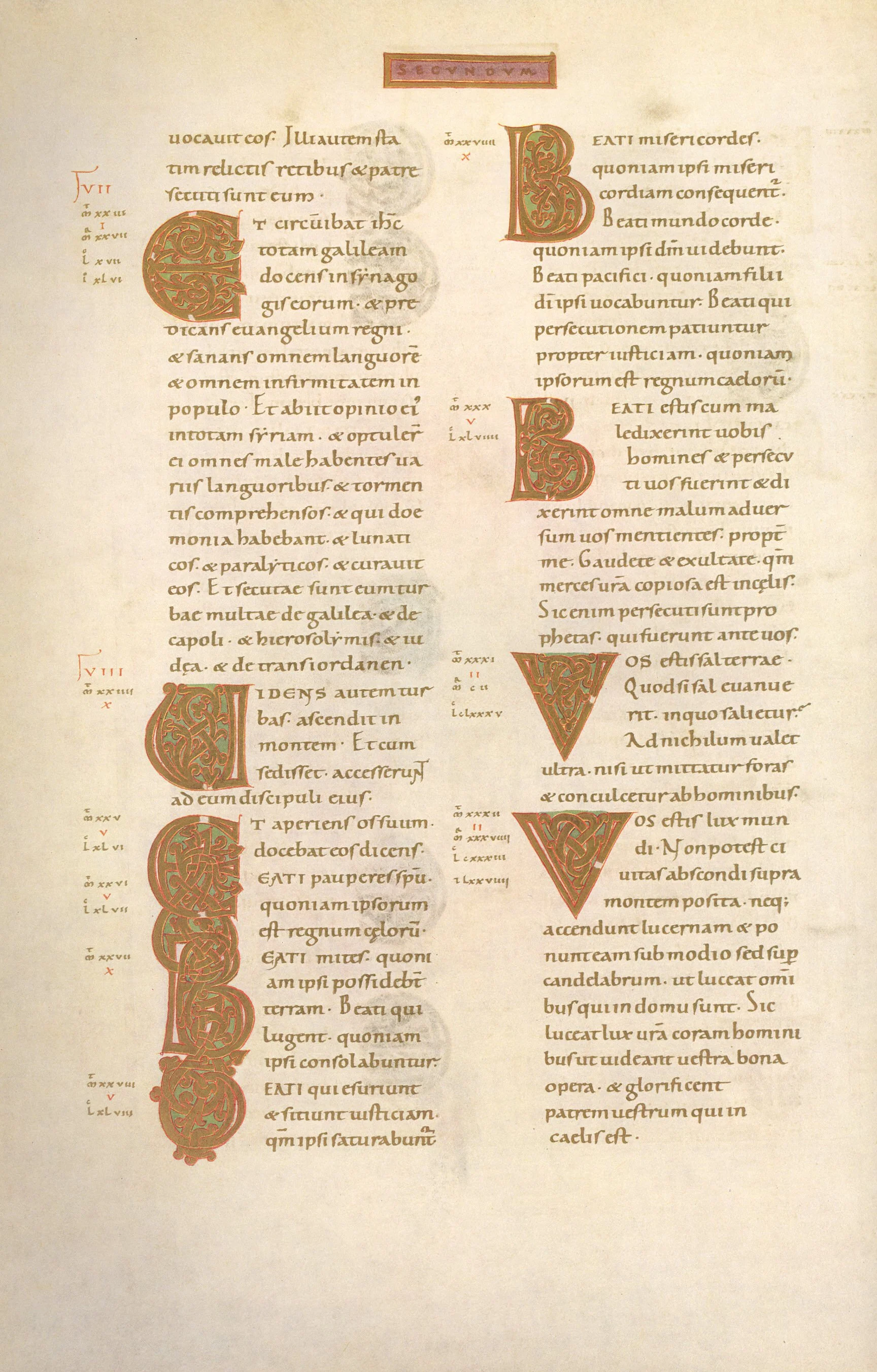
A book written in gold. A page of the Golden Gospels of Echternach (c. 1030–1050), whose entire text is gold ink: the Beatitudes in two golden columns, the initials interlaced in red and green, the canon numbers in red in the margin. Some early Gospel books were written this way from cover to cover — the word itself made precious metal.
Codex Aureus of Echternach (Golden Gospels), Echternach Abbey, c. 1030–1050. Germanisches Nationalmuseum, Nuremberg. Via Wikimedia Commons.
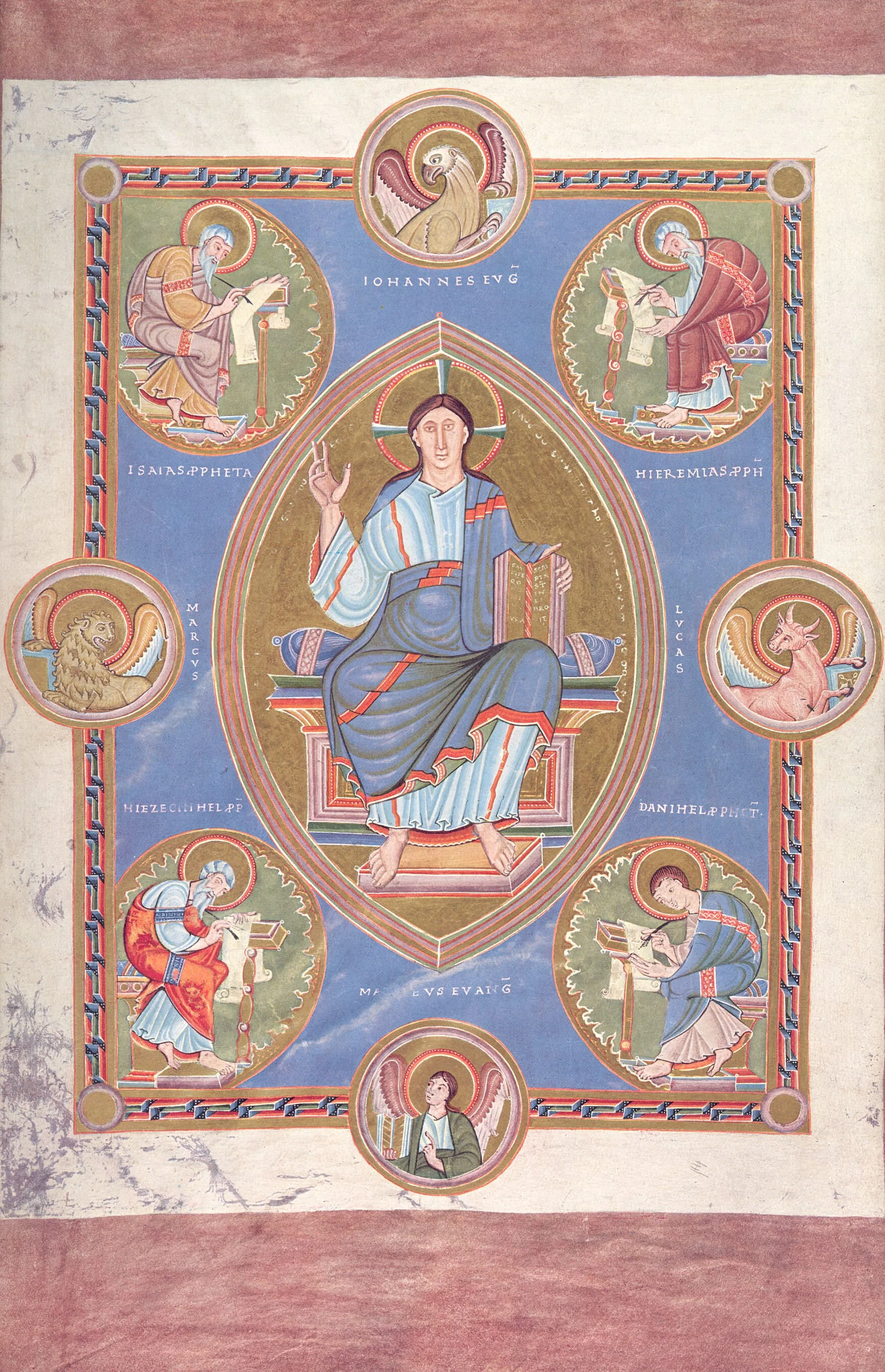
Gold as the light of heaven. Christ in Majesty from the Golden Gospels of Echternach (c. 1030–1050), enthroned in a mandorla of solid gold, the Evangelists writing in the roundels around him. In the style that came down from Byzantine mosaics and icons, gold is not a background colour — it is light itself, and everything holy stands in it.
Codex Aureus of Echternach (Golden Gospels), Echternach Abbey, c. 1030–1050. Germanisches Nationalmuseum, Nuremberg. Via Wikimedia Commons.
★ Now the question beneath the technique. Why gold at all? Why did the medieval book, of all the objects in the medieval world, get covered in it?
The first answer is theological, and it is the one the illuminators themselves would have given. Gold does not tarnish, and in a world that read decay as a moral fact, the untarnishing metal spoke of heaven. To set sacred words in gold, or to set the saints against a ground of gold, was to say that what the page carried belonged to a light that does not fail. The gold-ground style, with whole backgrounds laid in gold, came to the West from Byzantine mosaics and icons, where the glittering ground had long meant the uncreated light of heaven. When a scribe wrote a Gospel in gold, and some early Gospel books were written entirely in gold ink, he understood himself to be praising God with his materials.
The second answer is worldly, and Nocturne does not pretend otherwise. Gold displayed wealth. A patron who commissioned a book thick with gilding was announcing, in the most legible language available, exactly how much magnificence he could afford. Gold marked the important feasts, the important prayers, the important owners.
★ And here is the honest footnote the romantics leave out. Gilding became so fashionable, and gold in the later Middle Ages became so comparatively cheap, that by the end of the period gold accounted for only a small share of a fine manuscript's cost of production. The labor, the vellum, the pigments, the scribe's and illuminator's time: those were the true expenses. Gold's value as a measure of a book's splendor quietly degraded, the way any fashion degrades when everyone can afford it. The light stayed divine. The price did not.
Keep both answers in your head at once. The gold on the page is theology and economics laid down in the same leaf, and a scholar who sees only one of them is seeing only half the page.
Check in: Gold was only a small share of a fine book's cost by the late Middle Ages. What were the true expenses, and what was the gold buying that they could not?
❦ In your workbook: record the two answers together in your own way: the theology of the untarnishing light and the economics of the small share, and what each one explains about a page — copy, sketch, or note what matters.
In your packet: Assignment IV — Where the Gold Falls ✎ begins here. Work it now, or mark the place and take it as homework — your choice.
Guided Practice
Safety Note — Read Before Any Gold Work
From this lesson's original packet, where it stood first, before the materials.
Loose gold leaf is lighter than breath. Work away from open windows, fans, and heating vents. Never touch gold leaf with your fingers: the oils on your skin will ruin it and it will cling to you instead of the page. Keep brushes out of your mouth and wash your hands after handling gilding materials. Level Two work with real gold leaf requires an adult present for the entire session. Do not substitute historical white lead: it is poisonous, and modern gesso is the safe equivalent.
Assignment IV — Where the Gold Falls ✎ ★
Objective: Read a real illuminated page the way the lesson taught: gold as hierarchy and as meaning.
Instructions:
- Choose a digitized illuminated manuscript page from a museum collection (the British Library's digitised manuscripts, the Morgan Library, or the Getty are good hunting grounds). Pick a page with visible gilding.
- List every place gold appears on the page: initials, borders, haloes, backgrounds, line-fillers. Be exhaustive.
- For each gilded element, write one sentence on which kind of gold it appears to be: raised and burnished (mirror shine, dimensional), flat (softer, matte), or painted shell gold (fine lines, granular light). Admit uncertainty where the photograph does not let you decide.
- Write a final paragraph: what does the placement of the gold tell you about what the page's makers thought mattered most? Connect your answer to the lesson's two explanations: the theology of untarnishing light, and the economics of patron display.
To submit: A link or print of the page with your annotated list and final paragraph.
❦ Workbook path: working from a printed reproduction instead? Annotate the print itself, element by element, keep it folded into your workbook, and write the list and the final paragraph on the workbook pages facing it.
Materials
Required (Level One — household items)
- Heavy paper or card: watercolor paper, cardstock, or a manila folder. Thin printer paper will buckle under size and paint; the illuminator's ground must hold still.
- Metallic gold acrylic paint or a gold paint marker: your stand-in gold leaf. Acrylic gives the flattest, most leaf-like film; markers give the finest lines for shell-gold-style work.
- White glue (PVA) thinned with water: your stand-in size. Painted thin, left to turn tacky, it grips like glair for the purposes of this lesson.
- A soft flat brush and a fine round brush: the flat brush lays the 'leaf'; the fine brush draws the shell-gold-style lines.
- A teaspoon: your burnisher-substitute. The smooth back of the bowl, rubbed gently over dried gold paint, demonstrates what the agate did to leaf.
- Pencil, ruler, and eraser: for drawing the initial and ruling the border lines before any gold goes down. Gold forgives nothing; the drawing comes first.
- Internet access: for Assignment IV's study of a digitized illuminated page.
Suggested (Level Two — historically closer)
- A booklet of genuine gold leaf (25 leaves): the real material, available from art suppliers. Handle only with a soft brush; never with fingers. Adult supervision required for the whole session.
- Prepared gesso or acrylic gesso: the safe modern equivalent of the historical cushion. Do not make or use historical white-lead gesso.
- Gilder's tools if available: a gilder's tip (flat soft brush) for lifting leaf and a real agate burnisher. A teaspoon remains an honest substitute.
- Gum arabic solution or acrylic gold size: the modern flat-gilding adhesive. Follow the manufacturer's tack-time instructions exactly; tackiness is the whole art.
No purchased kits are required. The core lesson (the three roads, the burnish comparison, the hierarchy study) is fully achievable with card, gold paint, glue, and a spoon.
Reflection Questions
Answer the following questions in your workbook.
- Why is gilding not painting? What is the difference between color on the page and light on the page?
- The illuminator kept three roads to gold: raised, flat, and painted. Why not use the grandest road for everything?
- Why did gesso work have to be done at a flat desk when writing was done at a sloped desk?
- What did your burnish test show, and what does it suggest about why workshops paid for burnishing labor?
- On the strictest definition, what makes a manuscript 'illuminated,' and where does that word come from?
- The lesson gives two explanations for gold on the page: theology and economics. Which one do you find more convincing for the page you studied in Assignment IV, and why?
Workbook Checklist — Lesson 18
In my workbook I have:
- ☐ defined gold leaf and described how it is made, including its approximate thickness
- ☐ distinguished raised gilding from flat gilding and named the ground used for each
- ☐ defined gesso and explained why it was applied at a flat desk
- ☐ described the burnishing process and named the tools used
- ☐ defined shell gold and explained when an illuminator would choose it over leaf
- ☐ explained the symbolism of gold in medieval manuscripts and the origin of the word "illuminated"
- ☐ gilded a simple initial using household materials and evaluated the result honestly (Assignments II–IV)
☐ Lesson completed Date: ___ Signature: ___
Professor's Review
And so the page shines, scholars, and you know now exactly why.
You know the leaf: gold beaten to a whisper, twenty-five leaves to the book, green light passing through it at the thinnest. You know the raised road: the gesso cushion, the flat desk, the silk, and the dog-tooth burnisher that polishes gold into a mirror. You know the flat road: gum arabic, fish glue, glair, and gold laid thin for the smaller glories. You know the painted road: shell gold in its mussel shell, drawing light with a brush where no leaf could go.
And you know why. Because gold does not tarnish, and the men and women who laid it on the page read that fact as theology. Because patrons paid for splendor and got it. Because on the strictest definition, without gold the page is decorated but not illuminated, and this library does not deal in the almost.
In our next lesson, we turn from the gold to what grows around it: the borders, the vines, the leaves that frame the light. But the gold comes first, as it came first on the page. Nothing else on the manuscript shines without it.
PROFESSOR QUILLBERRY NOCTURNE
Scrollwork Library
Master Scribe & Illuminator
Cross-Class Connections

Creative Arts · Unit I, Lesson 5 — Adhesives, Heat, Wax & Glass
I keep glair on my workshop glue shelf, beaten egg white, and I tell my own scholars plainly that Professor Nocturne's Unit V students will meet it again from the page's side. The size that lays your flat gold tonight is mixed in my room. Come and see where your size comes from, and mind the shelf it sits on.
Creative Arts · Unit VII, Lesson 29 — Foil, Wire & Simple Metalwork
In my metalwork lessons, foil is metal rolled or hammered very thin, and gilded foil was the splendor of early medieval mounts. Your leaf is gold beaten until it flies; my foil is metal beaten until it bends. Same patience, heavier hammer. Come and try the heavier hammer.
PROFESSOR COGBRANCH TIMBERCLANK
Creative Arts Workshop
Runes · Lesson 16 — The Danube Hybrid
My classroom holds the Silver Book, the Codex Argenteus: Gospels written in silver and gold ink on purple-dyed parchment, the most luxurious materials the ancient world knew for a book. That is gold ground to ink, not beaten to leaf. Professor Nocturne's gold is laid; mine is written. Come and read my book's story, then go back and lay yours.
PROFESSOR THISTLELOOM WEBBLETHORN
Runes & Ancient Writing
Further Reading & Sources
For scholars who want to go deeper into gilding and illumination, these are the places I send my own students first.
*Cennino Cennini. Il Libro dell'Arte (c. 1400), translated by Daniel V. Thompson as The Craftsman's Handbook. Dover, 1954.* The great workshop manual of the early Renaissance, written by a painter trained in the medieval tradition. Cennini gives practical instructions for gilding on panel and in books: what gold to buy, how it should look, and how to lay it. The cheapest way to read a medieval craftsman's mind.
*Theophilus. De diversis artibus (On Divers Arts, 12th century), translated by John G. Hawthorne and Cyril Stanley Smith. Dover, 1979.* A German monk's manual of craft, a century older than Cennini, with recipes for grinding gold for manuscript painting among its many workshop instructions. The translators' notes on the metalwork are unusually good.
Browse the Scrollwork shelf in the school Library for readable editions of these works.
Submit your work for this lesson using the form below.
CONTINUE IN THE SCROLLWORK LIBRARY
← Previous · Lesson 17: Hierarchy & Page Layout Next · Lesson 19: Botanical Borders & Ornament →
Unit V — Manuscript Decoration Scrollwork Library — All 26 Lessons
The rest of Unit V: Lesson 17 · Hierarchy & Page Layout · Lesson 19 · Botanical Borders & Ornament · Lesson 20 · Marginalia & Manuscript Creatures