

SCROLLWORK
Unit V · Lesson 19BOTANICAL BORDERS & ORNAMENT
Professor Quillberry Nocturne
Master Scribe & Illuminator
The Scrollwork Library • School of Evershade
Professor's Introduction
To the margins, scholars. You have written the words. Now you will learn to frame them.
Open any great medieval book and your eye goes first not to the text but to the edge of the page, where the border blooms. Ivy leaves climb a bar of burnished gold. Acanthus unfurls in blue and copper. White vines knot themselves against red and green. The border is the manuscript's promise: what lies inside these words is worth the beauty around them.
Do not mistake the border for mere prettiness. Every border you will study tonight is built from small, repeatable units, a leaf, a berry, a spray, a dot, and the illuminator's whole art is learning to grow complexity from simplicity. That is a lesson about far more than decoration.
Take up your colors. Tonight the page gets its garden.
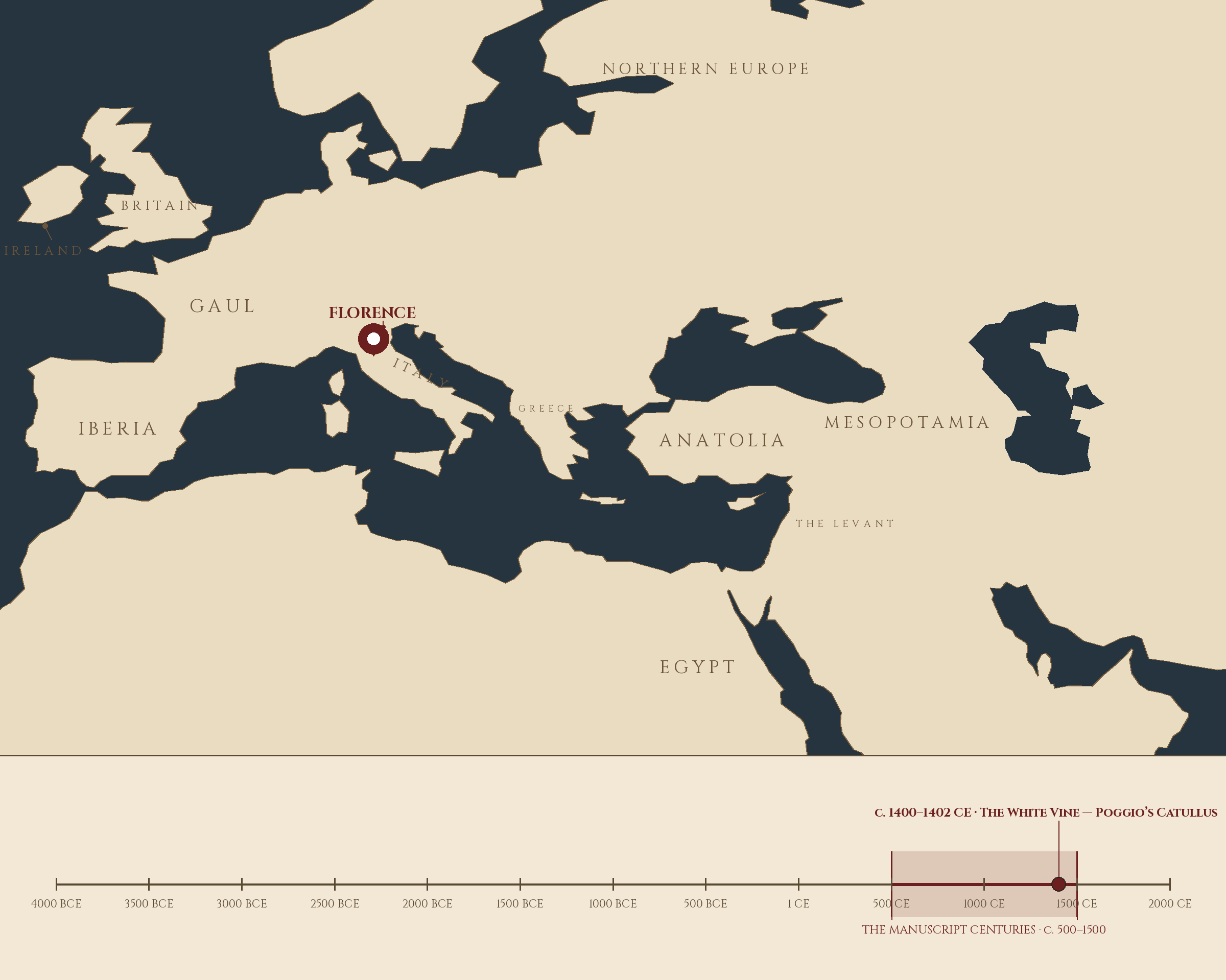
Where and when: Florence, Italy, c. 1400–1402 CE — The White Vine — Poggio's Catullus. The pin is this lesson. The line beneath the map is our road: every stop a place where writing changed, every lesson a pin.
Lesson Objectives
By the end of this lesson, students should be able to:
- Define a bar border and distinguish full, partial, and one-sided borders.
- Describe the ivy-leaf border tradition and identify its period and region (France and Flanders, 14th and 15th centuries).
- Define acanthus ornament and explain its classical roots and Renaissance revival.
- Define the white-vine (bianchi girari) style and date its first appearance to the early 15th century.
- Distinguish historiated initials from inhabited initials.
- Define puzzle initials and explain why penwork flourishing was the quickest way to color a page.
- Design and draw an original border using the repeatable-unit method.
Reading this lesson: ★ marks the passages to remember. They return on the unit quiz and the class test. Check in questions ask the material back as you go; answer them in your workbook when you meet them.
Working this lesson: Your assignment packet is the first download on this page. Work in it as the lesson moves along, answering each assignment as its subject is taught — or read the lesson through for your notes and take the assignments as homework afterward. Both are proper ways to sit this class. Signposts in the reading tell you where each assignment belongs. Written answers are short answers in your own words; a few honest lines are worth more than a filled page.
Your Assignment Packet
This lesson's assignments live in its packet: the Lexicon Handout (every term, course terms marked ◆), Materials, Guided Practice, the Assignment Manual with its answer key for self-checking, the Reflection Questions, and the Workbook Checklist. Download the packet before you begin and keep it beside you as you read.
The Vocabulary of the Edge
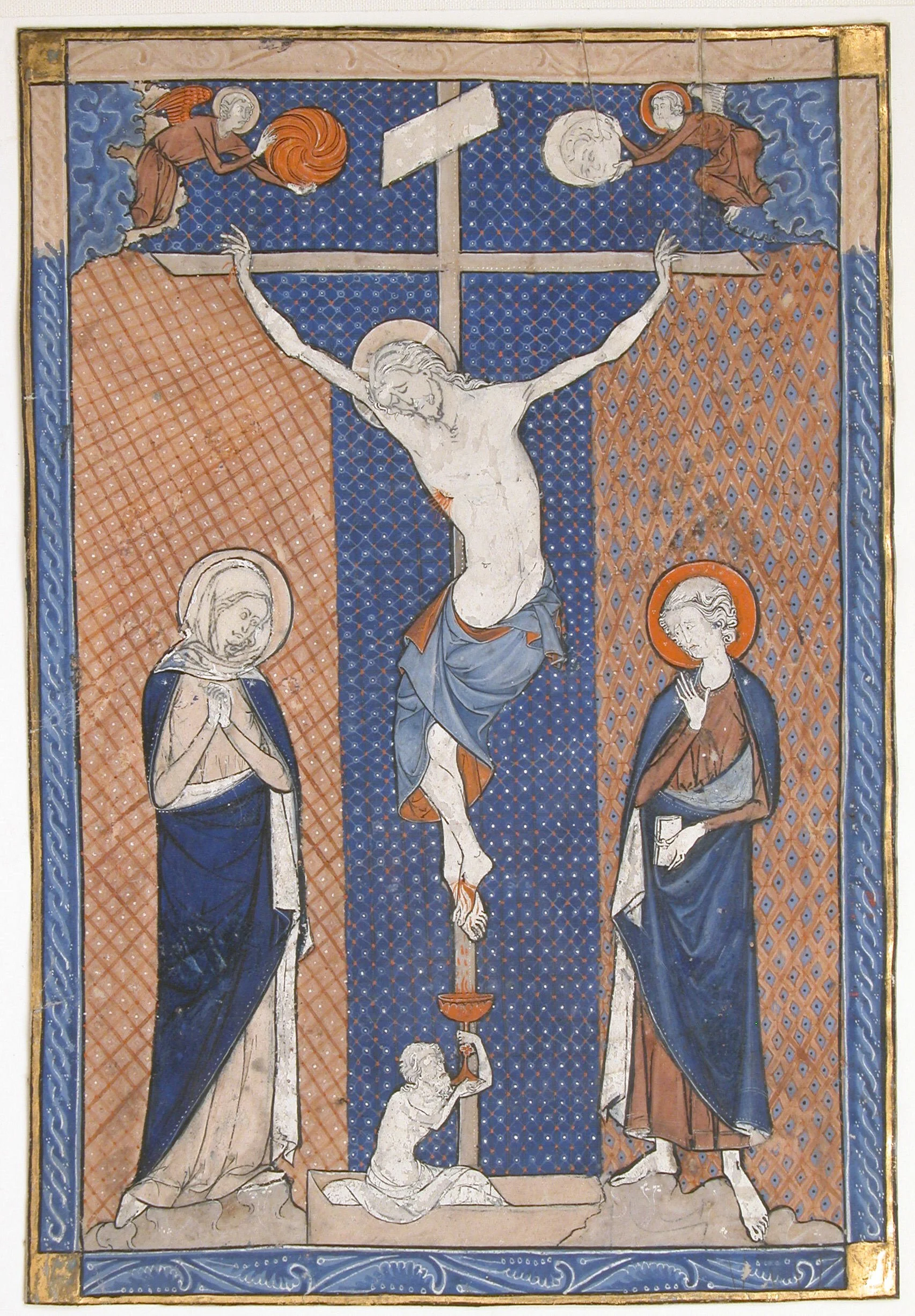
Diapering: pattern where plain gold would go. Behind this Crucifixion (France, about 1270–80) the grounds are not empty colour but repeated pattern — a dotted blue lattice behind the cross, rose lozenges to either side. Thirteenth-century illuminators diapered their grounds the way masons diapered walls: the surface itself is ornamented, all over, evenly.
Manuscript Leaf with the Crucifixion, from a Missal. French, ca. 1270–80. The Metropolitan Museum of Art, New York (1981.322).
Before we draw anything, we need words for what we see, because the medieval border has an anatomy, and every part of it has a job.
Stand before a great manuscript page, a Parisian book of hours, a Florentine choirbook, a Flemish psalter, and look at the margin. The border is not a frame in the modern sense. It does not simply surround. It grows. Stems climb from the text block into the white space, leaves unfurl, gold dots catch the light, and somewhere in the tangle a bird or a dragon may be hiding. The border announces that the words inside are worth more than plain ink.
Medieval borders take several characteristic forms, and you should learn to name them on sight. The bar border is among the oldest: one or more straight bars, often in blue and rose with white filigree, running beside the text, with sprays of foliage extending from the bars into the margins. Thirteenth-century French and Flemish psalters are full of them, and a fine description survives in auction records of a Flemish psalter leaf of about 1210 to 1240, where illuminated initials join "altogether in a one-sided bar border on alternately burgundy and blue ground." The bar anchors the decoration; everything else climbs from it.
The full border surrounds the text on all four sides, a complete garden around the words. The partial border decorates two or three sides, often extending from a large initial. The one-sided border fills one margin only, usually growing from a single bar. Great books vary their borders by the importance of the text: the grandest pages get full borders, lesser divisions get partial ones, and the hierarchy of the book is written in leaves and gold before a single word is read. You studied hierarchy itself in our last lesson but one; the border is hierarchy made visible.
And then there are the families of foliage, each with its own century and its own country, and learning to tell them apart is one of the great pleasures of manuscript study. That is where we go next.
Check in: Three border forms and a bar. Which form surrounds the text on all four sides, which decorates two or three sides, and what does the bar border anchor?
❦ In your workbook: record the border's forms, the bar, the full, and the partial, and what the border announces about the words inside in your own way — copy, sketch, or note what matters.
Professor Nocturne
To the edge, scholars, and consider what the border is actually doing.
The text is the treasure. The border is the chest it is kept in. No scribe spent weeks painting ivy leaves because the words needed leaves. The border says: someone believed these words were worth the labor of beauty. Every border is an act of valuation.
But notice something else. The border never touches the meaning of the words. It frames them, honors them, and leaves them entirely alone. The illuminator's highest art is devotion that does not interfere.
Remember that when you draw your own. The border serves the text. It never shouts over it.
The Four Great Border Families
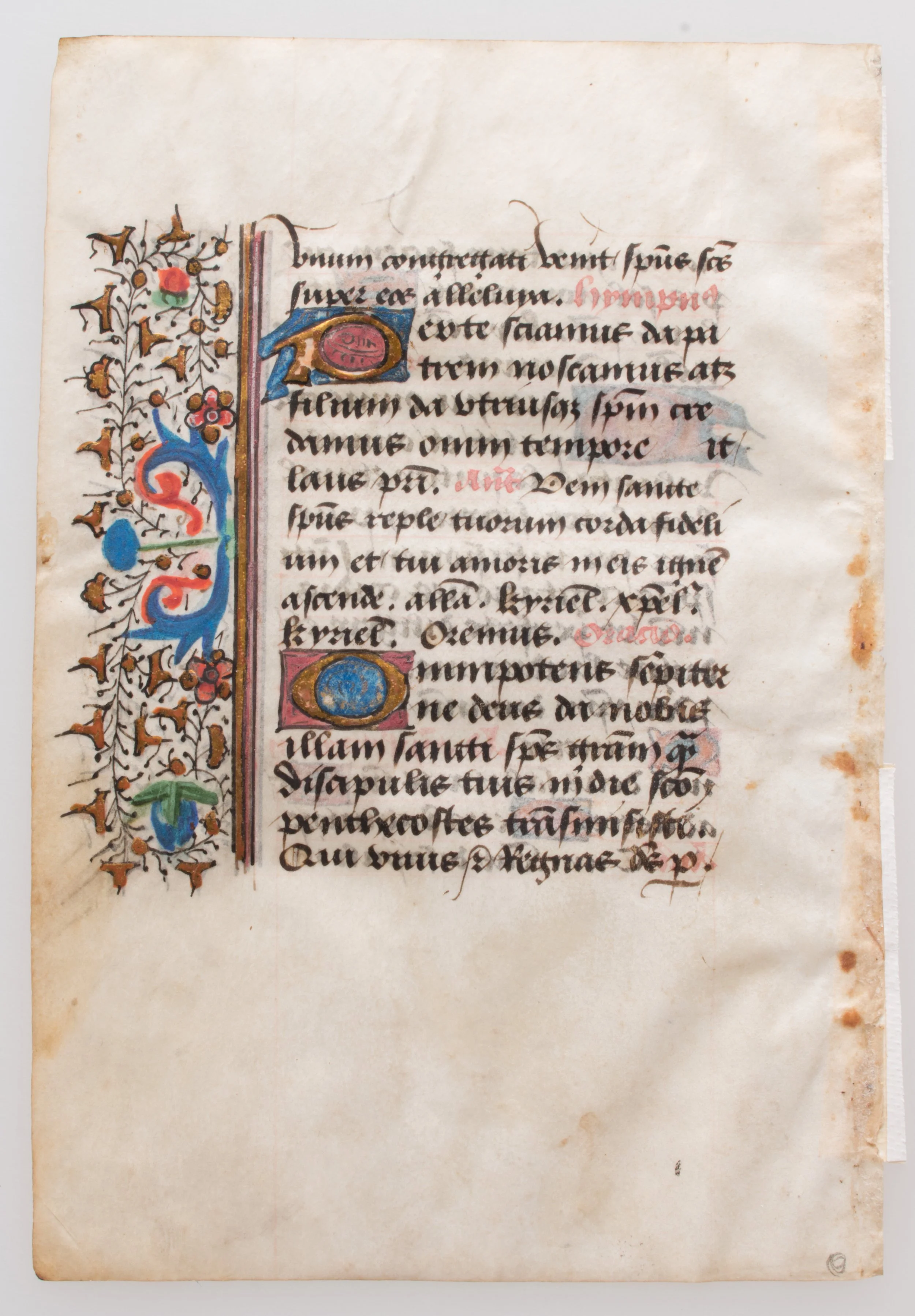
The ivy-leaf family. Down the edge of this little Book of Hours leaf (France, 1400s) runs the French and Flemish favourite: three-pointed ivy leaves in gold on hairline stems, with flowers and berries, growing from the initials beside a striped bar. A whole border system built from one small repeatable leaf.
Manuscript Leaf, from a Book of Hours. French, 15th century. The Metropolitan Museum of Art, New York (2003.493).
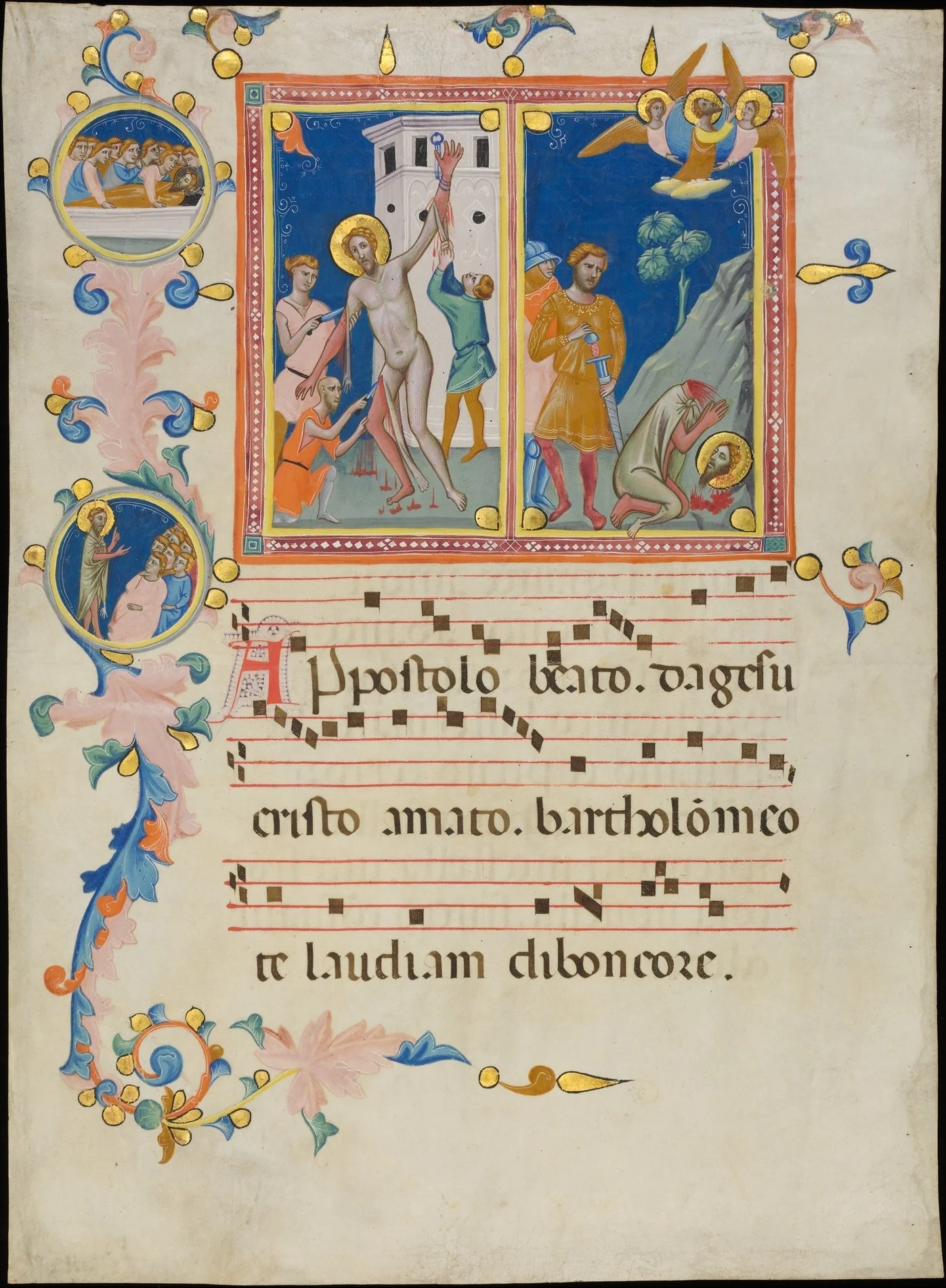
Acanthus and gold discs. The border of this Florentine song-book leaf (Pacino di Bonaguida, about 1340) is built of bold curling acanthus in pink, blue and green, with discs of gold set among the leaves and whole scenes carried in roundels — the Italian border manner that the Renaissance would take up and flood across Europe.
Manuscript Leaf with the Martyrdom of Saint Bartholomew, from a Laudario. Pacino di Bonaguida, Italian, ca. 1340. The Metropolitan Museum of Art, New York, The Cloisters Collection (2006.250).
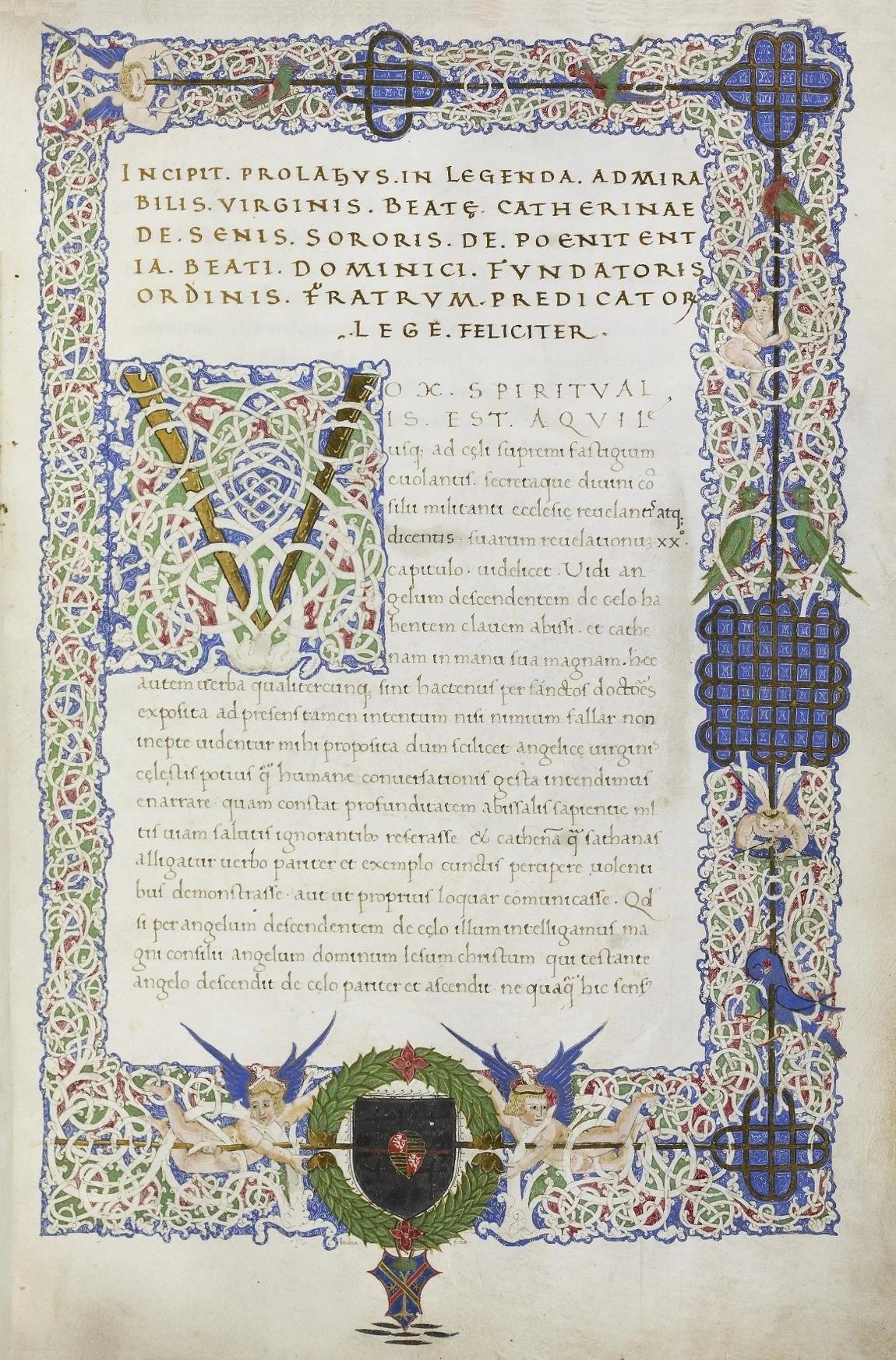
White vine, whole. Every side of this page (Italy, about 1470) is framed in bianchi girari — white vine: the stems left unpainted, interlacing and knotting against grounds of blue, red and green, with birds and putti in the weave and the initial itself built of gold vine. The white-vine border was invented in Florence around 1400; this is the invention grown splendid.
Legenda San Catherinae de Senis (Life of Saint Catherine of Siena), folio 10r: Initial V with White Vine Decoration. Italian, ca. 1470. The Walters Art Museum, Baltimore (W.350).
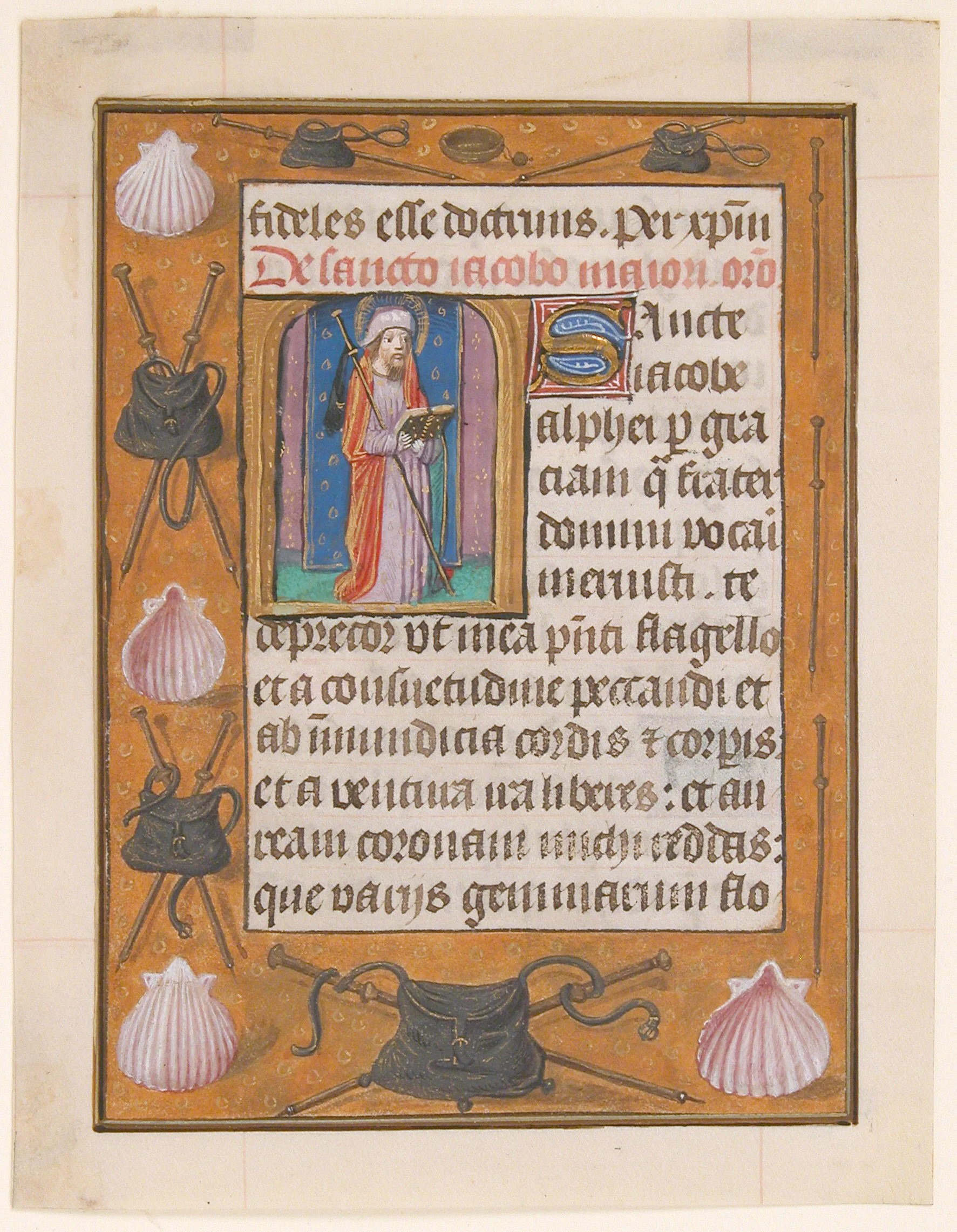
Strewn on gold. Around this prayer to Saint James (Netherlands, about 1500) the border is not a pattern but a scattering: scallop shells, pilgrims' scrips and staffs painted as if they lay on the gold ground itself. The late Flemish border painters strewn flowers, strawberries, insects and jewels the same way — real things, really painted, lying loose on the margin.
Manuscript Leaf with Saint James the Greater, from a Book of Hours. Netherlandish, ca. 1500. The Metropolitan Museum of Art, New York, The Friedsam Collection (32.100.475d).
Learn these four, and you can date and place half the decorated books in Europe.
★ The ivy leaf: France and Flanders, 14th and 15th centuries. The 1911 Encyclopaedia Britannica, still one of the clearest surveys of the subject, records the moment precisely: with the opening of the 14th century, "the three-pointed leaf, or ivy leaf, appears" in French and Flemish illumination, and it "soon becomes fixed and flourishes as a typical detail of ornament in French illumination of the 14th and 15th centuries." Small three-pointed leaves on hairline stems, scattered with gold dots and buds, growing from bar borders or drifting free in the margin. In England, the same centuries favored less conventional growths, daisy-buds, acorns, oak leaves, but in France the ivy leaf ruled for two hundred years. When you see those neat three-pointed leaves, you are looking at Paris.
★ The acanthus: Italy, 15th century. The acanthus leaf comes from stone, not from gardens. It crowns the Corinthian capitals of Roman temples, and when Italian humanists of the Renaissance reached back to classical antiquity, they brought the acanthus with them into their books. Manuscript acanthus is bold and architectural: broad curling leaves in copper, blue, green, and pink, dotted with discs of burnished gold. A German or Netherlandish psalter leaf of about 1500, sold at auction in our own century, shows borders that are "a mass of twining copper, blue, gold, pink and green acanthus leaves, dotted with discs of burnished gold." The illuminator's acanthus does not pretend to be a real plant. It is the idea of classical ornament, translated into paint.
★ The white vine: Florence, from about 1400. The bianchi girari, the white vines, are among the most distinctive borders ever devised: white interlacing scrolls with flattened knots, trilobes, and palmettes, set against flat grounds of red, blue, green, or yellow — solid here, where other books patterned the ground with diapering, a small repeated geometry in color and burnished gold. They were invented alongside the humanist script itself, first appearing in a manuscript of Catullus copied in Florence about 1400 to 1402, in the circle of Poggio Bracciolini, to whom its copying has been attributed. For most of the 15th century, white-vine borders announced an Italian humanist book the way ivy leaves announced a French one. The style faded from Italy by the end of the century, but while it lasted, nothing else looked like it.
The naturalistic garden: Flanders, late 15th century. Last comes the border that tried to stop being a border at all. Flemish illuminators of the later 1400s painted flowers, strawberries, insects, and jewels scattered across the margin as if the page were a meadow, sometimes with trompe l'oeil ("fools the eye") shadows as though real objects lay on the parchment. After centuries of stylized leaves, the border suddenly wanted to be nature itself. It is gorgeous, and it is the end of the road: within a generation, printed books would take over, and the painted border would become a luxury rather than a language.
Four families, two centuries, three countries. Learn the leaf, and you learn the book.
Check in: You are shown a border of small three-pointed leaves on hairline stems, scattered with gold dots. Which family is it, which country, which centuries? And a border of white interlacing scrolls on a red ground?
❦ In your workbook: record the four border families with the leaf, the country, and the century that marks each in your own way — copy, sketch, or note what matters.
In your packet: Exercise II — The Acanthus Corner ⚒ begins here. Work it now, or mark the place and take it as homework — your choice.
The Initials That Bloom
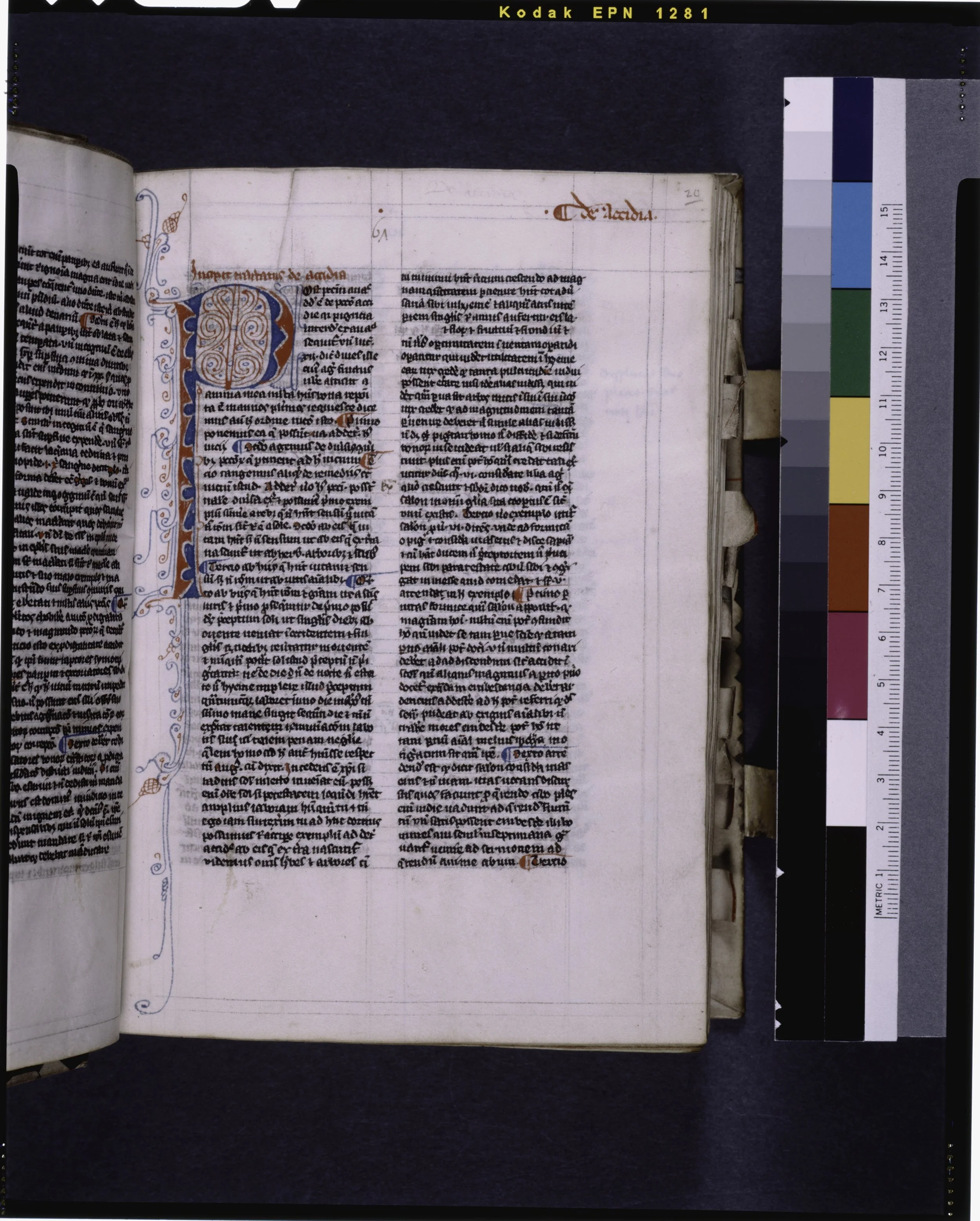
The puzzle initial. Red and blue fitted together like joinery, the gaps filled with penwork spirals — and the flourishing already escaping: filigree climbs the margin above the letter and trails down the page. This is the border being born. The quickest way to colour a whole page was a letter built like this (the treatise it opens, on sloth, begins under the running head "De accidia").
Manuscript page with large puzzle initial and penwork extending into the border. New York Public Library (Manuscripts and Archives Division); R. L. Stuart collection, bequeathed 1892.
The border does not stand alone. At its heart, or at its root, stands the decorated initial, and the initial has its own vocabulary, which historians developed with loving precision.
★ An ornamental initial is any decorated letter. Within that great family, the scholars draw a strict line. An inhabited initial contains human or animal figures that are decorative only, beasts and naked fighters tumbling through the letterforms without telling any story. A historiated initial contains an identifiable figure or a specific scene, Saint Paul with his sword at the opening of an epistle, the Annunciation at the start of a prayer, and the scene connects to the text the letter begins. Both kinds grew elaborate in luxury books, and both are first seen in the Insular art of the early 8th century, which means the Irish and English monasteries you studied in Unit IV were inventing this vocabulary while the rest of Europe was still learning to write it.
★ But the initial most students will actually draw is humbler and more useful: the puzzle initial. Red letter, blue penwork. Blue letter, red penwork. The flourishing extends into filigree, fine scrolling lines drawn with the pen, not the brush, sometimes growing out into the margin to become a border in miniature. As the Smarthistory guide to decorating the book observes, penwork flourishing was the quickest and easiest way to add color to the page, and the specific flourishing patterns can often pinpoint the city or region where a book was made. A puzzle initial is honest work: maximum beauty from minimum means, and every scribe's student should master it before touching gold.
Notice how the initial and the border belong to each other. The great initial anchors the corner; the border grows from it. The puzzle initial's flourishing reaches into the margin and becomes, by degrees, a bar border with ivy. Decoration is continuous. The page is one organism.
Check in: One initial holds tumbling beasts that tell no story; another holds Saint Paul with his sword at the opening of an epistle. Which is inhabited, which historiated, and where were both first seen?
❦ In your workbook: record the difference between an inhabited and a historiated initial, and the puzzle initial's recipe of letter and contrasting penwork in your own way — copy, sketch, or note what matters.
In your packet: Exercise III — The Puzzle Initial Page ⚒ begins here. Work it now, or mark the place and take it as homework — your choice.
Growing Your Own Border: The Repeatable Unit
Here is the illuminator's true secret, and it is the reason this lesson is practical rather than merely admiring.
★ No illuminator, however gifted, invented each leaf of a full border separately. That way lies madness and missed deadlines. Instead, the border is assembled from a small vocabulary of repeatable units: the stem, the leaf, the berry cluster, the spray, the gold dot. Learn to draw each unit cleanly, learn to combine them, and you can grow a border of any size, because the complexity is in the combination, not in any single element.
The method runs like this. First, draw the rinceau, the running scroll: a confident curling stem that will carry everything else. The rinceau is the border's spine; all its energy comes from this one line, so draw it boldly and do not fuss. Second, attach leaves at intervals along the stem, alternating sides, each leaf a simple pointed oval with a center vein. For ivy-leaf style, make them three-pointed; for acanthus style, make them broad and lobed. Third, add berries, small circles in clusters of three, and sprays, the hairline tendrils with tiny terminal dots that give Gothic borders their characteristic fizz. Fourth, place gold dots, small discs of gold paint or gold-colored pigment, at the spray terminals and in the open spaces. The gold dots are not decoration on the decoration; they are the light in the garden.
That is the whole art in its skeleton. Stem, leaf, berry, spray, gold dot. The Parisian atelier and the Florentine workshop used the same five units; they differed only in which leaf they favored and which century they worked in. Your hand can learn all five in an afternoon. Your eye will spend years learning to see how the masters combined them.
One honest note before you begin. The gold dots of a real medieval border were typically burnished gold leaf over raised gesso, the technique you studied in our last lesson. Your classroom gold will be paint, and that is exactly as it should be. The unit is what matters now, not the metal. Learn the leaf; the gold can wait.
Check in: Name the five repeatable units in the order the method builds them. What do the gold dots do in the finished border?
❦ In your workbook: record the five repeatable units and the order of the method that grows a border from them in your own way — copy, sketch, or note what matters.
In your packet: Exercise I — The Ivy-Leaf Border Bar ⚒ begins here. Work it now, or mark the place and take it as homework — your choice.
Guided Observation: Reading Real Borders
Before beginning the practical exercises, study real manuscript borders and record your observations. Use the British Library's Catalogue of Illuminated Manuscripts, the Fitzwilliam Museum's online collection, or the Getty Museum's manuscript pages, all linked in Further Reading.
Study:
- the shape of the leaves: three-pointed ivy, broad acanthus, or naturalistic flowers
- whether the border grows from a bar, an initial, or drifts free in the margin
- the repeatable units: can you spot the stem, the leaf, the berry, the spray, the gold dot
- the palette: which colors dominate, and where the gold sits
- one historiated or inhabited initial, and whether you can tell which it is
Consider the following questions:
- Which border family does this page belong to, and what does that tell you about where and when the book was made?
- How many different leaf shapes can you count, and how many times is each repeated?
- Where does the decorator's hand seem most confident: the stems, the leaves, or the flourishing?
- What does the border assume about the reader: that they will study it, or that it will simply glow at the edge of vision?
Record your observations carefully within your workbook.
Demonstration: The Five Units
Work with ordinary household materials: paper, pencil, eraser, colored pencils or markers, red and blue pens for the puzzle initial, and a gold-colored pen or paint for the dots. No special purchases are needed.
The Rinceau
Draw a loose, confident S-curve across your page, then let it curl into a spiral at each end. This is the spine of your border. Draw it three times, each bolder than the last, until the line feels like a growing thing rather than a drawn one.
The Leaf
Along your best rinceau, add leaves at regular intervals, alternating sides. Start with simple pointed ovals with a center vein. Then try the ivy-leaf version: three points, like a tiny trident. Then the acanthus version: broader, with wavy lobed edges. Note how the same stem carries three different centuries.
The Berry and the Spray
Between the leaves, add clusters of three small circles: berries. Then draw hairline tendrils curling away from the stem, each ending in a tiny dot or hook: sprays. The sprays give the border its energy; without them, the border sits still.
The Gold Dot
With your gold pen or paint, place small discs at the spray terminals and in open spaces between leaves. Step back and look: the dots are the light in the garden. Notice how little gold it takes to make the whole border glow.
The Puzzle Initial
Draw a large letter, two inches tall, in blue. Around and through it, draw red penwork flourishing: scrolls, filigree loops, small leaves, extending into the margin. Then draw the same letter in red with blue flourishing. This is the medieval quick method, and it is still the fastest beautiful letter you can make.
Materials
Required (Level One — household items)
- Paper: plain white paper or cardstock for border practice. Printer paper works; heavier paper or card takes color better.
- Pencil and eraser: for sketching rinceau stems and leaf shapes before committing to color.
- Colored pencils or markers: blue, red or rose, green, yellow or orange, and a copper or bronze for the acanthus tones of Exercise II. Any set will do.
- A gold-colored pen or paint: a gold gel pen, gold marker, or gold acrylic paint for the gold dots. Metallic gold is ideal; yellow works as a stand-in.
- A white colored pencil or gel pen: for the white filigree lines drawn over the colored bar in Exercise I. Most colored pencil sets include a white.
- A ruler: for ruling the bar border straight and even.
- Red and blue pens: for the puzzle-initial exercise. Fine-tip markers or brush pens in red and blue.
- Internet access: for the Guided Observation's study of real borders in online collections.
Suggested (Level Two — historically closer)
- Gouache paints: opaque watercolor in ultramarine blue, vermilion or rose, sap green, and ochre. Gouache behaves most like the medieval illuminator's tempera.
- A fine round brush: size 0 or 1 for leaves, berries, and filigree work.
- Parchment paper: the manuscript surface. Modern parchment paper from a craft store approximates the prepared skin the illuminators painted on.
- Shell gold or gold gouache: the classroom stand-in for burnished gold leaf. Real gold leaf over gesso belongs to Lesson 18's technique; paint teaches the unit.
No purchased kits or specialty tools are required. The core lesson (the five repeatable units, the ivy-leaf border, the puzzle initial) is fully achievable with paper, pencil, colored markers, and a gold pen.
Reflection Questions
Answer the following questions in your workbook.
- Why did the border grow from the initial rather than being designed separately?
- What does the ivy leaf tell you about a manuscript that the acanthus leaf does not, and vice versa?
- How does the repeatable-unit method change the way you think about complex decoration?
- Why was penwork flourishing the quickest way to add color to a page, and what does that tell you about medieval book economics?
- The border honors the text without touching its meaning. Where else in your life have you seen decoration that serves without interfering?
- Which of the four border families would you choose for a book of your own, and why?
Workbook Checklist — Lesson 19
In my workbook I have:
- ☐ defined a bar border and distinguished full, partial, and one-sided borders
- ☐ described the ivy-leaf border tradition and named its period and region (France and Flanders, 14th and 15th centuries)
- ☐ defined acanthus ornament and explained its classical roots and Renaissance revival
- ☐ defined the white-vine (bianchi girari) style and dated its first appearance to the early 15th century
- ☐ distinguished historiated initials from inhabited initials
- ☐ defined puzzle initials and explained why penwork flourishing was the quickest way to color a page
- ☐ designed and drawn an original border using the repeatable-unit method
☐ Lesson completed Date: ___ Signature: ___
Professor's Review
And so the page gets its garden.
Look at what you have learned tonight. You can name the border's anatomy: the bar, the rinceau, the leaf, the berry, the spray, the gold dot. You can tell an ivy leaf from an acanthus, a French border from a Florentine one, a historiated initial from an inhabited one. You can build a border from five small units, which is to say you have learned the illuminator's deepest secret: that great complexity grows from mastered simplicity.
But I hope you have learned something else as well. The border is devotion made visible. Someone believed the words inside were worth weeks of leaves and gold. When you frame your own words with even a simple puzzle initial, you are making the same declaration on a smaller scale: these words matter enough to be beautiful.
In our next lesson, we turn from the garden to its inhabitants: the marginalia, the hybrids, the visual jokes that medieval illuminators hid in the very borders you have learned to draw. You will need everything tonight taught you, because the creatures live in the leaves.
PROFESSOR QUILLBERRY NOCTURNE
Scrollwork Library
Master Scribe & Illuminator
Cross-Class Connections

Runes · Lesson 18 — The Celtic Manuscript Tradition
I teach the island books themselves: the Lindisfarne Gospels, the Book of Kells, their carpet pages and decorated initials, where the inhabited and historiated pair was born. The fuller history of those books is mine, and Professor Nocturne's lesson will not poach it. Read my telling, then go back and look at the initials with a border-maker's eyes.
PROFESSOR THISTLELOOM WEBBLETHORN
Runes & Ancient Writing

Creative Arts · Unit IV, Lesson 15 — Pigments, Paints & Color Charts
My color bench is where the illuminator's palette discipline is taught at the stone: colors mixed in small amounts, labeled, and recorded, so a border begun in October can be matched in May. His borders, my bench, one palette. Come and mix, and mind my charts when you do.
Creative Arts · Unit I, Lesson 5 — Adhesives, Heat, Wax & Glass
My glue shelf includes glair, the beaten egg white that laid the gold on the illuminator's page, the adhesive under the gold of Lesson 18. Every gold dot in paint tonight stands for leaf that somebody's glair once held down. Come and beat the egg white yourself, and you will respect every dot thereafter.
PROFESSOR COGBRANCH TIMBERCLANK
Creative Arts Workshop
Further Reading & Sources
For scholars who want to go deeper into the illuminator's garden, these are the places I send my own students first.
*Christopher de Hamel. The British Library Guide to Manuscript Illumination: History and Techniques. British Library, 2001.* De Hamel's short, richly illustrated guide to how illuminations were actually made: the pigments, the gold, the brushes, the workshop division of labor. The chapter on border decoration pairs directly with this lesson.
Smarthistory. "Decorating the Book." Smarthistory: Decorating the Book Historiated initials explained through a giant P containing Saint Paul, and penwork flourishing shown as "the quickest and easiest way to add some color to the page." Short, vivid, and free, with excellent manuscript images.
The British Library. Catalogue of Illuminated Manuscripts. British Library: Illuminated Manuscripts Thousands of manuscript images searchable by keyword. Search "bar border," "ivy leaf," or "acanthus" and compare real borders across centuries. The best free laboratory for the Guided Observation exercise.
The Fitzwilliam Museum, Cambridge. "The Peterborough Psalter." Fitzwilliam: Peterborough Psalter A 13th-century English psalter with red and blue penwork initials, foliate ornament, and historiated initials, described in full curatorial detail. Study the smaller initials to see puzzle-initial logic at work in a real book.
The J. Paul Getty Museum. Manuscript Collection. Getty: Manuscripts Search the collection for Books of Hours and choirbooks: superb examples of acanthus borders, white-vine decoration, and Flemish naturalistic margins, all photographed in high resolution.
1911 Encyclopaedia Britannica. "Illuminated Manuscripts." Britannica 1911: Illuminated Manuscripts The great public-domain survey: ivy-leaf borders in 14th-century France, white vine-stem borders in Renaissance Italy, diaper-work backgrounds, and the whole development of border styles century by century. Old, but unmatched as a single overview.
Browse the Scrollwork shelf in the school Library for readable editions of these works.
Submit your work for this lesson using the form below.
CONTINUE IN THE SCROLLWORK LIBRARY
← Previous · Lesson 18: Gold Leaf & Gilding Next · Lesson 20: Marginalia & Manuscript Creatures →
Unit V — Manuscript Decoration Scrollwork Library — All 26 Lessons
The rest of Unit V: Lesson 17 · Hierarchy & Page Layout · Lesson 18 · Gold Leaf & Gilding · Lesson 20 · Marginalia & Manuscript Creatures