SCROLLWORK
Unit VI · Lesson 22WAX SEALS & AUTHENTICATION
PROFESSOR QUILLBERRY NOCTURNE
Scrollwork Library • Master Scribe & Illuminator
How does a document prove it means what it says?
Professor's Introduction
A sealed note from Professor Nocturne.
You have learned to choose the surface, cut the quill, mix the ink, and shape the letter. Now we come to the part of the craft that has nothing to do with beauty and everything to do with trust.
A letter can be copied. A signature can be forged. A promise, written down, is only as strong as the proof that the right person made it. The wax seal — a metal die's impression pressed into wax, authenticating and closing a document — is the scribe's answer to that problem, and it is older than any alphabet you have studied in this school. Long before anyone wrote a word on parchment, people were pressing carved stones into wet clay to say: this is mine, this is true, I was here.
The seal is the writer's body made portable. It lets the absent be present. Treat it with respect, and mind the hot wax.
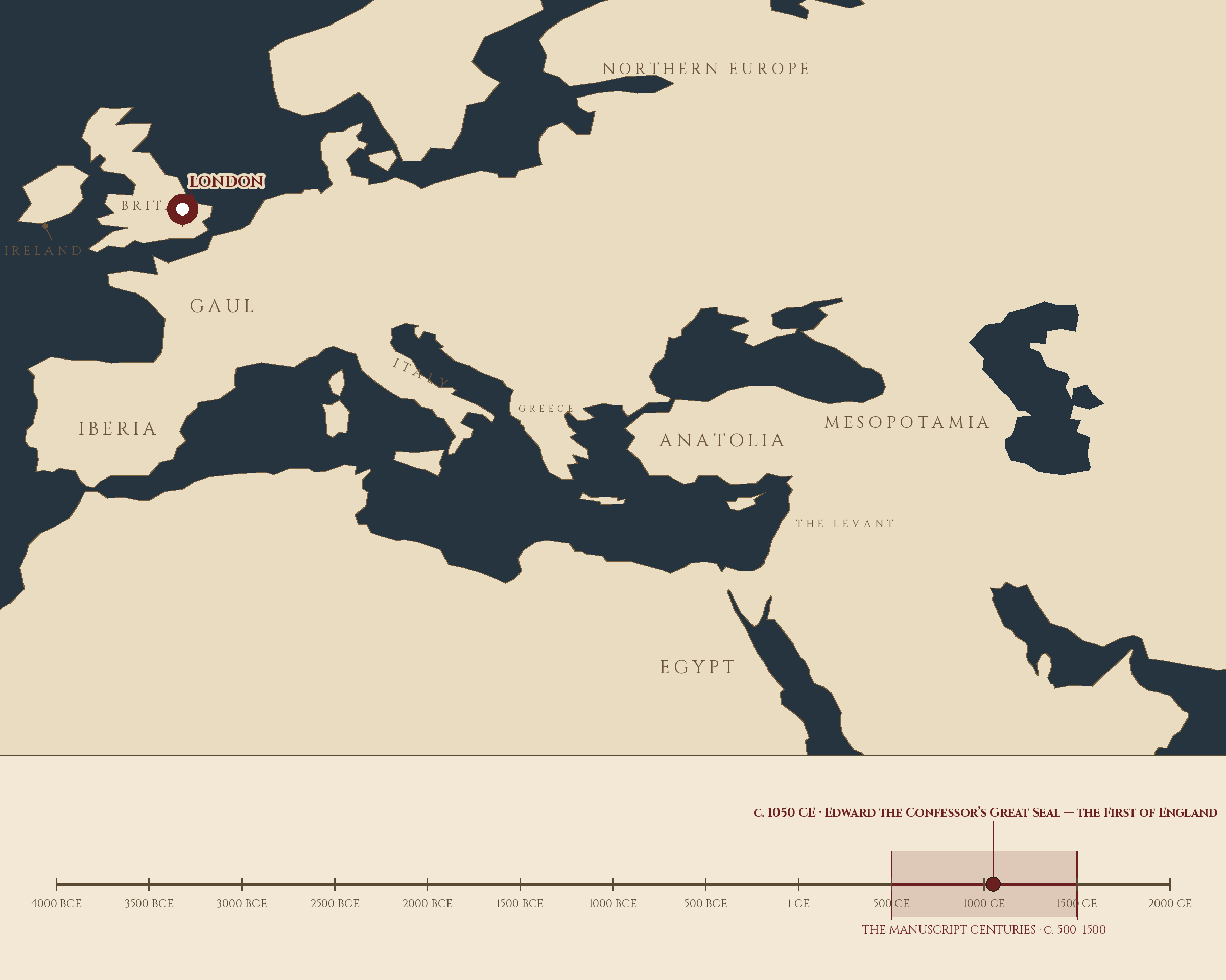
Where and when: London, England, c. 1050 CE — Edward the Confessor's Great Seal — the First of England. The pin is this lesson. The line beneath the map is our road: every stop a place where writing changed, every lesson a pin.
Lesson Objectives
By the end of this lesson, you will be able to:
- Define wax seal, seal matrix, signet ring, pendant seal, and sigillography.
- Explain how a seal authenticates a document and why the design had to be unique.
- Describe how medieval sealing wax was made and why its recipe changed over time.
- Describe the Great Seal of England and the offices that guarded it.
- Make a working wax seal using household materials, and explain what your seal claims about you.
Reading this lesson: ★ marks the passages to remember. They return on the unit quiz and the class test. Check in questions ask the material back as you go; answer them in your workbook when you meet them.
Working this lesson: Your assignment packet is the first download on this page. Read the Safety Note in its Guided Practice before any wax is melted: hot wax is this lesson's one real hazard, and the safety rules are part of the lesson. Work in the packet as the lesson moves along, answering each assignment as its subject is taught — or read the lesson through for your notes and take the assignments as homework afterward. Both are proper ways to sit this class. Signposts in the reading tell you where each assignment belongs. Written answers are short answers in your own words; a few honest lines are worth more than a filled page.
Assignment key: ✎ written work · ⚒ hands-on practical · ◐ both · ★ will be on the test · ❦ workbook path
Your Assignment Packet
This lesson's assignments live in its packet: the Lexicon Handout (every term, course terms marked ◆), Materials, Guided Practice, the Assignment Manual with its answer key for self-checking, the Reflection Questions, and the Workbook Checklist. Download the packet before you begin and keep it beside you as you read.
What a Seal Is
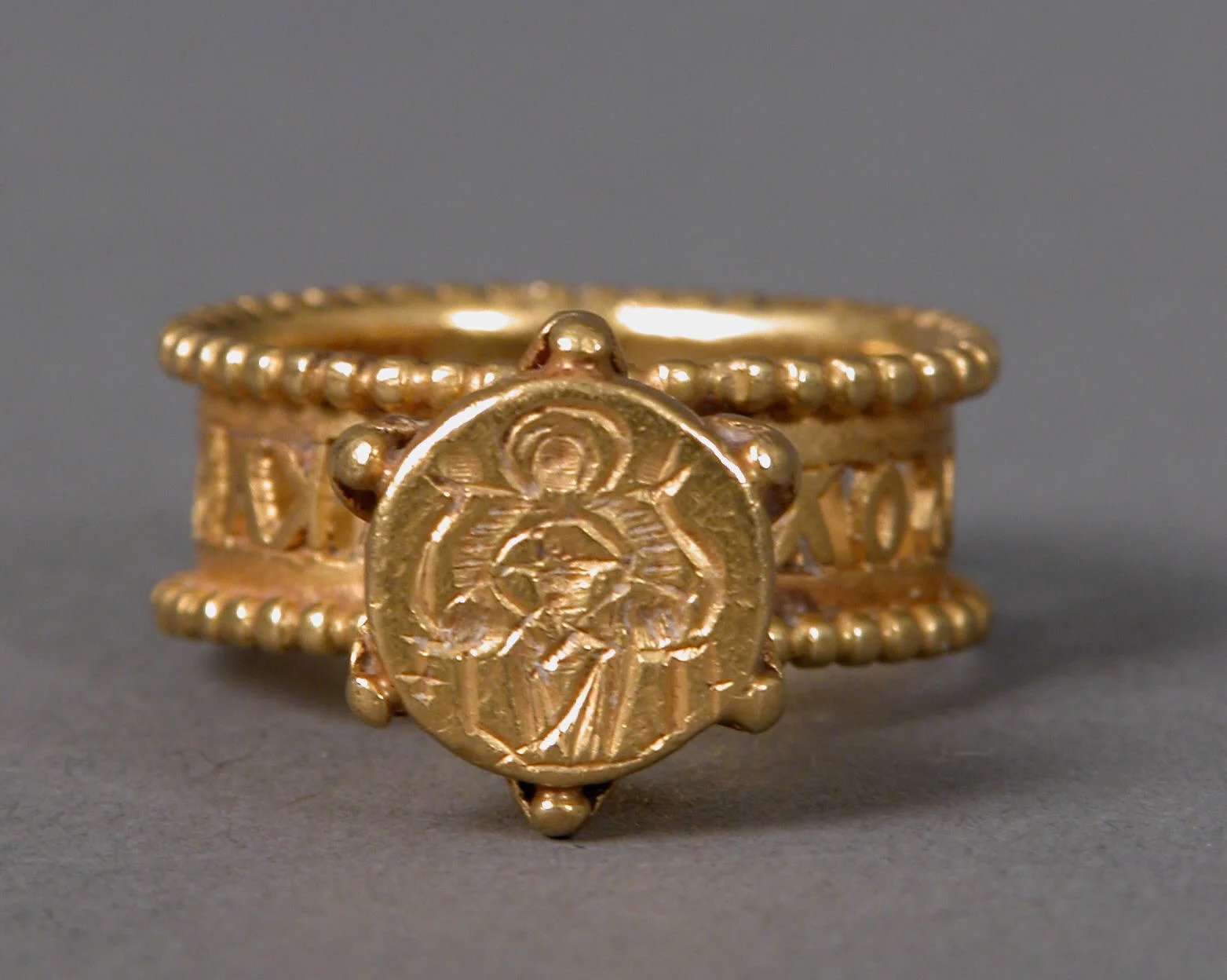
The seal you wear. A Byzantine gold signet ring, its bezel engraved with the Virgin and Child. A signet's owner carried his matrix on his own hand and pressed his mark into wax himself — the most personal seal there was, and the hardest to lend, forge, or lose.
The Metropolitan Museum of Art, New York (acc. 17.190.1654). CC0 (Met Open Access).
★ A seal, in the strict sense, is not the wax. It is the impression: the image left behind when an engraved metal die is pressed into something soft. The die has a name, and you must learn it, because the whole craft turns on the distinction. The die is called the matrix — the seal matrix — from the Latin mater, meaning mother. The matrix is the mother; every wax impression is her child. The National Archives, which keeps thousands of medieval seals in its care, defines the seal exactly this way: the term applies to the impression produced when an engraved metal die or matrix has been pressed into some soft material such as wax.
The wax is the servant, not the master. Beeswax, softened with resin, holds the impression and hardens around it. The matrix carries the design: a coat of arms, a portrait, a saint, an inscription naming the owner. Press the one into the other, and the document carries proof of its maker.
★ A seal did two jobs at once, and both matter. First, it authenticated. A charter granting land, a writ carrying orders, a letter closing a bargain: the seal said this document genuinely comes from the person whose name it bears, the way a signature does today. Second, it closed. A letter folded shut and sealed across its join could not be opened and reclosed without breaking the wax, the way the gum on an envelope works now. The unbroken seal told the recipient that no other hands had touched the message. Tamper evidence, eight centuries before the phrase existed.
Each seal was different from every other. That was the entire point. A king's seal carried his portrait and his titles. A merchant's carried his mark. A bishop's carried his saint. If your seal could be confused with another person's, it proved nothing.
Check in: Strictly speaking, what is a seal — the wax, the matrix, or the impression? And what two jobs did every seal do at once?
❦ In your workbook: record what a seal is, the matrix-as-mother distinction, and the seal's two jobs in your own way — copy, sketch, or note what matters.
In your packet: Assignment IV — The Tamper Test ◐ begins here. Work it now, or mark the place and take it as homework — your choice.
The Matrix: The Mother of Every Seal
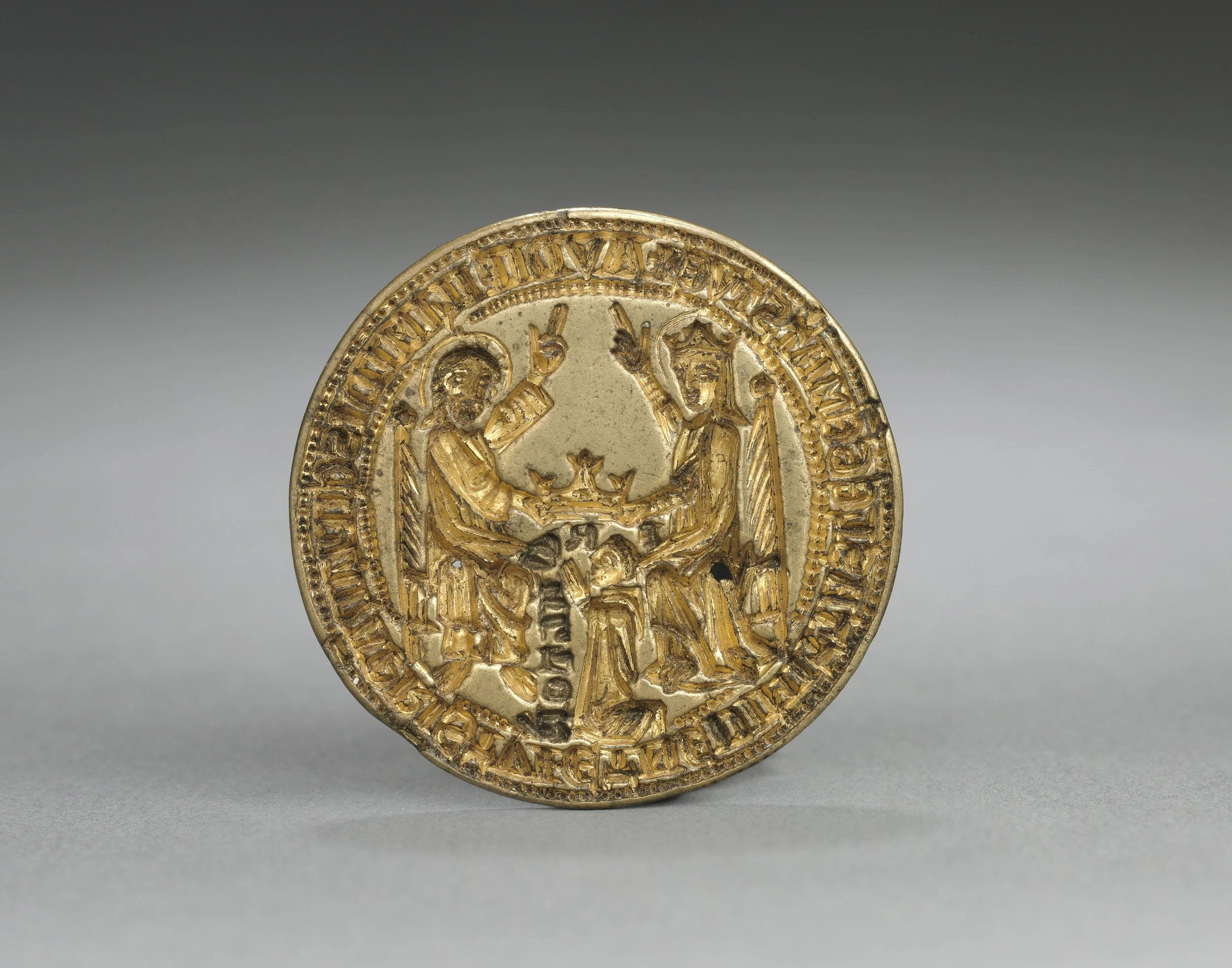
The mother of every impression. A monastery's seal matrix of gilded bronze (England or Germany, 14th century): Christ and the Virgin crown the house's patron while a monk — the community in miniature — kneels below, and the legend around the rim names the house in whose name every impression speaks. Press this into wax a thousand times and the thousand seals are siblings; lose the matrix, and the voice is gone.
The Cleveland Museum of Art (1974.11). CC0 (CMA Open Access).
The matrix was the valuable object. Wax is cheap and melts; the matrix endures. Medieval matrices were usually made of copper alloy, silver, or gold, and the design was cut into the surface by engravers. Goldsmiths made the fine ones. Tinsmiths, according to the Portable Antiquities Scheme, turned out simpler matrices in their thousands, because by the high Middle Ages nearly everyone who did business needed one.
★ The design had to be cut in reverse, mirror image, so that it would read correctly in the wax. This is the first test of a seal cutter's skill, and the first place a forgery betrays itself: a design cut the wrong way round prints backwards, and a backwards legend — the inscription lettered around the seal's rim — convicts its maker.
Matrices took many forms. The grand ones were large, double-sided discs of silver, heavy enough to need two hands or a press. The personal ones were small enough to wear. A matrix might hang from a chain at the belt, sit in a pouch at the waist, or take the form of a ring worn on the finger. The ring form has its own name: the signet ring. From the sixteenth century, small personal seals made from signet rings became fashionable among the higher ranks of society, and the ring you wore could sign your name as surely as your hand could.
★ Here is the rule that governed every matrix, and it is a stern one. The matrix belonged to one person, and one person only. On that person's death, the matrix was destroyed. Broken, defaced, buried with its owner. The reason was not sentiment. It was security. If a dead man's seal survived him, anyone who laid hands on it could forge his name, his orders, his grants. Breaking the ring was the medieval equivalent of cancelling a password. The New Scientist, reporting on forensic analysis of medieval seals, quotes the historian Elizabeth New: the seal was your credit card, passport, and signature all rolled into one. You do not leave those lying about after death.
★ In the twelfth century, seals belonged to a male elite: kings, great lords, bishops. But as written records multiplied, charters, land agreements, business exchanges, court documents, the need for proof of identity spread downward through society. The National Archives notes that as the number of written records increased from the twelfth century onward, seals filtered down through society until even bondsmen possessed their own. Merchants sealed their bargains. Farmers sealed their land transfers. Towns, guilds, hospitals, and abbeys each had corporate seals. Noblewomen and clergy often used seals shaped like a pointed oval, the vesica seal, a shape borrowed from sacred art. By the later Middle Ages, the seal was not a luxury of the great. It was the paperwork of ordinary life.
A sealed note from Professor Nocturne.
Hold here and consider what you have just read. The matrix is destroyed on its owner's death. Think about what that means for the historian.
Every matrix we have ever found in the ground is, in some sense, a failure of the system. It was lost, or dropped, or hidden, or buried with someone who should not have kept it. The ones that did their job properly were smashed to pieces centuries ago. We study the exceptions and imagine the rule.
This is worth remembering whenever you handle old things. The archive is full of survivors. The survivors are rarely typical. A good scribe knows what is missing, not only what is present.
Check in: Why was the design cut backwards, and why did the matrix have to die with its owner?
❦ In your workbook: record the matrix: its materials, its reverse-cut design, and the stern rule of its destruction in your own way — copy, sketch, or note what matters.
In your packet: Assignment III — Design Your Matrix ◐ begins here. Work it now, or mark the place and take it as homework — your choice.
The Wax: Beeswax, Resin, and Red
The earliest sealing wax was uncolored: plain beeswax, sometimes called cera flava, the yellow wax. But pure beeswax has a weakness. As it ages and loses moisture, it grows brittle and cracks, and a cracked seal proves nothing. Medieval seal makers solved this the way craftsmen always solve such problems: they changed the recipe.
★ The standard medieval recipe combined beeswax with Venice turpentine, a greenish-yellow resin drawn from the European larch tree. The resin acted as a natural plasticizer, keeping the wax flexible enough to take a crisp impression from the matrix and to survive the centuries without shattering. Scientific analysis of surviving seals confirms the mixture: beeswax for body, diterpenoid resins for flexibility, and the proportions tuned by experience.
Then came color. The earliest wax was uncolored, but later makers colored their wax red with vermilion, the brilliant mercury sulfide pigment you met in Lesson 7. Red wax announced importance. In some medieval royal chanceries, different colors of wax were used for different functions or departments of state, or to distinguish permanent grants from temporary ones. A red seal on a charter told the reader, before a word was read, that this document mattered.
★ From the sixteenth century, the recipe changed fundamentally. European trade with the Indies brought shellac, and seal makers rebuilt their formulas around it: shellac, turpentine, resin, chalk or plaster, and coloring matter, often vermilion or red lead, but not necessarily beeswax at all. What we now call "sealing wax," the brittle, glossy sticks that shatter into sharp fragments, is this later shellac compound, not the medieval beeswax mixture. The medieval seal was tougher and more flexible than its modern descendant. It had to be. It was doing legal work.
For the grandest documents, though, the old ways persisted. When the Great Seal of England was impressed, on great occasions of state, the material was still a mixture of resin and beeswax, made to last.
Check in: What did Venice turpentine do for beeswax, and what replaced the beeswax recipe from the sixteenth century?
❦ In your workbook: record the two recipes, beeswax and resin, then shellac, and what the wax's color could tell a reader before a word was read in your own way — copy, sketch, or note what matters.
In your packet: Assignment II — Make Your Seal ◐ is printed in the Guided Practice below. Work it now, or mark the place and take it as homework — your choice.
The Great Seal: The King's Name in Wax
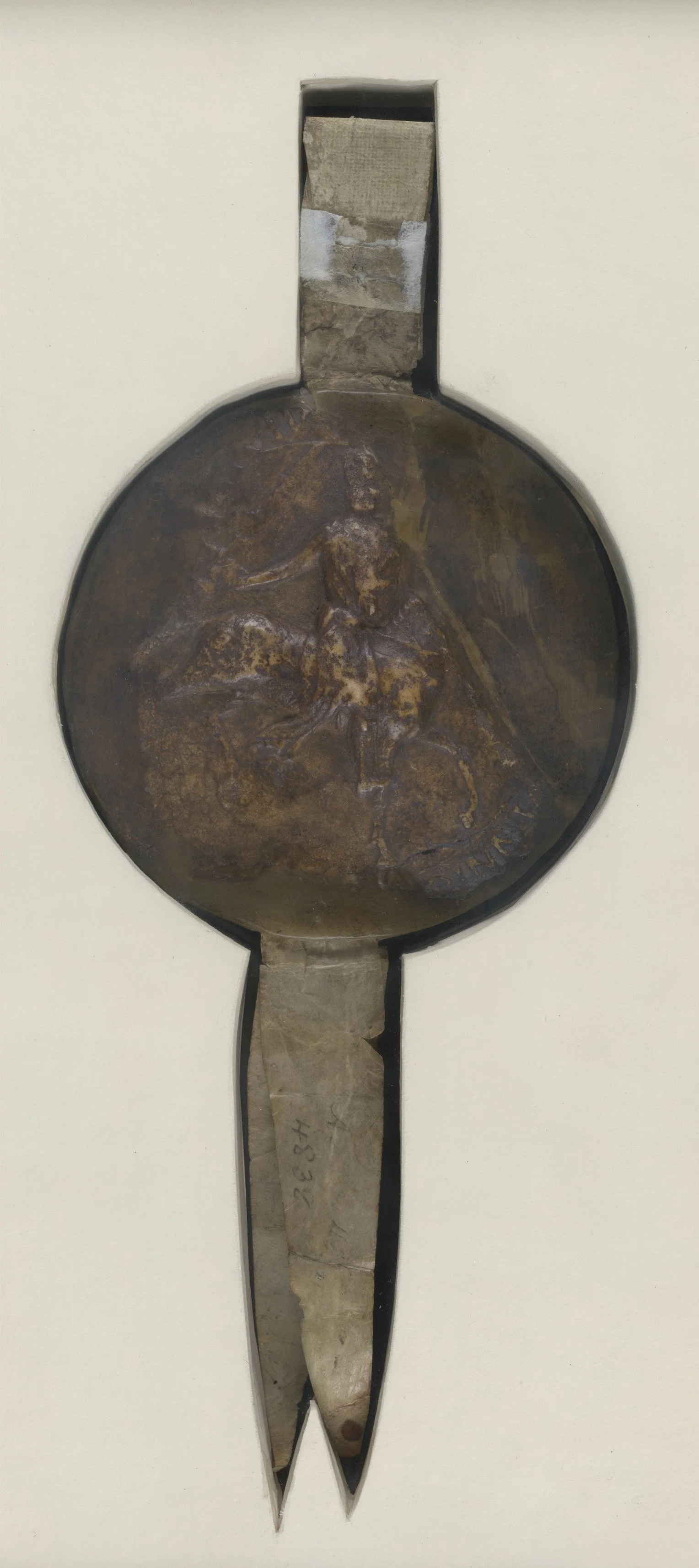
The king's name, hanging by a strip of skin. The Great Seal of King John in wax — the reverse face, the king on horseback — still pendant from the Articles of the Barons, the draft the barons forced on him in June 1215, weeks before Magna Carta. The wax was pale when it was pressed; eight centuries have darkened it to this deep brown, as age darkens nearly every seal that survives.
The British Library, London (Add MS 4838). Public domain.
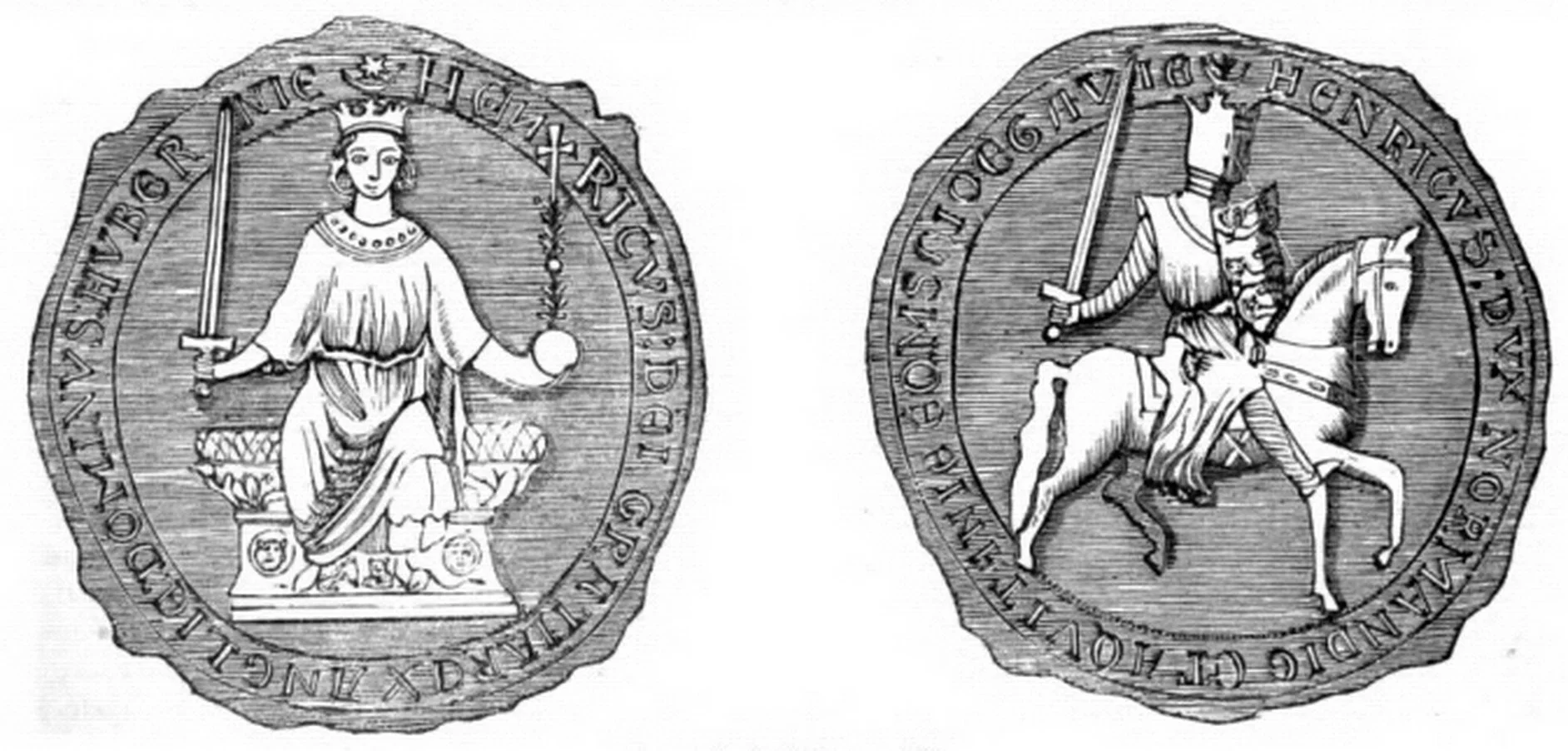
Both faces of majesty. The Great Seal of Henry III in a Victorian engraving: on one face the king enthroned, sword and orb in hand, the legend naming him "Henry, by the grace of God king of England, lord of Ireland"; on the other the same king on horseback, sword drawn — the ruler at peace and the ruler at war, pressed back to back into a single lump of wax.
Engraving from Cassell's Illustrated History of England, vol. 1 (19th century), via the Internet Archive. Public domain.
★ Every kingdom needed one seal above all others: the seal that spoke for the sovereign. In England, that seal was the Great Seal, first adopted by Edward the Confessor in the eleventh century and entrusted to his chancellor for safekeeping. From that day to this, the Great Seal has authenticated the most solemn acts of the English state: charters, commissions, grants, everything that expresses the pleasure of the sovereign.
The Great Seal was, and is, double-sided. Nearly every English great seal shows the monarch enthroned on the obverse, holding the orb and sceptre, the symbols of authority, and riding on horseback on the reverse, the military leader and defender of the realm. The design changed with each reign, and historians can read the country's story in the legends: Edward III was the first to style himself king of France and England on his seal, a claim that lingered on the wax for centuries after the reality faded.
★ The seal was too important to leave lying about. It lived in the custody of the Lord Chancellor, or the Lord Keeper, one of the great officers of state. A special officer of the Chancery, the Sigillator, handled the actual sealing of writs. And the rules were absolute. When a king or queen died, the matrix of the Great Seal was destroyed, so that no document could ever again be issued in a dead monarch's name. The punishment for counterfeiting the Great Seal was death. The seal was the sovereign's word made physical, and forging it was treated as an attack on the sovereign's person.
The wax itself carried meaning. Great Seals were made in different colors, though age darkens most of them to brown. In modern practice, dark green wax is used for letters patent raising men and women to the peerage, blue for documents concerning the close members of the royal family, and scarlet for documents appointing a bishop and most other patents. Color, as you learned in Lesson 7, is information.
There was also a smaller, more personal royal seal: the signet, the king's personal ring-seal, kept close to his person, used for documents the sovereign approved directly. The great machinery of the Chancery moved slowly; the signet moved at the speed of the king's own hand. Between them, the two seals mapped the two speeds of medieval government: the solemn and the swift.
Check in: Who kept the Great Seal, who did the actual sealing, and what happened to its matrix when the monarch died?
❦ In your workbook: record the Great Seal: its two faces, its keepers, and its colors in your own way — copy, sketch, or note what matters.
Seals in Daily Life
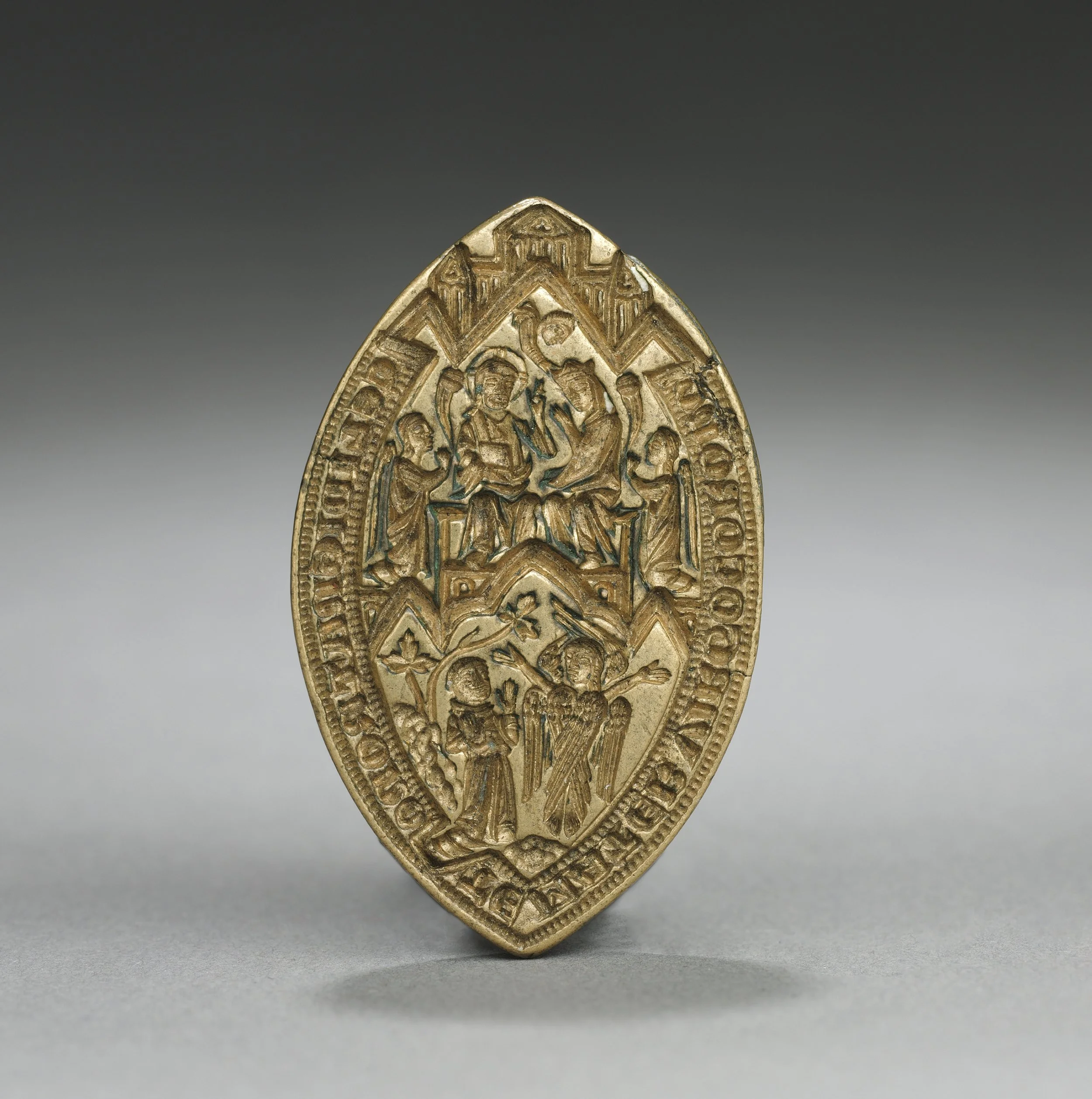
The almond seal. A vesica — the pointed oval, named for the mandorla of sacred art — in gilded bronze (England or Germany, 14th century): the Coronation of the Virgin above, the Annunciation beneath. Churchmen, religious houses, and many women sealed with the vesica; its shape alone told a reader, before a word of the legend, whose kind of authority had spoken.
The Cleveland Museum of Art (1974.12). CC0 (CMA Open Access).
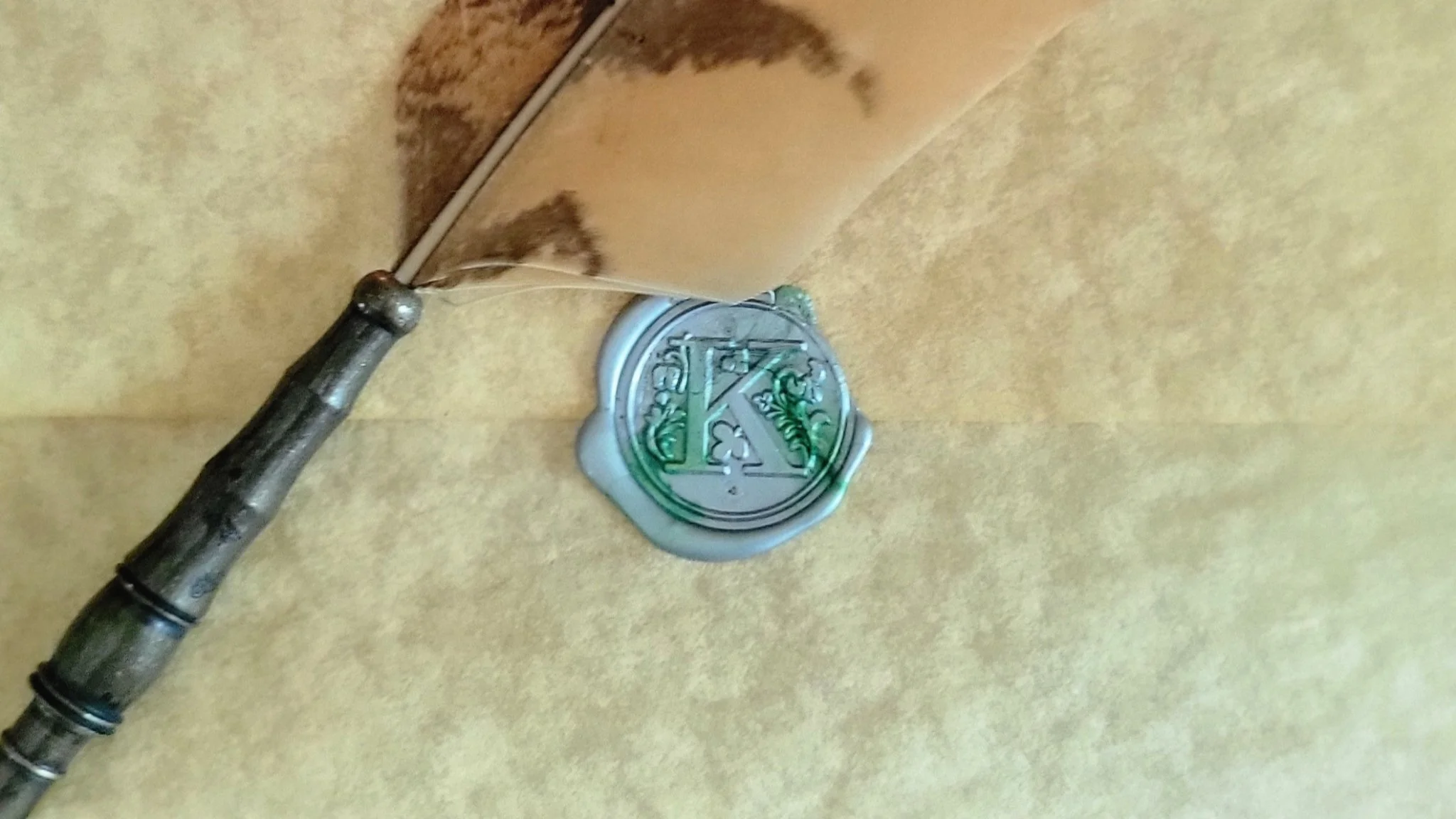
A personal seal, pressed at home. The Founder's initial in silver-and-green wax on a letter's fold, her quill beside it — the daily-life end of this lesson's long story. The great seals spoke for kings; this is the same act at the size of one desk and one name, which is where most sealing always lived.
Photograph by Kali Howell, the Founder, from her own sealing kit (October 21, 2026).
Step down from the throne room, and the seal is everywhere. A merchant in a market town seals the bond for a shipment of wool. A widow seals the deed selling her late husband's field, her vesica-shaped matrix pressing the wax with her own device. A monastery's great oval seal, inches across, authenticates the abbey's charters for centuries, the same matrix used by generation after generation of obedient hands.
★ The physical forms varied with the document. The grandest seals were pendant seals: great discs of wax hung from the bottom of the charter on cords or strips of parchment, swinging free like medallions. Some were double-sided, with elaborate designs on both faces, formed by pressing a sandwich of matrices and wax together. A pendant seal might be accompanied by a smaller counter-seal impressed on the reverse, and in careful administrations the seal and the counter-seal were kept by two different people, so that no single hand could authenticate alone. An early form of two-person integrity, centuries before the phrase.
Smaller documents took applied seals: a blob of wax pressed directly onto the face of the parchment, the matrix stamped into it where it sat. Letters were folded, and the wax laid across the join, so that opening the letter meant breaking the seal. From the fifteenth century, as paper grew common, a new fashion appeared: a piece of paper laid over the wax, pressed with a small matrix to make a paper seal, the design showing through the paper's fibers. In the nineteenth century came wafer seals: colored paper embossed with the design and stuck to the document, no wax at all.
★ And the study of all of this has a name, which you will now add to your lexicon: sigillography, from the Latin sigillum, a seal. The sigillographer reads matrices, wax, legends, and shapes the way you have learned to read letterforms. A seal's imagery, its size, its color, the rank of its owner, the date of its document: each is a stroke in a hand you are learning to recognize.
There is one more thing the seals gave the world, almost by accident. When sons inherited their fathers' seals and commissioned new matrices using the same symbols and devices, the designs began to pass down families like names. Historians believe this practice helped give rise to hereditary heraldry in western Europe in the twelfth century: the coat of arms, that great medieval system of visual identity, grew in part from the wax at the bottom of charters. The seal taught Europe how to draw identity itself.
Check in: What is the difference between a pendant seal and an applied seal, and why were the seal and the counter-seal sometimes kept by two different people?
❦ In your workbook: record the seal's forms, pendant, applied, counter-seal, paper, and wafer, and how the seal taught Europe heraldry in your own way — copy, sketch, or note what matters.
Guided Practice
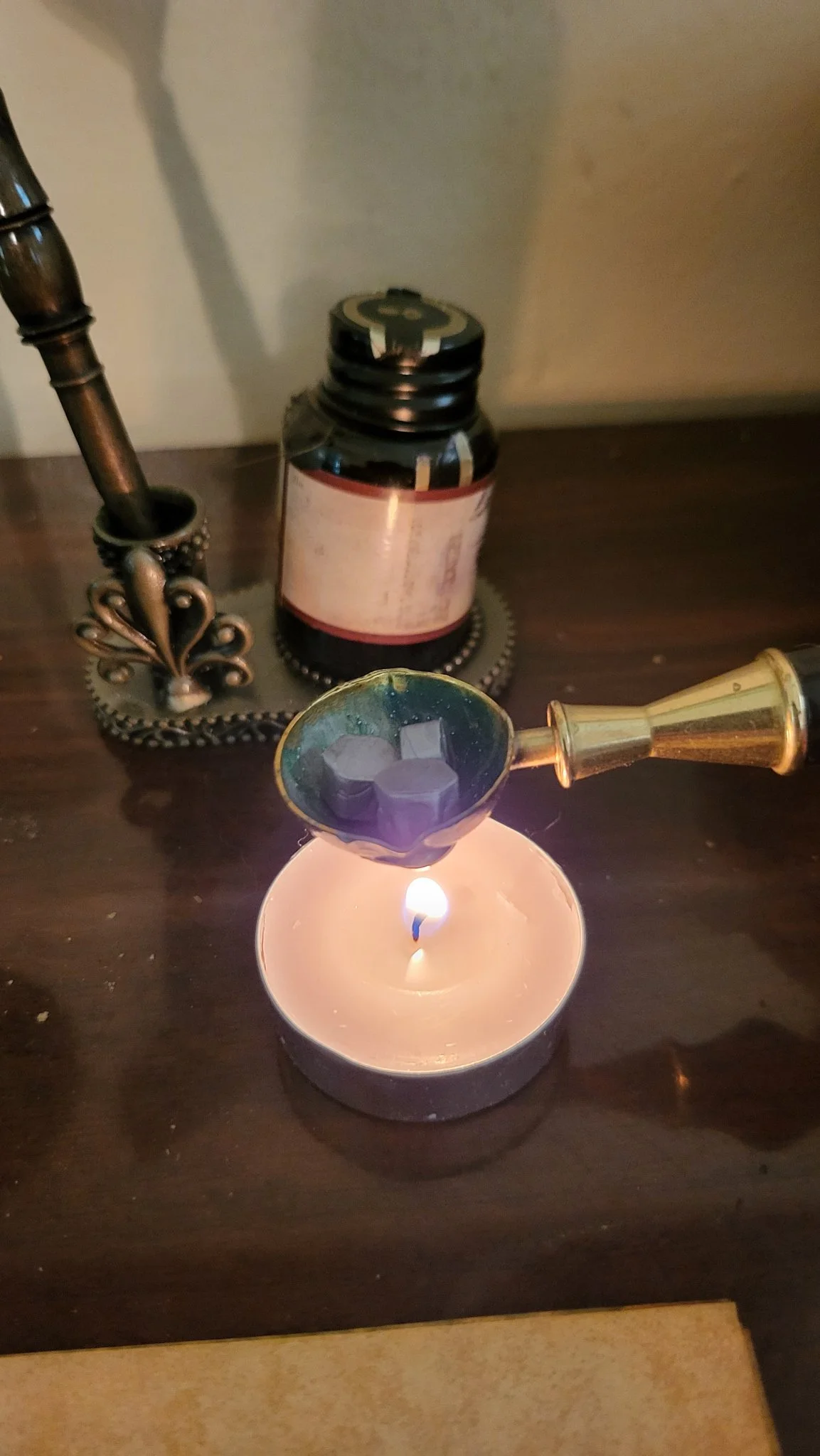
The spoon method, as the Safety Note names it. Wax beads melting in a brass spoon over a small flame — the oldest way to ready wax, done here on an adult's bench, on a heat-safe desk, with the inkstand waiting behind. Level One's glue-gun method needs no flame at all; this is the flame method with its rules kept.
Photograph by Kali Howell, the Founder, from her own sealing kit (2025).
Safety Note — Read First
Hot wax burns. Melted wax, whether from a glue gun, a spoon over a candle, or a sealing-wax stick, can stick to skin and scald. These rules are not optional:
- An adult must be present for any assignment involving melted wax, open flame, or a hot glue gun.
- Never use an open flame unsupervised. The Level One glue-gun method uses no flame at all and is the safest option.
- Keep a bowl of cool water nearby. If wax touches skin, cool it under running water; do not peel hot wax off.
- Work on a heat-safe surface (a ceramic tile, a metal tray) away from paper, curtains, and anything flammable.
- Tie back long hair and loose sleeves. The scribe's rule about the inkwell applies double to fire.
Assignment II — Make Your Seal ◐ ★
Objective: Produce a working wax seal and understand, by doing, what the matrix demands of its maker.
Instructions:
- Read the Safety Note in the Guided Practice before touching any equipment. Set up the heat-safe work surface, the bowl of cool water, and the adult supervisor.
- Choose your matrix substitute and study its pattern. If it has lettering, check whether it will print forwards or backwards, and note what that tells you about how real matrices were cut.
- Lightly oil the matrix. Lay a coin-sized pool of melted wax (glue-gun wax for Level One) on the parchment paper or across the folded join of your letter.
- Press the matrix straight down into the wax with firm, even pressure. Hold it still for a slow count of ten. Lift straight up, without twisting.
- Examine the impression. Is it crisp? Are there air bubbles, smears, or incomplete edges? Make at least three seals, improving your technique each time, and keep the best.
- In your workbook, answer: what did the wax demand that you did not expect? What would make your seal harder to forge?
To submit: Your best seal, mounted on its letter, with the workbook answers.
Your keepsake: your best seal, mounted on its letter: the first document your own matrix ever authenticated. Keep it with your workbook; every later sealing is measured against it.
❦ Workbook path: working in your workbook instead of on loose sheets? Make your practice impressions on a spare sheet tucked inside your workbook, keep the best impression beside it, and write the two workbook answers on the same page.
Materials
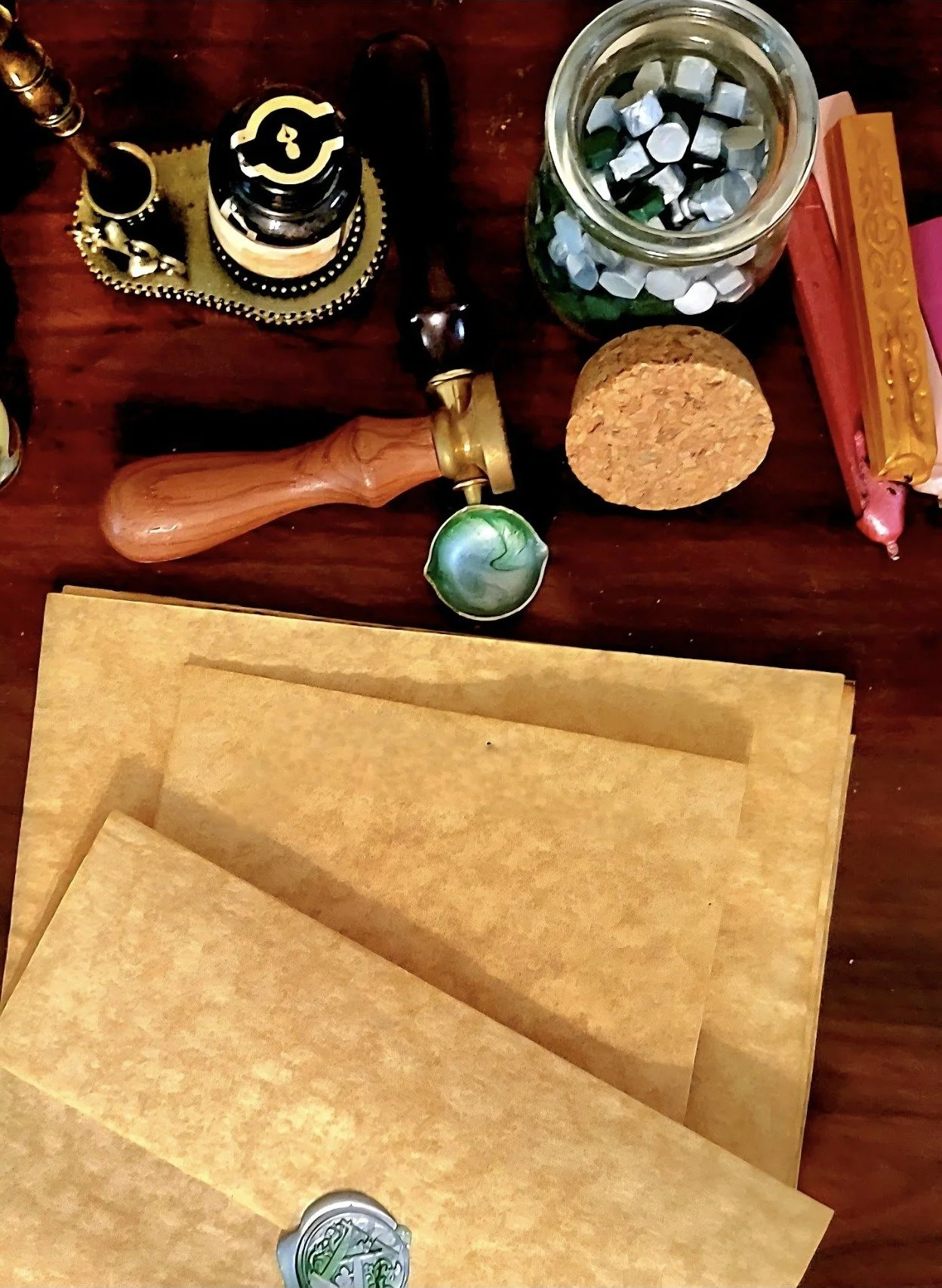
The sealer's bench today. Wax beads and sticks, the melting spoon, the stamp, and a letter closed in green-and-silver wax — the same family of materials this lesson describes, on the desk of a scholar who seals her own letters. The wax here is modern sealing wax and the colours are the Founder's own; the red wax of the lesson's history is pictured at image 3, in King John's pendant seal.
Photograph by Kali Howell, the Founder, from her own sealing kit (October 21, 2026).
Required (Level One — household items)
- Low-temperature glue gun + colored glue sticks (red or gold read most 'seal-like'): the safest stand-in for sealing wax. No flame, no spoon, no burns beyond what a glue gun can already do.
- A matrix substitute: a large coin, a bottle cap with a raised pattern, a carved eraser, or a button with a deep design. Anything with a raised or incised pattern will print.
- Parchment paper or a folded letter: the document to seal.
- Plain drawing paper and a pen or pencil: for Assignment III's two matrix designs and its written paragraphs.
- Cooking oil or petroleum jelly: a thin film on the matrix keeps it from sticking to the wax.
- Ceramic tile or metal tray: the heat-safe work surface.
- Bowl of cool water: the burn precaution. Non-negotiable.
Suggested (Level Two — historically closer)
- Real sealing-wax sticks + a brass seal stamp: the proper materials, used with a melting spoon over a candle or spirit lamp. Adult operation of the flame; the student handles only the cooled stamp.
- A carved matrix: a linocut block, a carved wooden disc, or a craft-store seal stamp with your own initials. Remember the lesson: cut the design in reverse so it prints correctly.
- Beeswax + powdered resin: for the historically curious, a small batch of the medieval recipe (beeswax softened with a little pine resin) behaves very differently from shellac wax. Adult supervision required; resin fumes need ventilation.
No purchased kits are required. The core lesson (what a seal claims, how the matrix prints, why the design must be unique) is fully achievable with a glue gun, a coin, and a folded letter.
Reflection Questions
Answer in your workbook.
- Why was the matrix, and not the wax, the valuable object? What does that tell us about where trust actually lived?
- A seal had to be unique to work. What modern objects follow the same rule, and what happens when the rule is broken?
- Why did medieval people destroy a dead person's matrix instead of passing it to the heir? What would inheritance have risked?
- The lesson says color is information. Give two examples from the lesson of wax color carrying meaning.
- How did the seal's job change between the twelfth century, when only the elite used seals, and the later Middle Ages, when bondsmen had them?
- Heraldry may have grown partly from seal designs passed down in families. What does that suggest about how practical tools become systems of identity?
Workbook Checklist — Lesson 22
In my workbook I have:
- ☐ defined wax seal, seal matrix, signet ring, pendant seal, and sigillography
- ☐ explained how a seal authenticates a document and why the design had to be unique
- ☐ described how medieval sealing wax was made and why its recipe changed over time
- ☐ described the Great Seal of England and the offices that guarded it
- ☐ made a working wax seal using household materials, and explained what my seal claims about me
☐ Lesson completed Date: ___ Signature: ___
Professor's Review
A sealed note from Professor Nocturne.
You came to this lesson knowing how to write. You leave it knowing how writing was trusted.
Remember the three things. The matrix is the mother, and she is destroyed at death, because a seal that outlives its owner is a loaded weapon. The wax is the servant, beeswax and resin in the Middle Ages, shellac after, and its color is part of its message. The impression is the child, and it must be unique, because a seal that could belong to anyone belongs to no one.
In the next lesson, we turn from the seal to the shelf: how the scrolls and books these seals authenticated were stored, labeled, and found again. A document no one can find is a document that does not exist. The archive is the seal's afterlife.
Mind the hot wax. It remembers your fingerprints longer than you will remember the burn.
PROFESSOR QUILLBERRY NOCTURNE
Scrollwork Library
Master Scribe & Illuminator
Cross-Class Connections
Runes · Lesson 1 — The Structural Wedge
My cuneiform lesson is where the bulla is defined: the clay lump stamped with a carved seal to mark ownership and guarantee contents, five thousand years before wax. The material changed from clay to wax; the idea never changed at all. Begin where I begin, and tonight's seal will look back at you with older eyes.
PROFESSOR THISTLELOOM WEBBLETHORN
Runes & Ancient Writing
Potions · Unit VI, Lesson 51 — Wax Seals & Colored Matrix Blends
I teach the wax itself: its four ingredients, why pigment hangs in it as a suspension, and why my red cracks where the medieval red bent. My lesson names Professor Nocturne's outright and divides the territory: I own the material; the meaning is his. Make your seal in his library, then bring it to my bench and learn what you have been pressing with.
PROFESSOR CRIMBLEBREW MUDDLENOOK
Potions Laboratory • Master Apothecary • Head of House Meridies

Creative Arts · Unit IV, Lesson 17 — Seal Matrices & Waxwork
In my workshop the matrix is not described but cut: a practice seal carved and tested in wax before any true matrix is committed. Draw your design in Professor Nocturne's lesson, then come and cut it under my eye: design small, reverse honestly, test before you commit.
Creative Arts · Unit VII, Lesson 29 — Foil, Wire & Simple Metalwork
My workshop returns to Lesson 17's matrix and finishes it at full craft, in metal, tested in wax at every stage. When wood and lino are no longer enough, that is where a matrix goes to become a lifetime's mother of seals. Come when you are ready for the metal.
PROFESSOR COGBRANCH TIMBERCLANK
Creative Arts Workshop
Further Reading & Sources
- Elizabeth New, Seals and Sealing Practices, British Museum Research Publication 217 (2010). The standard modern introduction to medieval English seals, by the historian behind the forensic seal research. - The National Archives research guide to seals: nationalarchives.gov.uk/helpwithyourresearch/research-guides/seals. Photographs, history, and a reading list from the archive that holds the Great Seals. - "Medieval wax seals are giving up fresh historical secrets," New Scientist: newscientist.com/article/2115811-medieval-wax-seals-are-giving-up-fresh-historical-secrets. Forensic science meets sigillography at Hereford Cathedral. - The National Archives on the Great Seal: nationalarchives.gov.uk/documents/education/great-seal.pdf. How the Great Seal was made, who kept it, and why forgery meant death. Browse the Scrollwork shelf in the school Library for readable editions of these works.
A letter drawn up at the Commission Desk finishes here — in wax, at the foot of the piece, as this lesson authenticates. The Desk will ask whether your piece is to be sealed. You are learning what that seal means and how it is earned.
The Commission DeskPROFESSOR QUILLBERRY NOCTURNE · SCROLLWORK LIBRARY
Professor Nocturne seals paper, and seals it well. In the Laboratory we seal glass and cork — finished specimens and stores kept against the damp — and there the judgment differs: wax guards dry goods faithfully, and betrays anything wet. Lesson 51 of my class teaches sealing for vessels, and when the wax should stay in its box.
Potions · Lesson 51: Wax SealsPROFESSOR CRIMBLEBREW MUDDLENOOK · POTIONS LABORATORY
Submit your work for this lesson using the form below.
CONTINUE IN THE SCROLLWORK LIBRARY
← Previous · Lesson 21: Constructing the Scroll Next · Lesson 23: Archive Labels & Library Systems →
Unit VI — Scrolls & Archives Scrollwork Library — All 26 Lessons
The rest of Unit VI: Lesson 21 · Constructing the Scroll · Lesson 23 · Archive Labels & Library Systems
From the Scrollwork Shelf
The printed companions to this lesson, from Professor Nocturne’s shelf in the shop.