Creative Arts
Course CapstoneThe Master Artisan's Build
Professor Cogbranch Timberclank
Master Artisan, Head of House Occidens
The Creative Arts Workshop • School of Evershade
Professor's Introduction

Set up your bench, scholars, one last time. There is no new lesson in this capstone. That is the point of it.
Twenty-nine lessons stand behind you: the tickets of the Foundation, paper and bound records, fiber, pigment and seals, clay and the garden bench, wood and furniture, and at the end the carving and the metal. A ticket, in this course's word, is a proven foundational skill: earned by drill, and spent every time a later build relies on it without re-teaching it. Each lesson gave you a drill, a practice piece, and a standard. This capstone asks the question the drills were rehearsing for. What will you build, now that you can build?
The guilds of the old workshops asked their journeymen the same question, and their answer was the masterpiece: one substantial piece, planned and made by the candidate's own hands, judged by the masters of the guild, proving that the maker could be trusted with the craft. A journeyman is a craft worker who has finished an apprenticeship and works for wages while learning toward mastery, traveling from master to master to widen his skill. This capstone is Evershade's form of it. You will choose one substantial piece that serves another class or a real need of this school. You will plan it before you touch material. You will build it across as many sittings as it honestly takes. And you will keep a build log from the first sketch to the final finish: the plan, the materials, the steps, the mistakes, and the mends.
Read that last part again, because it is the heart of the assessment. The log is judged alongside the object. A build that went wrong and was mended, with the mend written down honestly, passes with honor in this workshop. A flawless object with a dishonest log does not. The guild masters were not really judging a single piece; they were judging whether the maker could be trusted. So am I.
Choose well. Build true. Write it all down.
PROFESSOR COGBRANCH TIMBERCLANK
Creative Arts Workshop
Master Artisan, Head of House Occidens
Lesson Objectives
By the end of this capstone, students should be able to:
- Choose and define one substantial build that serves another class or a real Evershade need.
- Write a build plan naming the piece's purpose, its materials level, and at least three of the course's tool tickets the build will spend.
- Keep a complete build log throughout the work: plan, materials, steps, mistakes and mends, and finish.
- Execute the build to the workshop's standard of built true, applying the safety rules of every ticket used without prompting.
- Present the finished piece together with its log, and assess their own work honestly against the plan.
Your Assignment Packet
This lesson's assignments live in its packet: the Lexicon Handout (every term, course terms marked ◆), the Assignment Manual, and the Reflection Questions. Download the packet before you begin and keep it beside you as you read — work from it as each subject is taught, or take the assignments as homework afterward.
The Masterpiece: An Old Custom
The medieval and early modern workshops of northern Europe were organized as guilds, and the guilds ran on proof. A boy or girl entered as an apprentice, bound to a master for years of learning. Freed of the apprenticeship, the worker became a journeyman, traveling and working for daily wages, widening skill under many masters. To stand as a master in turn, with a workshop and apprentices of one's own, the journeyman made the masterpiece: a piece set or approved by the guild, executed to its standard, and judged by its officials.
The judging could be exacting to the point of theater. In several cities, guilds assigned a common theme for the masterpiece, so that candidates could be compared on equal terms; guilds in cities including Krakow, Hamburg, and Prague set their candidates the figure of St. George and the Dragon, and guild officials decided whether the work passed. One theme, many hands, and nowhere to hide: the piece showed planning, technique, and honesty of execution at a glance.
Two things about the custom deserve a scholar's attention. The first is that the piece was useful. Masterpieces were objects the world needed, chests, locks, vessels, instruments, made to be used, not ornaments made to be admired and shelved. The second is that the process was witnessed. The guild did not only receive a finished object; it knew the maker's record, the years, the work, the conduct at the bench. The piece was the summary of a documented formation. Your build log stands in that tradition. The object proves your hands. The log proves your judgment, and judgment, in the end, is what a master is.
Evershade keeps the custom and softens its teeth. No scholar here is refused the workshop for a failed build. But the standard is the guild's standard, stated plainly in the Assessment below, and the honor is real: a mended build, honestly logged, passes with honor.
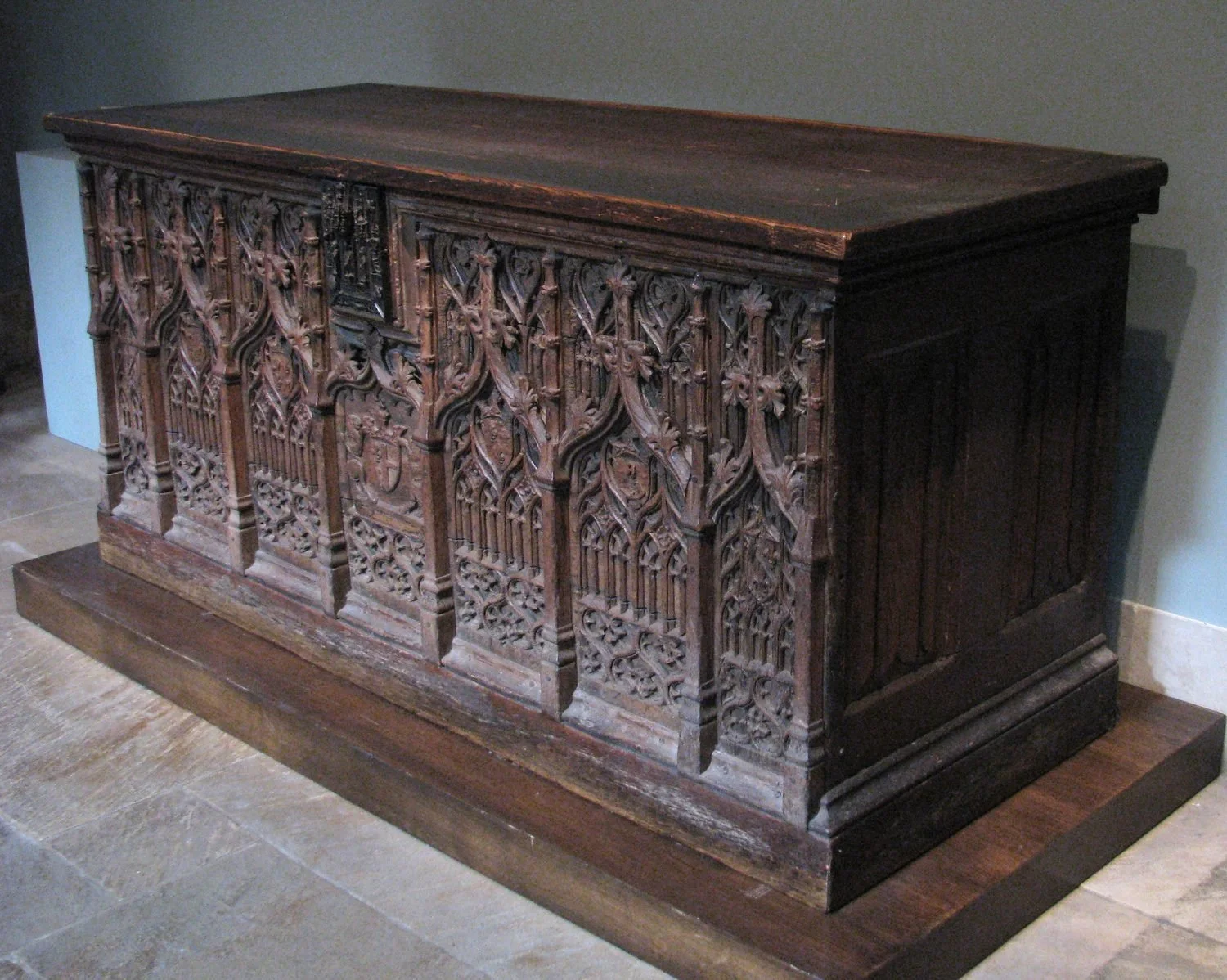
A French carved oak chest with coats of arms, early 16th century — heraldic panels carved under Gothic ogee arches, iron mounts, the work of a master workshop.
The Metropolitan Museum of Art (Object 17.190.393), Open Access (CC0).
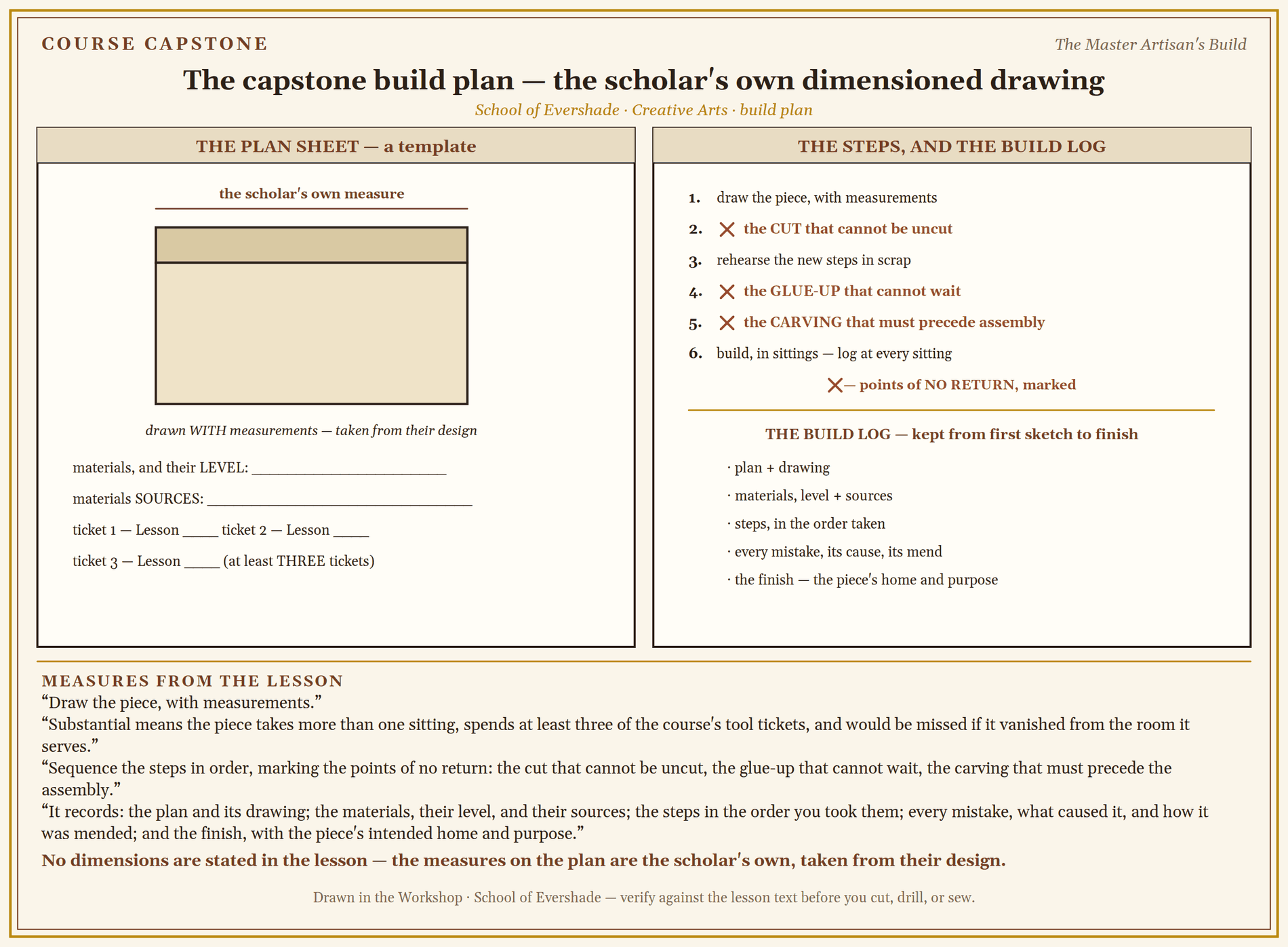
The capstone build plan — the scholar's own dimensioned drawing
The Build Brief
The charge. Choose and build one substantial piece that serves another class or a real need of the School of Evershade. Substantial means the piece takes more than one sitting, spends at least three of the course's tool tickets, and would be missed if it vanished from the room it serves.
Choosing the piece. Begin from need, not from novelty. Walk the school in your mind. The Runes classroom needs inscription plaques and ogham sticks that survive handling (Lessons 27 and 28). The Scrollwork Library needs bound portfolios and archival boxes (Lessons 9 and 11). The Greenhouse needs a plant press, drying racks, seed storage (Lessons 21, 25, 26). The Potions Laboratory needs shelves, a bench, a label and seal station (Lessons 16, 17, 26). The Celestial Tower needs demonstration models that will not collapse in a scholar's hands (Lesson 29, toward Extension E3). Your own house common room needs something it does not have. A piece for your own continued study qualifies if it is genuinely substantial and genuinely used: a bound field kit, a carving bench hook set, a storage system for your own workshop stores.
The tickets. Name at least three core tickets your build spends, by lesson: for example, a seed storage box might spend Lesson 2 (measuring and leveling), Lesson 23 (wood and grain), and Lesson 26's box construction on the discipline of Lesson 4's joinery. If your plan needs a ticket you cannot honestly claim, the plan is too big or the course has a lesson to revisit first. Both are respectable findings. Write them in the log.
The log. Your build log begins before your materials do and is written at every sitting, not reconstructed at the end. It records: the plan and its drawing; the materials, their level, and their sources; the steps in the order you took them; every mistake, what caused it, and how it was mended; and the finish, with the piece's intended home and purpose. A photographed or sketched stage earns its place in the log whenever words run short.
The presentation. Present the finished piece and the complete log together. The piece goes to the classroom or room it serves, with the scholar's name and the date on it or under it, in the workshop's manner.
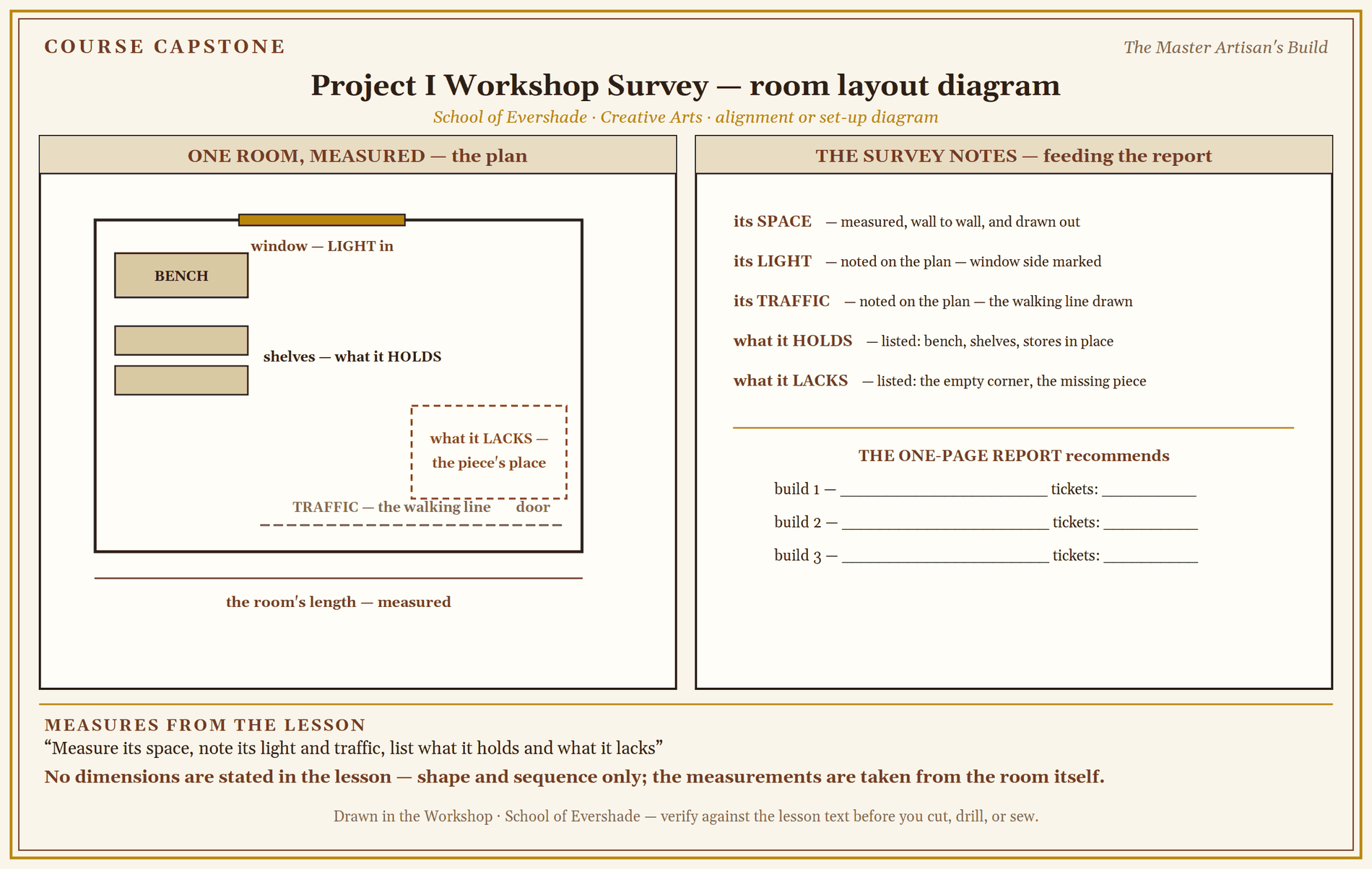
Project I Workshop Survey — room layout diagram
A Sealed Note from Professor Timberclank
A self-directed build has no teacher standing at the bench saying stop. So the stop rule must live in the scholar, and this note puts it there.
Every ticket you spend in this build carries its own rules, and they all apply at once, without me to recite them. The carving bench keeps Lesson 27's rules: work secured, hands behind the edge, brush before chisel. Heat and glass keep Lesson 5's. Metal keeps Lesson 29's: every end finished before the piece is handed over. If your build combines crafts, as most real builds do, the strictest rule at the bench governs the moment.
Work to the light you have, and stop when you are tired, hungry, or hurried. More builds are ruined in the last tired half hour than in all the careful mornings before them; I have mended enough castle timber to know. A build that waits a day loses nothing. A build forced through fatigue can lose the piece, and has lost fingers before now, in workshops less careful than this one.
And if something goes wrong beyond a mend you trust, you stop the build and you write it in the log, exactly as it happened. That entry is not a confession. It is the most masterful page a log can hold. We stop. We make it safe. Then we begin again.
PROFESSOR COGBRANCH TIMBERCLANK
Creative Arts Workshop
Master Artisan, Head of House Occidens
Stages of the Work
First, the need. Walk the school, in fact or in memory, and list three real needs your hands could meet. Choose the one whose making spends your strongest tickets and teaches you the most. Write the choice and the reasons in the log's first entry.
Second, the plan. Draw the piece, with measurements. List the materials and their level. List the tickets, by lesson number, that the build will spend. Sequence the steps in order, marking the points of no return: the cut that cannot be uncut, the glue-up that cannot wait, the carving that must precede the assembly. Show the plan to no one for approval; the log is its record. But read it aloud to yourself once. Plans survive being heard.
Third, the rehearsal. Wherever the build contains a step you have never done at full size, rehearse it in scrap, exactly as every lesson in this course rehearsed before it built. The practice piece is part of the build, and it goes in the log.
Fourth, the build. Work in sittings. Open each sitting by reading the log's last entry; close each sitting by writing the new one while the work is fresh: steps taken, mistakes made, mends applied, and the next step named. Keep the bench rules of every ticket in play.
Fifth, the finish. Finish the piece to its purpose: surfaces that hands touch are smooth, ends are safe, storage is dry, inscriptions are painted and legible. Sign and date the piece or its underside, and write the log's final entry: what the piece is, where it serves, and what you would do differently, which every honest maker can answer.
Sixth, the presentation. Present piece and log together. The piece takes its place in the room it serves. The log stays with the scholar, the first document of the next build.
Assessment
The capstone is assessed as the guilds assessed: as one judgment on the whole submission, object and record together.
The object is assessed for completeness (it does the job it was chosen to do), for craft (the tickets it claims are visibly and correctly spent), and for finish (built true: sound, safe, and fit for the room it serves).
The build log is assessed alongside the object, at equal weight. A complete log states the plan, the materials and their level, the steps in order, the mistakes and their causes, the mends, and the finish. A log that records a failure and its mend in full earns more than a log with nothing to record, because a build with no difficulties in it is either a very small build or an incompletely kept log, and the assessor will know which.
The standard, stated plainly: a mended build, honestly logged, passes with honor. Concealed damage, an invented log, or a piece presented as what it is not fails the capstone regardless of the object's appearance, because the capstone's subject is not the object. It is the maker's trustworthiness, of which the object is the evidence.
Assignment Manual
Assignment key: ✎ written work · ⚒ hands-on practical · ◐ both
Exercise I ✎ — The Course Review
Without consulting your workbooks, list all seven units of the Creative Arts course from memory, with the skill each one taught. For each of the twenty-nine lessons, write one sentence stating its subject and its drill. Check your lists against the course afterward and mark every gap honestly. Choose three lessons from three different units and write one paragraph for each, explaining how that lesson's ticket appears in your build plan.
Exercise II ⚒ — The Master Artisan's Build (The Capstone Project)
Execute the Build Brief exactly as given in this capstone: one substantial piece serving another class or a real Evershade need, spending at least three core tickets, built across as many sittings as it honestly takes, with the build log kept throughout. Present the finished piece and the complete log together. Assessment follows the standard stated above: the log is assessed alongside the object, and a mended build, honestly logged, passes with honor.
Project I ◐ — The Workshop Survey
Before your build begins, survey one room your piece might serve: a classroom corner, a common room, a shelf, a bench. Measure its space, note its light and traffic, list what it holds and what it lacks, and write a one-page report recommending the three most needed builds for that room, with the tickets each would spend. Your capstone build may answer one of them, and the other two become the workshop's standing list for the next scholar.
Project II ◐ — The Demonstration
Teach one of your build's tickets to another scholar, a family member, or a friend: the drill, its safety rules, and its standard, as your lessons taught them to you. Supervise their practice piece. Afterward, write one page on what the teaching showed you about your own understanding of the ticket, including anything you discovered you could do but could not yet explain.
Materials Guidance
There is no single materials list for a build you choose yourself. There is the workshop's standing order instead: Level One first in the planning, Level Two where the piece and your stores allow, and the same finished piece either way.
Level One (household)
- Materials gathered from what a household already holds: scrap and reclaimed wood checked for nails, card and board, cloth remnants, household adhesives and finishes, craft foil and wire.
- Tools already earned in the course's Level One lists, with adult supervision wherever a lesson required it.
- Found materials in the castle's own tradition: Timberclank's repairs were made from what the ruin offered, and a build that turns a discarded thing into a needed thing honors the school's history.
Level Two (historical)
- Historically accurate materials for the chosen craft: hardwood stock and true treenails, hide glue beside modern adhesive, genuine ochre and earth pigments, brass or copper for the matrix work, hazel for the ogham stick.
- Historical technique where the lesson taught it: hand-cut joinery, hand-sewn binding structures, woven wire in the Norse manner.
- The presentation order of this school: the authentic way is the build's face, with the modern way standing alongside wherever accessibility asks for it.
Whichever level your stores allow, the log states it plainly, and the standard does not move: the piece is assessed as built true, not as built expensive.
Reflection Questions
Answer the following questions in your workbook.
- The guilds judged the masterpiece and the maker's record together. What does your build log say about you that your finished piece, alone, could not?
- Where did your build go most wrong, and what does the mend you chose say about the maker you are becoming?
- Which of your twenty-nine tickets did you spend most confidently, and which did you avoid? What will you do about the avoided one?
- A mended build, honestly logged, passes with honor. Is there a build in your life outside this workshop, literal or otherwise, that this standard changes how you judge?
- Your piece now serves a room of this school. What do you hope the scholar who uses it in five years understands about its maker?
- The course taught seven material families. If you could apprentice for one more year in a single one of them, which would you choose, and what would you build first?
Professor's Review
The course ends the way the castle itself was repaired: something needed making, and a maker made it, and the record of the making was kept honestly enough for the next pair of hands to learn from.
Look at what stands behind you. Twenty-nine lessons ago, most of you had never measured to a knife line, never clamped a cut, never thrown a pot or sewn a signature or ground a pigment, never cut a joint that held without hardware or a letter that will outlast its carver. Now your hands hold the whole bench: paper and board, fiber and pigment, clay, wood, stone, and metal, each with its history, its discipline, its drills, and its standard. And the school around you is full of the proof, because this course never built for its own shelves. Its boxes hold the Greenhouse's seeds, its bindings hold the Library's portfolios, its plaques carry the Runes classroom's letters, its models turn in the Celestial Tower, and its racks dry the harvest every autumn. That is what a workshop is for.
The capstone piece you have made and logged is the last of that proof and the first of something else. The guilds had a word for a maker whose piece and record could be trusted, and they did not give the word away cheaply. Neither does this workshop.
Keep your tools. Keep your log. The bench will be here when the next build calls you, and it will call.
PROFESSOR COGBRANCH TIMBERCLANK
Creative Arts Workshop
Master Artisan, Head of House Occidens
Further Reading & Sources
Smarthistory, "The Role of the Workshop in Late Medieval and Early Modern Northern Europe." The guild workshop system, masters, journeymen, and apprentices, and the masterpiece tradition this capstone follows, including the guilds that set St. George and the Dragon as the candidate's theme.
UNESCO World Heritage Centre, "Jelling Mounds, Runic Stones and Church." A reminder, from Lesson 28, of work made to be judged by the centuries: the standard every capstone build quietly measures itself against.
The British Museum, "Sutton Hoo and Europe" gallery. The finest surviving bench work of the early medieval world, and the proof of what the tickets in this course lead toward when they are practiced for a lifetime.
Student-friendly starting points for exploring this lesson's world. All links verified October 2026.
- Smarthistory's workshop essay, read whole. Begin with the workshop's organization and end with the masterpiece: the road from apprentice to master, as the guilds built it.
- Print only: histories of the European craft guilds are held by most larger libraries; ask for the guilds' apprenticeship and masterpiece customs, and compare them, rule by rule, with this workshop's own.
Submit your work for this lesson using the form below.
From the Workshop Shelf
The printed companions to the capstone, from Professor Timberclank’s shelf in the shop.