

Creative Arts
Seasonal Workshop Special S4Summer: Camp Keepsakes & the Weather Station
Professor Cogbranch Timberclank
Master Artisan, Head of House Occidens
The Creative Arts Workshop • School of Evershade
Season: Summer · Hosted by: House Meridies, at the summer camp · Workshop tickets required: Lesson 2, "Hands, Eyes, Measuring, Marking & Leveling"; and Lesson 9, "Pamphlet & Single-Section Binding," or Lesson 11, "Case Binding & Archival Boxes."
Professor's Introduction

Set your pack down and look at the sky first, scholars. That is the correct order at camp, and it is the order of this workshop. The Summer Workshop meets at Meridies' camp, in the south house's own season, and it makes the camp's two instruments of keeping: a book that keeps the days, and a weather station that keeps the sky.
The keepsake book is the camp finale's build, the binding your Lesson 9 or Lesson 11 ticket earns you, made from the camp's own pages: logs, sketches, lists, and whatever else the days produced. A camp that is not written down becomes a rumor by September. Bound, it stays evidence.
The weather station is the other keepsake, and the more demanding one. A rain gauge and a wind vane are simple instruments with an old and honorable pedigree, and both of them are, underneath, Lesson 2 work: measuring, marking, leveling, and writing down what the instrument says rather than what you expected it to say. The gauge in this workshop is read the way a Korean governor read his in 1442. The vane turns in a line of descent from a bronze Triton on an Athenian tower. We build them plainly and we read them honestly, which is all any instrument has ever asked.
PROFESSOR COGBRANCH TIMBERCLANK
Creative Arts Workshop
Master Artisan, Head of House Occidens
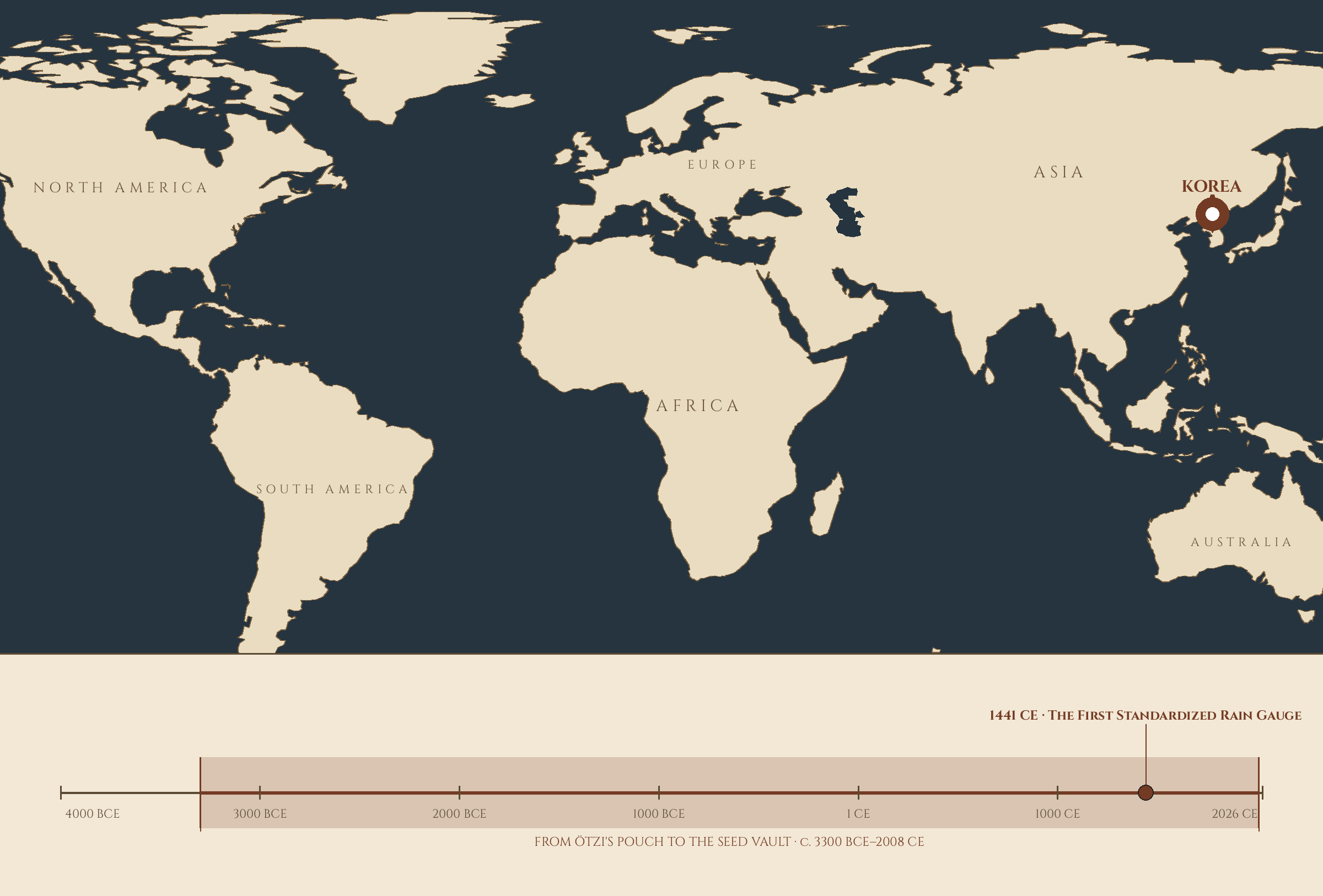
Where and when: Korea — 1441 CE, the first standardized rain gauge.
Workshop Objectives
By the end of this workshop, scholars should be able to:
- Tell the rain gauge's history: ancient rainfall records, the Tianchi basin gauges of 1247, and the cheugugi of 1441, the first standardized rain gauge, and say what standardization added.
- Build a straight-sided cylinder rain gauge, calibrate its scale by measurement, and set it level in the open, clear of splash and obstruction.
- Read the gauge the cheugugi way (depth by ruler, with the storm's beginning and end recorded) and keep the readings in the camp weather log.
- Tell the wind vane's history from the Tower of the Winds' bronze Triton to the church weathercock, and explain why a vane reports the direction the wind comes from.
- Build a wind vane that balances, turns freely on its pivot, and carries fixed directionals set by a known bearing.
- Bind the camp keepsake book as the camp finale, and keep the camp's weather log inside it.
Your Assignment Packet
This lesson's assignments live in its packet: the Lexicon Handout (every term, course terms marked ◆), the Assignment Manual, and the Reflection Questions. Download the packet before you begin and keep it beside you as you read — work from it as each subject is taught, or take the assignments as homework afterward.
Measuring the Rain
People have recorded rainfall for as long as they have taxed farms. Observers in India and in Greece were keeping rainfall records by about 400 to 500 BCE, and in India the readings were official business: the Arthashastra, the great treatise on statecraft, expected state storehouses to keep a rain gauge so land could be classified for taxation by the rain it received. In 1247 the Song dynasty mathematician Qin Jiushao devised Tianchi basin gauges in China for rain and snow. The instruments were everywhere, and they all had the same flaw, which was not in the instruments. Rain measured in a puddle is a lie told by the soil: earth drinks at different rates in different places, so a puddle's depth testifies about the ground, not the rain.
The Korean court of King Sejong the Great saw the flaw clearly and removed it by standardization. In August 1441 (by the lunar calendar), on an idea of the Crown Prince, later King Munjong, Sejong ordered his observatory, the Gwansanggam, to build a rain gauge of iron: a cylinder, about thirty-two centimeters deep and fifteen across, mounted on a stone stand tall enough that splashed water could not jump in and falsify the reading. In 1442 the order went kingdom-wide: an identical cheugugi in the courtyard of every provincial office, read the same way everywhere, the depth dipped with a ruler and recorded in pun, with the hour the rain began and the hour it stopped written down for every storm. The records were kept for centuries.
Pause on what the invention actually was. The cylinder was not new. The standard was: one instrument, one method, one record, everywhere, so that a depth in one province meant the same thing in another and a king could compare his whole kingdom's rain on one page. The workshop has met this doctrine before, in a herbarium cabinet: one specimen, one sheet, one size. A standard is an instrument, and the cheugugi is its clearest early proof. Europe's measuring followed: Benedetto Castelli had measured rain with a gauge in Italy in 1639; then in 1662 Christopher Wren, with Robert Hooke, built a self-emptying tipping-bucket gauge, and from 1677 Richard Towneley kept systematic rainfall records for fifteen years and published them, calling for observers everywhere to do the same. Our camp gauge is the cheugugi's direct descendant in method if not in metal: a straight-sided cylinder, a ruler, and a log that records the storm's hours as faithfully as its depth. In its formal name, our camp gauge is a pluviometer: any instrument that gathers precipitation over a known area and reports it as a depth.
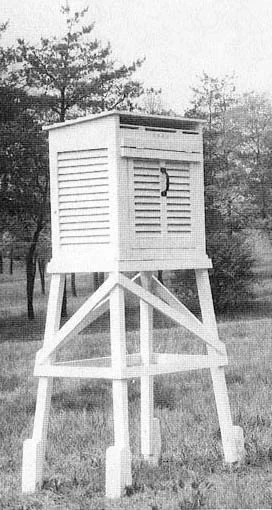
A Cotton Region instrument shelter — the white louvered thermometer shelter the U.S. Weather Bureau issued to its volunteer observers — photographed for the federal record (Figure 16, p. 20, of the report below, captioned "Cotton Region Instrument Shelter was the Type Used in Sonoma", credited to the National Archives and Records Administration).
Photograph credited to the National Archives and Records Administration, via NOAA. Public domain (PD-USGov).
The Pointer on the Roof
The wind vane begins, as so much begins, in Athens. In the first half of the first century BC, the astronomer Andronikos Kyrrhestes built the marble tower the Greeks called the Horologion and we call the Tower of the Winds: an octagonal tower in the Roman Agora, twelve meters high, with sundials on its faces, a water clock inside for cloudy days, and the carved figures of the eight winds around its frieze, each on the side his wind blows from. On its roof turned a bronze Triton, a sea god with a rod in his outstretched hand, swinging with the wind to point out which of the eight winds was blowing. The Greek national tourism authority calls the tower the first meteorological station in the world, and the claim is hard to argue with: time, wind, and public record in one building, which is precisely what our camp station is, at tent scale.
The vane's very name is a flag: it comes from the Old English fana, a banner, and banners told archers and sailors the wind's mind long before metal figures did. Viking shipwrights made gilded vanes for their longships' stems; when the ships retired, the vanes went up on churches, and a fine one from about 1050, the Söderala vane, survives. The church roof made the vane famous in one particular shape. Pope Gregory I had called the cockerel the emblem of Saint Peter; Pope Leo IV set a weathercock on Old Saint Peter's in Rome; and in the ninth century Pope Nicholas I ordered the figure placed on every church. The Bayeux Tapestry, stitched in the 1070s, shows the order being obeyed: a workman on a ladder fixing a weathercock to Westminster Abbey. The oldest surviving rooster vane of all, the Gallo di Ramperto, was made in 820 and rests today in a museum in Brescia.
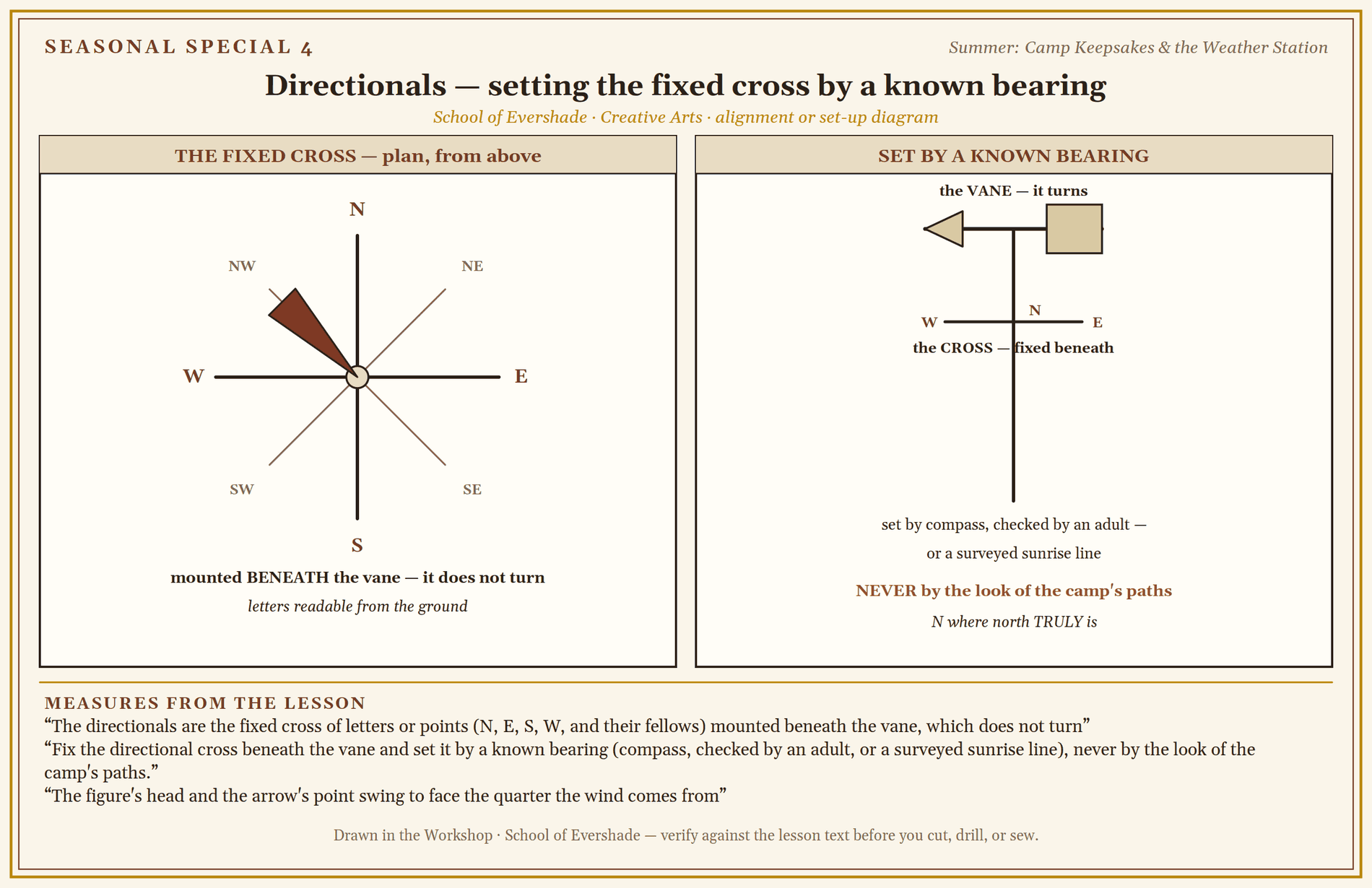
A vane's one lesson is in its grammar. The figure's head and the arrow's point swing to face the quarter the wind comes from: a north wind is named for its origin, not its destination, and a scholar reading the vane reads where the weather has been. Our camp vane carries a camp emblem instead of a Triton or a cock, local heraldry in an ancient office, and it is read the same way theirs were: by the directionals, against the sky, out loud, and into the log. The directionals are the fixed cross of letters or points (N, E, S, W, and their fellows) mounted beneath the vane, which does not turn; the vane swings against them to be read.
Camp Craft and the Keepsake
The organized summer camp is a young institution beside the gauge and the vane, and its founders were schoolmasters. In the summer of 1861, just as the Civil War began, Frederick Gunn of Connecticut marched his whole school, some forty pupils, forty-two miles to Long Island Sound, where they camped under bugle calls, caught their own fish, and drilled. It is remembered as the first organized summer camp. Ernest Balch founded Camp Chocorua in 1881 in New Hampshire on the conviction that summers of ease were softening the young, and from the 1876 North Mountain School onward, the movement grew: camps as schools under canvas, where children learned by doing in a world less mediated than the classroom.
The craft tradition inside camp has a name and a date: woodcraft, and 1902, when Ernest Thompson Seton founded the Woodcraft League. Seton built camp life around skills, the council fire as the camp's hearth and parliament, and a literature of the woods that campers kept in scrapbooks and journals; his borrowings from Native American cultures were enthusiastic and, seen from today, not always respectful, but the council fire and the craft program are the parts of his legacy camps kept and keep. The keepsake book of this workshop stands in that line knowingly: the camp journal, the nature log, the scrapbook of certificates and sketches are camp's oldest paperwork, and a bound book of the camp's own days is a keepsake with three centuries of weather records and a hundred and sixty years of camps behind it. We bind it properly, as the finale it is.
A Sealed Note from Professor Timberclank
Camp builds happen outdoors, among tents and ropes and other people's games, and the bench rules travel with the tools.
Binding work is piercing work: the awl and needle of Lessons 9 and 11 are used over the bench block, with nothing behind the work but the block, exactly as Lesson 4 taught. A needle is counted out and counted in, and a dropped needle stops the circle until it is found; camp ground hides sharp things generously and finds them with bare feet.
The weather station is mounted at ground level by scholars and raised by adults: vanes and posts that belong on roofs are placed by grown hands, and no scholar climbs for an instrument. A vane that will not turn is taken down and mended at the bench, never forced from below with a pole and hope.
Edges follow Lesson 29 wherever the vane's figure is cut from sheet: every edge finished, looped, or turned before the piece leaves the bench, because the camp vane will be handled by everyone who walks past it. We stop. We make it safe. Then we begin again.
PROFESSOR COGBRANCH TIMBERCLANK
Creative Arts Workshop
Master Artisan, Head of House Occidens
The Workshop Builds
Three builds, in the order camp uses them: the book first, so the log has a home from the first day; the gauge and the vane as the station rises; and the log running through all of it.
Build One ⚒ — The Camp Keepsake Book
This build is checked for signatures in order, stitching that holds, and a book that opens flat and lies quiet.
- Gather and order the pages. Collect the camp's pages: weather log sheets first (they are the camp's spine), then sketches, lists, maps, and records in the order the days made them. A book's contents are decided before a needle is threaded; editing is a bench skill.
- Fold the signatures. Fold the pages into signatures on Lesson 9's discipline, creases sharp, folios nested truly, and trim the fore-edge even with Lesson 2's measuring and Lesson 3's clamped cutting.
- Pierce on the block. Set the signature over the bench block and pierce the sewing stations with the awl, under the sealed note's rules: block behind the work, nothing else.
- Stitch and cover. Sew the pamphlet stitch of Lesson 9 (or case the book under Lesson 11 for scholars holding that ticket), fit the cover, and letter the title: the camp's name, the season, the year. Press the finished book flat overnight under a clean board and honest weight.
- Rule the weather log. In the book's first signature, rule the weather log's columns: date, rain (depth, and the storm's hours), wind quarter, and a line for the sky. The log begins the day the station rises.
Build Two ⚒ — The Rain Gauge
This build is checked for parallel sides, a scale earned by calibration, and a mounting level, open, and clear of splash.
- Prove the cylinder. Choose a vessel with truly parallel sides: measure its width at top, middle, and base with Lesson 2's tools. A vessel that narrows is rejected, kindly: in a narrowing vessel, equal rains read as unequal depths, and the gauge would lie with a straight face.
- Calibrate the scale. With the measuring jug, pour in a known depth of water (measure the water's depth in a straight glass as you establish it, or add water in measured amounts and compute), and mark the dipping ruler at each depth: the scale is earned by pouring, not assumed from the vessel's shape. Mark in the units your log will keep.
- Mount it in the open. Set the gauge on its post in open ground, away from roofs, eaves, and overhanging branches, rim level by the spirit level, and the vessel raised on its stand so splash from hard ground cannot jump in: the lesson of the cheugudae — the stone stand the gauge is mounted on — learned in 1441.
- Read it the cheugugi way. After rain, dip the ruler, read the depth against your calibrated scale, and write it in the log with the storm's beginning and end as best the camp observed them. Empty the gauge after reading, and reset it dry and level for the next storm.
- Keep it honest. Check the level weekly and after any storm that worries the post. A gauge out of level reads its tilt, not the rain, and the log deserves better.
Build Three ⚒ — The Wind Vane and the First Readings
This build is checked for balance, a free pivot, and directionals set by a bearing and verified.
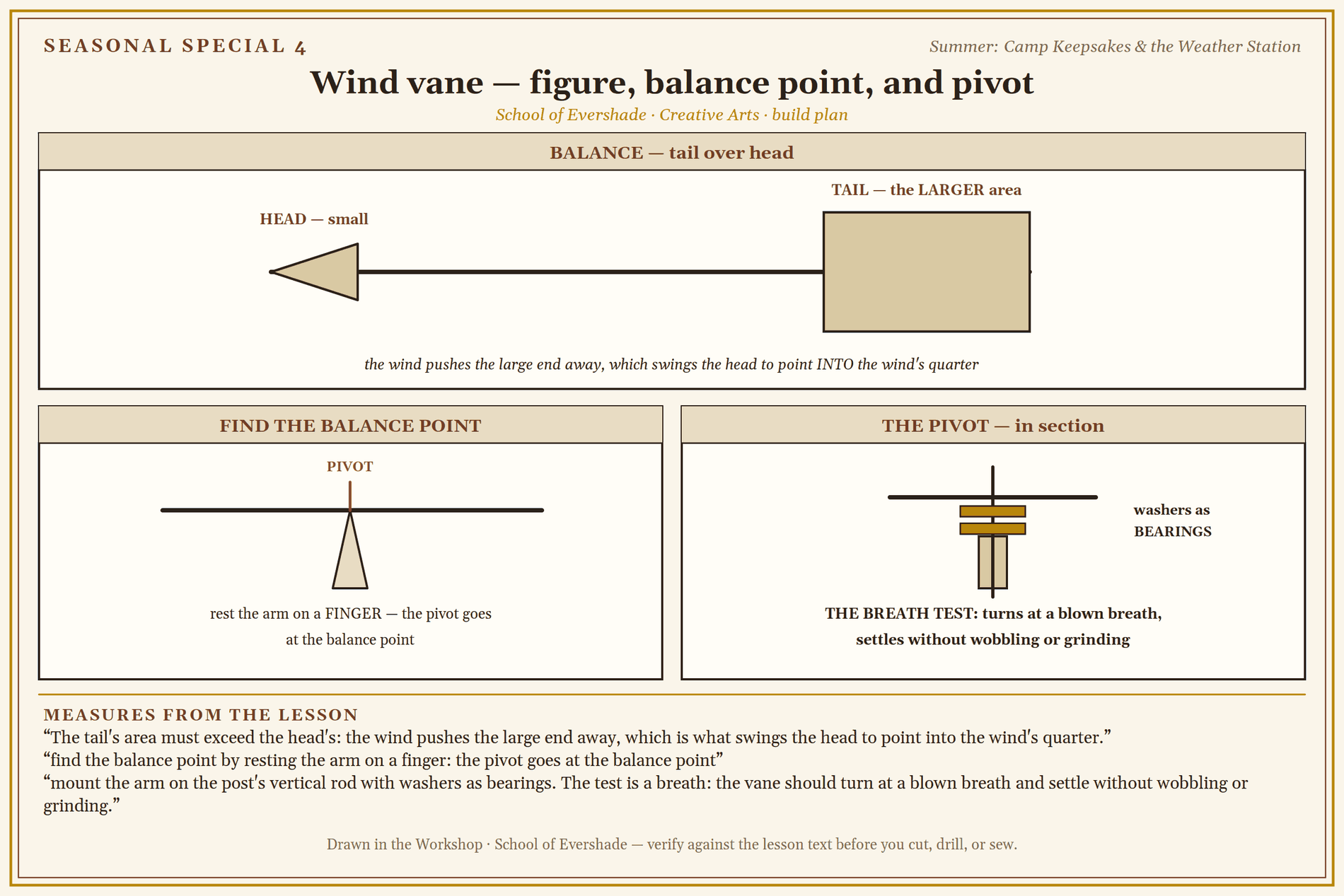
- Cut the figure. Draw the camp emblem or a clean arrow-and-tail on the sheet or plywood, and cut it with Lesson 29's finishing to come. The tail's area must exceed the head's: the wind pushes the large end away, which is what swings the head to point into the wind's quarter.
- Balance the beam. Mount the figure on its horizontal arm and find the balance point by resting the arm on a finger: the pivot goes at the balance point, or a breath of wind will spend itself lifting the heavy end instead of turning the vane.
- Fit the pivot. Drill the pivot hole (Lesson 4) and mount the arm on the post's vertical rod with washers as bearings. The test is a breath: the vane should turn at a blown breath and settle without wobbling or grinding.
- Set the directionals. Fix the directional cross beneath the vane and set it by a known bearing (compass, checked by an adult, or a surveyed sunrise line), never by the look of the camp's paths. Letters readable from the ground, N where north truly is.
- Take the first readings. Read the vane aloud at the log's hours for the camp's remaining days: wind quarter by the directionals, and how the sky agrees. Enter each reading in the keepsake book's log beside the rain. The station is now an instrument with a record, which is all the Tower of the Winds ever was, at twelve meters or at six feet.
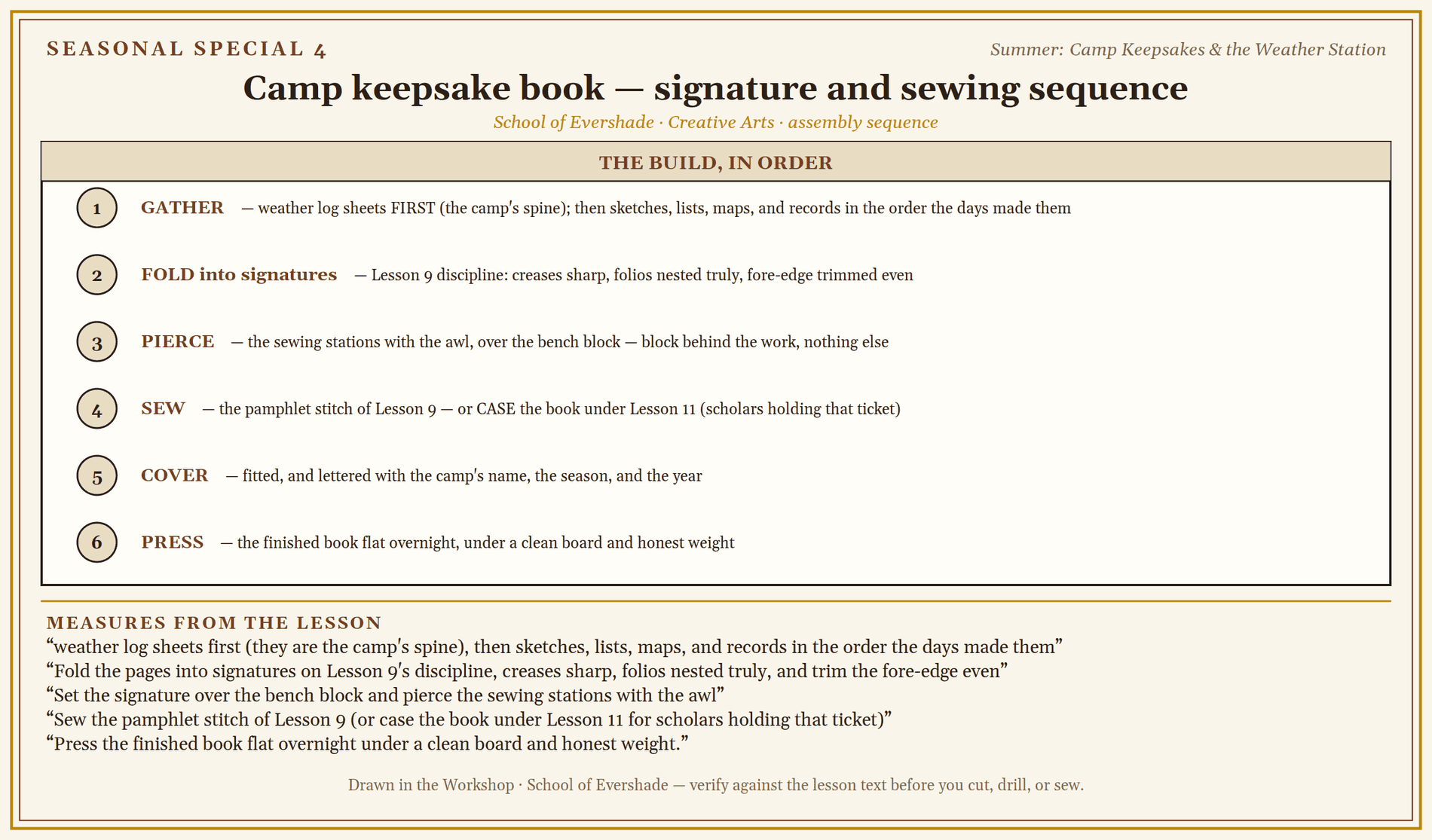
Camp keepsake book — signature and sewing sequence
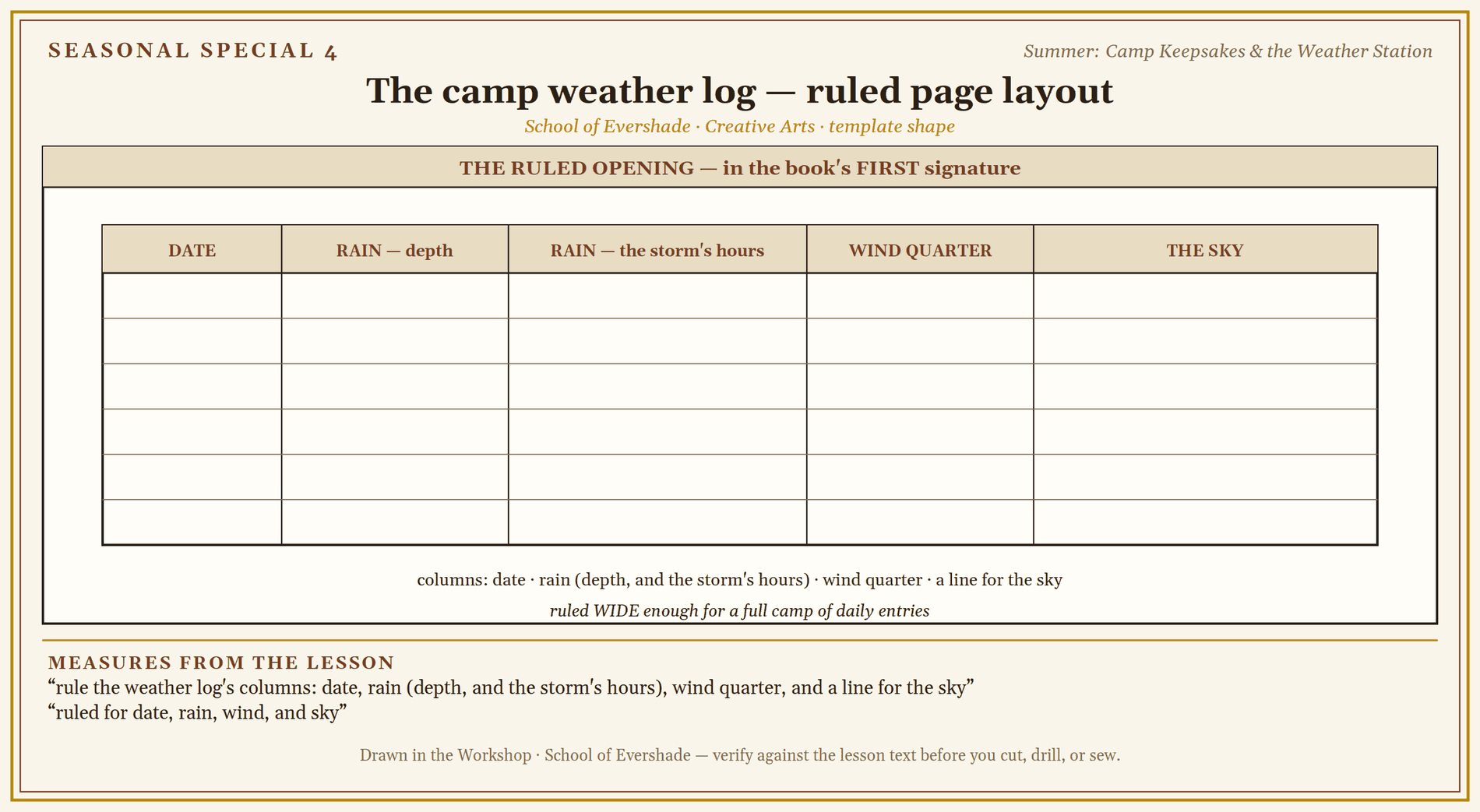
The camp weather log — ruled page layout
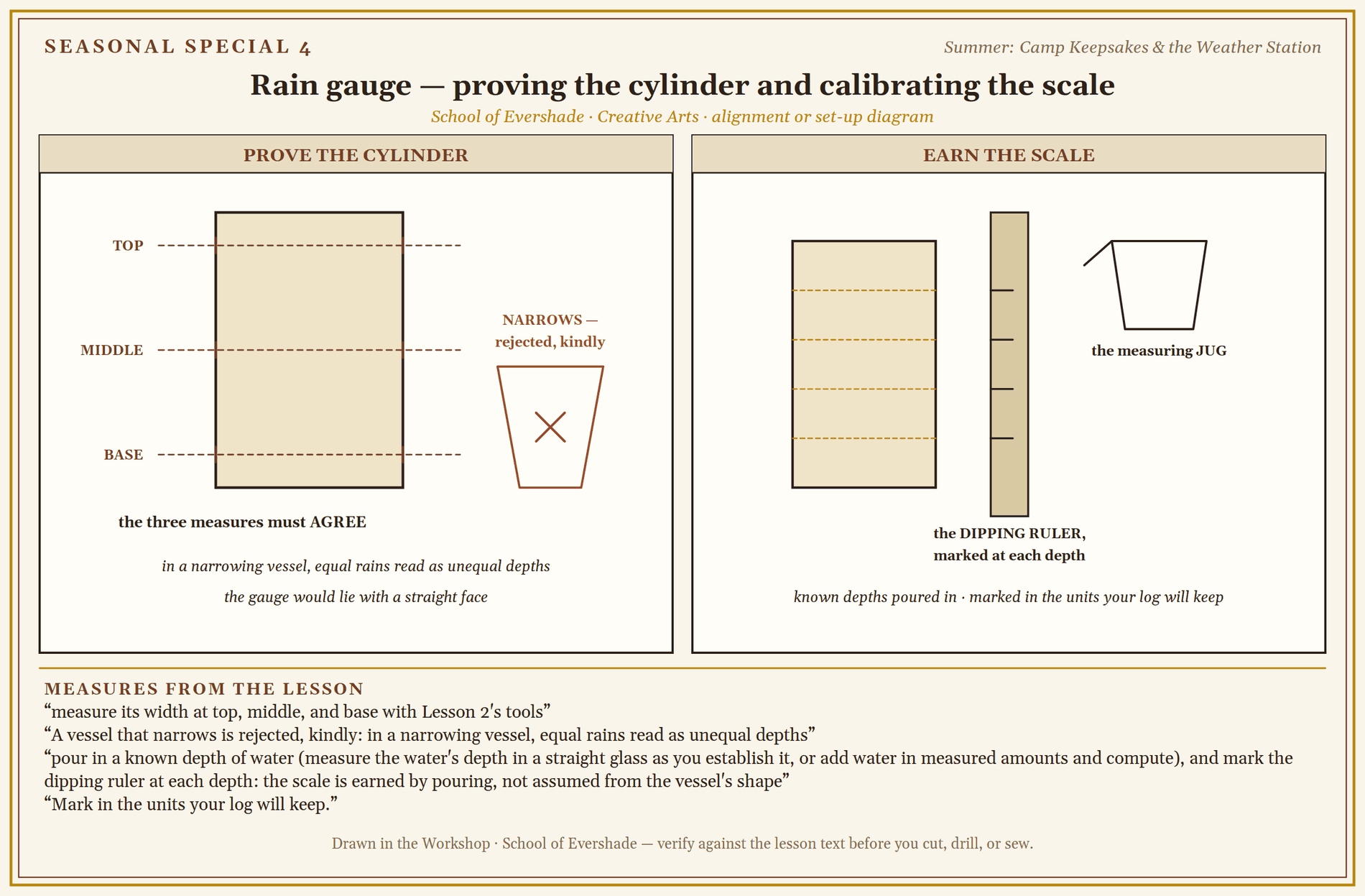
Rain gauge — proving the cylinder and calibrating the scale
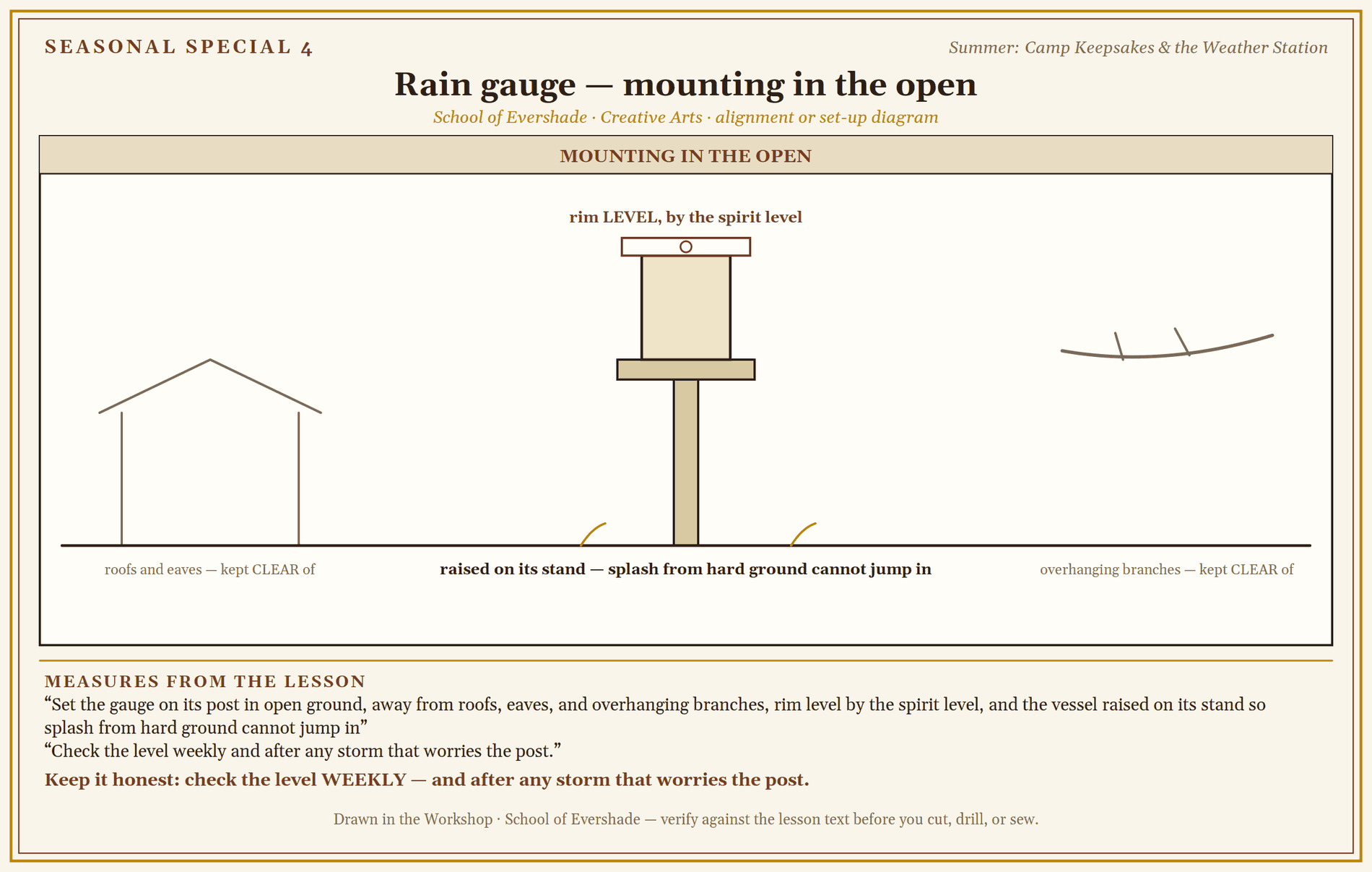
Rain gauge — mounting in the open
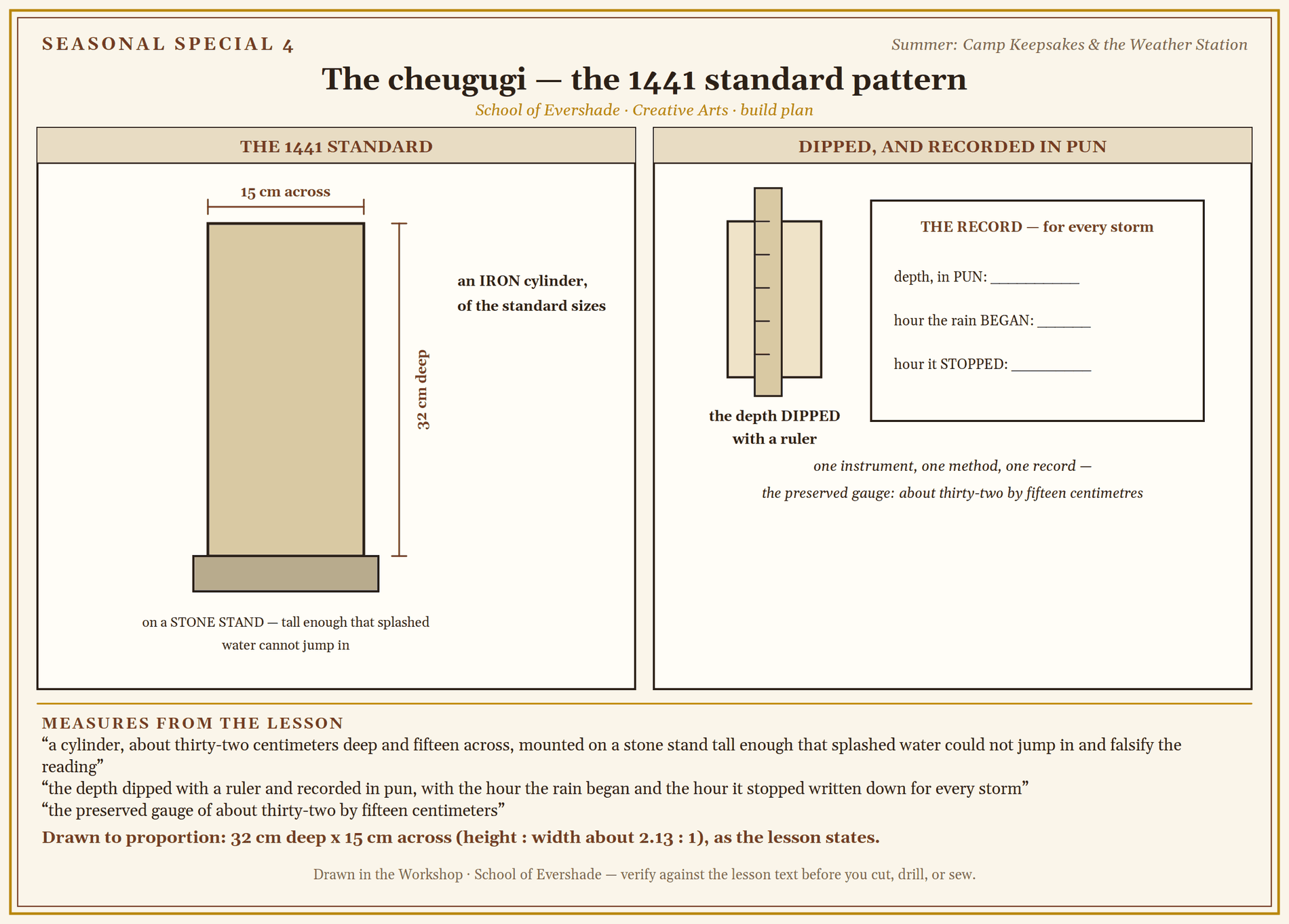
The cheugugi — the 1441 standard pattern
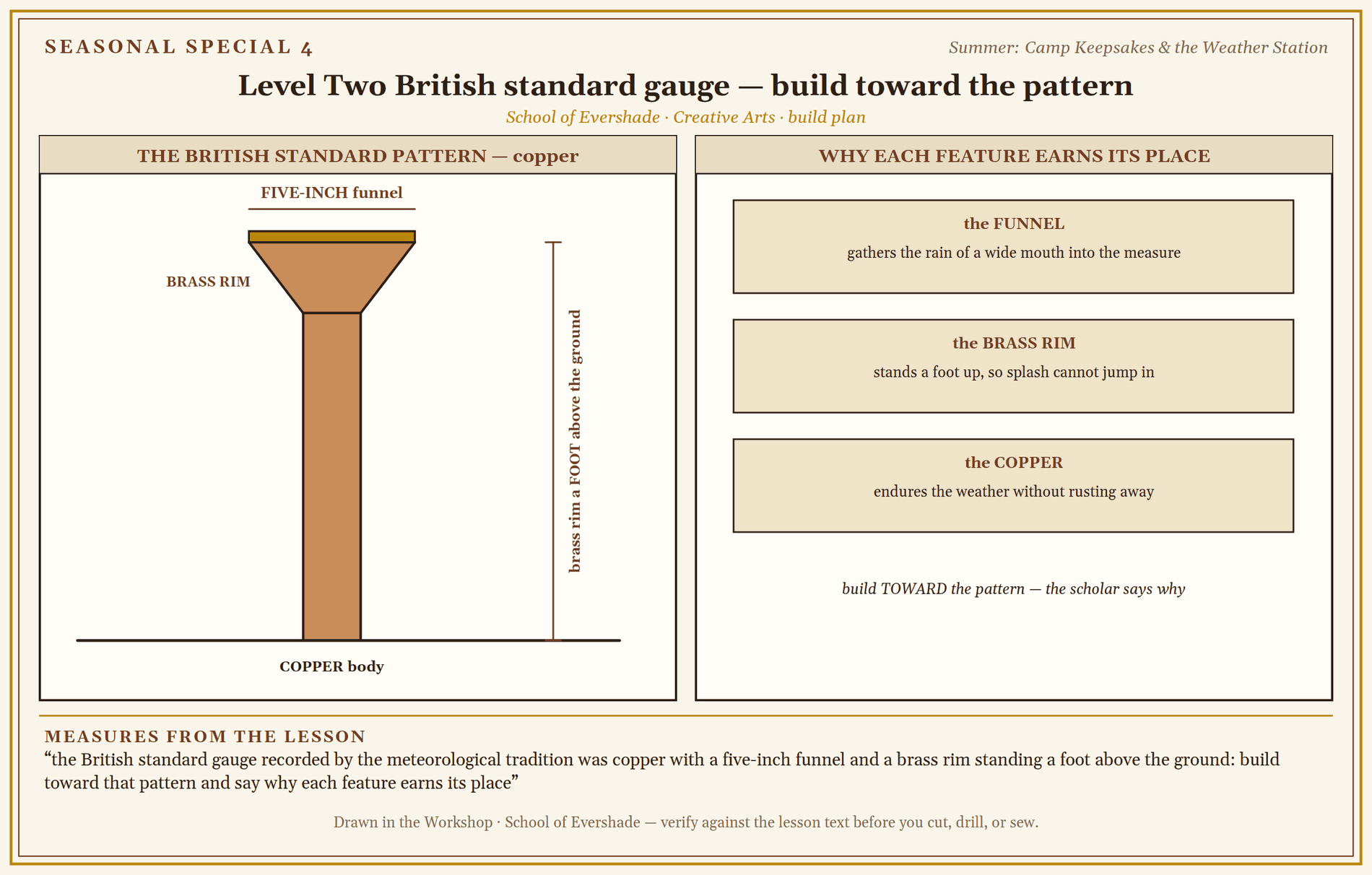
Level Two British standard gauge — build toward the pattern
Wind vane — figure, balance point, and pivot
Directionals — setting the fixed cross by a known bearing
Assignment Manual
Assignment key: ✎ written work · ⚒ hands-on practical · ◐ both
Assignment I ⚒ — The Station and the Book
Complete the three builds of this workshop: the keepsake book bound and its log ruled, the rain gauge calibrated, mounted, and read at least once on real rain (or, if the sky withholds, on a poured drill reading recorded as a drill), and the wind vane turning freely over verified directionals. The station stands when you leave camp, with its log begun.
Assignment II ✎ — Two Instruments, Two Histories
Write a short account of the two instruments: the cheugugi (the puddle problem, Sejong's standard, the identical gauges and the shared record) and the Tower of the Winds (Andronikos' tower, the Triton, the eight winds, and the vane's road to the church roof). Use the sources below, and end with what the two instruments, fifteen centuries apart, were both really measuring.
Assignment III ◐ — The Camp Weather Log
Keep the station's log for the whole of camp in the keepsake book: every rain reading with its storm's hours, the wind's quarter at the log's hours, and a sky line a day. At the finale, close the log with a one-page summary of the camp's weather, written from the record and not from memory. The log is written; the station is built; the book that holds them is built too, and the three are handed in as one work.
Materials
Level One (household)
- A straight-sided cylinder for the gauge: a tall jar, can, or bottle with parallel sides (parallel is the whole point), its rim made safe with tape or a rolled edge
- A ruler for dipping readings, a measuring jug for calibration, a post to mount the gauge, and Lesson 2's spirit level
- Plywood or sheet offcuts for the vane figure, a dowel or smooth bolt for the pivot, and washers for the bearing
- Fixed directionals: four letters or points on a cross arm, and a compass or a known bearing (a surveyed line, a sunrise mark) for setting them
- The camp's pages for the keepsake: log sheets, sketches, and records, gathered and ordered
- Lesson 9's binding kit (paper signatures, needle, thread, awl, bench block) or Lesson 11's (boards, cloth, glue) for scholars holding that ticket
- The weather log's home: the keepsake book itself, ruled for date, rain, wind, and sky
Level Two (historical)
Everything in Level One, plus:
- A copper cylinder gauge in the old standard pattern: the British standard gauge recorded by the meteorological tradition was copper with a five-inch funnel and a brass rim standing a foot above the ground: build toward that pattern and say why each feature earns its place
- A vane figure cut and chased in copper or brass sheet with Lesson 29's metalwork, in place of plywood
- A case-bound keepsake from Lesson 11 with a printed or stamped cover from Lesson 16's label station, the deluxe form of the camp's book
- The gauge read with a dip ruler graduated by hand in the cheugugi manner, its scale cut by calibration and kept with the station
Both levels keep the same log and are judged by the same reading: the numbers written are the numbers the instruments gave.
Reflection Questions
Answer the following questions in your workbook.
- The cheugugi's invention was a standard, not a cylinder. What did the standard let a king do that five hundred private rain jars could not, and where else in this school have you met a standard doing the same work?
- A wind vane reports where the wind comes from, not where it is going. Why do you think the old namers of winds chose the origin, and what does that choice preserve that the other would lose?
- Your gauge's scale was earned by pouring measured water. What is the difference between a calibrated instrument and a merely marked one, and which of your other tools have you actually calibrated?
- Gunn marched forty pupils forty-two miles. What did he believe a camp could teach that his schoolroom could not, and does this workshop agree with him?
- The keepsake book and the weather station are both instruments for defeating the same enemy. Name the enemy, and say which of the two builds you trust further against it, and why.
Professor's Review
Close the log and look at the camp once more, scholars, before the tents come down. The station stands in its open ground, gauge empty and level, vane turning over its true letters, waiting for weather that will arrive whether or not anyone records it. Because of your work, someone will.
You have bound the camp's days into a book that will outlast the summer's telling, and you have kept its sky in numbers a stranger could check, by a method a Korean governor would recognize at a glance. That is the whole of the workshop's teaching, and it is not small: make the thing true, write down what it says, and bind the record so it lasts.
Autumn will call the press and the keeping box back to work, and the station's log, if the camp keeps it, will run on into the school year. Scales true, stitches sound, bearings honest: go home to your own weather.
PROFESSOR COGBRANCH TIMBERCLANK
Creative Arts Workshop
Master Artisan, Head of House Occidens
Further Reading & Sources
Wikipedia. "Rain gauge." The long record: rainfall noted in India and Greece by 400 to 500 BCE, Qin Jiushao's Tianchi basins of 1247, the cheugugi of 1441 as the first standardized gauge, Wren and Hooke's tipping bucket of 1662, and Towneley's fifteen years of systematic records.
Wikipedia. "Ch'ŭgugi." The gauge itself: Sejong's order of August 1441, the standardized system of 1442 with identical gauges in every provincial courtyard, the stone stand that defeats splash, the preserved gauge of about thirty-two by fifteen centimeters, and readings taken in pun with each storm's hours.
Wikipedia. "Weather vane." The vane from fana, the flag: the Tower of the Winds' Triton of about 50 BC, the Gallo di Ramperto of 820, Viking ship vanes carried to church roofs, and the popes who put a cockerel on every steeple.
Greek National Tourism Organisation (Visit Greece). "Tower of the Winds." The Horologion of Andronikos Kyrrhestes in the Roman Agora: Pentelic marble, eight meters across, the brazen Triton on its roof, the eight winds on its faces, and its standing as the first meteorological station in the world.
HISTORY. "What Was the First American Summer Camp in America?" Organized camp's beginnings: the 1861 trek that laid the foundation, Rothrock's North Mountain School of 1876, Camp Chocorua in 1881, and camp as a laboratory for qualities the classroom struggled to grow.
Print only: Ernest Thompson Seton, The Birch-Bark Roll of the Woodcraft Indians. The Woodcraft League's own handbook of camp craft and council-fire order, the book Adirondack campers were still playing and working from a century later. Consult in a library.
Student-friendly starting points for exploring this special's world. All links verified October 2026.
- Wikipedia. "Ch'ŭgugi." Begin with the gauge that was a system: one survivor, in a museum, of the thousands of identical instruments that once reported a kingdom's rain.
- Morning Brew. "The History of Summer Camps in the US." Gunn's forty pupils and their forty-two miles, the first independent camps, and how camp grew from toughening school to the handicrafts-and-s'mores era.
- Greek National Tourism Organisation. "Tower of the Winds." The tower itself, in the Agora where it still stands: read the eight winds' names and find your camp vane's ancestor among them.
Submit your work for this lesson using the form below.
CONTINUE IN THE CREATIVE ARTS WORKSHOP
← Previous · Seasonal Workshop Special S3: Spring: Starting & Growing Next · Course Capstone: The Master Artisan’s Build →
Creative Arts Workshop · All 39 Lessons
Bookstore Shelf The Library · Creative Arts Shelf Course Supplies
The rest of the Seasonal Specials: Special S1 · Autumn: Harvest & Keeping · Special S2 · Winter: Feeders, Lanterns & Sealed Letters · Special S3 · Spring: Starting & Growing