

Creative Arts
Seasonal Workshop Special S3Spring: Starting & Growing
Professor Cogbranch Timberclank
Master Artisan, Head of House Occidens
The Creative Arts Workshop • School of Evershade
Season: Spring · Hosted by: House Oriens, at the Greenhouse door and the Workshop · Workshop tickets required: Lesson 19, "Clay I: Pinch, Coil & Slab"; Lesson 21, "Building the Plant Press"; Lesson 22, "Garden Structures: Supports, Cold Frames & Garden Models."
Professor's Introduction

Mind the mud on the path, scholars. The Spring Workshop meets at Oriens' door, in the east house's season of starting, and our work is the work of beginnings: the vessels young plants start in, and the shelter they start under.
A seed is Professor Fernfoot's affair: which seed, in which soil, sown when and how deep. Those decisions are the Greenhouse's teaching, and this workshop does not borrow them. What the Workshop owns is everything the seed is sown into. A pot that holds water like a soup bowl drowns what it was built to raise. A paper pot that collapses at its first watering is a lesson in the wrong subject. A marker that fades by May leaves a bed of mysteries. Starting well is a building problem before it is a gardening one, and it is ours.
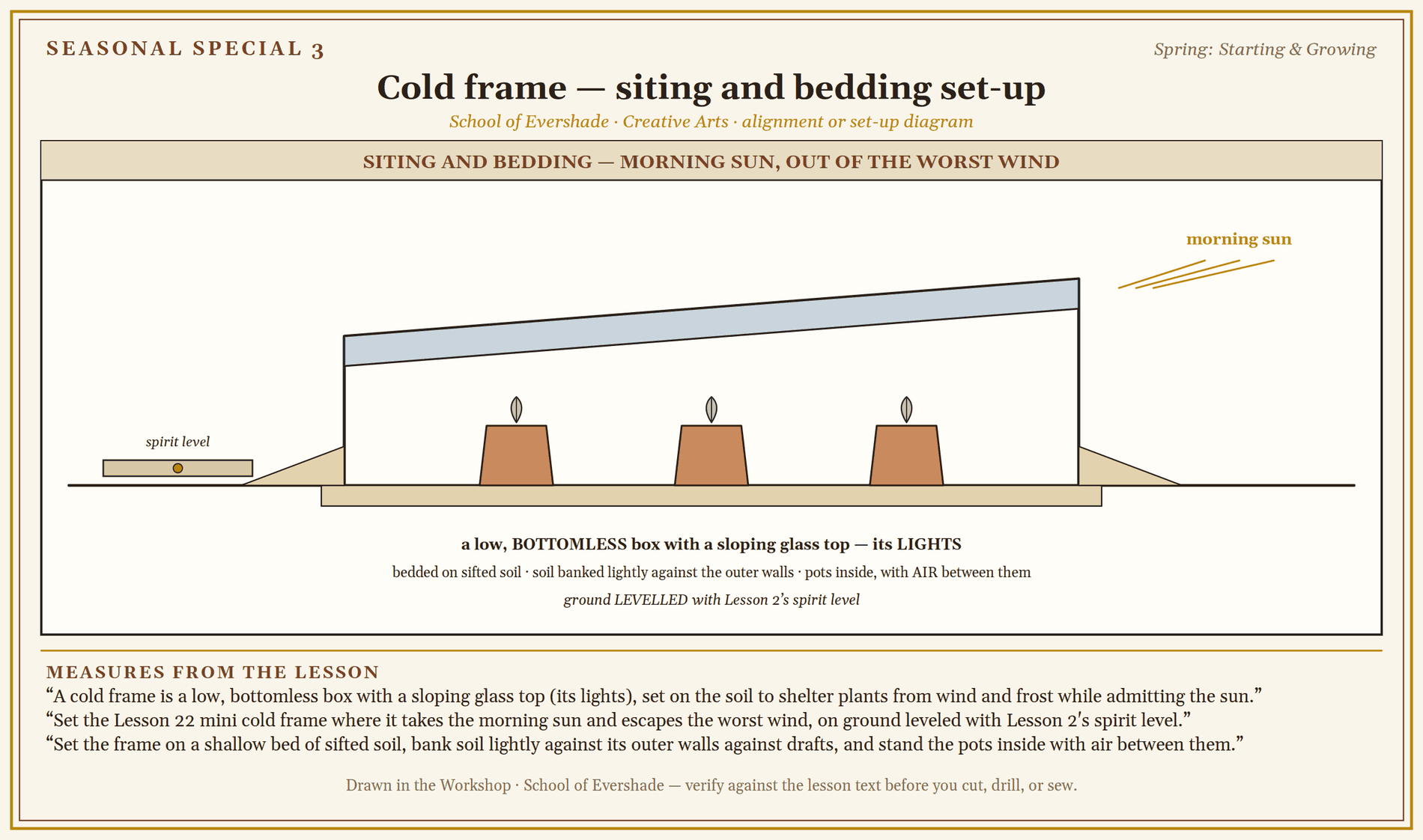
We will form clay pots with true drainage, fold paper pots that hold together wet and rot away kindly when planted whole, incise markers that will still be readable when the harvest comes, and set the Lesson 22 cold frame into working service, vented the way the Paris market gardeners vented theirs. A cold frame is a low, bottomless box with a sloping glass top (its lights), set on the soil to shelter plants from wind and frost while admitting the sun. And before we disperse, we will dress the Lesson 21 press for its season, because the first specimens are already on their way.
PROFESSOR COGBRANCH TIMBERCLANK
Creative Arts Workshop
Master Artisan, Head of House Occidens
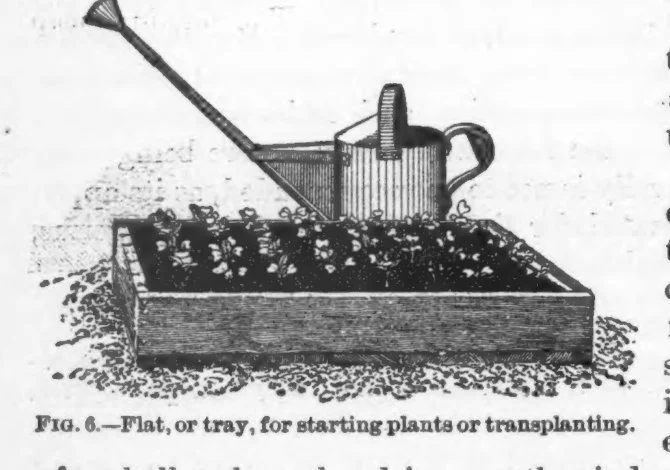
Figure 6 of Farmers' Bulletin No. 255 (1906), "Flat, or tray, for starting plants or transplanting" — the shallow wooden seed flat of the period garden.
U.S. Department of Agriculture, Farmers’ Bulletin No. 255 (1906). Public domain.

Where and when: Paris — 1845 CE, the Paris maraîchers’ manual.
Workshop Objectives
By the end of this workshop, scholars should be able to:
- Tell how the maraîchers of Paris started plants early (hotbeds, bell cloches, and glass frames) and what job each device does.
- Explain a hotbed's heat honestly: it is fermentation, the work of decay, banked under soil and glass.
- Form clay flower pots by pinch and slab with working drainage, and say why a pot without drainage is a bowl.
- Fold paper seed pots that survive watering and can be planted whole.
- Make plant markers that stay legible outdoors for a full season.
- Set the mini cold frame into service: sited, leveled, vented on the notched-peg rule, and run through a hardening-off week.
- Ready the Lesson 21 press for the season: blotters changed, straps sound, boards proven true.
Your Assignment Packet
This lesson's assignments live in its packet: the Lexicon Handout (every term, course terms marked ◆), the Assignment Manual, and the Reflection Questions. Download the packet before you begin and keep it beside you as you read — work from it as each subject is taught, or take the assignments as homework afterward.
Paris Grew Spring Early
For three centuries, the market gardens of Paris did something that read like sorcery to their neighbors: they sold lettuces in January, radishes and mushrooms while the frost was still on the ground, melons by June. The gardeners who did it, the maraîchers, worked small plots in and around the city with a system so effective that when two of them, Moreau and Daverne, finally wrote it down in 1845, their manual became the record of a whole profession. The system's principles are still taught: rich soil improved relentlessly, close planting, succession sowing, and above all, command of the season's edges, spring brought forward and autumn held back.
The scale of it deserves a scholar's respect. By 1844, a contemporary count found some 1,125 maraîchers working roughly 1,500 acres inside Paris, and their equipment ran to hundreds of thousands of glass frame-lights and between five and six million bell cloches. A cloche — French for "bell" — is a bell-shaped cover of glass (now often plastic) set over a single plant to shelter it from cold and coax it early. Five million bells of glass, each one lifted, vented, and set down by hand, in gardens where a single grower might tend five thousand. This was not a quaint custom. It was an industry of attention, and its tools were simple enough to sit on this workshop's bench: manure, soil, glass, and discipline.
The system spread the way good systems do. William Robinson carried word of it to English readers in 1869, Victorian gardeners adopted its methods wholesale into their walled gardens (the Victorians grew melons and pineapples with Parisian heat), and in the later twentieth century it crossed to America, where it underlies the biointensive gardening taught today. When you vent a cold frame on a notched peg this week, you are using a gesture refined by people who fed a city out of season, with no fuel but rot and no light but the sun.
Heat from Below, Glass Above
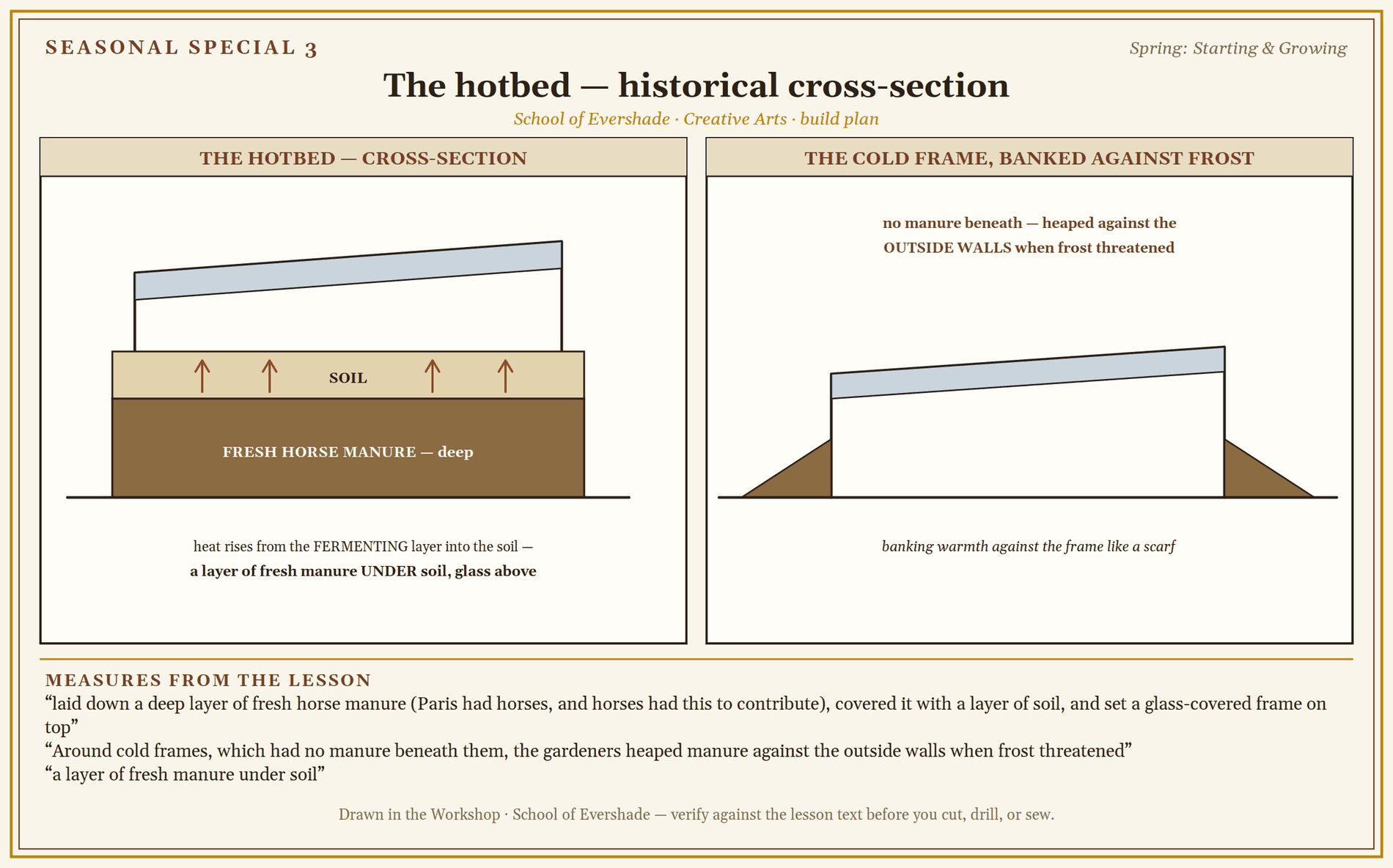
The hotbed is the system's engine, and its principle is one this school never tires of: decay is work, and work makes heat. The maraîcher dug a pit or raised a bed, laid down a deep layer of fresh horse manure (Paris had horses, and horses had this to contribute), covered it with a layer of soil, and set a glass-covered frame on top. The manure, fermenting, warmed the soil from below for weeks, and seeds sown in that soil germinated into a private spring while the fields outside were still frozen. Around cold frames, which had no manure beneath them, the gardeners heaped manure against the outside walls when frost threatened, banking warmth against the frame like a scarf.
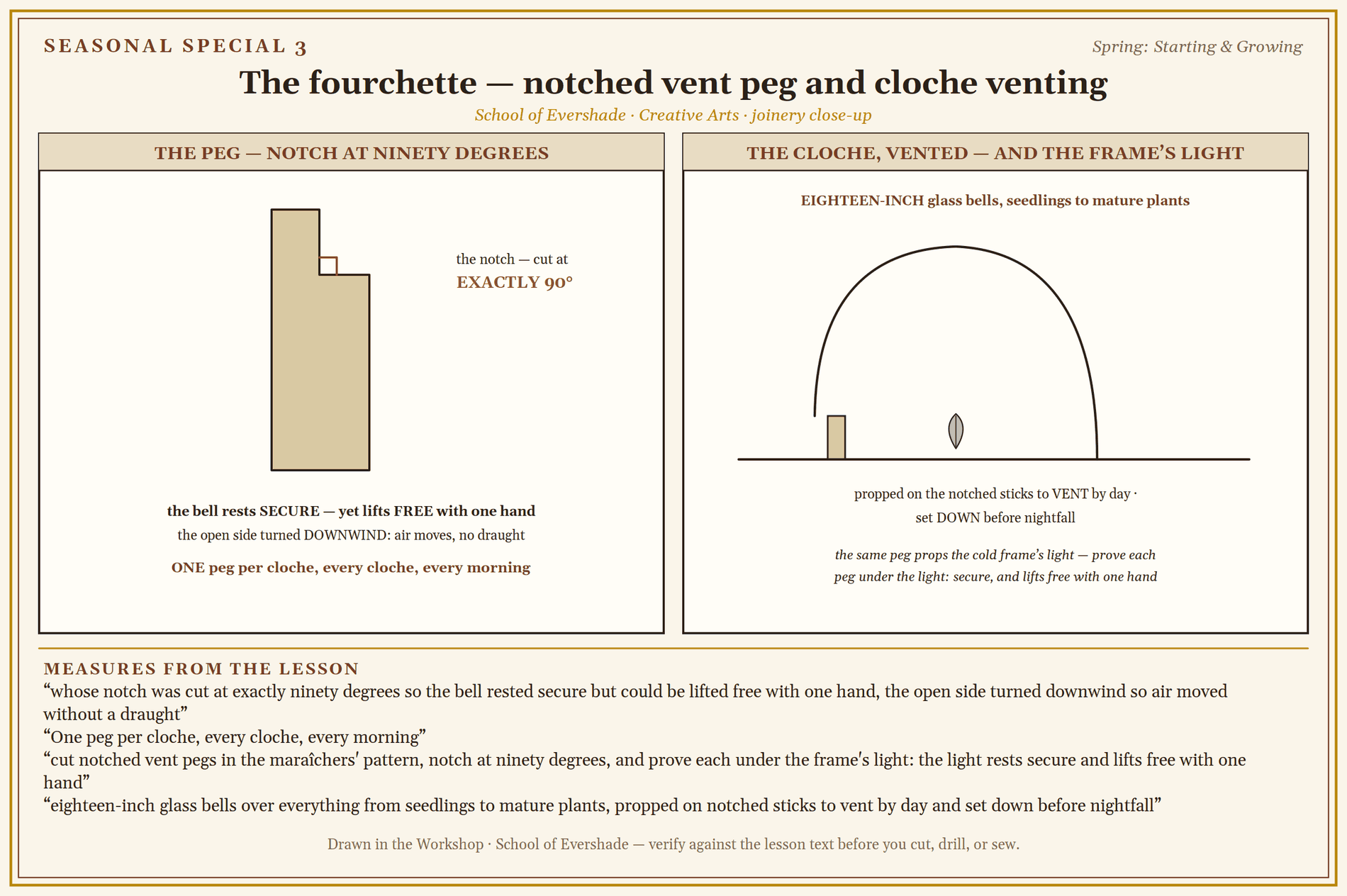
Above the heat stood the glass, and glass has its own discipline. The bell cloche covered one plant: on a sunny morning the gardener propped its edge on a notched wooden peg, the fourchette, whose notch was cut at exactly ninety degrees so the bell rested secure but could be lifted free with one hand, the open side turned downwind so air moved without a draught. One peg per cloche, every cloche, every morning; and the bells came down flat before nightfall, and fast when storms threatened, because a field of five thousand glass bells in a hailstorm is a fortune dissolving. The frames got the same respect: covered with reed mats at night against the frost, opened by degrees as the day warmed.
Read the three devices as one machine with three parts. The hotbed pushes the season from below. The cloche and the frame hold the gain and meter the air. The gardener's rounds, morning and evening, are the machine's clockwork. Our cold frame in this workshop is the same machine at its smallest: no manure under it unless your Level Two work puts it there, but sited, vented, and covered by the same rules, and judged by the same result. Plants started early, and alive to show for it.
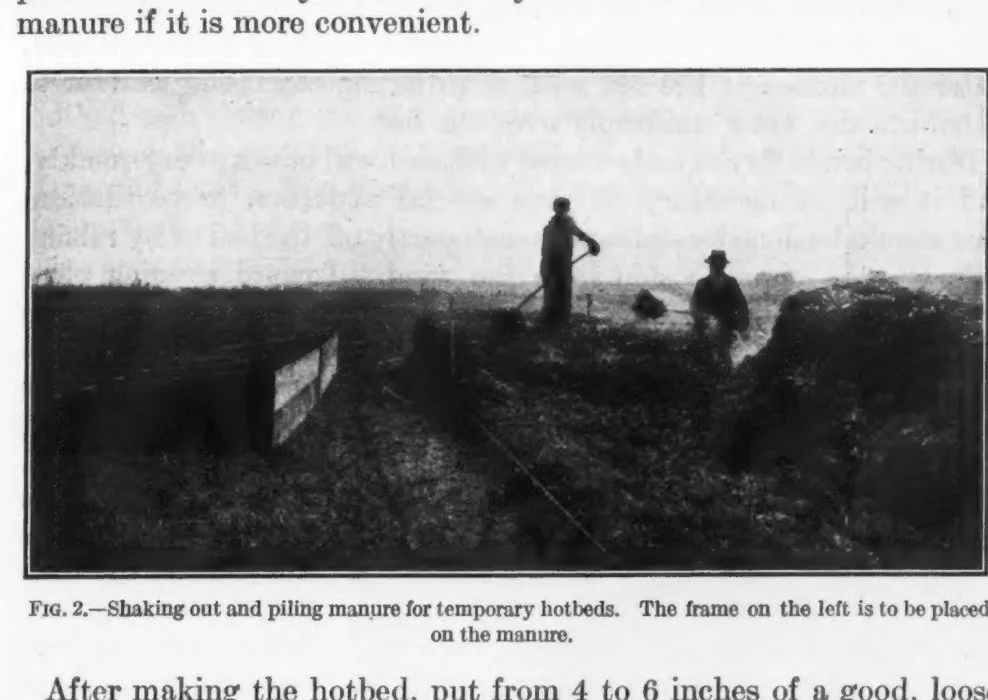
Figure 2 of USDA Farmers' Bulletin No. 642 (1915): "Shaking out and piling manure for temporary hotbeds. The frame on the left is to be placed on the manure." — workers forking fresh manure into the broad pile that will heat the bed.
U.S. Department of Agriculture, Farmers’ Bulletin No. 642 (1915). Public domain.
A Sealed Note from Professor Timberclank
Spring puts glass and soil in the same pair of hands, and we settle both before the frame is opened.
Glass lights and cloches are carried two-handed, by their frames, never by the pane, and a pane that is cracked is retired whole and replaced, never worked around and never taped into service. Panes wait in their rack, not leaned against the bench leg where a boot will find them. This is Lesson 5's glass discipline, and the season does not dilute it.
Manure and compost are honest materials and dirty ones. Gloves for the handling, tools washed after (Lesson 18's care), and hands washed before food, before the press, and before any specimen work: soil and specimens do not share hands in this school. A cut that meets manure gets washed and dressed at once, not at the end of the round.
And the frame's glass in spring sun is a small furnace. A closed frame at noon can cook the plants it sheltered at dawn. The venting round is not optional because the morning was cold. We stop. We make it safe. Then we begin again.
PROFESSOR COGBRANCH TIMBERCLANK
Creative Arts Workshop
Master Artisan, Head of House Occidens
The Workshop Builds
Three builds, in the order the season uses them: pots before sowing, markers before the beds forget what is in them, and the frame in service over both.
Build One ⚒ — Clay Pots for Starting
This build is checked for even walls, a true base, and drainage that actually drains.
- Wedge and divide. Wedge the clay as Lesson 19 taught until it is even and free of air pockets, and divide it into pot-sized lumps, each weighed in the hand against the last so the set comes out a family.
- Pinch the pot. Open the lump with the thumb and pinch the walls up in turns, rotating as you go, until the walls stand even, no thinner at the rim than at the base. A starting pot is small and straight-sided, wider at the mouth than at the foot, so the young plant slides out whole at planting time.
- True the base. Set the pot on its rim and flatten the base against the board so it stands without rocking. A pot that rocks spills, and a pot that spills on the bench teaches the wrong lesson about the bench.
- Pierce the drainage. Before the clay firms, pierce one clean hole through the center of the base from inside out. Say the rule aloud while you do it: a pot without drainage is a soup bowl, and nothing is started in a soup bowl.
- Make the saucer and dry slowly. Roll a slab, cut a disc wider than the pot's foot, and lift its edge into a shallow saucer. Dry pots and saucers together, slowly, under a cloth, turned as they dry: haste cracks clay, and spring has waited this long already.
- Test with water. When dry, set each pot in its saucer, fill with soil, and water it. The water should pass through and stand in the saucer, not in the pot. A pot that fails is recycled to the clay bin with its fault named, which is information, not disgrace.
Build Two ⚒ — Paper Seed Pots and Plant Markers
This build is checked for pots that hold together wet and markers that can be read at arm's length in June.
- Fold the pots. From newspaper or recycled sheets, fold square seed pots on Lesson 7's scoring discipline: corners crisp, seams tucked, the base folded double so it bears weight. Make them in batches of a size, like the maraîchers made everything: a system, not a gesture.
- Water-test one. Fill a test pot with soil, water it thoroughly, and lift it. It should hold together, damp and entire, long enough to be carried to the frame. A pot that sags apart at the first watering gets its fold corrected before the batch proceeds.
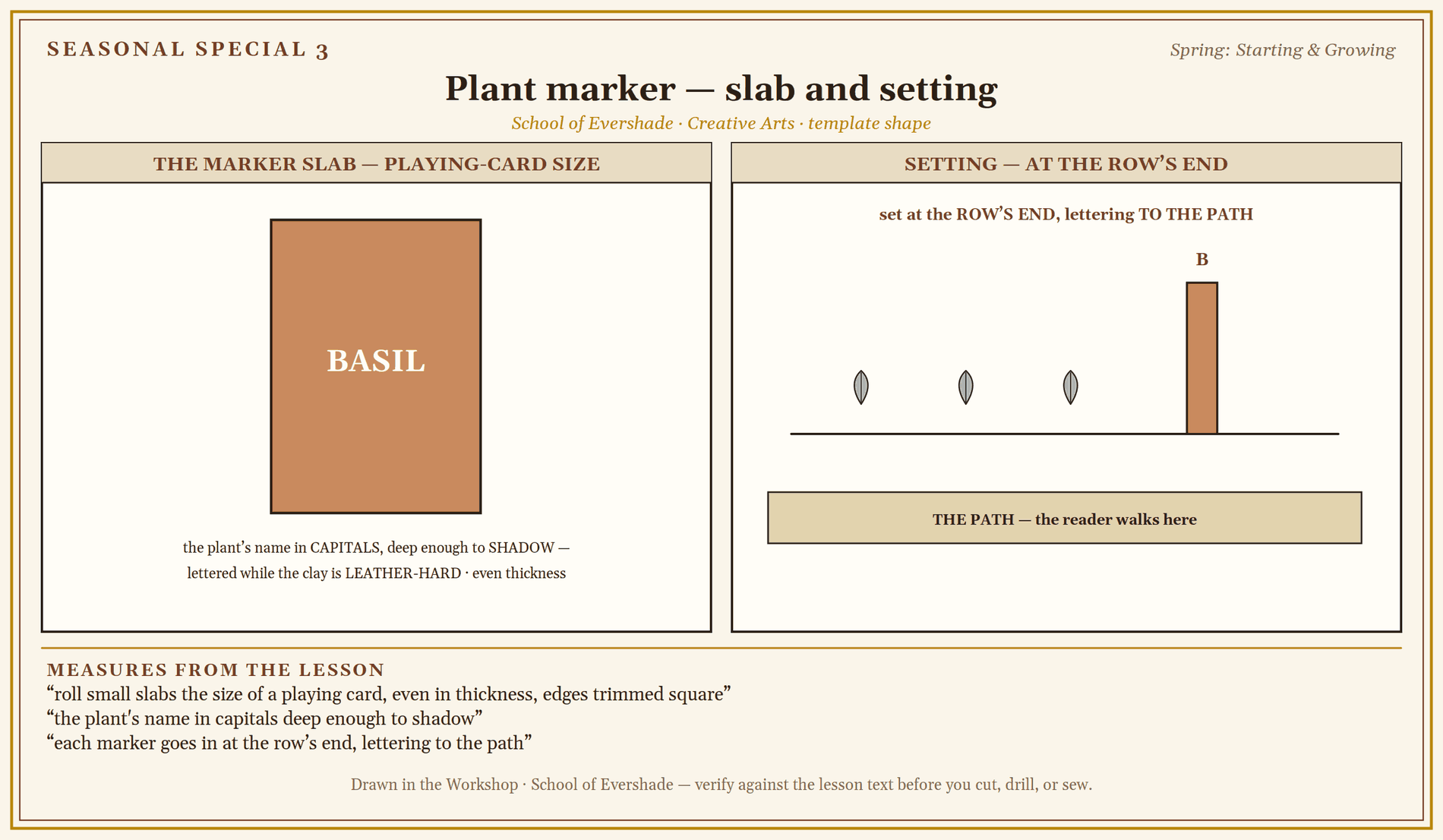
- Roll the marker slabs. From clay offcuts, roll small slabs the size of a playing card, even in thickness, edges trimmed square with the knife on the mat (Lesson 3's rules).
- Incise the names. With the Lesson 6 stylus, letter each marker while the clay is leather-hard: the plant's name in capitals deep enough to shadow, so the name reads by light and not by ink. Ink fades outdoors; a cut does not.
- Dry and set. Dry the markers with the pots. When the beds are ready, each marker goes in at the row's end, lettering to the path, where the scholar who tends the bed will actually stand to read it.
Build Three ⚒ — The Cold Frame in Service
This build is checked for a level frame, a working vent, and a week's honest log.
- Site the frame. Set the Lesson 22 mini cold frame where it takes the morning sun and escapes the worst wind, on ground leveled with Lesson 2's spirit level. A frame on a slope vents its heat at the high corner and pools its cold at the low one; level is not fussiness here.
- Bed it in. Set the frame on a shallow bed of sifted soil, bank soil lightly against its outer walls against drafts, and stand the pots inside with air between them. The seedlings those pots hold arrive by pricking out: moving them from the crowded seed tray into pots of their own, lifted by a leaf and settled into dibbled holes at the spacing they need to grow on.
- Cut the fourchettes. From offcuts, cut notched vent pegs in the maraîchers' pattern, notch at ninety degrees, and prove each under the frame's light: the light rests secure and lifts free with one hand.
- Run the rounds. Each morning, judge the day: light propped on the peg in sun, open side downwind; light down before nightfall; blanket or mat over the frame when frost is threatened. This round, done daily, is the build. The frame is furniture; the rounds are the craft.
- Harden off. Across the week, give the starts longer hours with the light fully open, then hours outside the frame entirely, until they stand a full day unprotected. Log each day in the workshop record: weather, vent state, and how the starts answered.
- Dress the press before you leave. Change the Lesson 21 press's blotters, check its straps for wear, prove its boards true, and leave it dressed and empty, ready for the season's first specimens. Readiness is a build too.
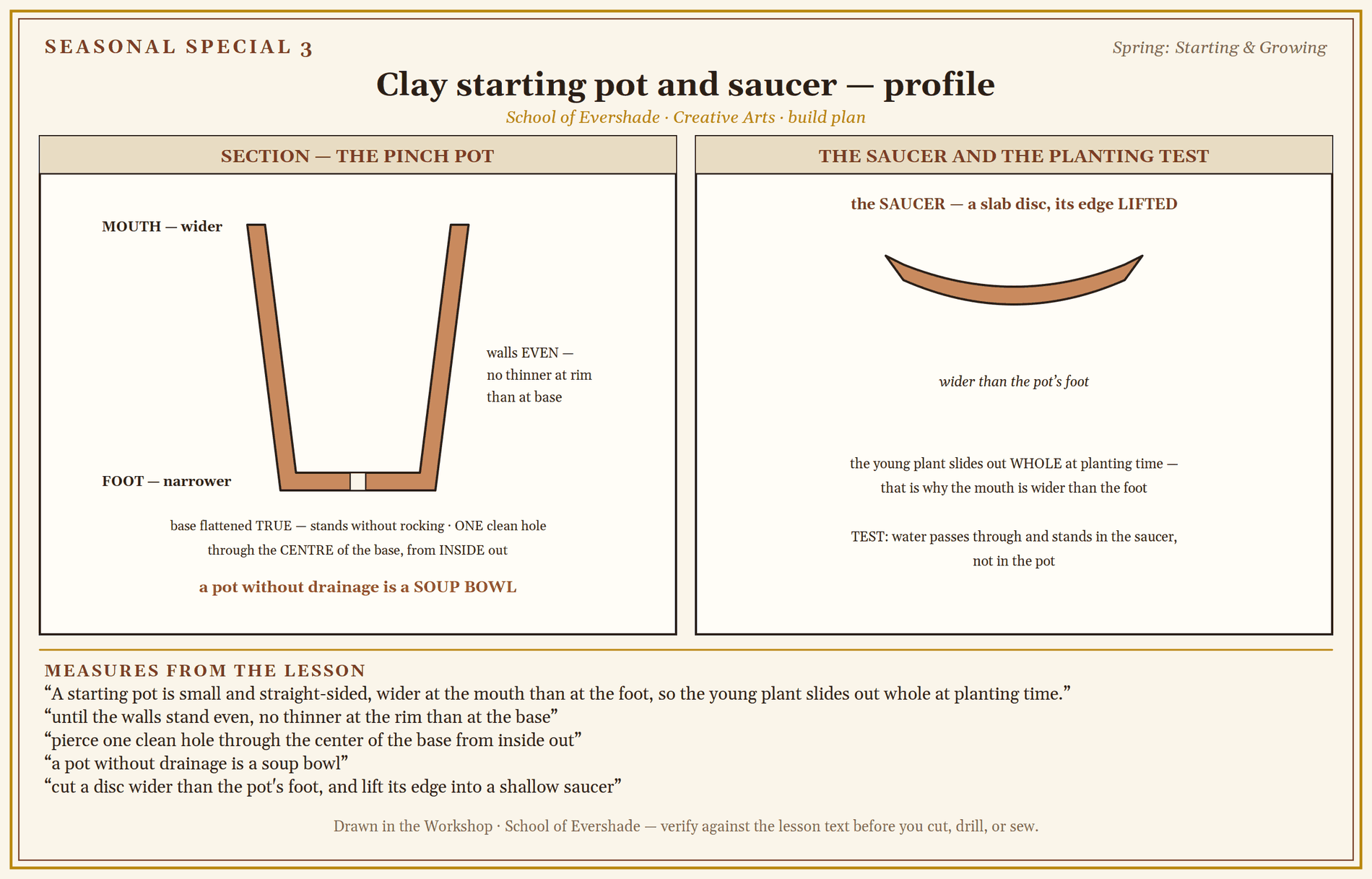
Clay starting pot and saucer — profile
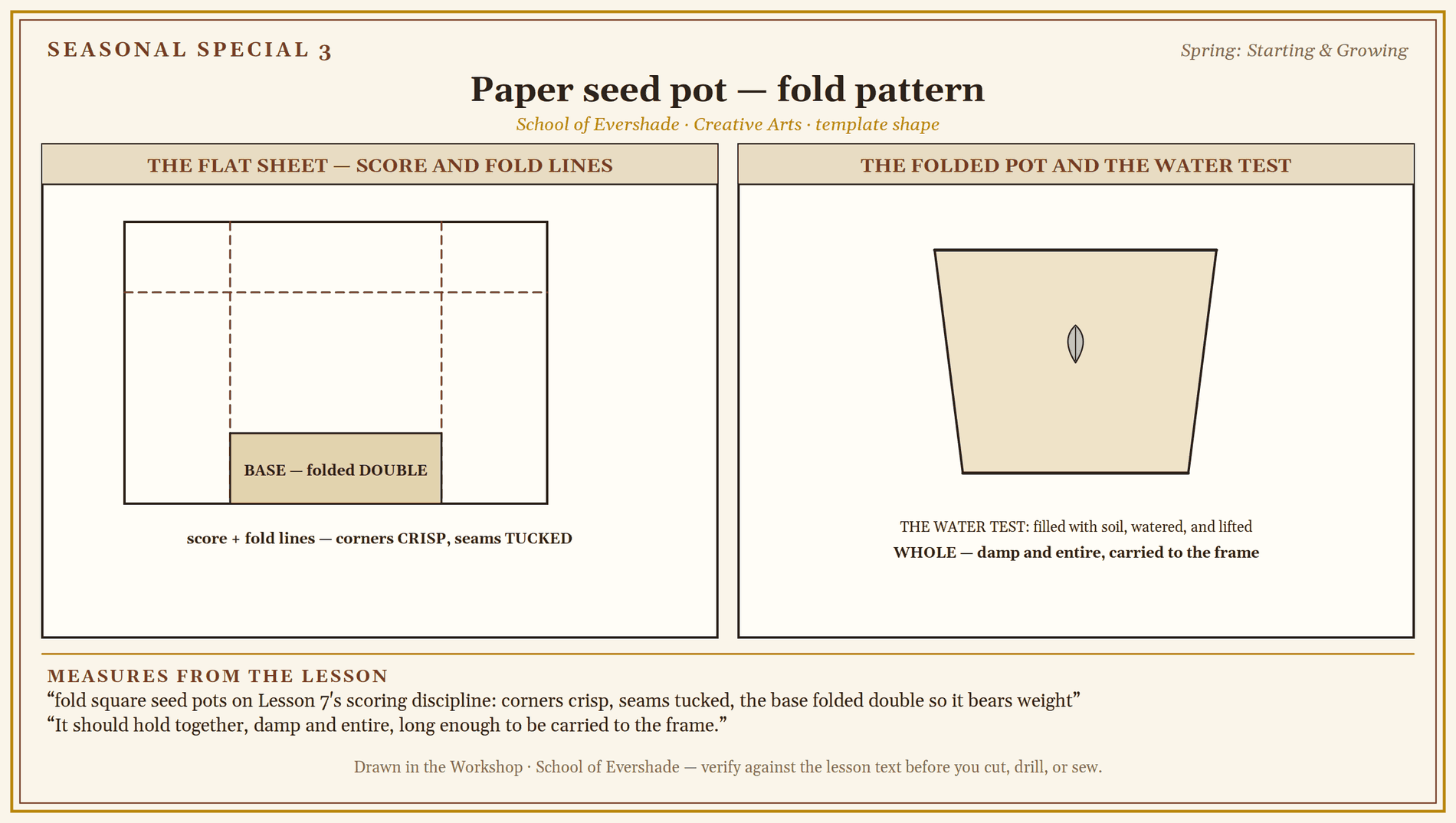
Paper seed pot — fold pattern
Plant marker — slab and setting
Cold frame — siting and bedding set-up
The fourchette — notched vent peg and cloche venting
The hotbed — historical cross-section
Assignment Manual
Assignment key: ✎ written work · ⚒ hands-on practical · ◐ both
Assignment I ⚒ — Pots, Markers, Frame
Complete the three builds of this workshop: a set of drained clay pots with saucers, a batch of water-tested paper pots with incised markers, and the cold frame in service through a full hardening-off week, with the press dressed and proven before you finish. The frame's log is part of the evidence and is handed in with the builds.
Assignment II ✎ — The Maraîchers' Spring
Write a short account of the Paris market gardens' starting system: the gardens' scale (the growers, the acres, the millions of cloches), the hotbed's engine, the cloche's venting discipline, and how the system traveled to England and America. Use the sources below, and keep the history to what was done and why it worked.
Assignment III ◐ — The Starting Record
Run one tray or frame of starts from sowing to planting out under Professor Fernfoot's scholars' direction, keeping the starting record: what was sown, in which of your pots, the venting and watering rounds, the hardening-off days, and the result at planting. The record is written; the plants are built things, grown; the two are handed in together.
Materials
Level One (household)
- Air-dry or garden clay, a board to work on, water, and Lesson 19's hand tools
- A piercing tool for drainage holes, and a tray for drying the pots slowly
- Newspaper or recycled paper sheets for the paper pots, folded on Lesson 7's discipline
- Slab offcuts of clay for the markers, and a stylus from Lesson 6 for the lettering
- The Lesson 22 mini cold frame, complete with its lights
- Notched vent pegs cut from offcuts, and an old blanket, mat, or straw for frost nights
- Seed compost or sifted soil, a watering can with a fine rose, and the Lesson 21 press with fresh blotters
Level Two (historical)
Everything in Level One, plus:
- Terracotta firing for the clay pots, arranged by an adult through a kiln-owning neighbor, studio, or school: the pots fired in the old material, not merely dried
- A true glass bell cloche, handled under the sealed note's glass rules, to work beside the frame and learn the fourchette's one-peg venting at first hand
- A working hotbed under the frame, built the maraîcher way: a layer of fresh manure under soil, made by adults with gloves, tools washed after
- Hardwood frame lights for the cold frame, glazed and puttied in the traditional manner
Both levels start the same plants under the same rules and are judged by the same morning round: nothing cooked, nothing frozen, nothing drowned.
Reflection Questions
Answer the following questions in your workbook.
- A pot without drainage is a soup bowl. What other builds in this course fail in exactly the same way, by omitting the one feature that is their whole purpose?
- The maraîchers' five million cloches were each lifted by hand, morning and evening. What does that arithmetic say about the price of an early lettuce in 1844, and about what attention is worth?
- The hotbed's heat is decay, banked. Where else in this school is something usually thrown away doing the central work of a build or a lesson?
- Hardening off is a kindness performed slowly on purpose. Which other workshop practices protect a thing by exposing it gradually rather than all at once?
- This workshop builds the vessels; the Greenhouse decides what fills them. When your pots went into service under Fernfoot's scholars' direction, what did you learn about your own build that the bench alone could not have taught you?
Professor's Review
Stand back and look at the frame, scholars, with the light up on its peg and the starts standing in their rows of your own pots, each with its marker where a reader can read it. That is a spring garden in its working clothes, and every piece of it passed through your hands.
You know now why Paris ate lettuce in January, and it was not magic and it was not luck. It was manure, glass, and rounds kept faithfully, which is this workshop's whole curriculum in three words. Keep the rounds. The frame forgives a cold night; it does not forgive a forgotten noon.
The press stands dressed for the Greenhouse's first specimens, and the Autumn Workshop will want it again for the harvest. Next we meet at Meridies' camp, where your Lesson 9 binding becomes a keepsake and your Lesson 2 measuring becomes a weather station. Until then, water what you started.
PROFESSOR COGBRANCH TIMBERCLANK
Creative Arts Workshop
Master Artisan, Head of House Occidens
Further Reading & Sources
Wikipedia. "Cloche (agriculture)." The bell and its history: Parisian market gardens of the 1800s, eighteen-inch glass bells over everything from seedlings to mature plants, propped on notched sticks to vent by day and set down before nightfall.
Wikipedia. "French intensive gardening." The maraîcher system as a whole: fermenting manure warming the soil from the 1500s onward, Moreau and Daverne's 1845 manual, and the method's travels to England and America.
Bite Sized Gardening (Stefan Drew). "Les Maraîchers Parisiens." The working detail this workshop follows: hotboxes of decomposing manure under soil and glass, manure heaped around cold frames against frost, mats over the frames at night, the fourchette's ninety-degree notch, and the 1844 count of growers, acres, and millions of cloches.
Print only: Moreau and Daverne, Manuel pratique de la culture maraîchère de Paris (Paris, 1845). The maraîchers' own manual, written by two of their number: the primary source for the whole system. Consult in a library or facsimile.
Print only: Eliot Coleman, The Winter Harvest Handbook (Chelsea Green, 2009). The modern master's account of unheated season extension, and a source behind the cloche history above. Consult in print.
Student-friendly starting points for exploring this special's world. All links verified October 2026.
- Bite Sized Gardening. "Les Maraîchers Parisiens." Begin here for the gardeners themselves: their cans, their pegs, their glass by the million, and a city fed out of season.
- Wikipedia. "Cloche (agriculture)." One plant, one bell of glass, one peg: the smallest greenhouse ever standardized, and the ancestor of every cover in your garden.
Submit your work for this lesson using the form below.
CONTINUE IN THE CREATIVE ARTS WORKSHOP
← Previous · Seasonal Workshop Special S2: Winter: Feeders, Lanterns & Sealed Letters Next · Seasonal Workshop Special S4: Summer: Camp Keepsakes & the Weather Station →
Creative Arts Workshop · All 39 Lessons
Bookstore Shelf The Library · Creative Arts Shelf Course Supplies
The rest of the Seasonal Specials: Special S1 · Autumn: Harvest & Keeping · Special S2 · Winter: Feeders, Lanterns & Sealed Letters · Special S4 · Summer: Camp Keepsakes & the Weather Station