

Creative Arts
Seasonal Workshop Special S1Autumn: Harvest & Keeping
Professor Cogbranch Timberclank
Master Artisan, Head of House Occidens
The Creative Arts Workshop • School of Evershade
Season: Autumn · Hosted by: House Occidens, at the Terrace and the Workshop · Workshop tickets required: Lesson 7, "Paper, Card & Board Construction"; Lesson 10, "The Field & Observation Kit"; Lesson 21, "Building the Plant Press."
Professor's Introduction

Come in and shut the door against the first cold wind, scholars. Autumn is the keeping season, and this workshop is Occidens' own, so we meet on my house's ground and do my house's work: we take what the year grew and we keep it well.
Keeping is a craft, with rules as strict as any joint in this room. A harvest does not keep itself. Left in a heap it molds; left in the light it fades and sprouts; left unsorted it carries its failures into storage and shares them. The keeper's work is drying, sorting, and storing, each done in its right order, and the keeper's rule can be said in four words: cool, dry, dark, labeled. Everything this workshop builds serves one of those words.
Understand whose harvest this is. Professor Fernfoot's scholars decide what is gathered, when it is ripe, and how it is cut; their Unit IV lessons, on drying, pressing, and seed saving, teach the keeping itself. This workshop builds the gear those lessons call for and puts the gear to work beside them: the press in its autumn service, a tray that makes sorting honest, envelopes that hold a seed lot apart from every other, and bundles hung where the air can do its part.
Bring your Lesson 7 hands, your Lesson 10 kit, and the press you proved in Lesson 21. We begin.
PROFESSOR COGBRANCH TIMBERCLANK
Creative Arts Workshop
Master Artisan, Head of House Occidens
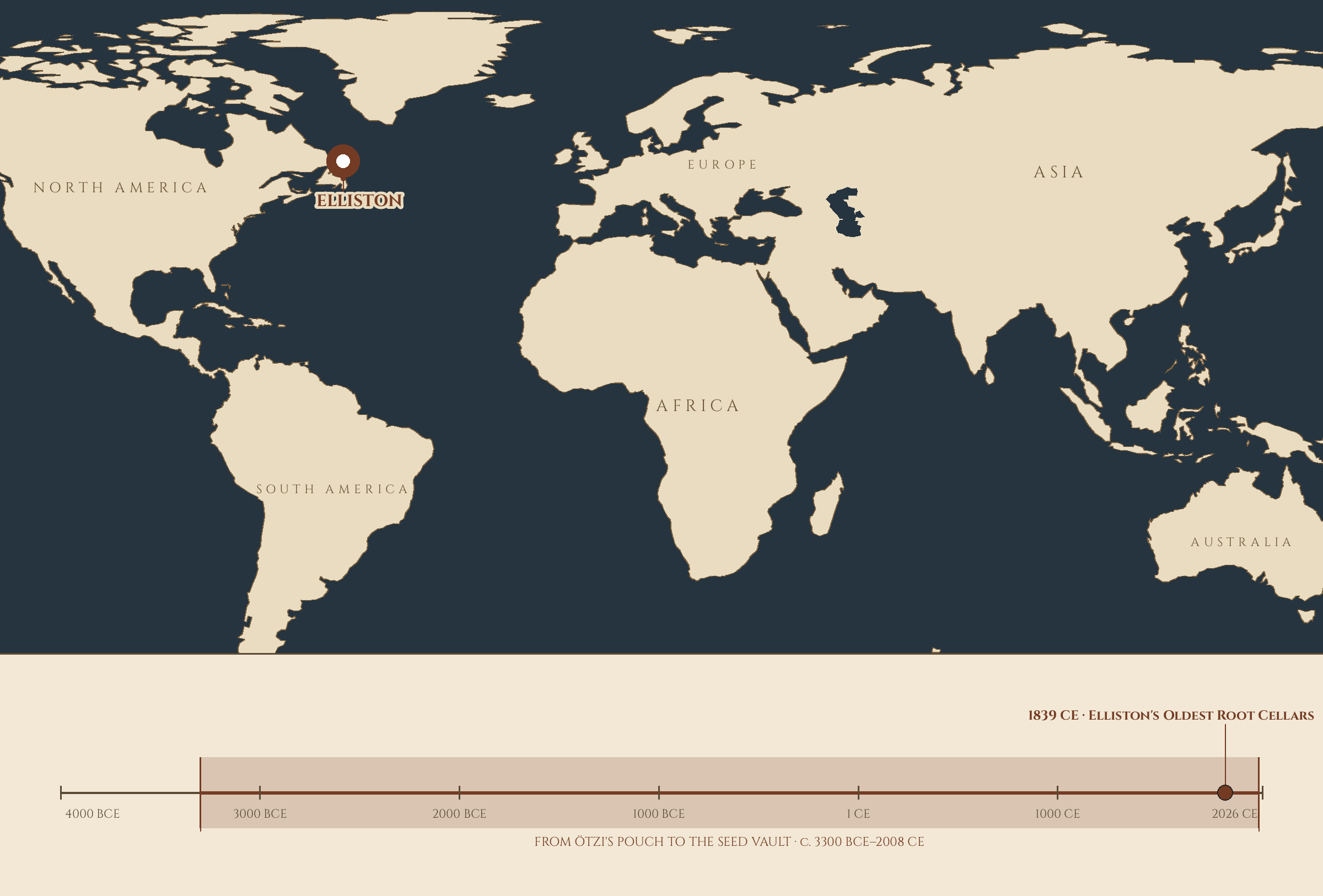
Where and when: Elliston, Newfoundland — 1839 CE, Elliston’s oldest root cellars.
Workshop Objectives
By the end of this workshop, scholars should be able to:
- State the keeper's rule (cool, dry, dark, labeled) and explain why each word is on the list.
- Tell the history of harvest keeping: burial and pitting, the straw-and-earth clamp, and the root cellar.
- Press autumn leaves and seed heads in the Lesson 21 press and mount them as labeled herbarium cards.
- Build a seed sorting tray, sort and winnow a seed harvest on it, and fold labeled seed envelopes to hold each lot.
- Tie drying bundles that dry evenly, hang them correctly, and read them for readiness.
- Fit a keeping box for stored goods, with a contents list, and say what belongs in it and what does not.
Your Assignment Packet
This lesson's assignments live in its packet: the Lexicon Handout (every term, course terms marked ◆), the Assignment Manual, and the Reflection Questions. Download the packet before you begin and keep it beside you as you read — work from it as each subject is taught, or take the assignments as homework afterward.
The Earth Keeps: Burial, Clamps, and Cellars
The oldest storage technology is a hole. The United States Department of Agriculture's bulletin on potato storage, written when the work was still everyday knowledge, opens its history plainly: storage in its primitive stage consisted in burying the product in the soil, or keeping it in a cave or an excavated chamber, and the simplest of those forms, pitting, was still in practice when the bulletin was revised in 1933. Before there were storage houses there was the ground, because the ground a few inches down holds a steady temperature while the air above it swings.
The clamp improved the hole into a structure. On well-drained ground the keeper laid a bed of dry straw, heaped the potatoes or roots on it in a ridge, covered the heap with straw deep enough to shut out light and frost, and then mounded earth over the whole, leaving a small ventilator of twisted straw at the top so the heap could breathe out its own warmth and moisture. The bulletin prints the cross-section like a recipe: straw, earth, straw, earth, thicker as the winter deepened. A clamp could hold a field's harvest where it grew, and a family opened one end at a time and took out dinner. Before any crop went into a clamp or a cellar for the close months, it had its curing: the first days after harvest, resting in warmth and moving air so its skins set, its surface wounds healed, and its field moisture left before it went into close storage.
The root cellar made the hole permanent and gave it a door. Dug under a house or into a hillside, it held the earth's cool through summer and its protection through frost, and whole communities were provisioned from cellars. Elliston, in Newfoundland, calls itself the Root Cellar Capital of the World for its 135 documented cellars; its oldest cellars date to 1839, and many are still in use. The town's memory holds families storing eighty sacks of potatoes at seventy-five pounds the sack, with milk, butter, and bread chilled in the same cool dark in summer. Cellars taught their keepers fine distinctions, too: apples were stored apart from the roots, because ripening apples give off a gas that hurries everything near them toward spoilage. The keeper's rule was already complete in those cellars. Cool, dry or rightly humid, dark, and each thing with its own place.
The modern world keeps the rule and changes the furniture. A refrigerator's crisper, a cool garage corner, a plastic bin in a dark cupboard: all of them are the clamp and the cellar wearing new clothes, and all of them fail in the old ways when the rule is broken. This workshop keeps at bench scale, with a box and a label where the Elliston families had a hillside, and the standard does not shrink with the scale.
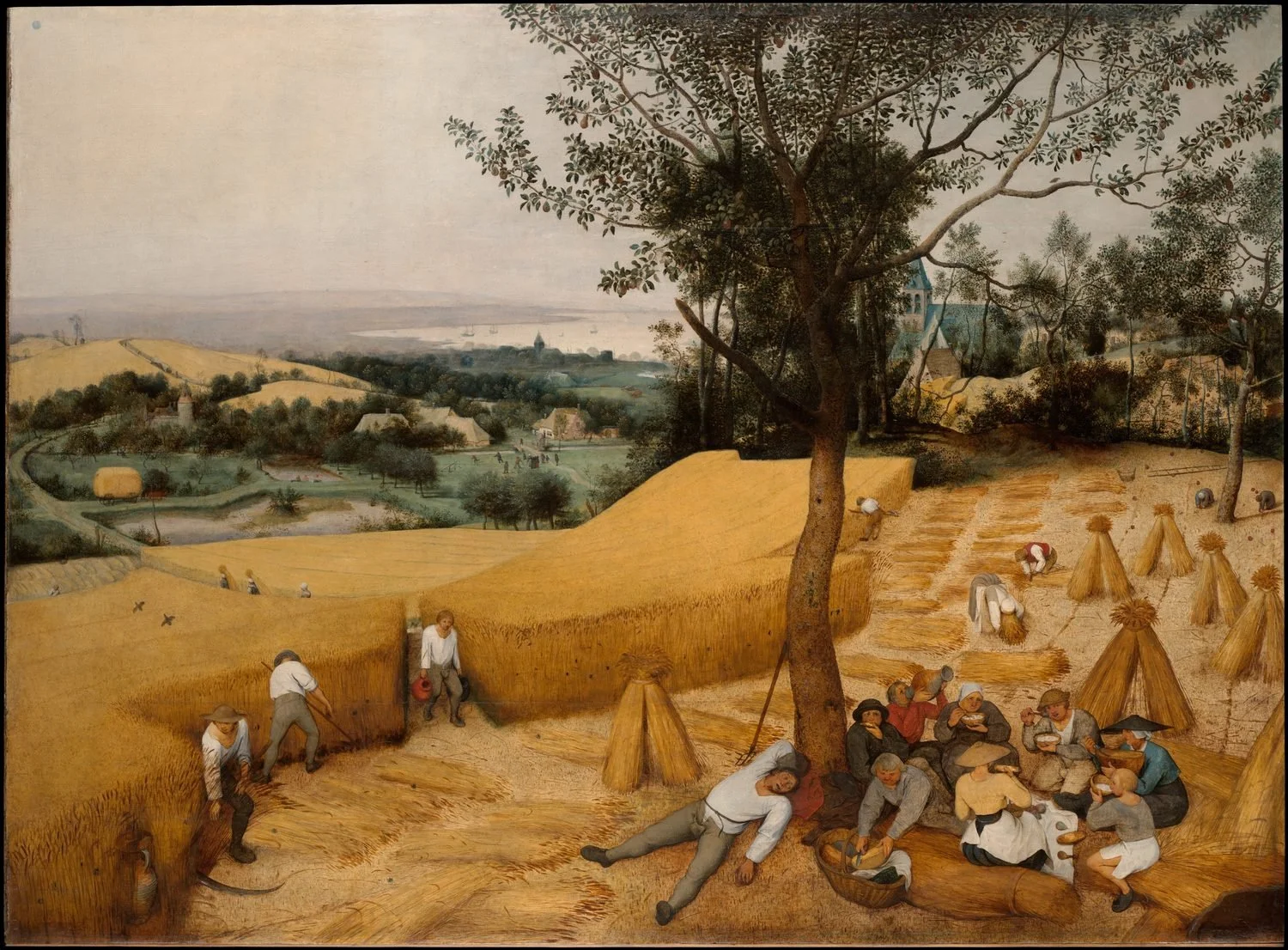
Pieter Bruegel the Elder, *The Harvesters* (1565) — reapers cutting wheat, binding sheaves, and resting at the harvest meal in a broad valley landscape.
The Metropolitan Museum of Art (Object 19.164), Open Access (CC0).
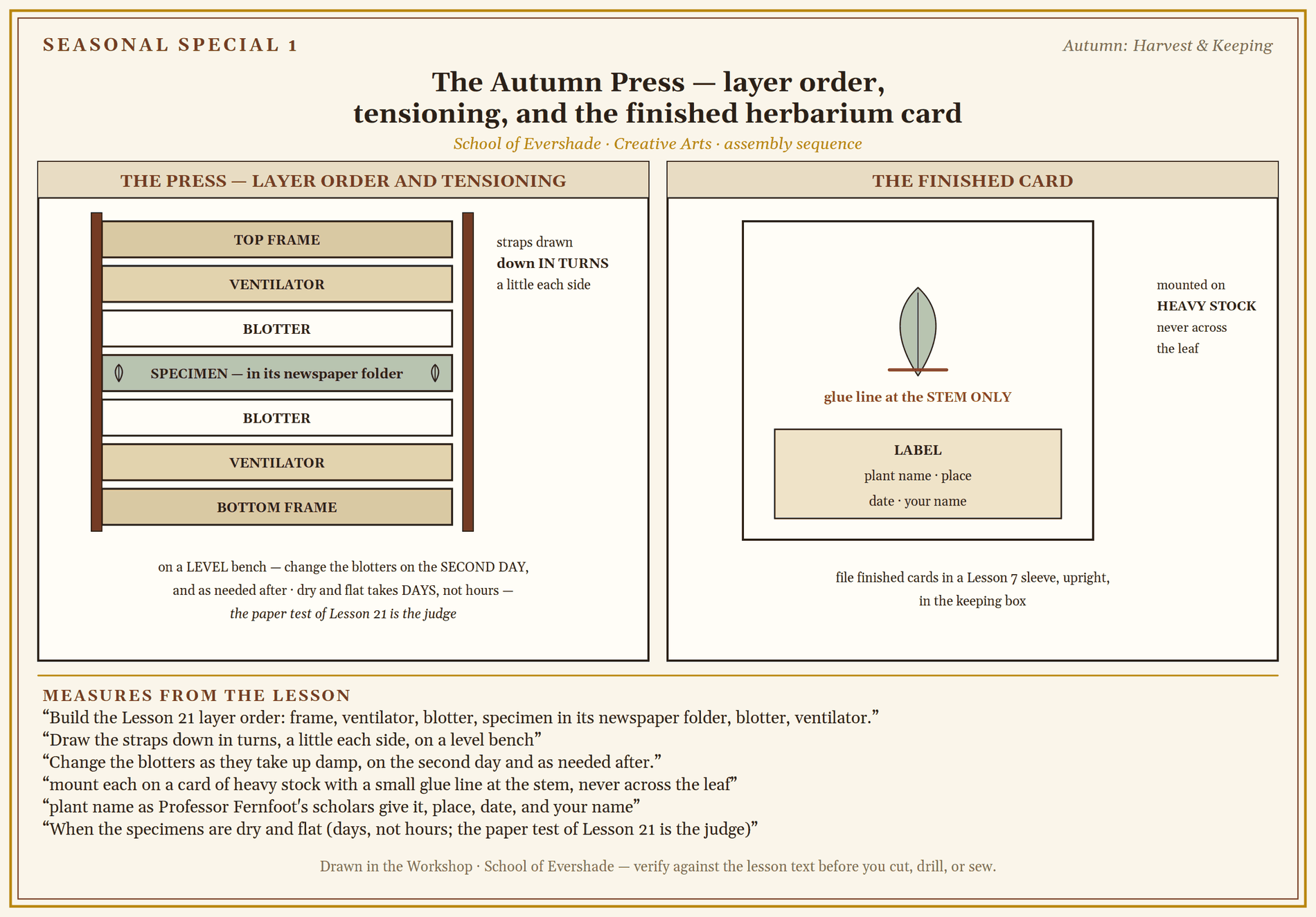
The Autumn Press — layer order, tensioning, and the finished herbarium card
Sorting, Drying, and the Seed Keeper
Drying is keeping by subtraction: take the water away and decay loses its footing. The still room and the attic beam carried the herb harvest for centuries, bundles tied small and hung head-down in warm, moving air out of the sun. The practice is written down today in extension guides in nearly the old words: tie small bundles, hang them where air circulates, keep them from dust, and store the dried leaves whole, in airtight jars, in a cool dark place, because whole leaves hold their oils and their strength longest. Seed heads are treated as a harvest of their own: cut the stalks, hang them upside down, and shake the seed out when it is dry, then rub the seed between the hands and blow the chaff away. That last gesture is winnowing, and it is older than the plow's iron.
Seed asks for more than drying. A seed is alive and asleep, and keeping it is a promise made to a spring you will not supervise. Its viability — the seed's living capacity to germinate when its season comes — is spent by heat, damp, and light, and saved by their opposites. The modern seed-keeping movement began, fittingly, with two seeds handed down a family: in 1975, Kent and Diane Ott Whealy founded the Seed Savers Exchange after being given a German Pink tomato and a Grandpa Ott's morning glory, varieties Diane's great-grandparents had carried from Bavaria to Iowa in 1884. Their first seed swap ran among thirty gardeners on a six-page list. The Exchange now counts thousands of members, publishes a yearbook of members' seed offerings, and in 2007 was among the first depositors in the Svalbard Global Seed Vault: the clamp principle, an earth's steady cold guarding a harvest, built at the scale of the whole world's seed.
Your envelope on this bench is the same instrument at your scale. One lot, one envelope, one label, and the record kept where the seed is. A seed without its label is a rumor. Labeled, dated, and stored cool and dry and dark, it is a variety with a future.
A Sealed Note from Professor Timberclank
Autumn work brings three quiet hazards to the bench, and we name them before the first bundle is tied.
Cutting tools do the harvest cutting: pruners and knives are Lesson 18 and Lesson 3 tools, and their rules travel with them. Cut away from the hand that holds the stem, keep the holding hand behind the blade's road, and never carry an open blade through a crowd of scholars reaching for the same bundle.
What is moldy, slimy, or sour-smelling is not kept, and it is not trimmed and kept either. It goes to the compost whole. Keeping is selection, and throwing away is part of it.
And nothing dried at this workshop is tasted, brewed, or dosed. These are specimens, decorations, and seed. What is food and what is medicine is ruled on in the Greenhouse and the Laboratory, by their professors, in their lessons. This bench keeps; it does not cater. We stop. We make it safe. Then we begin again.
PROFESSOR COGBRANCH TIMBERCLANK
Creative Arts Workshop
Master Artisan, Head of House Occidens
The Workshop Builds
Three builds, done in the order the harvest demands: press first, while the leaves are fresh; sort while the seed heads are dry; bundle and box last, when everything else has somewhere to go.
Build One ⚒ — The Autumn Press: Herbarium Cards
This build is checked for even pressing, honest labels, and cards flat enough to file.
- Gather with the kit. With the Lesson 10 field kit, collect fallen leaves and spent seed heads, choosing whole, dry specimens and leaving the plant itself unharmed. Note the place and date on the spot, in the field notebook: a label written later is a label half-invented.
- Lay the press. Build the Lesson 21 layer order: frame, ventilator, blotter, specimen in its newspaper folder, blotter, ventilator. Arrange each leaf flat, face up, untorn edges outward, exactly as it should be studied in January.
- Tension in turns. Draw the straps down in turns, a little each side, on a level bench, and set the press where its air is dry. Change the blotters as they take up damp, on the second day and as needed after.
- Mount the cards. When the specimens are dry and flat (days, not hours; the paper test of Lesson 21 is the judge), mount each on a card of heavy stock with a small glue line at the stem, never across the leaf.
- Label and file. Write the card's label in your keeper's hand: plant name as Professor Fernfoot's scholars give it, place, date, and your name. File the finished cards in a Lesson 7 sleeve, upright, in the keeping box.
Build Two ⚒ — The Seed Sorting Tray and Envelopes
This build is checked for a tray that contains the work, seed sorted honestly, and every envelope labeled before it is filled.
- Build the tray. From scrap board, measure and cut a base about the size of a serving tray and four low rails. Join the rails to the base with screws (or the Level Two lapped joint), sand every edge, and test it with a handful of dry seed heads: nothing escapes the rails when the tray is tilted and shaken gently.
- Shake and rub. Over the tray, shake the dried seed heads so the seed falls free. Rub stubborn heads between your palms above the tray, the way keepers have always done, and pick out stems and husks by hand.
- Winnow. At a doorway or before a gentle fan, pour the seed slowly from one hand to the tray in the moving air. The chaff drifts aside; the seed falls straight. Pour again until what falls is seed and only seed.
- Grade honestly. Sort out the shriveled, the broken, and the insect-bored. What remains is the lot. A small lot of sound seed outranks a full envelope of doubts, and it goes to the compost without argument if it fails.
- Fold and label. Fold a Lesson 7 seed envelope for the lot. Write the label before the seed goes in: plant, variety if known, the bed or place it came from, the year, and your name. Fill, close, and stand the envelope upright in the keeping box.
Build Three ⚒ — Drying Bundles and the Keeping Box
This build is checked for small bundles, moving air, and a box whose contents can be read from its lid.
- Cut after the dew. Gather herb and flower stems in the late morning, when the dew is off them; wet stems dry slowly and mold in the bundle's heart. Cut with pruners under the sealed note's rules.
- Bundle small. Lay five to ten stems together, heads even, and bind the stems with a rubber band where you can: keepers and extension guides alike note that a band tightens itself as the stems shrink, where string loosens and drops its bundle. Hang the bundles head-down from the line or rack.
- Give them air and shade. Hang the bundles where air moves and sun does not fall directly: a porch beam, a still-room line, the Lesson 25 rack if your workshop has one standing. Seed heads go head-down inside a paper bag tied at the neck, so what falls is caught.
- Read for readiness. Visit the bundles as they dry. Leaves are ready when they crumble at a touch and stems snap rather than bend. What is dry comes down; what is doubtful hangs on; what is moldy goes to the compost whole.
- Fit the keeping box. Line the box with clean paper. Stand the seed envelopes upright at one end, lay the filed herbarium cards flat, and give the dried bundles' stripped leaves a labeled jar or paper packet of their own. Write the contents list on a card and fix it inside the lid. Store the box in the coolest, driest, darkest place your house affords, and write the place on the list.
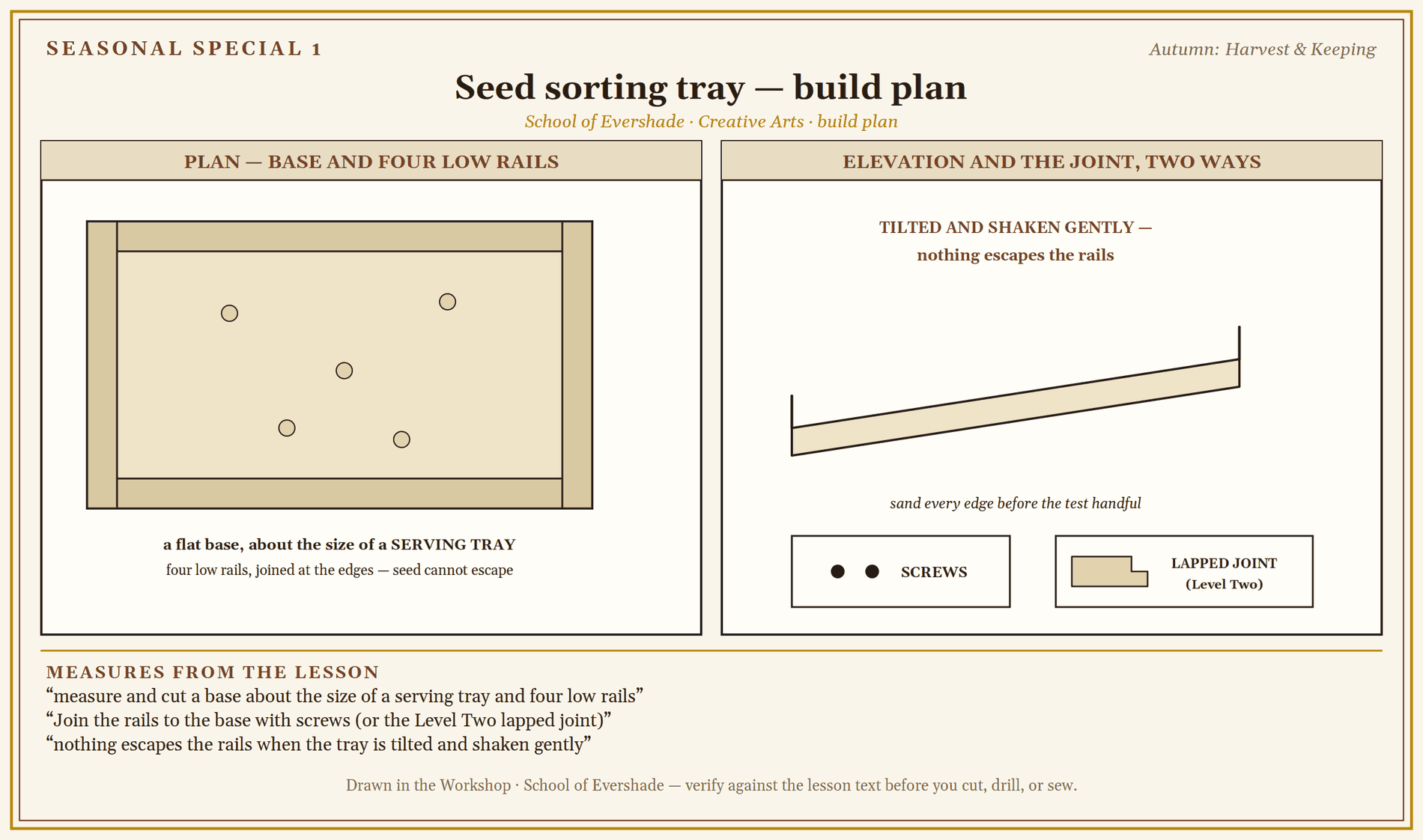
Seed sorting tray — build plan
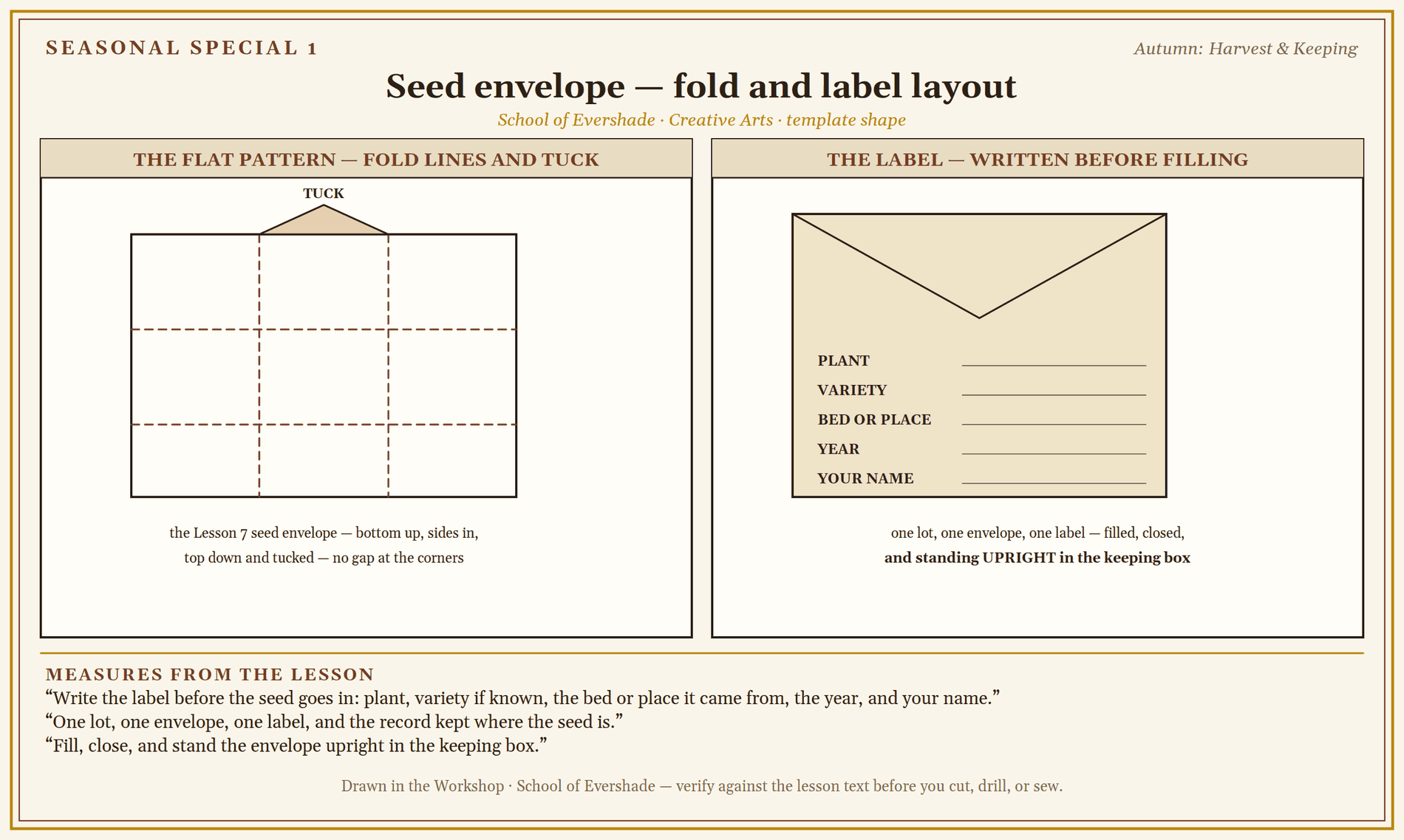
Seed envelope — fold and label layout
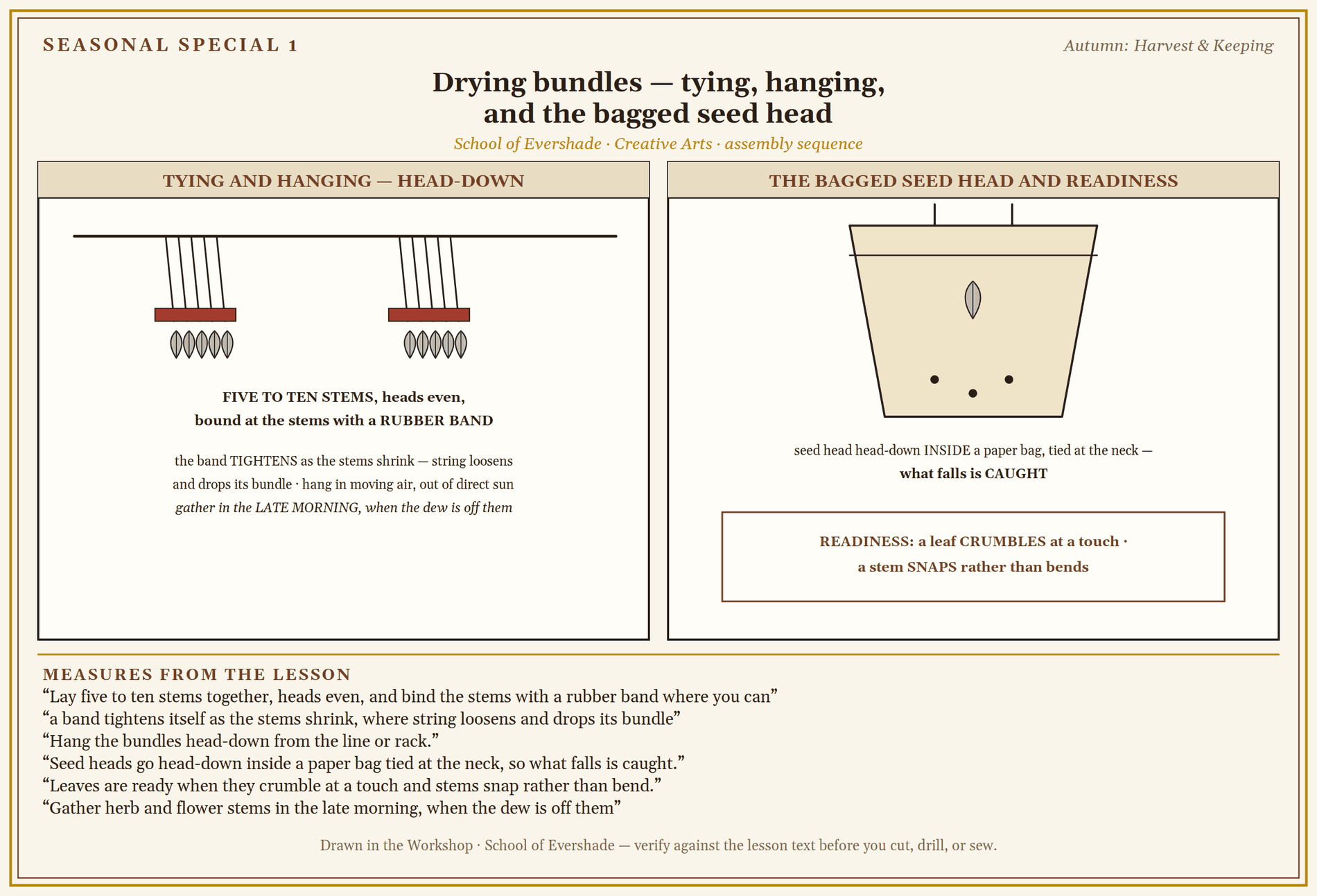
Drying bundles — tying, hanging, and the bagged seed head
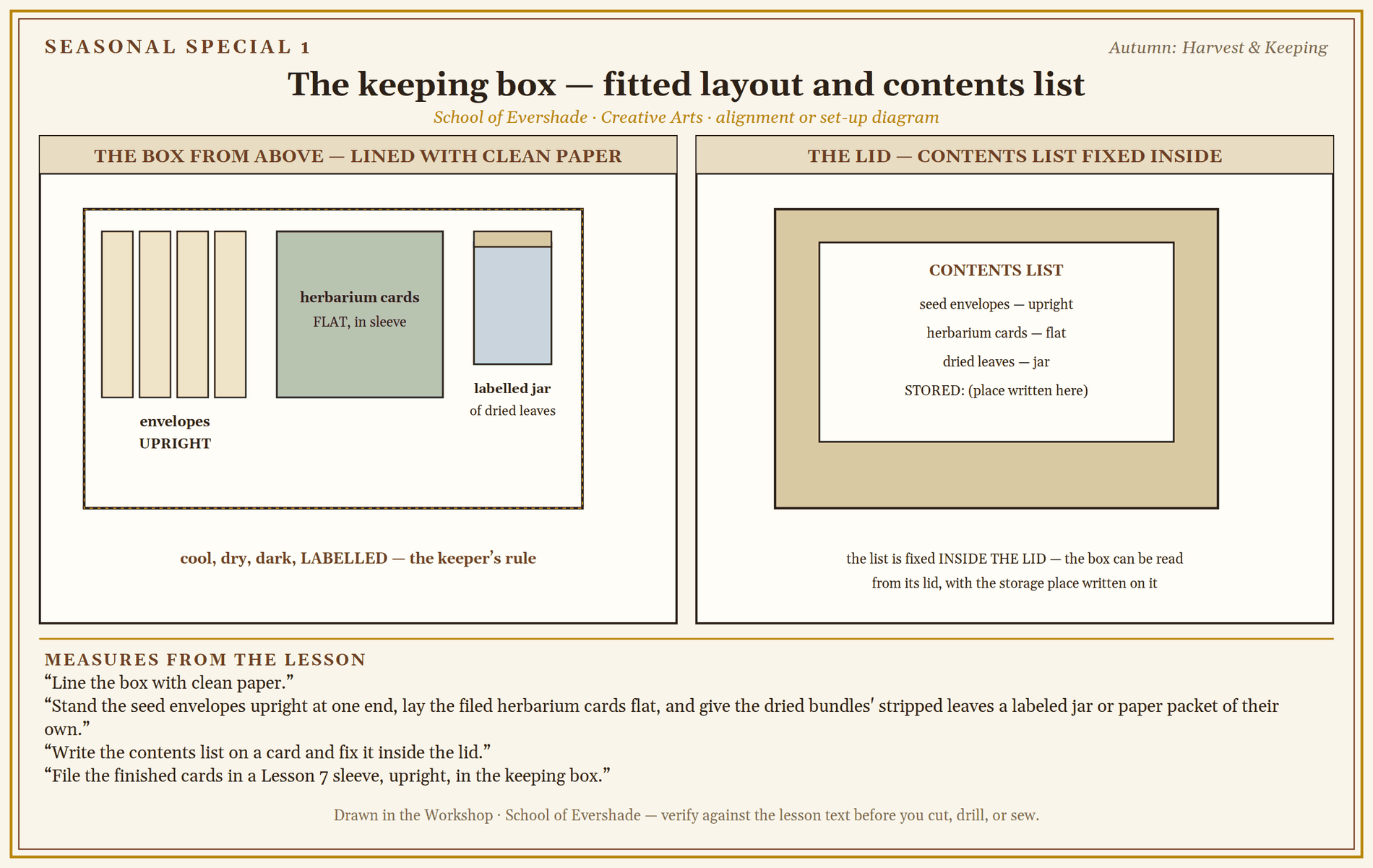
The keeping box — fitted layout and contents list
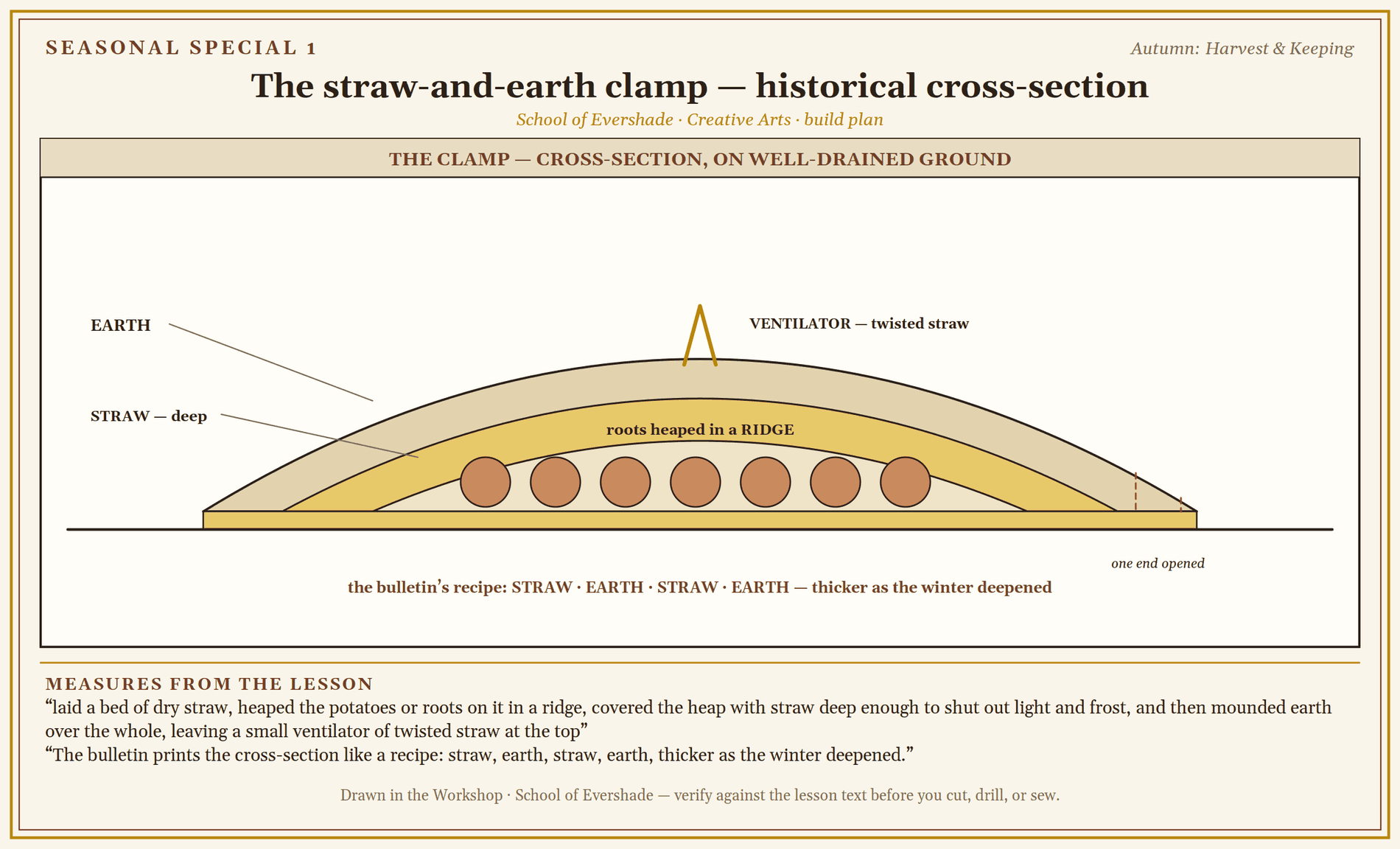
The straw-and-earth clamp — historical cross-section
Assignment Manual
Assignment key: ✎ written work · ⚒ hands-on practical · ◐ both
Assignment I ⚒ — Run the Keeping
Complete the three builds of this workshop: a set of pressed and labeled herbarium cards, a sorting tray with at least one seed lot sorted, winnowed, graded, and enveloped, and drying bundles hung and read, with the keeping box fitted, listed, and stored. The press is returned clean, its blotters aired, ready for the Greenhouse's next call.
Assignment II ✎ — The Keeper's History
Write a short history of keeping the harvest: burial and pitting, the straw-and-earth clamp, the root cellar and its communities (Elliston will serve), and the modern seed vaults, ending with the single rule all four obey. Use the sources below, and keep your history to what was done and why, as this school teaches it.
Assignment III ◐ — The Harvest Record
Choose one stored item from your keeping box (a seed lot, a card, a bundle's leaves) and keep its harvest record: what it is, where and when it was gathered, how it was dried or sorted, where it is stored, and a check made one month later recording its condition. The record is written; the thing recorded is kept; the two are handed in together and judged together.
Materials
Level One (household)
- The Lesson 21 plant press, with fresh blotters and folded newspaper
- Fallen leaves, seed heads, and herb stems gathered with the Lesson 10 field kit, with Professor Fernfoot's scholars' leave where the Greenhouse's beds are concerned
- Card stock or heavy paper for herbarium cards, glue, and a pen for labels
- Scrap board and offcuts, screws, and sandpaper for the sorting tray
- Paper for seed envelopes (Lesson 7 stock), and a pencil that will not fade
- Twine and rubber bands for bundles; a line or rack to hang them from
- A lidded box for the keeping box, with paper to line it
Level Two (historical)
Everything in Level One, plus:
- A sorting tray built with lapped corner joints from Lesson 4 instead of screws, in hardwood offcuts
- Seed envelopes folded from the recycled handmade paper of Lesson 7's Level Two
- A wooden keeping chest with a fitted lid, built to Lesson 26's standard, in place of the household box
- A bundle of lavender or wormwood laid in the keeping box in the old manner, as a fragrant guard the old keepers swore by, labeled as tradition and not as treatment
Both levels keep by the same rule and are judged by the same test: what comes out of storage in the condition it went in.
Reflection Questions
Answer the following questions in your workbook.
- The keeper's rule is four words. Which of the four did your own workshop work find hardest to honor, and what did you change to honor it?
- A clamp and a seed vault are separated by five centuries and half the world. What do they share that makes both of them keeping, and what does the vault do that no clamp could?
- Sorting is selection: some of the harvest is composted so the rest can be trusted. Where else in this school does the same discipline appear, in the Greenhouse, the Laboratory, or your own class?
- Elliston's cellar of 1839 is still in use. What does that building know about lasting that a plastic bin does not, and what does the bin do better?
- This workshop built gear for Professor Fernfoot's lessons and used it beside her scholars. What did you learn about the Greenhouse's work by building for it?
Professor's Review
The bench is clear, scholars, and the box is shut with its list inside the lid, which is where an autumn workshop should end: everything kept, and everything kept findable.
You have pressed the season flat enough to study in January. You have sorted seed the way it has been sorted since hands first rubbed a seed head over a tray, and you have hung bundles in moving air and read them honestly. None of it is decoration. It is the year's growth, carried through the dark months by four words and the discipline to keep them.
The press goes back on its shelf now, but keep your hand in: the Winter Workshop meets in Septentrio's Aerie, where we build for the birds, for the dark, and for a friend far away. The keeping you learned here is what winter tests.
PROFESSOR COGBRANCH TIMBERCLANK
Creative Arts Workshop
Master Artisan, Head of House Occidens
Further Reading & Sources
South Dakota Public Broadcasting. "South Dakota Home Garden: Root Cellar History." Root cellars as the farm's winter engine: pits below the house, the earth's insulation, apples kept apart for the ripening gas they give off, and cellars that still store the nursery trade's bare-root stock each fall.
Heritage Foundation of Newfoundland and Labrador. "Elliston: The Root Cellar Capital of the World." Community Stories. The 135 documented cellars of Elliston, the oldest dating to 1839 and many still in use, the Twin Cellars of 1915, and a family's eighty seventy-five-pound sacks of potatoes, told by the community that keeps them.
United States Department of Agriculture. Potato Storage and Storage Houses. Farmers' Bulletin No. 847 (1917, revised 1933). Internet Archive. The working manual of the storage era: burial and pitting as storage's primitive stage, the straw-and-earth pit with its ventilator, cellar construction, and the rules of temperature, darkness, and air that this workshop inherits.
Penn State Extension. "Let's Preserve: Drying Herbs" (fact sheet). The modern statement of the bundle craft: small bundles hung in moving air, seed heads hung head-down and shaken out when dry, chaff rubbed and blown away, and dried herbs stored whole, airtight, cool, and dark.
Wikipedia. "Seed Savers Exchange." The 1975 founding on two Bavarian heirloom seeds, the first swap among thirty gardeners, the Yearbook of members' offerings, Heritage Farm, and the Exchange's founding deposit in the Svalbard Global Seed Vault.
Print only: Suzanne Ashworth, Seed to Seed: Seed Saving and Growing Techniques for Vegetable Gardeners (Seed Savers Exchange). The seed keeper's standard bench book, variety by variety. Held by many libraries; consult in print.
Student-friendly starting points for exploring this special's world. All links verified October 2026.
- Heritage Foundation of Newfoundland and Labrador. "Elliston: The Root Cellar Capital of the World." Begin in Elliston, where keeping the harvest built a town's landscape and one cellar has worked since 1839.
- Wikipedia. "Seed Savers Exchange." Two seeds carried across an ocean in 1870 became a movement of thousands of keepers; your labeled envelope is its smallest working part.
- Penn State Extension. "Let's Preserve: Drying Herbs." The bundle and seed-head methods of this workshop, set out in an extension fact sheet you can pin inside the keeping box's lid beside your contents list.
Submit your work for this lesson using the form below.
CONTINUE IN THE CREATIVE ARTS WORKSHOP
← Previous · Studio Extension E5: Relief & Scale Displays Next · Seasonal Workshop Special S2: Winter: Feeders, Lanterns & Sealed Letters →
Creative Arts Workshop · All 39 Lessons
Bookstore Shelf The Library · Creative Arts Shelf Course Supplies
The rest of the Seasonal Specials: Special S2 · Winter: Feeders, Lanterns & Sealed Letters · Special S3 · Spring: Starting & Growing · Special S4 · Summer: Camp Keepsakes & the Weather Station