

Creative Arts
Seasonal Workshop Special S2Winter: Feeders, Lanterns & Sealed Letters
Professor Cogbranch Timberclank
Master Artisan, Head of House Occidens
The Creative Arts Workshop • School of Evershade
Season: Winter · Hosted by: House Septentrio, in the Aerie and the Workshop · Workshop tickets required: Lesson 5, "Adhesives, Heat, Wax & Glass"; Lesson 17, "Seal Matrices & Waxwork"; Lesson 23, "Wood, Grain & Safe Hand Tools."
Professor's Introduction

Bundle up and climb with me, scholars. The Winter Workshop meets in Septentrio's Aerie, in the north house's own season, because winter work is care work done in the dark months, and the north knows the dark months. Three builds, one habit of mind: we look after what winter makes vulnerable.
We build a feeder for the birds, who do not need our charity but accept our hospitality, and whose visits are a winter scholar's honest wages. We build a lantern, and not any lantern: two winters ago Professor Glimmerwick's Celestial Studies lesson, "Dark Skies," left this workshop a standing commission, a lantern built at full craft that lights a path without stealing the sky. This workshop fulfills it. And we seal letters for the pen-pal exchange, because winter is the letter-writing season and a letter that travels should travel closed, with somebody's mark upon it.
Each build spends a ticket you already hold: the wood ticket of Lesson 23, the wax and glass discipline of Lesson 5, and the seal craft of Lesson 17. Nothing here exceeds them. Everything here honors them.
PROFESSOR COGBRANCH TIMBERCLANK
Creative Arts Workshop
Master Artisan, Head of House Occidens
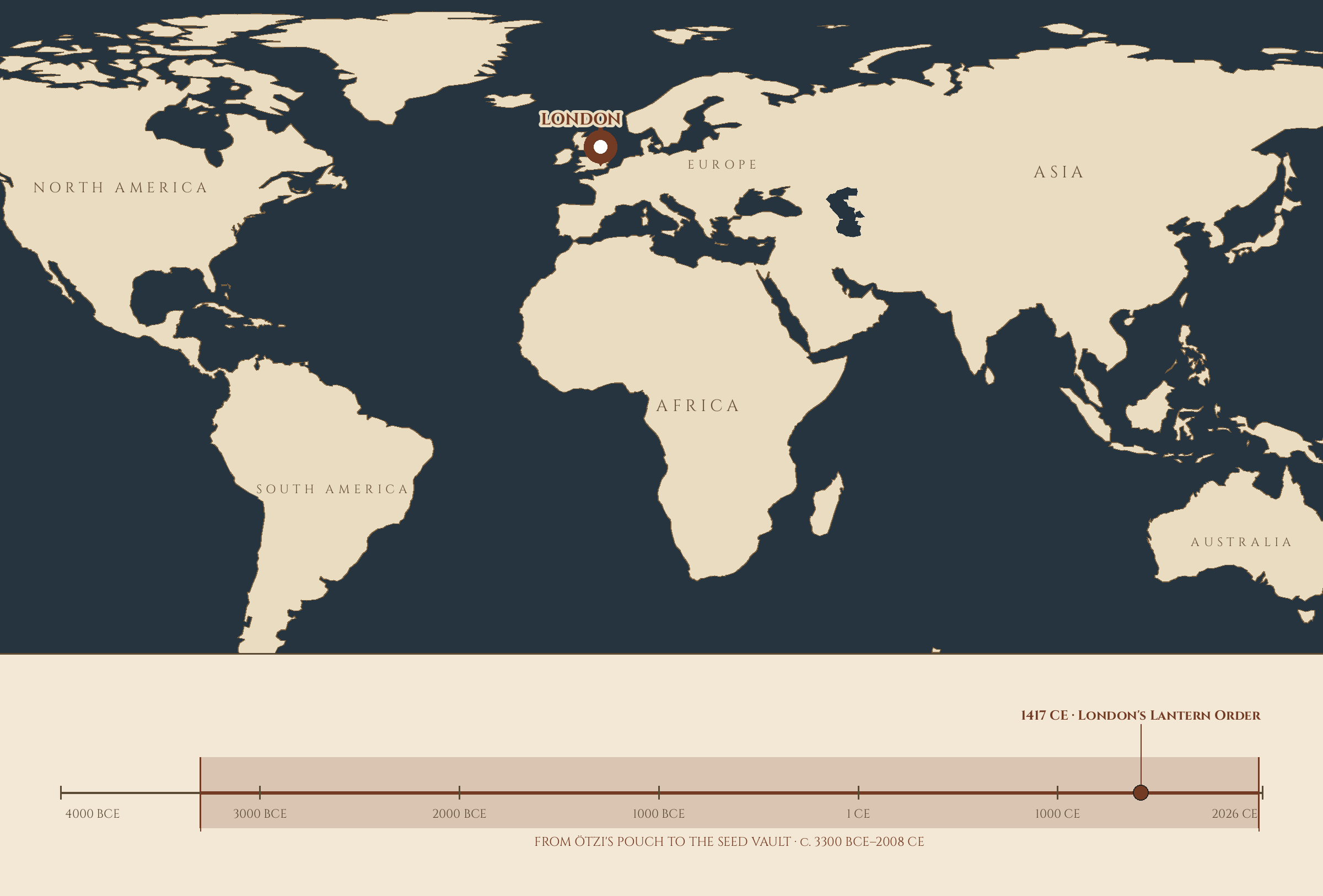
Where and when: London — 1417 CE, London’s lantern order.
Workshop Objectives
By the end of this workshop, scholars should be able to:
- Tell the recorded history of feeding wild birds, from a sixth-century monk's robin to a national pastime and a science-checked supplement.
- Build a bird feeder from offcuts that sheds weather, gives small birds a fair table, drains, and comes apart to be cleaned.
- State what makes light a pollutant (skyglow, glare, light thrown where it is not wanted) and what makes a light dark-sky kind: shielded, downward, warm in color, no brighter than needed, and put out when not wanted.
- Build the dark-sky lantern at full craft, with a hood and a working shutter in the old dark-lantern manner, and test it at dusk.
- Explain sealing wax's three jobs (closing, proving the sender, showing tampering) and seal a pen-pal letter with a Lesson 17 matrix.
- Work the wax bench under Lesson 5's heat rules without being reminded.
Your Assignment Packet
This lesson's assignments live in its packet: the Lexicon Handout (every term, course terms marked ◆), the Assignment Manual, and the Reflection Questions. Download the packet before you begin and keep it beside you as you read — work from it as each subject is taught, or take the assignments as homework afterward.
Feeding the Winter Birds
Bird feeding has a recorded history longer than most crafts in this room. The British naturalist James Fisher wrote that the first person recorded feeding wild birds was a sixth-century monk, Saint Serf of Fife, who tamed a robin by feeding it. For a thousand years after, feeding stayed a kindness of individuals. Then the hard winter of 1890–91 came to Britain, and the national newspapers took it up, asking the public to put out food for the birds; by 1910, Punch magazine could declare feeding birds a national pastime. The custom crossed the Atlantic and settled: in the United States, February, the hungriest month, was named National Bird-Feeding Month by congressional decree in 1994.
The twentieth century also asked the honest question, and asked it scientifically: does feeding make birds dependent? The study that settled it watched chickadees at a Wisconsin nature center whose feeder had been stocked for twenty-five winters, then removed. The banded feeder birds survived the winter at the same rates as birds that had never known a feeder, and even at the height of winter the feeder regulars were taking only about a fifth to a quarter of their calories from it. A feeder, it turns out, is a supplement and a supplement only: one shelf in a larder the birds stock from the whole winter landscape.
That is the spirit in which this workshop builds. We are not rescuing the birds. We are setting a table at the edge of their own competence, and being paid in the oldest currency there is: company, close enough to study, through the months when the garden gives a scholar nothing else alive to watch.
A Light That Knows Its Place
The lantern began as an answer to a simple failure: a flame in the open air goes out, and a flame unguarded indoors burns the house down. The lantern is a flame with a case around it: a frame, a light inside, and windows of whatever the age could make translucent. Before sheet glass was cheap, the window was horn, scraped thin and flattened until light passed through it; the old spelling "lanthorn" is the word reshaped by the material — a folk spelling born of the horn it was made from. In 1417, the Mayor of London ordered every household to hang a lantern outside after nightfall in the winter months, the first organized public street lighting, and it is no accident this workshop meets in winter: the lantern is winter's tool first.
Among the lantern's old forms, one matters most to us. The dark lantern carried a sliding shutter. Close the shutter and the room went dark while the candle stayed lit behind it, ready in an instant. Its makers understood something the bright age forgot: the point of a lamp is not light. The point is light where and when it is wanted, and darkness everywhere else, and a shutter gives you both.
The modern world lit everything and named the cost afterward: light pollution, the skyglow that erases the stars, glare that blinds instead of guiding, light thrown onto land and water where nothing asked for it. Skyglow is light spent on nothing, paid for in stars. DarkSky International, the body that certifies dark-sky places and fixtures, states the remedy as a builder's specification, and this workshop builds to it: a proper outdoor light is fully shielded so no light escapes upward or sideways; warm in color, a candle's warmth rather than a blue glare (their fixtures are capped at a warm 3000 kelvin, with warmer better); no brighter than the task needs; and controlled, by timer, dimmer, or shutter, so it burns only while it is wanted. Professor Glimmerwick's red-filter card lantern teaches the principle in Celestial Studies. The commission left to this workshop is the principle at full craft, in wood, metal, and glass, with the dark lantern's own shutter for a conscience.
The Sealed Letter
Before the envelope, the letter was the envelope. The writer filled a sheet, folded it so the writing faced inward, tucked the folds, and closed the packet with wax: a letter close. The wax did three jobs at once, and a scholar should be able to name them. It closed the letter against casual eyes. It proved the sender, because the seal pressed into it was that person's matrix, signet, or mark, known to the receiver. The signet among them is a personal seal small enough to wear, most often a ring, its face engraved in reverse with a crest, an initial, a merchant's mark, or a private symbol. And it showed tampering: a seal is nearly impossible to break and remake without the damage declaring itself, so an unbroken seal at delivery was evidence the letter had traveled as it was sent.
The material has its own history. Medieval sealing wax was beeswax worked with Venice turpentine, the resin of the larch, first used plain and later colored red with vermilion. When European trade with the Indies opened in the sixteenth century, shellac entered the recipe and the wax grew harder and finer, fit for documents that were meant to outlast their writers. Behind the wax stands the signet: the Victoria and Albert Museum holds a gilt bronze signet ring, made in Italy around 1500 to 1600, its oval face engraved with a shield bearing a boar's head. Rings like it were worn on the forefinger or thumb, the museum notes, so the hand could turn and press in one motion. Personal seals witnessed wills, deeds, loans, and letters; they were signatures for an age that trusted an image cut in reverse more than a name written straight.
Envelopes, known from the sixteenth century, took over the closing work in the nineteenth, and the wax seal retired into ceremony. The pen-pal exchange of this school un-retires it for an afternoon. A scholar's letter, sealed with the matrix they cut in Lesson 17, travels the way letters traveled for five hundred years: closed, proven, and showing honestly whether it arrived as it left.
A Sealed Note from Professor Timberclank
This workshop works at the wax bench, and the wax bench rules are Lesson 5's rules, and they do not soften for the season.
The candle stands in its holder, on a tray, and is never carried lit from bench to bench. Sealing wax is melted in the spoon or from the stick's end over the tray, never over the letter, the lap, or the floor. Sleeves are back, hair is back, and the bench's cup of water stands where it always stands. A spill of hot wax is left alone until it hardens and lifts clean; it is never wiped while it can burn.
And the feeder build is saw work under Lesson 23: stock clamped, lines marked, cuts made to the line, and offcuts swept before they become the floor's opinion of your care. If the flame fights you, if the saw wanders, if the room gets loud and hurried: we stop. We make it safe. Then we begin again.
PROFESSOR COGBRANCH TIMBERCLANK
Creative Arts Workshop
Master Artisan, Head of House Occidens
The Workshop Builds
Three builds, in the order the season wants them: the feeder first, while there is light to hang it by; the lantern second, finished before the dusk test; the letters last, at the warm bench, when the cold work is done.
Build One ⚒ — A Bird Feeder from Offcuts
This build is checked for a roof that sheds weather, drainage that keeps seed dry, and a table that can be emptied and scrubbed.
- Design the table. The table you are designing is the bird table, the oldest feeder of all: a flat platform, later given a roof and a raised lip, where food is set out for wild birds. Sketch a platform with a raised lip on three sides and a gap at the fourth for sweeping out, a roof on posts above it held clear so small birds enter and rain does not, and a hanging loop or post mount. Size it to your offcuts, not the other way round.
- Cut to the line. Mark every piece from Lesson 2's habit, clamp, and cut under Lesson 23. Drill two or three drainage holes through the platform's low corners: a feeder that holds water feeds nothing but mold.
- Assemble. Screw the lip and posts, set the roof with an overhang all round, and check the whole for square. Leave the feeding surface unfinished wood, scrubbed clean; finish the roof and outer faces only.
- Mount it kindly. Hang or post the feeder where birds have cover within a short flight and cats have no launching shelf nearby, at a height you can reach to fill and clean without a ladder's drama.
- Stock and watch. Fill with a plain seed mix, note the date, and keep the first week's visitors in the workshop record. A feeder can take weeks to be found; patience is part of the build.
Build Two ⚒ — The Dark-Sky Lantern
This build is checked for light that goes down and out at ankle height, none that escapes upward, and a shutter that closes smoothly and stays closed.
- Frame the body. Build a four-sided lantern body in workshop stock, taller than its candle, with a solid top cap that overhangs the panes: the cap is the first shield, and no light leaves this lantern upward, ever.
- Fit the panes. Set the heat-safe glass or mica panes in their frames with the edges seated and safe (Lesson 5: edges are finished or covered before hands are). One side is the door, hinged, with a catch that holds against wind.
- Fit the hood and reflector. Line the top inside with a bright reflector angled to throw the light down and out at the base, the way a path light should: a pool of light at the feet, not a glare at the eyes.
- Fit the shutter. Make the dark lantern's shutter: a sliding or hinged panel that covers the panes fully. It must move with one cold hand, close completely, and stay where it is put. This panel is the commission's heart: light on duty, darkness on request.
- Seat the light. Fix the candle holder at the base's center, or fit the warm LED candle for everyday service. The flame, when a flame is used, is lit only at the wax bench or its test station, under the sealed note's rules, never carried about the room.
- Test at dusk. At evening, set the lantern on its path. Walk the path toward it and away: you should see the ground lit and never the bare source. Open and close the shutter. Note glare, leaks upward, and wind behavior in the workshop record, and mend what the test finds before the lantern is signed.
Build Three ⚒ — Wax-Sealed Pen-Pal Letters
This build is checked for a clean pool of wax, an impression that reads, and a letter closed so its seal is its witness.
- Write first. Compose the letter in Professor Nocturne's forms, in the Scrollwork room's teaching: the sealing is this workshop's, but a letter's manners are hers, and we do not borrow them.
- Make a test seal. On scrap paper, melt a pool of wax in the spoon, pour it, wait the breath Lesson 17 taught, press your matrix straight down, hold, and lift clean. Read the impression. A matrix that fails on scrap gets its lesson there, not on the letter.
- Close the letter. Fold the letter as a letter close, writing inside and address out, or fold and place it in its envelope. Either way, the wax goes where the opening is, so the seal must break for the letter to open.
- Seal it. At the wax bench, under the sealed note's rules, pour the wax pool onto the fold, press the matrix, hold it steady as the wax sets, and lift. The impression should read at a glance: your mark, whole and unblurred.
- Send it into the exchange. Log the letter in the workshop record (to whom, when, which seal) and hand it to the exchange as the exchange directs. Somewhere across the water or the county, a scholar is about to receive proof that letters once traveled exactly like this.
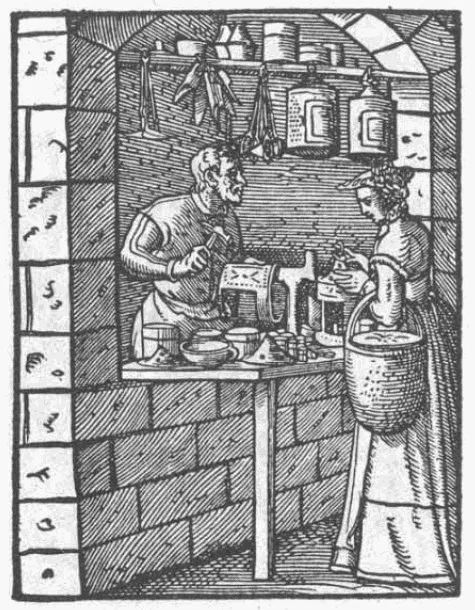
A lantern maker's workshop, 1568 woodcut — lanterns being framed and glazed, finished lanterns hung around the bench.
Woodcut from the Ständebuch (Book of Trades), Frankfurt, 1568. Public domain, via Wikimedia Commons.
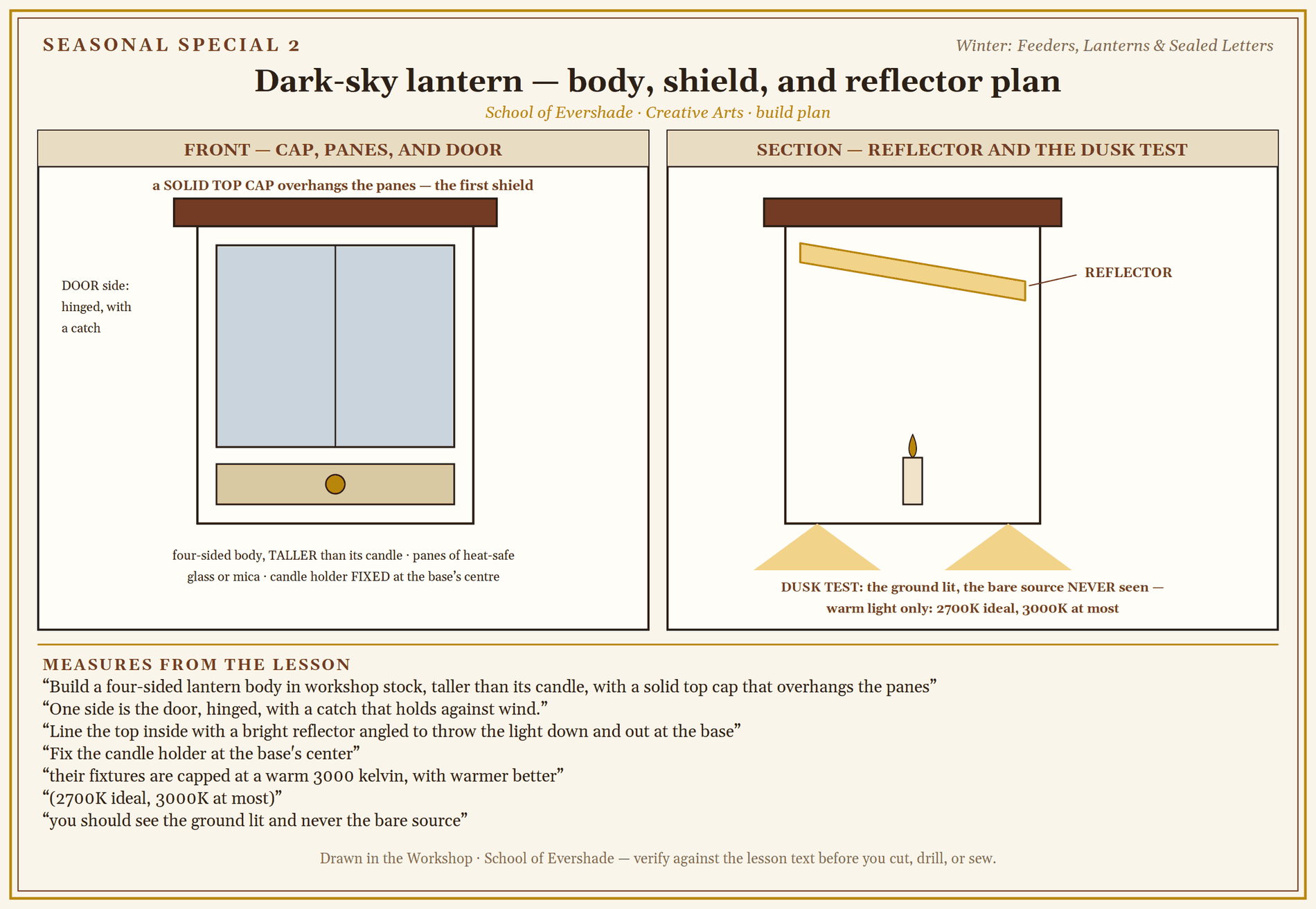
Dark-sky lantern — body, shield, and reflector plan
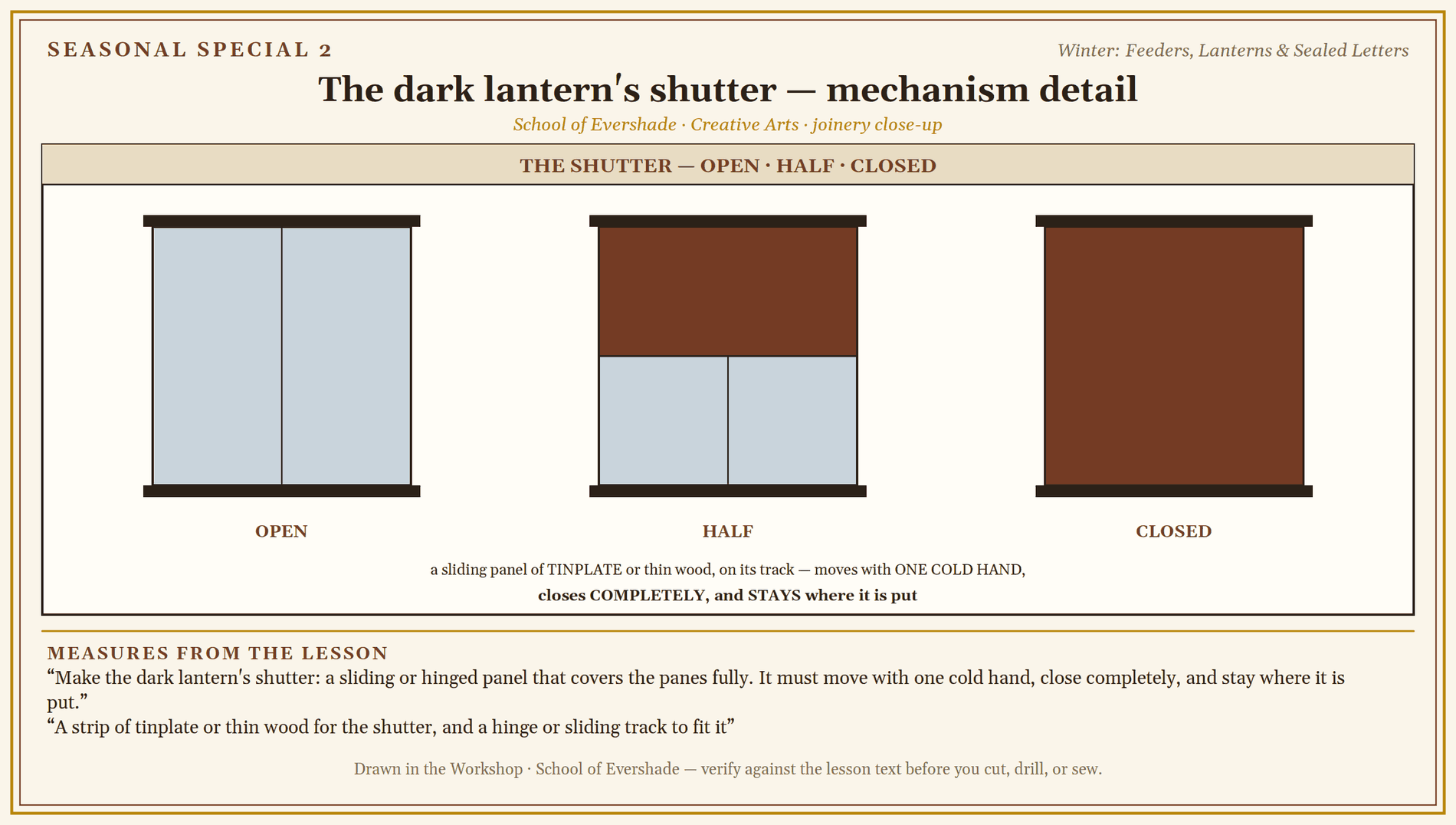
The dark lantern's shutter — mechanism detail
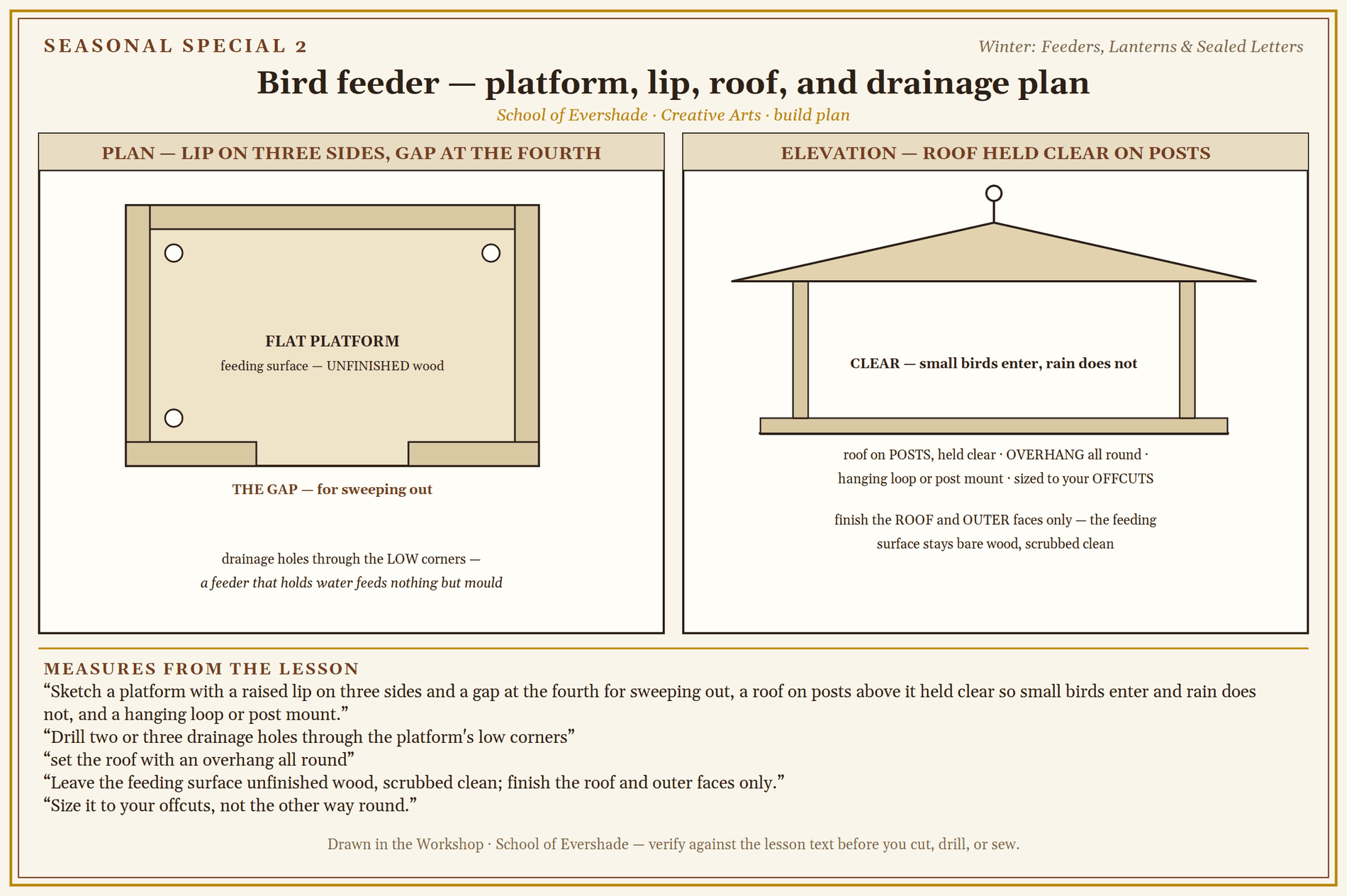
Bird feeder — platform, lip, roof, and drainage plan
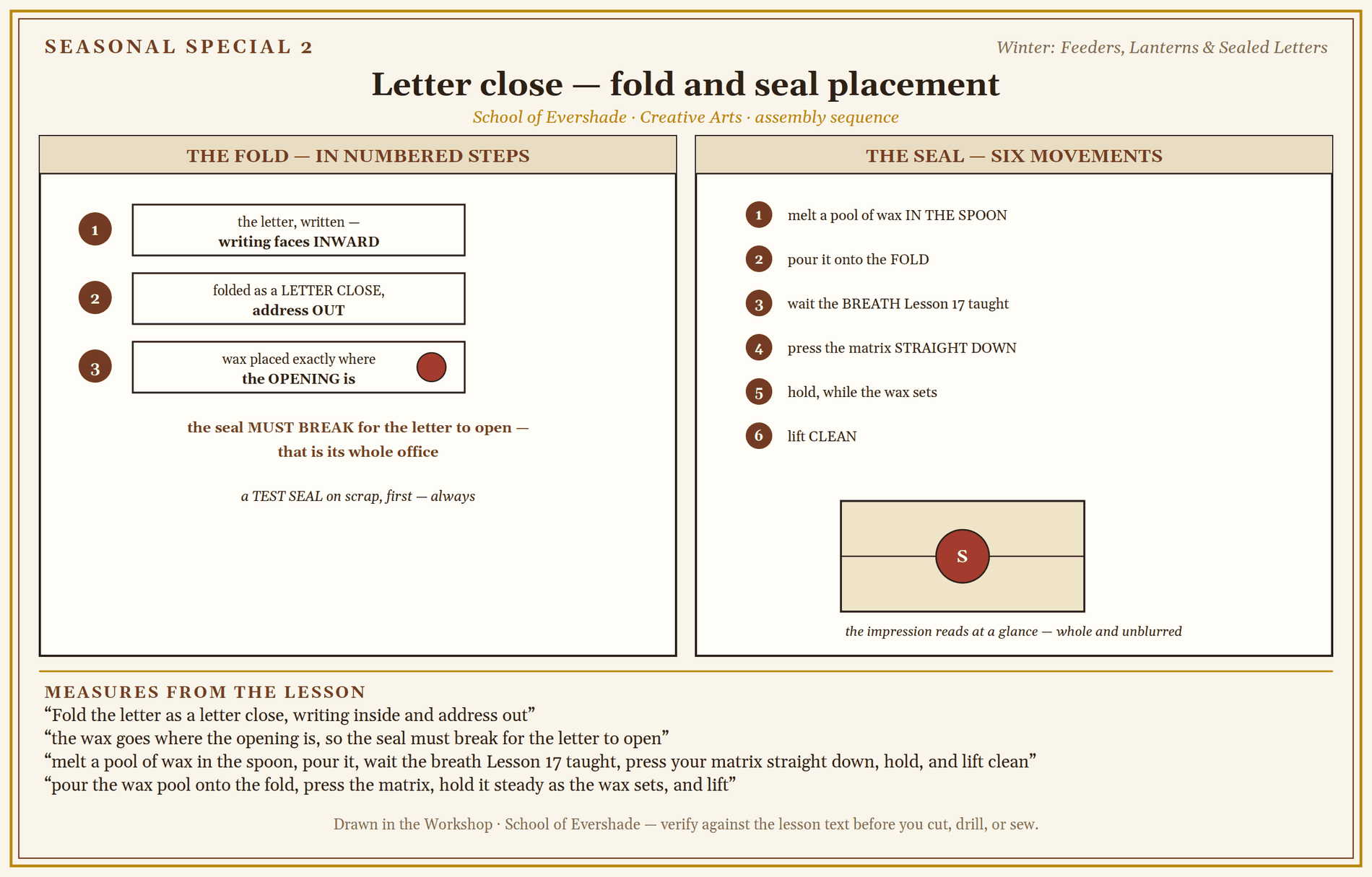
Letter close — fold and seal placement
Assignment Manual
Assignment key: ✎ written work · ⚒ hands-on practical · ◐ both
Assignment I ⚒ — The Winter Builds
Complete the three builds of this workshop: a feeder hung, stocked, and entered in the record; the dark-sky lantern built to the commission and passed at the dusk test; and one pen-pal letter written, sealed with your own matrix, and sent into the exchange. The lantern, once signed, is delivered to the Celestial Tower path duty it was commissioned for, or to the path your household assigns it, with its shutter in working order.
Assignment II ✎ — Kind Light, Honest Seals
Write a short history of one of this workshop's three crafts: the recorded history of feeding wild birds (the monk, the hard winter, the newspapers, and the science that followed), the lantern from horn panes to the dark lantern's shutter, or sealing wax and the signet as signature, evidence, and art. Use the sources below, and keep the history to what was made and why.
Assignment III ◐ — The Feeder Log and the Dusk Test
For two weeks, keep the winter record: the feeder's visitors as best you can name them, with dates and weather, and one formal dusk test of the lantern written up in full (what the light did, where it escaped, what you mended). The record is written; the things recorded are built; the two are handed in together.
Materials
Level One (household)
- Clean offcuts and scrap board for the feeder, exterior screws, and an oil finish for the outer wood only
- A frame for the lantern: tinplate, stiff sheet metal, or wood-and-metal from workshop stock; panes of heat-safe glass or mica, bought cut to size (glass cutting belongs to Lesson 5's adult list)
- A candle in a secure holder, or a warm-white LED candle for the lantern's everyday service
- A strip of tinplate or thin wood for the shutter, and a hinge or sliding track to fit it
- Sealing wax sticks, a melting spoon, and the wax bench's candle and water cup
- Your Lesson 17 seal matrix, writing paper, and an envelope or a sheet to fold as a letter close
Level Two (historical)
Everything in Level One, plus:
- A feeder joined with pegged joints from Lesson 4 in place of screws, built as a roofed bird table on a post in the old garden pattern
- Horn panes for the lantern, prepared by scraping and flattening in the historical manner (adult-led, and a demonstration before it is a task), with glass as the workshop's working pane
- A hood and shutter in brass sheet, cut and bent with Lesson 29's metalwork discipline
- Sealing wax compounded at the bench in the medieval manner, beeswax and resin, adult-led under Lesson 5's heat rules, beside the modern stick for comparison
- A letter written to be sent as a true letter close, no envelope, addressed on the outer fold
Both levels are judged by the same tests: the feeder drains and cleans, the lantern shields and shutters, and the seal lifts clean and reads true.
Reflection Questions
Answer the following questions in your workbook.
- The chickadee study found feeder birds taking only a fifth to a quarter of their winter calories from the feeder. Does that finding make feeding the birds more worth doing, or less? Defend your answer like a keeper, not a sentimentalist.
- The dark lantern's shutter made darkness without wasting the flame. What does that design understand about light that a brighter lamp does not?
- A wax seal closes, proves, and witnesses. Which of its three jobs matters most for a pen-pal letter between scholars, and why?
- This commission came from another professor's lesson and was built in a third room (this one) for a fourth place (the Tower path). What does that chain say about how this school is built?
- Septentrio hosts the winter workshop and Occidens' professor leads it. What does the season ask of both houses, and of you, that the other seasons do not?
Professor's Review
Three builds on the bench, scholars, and each of them pointed outward: the feeder at the birds, the lantern at the path, the letter at a friend you may never have met. Winter work is like that. It leaves the house.
The feeder will be found in its own time, and the log will fill. The lantern passed its dusk test or it did not, and if it did not, you know the workshop's answer: mend it at the bench, and test again. There is no shame in a second test. A lantern is signed when it has passed, and not before — and there is none of that worry here. Professor Glimmerwick's commission is discharged: her tower's path has a light that knows its place.
Spring meets in Oriens, among the starting pots and the cold frame. The birds you fed will be singing at it. Until then, keep the feeder stocked and the shutter oiled.
PROFESSOR COGBRANCH TIMBERCLANK
Creative Arts Workshop
Master Artisan, Head of House Occidens
Cross-Class Connections
Celestial Studies · Unit VI, Lesson 33 — Dark Skies
Workshop scholars, my thirty-third lesson is given to the dark itself: what light pollution steals from the sky, and how a light can be taught its manners. Its own practical builds the simple red-filter lantern at Tower scale. The lantern at full craft — hooded, shuttered in the old dark-lantern manner, its warm light aimed at your chart and your feet and nowhere else — is this Winter Workshop’s build, and the commission is named in both our rooms so that a scholar who reads either page finds the other. Learn the sky’s claim in my lesson; then go down to the bench and build the light that honours it.
PROFESSOR VESPER GLIMMERWICK
Celestial Studies
Further Reading & Sources
Wikipedia. "Bird feeding." The recorded history this workshop teaches: Saint Serf and the robin in the sixth century, the newspapers of the hard winter of 1890–91, Punch's "national pastime" of 1910, and February's naming as National Bird-Feeding Month in 1994.
National Geographic. Hamilton, Martha M. "Bird Feeding Takes Wing in U.S., With Summer Meals, Designer Seed" (2014). The dependency question answered: Temple and Brittingham's chickadee study, the removed feeder, and the finding that feeder birds took only twenty to twenty-five percent of their calories from it.
Wikipedia. "Lantern." The flame's case across history: horn panes scraped thin before glass, the "lanthorn" spelling, London's winter lantern order of 1417, and the dark lantern with its sliding shutter.
Lumens, The Edit. "What Is Dark Sky Compliance? Guide + Solutions." DarkSky International's standards stated as a specification: full shielding and downward light, warm color (2700K ideal, 3000K at most), no brighter than needed, and controls so light burns only while wanted.
Wikipedia. "Sealing wax." Beeswax and larch resin in the Middle Ages, vermilion red, shellac after the Indies trade, and the method of melting, pooling, and pressing that this workshop follows.
Victoria and Albert Museum. "Signet Ring" (object record, O121009). A gilt bronze signet ring, Italy, 1500–1600, engraved with a boar's head shield: the museum's account of personal seals as legal safeguard, worn on forefinger or thumb for the press.
Print only: Stephen Moss, A Bird in the Bush: A Social History of Birdwatching (Aurum Press, 2004). The social history behind the bird table, including the winters that made feeding a nation. Consult in a library.
Student-friendly starting points for exploring this special's world. All links verified October 2026.
- Wikipedia. "Bird feeding." Begin with the monk and his robin, and read how a kindness became a pastime and then a science.
- Victoria and Albert Museum. "Signet Ring" (object record). One small ring that signed letters and witnessed wills: look at the boar's head and imagine your own matrix at that size.
- Lumens, The Edit. "What Is Dark Sky Compliance?" The five habits of a well-mannered light, in plain terms, for testing every lantern and lamp you meet from now on.
Submit your work for this lesson using the form below.
CONTINUE IN THE CREATIVE ARTS WORKSHOP
← Previous · Seasonal Workshop Special S1: Autumn: Harvest & Keeping Next · Seasonal Workshop Special S3: Spring: Starting & Growing →
Creative Arts Workshop · All 39 Lessons
Bookstore Shelf The Library · Creative Arts Shelf Course Supplies
The rest of the Seasonal Specials: Special S1 · Autumn: Harvest & Keeping · Special S3 · Spring: Starting & Growing · Special S4 · Summer: Camp Keepsakes & the Weather Station