HERBOLOGY GREENHOUSE
Supplies for this course: everything this course asks you to gather, by level, lives on the Herbology supplies page.
Course SuppliesVisit Professor Fernfoot's OfficeBookstore Shelf
Welcome to the Herbology Greenhouse, scholars. I am Professor Beryl Fernfoot, Master Herbalist, and this is my course.
Herbology is the study of real plants: how they are built, what they need, how they multiply, and how we keep what they give us. You will learn the proper names of leaf shapes and the honest history of the spice trade. You will test your soil with your own hands, read the light in your windows, and coax seeds out of their sleep. Nothing here is pretend. A plant you grow yourself will teach you things no page can.
At the heart of this course walks a companion: your Scholar's Familiar. In the very first lesson you will choose a single forgiving plant, a mint or a spider plant or a pothos, and you will keep it through the whole course. You will watch it the way the old herbalists watched their plants, through whole seasons, and write down what you see. If you cannot keep a living plant, you may adopt one instead: a park tree, a neighbor's garden bed, a brave weed in a sidewalk crack. The skills are the same. Only the ownership differs.
Thirty-seven lessons stand between you and the gardener you will become, and at the end waits the Master Herbologist Defense, where you will present everything you have learned and grown. Take it slowly. Plants do not hurry, and neither should we.
A Note from Professor Fernfoot

You will find notes like this one all through the greenhouse lessons, every one of them sealed with my mark. They are the moments I would stop beside your bench if I could: a caution about a plant that bites back, a shortcut learned from forty seasons, a reason to look twice at something small.
The lesson carries the botany. My notes carry the gardener. Mind both, and your plants will thank you.
PROFESSOR BERYL FERNFOOT
Herbology Greenhouse
Master Herbalist, Head of House Oriens
What You Will Need
Keep at hand:
- A beginner plant, your Familiar
- Pots and potting soil
- A watering can or jug
- Basic hand tools
- Labels and plant supports
- A notebook for your grow ledger
Most of this course asks for ordinary things: pots with drainage holes, a bag of potting mix, a watering can, a notebook for your grow ledger, and a magnifying glass. Each lesson names exactly what to gather before you begin.
Your Scholar's Familiar should be a ruthlessly forgiving plant. In Lesson 1 I recommend mint, spider plant, or pothos: all three survive beginner mistakes and teach beautifully. Choose the one you love looking at, because you will be looking at it for a long time.
If you cannot keep a living plant, you may adopt one instead. A park tree you visit weekly, a neighbor's garden bed, a store display, even a sidewalk weed will serve. Every Familiar activity in this course includes a no-plant alternative path, and the final defense has a full alternative track built from field observation and research. No scholar is left out of this course for want of a pot.
Sharp tools appear in this course: pruning shears, knives for cuttings, and similar. Every lesson that uses them carries its own safety instruction. Young scholars work with an adult nearby. Read the safety notes. I do not repeat myself about blades.
Course Learning Objectives
By the end of this course, scholars will be able to:
- Identify plant structures using proper botanical vocabulary, and read and write scientific plant names correctly.
- Select, house, and care for a living plant through a full growing cycle, keeping honest records in a grow ledger.
- Read a growing environment: test soil texture and pH, map light and microclimates, and match each plant to the conditions it needs.
- Multiply plants by seed and by vegetative methods: scarification, stratification, cuttings, division, and layering.
- Prune with understanding, recognizing when a plant needs the shears and when it needs to be left alone.
- Harvest, dry, press, and store plant material using traditional methods, and save seeds that will grow true.
- Identify dangerously toxic plants and their look-alikes, and practice garden safety without exception.
- Design a complete garden to scale, matched to a real site, and defend every choice with course knowledge.
A Note on Safety
Plants are real, and real things have real risks. Some lessons in this course deal with dangerously poisonous plants. You will learn to identify them, to tell them from their harmless look-alikes, and to handle every unknown plant with the respect it deserves. We never taste unidentified plants. We never make dosage recipes or medicinal claims in this greenhouse; that is not what Herbology is for. If you ever suspect a poisoning, call Poison Control at 1-800-222-1222, or 911 in an emergency. The rules are simple, and they are not optional.
PROFESSOR BERYL FERNFOOT
Herbology Greenhouse
Master Herbalist, Head of House Oriens
The Curriculum
Unit I: Morphology, Taxonomy & the Ancient Lore
Before you can grow a plant well, you must learn to see it. Seven lessons on the plant itself: choosing your Scholar's Familiar, the architecture of leaves, stems, and roots, the two-name system Linnaeus gave to botany, the true history of herbs and spices, and the baneful greenhouse, where you will learn which plants can harm you and how to handle them safely.
Unit II: Soils, Sunlight & Growing Environments
A plant is only as healthy as its home. Nine lessons on the growing environment: soil texture and drainage, pH and chemistry, the nutrients plants eat, composting, reading sunlight through the seasons, watering deeply and correctly, microclimates, and the cycles of the year. It ends with your Growing Plan, a complete care document for your plant and your place.
Unit III: Propagation, Pruning & Plant Stewardship
The gardener's hands learn their trade. Ten lessons on making more plants and keeping them well: starting seeds, waking dormant ones, stem cuttings, root division, layering, the geometry of pruning, recognizing pests and disease, and the gentle mechanics of repotting. It closes with a stewardship project of your own choosing.
Unit IV: Harvest, Preservation & Use
What the garden gives, the gardener keeps. Six lessons on the harvest: timing it to the hour and the plant part, drying herbs the traditional way, pressing specimens for a personal herbarium, saving seeds that will grow true, and the classic culinary herbs of the kitchen garden. It ends with a harvest festival project.
Unit V: The Master Herbologist's Craft
The keeper becomes the craftsperson. Five lessons on the deeper work: toxic plants and garden safety, companion planting separated honestly from folklore, the ethics of foraging wild plants, building your own materia botanica, and finally designing a complete garden to scale.
The Master Herbologist Defense. The capstone. You will assemble a portfolio of everything you have grown, recorded, and made across all five units, present the journey of your Scholar's Familiar, defend your Master Garden Plan, and sit the Master Herbologist Examination.
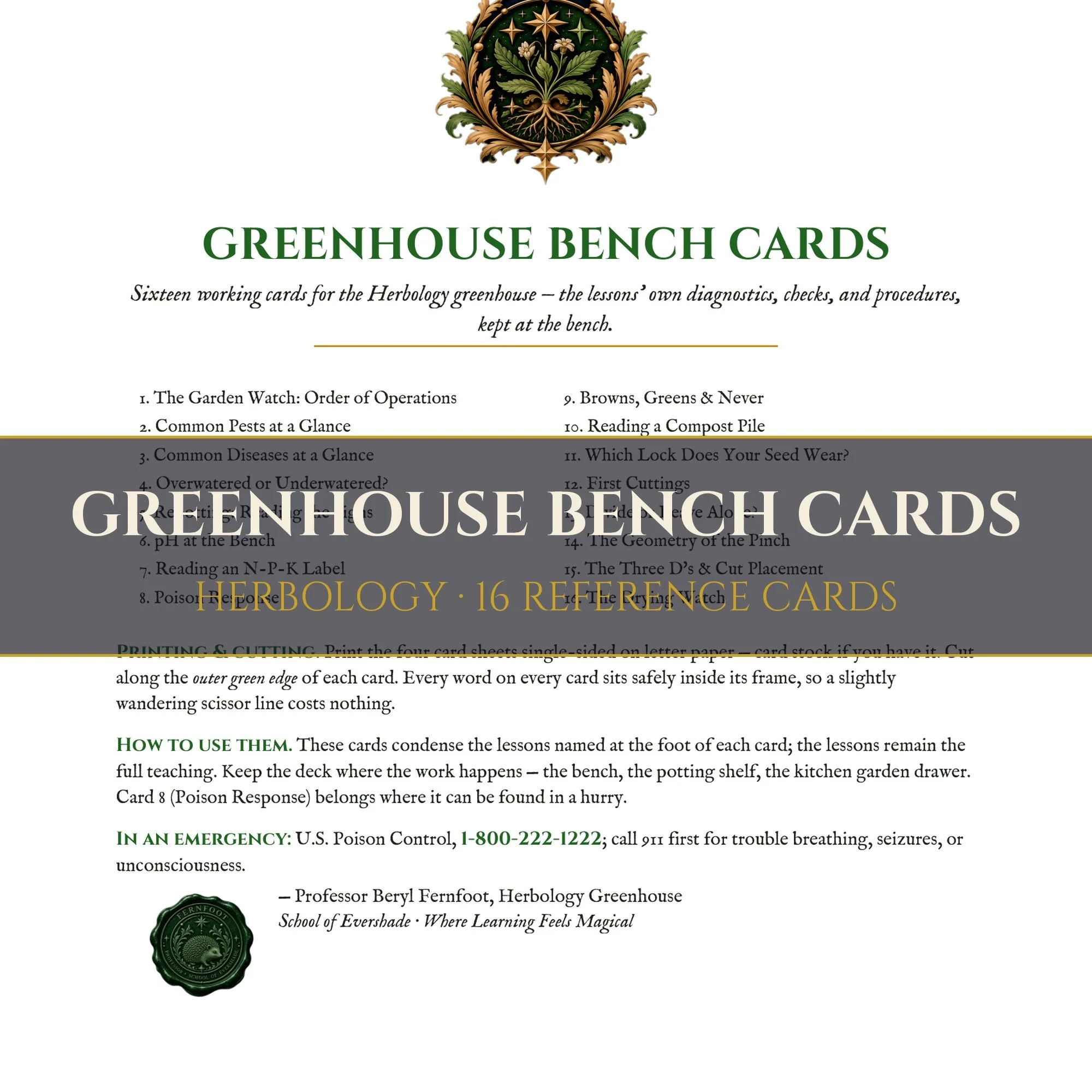
THE MATERIA BOTANICA
The Greenhouse keeps a book with the Laboratory: every plant our lessons teach — two hundred and two of them — gathered into one archive, each in its two keepings: the living plant, and the work it does after harvest.
Search it by name, or walk its shelves by kind, by the home it wants, or by the laboratory work it serves. The toxic shelf is marked wherever it stands.
Enter the ArchivePROFESSOR BERYL FERNFOOT · HERBOLOGY GREENHOUSE

From the Herbology Bookshelf
Printed volumes from this classroom’s own shelf in the school Bookstore — bound editions to keep beside your lessons.
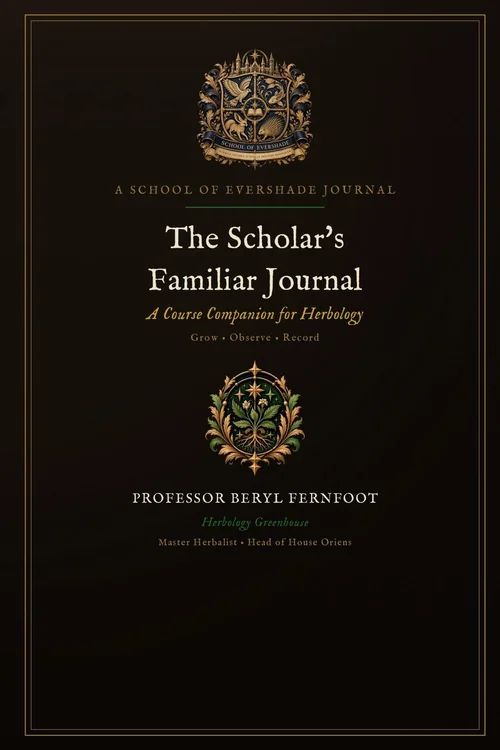
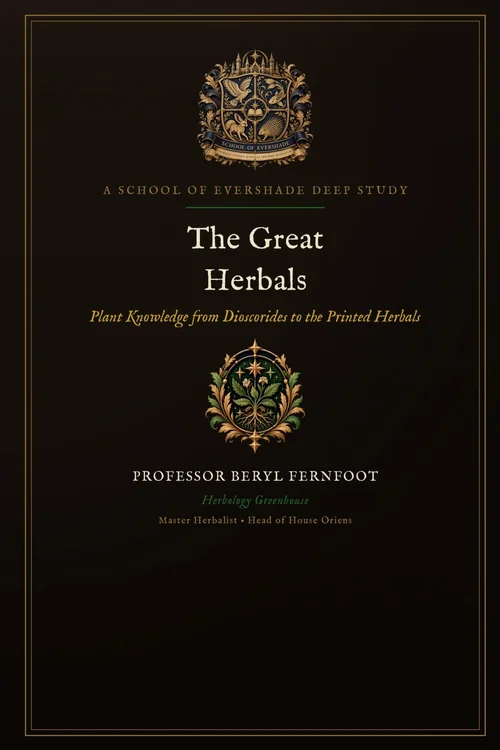
From the Greenhouse Shelf
The printed companions to this greenhouse, from Professor Fernfoot’s shelf in the shop.
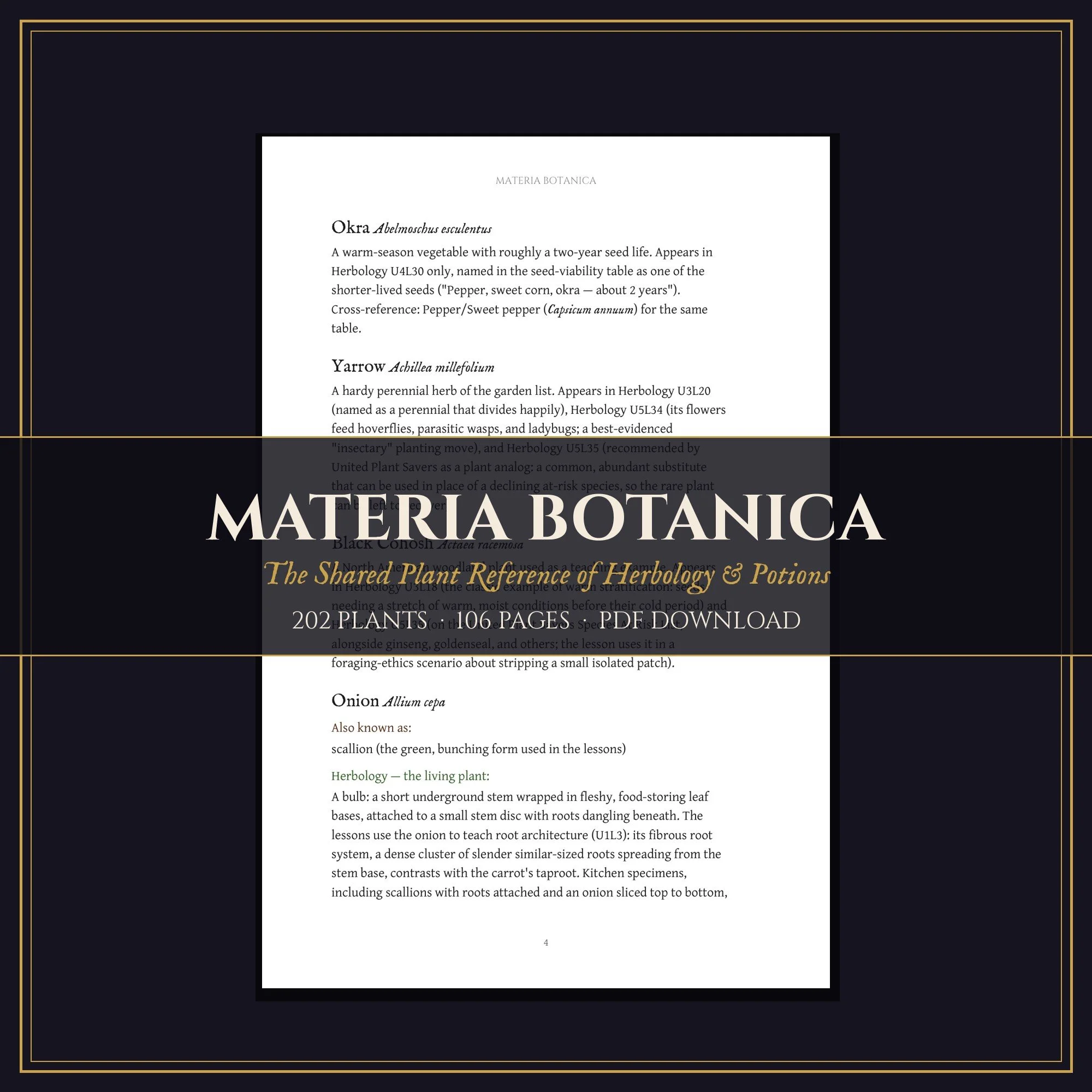
Materia Botanica — The School of Evershade's Shared Plant Reference (202 Plants)
$6.95
View in the Shop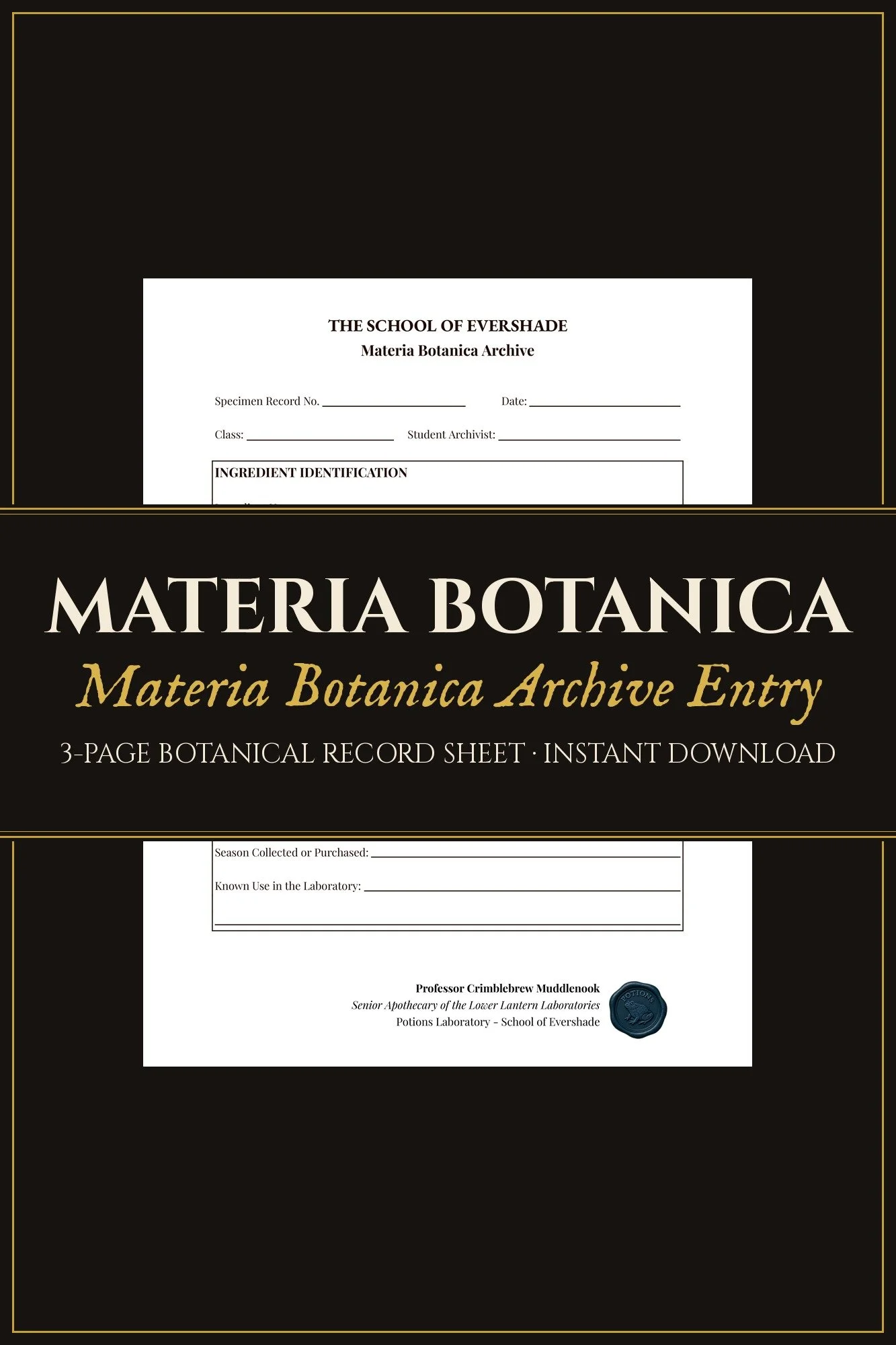
Materia Botanica Archive Entry Packet 3-Page Printable Botanical Record Sheet
$2.99
View in the Shop
Herbology — Familiar Journal Pages: Starter & Familiar Record Pages (7 Pages)
$2.95
View in the Shop
Herbology — Familiar Journal Pages: Seasonal Reflections & Familiar Gallery Pages (14 Pages)
$4.99
View in the Shop