
Unit V: The Master Herbologist's Craft
HERBOLOGY GREENHOUSE · UNIT V OF V
You have learned to sow, to feed, to water, to prune, to harvest, and to keep. You have raised plants from seed and from cuttings, read the weather in a leaf, and carried a harvest safely into storage. Now we come to the work of the master: the plants that can harm and must be known cold, the old claims about plant friendships that deserve an honest verdict, the ethics of taking from the wild, the written herbal that holds a lifetime of knowledge, and finally the garden you will design yourself, to scale, on paper, before a single seed is sown.
This unit asks more of your judgment than any before it. Give it the same patience you have given your Familiar all along, and it will give you the craft in return.
Unit Learning Objectives
By the end of this unit, scholars will be able to:
- Identify six toxic garden plants by their key features, distinguish poison hemlock from wild carrot, and state the correct response to suspected poisoning.
- Explain companion planting honestly: name pairings with real evidence, name claims that are folklore, and design a working herb guild.
- Forage ethically: apply the rules of permission, positive identification, and the honorable harvest, and document wild plants by observation.
- Build a materia botanica entry with complete fields and honest cautions, and maintain it as a living document.
- Design a complete garden to scale, matching plants to site and purpose, and defend every choice.
In This Unit
Lesson 33: Toxic Plants & Garden Safety
Know foxglove, oleander, monkshood, yew, lily of the valley, and castor bean by their features, and know exactly what to do if poisoning is suspected.
Lesson 34: Companion Planting & Guild Design
Learn the Three Sisters, test old claims against real evidence, and design a small herb guild where every plant earns its place.
Lesson 35: Foraging Ethics & Wildcrafting
Take only with permission, identify with certainty, protect the vulnerable, and keep a forager's field journal.
Lesson 36: The Materia Botanica, Building Your Herbal
Write the book of your plants in Evershade's shared tradition, with cautions as honest as your observations.
Lesson 37: The Master Herbologist's Garden Design
Read a site the way you learned to read a pot, choose plants by purpose and fit, and draw your Master Garden Plan to scale.
The Master Herbologist Defense closes the course. You will find it, with the Class Test download, at The Master Herbologist Defense.
What Scholars Will Grow, Practice, and Make
Scholars complete a toxic-plant identification study, design an herb guild, keep forager's journal entries, draft complete materia botanica entries with honest cautions, and draw the scaled Master Garden Plan they will defend at the end of the course.
With the craft complete and the garden planned, one task remains: the Master Herbologist Defense, where you will present everything you have grown, recorded, and made, and prove yourself a true herbologist.
From the Greenhouse Shelf
The printed companions to this unit, from Professor Fernfoot’s shelf in the shop.
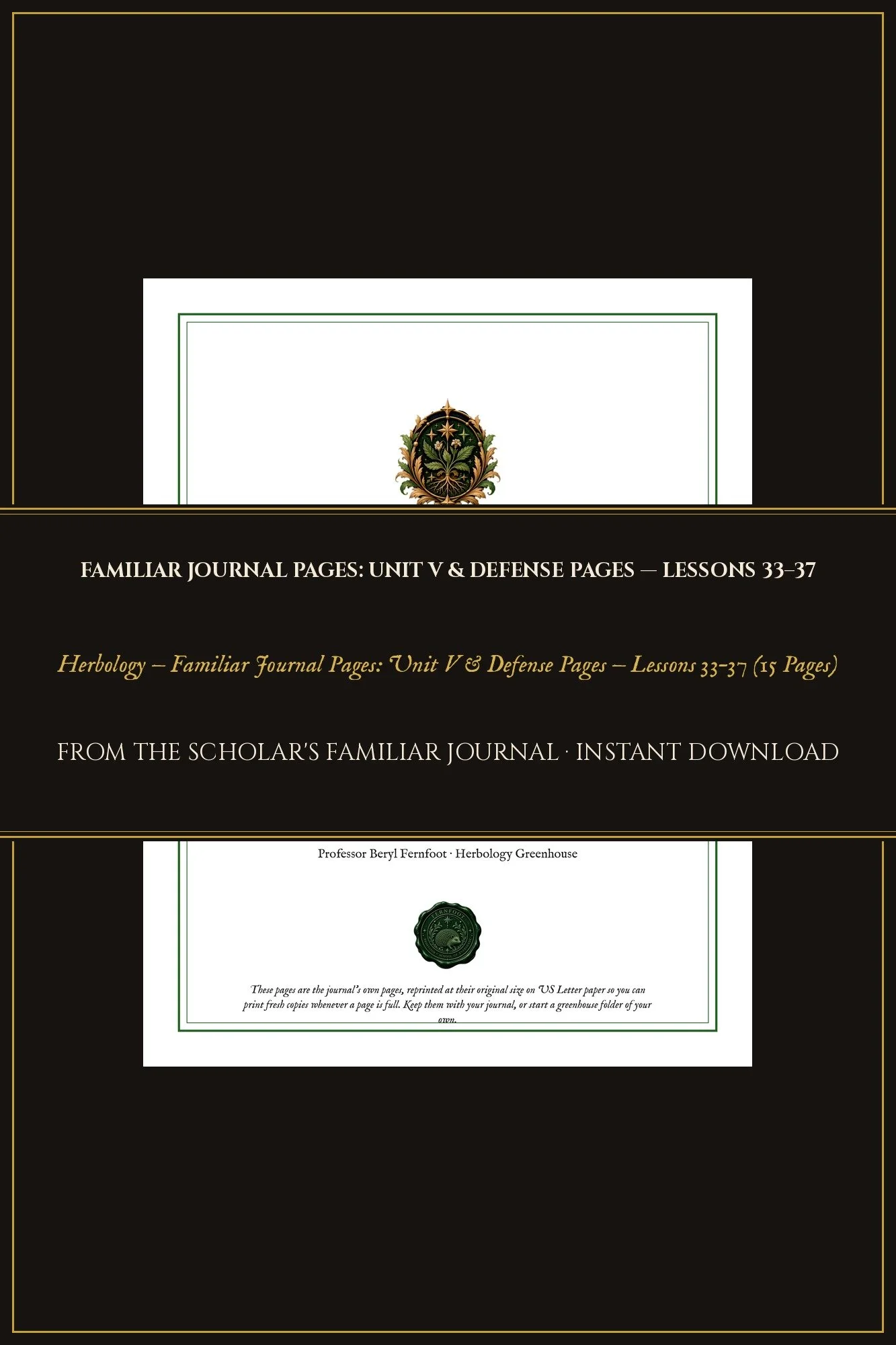
Herbology — Familiar Journal Pages: Unit V & Defense Pages — Lessons 33–37 (15 Pages)
$4.99
View in the Shop