

HERBOLOGY
Unit V · Lesson 35FORAGING ETHICS & WILDCRAFTING
PROFESSOR BERYL FERNFOOT
Herbology Greenhouse
Master Herbalist
UNIT V • LESSON 35
The Master Herbologist's Craft
Professor's Introduction

Come in, scholars,
Everything you have learned so far has happened in the greenhouse, in pots, in garden beds, in places where the plants were invited. Today we step outside the gate. Beyond the school grounds there are plants that no one planted, that belong to no one and to everyone, that have kept their own counsel in the woods and meadows for longer than any school has stood.
To gather from the wild is one of the oldest human crafts. It is also one of the easiest to get wrong. A garden forgives a heavy hand; you can water it, feed it, plant it again. The wild does not work that way. A plant taken from a struggling population does not come back next spring. A patch harvested carelessly may not recover in your lifetime.
This lesson is about the gatherer's manners. You were introduced to foraging ethics in Lesson 6, when we spoke of the baneful plants and the rules of the wild harvest. Now, as advanced scholars, you will learn the full craft: the honorable harvest, the plants that must never be taken, the laws that protect them, and the field journal that lets you gather knowledge even when your hands stay empty.
The wild is generous to those who approach it with respect. Let us learn to be worthy of it.
— Professor Beryl Fernfoot, Herbology Greenhouse • Master Herbalist • Head of House Oriens
The line beneath the map is our road: every stop a place where the knowledge of plants changed, every lesson a step along it.
Lesson Objectives
By the end of this lesson, you will be able to:
- Explain the rules of the honorable harvest: permission, the fraction rule, and leaving more than you take
- Describe why wild populations are more vulnerable than garden plants, and how a forager's footprint differs
- Apply the hundred-percent rule of positive identification and connect it to the Three-Sign Rule from Lesson 6
- Name at least five plants on the United Plant Savers at-risk list and explain the concept of a plant analog
- Describe the legal landscape of foraging: private land permission, park rules, and permits such as those required for wild ginseng
- Keep a forager's field journal entry that documents a wild plant by observation alone
- Distinguish foraging observation (always welcome, with respect) from foraging harvest (sometimes restricted, always conditional)
Reading this lesson: ★ marks the passages to remember. They return on the unit quiz and the class test. Check in questions ask the material back as you go; answer them in your workbook when you meet them.
Working this lesson: Your assignment packet is the first download on this page. Work in it as the lesson moves along, answering each assignment as its subject is taught — or read the lesson through for your notes and take the assignments as homework afterward. Both are proper ways to sit this class. Signposts in the reading tell you where each assignment belongs. Written answers are short answers in your own words; a few honest lines are worth more than a filled page.
Your Assignment Packet
This lesson's assignments live in its packet: the Lexicon Handout (every term, course terms marked ◆), Materials, Guided Practice, the Assignment Manual with its answer key for self-checking, the Reflection Questions, and the Workbook Checklist. Download the packet before you begin and keep it beside you as you read.
The Wild Is Not a Garden
A garden is a promise. You prepare the soil, you plant the seed, you water through the dry weeks, and the plant's abundance is, in some measure, your own doing. The wild makes no such promise. A wild plant grew where it did because a seed happened to land in the right crack of the world, because the rain came at the right week, because no deer browsed it to the ground. Its abundance is luck and deep time, not your labor.
★ This is the first thing the wildcrafter must understand: you are a guest taking from a household you did not build. Every leaf you gather is one the plant made for itself, for its pollinators, for the caterpillars that will become next year's moths, for the birds that eat its seeds. Harvesting from the wild is never a private transaction between you and the plant. It is a withdrawal from a shared account, and the other account holders cannot speak for themselves.
Check in: Why is wild harvesting never a private transaction between you and the plant — who else holds an account in it?
Gardens forgive. If you harvest your basil too hard, it sulks, you water it, it recovers. Wild populations do not always recover. A slow-growing woodland plant like ginseng can take five to ten years to reach maturity; a single careless digger can undo a decade in an afternoon. In some regions, foragers have watched ramps, the wild leeks of eastern woodlands, vanish entirely from places where they once carpeted the forest floor. Local extinction is a real phrase, and it arrives quietly, one basket at a time.
So the advanced herbologist approaches the wild with a different posture than the greenhouse. In the greenhouse, the question is what does this plant need from me. In the wild, the question is what may I take without being missed.
❦ In your workbook: record the wild-is-not-a-garden contrast in your own way — the guest in a household you did not build, the shared account, and the question the wild asks — copy, sketch, or note what matters.
The Rules of the Honorable Harvest
The honorable harvest is the wildcrafter's code. It has been taught in different words by many traditions, and you will hear different numbers from different teachers, but the direction is always the same: take little, take carefully, and leave the place better than the taking requires.
★ First: permission. On private land, ask the landowner, and get the answer in clear words; in some states, for regulated plants like ginseng, the law requires written permission on posted land. On public land, the rules change with every boundary line, and we will study them below. Never assume. A plant you take without permission is not foraged. It is stolen.
Check in: What makes a taken plant "stolen" rather than foraged — and where does permission come from on private land?
★ Second: the fraction rule. Never take more than a fraction of any healthy, abundant stand. Many foragers use the one-third rule: take no more than one-third, and leave two-thirds for the plant, for the wildlife, and for the other foragers. Some teachers are stricter and say a tenth. The exact number matters less than the discipline: if you cannot bear to leave most of it standing, you are taking too much. And the fraction rule has a hard floor beneath it. If the population is small, struggling, or the only one you know of, take nothing at all. The rule for a scarce plant is not a smaller fraction. It is zero.
Check in: State the fraction rule and its hard floor — when is the correct fraction zero?
Third: take only what you will use. A gathered plant that rots in a bag on your counter is a small tragedy. Plan the harvest before you go: know what you will do with the plant, in what quantity, and gather only that. This is the same respect you learned in Lesson 27's harvest timing. The harvest begins in the mind, not the hand.
★ Fourth: harvest in a way that lets the plant continue. For leaves and aerial parts, take scattered leaves from many plants rather than stripping one. For roots, the old guidance is to replant the crown and the root tip where you can, so the plant has a chance to regrow. For bark, never strip a trunk; take small twigs or branches instead. For seeds and fruit, leave the greater share for wildlife and for the next generation. And when ginseng is dug, the law in several states requires the digger to plant the plant's own seeds at the site: a legal version of an ancient courtesy.
Fifth: leave no trace. Fill the holes you dig. Do not trample the surrounding plants to reach the one you want. Carry out everything you carried in. The next visitor, human or otherwise, should not be able to tell you were there.
Sixth: begin as an observer. This is the rule Lesson 6 gave you, and it still stands. Until your identification skills are solid, observe without collecting. A season of watching teaches more than a basket of mistakes.
Your Scholar's Familiar has taught you to watch one plant closely for months. The wild asks for the same attention, spread wider. (No-plant alternative: your adopted plant or a regular walking route works perfectly for this lesson's observation exercises. Wildcrafting's first skill is watching, and watching needs no ownership.)
❦ In your workbook: record the six rules of the honorable harvest in your own way — permission, fraction, use, method, trace, and begin as an observer — copy, sketch, or note what matters.
In your packet: Assignment II — The Honorable Harvest Audit ✎ begins here. Work it now, or mark the place and take it as homework — your choice.
Professor's Mid-Lesson Note
Scholars, I want to tell you about the largest plant in the patch.
Experienced wildcrafters teach that the biggest, most vigorous plant in a stand is often its anchor. It shades the young ones, feeds the soil life around its roots, and drops the most seed. And it is the plant every harvester wants, because it is the finest.
Leave it. Take from the middle of the stand, from the healthy and ordinary, and let the finest plant go on being the finest. This is not sentiment. It is how populations stay strong: the best seed, the best shelter, and the strongest roots remain.
The honorable harvest is not only about how much you take. It is about what you choose to leave.
— Professor Beryl Fernfoot, Herbology Greenhouse • Master Herbalist • Head of House Oriens
Positive Identification: The Hundred-Percent Rule
In Lesson 6 you learned the Three-Sign Rule: confirm at least three independent identifying features, with no contradictions, before treating a plant as identified. In the wild, the rule hardens into something stricter: the hundred-percent rule. If you are not completely certain what a plant is, you do not harvest it, you do not taste it, and you do not take it home to figure out later. You leave it standing, and you are glad to have met it.
★ This is not timidity. It is the central safety discipline of wildcrafting, because the wild contains plants that can kill with a single mistaken bite, and many of them have harmless doubles. You studied the classic case in Lesson 6: Queen Anne's lace, with its hairy green stems, and poison hemlock, with smooth stems blotched purple, both wearing the same umbrella of white flowers. A full Unit V lesson is devoted to these dangerous doubles. The mistake is always the same: one matching feature, and confidence that outruns knowledge.
Check in: What does the hundred-percent rule forbid when you are not completely certain — all three of its prohibitions?
Build your certainty the way the course has taught you from the beginning:
- Use more than one field guide, and make sure at least one covers your exact region. Plants vary by place, and a guide written for another state can mislead.
- Learn the plant in all its seasons if you can. A plant you know only in flower is a stranger in spring.
- Learn its habitat. A plant growing where it should not grow is a warning, not a discovery.
- When in doubt, photograph and walk away. A photograph can be studied at home, shown to an expert, and compared against references. A harvested plant cannot be un-harvested.
★ And remember the number you learned in Lesson 6: if someone may have swallowed an unidentified plant, the Poison Help line is 1-800-222-1222 in the United States, free and confidential, day and night. It is distinct from 911, which is for emergencies already underway. Know the number before you need it.
❦ In your workbook: record the hundred-percent rule in your own way — the Three-Sign Rule hardened, the four certainty-builders, and the Poison Help number — copy, sketch, or note what matters.
The Protected and the At-Risk
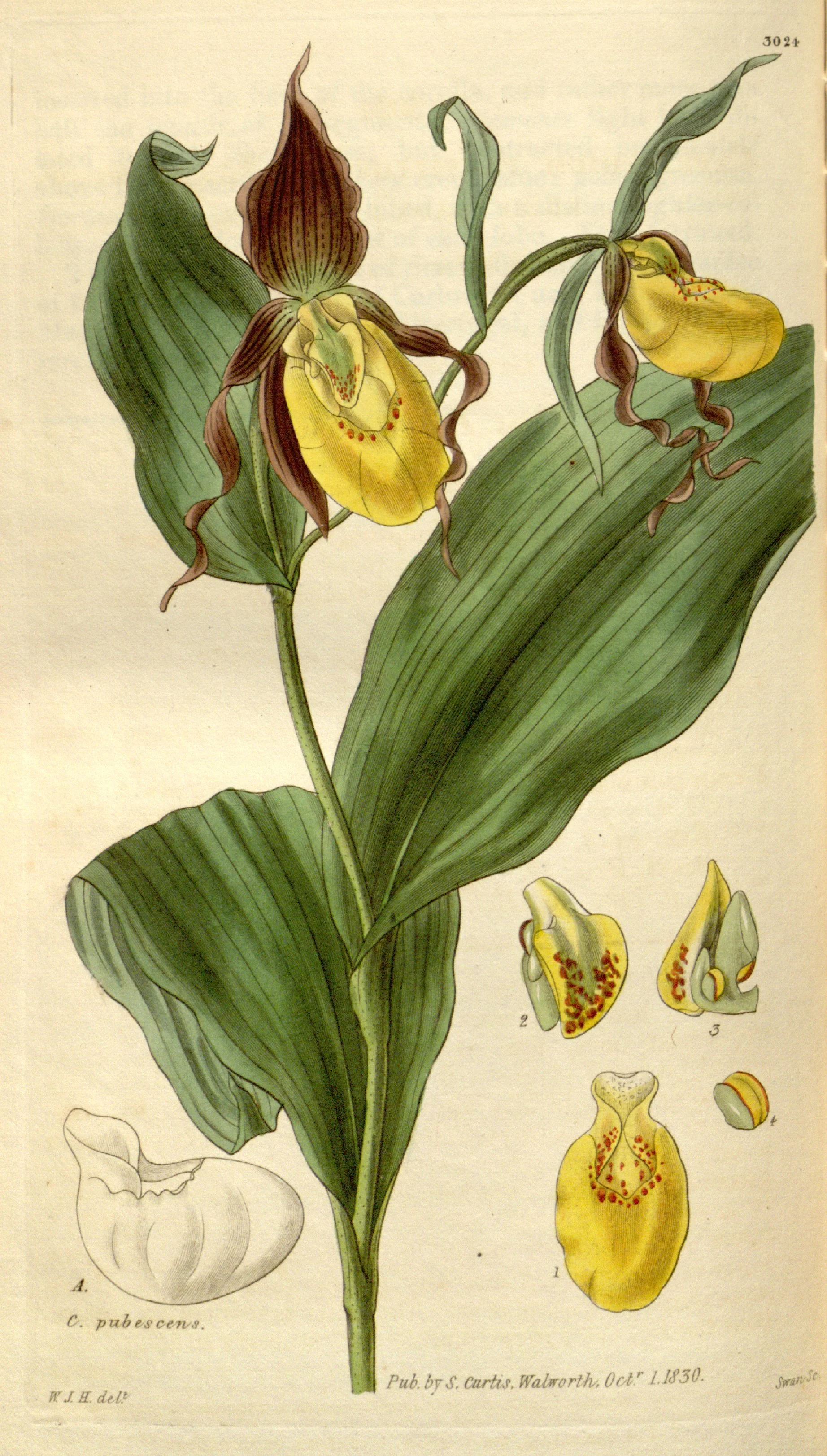
A lady's slipper orchid, plate 3024 of Curtis's Botanical Magazine (1830), published as Cypripedium pubescens — a yellow lady's slipper of North American woods. The lesson's rule for this plant is simple and absolute: lady's slippers are ranked Critical on the United Plant Savers Species At Risk List, and many states protect native orchids by law. Do not pick, do not dig, do not wild-harvest. Admire it, sketch it, journal it — and leave it standing.
Curtis's Botanical Magazine, plate 3024 (1830), drawn by W. J. Hooker. Public domain.
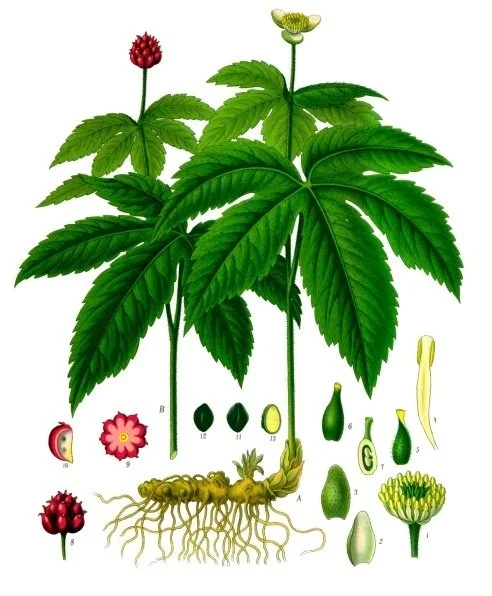
Goldenseal (Hydrastis canadensis), from Köhler's Medizinal-Pflanzen: the lobed leaves, the red fruit head, and the yellow rhizome that made the plant famous — and made it scarce. Goldenseal stands on the United Plant Savers Species At Risk List, and the lesson's rule is absolute: at-risk species are never wild-harvested. The ethical answer to wanting this plant is its analog — a common plant instead — and this plate, studied at the desk.
Franz Eugen Köhler, Köhler's Medizinal-Pflanzen (plate 209). Public domain.
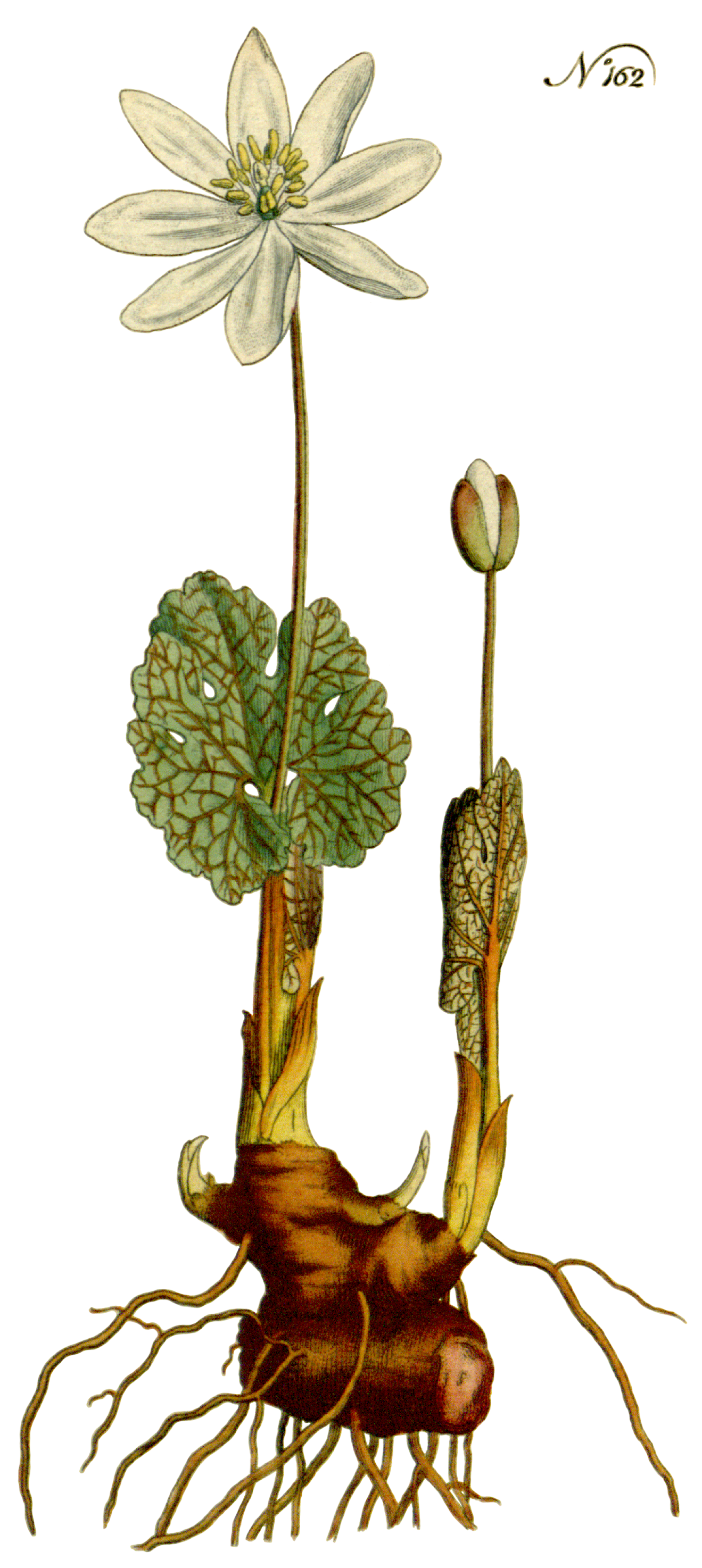
Bloodroot (Sanguinaria canadensis), plate 162 of Curtis's Botanical Magazine: the white spring flower, the lobed leaf, and the thick rhizome beneath. Bloodroot stands on the United Plant Savers Species At Risk List; like every plant on that list, it is studied, sketched, and left to grow — never wild-harvested. A plate from 1792 can teach the eye everything this lesson asks, with the plant itself untouched.
William Curtis, Curtis's Botanical Magazine, plate 162. Public domain.
Some plants must not be gathered at all, not because the harvester is clumsy, but because the plant itself is in trouble.
The nonprofit conservation organization United Plant Savers keeps a Species At Risk List of wild North American medicinal plants in decline, plants whose popularity has outrun their populations and whose habitats are shrinking. On it you will find American ginseng, goldenseal, black cohosh, bloodroot, echinacea, osha, slippery elm, and wild yam. Some are ranked as Critical: the lady's slipper orchid, that delicate forest orchid; false unicorn, now described as virtually nonexistent in the wild; trillium, or beth root; the Venus fly trap; peyote; sundew.
★ The rule for these plants is simple and absolute: do not wild-harvest at-risk species. Let them grow. United Plant Savers pairs its list with a companion list of plant analogs: common, abundant plants that can serve in place of the rare ones, so that no one needs to reach for a plant in trouble. Plantain for the field kit. Yarrow for the same. Dandelion for the spring tonic. The analog list is the ethical forager's answer to desire. Want the rare plant's gifts? Take the common plant instead, and leave the rare one to its slow recovery.
Check in: Name five plants on the at-risk list — and state the absolute rule that governs them.
Beyond any organization's list, individual states protect their own. Many states list native orchids, including the lady's slippers, as protected species that may not be picked or dug at all. Ginseng, as we will see, is regulated nearly everywhere it grows wild. And international law reaches the plant trade too: American ginseng has been listed in Appendix II of CITES, the Convention on International Trade in Endangered Species of Wild Fauna and Flora, since 1975, which means its international trade is licensed and tracked.
★ The advanced herbologist's habit is this: before you gather any wild plant, ask whether it is at risk. Check the United Plant Savers list. Check your state's protected species list. If the answer is yes, or if you cannot find the answer, the harvest does not happen. Uncertainty, here as everywhere in this lesson, resolves toward the plant.
❦ In your workbook: record the protected and the at-risk in your own way — the list, the Critical names, the analog answer, and the habit of checking before gathering — copy, sketch, or note what matters.
In your packet: Assignment IV — The At-Risk Study ✎ begins here. Work it now, or mark the place and take it as homework — your choice.
The Law of the Land
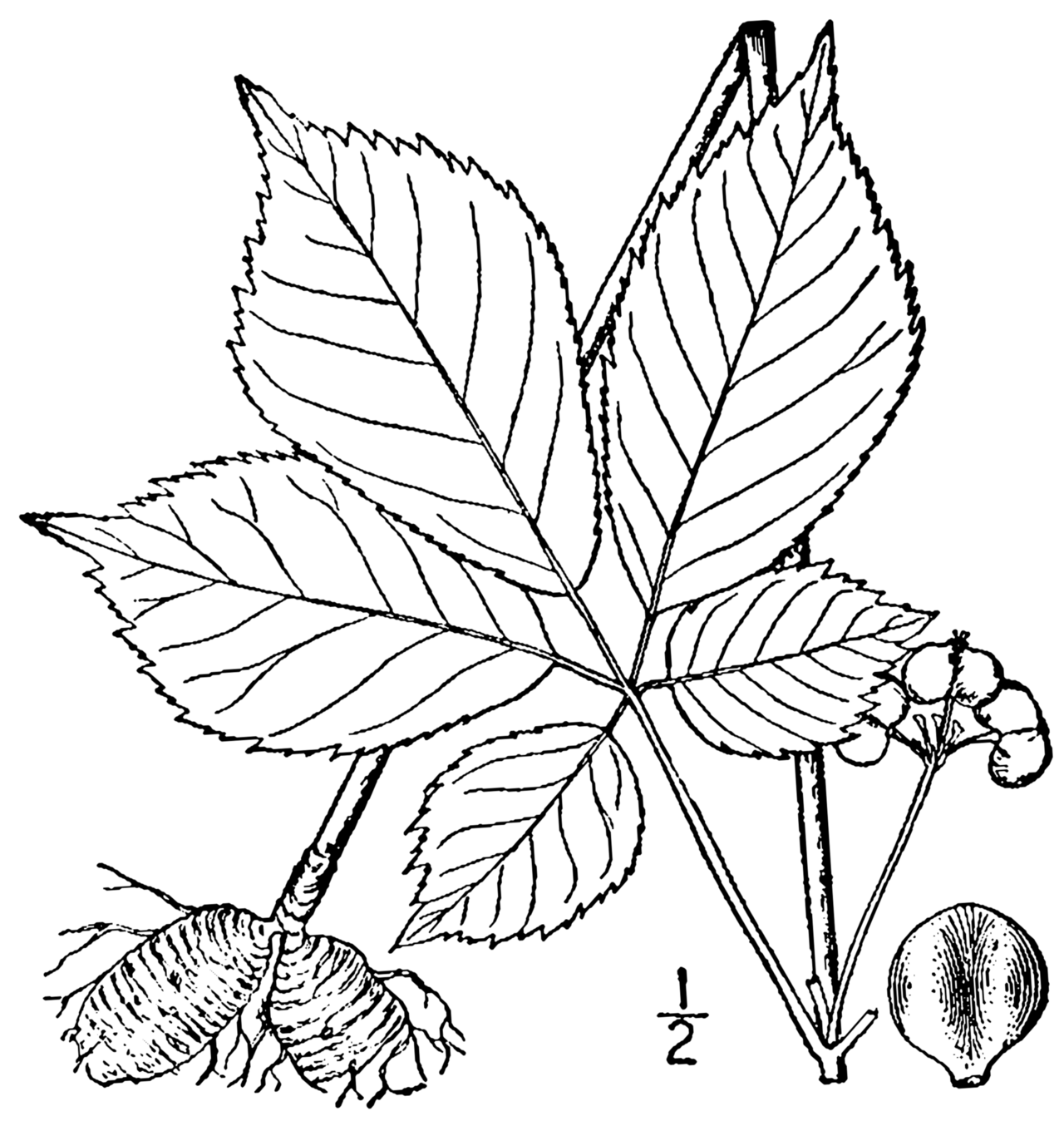
American ginseng (Panax quinquefolius), drawn for Britton & Brown's Illustrated Flora (1913): the leaflet whorl, the forked root the trade dug for, and the berries whose seeds the law now requires the digger to plant at the site. Ginseng has been listed in CITES Appendix II since 1975, and nearly every state where it grows wild regulates its harvest. This plate is a study portrait, not a field guide — in the woods, the hundred-percent rule and the permit come first, and the beginner's harvest is the journal, not the root.
Britton, N.L., and A. Brown, An Illustrated Flora of the Northern United States and Canada (1913), via the USDA-NRCS PLANTS Database. Public domain.
Ethics tell you what is right. The law tells you what is permitted, and the two do not always overlap. The master herbologist respects both.
Private land is the simplest case: the landowner's permission decides everything. Ask, and accept the answer. On posted land in some states, permission for regulated plants must be written down and carried with you.
Public land is a patchwork, and the only safe approach is to check the rules for the exact place where you stand.
- In national parks, the default under federal regulation (36 CFR 2.1) prohibits removing or disturbing plants. Individual park superintendents may allow limited personal-use gathering, such as a quart of berries a day in some parks, but about a quarter of national parks ban foraging entirely. Never assume the exception.
- State parks vary widely. Many states, including Arkansas and California, prohibit nearly all foraging on state lands. Others allow berries or mushrooms for personal use. Some cities fine foragers in municipal parks.
- National forests are often the most permissive, with many allowing personal-use gathering, but the rules differ from forest to forest. Always check with the local office first.
★ Regulated plants carry their own laws, and ginseng is the great American example. Because wild American ginseng has been heavily dug for the root trade, nearly every state where it grows regulates the harvest: designated harvest seasons, commonly September through December; minimum plant sizes, usually three or more leaf prongs, a proxy for the plant's age, with some states requiring plants to be five or even ten years old; harvester permits; and a requirement to plant the harvested plant's seeds at the dig site. Harvest is banned in most state parks and wildlife refuges, and the U.S. Forest Service has suspended ginseng harvesting entirely in national forests across Kentucky, North Carolina, Georgia, and Tennessee. Enforcement is real. West Virginia raised first-offense fines for illegal digging into the hundreds of dollars. Ohio has used conservation K-9 units to detect poached roots. Some parks mark wild ginseng with dye or microchips to make illegal collection easier to spot.
Check in: Name four elements of ginseng's legal regulation — season, size, permits, and what the digger must plant.
Study the ginseng story, because it is the whole lesson in miniature: a beloved plant, a heavy demand, a slow biology, and a community of careful diggers, stricter laws, and watchful officers standing between the plant and its disappearance. The law did not arrive because foragers were wicked. It arrived because enough well-meaning people each took just a little at the same time.
Before you gather anywhere beyond your own garden: learn the land's rules, get the permits, and keep them with you. The master herbologist's basket is never heavier than the law allows.
❦ In your workbook: record the law of the land in your own way — private permission, the public-land patchwork, and the ginseng story in miniature — copy, sketch, or note what matters.
The Forager's Field Journal: Harvesting Knowledge Instead
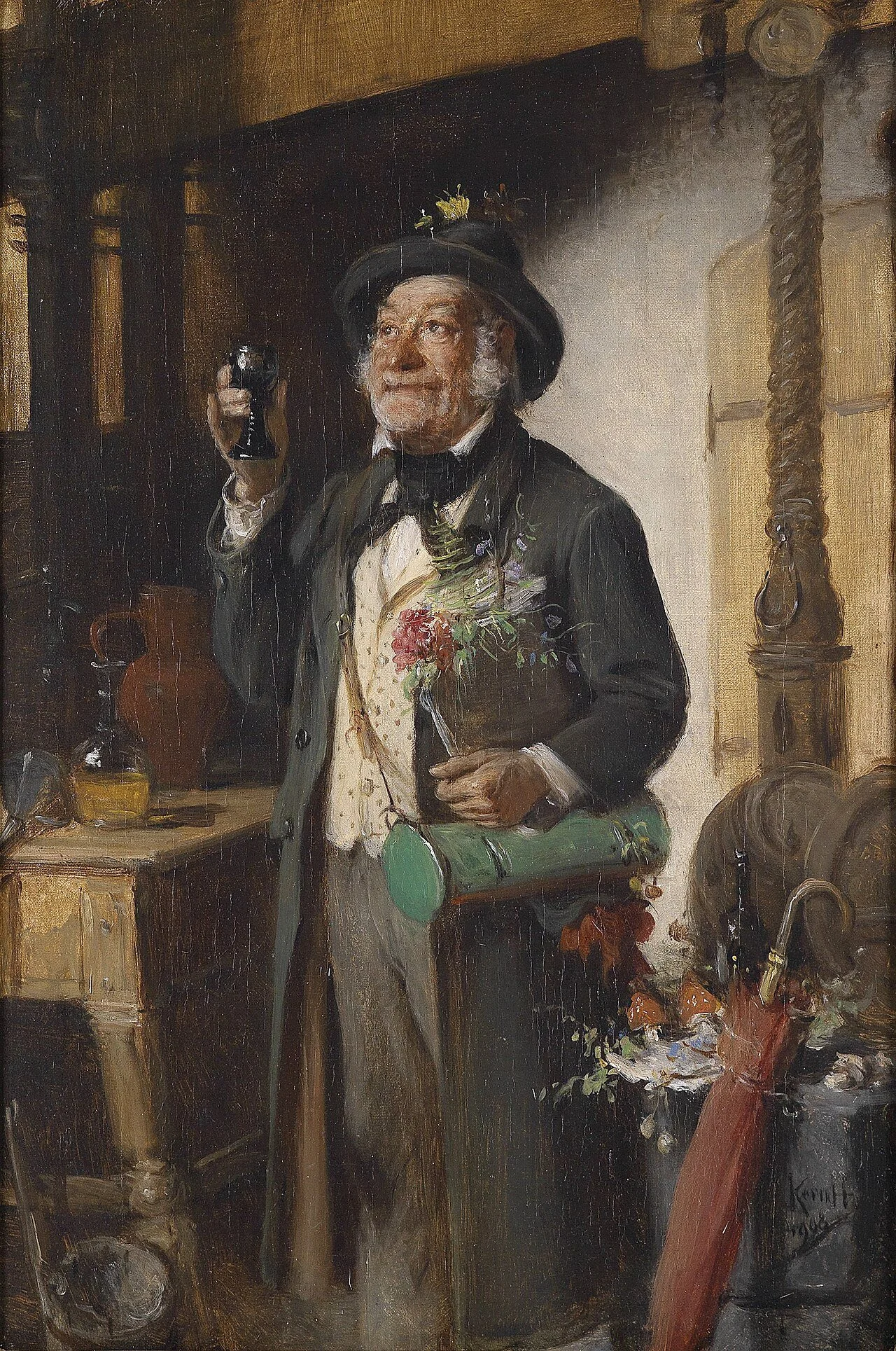
The Botanist, by Hermann Kern (1896): the field botanist come home with his green vasculum — the tin collecting case botanists carried for two centuries — still under his arm. This lesson keeps the kit and changes the cargo: the modern wildcrafter's case rides light, and the journal rides heavy. Walk, watch, write, and leave everything standing, and the notebook comes home fuller than any basket.
Hermann Kern (1838–1912), Der Botaniker (The Botanist), 1896. Public domain.
Here is the loveliest secret of this lesson: the most valuable thing you can gather from the wild is not the plant. It is the knowledge of the plant. And knowledge, unlike roots and leaves, can be harvested without limit, without permission, and without harming anything.
★ The forager's field journal is the wildcrafter's true basket. In it you record what you find, in the tradition of the herbarium keepers you met in Lesson 29, and the way you have recorded your Scholar's Familiar all year. A complete field journal entry holds:
- Date, time, and weather. Plants look different in morning and afternoon, in drought and after rain.
- Place. The trail, the county, the habitat: oak-hickory slope, roadside ditch, pond margin. Be precise enough to return, and discreet enough in any shared journal not to advertise a fragile patch to the world.
- The plant's story. What is it? What stage of growth? What is growing beside it? Who is visiting it: bees, beetles, deer sign?
- Identifying features. Write down the features that satisfy the Three-Sign Rule, in your own words, and sketch what you see. A sketch teaches the hand what the eye has learned.
- A photograph, if you can take one without trampling the patch to get it.
Check in: Name the five things a complete field journal entry holds — and the discretion rule for place.
For your first seasons of wildcrafting, let the journal be the whole harvest. Walk, watch, write, and leave everything standing. You will be astonished how much this teaches: the rhythm of a place across the months, the return of the same plants to the same corners, the slow education of the eye. And when your identification is finally certain, when the plant is common and the land's rules allow, your first real harvest will be a small, careful, honorable thing, because you will know exactly what you are taking, from whom, and what it costs.
This is also the heart of the no-plant path through this course. If you have no garden and no Familiar of your own, the wild, the park, the sidewalk weed, and the neighbor's hedge are your classroom, and the field journal is your textbook. The skills are identical. Only the ownership differs, and the wildcrafter would tell you that ownership was never the point.
❦ In your workbook: record the field journal in your own way — the true basket, its five entries, and the journal as the whole first harvest — copy, sketch, or note what matters.
In your packet: Assignment III — The Field Journal Entry ◐ begins here. Work it now, or mark the place and take it as homework — your choice.
Guided Observation: Reading a Wild Plant Without Taking It
This lesson's observation is the field journal worked in full at one plant: a complete entry made by observation alone — date, place, story, and three signs — with hands empty and the plant left standing, exactly as the lesson teaches the beginner's whole harvest should be.
You will need:
- one wild plant you can visit (a park tree, a sidewalk weed, a plant at the wood's edge, or your adopted plant — this assignment IS the no-plant path, and observation is the whole harvest)
- a notebook and pencil
- a phone camera, if you have one
Record the frame. Write the date, time, and weather first. Plants look different in morning and afternoon, in drought and after rain, and your entry must say which plant, in which light, you actually saw.
Record the place, precisely and discreetly. Name the trail, the county, and the habitat: oak-hickory slope, roadside ditch, pond margin. Be precise enough to return, and discreet enough in any shared journal not to advertise a fragile patch to the world.
Tell the plant's story. What stage of growth is it in? What is growing beside it? Who is visiting it: bees, beetles, deer sign? The entry records a living plant in a living place, not a specimen on a page.
Satisfy the Three-Sign Rule on paper. Write down at least three independent identifying features, in your own words, with no contradictions — and sketch what you see. A sketch teaches the hand what the eye has learned. If three honest signs will not come, the entry says so, and the plant stays unnamed: uncertainty resolves toward the plant.
Photograph without trampling. Take a photograph, if you can, without trampling the patch to get it. A photograph can be studied at home, shown to an expert, and compared against references. A harvested plant cannot be un-harvested.
Consider:
- Which of your three signs is strongest, and which would you check again on a second visit?
- What did the journal harvest that a basket could not have carried?
- What did you choose NOT to gather, and which rule of this lesson governed the choice?
No-plant alternative: this observation IS the no-plant path. The wild, the park, the sidewalk weed, and the neighbor's hedge are your classroom; ownership was never the point.
Workbook path: if no wild plant is within your reach this week, work the same entry on a clear photograph of a wild plant, or on a garden plant observed through the same five headings — frame, place, story, three signs, photograph — and write the non-gathering paragraph from the photograph's evidence. The journal discipline is the skill; the hedgerow is its next occasion.
Materials
Required (Level One — household items)
- A notebook and pencil: for field journal entries and the harvest audit.
- Phone camera (if available): for photographing plants without picking them.
- Library or internet access: for the at-risk plant research and regional rules.
- Comfortable walking shoes: for the observation walk.
Suggested (Level Two — historically closer)
- A bound journal: for a lasting field journal in the naturalist tradition.
- Ink pens: for final journal entries and the at-risk profile.
- A regional field guide: for practicing the Three-Sign Rule outdoors.
- A hand lens or magnifier: for close study of identifying features (optional).
Safety notes: No assignment in this packet requires gathering, handling, or tasting any wild plant. All field work is observation only: look, sketch, photograph, and leave every plant standing. Never eat any wild plant. An adult should accompany younger scholars outdoors. Carry the lesson's own guardrails with the materials: permission before any gathering, the hundred-percent rule before any harvest is even considered, at-risk species never wild-harvested, and the Poison Help line — 1-800-222-1222 in the United States, free and confidential, day and night — known before you need it.
Reflection Questions
Answer the following questions in your workbook.
- The lesson says a garden forgives a heavy hand but the wild does not. What makes wild populations more vulnerable than garden plants? Give two reasons from the lesson.
- Why does the honorable harvest single out the largest plant in the patch for protection? What does this teach about the difference between taking the best and taking sustainably?
- The ginseng story is called "the whole lesson in miniature." Explain what that means: which parts of the lesson does the ginseng case illustrate?
- The lesson claims the field journal is "the wildcrafter's true basket." Do you agree that knowledge can be a harvest? What is gained and what is lost when the hands stay empty?
- Professor Fernfoot says uncertainty "resolves toward the plant." What does this principle mean, and where else in the course have you practiced it?
Workbook Checklist — Lesson 35
In my workbook I have:
- ☐ explained the rules of the honorable harvest — permission, the fraction rule with its zero floor, use, method, leave no trace, and begin as an observer
- ☐ described why wild populations are more vulnerable than garden plants, and how a forager's footprint differs
- ☐ applied the hundred-percent rule and connected it to the Three-Sign Rule from Lesson 6, with the Poison Help number recorded
- ☐ named at least five plants on the United Plant Savers at-risk list and explained the plant analog answer
- ☐ described the legal landscape — private permission, the public-land patchwork, and ginseng's seasons, sizes, permits, and seed return
- ☐ kept a complete field journal entry — date, time, weather, place, story, and three signs — by observation alone, with a sketch
- ☐ judged the five audit scenarios against the six rules, naming the governing rule in each verdict
- ☐ written the at-risk profile with its analog, and the paragraph on what I chose not to gather and why
☐ Lesson completed Date: ___ Signature: ___
The Professor's Closing Note
My scholars,
You came to this lesson expecting to learn how to take from the wild. I hope you leave it understanding that the greater craft is knowing when not to.
The honorable harvest, the hundred-percent rule, the at-risk list, the law of the land, the field journal: these are not five separate lessons. They are one posture, practiced five ways. The posture is this: the wild is older than you, more patient than you, and more generous than you deserve, and your job is to be the kind of guest such a host deserves.
Walk out soon, notebook in hand, and find one wild plant. Learn its name the honest way, with three signs and no contradictions. Write it down. Leave it standing. That is your first wildcrafting, and it is enough.
— Professor Beryl Fernfoot, Herbology Greenhouse • Master Herbalist • Head of House Oriens
Cross-Class Connections

Creative Arts · Unit II, Lesson 10 — The Field & Observation Kit
Benches clear, scholars, and boots by the door. Professor Fernfoot sends you to the hedgerow with a journal and a rule — observe, record, photograph, sketch, and let the thing stay where it lives — and my workshop builds the kit that carries that rule into the field: a journal cover fitted to your own book, a collecting case in the spirit of the botanist's vasculum for the few fallen, permitted, purposeful things a lesson genuinely gathers, and a test carry on a real walk to fix what the walk complains about. The finest field kit ever assembled weighs the most in notes and the least in specimens. Build yours before your first field season, and bring me the walk's report.
Further Reading & Sources
- Species At Risk List — United Plant Savers — the conservation list of declining wild North American medicinals, with Critical and At Risk rankings.
- Wild Ginseng Is Declining, but Small-Scale 'Diggers' Can Help Save It — the ginseng case study: CITES Appendix II listing, state seasons and permits, rising fines, K-9 enforcement, and national forest suspensions.
- Missouri Ginseng Regulations — Missouri Department of Conservation — a working example of a state permit system: seasons, the three-prong rule, and the seed-planting requirement.
- The Case for Legal Foraging in America's National Parks — how the National Park Service rule (36 CFR 2.1) works, why rules vary park by park, and why visitors often learn the rules only after breaking them.
- Foraging in Minnesota: Know Your Public Land Laws — a clear example of the public-land patchwork: state parks, state forests, wildlife areas, and federal lands, each with different rules.
- Your Essential Guide to Ethical and Sustainable Foraging — the fraction rule, selective harvesting, and spreading the harvest across an area.
Browse the Herbology shelf in the school Library for readable editions of these works.
The greenhouse doors stand open. Walk gently, and leave the wild standing. — Professor Beryl Fernfoot, Herbology Greenhouse • Master Herbalist • Head of House Oriens
End of Lesson 35.
Plants from this lesson stand in the Materia Botanica, the school's shared archive — each kept with its lessons, its keepings, and its cautions. This lesson's company:
Wild carrotAmerican ginsengBlack CohoshBloodrootEchinacea The whole Materia BotanicaPROFESSOR BERYL FERNFOOT · HERBOLOGY GREENHOUSE
Submit your work for this lesson using the form below.
CONTINUE IN THE HERBOLOGY GREENHOUSE
← Previous · Lesson 34: Companion Planting & Guild Design Next · Lesson 36: The Materia Botanica: Building Your Herbal →
Unit V — The Master Herbologist's Craft Herbology Greenhouse — All 37 Lessons
The rest of Unit V: Lesson 33 · Toxic Plants & Safety · Lesson 34 · Companion Planting · Lesson 36 · Materia Botanica · Lesson 37 · Garden Design · The Master Herbologist Defense