HERBOLOGY
Course CapstoneTHE MASTER HERBOLOGIST DEFENSE
PROFESSOR BERYL FERNFOOT
Herbology Greenhouse
Master Herbalist
Herbology Greenhouse • The Master Herbologist Defense • Course Capstone
Professor's Introduction

My dearest scholars,
You began this course by choosing a plant and promising, mostly, to leave it alone. Think of how far that promise has carried you. You have learned the parts of a plant and the names of its needs. You have read soil with your fingers, measured light with your hours, and learned the chemistry of what roots drink. You have woken sleeping seeds, coaxed roots from stems, divided crowns, layered branches, pinched tips, and pruned with a steady hand. You have watched for pests like a sentry, repotted like a surgeon, harvested like a steward, and preserved what you gathered for the months ahead.
Now comes the last gate, and it is the oldest kind of examination there is. In the old universities, when a scholar had finished their studies, they stood before a panel and defended their work: they spoke, they showed their evidence, and they answered questions. The Latin phrase for it is viva voce, which means "with living voice," and that is exactly what you will do. You will speak about what you have learned, show what you have done, and stand behind it.
Ours will be a gentler affair than the old disputations. I am not a panel of stern professors; I am your hedgehog, and I have watched you grow alongside your plants. But the principle is the same. A Master Herbologist does not hide behind other people's knowledge. They point to their own work and say: this I did, this I saw, this I understand.
Gather your journals. Gather your records, your photographs, your pressed specimens, your seed envelopes. We are going to lay it all out on the table and look at it together, the way a gardener surveys a season's work.
I am so proud of you. Let us begin.
— Professor Beryl Fernfoot, Herbology Greenhouse • Master Herbalist • Head of House Oriens
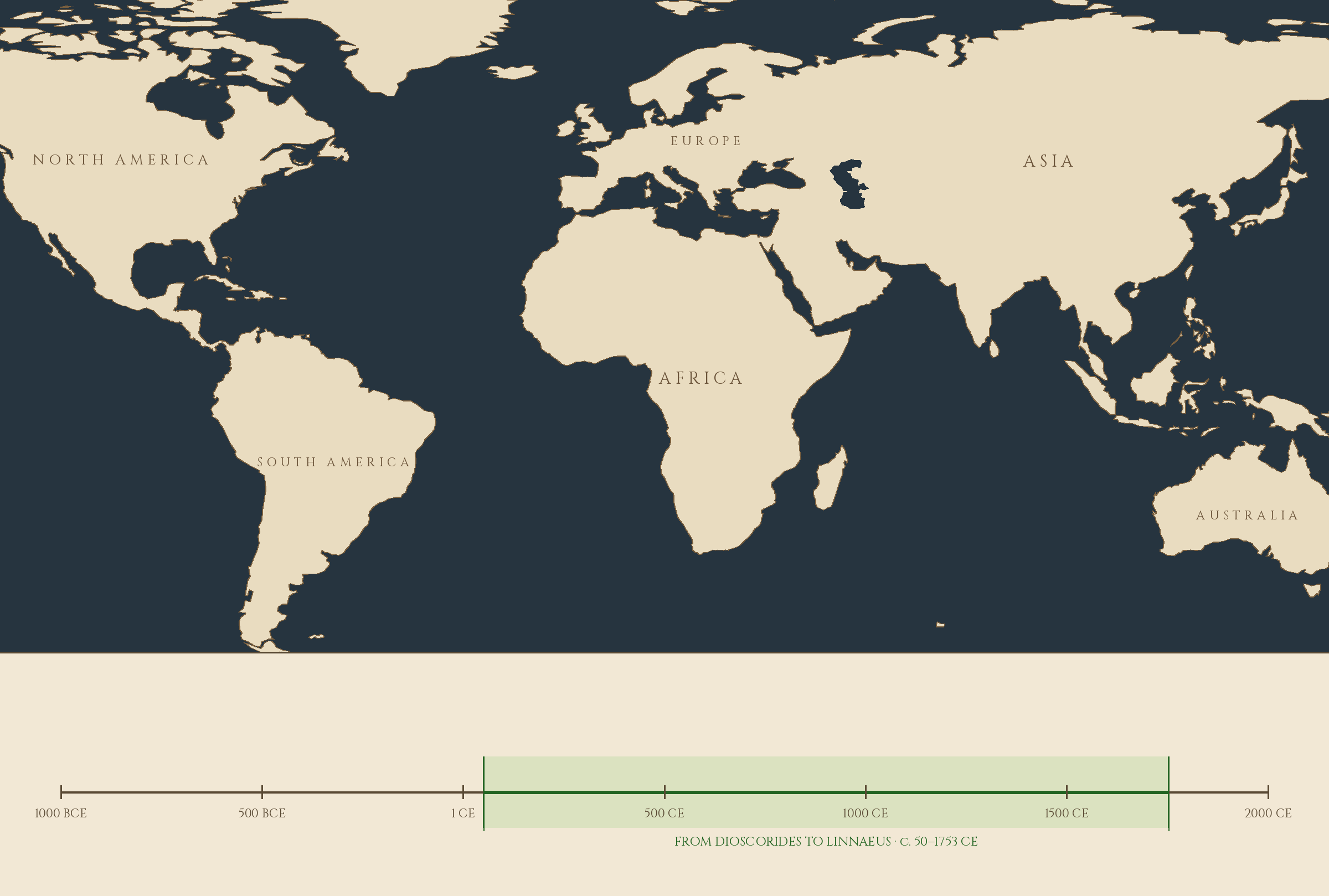
The line beneath the map is our road: every stop a place where the knowledge of plants changed, every lesson a step along it. The Defense is where the scholar shows what the walking taught.
Learning Objectives
By the end of this capstone, you will be able to:
- Assemble a complete Herbology portfolio that documents your work across all five units of the course.
- Present the journey of your Scholar's Familiar, from first choosing to final understanding, with honest evidence.
- Defend your Master Garden Plan from Lesson 37, explaining every choice with course knowledge.
- Demonstrate propagation and preservation competence through your recorded results.
- Pass the Master Herbologist Examination, drawing on the full course.
Reading this capstone: There are no ★ marks in this document, and that is honest: the Defense is not material for a later test — it is the course's final assessment itself, standing beyond the unit quizzes and the class test. Check in questions ask the ceremony's own standards back as you go; answer them in your workbook when you meet them.
Working this capstone: Your defense packet is the first download on this page. Work in it as the capstone moves along, assembling each part of the portfolio as its subject is presented — or read through for notes and assemble afterward. Both are proper ways to sit this class. Signposts in the reading tell you where each assignment belongs. Written answers are short answers in your own words; a few honest lines are worth more than a filled page.
Your Assignment Packet
This capstone's work lives in its defense packet: the Lexicon Handout (every term of the Defense, course terms marked ◆), Materials, Guided Practice (the portfolio assembly, part by part), the Assignment Manual — Assignments I–IV as the course gives them, with the Master Herbologist Examination printed in full as Assignment I — the Reflection Questions, the Workbook Checklist, and Answers & Self-Check, which carries the examination's answer key and, for the portfolio assignments, the Standard of Judgment you assess yourself against. Download the packet before you begin and keep it beside you as you read.
The Defense Ceremony
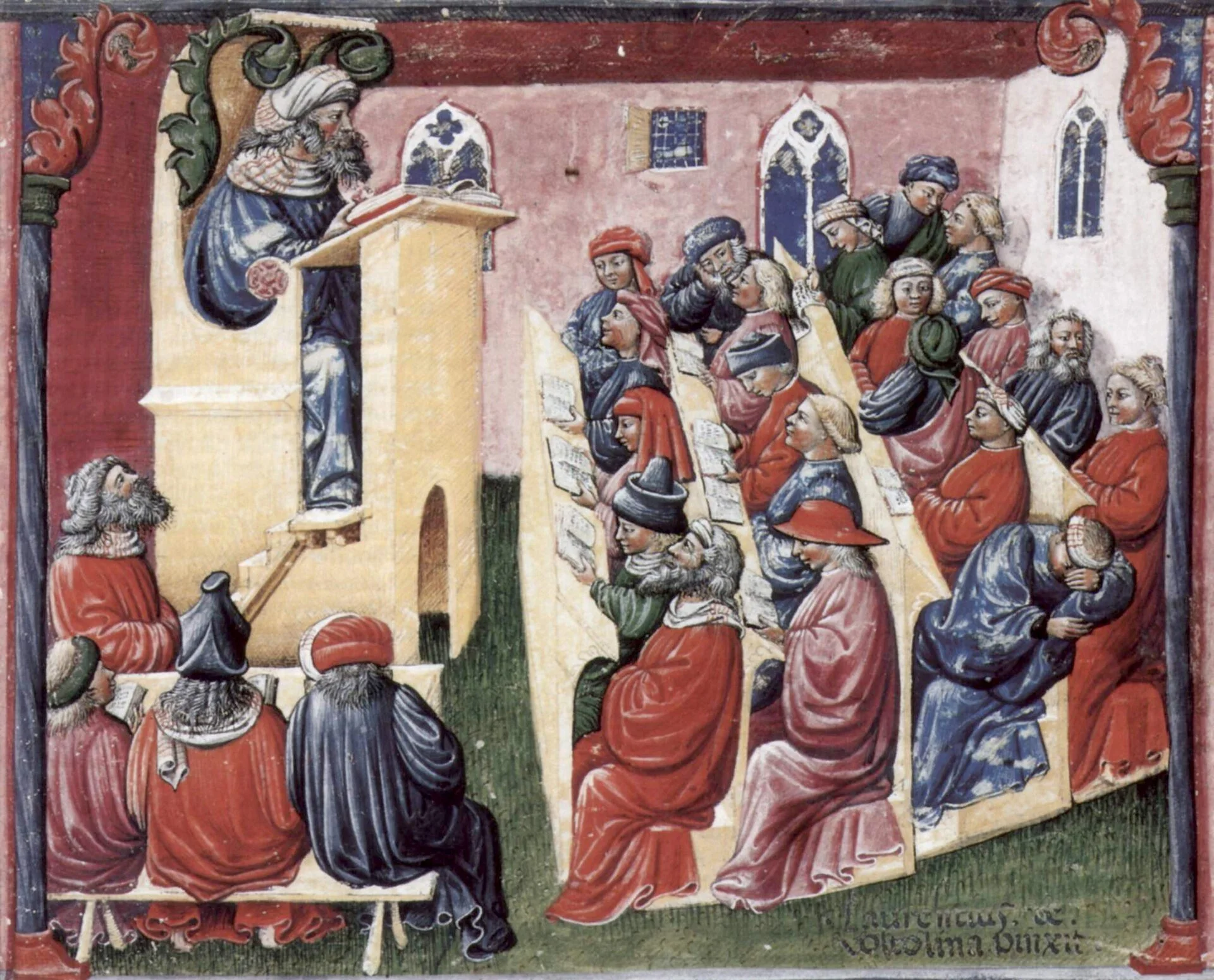
A university lecture at Bologna in the 1350s, painted by Laurentius de Voltolina: Henricus de Alemannia at his lectern, his students at their desks with their books open — attending, reading, conferring, and, in the front row, one of them honestly asleep. The old universities examined the way this room teaches: aloud, in company, with the work open in front of everyone. Your defense follows the same shape, scaled to the greenhouse.
Laurentius de Voltolina, Liber ethicorum des Henricus de Alemannia (single sheet, Min. 1233), Kupferstichkabinett, Berlin. Public domain.
A defense is not an ambush. It is a celebration with standards.
The word itself tells you what to expect. You are not defending yourself against an accusation. You are defending your work the way a gardener defends a seedling from a cold night: you stand beside it, you show that you cared for it properly, and you answer for it honestly. The old scholars called this defending a thesis, and the tradition reaches back to the medieval universities, where candidates stood before panels of learned men and women and publicly defended the claims they had written. They spoke with living voice, they answered objections, and when they were done, they were admitted to the fellowship of scholars.
Your defense follows the same shape, scaled to our greenhouse.
Check in: You are not defending yourself against an accusation. What are you defending — and how does a gardener defend a seedling from a cold night?
❦ In your workbook: record the defense ceremony in your own way — what a defense is, the old tradition it comes from, and the shape yours will follow — copy, sketch, or note what matters.
The Five Parts
You will present five things, in this order:
First, your Scholar's Familiar. Your grow journal or your field-observation profile, whichever track you followed. This is the heart of your defense, and it is presented first because it is the longest story you have to tell.
Second, your propagation results. What you grew from seed, cutting, division, or layering in Unit III. Your logs, your success rates, and your honest account of what failed.
Third, your harvest and preservation project. What you gathered and how you kept it, from Unit IV.
Fourth, your Master Garden Plan. The design you completed in Lesson 37, defended choice by choice.
Fifth, the examination. A written examination covering the whole course, completed before the defense presentation or alongside it.
❦ In your workbook: record the five parts in your own way — their order, and what each one presents — copy, sketch, or note what matters.
How It Proceeds
Lay your portfolio out in order. Speak through each part in your own words. For each claim you make, point to the evidence: the dated entry, the photograph, the pressed leaf, the seed envelope. Then answer questions. Your examiner may be a parent, a fellow student, or your own honest self with a red pen; whoever it is, they should ask you to explain your reasoning, not merely recite facts.
Scholars, a word about nerves, because I know some of you are trembling already. Nerves mean you care, and caring is the whole qualification. But a defense rewards honesty more than polish. If something failed, say so, and say what you learned. If you do not know an answer, say "I do not know, but here is how I would find out." A scholar who admits a gap is further along than one who papers over it. I would rather hear one true sentence about a dead cutting than ten pretty ones about a success you cannot prove.
— Professor Beryl Fernfoot, Herbology Greenhouse • Master Herbalist • Head of House Oriens
Check in: A defense rewards honesty more than polish. What do you say when something failed — and what do you say when you do not know an answer?
❦ In your workbook: record how the defense proceeds in your own way — the order on the table, the evidence each claim points to, and the honesty the questions reward — copy, sketch, or note what matters.
The Standard of Judgment
You pass your defense when your portfolio shows, to an honest reader:
- Completeness. All five parts are present and finished.
- Evidence. Claims rest on dated records, not memory alone.
- Understanding. You can explain the why behind your choices, using the course's language.
- Honesty. Failures are recorded and learned from, not hidden.
- Care. The work shows the stewardship this course has taught: plants handled gently, records kept faithfully, safety observed throughout.
There are no trick questions in the examination, and there is no shame in the honest "I am still learning this." The title of Master Herbologist is not a claim of knowing everything. It is a claim of knowing how to learn, how to observe, and how to care. If you can show those three things, the title is yours.
Check in: Name the five qualities an honest reader looks for in your portfolio.
❦ In your workbook: record the standard of judgment in your own way — the five qualities, and what the title of Master Herbologist actually claims — copy, sketch, or note what matters.
The Portfolio: Five Parts
Part I — The Scholar's Familiar
This is the longest arc of your course, and the center of your defense.
The grow-journal track. If you kept a Scholar's Familiar through the course, your portfolio should contain, in order:
- Your original choice, from Lesson 1: the plant you selected, why you chose it, and your baseline description (what the plant looked like on the day you began).
- Your first-weeks record: proof of the restraint Lesson 1 asked of you. No repotting, no fertilizing, no fussing, just observation. Note the dates you were tempted and what you did instead.
- Regular observation entries across the course: light, water, growth, changes. Dated. Sketched or photographed where you could.
- Your Unit II growing plan (Lesson 16): the informed reassessment where you used your new knowledge of soil, light, water, and placement to confirm or improve your Familiar's conditions.
- Your Unit III work with the Familiar: pinching, pruning, or propagation attempts, with results recorded honestly.
- Your Unit IV harvest record, if your Familiar was a plant you could harvest from.
- A final assessment: where the plant stands now, what you would do differently, and what the plant taught you that no lesson could.
The field-observation track (no-plant alternative). If you followed the no-plant path, your defense is not lesser; it is parallel. Your portfolio contains a complete Field-Observation Profile of your adopted plant: the plant you visited regularly through the course (a park tree, a neighbor's garden plant, a store display, a sidewalk weed, whatever you could return to).
A complete profile contains:
- Identity. The plant's common name and its Latin name, verified with at least two sources. If you could not determine the exact species, say so honestly and explain how close you got (genus, family) and what you would need to be certain.
- Habitat description. Where the plant grows: light, soil, shelter, neighbors, water. Written from your Unit II knowledge.
- A dated observation log. At least six weeks of regular visits, dated, with notes on condition, growth, changes, and the season's effects. Sketches or photographs where possible.
- A growing-conditions assessment. Using your Unit II knowledge, evaluate the plant's soil, light, water, and placement. Is it well placed? What would you change if it were yours to move?
- A propagation assessment. Using your Unit III knowledge, identify which propagation methods this plant could be multiplied by, and why.
- A harvest-and-preservation assessment. Using your Unit IV knowledge, describe what could responsibly be gathered from this plant and how it would be preserved. Where gathering would harm the plant or break rules (a park tree is not yours to pick), say so and explain the stewardship reasoning.
- Sources. Every identification and every claim that rests on research, cited.
The skills are identical; only the ownership differs. An examiner should not be able to tell, from the quality of the work, which track you followed.
❦ In your workbook: record Part I in your own way — your Familiar's arc from first choosing to final assessment, on whichever track you followed — copy, sketch, or note what matters.
In your packet: Assignment II — The Scholar's Familiar Portfolio ◐ (or, on the no-plant path, Assignment III — The Field-Observation Portfolio ◐) begins here. Work it now, or mark the place and take it as homework — your choice.
Part II — Propagation Results
From Unit III, present:
- Which propagation methods you attempted (seed, scarification, cutting, division, layering, or a combination).
- Your dated logs: what you did, when, and what happened.
- Your success rate, calculated honestly: how many attempts, how many successes.
- Your honest accounting: what failed, what you think caused it, and what you would change.
A student who attempted six cuttings and rooted two, and can explain why the other four failed, has learned more than a student who rooted six and cannot say why. The log is the learning.
❦ In your workbook: record Part II in your own way — the methods you attempted, your honest success rate, and what the failures taught — copy, sketch, or note what matters.
Part III — Harvest & Preservation
From Unit IV, present:
- What you harvested, when, and why that timing was right (morning, season, readiness).
- How you preserved it: drying, pressing, seed saving, or a combination.
- Your labels. Show them. A jar without a label is a mystery, not an archive.
- What you would do differently next season.
❦ In your workbook: record Part III in your own way — what you gathered, how you kept it, and the labels that make it an archive — copy, sketch, or note what matters.
Part IV — The Master Garden Plan
From Lesson 37, present your complete plan and defend it, choice by choice:
- Why these plants, in these places. Every placement should trace back to something you learned: this one needs the morning sun from Lesson 12; this one the drainage from Lesson 8; this one the pH from Lesson 9.
- Your seasonal calendar: what happens when, and why.
- Your honest constraints: space, budget, time. A plan that admits its limits is a plan that can survive them.
❦ In your workbook: record Part IV in your own way — each placement and the course knowledge it traces back to, and the constraints your plan admits — copy, sketch, or note what matters.
In your packet: Assignment IV — The Master Garden Plan ◐ begins here. Work it now, or mark the place and take it as homework — your choice.
Part V — The Examination
The written examination follows in the Assignment Manual. It covers the whole course: plant parts and care, soils and sunlight, propagation, pruning, pests, harvest, and preservation. There are no surprises in it. If you did the work, you know the answers.
❦ In your workbook: record Part V in your own way — the ground the examination covers, and where your own work has already answered it — copy, sketch, or note what matters.
In your packet: Assignment I — The Master Herbologist Examination ✎ begins here. Work it now, or mark the place and take it as homework — your choice.
A word before you assemble: the portfolio this Defense examines is drawn from the record you have kept all course long. If you kept yours in The Scholar's Familiar Journal, the printed companion to this course, your five parts are already in one binding — the choice and its date, the dated observations, the plans reassessed, the harvest recorded. Bring the journal itself if you can; it is the evidence.
The journal is printed for the school at Lulu, and listed among the Herbology books on the Bookstore Shelf.
PROFESSOR BERYL FERNFOOT
Herbology Greenhouse
Materials
Everything on this list is work you already have: the Defense asks for no new purchases and no new growing. Gather, in the professor's own words from her introduction, your journals, your records, your photographs, your pressed specimens, and your seed envelopes — and lay it all out on the table in the order of the five parts.
- Your grow journal — the dated record of your Scholar's Familiar across the course (grow-journal track, Part I). On the no-plant path, your Field-Observation Profile of your adopted plant takes its place, with the same weight.
- Your Unit II growing plan (Lesson 16) — the informed reassessment of your Familiar's soil, light, water, and placement.
- Your propagation logs from Unit III — dated logs of what you did, when, and what happened, with your success rate calculated honestly.
- Your harvest and preservation project from Unit IV — what you gathered, how you kept it, and your labels, shown.
- Your Master Garden Plan from Lesson 37 — the complete plan, defended choice by choice.
- The examination, in your defense packet — Assignment I, completed before the defense presentation or alongside it.
- A red pen, if you are your own examiner — your examiner may be a parent, a fellow student, or your own honest self with a red pen.
The Standard of Judgment governs how all of it is handled, in the source's own words: plants handled gently, records kept faithfully, safety observed throughout.
Reflection Questions
- Which of the five portfolio parts was hardest to complete honestly, and what made it hard?
- If you could repeat the course with the knowledge you have now, what would you do differently in the first month?
- What is one thing your Familiar (or adopted plant) taught you that no lesson stated directly?
- How has your definition of "a good gardener" changed since Lesson 1?
- What will you grow next, and why?
Workbook Checklist — The Defense
In my workbook I have:
- ☐ assembled my Scholar's Familiar portfolio — grow journal (Assignment II) or Field-Observation Profile (Assignment III) — from Lesson 1 baseline to final assessment
- ☐ presented my propagation results from Unit III: methods attempted, dated logs, success rate calculated honestly, failures accounted for
- ☐ presented my harvest and preservation project from Unit IV: what was gathered, how it was kept, labels shown
- ☐ defended my Master Garden Plan from Lesson 37 choice by choice, its honest constraints stated
- ☐ completed the Master Herbologist Examination, Sections A–E, from memory first, then checked against the key
- ☐ judged my whole portfolio against the Standard of Judgment: completeness, evidence, understanding, honesty, care
- ☐ for every claim in my defense, pointed to its evidence — the dated entry, the photograph, the pressed leaf, the seed envelope
☐ Defense completed Date: ___ Signature: ___
The Professor's Closing Note
My scholars,
When you chose your Familiar in the first lesson, I asked you to do the hardest thing in gardening: nothing. To watch. To wait. To let the plant be itself while you learned to see it. And now, at the end, I ask you for the same thing one more time, but larger.
Keep watching. The course is ending, but the plants are not finished with you, and you are not finished with them. Every garden you ever plant, every windowsill you ever fill, every weed you ever pause to identify on a walk, is a continuation of what you began here.
You came to this greenhouse as students. You leave it as Master Herbologists: not because you know everything, but because you know how to look, how to learn, and how to care. Chosen with love. Properly housed with knowledge. That was always the whole of it.
The greenhouse door is always open to you. Come back and tell me what grows.
With all my heart,
— Professor Beryl Fernfoot, Herbology Greenhouse • Master Herbalist • Head of House Oriens
Further Reading & Sources
- Examining the doctoral viva — London Review of Education — the viva voce tradition: "live talk," the defense as rite of passage.
- From Licentia Docendi to Doctorate — on the medieval disputation tradition — candidates defending theses before panels of scholars in the old universities.
- Kew Herbarium — Wikipedia — one of the world's largest herbaria; what a lifetime of pressed specimens looks like.
- Seed Saving Guide — Seed Savers Exchange (PDF) — the living tradition of seed stewardship, crop by crop.
- Seed Saving Basics — Penn State Extension — beginner-friendly guidance on choosing plants and harvesting seed.
Browse the Herbology shelf in the school Library for readable editions of these works.
End of The Master Herbologist Defense.
Submit your work for this lesson using the form below.
THE CLASS TEST
HERBOLOGY GREENHOUSE · ALL FIVE UNITS · LESSONS 1–37
The lessons are done, all thirty-seven of them, and the scholar who chose a single plant in Lesson 1 now stands at the Defense with a full journal and a garden's worth of knowledge. This test covers the whole of the Herbology Greenhouse, and it measures retention: not what you can look up, but what has stayed with you now that the class is complete. Take it from memory, in one sitting if you can, before you consult your notes, and attempt every part before you turn to the answer key at the back of the packet.
This is not the Master Herbologist Examination inside your defense packet. That one belongs to the Defense itself, and you sit it as part of your portfolio. This class test is the course remembered whole. The test packet is a single download. Its parts move from questions drawn across every unit, through the vocabulary of the whole course, to short written answers and applied questions. When you have finished, score it honestly, note the result in your workbook, and let any question that went wrong point you back to the lesson worth rereading. Then the class is complete, and the craft is yours.
CONTINUE IN THE HERBOLOGY GREENHOUSE
← Previous · Lesson 37: The Master Herbologist's Garden Design
Unit V — The Master Herbologist's Craft Herbology Greenhouse — All 37 Lessons
The rest of Unit V: Lesson 33 · Toxic Plants & Safety · Lesson 34 · Companion Planting · Lesson 35 · Foraging Ethics · Lesson 36 · Materia Botanica · Lesson 37 · Garden Design · The Master Herbologist Defense
From the Greenhouse Shelf
The printed companions to the Master Herbologist Defense, from Professor Fernfoot’s shelf in the shop.

Herbology — Familiar Journal Pages: Unit V & Defense Pages — Lessons 33–37 (15 Pages)
$4.99
View in the Shop