
HERBOLOGY
Unit V · Lesson 36THE MATERIA BOTANICA: BUILDING YOUR HERBAL
PROFESSOR BERYL FERNFOOT
Herbology Greenhouse
Master Herbalist
Herbology Greenhouse • Unit V: The Master Herbologist's Craft • Lesson 36
Professor's Introduction

Hello, my gardeners,
You have learned to sow, to feed, to water, to prune, to harvest, and to keep. You have raised plants from seed and from cuttings, read the weather in a leaf, and carried a harvest safely into storage. Now we come to the work that holds all the rest together: writing it down so that none of it is lost.
Every gardener who ever lived faced the same problem you face. Knowledge about plants is too precious to trust to memory alone, and too alive to fit in a single head. So gardeners have always written herbals: books that gather everything known about each plant into one place, where the next gardener can find it.
Our school keeps such a book. It is called the Materia Botanica, and it belongs to two classes at once. This lesson will teach you what it is, why it is shared, and how to write in it. By the end, you will have drafted your first entry, and the archive will be one plant richer for your work.
Take up your pen, scholars. The library is waiting.
— Professor Beryl Fernfoot, Herbology Greenhouse • Master Herbalist • Head of House Oriens
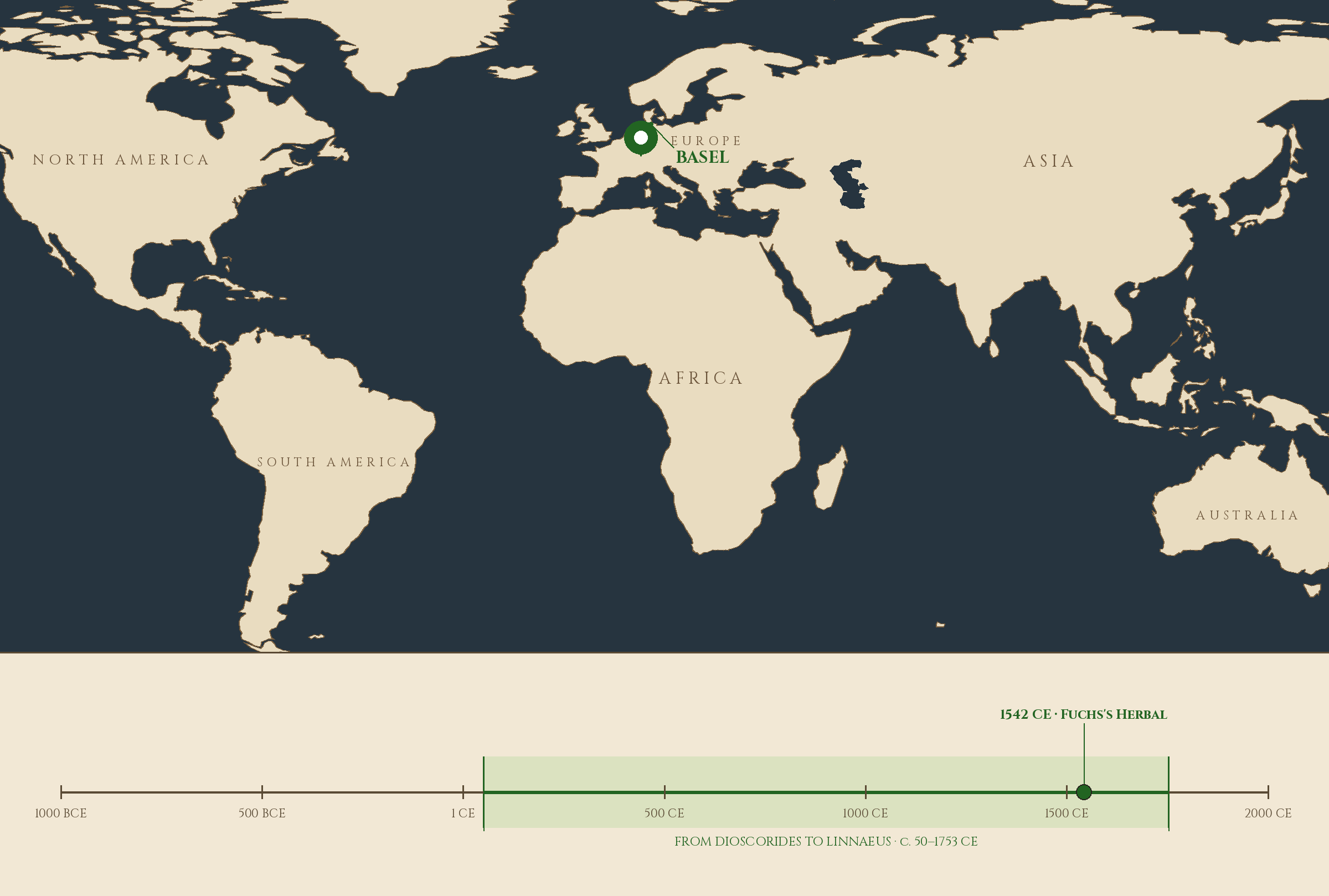
Where and when: Basel, 1542 CE — Fuchs's Herbal. The pin is this lesson. The line beneath the map is our road: every stop a place where the knowledge of plants changed, every lesson a step along it.
Lesson Objectives
By the end of this lesson, you will be able to:
- Explain what a materia botanica is and how the great herbals of history served the same purpose.
- Describe why Evershade keeps ONE shared Materia Botanica for both Herbology and Potions, rather than one per class.
- Name and explain the purpose of all eight fields in a standard materia entry.
- Draft a complete entry for a plant you have grown or observed, using your own records.
- Write an honest Cautions field, distinguishing what history records from what is safe to recommend.
- Maintain your entries as a living document, dating every revision.
Reading this lesson: ★ marks the passages to remember. They return on the unit quiz and the class test. Check in questions ask the material back as you go; answer them in your workbook when you meet them.
Working this lesson: Your assignment packet is the first download on this page. Work in it as the lesson moves along, answering each assignment as its subject is taught — or read the lesson through for your notes and take the assignments as homework afterward. Both are proper ways to sit this class. Signposts in the reading tell you where each assignment belongs. Written answers are short answers in your own words; a few honest lines are worth more than a filled page.
Your Assignment Packet
This lesson's assignments live in its packet: the Lexicon Handout (every term, course terms marked ◆), Materials, Guided Practice, the Assignment Manual with its answer key for self-checking, the Reflection Questions, and the Workbook Checklist. Download the packet before you begin and keep it beside you as you read.
A Very Old Idea
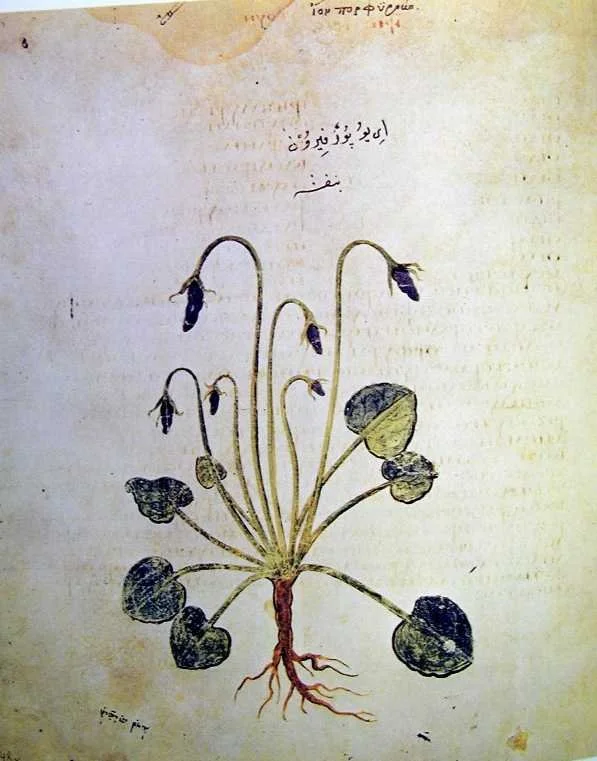
A page of the Vienna Dioscorides (folio 148v, Constantinople, 6th century): the violet, painted whole — root, leaves, and buds — in the illustrated copy of Dioscorides' De Materia Medica that served as a hospital text for over a thousand years. Look above the painting: a later reader has written the plant's name in Arabic. The herbal was always a conversation, never a finished monument.
Violet page of the Vienna Dioscorides (Codex Vindobonensis med. gr. 1, Austrian National Library, Vienna), 6th century. Public domain.
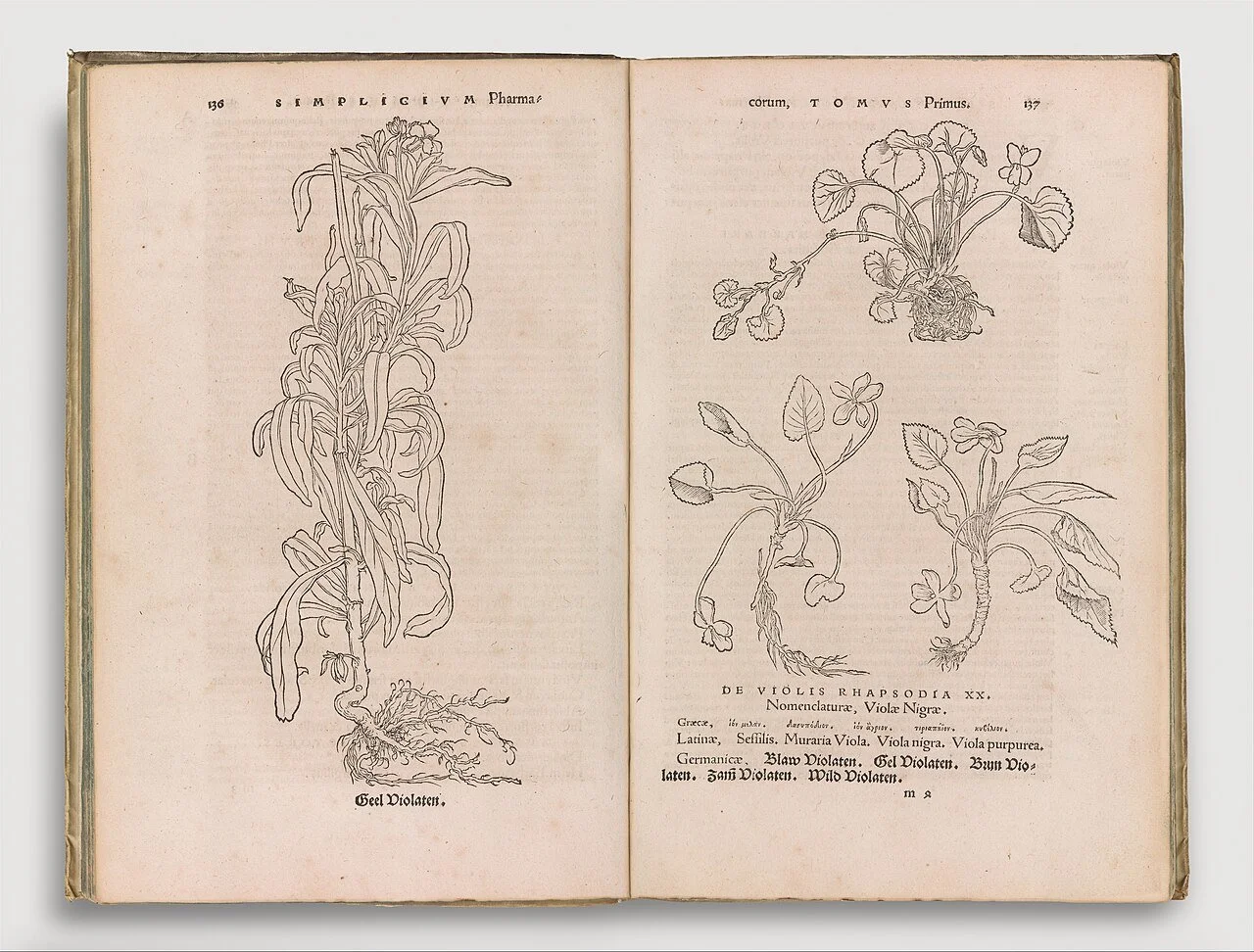
Brunfels's Herbarum vivae eicones (1530) open at the violets: Weiditz's woodcuts drawn from living plants, and beneath them the plant's names set out in Greek, Latin, and German. An entry's Name field does the same work today — every name the plant carries, recorded, because names vary by region and century.
Otto Brunfels, Herbarum vivae eicones (Strasbourg, 1530), woodcuts by Hans Weiditz the Younger; the Metropolitan Museum of Art, Gift of Mortimer L. Schiff, 1918 (18.57.6). CC0.
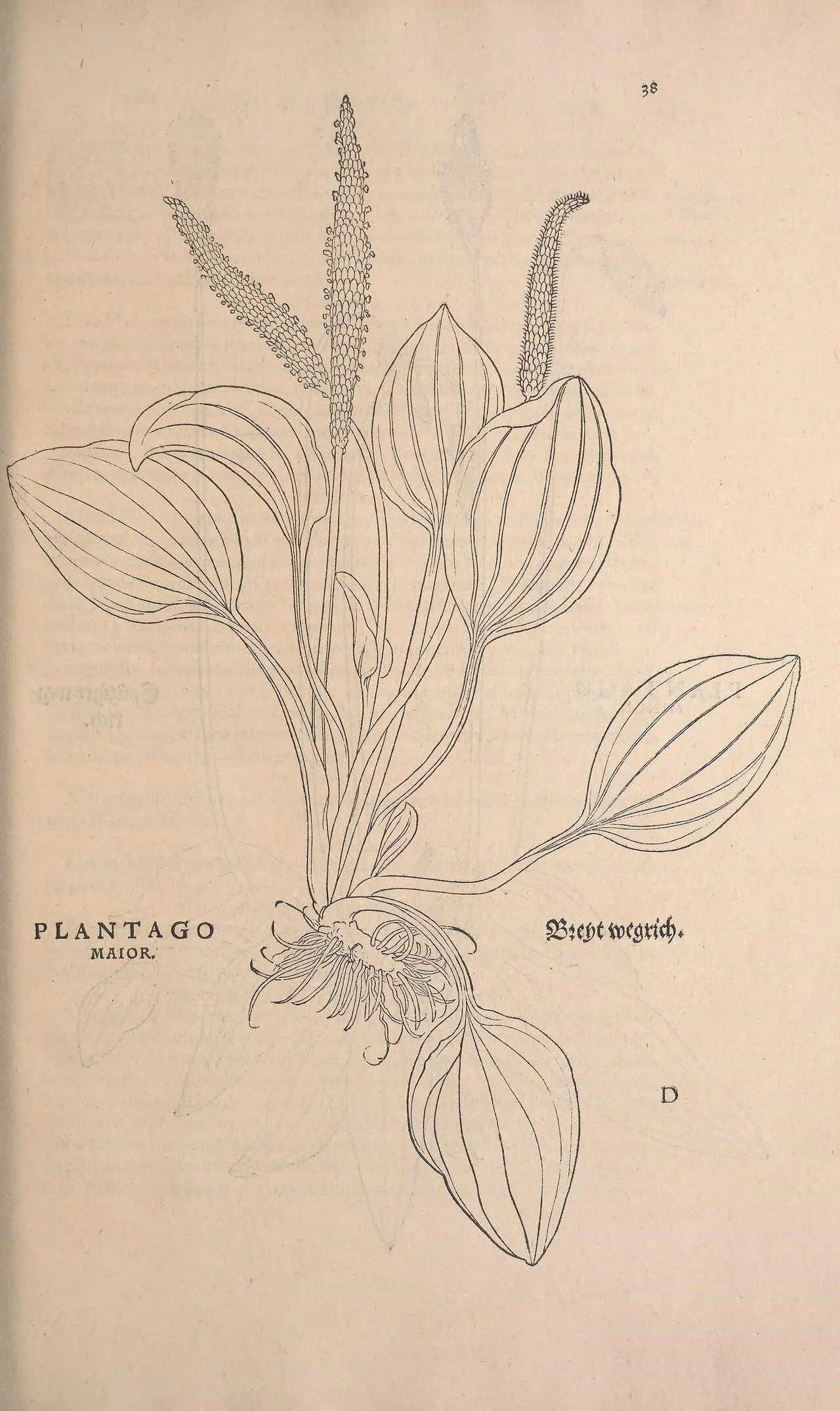
A page of Fuchs's De historia stirpium (Basel, 1542): greater plantain drawn from life at full page — leaves, seed spikes, and root — with its Latin name and its German name on the same page. Fuchs's herbal carried more than 500 such woodcuts and went through 39 printings in five languages in his lifetime.
Leonhart Fuchs, De historia stirpium commentarii insignes (Basel, 1542), p. 38; drawn by Albrecht Meyer, transferred by Heinrich Füllmaurer, cut by Veit Rudolph Speckle; scan via the Biodiversity Heritage Library. Public domain.
Long before there were schools of herbology, there were herbals: books describing plants, usually with notes on identification, growing conditions, and historical uses. You met the word itself in Lesson 5. The tradition is one of the oldest kinds of science writing in the world, and it began with a Greek physician in the Roman army.
★ Pedanius Dioscorides traveled with the legions and used his journeys to observe plants wherever he went. Between about 50 and 70 CE he gathered what he had learned into five volumes called De Materia Medica, "On Medical Material," written in Greek though we know it by its Latin title. The work describes around 600 plants and roughly a thousand preparations made from them, each entry giving recognition details, properties, and cautionary notes. It is, frankly, the ancestor of the very lesson you are reading now.
Check in: Who wrote De Materia Medica, when, and how many plants does it describe?
What happened next is remarkable. De Materia Medica never left circulation. It was copied by hand in Greek, Latin, and Arabic through the entire medieval period, and it was still being used as a working reference more than 1,500 years after it was written, making it one of the longest-lasting science books in history. The Vienna Dioscurides, an illustrated manuscript made in 6th-century Constantinople, served as a hospital text in that city for over a thousand years. Monks and physicians across Europe and the Islamic world kept the book alive by copying it, illustrating it, and adding their own observations in the margins. Those margins are worth remembering: the herbal was always a conversation, never a finished monument.
In the Middle Ages, the herbal tradition moved into the monastery gardens. Monks and nuns cultivated herbs, copied herbals, and wrote their own. Hildegard of Bingen, whom you met in Lesson 5, cataloged 230 plants in her Physica between 1151 and 1158. Every entry in these books carried the same hope: that the next person who needed the knowledge would find it waiting.
Then came printing, and the herbal changed shape. In 1530, the German physician Otto Brunfels published Herbarum vivae eicones, "Living Images of Plants," with woodcuts by the artist Hans Weiditz drawn directly from living specimens rather than copied from older books. It is often called the first modern herbal. Twelve years later, Leonhart Fuchs published De historia stirpium, "Notable Commentaries on the History of Plants," in Basel: nearly 500 plants, more than 500 woodcuts drawn from life by three named artists, many species described for the first time. During Fuchs's lifetime the book went through 39 printings in five languages. The printed herbal carried plant knowledge to people who would never own a manuscript, and the illustrations, drawn from life, let a reader match a name to a living plant with new confidence.
Check in: What made the woodcuts in Brunfels's and Fuchs's herbals different from the pictures in older books — and what did printing change about who could own an herbal?
This is your inheritance, scholars. The herbal tradition says: learn the plant, write down what you learned, and leave the page better than you found it. Our Materia Botanica is Evershade's chapter in a story two thousand years old.
❦ In your workbook: record the herbal's long story in your own way — Dioscorides and his 1,500 years, the margins that kept the conversation going, and the printed herbals drawn from life — copy, sketch, or note what matters.
You may feel a small flutter at the thought of adding your own words to such a lineage. Good. That flutter is respect, and respect is the correct attitude toward both plants and the people who studied them before you. But do not let it frighten your pen. Dioscorides began with observation, Brunfels with a walk through the fields, Fuchs with a garden behind his house. Every herbal in history began with one person looking closely at one plant. You have been doing exactly that all year.
— Professor Beryl Fernfoot, Herbology Greenhouse • Master Herbalist • Head of House Oriens
What Our Materia Botanica Is
The Evershade Materia Botanica is one shared reference work that collects everything our two plant classes learn about the same plants. Herbology contributes the growing knowledge: identification, cultivation, soil, water, light, propagation, harvest. Potions contributes the preparation knowledge: how the harvested material is inspected, prepared, and transformed in the laboratory. One plant, one entry, both kinds of knowledge side by side.
It lives outside the lesson flow of either class. Lessons point to it and contribute to it, but it is not a chapter inside Herbology or inside Potions. It stands on its own, the way a library stands apart from the classrooms it serves.
★ Why one book and not two? Because the plant is one thing. A gardener who knows how mint grows but not how its harvest is judged has half the picture. An apothecary who knows how to prepare mint but not how it was grown is working blind. In the real world, the grower and the preparer were often the same person: the monastery gardener dried what the infirmarian used; the village herbalist gathered what she prepared. Splitting the knowledge into two books would teach you to see half a plant. We would rather teach you to see the whole.
Check in: Give both reasons for one shared book — the plant itself, and the practical one that follows it.
There is a second reason, and it is practical. Every plant you study in Herbology will meet you again in Potions, and every preparation you learn in Potions began as a living plant somebody grew. One shared book means your growing notes from this class sit beside your preparation notes from the laboratory, and each makes the other more useful. The mint you coaxed through damping off in Unit III is the same mint whose dried leaves you will learn to judge in the Potions laboratory. The entry holds both stories.
A word about timing, so there is no confusion. The completed reference book, with entries for every plant in both classes, will be assembled after the Potions lessons are finished, because only then will the full plant list be known. What you are building now, in this lesson and the ones around it, are your own entries: the first pages of your personal herbal. Blank template pages, matching the reference layout with a wide inner margin for binding, will be provided for you to fill in and eventually bind into your own book. That binding project belongs to Creative Arts, and it is something to look forward to.
❦ In your workbook: record what our Materia Botanica is in your own way — one plant, one entry, both kinds of knowledge, and a book that stands on its own like a library — copy, sketch, or note what matters.
The school's Materia Botanica has a home of its own, and this lesson's work begins there. On its page you will find the full index of its 202 plants and the book itself in the school shop. The blank entry templates this lesson writes on are free to download — print as many as your herbal needs.
PROFESSOR BERYL FERNFOOT
Herbology Greenhouse
The Anatomy of an Entry
Every entry in the Materia Botanica follows the same eight fields. The format is fixed so that any reader can find any kind of information in the same place, in every entry, whether the entry was written by you, by a classmate, or by Professor Muddlenook himself. Here are the fields, and what belongs in each.
1. Name. The common name or names, followed by the binomial, the two-part Latin name you learned in Lesson 5. If the plant has several common names, list them; common names vary by region and century, and recording them is part of the work.
2. Family. The plant family, which you also learned to find in Lesson 5. Families group plants with shared structure, and they are often the fastest route to understanding a new plant.
3. Description. What the plant looks like, from your own observation. Use the vocabulary you built across this course: leaf shape and arrangement, stem character, growth habit, flowers and fruit when present. This is the Botanical Profile skill from your Unit I threshold, condensed into its essentials.
4. Growing Notes. How the plant grows. Soil preference, light needs, water habits, propagation methods that worked for you, companions and competitors, problems you observed and how you answered them. This is the Herbology half of the entry, and it should read like advice from someone who has actually grown the thing, because it is.
5. Harvest Notes. When and how to gather. What part is gathered, at what stage, at what time of day and season, and how much may be taken without harming the plant. Your Unit IV studies live here.
6. Preparation Notes. What happens after harvest: drying, storing, and how the material is judged ready for use. This is where the Potions half begins. The laboratory transformations themselves belong to Potions lessons; here you record the condition of the material as it leaves the grower's hands.
★ 7. Historical Uses. What history records people doing with this plant, with sources. This field is a record, not a recommendation. Write what the sources say, cite them, and let the past speak for itself. You will never find a dosage or a direction for use in this field, in any entry, in this school.
★ 8. Cautions. Everything a reader must know to stay safe: toxic look-alikes, skin irritants, which parts are unsafe, who should exercise particular care, and storage warnings. When in doubt, write more here, not less. An entry with an empty Cautions field is an unfinished entry, unless the plant is genuinely benign and you have verified that claim.
Check in: Name all eight fields in order — and say which two fields carry the lesson's safety discipline, and how.
❦ In your workbook: record the anatomy of an entry in your own way — the eight fields in their fixed order, and what belongs in each — copy, sketch, or note what matters.
In your packet: Exercise II — The Honest Cautions ✎ begins here. Work it now, or mark the place and take it as homework — your choice.
A Worked Example: Spearmint
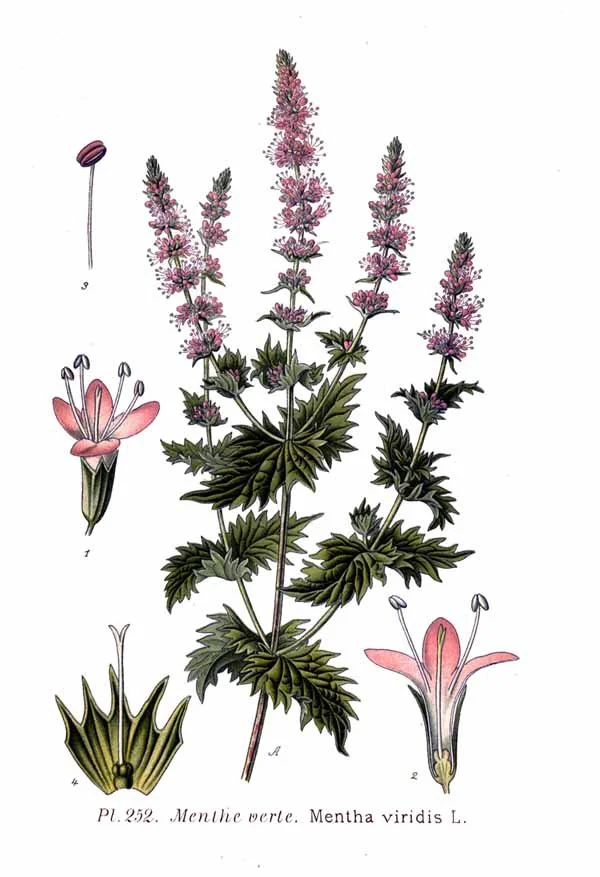
Spearmint, the worked example's plant, drawn whole with its flower parts enlarged beside it: serrated opposite leaves and dense spikes of pale lilac flowers, as the entry describes. The plate letters it Mentha viridis L. — the older name for Mentha spicata, and itself a small lesson in why an entry records every name a plant has carried.
Amédée Masclef, Atlas des plantes de France (1891), plate 252. Public domain.
Here is a complete entry for a plant you know well, written exactly as yours should be. Read it once through, then read it again with the eight fields in mind.
Name. Spearmint. Mentha spicata. Also called garden mint and common mint in older books.
Family. Lamiaceae, the mint family. You can confirm the family in the field: square stems, opposite leaves, and that unmistakable scent when a leaf is crushed.
Description. A perennial herb growing one to two feet tall, spreading vigorously by underground runners. Stems square in cross-section. Leaves opposite, lance-shaped with serrated edges, bright green, strongly aromatic. Small pale lilac flowers in dense spikes in summer. If you have grown mint, you have seen all of this; if you have only met it in a garden bed, you have still seen enough to begin.
Growing Notes. Forgiving and vigorous, which is why it was one of your first-week choices in Lesson 1. Prefers moist, reasonably rich soil and tolerates part shade to full sun. Spreads aggressively by the runners you studied in Lesson 21; grow in a pot or a buried bottomless container unless you want a mint lawn. Propagates readily from stem cuttings (Lesson 19) and root division (Lesson 20). Seldom troubled by pests; check for the usual suspects from Lesson 24.
Harvest Notes. Gather leafy stems as needed through the growing season, cutting just above a leaf pair so the plant branches. Take no more than a third of the plant at once. See Lesson 27 for the full teaching on harvest timing.
Preparation Notes. Dries well by the hang-drying method from Lesson 28; strip the crisp leaves from the stems and store in a labeled, dated jar away from light. Fresh sprigs keep several days standing in water in the refrigerator.
Historical Uses. Mint of one kind or another has flavored food and scented rooms since ancient times. It is native to the Mediterranean region and spread widely through trade. The Roman writer Pliny recorded that Greeks and Romans flavored sauces and wines with mint and dressed their tables with sprays of it. In medieval England, mint was grown in monastery and manor gardens; an English gardening book written before 1440 already lists it among familiar plants.
Cautions. Confirm identification before tasting any mint-like plant; several unrelated plants share the scent. Wash all gathered material. Pennyroyal, a related mint, is unsafe and must never be confused with culinary mints; know your species. Stored dried mint must be labeled and dated, and kept where small children will not mistake it for something else.
Notice what the entry does not do. It recommends no remedy, prescribes no dose, and promises no effect. It tells you what the plant is, how it grows, how it was gathered, what history says, and what to watch for. That is the whole of the work, and it is enough.
Check in: In the spearmint entry, which field carries the pennyroyal warning — and what three things does the whole entry refuse to do?
❦ In your workbook: record the worked example in your own way — how each of the eight fields sounds when a real plant fills it, and the three refusals that close it — copy, sketch, or note what matters.
How to Write Your First Entry
Choose a plant you have grown or observed closely. Your Scholar's Familiar is the natural choice; you have a year of records to draw on. If you are on the adopted-plant path, choose the plant you know best.
Then work through the fields in order.
Gather your records first. Open your grow ledger, your observation journal, your propagation logs. The Growing Notes field is written from these, not from memory. If you recorded that your plant wilted every third afternoon until you moved it, that belongs in the entry. Real records make real herbals.
Describe from the plant, not from a book. Sit with the specimen for the Description field. Measure a leaf. Note the stem. The books can confirm what you see, but the entry begins with your eyes.
Research one historical fact properly. For Historical Uses, find one verifiable fact with a real source: a named author, a named book, a date. One solid fact with a source outweighs a page of vague tradition. The Further Reading section below will show you the kind of sources that count.
Write the Cautions field last, and write it honestly. Look up the plant's toxic look-alikes. Note skin irritants. If you cannot verify a caution, write what you do know and mark what you still need to confirm. An honest "not yet verified" is worth more than a confident guess.
Leave blank what you do not know. A blank field is not a failure. It is a promise to your future self, and every herbal in history has them. Date your entry, and when you fill a blank later, date the revision too.
Check in: Put the working order in sequence: where do the Growing Notes come from, where does the Description begin, and which field is written last — and why?
❦ In your workbook: record how to write your first entry in your own way — records first, eyes before books, one sourced fact, cautions last and honest — copy, sketch, or note what matters.
In your packet: Exercise I — Your First Entry ✎ begins here. Work it now, or mark the place and take it as homework — your choice.
The Living Document
A materia botanica is not finished when you write it. It is finished never, which is its virtue.
★ Plants will teach you new things after the entry is written: a propagation method that failed, a pest you had not met, a harvest that came two weeks early. When that happens, revise the entry. Add the new knowledge, keep the old, and write the date beside the change. Dated revisions are how a personal observation becomes a trustworthy record.
Cross-reference as you go. When your mint entry mentions the runners of Lesson 21 or the drying of Lesson 28, note it. When a Potions lesson teaches you something new about a plant you have already entered, add it to the Preparation Notes with the date. The entry grows as you grow.
Your entries are yours. The blank template pages will match the completed reference layout, with a wide inner margin so the pages can be bound. When the Creative Arts bookbinding project arrives, your filled pages will become your own herbal: a book no one else in the world owns, because no one else grew your plants and wrote your observations. Kali's completed reference, when it is published after the Potions course is done, will be the model on your shelf, not the book you write in. Yours is the one with your handwriting in it.
Check in: When a plant teaches you something new after its entry is written, what exactly do you do — and what do you write beside the change?
❦ In your workbook: record the living document in your own way — revise, keep the old, date the change, and cross-reference as you go — copy, sketch, or note what matters.
In your packet: Exercise III — Design Your Template Page ⚒ begins here. Work it now, or mark the place and take it as homework — your choice.
Safety Notes
- The Historical Uses field records what history says. It never recommends, prescribes, or suggests that the reader try anything. No dosages appear in any entry, ever.
- The Cautions field is mandatory. If you cannot verify the safety information for a plant, write "not yet verified" and keep researching. Never guess.
- Confirm a plant's identity with certainty before tasting any part of it. Wash all gathered plant material.
- Keep all dried and stored plant material labeled with the plant name and the date, stored out of reach of small children.
- Younger students should do historical research with an adult's help in choosing reliable sources.
Check in: A caution you cannot verify goes into the entry in what exact words — and what must you never do instead?
❦ In your workbook: record the safety notes in your own way — a record, never a recommendation; no dosages, ever; "not yet verified," never a guess — copy, sketch, or note what matters.
Guided Observation: Reading Your Records Before You Write
This lesson's observation is the herbalist's desk work, done before the pen touches the entry page: a close reading of your own year's records and of the living plant itself, so that the entry you draft is written from evidence — because an entry written from memory alone is the one failure this lesson exists to prevent.
You will need:
- your grow ledger, your observation journal, and your propagation logs from this year
- the living plant you will enter (your Scholar's Familiar, or your adopted plant)
- a ruler, for measuring a leaf
- a pencil
Gather your records first. Open your grow ledger, your observation journal, your propagation logs. Read them the way you would read a source: looking for what actually happened. If you recorded that your plant wilted every third afternoon until you moved it, that belongs in the entry. Real records make real herbals.
Describe from the plant, not from a book. Sit with the specimen. Measure a leaf. Note the stem — its shape in cross-section, the arrangement of the leaves along it. The books can confirm what you see, but the entry begins with your eyes.
Test the entry against its example. Lay your gathered notes beside the spearmint entry in this lesson and ask, field by field: have I got this kind of information for my plant? Where the answer is no, you have found your blank fields — honestly, and before you write a word.
Mark the blanks before you fill anything. List every field, or part of a field, you cannot yet verify. Those blanks are promises to your future self, and every herbal in history has them. The Cautions gaps go on the list in the entry's own words: "not yet verified."
Consider:
- What did your records tell you that your memory alone would have lost?
- What did measuring the living plant show that a book description could not?
- Which of your fields will stand blank today — and why is that a promise, not a failure?
No-plant alternative: work the same reading on your adopted plant — the park tree, garden bed, or store display you have been observing all year — from your observation journal. The skills are identical; only the ownership differs.
Workbook path: if the plant itself is not within reach this week, work the records half in full — read the ledger, journal, and logs, test them field by field against the spearmint example, and list the blanks. The sitting-with-the-plant half waits for the plant; the entry begins with your eyes, and your eyes will have their turn.
Materials
Required (Level One — household items)
- Your course records: grow ledger, observation journal, and propagation logs from this year. The Growing Notes field is written from these, not from memory.
- The living plant: your Scholar's Familiar, or your adopted plant, for the Description field. A ruler for measuring leaves.
- Paper and pen: for drafting your entry and designing your template page. A straightedge helps with the layout.
- Library or internet access: for researching one verifiable historical fact with a real source.
Suggested (Level Two — historically closer)
- Bound blank book: a proper journal for your herbal entries, the way the old herbalists kept theirs.
- Press and mounting paper: a pressed specimen to accompany the entry, in the herbarium tradition.
Safety notes: The Historical Uses field records what history says. It never recommends, prescribes, or suggests that the reader try anything. No dosages appear in any entry, ever. The Cautions field is mandatory. If you cannot verify the safety information for a plant, write "not yet verified" and keep researching. Never guess. Confirm a plant's identity with certainty before tasting any part of it. Wash all gathered plant material. Keep all dried and stored plant material labeled with the plant name and the date, stored out of reach of small children. Younger students should do historical research with an adult's help in choosing reliable sources.
Reflection Questions
Answer the following questions in your workbook.
- Why does Evershade keep one shared Materia Botanica instead of a separate herbal for each class?
- The Historical Uses field records what history says but never recommends anything. Why is this distinction essential?
- What is the difference between a blank field marked "not yet verified" and a guessed answer, and why does it matter?
- How do dated revisions turn personal observation into a trustworthy record?
- Dioscorides' herbal stayed in use for over 1,500 years partly because readers added their own observations in the margins. What does that tell you about who an herbal is really for?
Workbook Checklist — Lesson 36
In my workbook I have:
- ☐ explained what a materia botanica is and how the great herbals of history served the same purpose
- ☐ described why Evershade keeps ONE shared Materia Botanica for Herbology and Potions — the plant is one thing, and each class's notes make the other's more useful
- ☐ named all eight fields of a materia entry and what belongs in each
- ☐ drafted a complete entry for a plant I have grown or observed, from my own records, and dated it
- ☐ written an honest Cautions field — history recorded as history, nothing recommended, "not yet verified" where I could not verify
- ☐ kept my entry as a living document — revisions dated, blanks left honest, cross-references noted
☐ Lesson completed Date: ___ Signature: ___
The Professor's Closing Note
You came to this lesson as students, scholars. You will leave it as authors. Somewhere in the school's archive, a thousand years from now in spirit if not in fact, a future gardener will open a materia botanica and find an entry in your hand. Write it as if that gardener is real, because the habit of writing for the future is what turns a gardener into a herbalist.
I am proud of every page you have filled this year, and I am proudest of the ones you are about to write.
— Professor Beryl Fernfoot, Herbology Greenhouse • Master Herbalist • Head of House Oriens
Cross-Class Connections

Potions · Unit II, Lesson 17 — Consolidating the Potions Journal
In good order, scholars. Your greenhouse entries are half of this book; my laboratory keeps the other half, and in this lesson we consolidate it: every entry reviewed, every classification repaired, every specimen indexed so it can be found in under a minute, and a stewardship plan written for the archive's future. Professor Fernfoot teaches you to write the growing half honestly. Bring that honesty to my benches, and we will make the whole archive worthy of its shelves. — Muddlenook.

Creative Arts · Unit II, Lesson 11 — Case Binding & Archival Boxes
Cases are not hurried, scholars, and neither is a herbal meant to outlive its maker. The template pages you rule in the Greenhouse — wide inner margin and all — are a text block waiting for its case. In my workshop you will learn to case such a book to measure and to build the archival box in which a great plant record rests against the centuries it is meant to inform. The school's Materia Botanica will one day rest in a box built by these rules. Bring your filled pages when they have grown into a book, and we will house them properly.

Scrollwork · Unit VI, Lesson 23 — Archive Labels & Library Systems
You have written the entries. Now the question that decides whether any of it mattered: when a gardener comes looking for your plant a century from now, will they find it? In my library we take up the label, the list, and the shelfmark — the humblest writing in the building, and the most load-bearing. A reference book that cannot be found is a book that does not exist. Come and learn how the medieval librarians made their memory hold, and give your herbal the system it deserves. — Nocturne.
Further Reading & Sources
- De materia medica — Wikipedia — the five-volume work, its 1,500-year working life, and the Vienna Dioscurides manuscript.
- De historia stirpium commentarii insignes — Wikipedia — Fuchs's 1542 printed herbal: nearly 500 plants, 500+ woodcuts drawn from life.
- Otto Brunfels — Wikipedia — the Herbarum vivae eicones of 1530 and Weiditz's woodcuts drawn from living specimens.
- Otto Brunfels — King's College London, Special Collections — the herbal tradition and Brunfels's place in it, with a hand-coloured mint woodcut.
- Mint — Ohio State, Middle East Studies Center — the genus Mentha: ancient use, Mediterranean origins, and spread through trade.
- Mint History — Our Herb Garden — folklore and recorded history of mint, including classical references.
Browse the Herbology shelf in the school Library for readable editions of these works.
End of Lesson 36.
One plant from this lesson stands in the Materia Botanica, the school's shared archive — kept with its lessons, its keepings, and its cautions.
Pennyroyal The whole Materia BotanicaPROFESSOR BERYL FERNFOOT · HERBOLOGY GREENHOUSE
Submit your work for this lesson using the form below.
CONTINUE IN THE HERBOLOGY GREENHOUSE
← Previous · Lesson 35: Foraging Ethics & Wildcrafting Next · Lesson 37: The Master Herbologist's Garden Design →
Unit V — The Master Herbologist's Craft Herbology Greenhouse — All 37 Lessons
The rest of Unit V: Lesson 33 · Toxic Plants & Safety · Lesson 34 · Companion Planting · Lesson 35 · Foraging Ethics · Lesson 37 · Garden Design · The Master Herbologist Defense