

HERBOLOGY
Unit V · Lesson 33TOXIC PLANTS & GARDEN SAFETY
PROFESSOR BERYL FERNFOOT
Herbology Greenhouse
Master Herbalist
UNIT V • LESSON 33
The Master Herbologist's Craft
IMPORTANT SAFETY NOTICE: This lesson teaches you to recognize dangerous plants and what to do if someone is exposed. It is for identification and prevention only. If you believe someone has eaten part of a toxic plant, call Poison Control at 1-800-222-1222 (United States, 24 hours, free) or your local emergency number immediately. Do not wait for symptoms. Do not try to treat poisoning yourself.
Professor's Introduction

Gently does it, gardeners,
We have spent thirty-two lessons learning to love plants, and that love has not changed. But love without respect is incomplete, and today we complete it. Some plants can hurt you. Not because they are evil. They are not. They are simply defended, the way a hedgehog is defended, and a wise gardener learns which defenses to admire from a distance.
This is the most important lesson in Unit V, and I want you to read it slowly. You will learn the faces of the most dangerous plants a gardener is likely to meet. You will learn what to do if someone you love puts one in their mouth. You will learn how to make a garden safe for small children and curious pets. None of this is meant to frighten you out of gardening. Quite the opposite. Knowledge is what lets you garden with confidence instead of luck.
We will not be tasting, handling, or collecting any of these plants. This is a lesson of the eyes and the mind. Read, remember, and keep the Poison Control number where you can find it.
— Professor Beryl Fernfoot, Herbology Greenhouse • Master Herbalist • Head of House Oriens
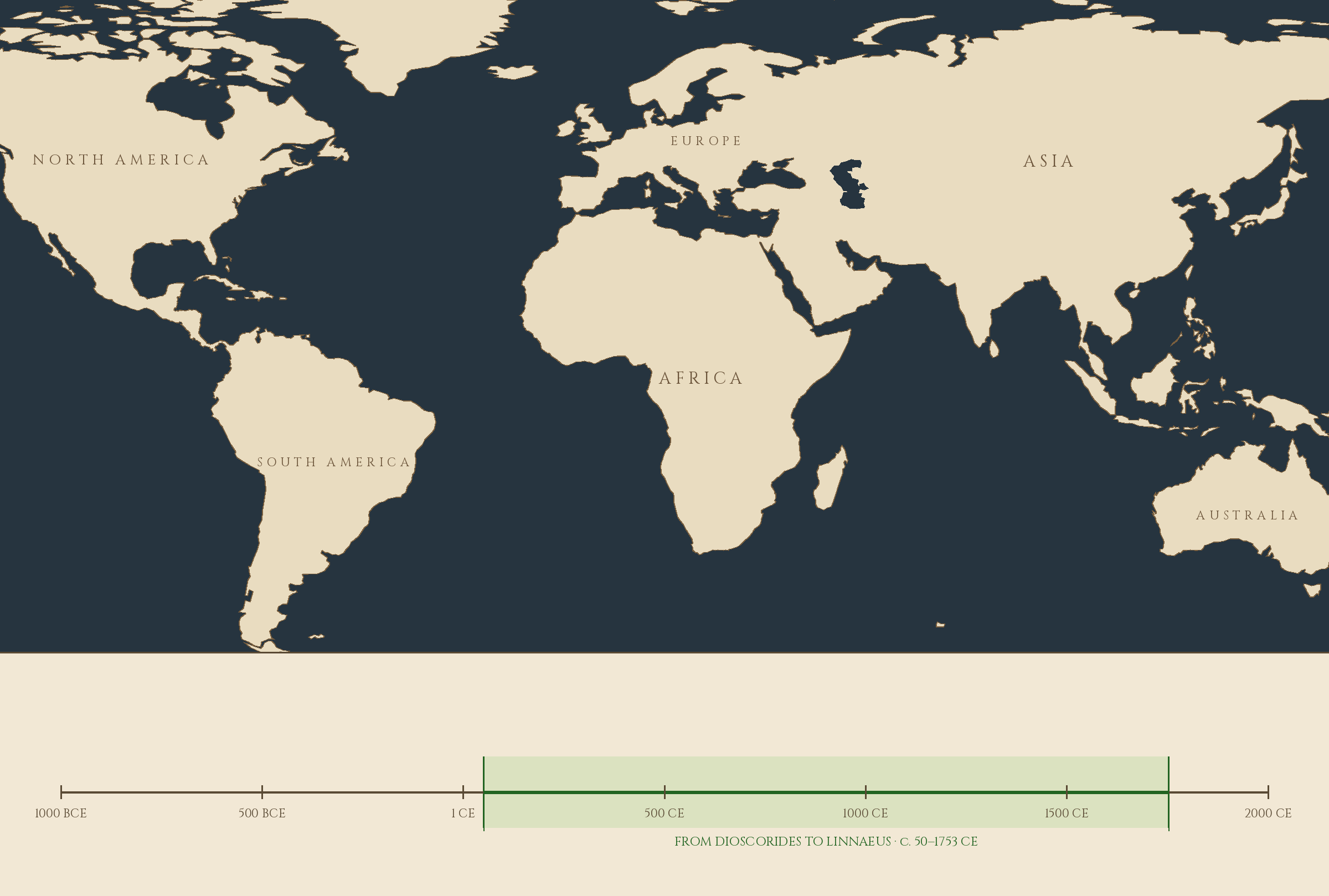
The line beneath the map is our road: every stop a place where the knowledge of plants changed, every lesson a step along it.
Lesson Objectives
By the end of this lesson, you will be able to:
- Explain the difference between a toxic plant, an irritant plant, and one that is merely bitter or unpleasant
- Identify six toxic garden plants by their key features: foxglove, oleander, monkshood, yew, lily of the valley, and castor bean
- Name the toxic parts and the type of toxin for each of the six plants
- Distinguish poison hemlock from wild carrot using stem, height, and flower differences
- Describe the correct first response to a suspected plant poisoning, including the Poison Control number
- Explain why vomiting should never be induced unless Poison Control instructs it
- Audit a garden or growing space for plant-safety hazards, especially for children and pets
- State the safe removal rules for a toxic plant already growing in a garden
Reading this lesson: ★ marks the passages to remember. They return on the unit quiz and the class test. Check in questions ask the material back as you go; answer them in your workbook when you meet them.
Working this lesson: Your assignment packet is the first download on this page. Work in it as the lesson moves along, answering each assignment as its subject is taught — or read the lesson through for your notes and take the assignments as homework afterward. Both are proper ways to sit this class. Signposts in the reading tell you where each assignment belongs. Written answers are short answers in your own words; a few honest lines are worth more than a filled page.
Your Assignment Packet
This lesson's assignments live in its packet: the Lexicon Handout (every term, course terms marked ◆), Materials, Guided Practice, the Assignment Manual with its answer key for self-checking, the Reflection Questions, and the Workbook Checklist. Download the packet before you begin and keep it beside you as you read.
Why This Lesson Comes Now
You are in Unit V, the master herbologist's craft, because you have earned the right to this knowledge. A beginner should be told simply: do not eat plants you cannot identify. A master must know more. You must know which plants in your own neighborhood are dangerous, what their toxins do, and exactly what to do when something goes wrong.
Most gardeners will never have a poisoning emergency. But the ones who do are almost never the ones who studied toxic plants. They are the ones who assumed every garden plant was safe because it was sold in a garden center. That assumption is the most dangerous thing in this lesson, and we will remove it today.
Here is the principle that governs everything else: learn the plant before you touch it, and teach everyone who shares your garden the same rule. Respect is the whole of plant safety. The details are the decoration.
Check in: What assumption does this lesson remove — and what principle governs everything else in it?
❦ In your workbook: record why this lesson comes now in your own way — the master's knowledge, the dangerous assumption, and respect as the whole of plant safety — copy, sketch, or note what matters.
Three Words You Must Not Confuse
Before we meet the plants, we need three words, because people use them carelessly and the carelessness matters.
★ Toxic means the plant can cause serious harm or death if eaten or, in some cases, absorbed through the skin. The harm comes from chemical compounds called toxins, and the dose that causes harm can be very small. All six plants in this lesson are toxic.
Irritant means the plant causes pain, redness, or blistering where it touches the body, but does not poison the whole system. Stinging nettles sting. Some spurges burn the skin. An irritant is unpleasant and sometimes serious, but it is a different kind of danger than a toxin. A plant can be both toxic and irritating, and several in this lesson are.
Bitter means the plant tastes bad. Bitterness is not a safety signal. Many bitter plants are perfectly safe, and, critically, some extremely toxic plants do not taste bad at all. Never use taste to judge safety. The rule is absolute: you do not taste a plant to identify it.
Write those three words in your notebook with their definitions. You will use all of them for the rest of the lesson, and you must not blur them.
Check in: State the difference between toxic, irritant, and bitter — and say why taste can never judge a plant's safety.
❦ In your workbook: record the three words in your own way — toxic, irritant, and bitter, with their definitions, exactly as this lesson asks you to write them in your notebook — copy, sketch, or note what matters.
The Six Plants Every Gardener Should Know
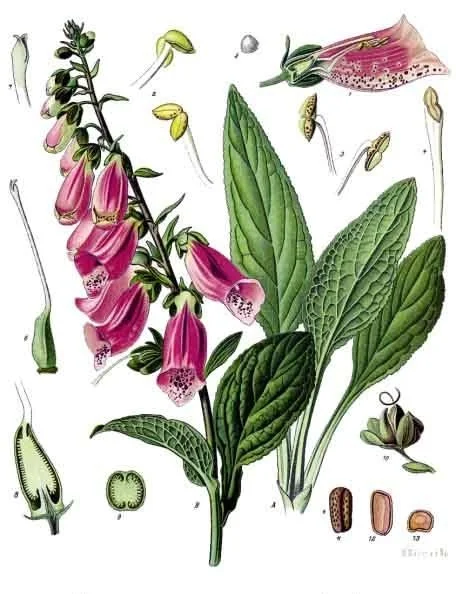
Foxglove (Digitalis purpurea) — for identification only. Know it by the tall spike of tubular purple, pink, or white flowers, freckled inside with dark spots, and by the soft, wrinkled leaves of its first-year rosette. Every part is poisonous: it contains cardiac glycosides that act directly on the heart. Never mistake a garden plant for a pharmacy — no one can measure a dose from a leaf.
From Köhler's Medizinal-Pflanzen (Franz Eugen Köhler, 1887–1914). Public domain.
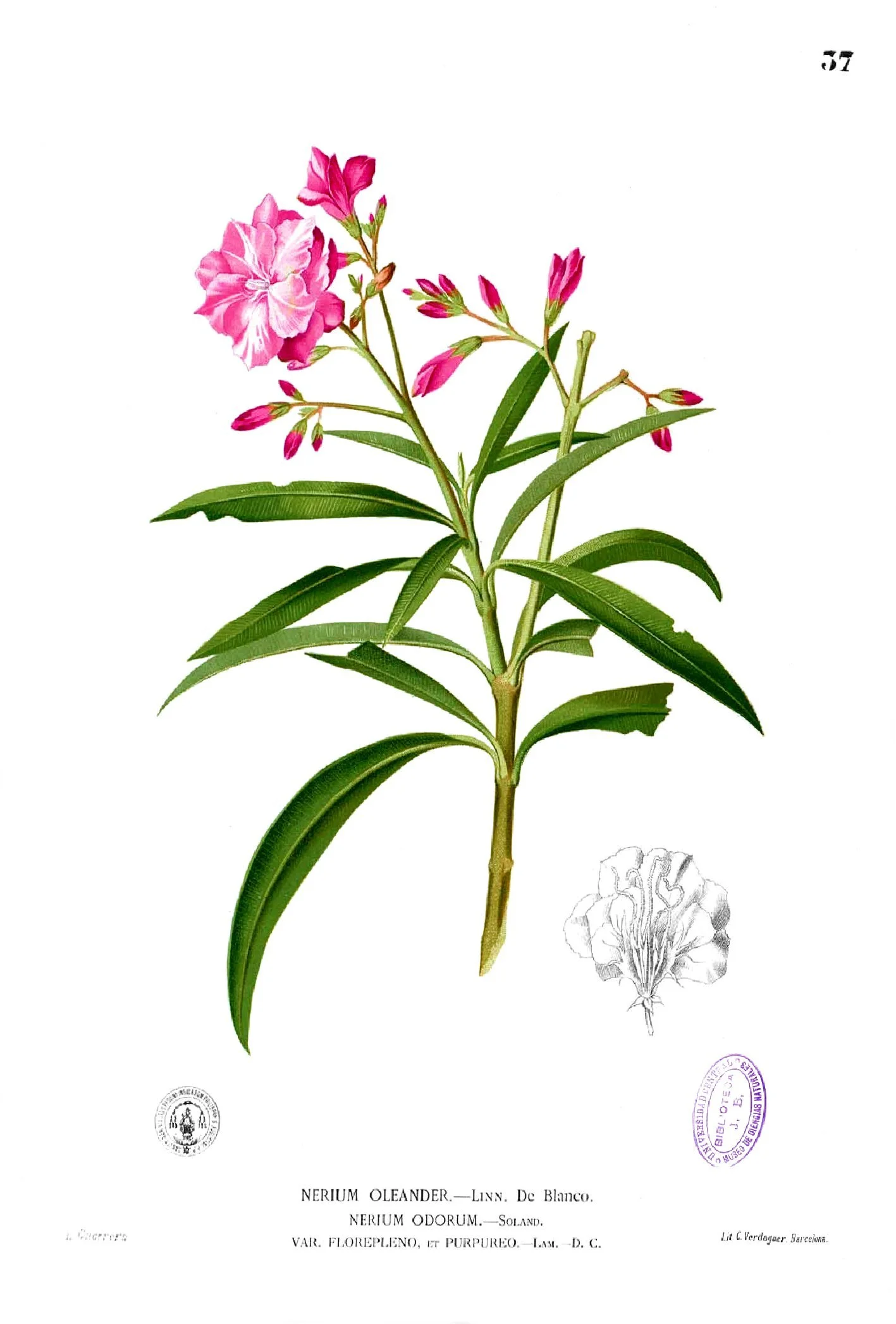
Oleander (Nerium oleander) — for identification only. Know it by the long, narrow, leathery leaves in pairs or whorls and the showy flower clusters at the branch tips; this plate draws a double-flowered garden variety. Every part is toxic, including the sap and the smoke: never burn oleander trimmings, because heat does not destroy these toxins. Bag trimmings and dispose of them with household waste.
From the illustrated posthumous edition of Flora de Filipinas by Francisco Manuel Blanco (1877–1883), plate 37. Public domain.
There are more toxic plants in the world than any one lesson can hold. These six are the ones a gardener is most likely to encounter: in gardens, in parks, in hedges, in ornamental plantings, or growing wild at the edges of towns. Learn their faces. You may already know some of them by sight without knowing what they are.
Foxglove
Digitalis purpurea. A biennial that spends its first year as a low rosette of soft, wrinkled leaves and its second year sending up a tall spike, two to five feet high, crowded with tubular flowers in purple, pink, or white, often freckled inside with dark spots. It is one of the most beautiful plants in the cottage garden tradition, and every part of it is poisonous.
★ Foxglove contains cardiac glycosides, compounds including digitoxin and digoxin that act directly on the heart. Eaten, they can cause nausea, vomiting, confusion, and a dangerously irregular heartbeat. The same compounds, carefully measured in a laboratory, became important heart medicines, which is why you must never mistake a garden plant for a pharmacy. The medicine is the dose, and no one can measure a dose from a leaf.
Foxglove is also mildly irritating to handle for some people. Wear gloves if you must touch it, and never put foxglove trimmings on the compost where pets or wildlife might reach them.
Oleander
Nerium oleander. An evergreen shrub with long, narrow, leathery leaves arranged in pairs or whorls along the stems, and clusters of showy five-petaled flowers in pink, red, white, or apricot at the branch tips. It is one of the most common ornamental shrubs in warm climates, planted in highway medians, school grounds, and gardens across the southern United States and around the Mediterranean.
★ Every part of oleander is toxic, including the sap, the wood, and the smoke. Like foxglove, it contains cardiac glycosides, in this case oleandrin and neriine. Even chewing a leaf once or twice has sent people to the hospital. The sap can irritate skin. And this is the detail gardeners must memorize: burning oleander trimmings produces toxic smoke, because heat does not destroy these particular toxins. Never burn oleander. Bag trimmings and dispose of them with household waste.
Oleander is the plant that proves beauty is not evidence of safety. It is also the reason this lesson insists that children learn the names of the dangerous plants in their own yards.
Monkshood
Aconitum napellus. A tall perennial of the late-summer border, three to five feet high, with deeply divided, fern-like leaves and spikes of hooded flowers in deep blue or purple. Each flower has an upper petal shaped like a medieval monk's hood, which gives the plant its name. Gardeners also call it wolfsbane or aconite.
★ Monkshood is considered one of the most poisonous garden plants in Europe, and it deserves the reputation. All parts contain aconitine, a potent alkaloid most concentrated in the roots and seeds. Ingestion causes burning and numbness of the mouth, vomiting, a slow and irregular heartbeat, and can be fatal. Unusually, aconitine can also be absorbed through the skin, especially through cuts, so monkshood should be handled only with gloves.
If monkshood grows in a garden visited by children, the responsible choice is to remove it. Admire it in botanical gardens, where someone else has made that decision for you.
Check in: For foxglove, oleander, and monkshood, name the toxin group or toxin in each — and state the one handling rule that belongs to monkshood alone.
Yew
Taxus baccata and its relatives. An evergreen conifer of churchyards, old estates, and clipped hedges, with flat, dark green needles and, in autumn, bright red cup-shaped arils that look like berries. The tree can live for centuries and is often enormous, but the danger comes in small packages.
Every part of the yew is poisonous except the soft red flesh of the aril. The needles, bark, and especially the hard seeds contain taxines, alkaloids that disrupt the heart. As little as a small handful of needles can be fatal to an adult, and dried yew keeps its toxicity for months, so fallen clippings are as dangerous as living branches.
★ Here is the subtlety that makes yew worth studying closely. The red aril flesh itself is not poisonous. The seed inside it is. Birds eat the arils and pass the hard seeds unharmed, which is how the tree spreads. A child who eats an aril and swallows the seed whole may pass it safely, but a child who chews the seed is in grave danger. Do not teach children that any part of a yew is safe to eat. Teach them that yew trees are for looking at, not tasting.
Lily of the Valley
Convallaria majalis. A low, spreading perennial of shady corners, six to twelve inches tall, with broad oval leaves and arching stems hung with small, nodding, sweetly fragrant white bells in spring. By autumn the flowers give way to round red berries. It is beloved in wedding bouquets and old-fashioned gardens.
All parts of lily of the valley contain a large group of cardiac glycosides, including convallotoxin, numbering some thirty or more distinct compounds. The red berries are the particular danger because they look like candy and appeal to small children. Even the water in a vase that has held lily of the valley stems carries enough toxin to cause nausea and a slowed pulse.
Before it flowers, lily of the valley can be mistaken for wild garlic, whose leaves are similar. Wild garlic smells strongly of garlic when crushed. Lily of the valley does not. But remember the standing rule: you never taste to identify.
Castor Bean
Ricinus communis. A dramatic tropical-looking plant with huge, hand-shaped leaves up to three feet across, grown as an ornamental annual in temperate gardens and as a perennial shrub where winters are mild. Its seed capsules are round and spiny, splitting to reveal glossy, mottled seeds marked like ticks, which is what the Latin name Ricinus means.
★ The seeds contain ricin, one of the most potent natural toxins known. A few chewed seeds can be fatal to an adult, and one or two can kill a small child. The foliage can also cause severe skin rashes in sensitive people when handled.
Because castor bean is so striking, gardeners sometimes plant it without learning its name's warning. If you have small children or pets, do not grow castor bean. If you see it in a public garden, admire the leaves and keep your hands in your pockets.
Check in: State the yew's trap in one sentence — and say why lily of the valley's red berries, and even its vase water, are dangers.
Scholars, pause here and look at what you have just read. Six plants, six different toxins, but one shared lesson: every one of them is beautiful, every one is commonly planted, and every one is dangerous. The gardener's defense is not fear. It is recognition. Walk through these descriptions once more, slowly, and picture each plant. The next section will test that picture against the most dangerous confusion of all.
— Professor Beryl Fernfoot, Herbology Greenhouse • Master Herbalist • Head of House Oriens
❦ In your workbook: record the six plants in your own way — each plant's face, its toxic parts, and its toxin — copy, sketch, or note what matters.
In your packet: Exercise II — The Look-Alike Study ✎ begins at the next section. Work it now, or mark the place and take it as homework — your choice.
The Deadliest Look-Alike: Poison Hemlock and Wild Carrot
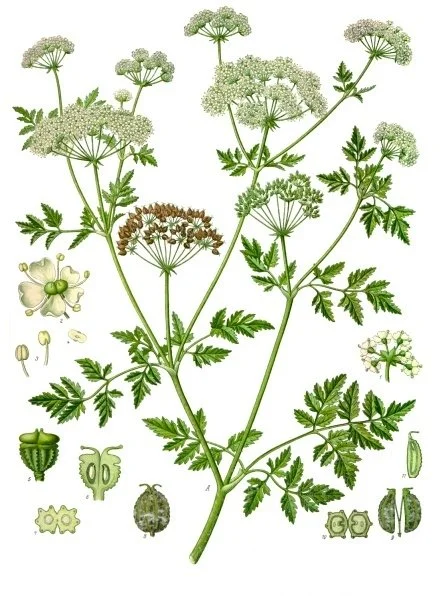
Poison hemlock (Conium maculatum) — for identification only, and never to be sought out. The plate shows what a plate can: the fern-like leaves and flat-topped umbrella clusters of tiny white flowers. The decisive sign is one to learn from this lesson, not from handling: a smooth, hairless stem with purple blotches, on a plant six to ten feet tall. If you are not completely certain, you do not touch it, you do not pick it, and you certainly do not eat it.
From Köhler's Medizinal-Pflanzen (Franz Eugen Köhler, 1887–1914). Public domain.
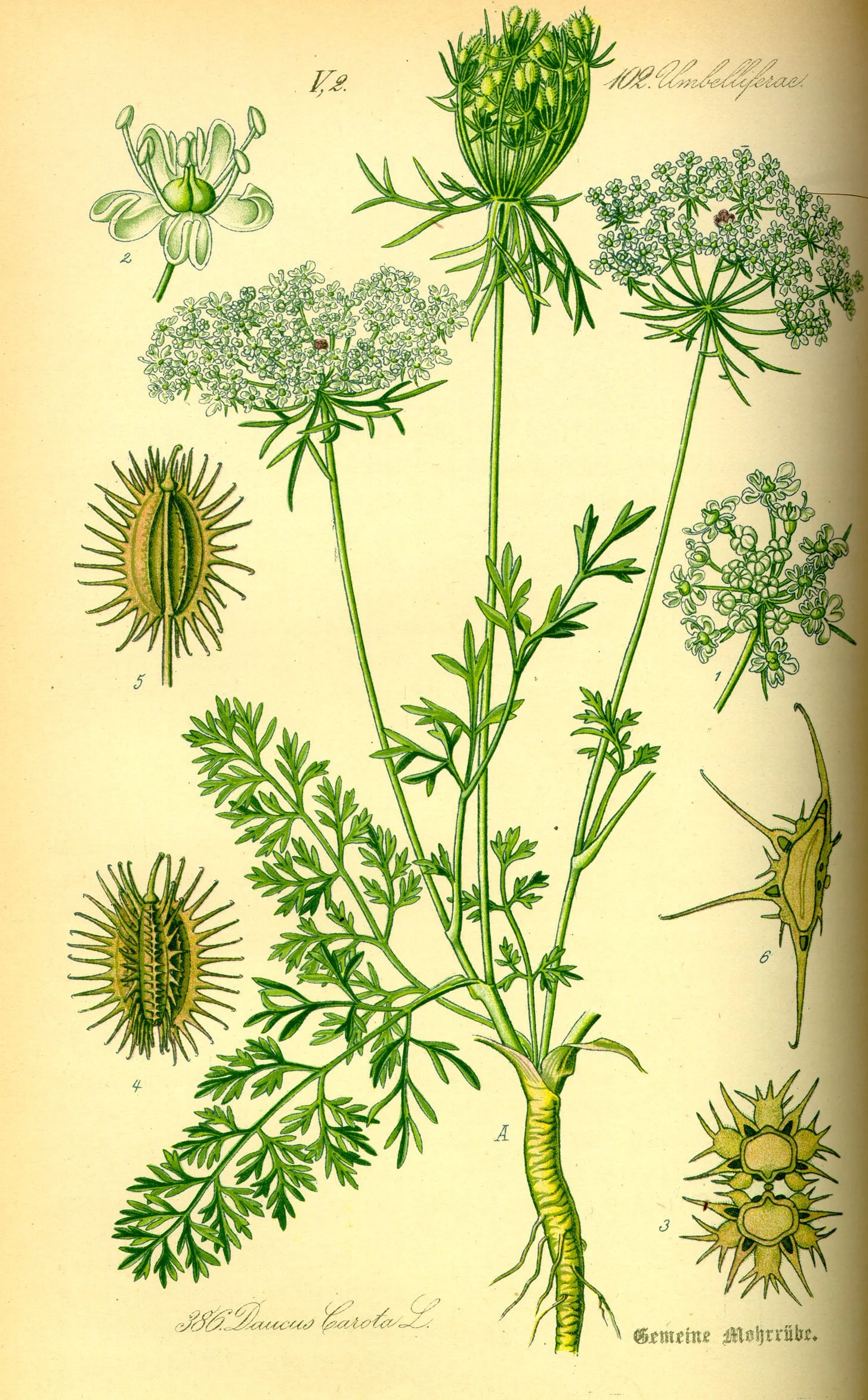
Wild carrot (Daucus carota), also called Queen Anne's lace — the look-alike, shown for comparison, not for gathering. Find the single tiny dark floret at the center of its flat-topped white umbels, like a drop of blood on lace. Learn the pair in the lesson's order — stem, height, flower center, smell — and remember that resemblance is not identification: the Queen has hairy legs; hemlock's stem is smooth and purple-blotched.
Otto Wilhelm Thomé, Flora von Deutschland, Österreich und der Schweiz (1885), plate 386. Public domain.
Most plant poisonings do not come from the famous toxic ornamentals. They come from look-alikes: a dangerous plant mistaken for a safe one. The classic and most dangerous example in North America and Europe is poison hemlock (Conium maculatum) confused with wild carrot (Daucus carota), also called Queen Anne's lace.
Both are biennials of the carrot family. Both have finely divided, fern-like leaves. Both produce flat-topped clusters of tiny white flowers shaped like umbrellas. They grow in the same roadsides and field edges. And poison hemlock is lethally toxic in all its parts, while wild carrot has an edible root. This is the confusion that kills foragers.
Learn the differences, and learn them in this order, because the stem is the most reliable sign:
- ★ The stem. Poison hemlock has a smooth, hairless stem, often with distinctive purple blotches or streaks. Wild carrot has a green stem covered in fine hairs. The memory aid gardeners use: the Queen has hairy legs. If the stem is smooth and purple-blotched, walk away.
- The height. Mature poison hemlock is a giant, six to ten feet tall, towering over its neighbors. Wild carrot is a modest one to two feet.
- The flower center. Wild carrot often bears a single tiny dark floret in the center of its white flower cluster, like a drop of blood on lace. Poison hemlock has no such mark.
- The smell. Crushed poison hemlock foliage smells unpleasant and musty. Wild carrot root smells like a carrot. But you should never need the smell test, because you should never be handling a plant you suspect is hemlock with bare hands. Its sap irritates skin.
★ The rule for all look-alikes, and it is absolute: if you are not completely certain, you do not touch it, you do not pick it, and you certainly do not eat it. Take photographs from a safe distance and ask your local agricultural extension office to confirm the identification. Being wrong about a look-alike is not a learning experience. It is an emergency.
Check in: Give the four hemlock–wild carrot differences in their taught order — and say why the stem comes first and the smell test last.
No-plant alternative: study the two plants from verified extension-service photographs and write a side-by-side comparison from the four differences above, as if preparing a field guide page.
❦ In your workbook: record the deadliest look-alike in your own way — the four differences in order, the Queen's hairy legs, and the absolute rule — copy, sketch, or note what matters.
Children, Pets, and the Garden
Adults are rarely poisoned by plants, because adults rarely put unknown leaves in their mouths. Children under six are the most frequent victims of plant poisoning, and the reason is simple: small children explore the world by tasting it. Bright berries are irresistible to a toddler. This section is about designing that risk out of the garden.
Walk your growing space with a child's eyes, at a child's height. Which berries are within reach? Which low plants have interesting seed pods? Lily of the valley, yew arils, and oleander flowers are the classic child-height hazards. If you garden with small children, either remove these plants or fence them out of reach, and teach the single unbreakable rule early: we never put any plant part in our mouths unless a grown-up we trust says it is food.
Pets deserve the same audit. Dogs chew. Cats nibble houseplants. Many of this lesson's plants are equally toxic to animals, and some plants that merely sicken people can kill a cat. Keep the Scholar's Familiars you chose in Lesson 1 where pets cannot reach them, and check any new houseplant against a pet-toxicity list before it comes indoors.
Two habits close this section. First, teach children the names of the dangerous plants in their world the way you teach them to look both ways before crossing a street: calmly, early, and more than once. Second, save the Poison Control number in your phone today, before you need it. Prevention is a phone number saved in advance.
Check in: Name the three classic child-height hazards — and state the single unbreakable rule taught early.
No-plant alternative: audit a public park or a relative's garden (with permission) for the same hazards, and write the child-safety recommendations you would give its gardener.
❦ In your workbook: record children, pets, and the garden in your own way — the child's-height walk, the pet audit, and the two closing habits — copy, sketch, or note what matters.
In your packet: Exercise I — The Garden Safety Audit ◐ begins here. Work it now, or mark the place and take it as homework — your choice.
If Exposure Happens
Read this section carefully now, while no one is frightened, because frightened people cannot learn new procedures. If you suspect someone has eaten part of a toxic plant, or a child is found with plant material in their mouth, follow these steps in order.
- Stay calm and act quickly. Remove any remaining plant material from the person's mouth. Do not wait for symptoms to appear. Some toxins act fast; others are delayed. Absence of symptoms proves nothing.
- ★ Call Poison Control: 1-800-222-1222. In the United States this number reaches your local poison center, free, confidential, and staffed around the clock. If you are outside the United States, call your local emergency number. Tell them the person's age and weight, what plant was eaten and how much, and when it happened. If you can, bring the plant or a clear photograph of it.
- ★ Do NOT induce vomiting. This is the old advice, and it is wrong. Vomiting can cause additional burns on the way back up and can send plant material into the lungs. Never give syrup of ipecac (a historical emetic once kept in homes to induce vomiting after poisonings) or activated charcoal at home. The only exception is if Poison Control specifically tells you to, which modern guidance almost never does.
- Call 911 if the person has serious symptoms. Trouble breathing, seizures, unconsciousness, a dangerously slow or irregular pulse: these are emergencies. Call 911 first, then Poison Control.
- For skin exposure, remove contaminated clothing, rinse the skin with plenty of cool water, and wash gently with soap. For eye exposure, rinse with clean water for at least fifteen minutes and seek medical advice.
Write the number 1-800-222-1222 on the inside cover of your garden notebook, on a card taped inside a kitchen cabinet, and in your phone. The scholars who need this section will not have time to look it up.
Check in: Give the five steps in order — and explain why vomiting is never induced unless Poison Control instructs it.
❦ In your workbook: record the exposure steps in your own way — all five, in order, with the Poison Control number written where you will find it — copy, sketch, or note what matters.
In your packet: Exercise III — The Poison Response Card ⚒ begins here. Work it now, or mark the place and take it as homework — your choice.
If It Is Already Growing in Your Garden
Sooner or later, a gardener looks at an established planting with new eyes and realizes something toxic has been growing there all along. Perhaps the oleander came with the house. Perhaps the yew hedge predates your memory. Do not panic, and do not feel foolish. Now you know, and knowing is the point of this lesson.
First, assess. Is the plant somewhere children or pets can reach it? Is it a plant you can live with by teaching around it, like a tall yew hedge, or is it something low and tempting, like lily of the valley at toddler height? Fencing, pruning out of reach, and education solve many situations without removal.
★ If you decide to remove it, follow these rules. Wear gloves, long sleeves, and eye protection. Keep children and pets away from the work area. Do not compost toxic plant material; bag it and dispose of it with household waste so no animal or person encounters it later. Wash your tools, gloves, and hands when you are done. And remember the oleander rule: never burn the trimmings of a toxic plant, because some toxins travel in smoke.
If you are unsure about identification or about safe removal, your local agricultural extension office will advise you. Asking for help is not a failure of mastery. It is mastery.
Check in: Before removal, what two questions does the assessment ask — and what are the removal rules, including the oleander rule?
❦ In your workbook: record the already-growing rules in your own way — assess first, then the removal rules and the extension office — copy, sketch, or note what matters.
Safety Notes
- This lesson is for identification and prevention only. It contains no remedies, no dosages, and no medicinal uses. Do not attempt to treat poisoning yourself.
- Poison Control (United States): 1-800-222-1222, 24 hours, free, confidential. Save it in your phone today.
- Never induce vomiting after a suspected poisoning unless Poison Control explicitly instructs it.
- Never taste a plant to identify it. Bitterness is not a safety signal.
- Wear gloves, long sleeves, and eye protection when removing any toxic plant. Bag trimmings for household waste; never compost or burn them.
- Keep all six plants in this lesson away from small children and pets, or out of their reach.
- Younger students: all garden audits and any plant removal must be done with an adult.
❦ In your workbook: record the safety notes in your own way — identification and prevention only, the number saved today, and never taste to identify — copy, sketch, or note what matters.
Guided Observation: Reading a Garden at a Child's Height — Without Touching
This lesson's observation is the safety audit's eye, worked in full before any exercise begins: a slow walk through a growing space at a child's height, reading reach, berries, and seed pods with the eyes only — because this lesson handles nothing. Every plant in it is studied from references and from a safe distance.
You will need:
- a garden, yard, indoor plant collection, public park, or relative's garden (with permission)
- this lesson, open at the six plants and the look-alike section
- a notebook and a pen
- a camera, if you have one, for photographing unidentified plants from a safe distance
Walk at a child's height. Go through the space slowly, looking at what a small child can reach: which berries are within reach, which low plants have interesting seed pods, which flowers sit at toddler height. Lily of the valley, yew arils, and oleander flowers are the classic child-height hazards this lesson names.
Name what you can; mark what you cannot. List every plant you can identify. Mark any that are toxic, irritating, or unknown. An unknown plant is recorded as unknown — never handled, never tasted, and photographed from a safe distance if you want your local agricultural extension office to confirm it.
Read the reach, not just the plant. For each hazard you find, note who could reach it — children, pets, or no one. Dogs chew; cats nibble houseplants; and some plants that merely sicken people can kill a cat.
Close with the number. End the walk by saving the Poison Control number — 1-800-222-1222 — in your phone, if it is not already there. Prevention is a phone number saved in advance.
Consider:
- Which hazards in this space sit at a child's height, and which sit safely out of reach?
- Which plants could you not identify — and what will you do about each of them, short of touching or tasting?
- What single change would design the most risk out of this space?
No-plant alternative: audit a public park or a relative's garden (with permission) for the same hazards, and write the child-safety recommendations you would give its gardener.
Workbook path: if no growing space is within your reach this week, work the same reading on paper: sketch a garden you know from memory, mark the child-height hazards and the unknowns on the sketch, and write the recommendations you would give its gardener. The auditor's eye is the skill; the walk itself is its next occasion.
Materials
Required (Level One — household items)
- This lesson: keep it beside you during the garden safety audit.
- Notebook and pen: for the audit list, the look-alike chart, and your reflections.
- An index card: for the poison response card in Exercise III.
- A phone: save Poison Control (1-800-222-1222) in it today, before you need it.
- Gloves: for the garden audit, in case you meet something you cannot identify.
Suggested (Level Two — historically closer)
- A regional field guide to poisonous plants: for identifying anything your audit turns up.
- A camera: photograph unidentified plants from a safe distance to show your extension office.
- Laminating supplies: to make the poison response card durable enough for the garden shed.
Safety notes: Poison Control (United States): 1-800-222-1222 — 24 hours, free, confidential. Save it in your phone today. Never induce vomiting after a suspected poisoning unless Poison Control explicitly instructs it. Never taste a plant to identify it. Photograph unknown plants from a safe distance. Wear gloves, long sleeves, and eye protection when removing any toxic plant. Bag trimmings for household waste; never compost or burn them. Younger students: all garden audits and any plant removal must be done with an adult.
Reflection Questions
Answer the following questions in your workbook.
- The lesson says "love without respect is incomplete" and calls recognition, not fear, the gardener's defense. What does this distinction mean in practice? How would a fearful gardener and a respectful gardener behave differently in the same garden?
- Why is the dose principle ("the dose makes the medicine, and a garden cannot measure a dose") the reason this course teaches no medicinal uses of plants? Explain in your own words.
- Poison hemlock and wild carrot look alike to a casual glance. What does this example teach about the limits of casual observation, and how does it connect to the observation habits you have built since Lesson 1?
- The lesson instructs you never to induce vomiting after a suspected poisoning, reversing advice many households still follow. Why do you think the old advice persisted, and what does its reversal suggest about how safety knowledge changes?
- You have now studied thirty-three lessons of plant love and one lesson of plant danger. How does this lesson change the way you read the earlier lessons, if at all?
Workbook Checklist — Lesson 33
In my workbook I have:
- ☐ explained the difference between toxic, irritant, and bitter — and why taste never judges safety
- ☐ named the six plants, their toxic parts, and the type of toxin in each
- ☐ distinguished poison hemlock from wild carrot by stem, height, flower center, and smell — stem first
- ☐ written the five exposure steps in order, with the Poison Control number saved in my phone, my garden notebook, and on a kitchen card
- ☐ explained why vomiting is never induced unless Poison Control instructs it
- ☐ audited a growing space at a child's height and written one concrete action for every hazard found
- ☐ stated the safe removal rules — gloves, long sleeves, eye protection; children and pets away; bagged for household waste, never composted or burned
- ☐ made the Poison Response Card and placed one copy where my household will find it
☐ Lesson completed Date: ___ Signature: ___
Cross-Class Connections

Potions · Unit I, Lesson 1 — Welcome to the Potions Laboratory
Scholars, welcome — and read my Safety Covenant before you touch a single jar. The fifth promise of that Covenant is this lesson's own discipline wearing my apron: if anything is swallowed, flush with clean water, tell an adult at once, and call your local poison control center or emergency number if there is any doubt — and never treat an exposure with a home remedy. Professor Fernfoot teaches you the plants; my laboratory teaches you the bench they are worked at. Sign the Covenant with an adult beside you, and both rooms are safer for it.
Herbology · Unit I, Lesson 6 — The Baneful Greenhouse
The Professor's Closing Note
You now know the dangerous faces in the garden, scholars, and that knowledge is a kind of protection you can share. Teach it kindly, keep the number saved, and garden on with confidence.
— Professor Beryl Fernfoot, Herbology Greenhouse • Master Herbalist • Head of House Oriens
Further Reading & Sources
- Foxglove — Britannica — botanical description, biennial habit, and the cardiac glycosides found in all parts of Digitalis.
- Nerium oleander — UF/IFAS Extension (PDF) — University of Florida fact sheet: all parts poisonous, toxic smoke from burning, hospitalizations from chewing leaves.
- Aconitum napellus — Wikipedia — monkshood's extreme toxicity, aconitine, skin absorption, and helmet-flower identification.
- Yew — Royal Botanic Gardens, Kew — Taxus baccata: all parts poisonous except the red arils, taxine compounds, toxicity retained in dried material.
- Poisoning in Children — UW Medicine Health Library — current guidance: do not induce vomiting, do not give ipecac, call Poison Control at 1-800-222-1222.
- Poison Hemlock Identification — MSU Extension via Morning Ag Clips — purple-blotched smooth stems, height, and the wild carrot comparison.
Browse the Herbology shelf in the school Library for readable editions of these works.
End of Lesson 33.
Plants from this lesson stand in the Materia Botanica, the school's shared archive — each kept with its lessons, its keepings, and its cautions. This lesson's company:
Castor BeanFoxgloveLily of the ValleyWild carrotYew The whole Materia BotanicaPROFESSOR BERYL FERNFOOT · HERBOLOGY GREENHOUSE
Submit your work for this lesson using the form below.
CONTINUE IN THE HERBOLOGY GREENHOUSE
← Previous · Lesson 32: Unit IV Harvest Festival Project Next · Lesson 34: Companion Planting & Guild Design →
Unit V — The Master Herbologist's Craft Herbology Greenhouse — All 37 Lessons
The rest of Unit V: Lesson 34 · Companion Planting · Lesson 35 · Foraging Ethics · Lesson 36 · Materia Botanica · Lesson 37 · Garden Design · The Master Herbologist Defense