
SCROLLWORK
Unit II · Lesson 7RED INKS & RUBRICATION
Professor's Introduction

Clean hands, scholars, and welcome back to the ink-making unit.
In our last two lessons you made black inks: carbon ink from soot and charcoal, and iron gall ink from oak galls and iron salts. Black is the worker. Black carries the text, line after line, page after page, and asks for nothing in return.
Tonight we meet the ink that does not carry the text at all. Red ink writes almost nothing: a heading here, an initial there, a line of direction for the priest at his prayers. And yet it governs the whole page. Before your eye reads a single word, the red has already told you where to look, what matters most, and where one thing ends and the next begins.
Color is information. That is the whole of this lesson in three words, and I expect you to prove you understand it before you leave.
We will study four historical reds: minium and vermilion, the two mineral reds that could kill the careless; madder and brazilwood, the two plant reds that asked only patience. We will meet the rubricator, the specialist scribe whose entire craft was the red pen. And we will uncover a small etymological scandal: the word "miniature" has nothing to do with smallness, and I shall expect you to stop misusing it by the end of the evening.
A warning before we begin, and I give it in my sternest voice. Two of the reds in this lesson are poisons. Vermilion is a mercury compound. Minium is a lead compound. You will learn their histories, you will admire their colors in manuscripts, and you will never, under any circumstance, grind them, buy them, or bring them to your desk. Some materials belong to the story, not to the desk. These two belong to the story. Is that understood? Good. Then let us begin.
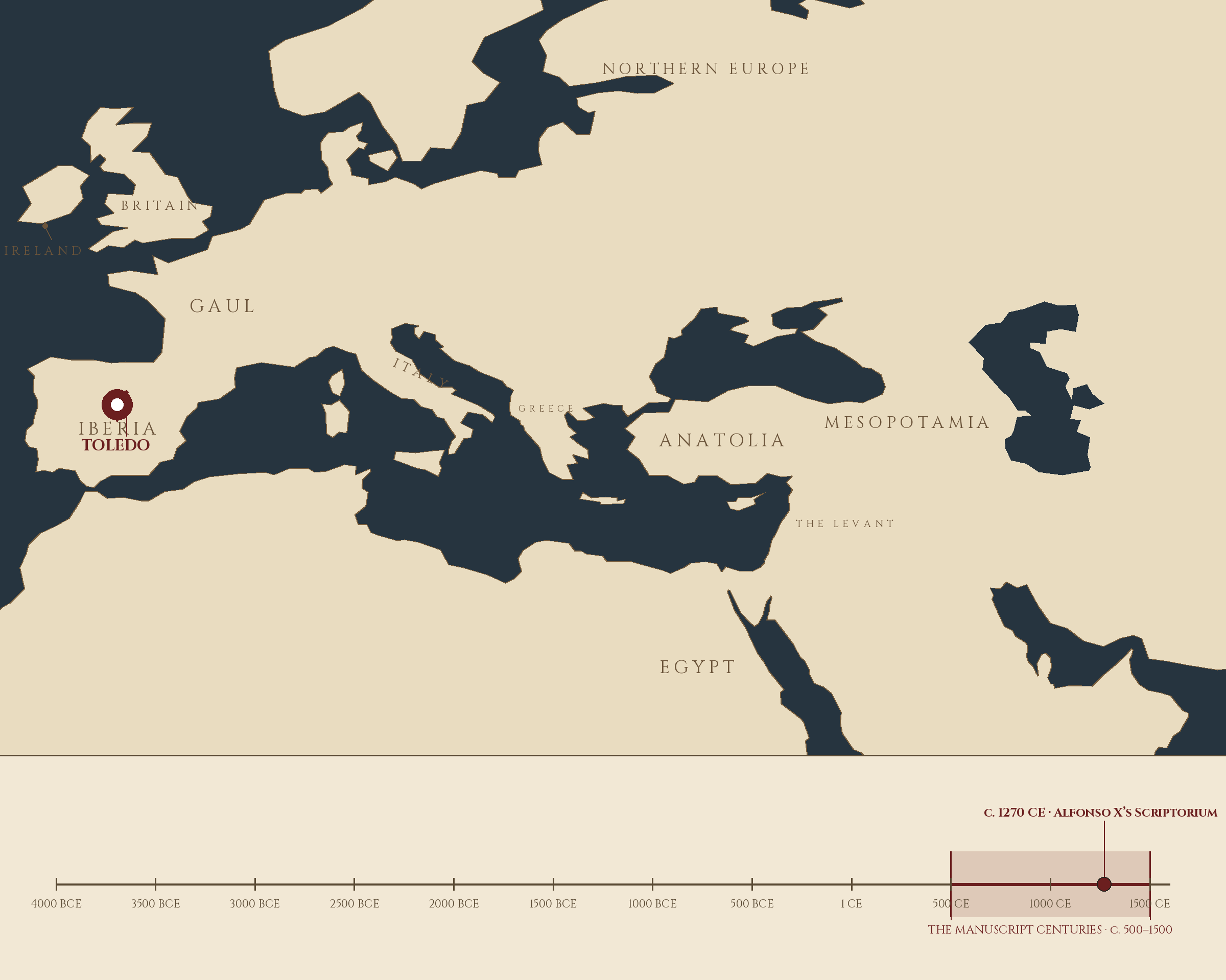
Where and when: Toledo, Castile, c. 1270 CE — Alfonso X's Scriptorium. The pin is this lesson. The line beneath the map is our road: every stop a place where writing changed, every lesson a pin.
Lesson Objectives
By the end of this lesson, students should be able to:
- explain what rubrication is and describe the rubricator's place in medieval manuscript production
- trace the word "rubric" from the Latin rubrica through medieval manuscripts to its modern uses
- describe four historical red pigments (minium, vermilion, madder, brazilwood) and name the source of each
- explain why the word "miniature" comes from minium rather than from smallness
- identify which historical red pigments are too toxic to handle and explain why they are studied but never made
- design a rubricated page that uses red as information, following the medieval hierarchy of headings, initials, and directions
Reading this lesson: ★ marks the passages to remember. They return on the unit quiz and the class test. Check in questions ask the material back as you go; answer them in your workbook when you meet them.
Working this lesson: Your assignment packet is the first download on this page. Work in it as the lesson moves along, answering each assignment as its subject is taught — or read the lesson through for your notes and take the assignments as homework afterward. Both are proper ways to sit this class. Signposts in the reading tell you where each assignment belongs. Written answers are short answers in your own words; a few honest lines are worth more than a filled page.
Your Assignment Packet
This lesson's assignments live in its packet: the Lexicon Handout (every term, course terms marked ◆), Materials, Guided Practice, the Assignment Manual with its answer key for self-checking, the Reflection Questions, and the Workbook Checklist. Download the packet before you begin and keep it beside you as you read.
The Red Before the Word
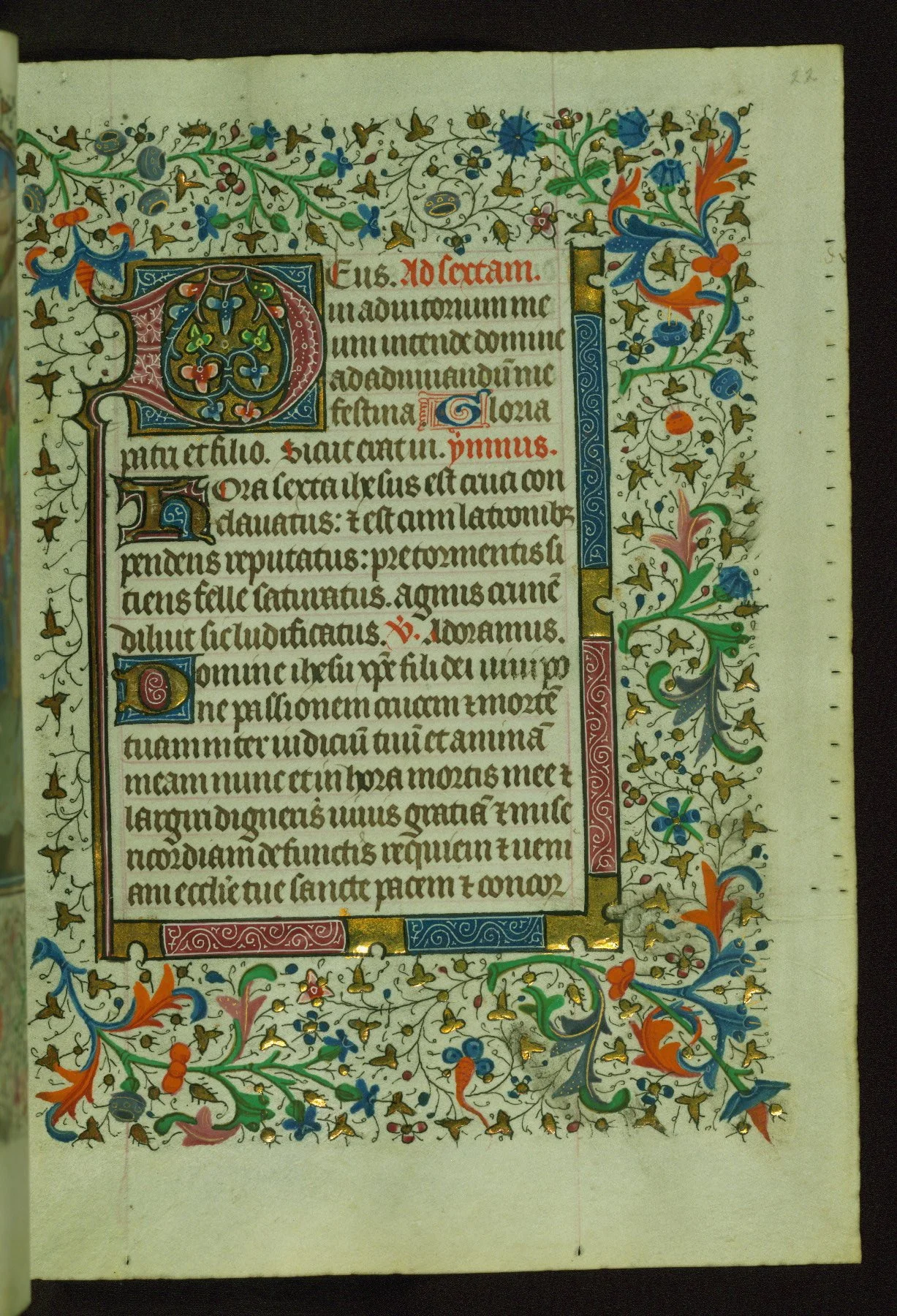
A rubricated page: the red gives the directions, the black carries the prayer — color is information.
Book of Hours, fol. 22r (Walters Manuscript W.246), The Walters Art Museum, Baltimore. CC0.
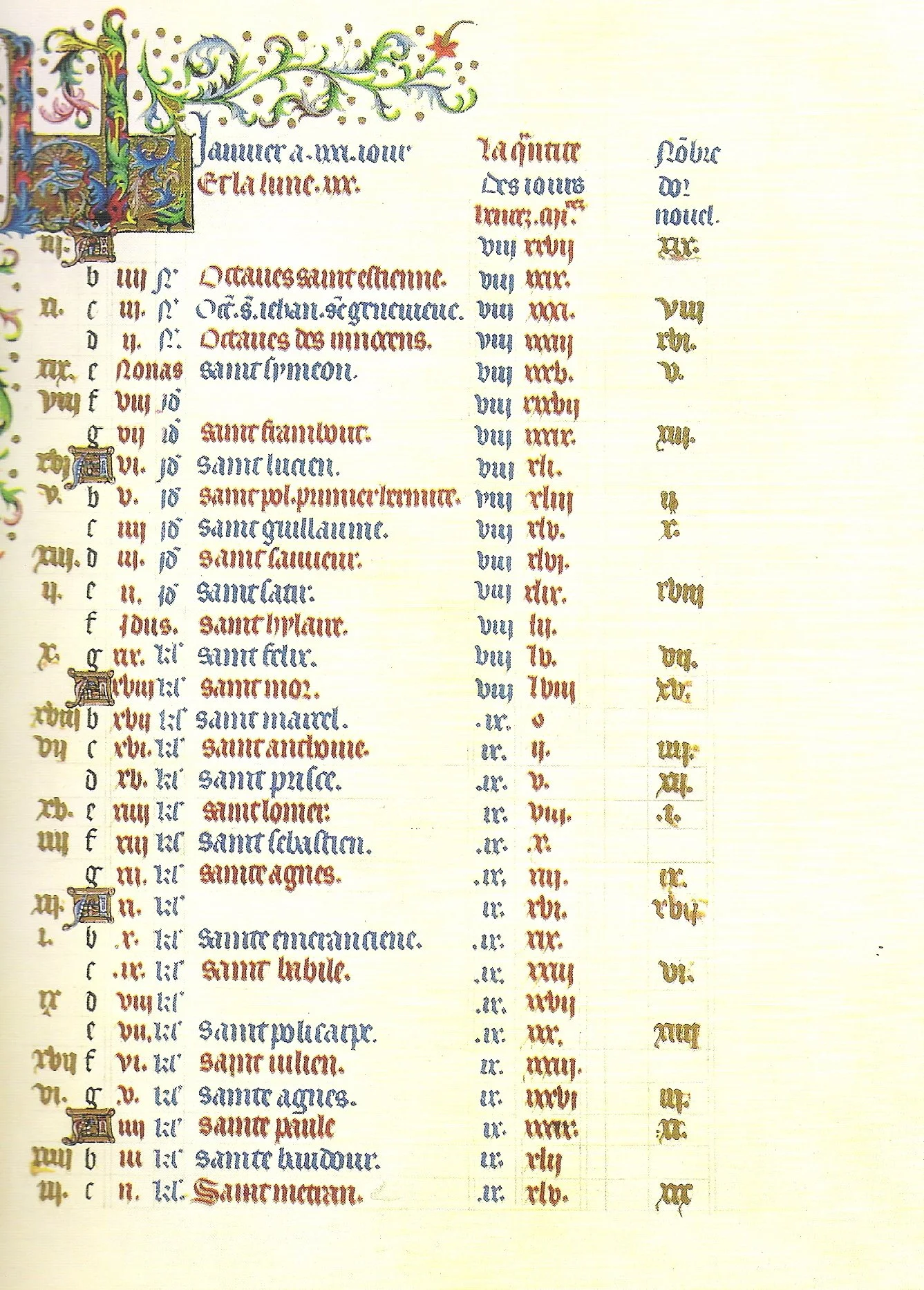
A calendar page from the Très Riches Heures: the great feasts stand in red — the original red-letter days.
January calendar page from the Très Riches Heures du duc de Berry (Musée Condé, Chantilly, MS 65, fol. 2r). Public domain.
Open any medieval manuscript, a gospel book, a book of hours, a law code, and before you read a word, the red speaks. A heading burns red at the top of the page. An initial letter stands two lines tall in red and blue. In a service book, a line of red tells the priest what to do while the black text tells him what to say. The page has a hierarchy, and the hierarchy is written in color.
★ The practice is older than the Middle Ages. In pharaonic Egypt, scribes emphasized important text on papyri, headings and the beginnings of new parts of a narrative, with red ink. The Romans carried the habit forward, and the medieval scriptoria raised it to a system: rubrication, the addition of red text for emphasis, performed as its own separate stage in the making of a book.
★ The Latin tells the story plainly. Ruber means red. Rubrica means red ochre, the red earth used as pigment. Rubricare means to color red. From these came our rubric: first the red heading itself, then the textual unit the heading defined (a chapter of law, a section of liturgy), then, centuries later, when the red ink was long gone from the practice, the modern senses. A teacher's grading rubric is a set of headings under which work is judged. To do something "under the rubric of" a cause is to file it under that heading. The red has faded from the word, but the structure the red built remains.
★ What did the red mark? Titles and headlines first, the signposts of the page. The initials of chapters and sections, enlarged and reddened so the eye could find the joints of the text. In liturgical calendars, the feast days that mattered most stood in red, which is why a memorable day is still, in English, a "red-letter day." In missals and service books, the rubrics were directions: stand here, kneel now, say this aloud. The black text was the prayer; the red text was the choreography. Scholars of manuscripts still use patterns of rubrication to identify textual traditions (which workshop, which region, which century), because every scriptorium rubricated a little differently, the way every hand carries its own signature.
Check in: Open a service book in your mind. Which color tells the priest what to do, and which color tells him what to say?
❦ In your workbook: record how the red governs a manuscript page in your own way — copy, sketch, or note what matters.
Four Reds
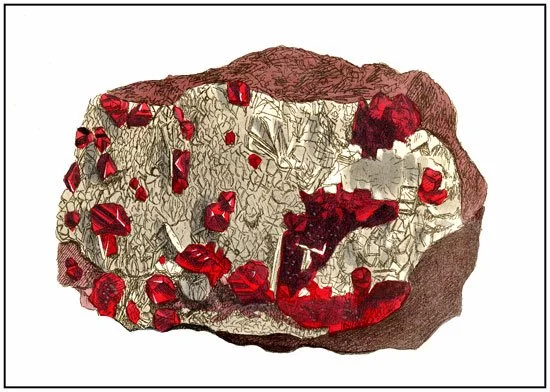
Cinnabar, the mercury ore of vermilion, drawn from a specimen from Almadén in 1811: the brilliant poison, in the rock.
Cinnabar from Almadén, Spain, drawn by James Sowerby, Exotic Mineralogy (1811). Public domain.
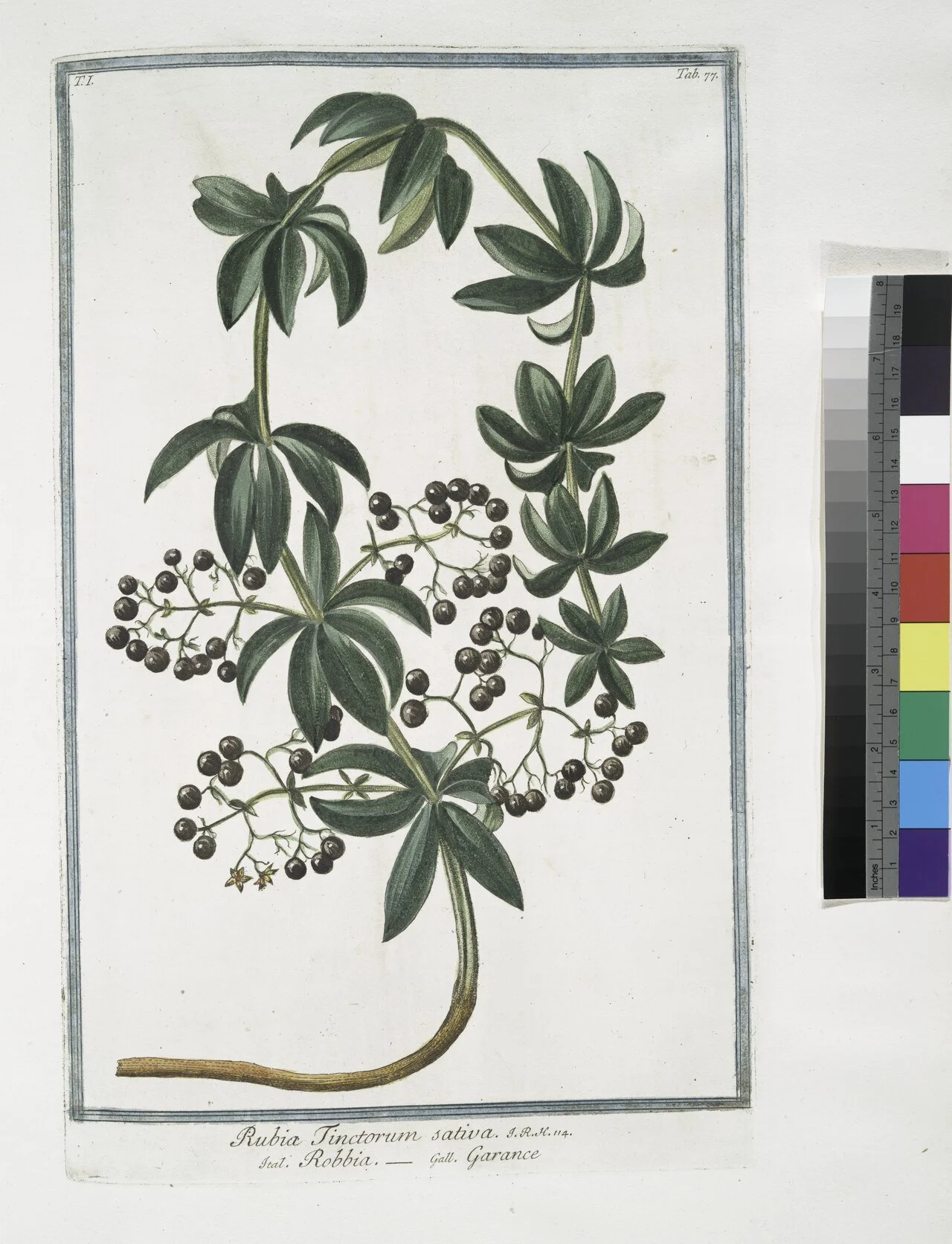
Dyer's madder: the red lives in the root, drawn at the foot of this plate — a heading's color, dug from the ground.
Dyer's madder, Rubia tinctorum (Tab. 77). Scan by the New York Public Library. Public domain.
A medieval rubricator did not reach for one red. The shelf held several, and they were not interchangeable. Two came from the mineral world, brilliant and deadly. Two came from the plant world, humbler and safer. Know all four, and know which two you will never touch.
Minium: The Red That Names Pictures
★ Minium is red lead: Pb3O4, lead tetroxide. The Romans made it by heating white lead to extreme temperatures, and scholars count it among the first synthetic pigments: a color manufactured, not merely found. Its shade runs more orange than scarlet, an eye-popping red-orange that showed well against marble and gold. The Romans used it for inscriptions. Medieval manuscript makers used it for paragraph signs, for versals (the enlarged capitals that begin verses or paragraphs), for headings, for the red delineation of early illustrations.
It is highly toxic. Lead is lead: the pigment is dangerous to inhale as dust, dangerous to ingest, dangerous to handle carelessly. It also misbehaves with age. In frescoes and watercolors, minium can darken as the red lead transforms toward black lead oxide, a decay conservators have identified on medieval manuscripts. Light and humidity are the likely culprits. The rubricator's red could betray him across the centuries, and on some pages it has.
★ But minium's strangest legacy is not chemical but linguistic. The Latin verb miniare meant "to color with minium," and the miniator was the person who applied it, originally a rubricator, a worker in red with nothing to do with pictures at all. Because early manuscript illustrations were delineated with minium, the pictures themselves came to be called miniatures. The small scale of medieval pictures then caused a famous etymological confusion: later writers assumed "miniature" must come from some word meaning "small," and the word drifted into its modern sense: small paintings, portrait miniatures, anything in little. The red lead was forgotten; the smallness was invented. Remember the truth, and you will never misuse the word again: a miniature is named for a poison, not for its size.
Check in: A friend calls a tiny painting a miniature "because miniature means small." Correct them: where does the word actually come from?
Vermilion: The Brilliant Poison
★ If minium is orange-red, vermilion is scarlet, the vivid candy-apple red that seems to glow from inside. It is mercury sulfide, HgS, ground from the mineral cinnabar or, in the synthetic form, manufactured directly. The natural pigment was known across the ancient world; the synthetic version was invented in China and reached Europe by about the eighth century, by way of the Islamic world. By the Renaissance it was everywhere, from Titian's robes to apothecaries' shelves, prized above minium despite its higher price.
It is very toxic, and the sources are blunt about it: the pigment should be used with great care. Mercury attacks the nervous system, and the miners and grinders who produced vermilion paid for its brilliance: there is evidence that even Neolithic workers suffered mercury poisoning from cinnabar. The finished color was so magnificent that the blood shed to acquire it only added to its prestige as a symbol of power. That sentence should chill you a little. It is meant to.
In manuscripts, vermilion supplied the most brilliant reds of the medieval palette. But note the honest complication: vermilion can darken with exposure to light, shifting toward brown or black. The bridle in Uccello's Battle of San Romano has famously darkened. Beauty, poison, and instability in one pigment. The rubricator's brightest tool was also his most treacherous.
Check in: Two of this lesson's four reds belong to the story, never to the desk. Name them, and name the metal in each that makes it so.
Madder: The Root That Wrote in Red
★ After two poisons, a relief. Madder is a plant, Rubia tinctorum, and its red comes from the roots. Rose madder supplied one of the standard red inks for medieval titles and headings: the roots were cooked down with soft rainwater and fermented until the right color was achieved. No mercury. No lead. Only a root, water, patience, and the alum mordant that fixed the dye as a lake pigment — a dye made into a pigment by fixing it onto a colorless base.
Madder's red is deeper and quieter than vermilion's, a brick or rose red rather than a scarlet shout. For headings and titles, that was often exactly right: the red needed to govern the page, not to set it on fire. When you see a medieval heading in a warm, earthy red rather than a brilliant scarlet, you may well be looking at madder.
Brazilwood: The Newcomer
Brazilwood is the youngest of the four reds in the European story. The chipped heartwood of the tree, steeped overnight in beer, wine, or vinegar, then boiled down with alum and gum arabic and strained through cloth, yields reds, pinks, and purples of remarkable delicacy. A 1596 English recipe book gives the method in full: an ounce of brazilwood to a third of a quart of liquid, alum and gum arabic beaten to powder and stirred in, chalk scraped in if a darker shade is wanted.
★ Scientific analysis of manuscripts from the scriptorium of Alfonso X of Castile (reigned 1252–1284), including the Cantigas de Santa Maria, the Lapidario, and the Book of Games, found brazilwood lake pigments in pinks, reds, and purples: the first reported use of this lake pigment in European medieval manuscript illumination. A king's workshop, reaching for a new red. The palette was never finished; every century added something.

A Note from the Headmaster
Squirty here, and I confess I read this lesson's ink analysis with unusual attention. One of the manuscripts the scientists tested comes from the scriptorium of Alfonso X — and Alfonso's Book of Games, finished in 1283, is where alquerque survives in full: board, pieces, and leaps, set down by a king. The mother of draughts is waiting in the Games Room, played exactly as his book describes.
❦ In your workbook: record the four reds in your own way — copy, sketch, or note what matters: a row for each red, its source, its color, and whether it may ever touch your desk.
In your packet: Assignment III — The Four Reds ✎ begins here. Work it now, or mark the place and take it as homework — your choice.
Professor Nocturne
Attend, scholars, and hold the lesson's three words firmly: color is information.
The black text says what the words are. The red text says where to look. Before literacy was common, before indexes and tables of contents, the rubricator built the page's navigation out of color alone. The heading tells you a new matter begins. The red initial tells you where the section breaks. The feast day in red tells you this day outranks the black days around it. The direction in red tells the priest what his body must do while his voice speaks the black.
This is why the rubricator was a specialist, not an afterthought. To rubricate is to decide what matters. The main scribe copies the text; the rubricator judges it. Every red mark is a decision about hierarchy, and hierarchy is meaning.
You will practice this judgment yourself before the evening ends. Choose your reds carefully, and remember which reds you may not choose at all.
In your packet: Assignment V — The Color-as-Information Essay ✎ begins here. Work it now, or mark the place and take it as homework — your choice.
The Division of Labor
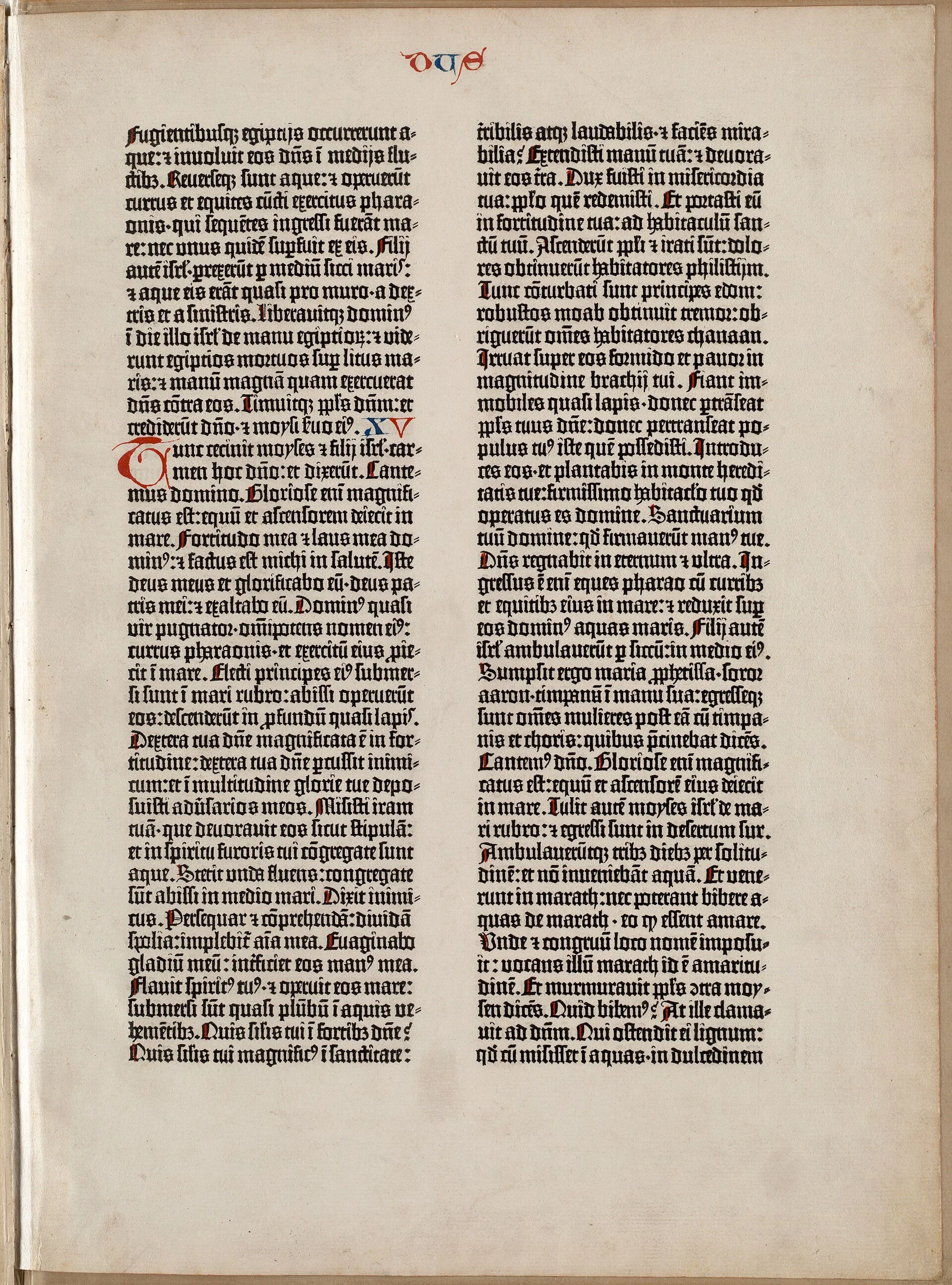
A printed page, finished by hand: Gutenberg's Bible left blank spaces, and the rubricator's red completed them.
An original leaf of the Gutenberg Bible (Mainz, c. 1454), via the Digital Public Library of America. Public domain.
A medieval book was not made by one hand. It passed through several, in order, and the order mattered.
★ First the scribe wrote the black text, and wrote it with the rubrication already in mind, leaving blank spaces where the red would go. This presupposes very careful planning before ever putting pen to parchment: the scribe had to know, line by line, where every heading, initial, and direction would fall. Then the gatherings — the folded sheet-groups the book would be sewn from — went to the rubricator, who added the titles, headlines, initials of chapters and sections, and notes in red, working from an ink-pot with a sharpened quill or a reed pen. If the book was to be illustrated, it went next to the illuminator for the pictures and the gold.
The rubricator was not the illuminator's assistant and not the scribe's inferior. The work required its own judgment: which headings, how large the initials, and where the red would guide without overwhelming. ★ In late medieval France, scholars have shown that the red rubrics and the red pen-flourished initials were often executed by different hands entirely, as the inks themselves differ: rubric ink on one side, initial ink on the other. A luxury book might pass through half a dozen specialists before it was bound. Your single-author textbook, produced by one writer at one desk, would have looked to them like a miracle of loneliness.
And the tradition outlived the manuscript. When printing arrived, the first printed books left blank spaces for rubrication by hand. The printers knew their buyers expected red, and the rubricators came to the printed page with their pens as they had come to the written one. The Malmesbury Bible of 1407, a manuscript, was rubricated by hand as manuscripts always were; and a Blackletter Bible printed at Strasbourg in 1497 carries hand rubrication over print. The red refused to retire.
❦ In your workbook: record the order of hands a medieval book passed through in your own way — copy, sketch, or note what matters.
Guided Observation: Reading in Red
Before you take up the pen, study how red governs the pages you already own. The rubricator's logic did not die with the manuscript; it moved into print, into screens, into every designed page you have ever read.
Gather three or four printed items: a textbook, a novel, a magazine, a church bulletin or program if you have one. Examine each and record:
- Where does red (or its modern stand-ins: bold type, larger type, italics) appear?
- What does each red element mark: a new chapter, a heading, a warning, a name, a direction?
- Cover every red element with your thumb. How much harder is the page to navigate?
- Find one "red-letter day" in your own life: a date on a calendar printed in red, a deadline marked in red ink. What is the red telling you to feel about that day?
Consider this: the medieval reader met the red before the word. Do you? When you open a textbook, where does your eye go first, and who put it there?
In your packet: Assignment IV — The Manuscript Investigation ✎ begins here. Work it now, or mark the place and take it as homework — your choice.
Demonstration: The Rubricator's Hand
You will now rubricate a page yourself: first in the safe modern manner, then, for those who wish to go further, with a historical plant red. The mineral reds are excluded entirely. Read the safety note before you begin.
Safety Note — Read First
Vermilion and minium are never made or handled in this lesson. Both are toxic heavy-metal pigments (mercury and lead). They belong to the history you have just studied, not to your desk. No historical authenticity is worth a poisoning, and Professor Nocturne will take a dim view of any scholar who disagrees.
Level One — The Household Rubrication
Materials: plain paper, a black pen, and a red pen, marker, or colored pencil. That is the entire kit.
1. On a fresh page, write (or copy) a short text in black: three or four paragraphs on any subject. Leave generous blank space at the top of the page and at the start of each paragraph: the scribe's foresight, practiced by you. 2. Return as the rubricator. In red, add: - a title at the top of the page - a heading over each paragraph - an enlarged red initial letter at the start of each paragraph, at least two lines tall - one line of "direction" in red (an instruction to your reader: "read this paragraph twice," "note the third sentence") 3. Step back and judge your own work as the rubricator judges: does the red tell a stranger where to look? Is anything red that should be black? Is anything black that should be red?
Level Two — The Historian's Red
Materials: frozen blackberries or raspberries (or dried madder root from a dye supplier, with adult supervision), white vinegar, gum arabic or honey, a strainer, a small saucepan, paper.
Berry ink (the safer red):
- Simmer a handful of berries in just enough water to cover them for 15 minutes. Mash, then strain through cloth. You should have a deep red-purple juice.
- Stir in a teaspoon of white vinegar (it brightens the color) and half a teaspoon of gum arabic or honey dissolved in warm water (the binder).
- Write with a dip pen or a small brush. Note honestly in your workbook that berry inks are fugitive: they fade with light and time. That fading is itself a lesson about why the manuscript reds had to be stronger stuff.
Madder ink (with adult supervision):
- Simmer one tablespoon of dried madder root (from a dye or fiber-arts supplier) in a cup of water for 30 minutes. Do not boil hard.
- Strain, add a pinch of alum if available (the mordant), and half a teaspoon of gum arabic.
- Compare the madder red to the berry red side by side. Which is closer to the manuscript headings you have seen in reproductions? Why might a medieval rubricator have preferred the root?
Record everything: color, flow, drying time, fading over the following week. The rubricator's craft was observational before it was anything else.
In your packet: Assignment II — The Rubricated Page ◐ begins here. Work it now, or mark the place and take it as homework — your choice.
Materials
Required (Level One — household items):
- Paper: plain white paper or a workbook, for the rubricated page and the observation record
- Pens: one black pen and one red pen, marker, or colored pencil. The two-ink kit is the whole lesson
- Printed items for observation: a textbook, a novel, a magazine, a church bulletin or program, a calendar (whatever you own)
Suggested (Level Two — historically closer):
- Frozen blackberries or raspberries: for the berry-red ink
- White vinegar and gum arabic or honey: the brightener and the binder
- Dried madder root: from a dye or fiber-arts supplier, with adult supervision
- A dip pen or small brush: for writing with the historical inks
- A strainer, a small saucepan, water, and a cloth to strain through: for simmering and straining the Level Two inks
- Alum: a pinch, if available, for the madder ink (the mordant)
No purchased kits or specialty tools are required. The core lesson (reading the red hierarchy and rubricating a page) is fully achievable with paper and two pens. The mineral reds (vermilion, minium) are excluded from all practical work by the safety rule above.
Reflection Questions
Answer the following questions in your workbook.
- What is rubrication, and where did the rubricator stand in the order of medieval book production?
- Trace the word "rubric" from its Latin roots to two of its modern English senses.
- Name the four historical reds studied in this lesson, the source of each, and which two are too toxic to handle.
- Explain the true etymology of "miniature" and the confusion that obscured it.
- Why did the main scribe leave blank spaces in the text, and what does that reveal about medieval planning?
- What is a "red-letter day," and what manuscript practice does the phrase preserve?
- In your own words, defend or challenge the lesson's three-word claim: color is information.
Workbook Checklist — Lesson 7
In my workbook I have:
- ☐ explained what rubrication is and where the rubricator stood in the order of medieval book production
- ☐ traced the word "rubric" from the Latin rubrica through medieval manuscripts to its modern uses
- ☐ named the four historical reds and the source of each, and marked which two are too toxic to handle
- ☐ explained why the word "miniature" comes from minium rather than from smallness
- ☐ rubricated a page of my own, using red as information: title, headings, initials, and a direction
- ☐ recorded how red, or its modern stand-ins, governs three or four printed pages I own
☐ Lesson completed Date: ___ Signature: ___
Professor's Review
And so the red lesson ends, scholars. Tidy your pens: black in its pot, red in its own, never the two confused, for the rubricator's first discipline is keeping the colors in their places.
You can now explain what rubrication was and who performed it. You can trace rubric from red ochre to the grading of examinations. You can name four reds (minium, vermilion, madder, brazilwood), and you know which two are poisons and why they are studied but never made. You know that a miniature is named for red lead and not for smallness, and I shall be watching your vocabulary henceforth.
Keep your rubricated page. In Unit IV, when you study the letterforms themselves, you will write headings worthy of the red you have learned to command. In Unit V, when you gild, you will learn what the rubricator's red does beside gold. And in your final manuscript, the red will be there, governing the page, telling the reader where to look before a single black word is read.
Color is information. Do not forget it.
PROFESSOR QUILLBERRY NOCTURNE
Scrollwork Library
Master Scribe & Illuminator
Cross-Class Connections

Runes · Lesson 20 — Spacing & Punctuation (the litterae notabiliores, red's notable letters)
Webblethorn's scholars meet the rubricator's other hand: the enlarged red initial, one on a page, teaching the hierarchy the color enforced before punctuation existed to do it. Your red initial and her notable letter are the same decision, made in two classrooms.
Runes · Lesson 18 — The Celtic Manuscript Tradition (Insular books, where the grandest hand was kept for rubrics)
In the island books, the most formal script of all was reserved for the rubrics, the display headings — and her scholars dot their initials with red ochre and vermilion-style pigment, as the island scribes did. The red-marked headings of ancient texts: there they are.
Runes · Lesson 12 — The Viking Compaction (red ochre rubbed into carved runes)
Remember what rubrica means: red ochre, the red earth. Webblethorn's carvers rub that same earth into cut runes so the letters stand out against the wood. This lesson's word began as that lesson's pigment.
Runes · Lesson 20 — Spacing & Punctuation
My scholars meet the rubricator's other hand: the enlarged red initial, one on a page, teaching the hierarchy the color enforced before punctuation existed to do it. Your red initial and my notable letter are the same decision, made in two classrooms. Come and see the decision from the reader's side.
Runes · Lesson 18 — The Celtic Manuscript Tradition
In my island books, the most formal script of all was reserved for the rubrics, and my scholars dot their initials with red ochre and vermilion-style pigment, as the island scribes did. The red-marked headings of ancient texts are waiting in my classroom. Come and read them.
Runes · Lesson 12 — The Viking Compaction
Remember what rubrica means: red ochre, the red earth. My carvers rub that same earth into cut runes so the letters stand out against the wood. This lesson's word began as my lesson's pigment. Come and rub the earth into the carving yourself.
PROFESSOR THISTLELOOM WEBBLETHORN
Runes & Ancient Writing

Potions · Unit VI, Lesson 49 — Fluid Color: Plant & Berry Stains (madder, weld, and woad: the dyer's red)
Muddlenook's laboratory works this lesson's plant reds from the other side: madder root for red, and berry stains that fade exactly as your Level Two berry ink fades. Make the ink here; learn in his laboratory why the mordant mattered more than the dye.
Potions · Unit VI, Lesson 51 — Wax Seals & Colored Matrix Blends (vermilion, the classic red of sealing wax)
The classic red of sealing wax was this lesson's brilliant poison, and Muddlenook's rule is the same as mine, word for word in spirit: vermilion is studied there and never handled, and the red wax is colored with modern pigments. Two classrooms, one discipline.
Potions · Unit VI, Lesson 49 — Fluid Color: Plant & Berry Stains
I work this lesson's plant reds from the other side: madder root for red, and berry stains that fade exactly as your Level Two berry ink fades. Make the ink in Professor Nocturne's library; then come to my laboratory and learn why the mordant mattered more than the dye.
Potions · Unit VI, Lesson 51 — Wax Seals & Colored Matrix Blends
The classic red of sealing wax was this lesson's brilliant poison, and my rule is the same as Professor Nocturne's, word for word in spirit: vermilion is studied in my laboratory and never handled, and the red wax is colored with modern pigments. Two classrooms, one discipline. Come and see the discipline kept.
PROFESSOR CRIMBLEBREW MUDDLENOOK
Potions Laboratory • Master Apothecary • Head of House Meridies

Celestial Studies · Unit I, Lesson 5 — Calendars of the World
Glimmerwick keeps the calendar this lesson borrows its best phrase from: the feast days that stood in red while the ordinary days stood in black. Her scholars count the year by sun and moon; the red-letter day is what the counting looked like on the page.
Celestial Studies · Unit I, Lesson 5 — Calendars of the World
I keep the calendar this lesson borrows its best phrase from: the feast days that stood in red while the ordinary days stood in black. My scholars count the year by sun and moon. Come and learn the counting; the red-letter day is what it looked like on the page.
PROFESSOR VESPER GLIMMERWICK
Celestial Studies • Astronomer & Celestial Historian
Further Reading & Sources
Wikipedia. "Rubrication." The separate stage of manuscript production: rubricators and rubrishers, the Latin roots (ruber, rubricare), and the practice's origin in pharaonic Egypt. en.wikipedia.org/wiki/Rubrication
Wikipedia. "Minium (pigment)." Red lead in manuscripts: paragraph signs, versals, capitals, and headings; the miniare verb and the miniator; the pigment's tendency to darken. en.wikipedia.org/wiki/Minium_(pigment))
Wikipedia. "Vermilion." Mercury sulfide from cinnabar; the Chinese synthetic invention and its medieval arrival in the West; the pigment's brilliance, toxicity, and tendency to darken. en.wikipedia.org/wiki/Vermilion
Wikipedia. "Miniature (illuminated manuscript)." The true etymology, from miniare ("to color with minium"), and the confusion with smallness that followed. en.wikipedia.org/wiki/Miniature_(illuminated_manuscript))
UCLA. "Scribes' Toolkit: Medieval Inks." Period ink recipes including brazilwood reds (the 1596 English recipe), vermilion with gum arabic and egg white, and the full medieval palette. pages.gseis.ucla.edu/faculty/drucker/HoB_Site/HoB_Scribes_Medieval_Inks.html
Browse the Scrollwork shelf in the school Library for readable editions of these works.
Submit your work for this lesson using the form below.
CONTINUE IN THE SCROLLWORK LIBRARY
← Previous · Lesson 6: Oak Gall Ink Next · Lesson 8: Ink Flow & Preservation →
Unit II — Ink & Pigment Scrollwork Library — All 26 Lessons
The rest of Unit II: Lesson 5 · Soot & Charcoal Ink · Lesson 6 · Oak Gall Ink · Lesson 8 · Ink Flow & Preservation