

SCROLLWORK
Unit II · Lesson 6OAK GALL INK
Professor's Introduction
Eyes here, scholars.
Last lesson, you made carbon ink: soot and water and binder, the oldest black we know. It sits upon the page, honest and stable, and asks nothing of the fibers beneath it. Tonight we meet its great rival, the ink that ruled Europe for eight hundred years and still holds most of what the Middle Ages wrote.
Iron gall ink — the ink of oak galls, an iron salt, and a binder — goes onto the page pale and unremarkable, almost grey. Then the air touches it, and it darkens. It does not sit upon the page. It bites into it, bonds with the fibers, and becomes part of the sheet itself. That is why it endures. That is also why, centuries later, it is eating the manuscripts it was meant to preserve.
You will make this ink, or its close cousin, with your own hands. You will watch a pale liquid turn black in the air, and you will understand the bargain every medieval scribe struck: permanence purchased with acid. Observe carefully. The ink rewards attention and punishes haste.
Grind finely. Measure honestly. And mind the safety notes. Iron salts are not toys.
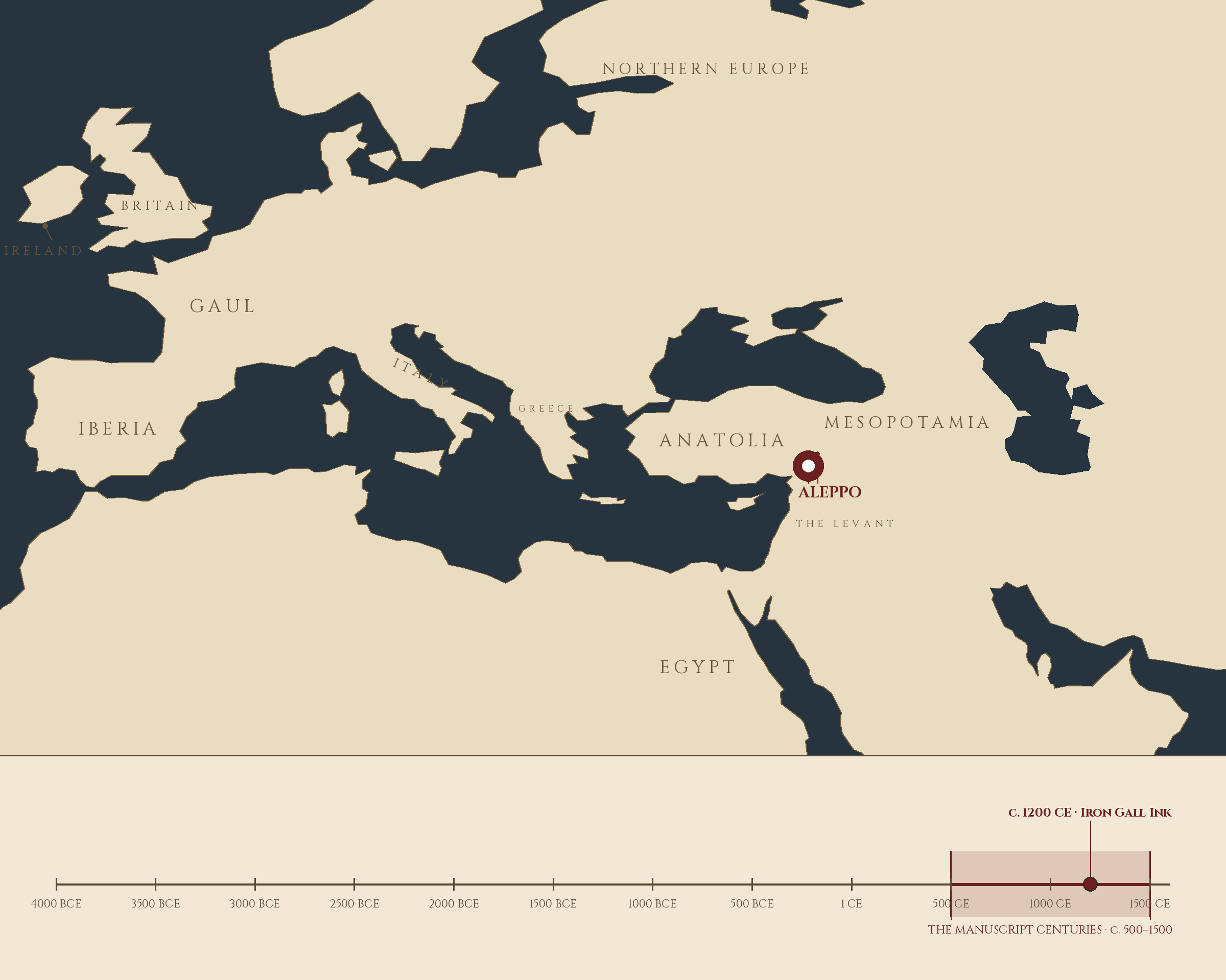
Where and when: Aleppo, Syria, c. 1200 CE — Iron Gall Ink. The pin is this lesson. The line beneath the map is our road: every stop a place where writing changed, every lesson a pin.
Lesson Objectives
By the end of this lesson, students should be able to:
- explain what an oak gall is and how gall wasps produce it
- describe the three essential ingredients of iron gall ink and the role of each
- define oxidation and explain why iron gall ink darkens after writing
- distinguish ferrous from ferric iron in the ink's chemistry
- explain ink corrosion and why it threatens historical manuscripts
- evaluate the trade-off between permanence and preservation in writing inks
- prepare a small batch of iron gall ink (or its household analogue) following safety procedures
Reading this lesson: ★ marks the passages to remember. They return on the unit quiz and the class test. Check in questions ask the material back as you go; answer them in your workbook when you meet them.
Working this lesson: Your assignment packet is the first download on this page. Work in it as the lesson moves along, answering each assignment as its subject is taught — or read the lesson through for your notes and take the assignments as homework afterward. Both are proper ways to sit this class. Signposts in the reading tell you where each assignment belongs. Written answers are short answers in your own words; a few honest lines are worth more than a filled page.
Your Assignment Packet
This lesson's assignments live in its packet: the Lexicon Handout (every term, course terms marked ◆), Materials, Guided Practice, the Assignment Manual with its answer key for self-checking, the Reflection Questions, and the Workbook Checklist. Download the packet before you begin and keep it beside you as you read.
Historical Overview: The Wasp's Gift
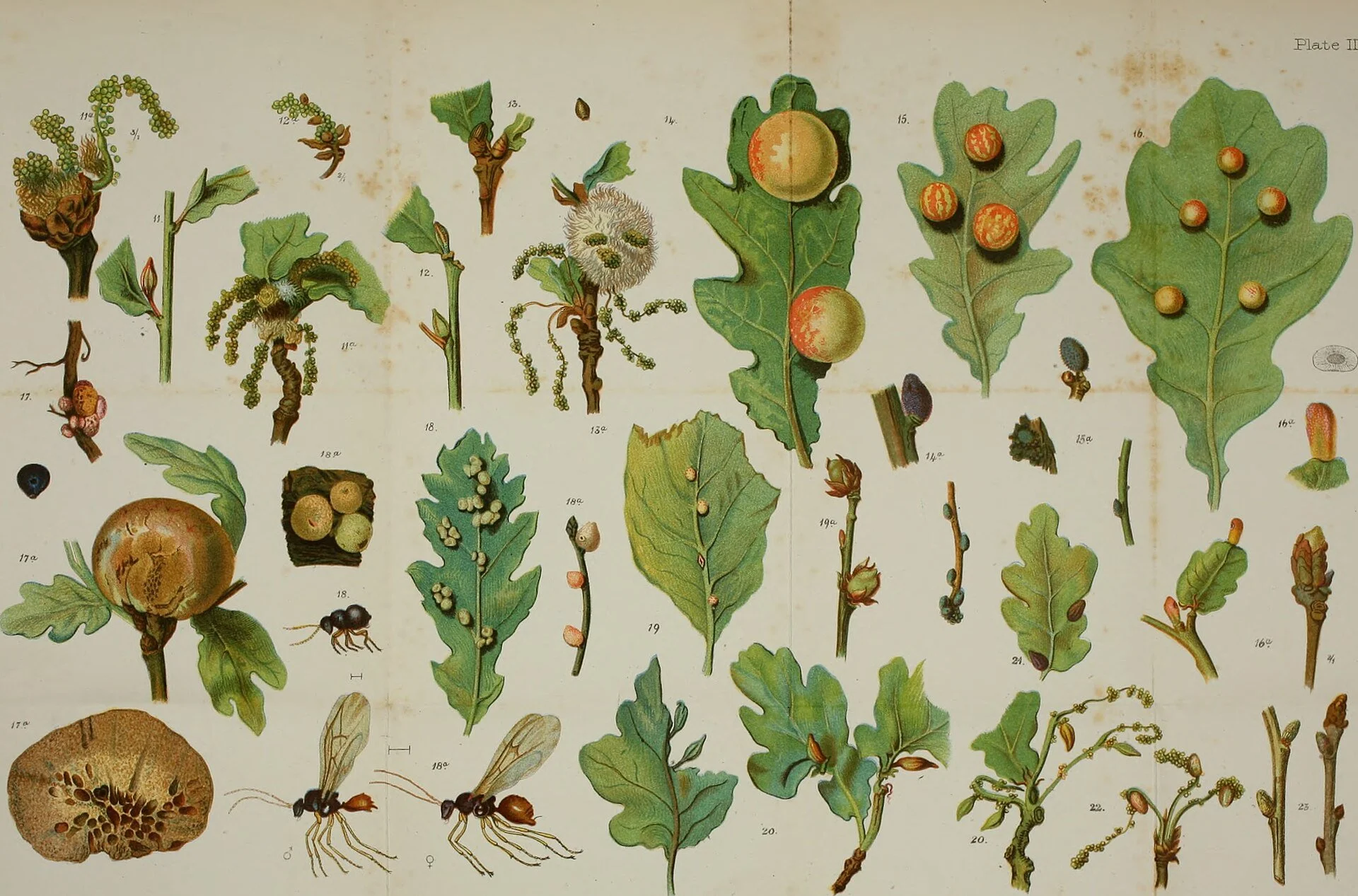
Oak galls of many kinds, and the wasps that cause them, painted for a scientific study of 1894.
Oak galls and gall wasps, Plate II from Hermann Adler, Alternating Generations: A Biological Study of Oak Galls and Gall Flies (1894), via the Biodiversity Heritage Library. No known copyright restrictions.
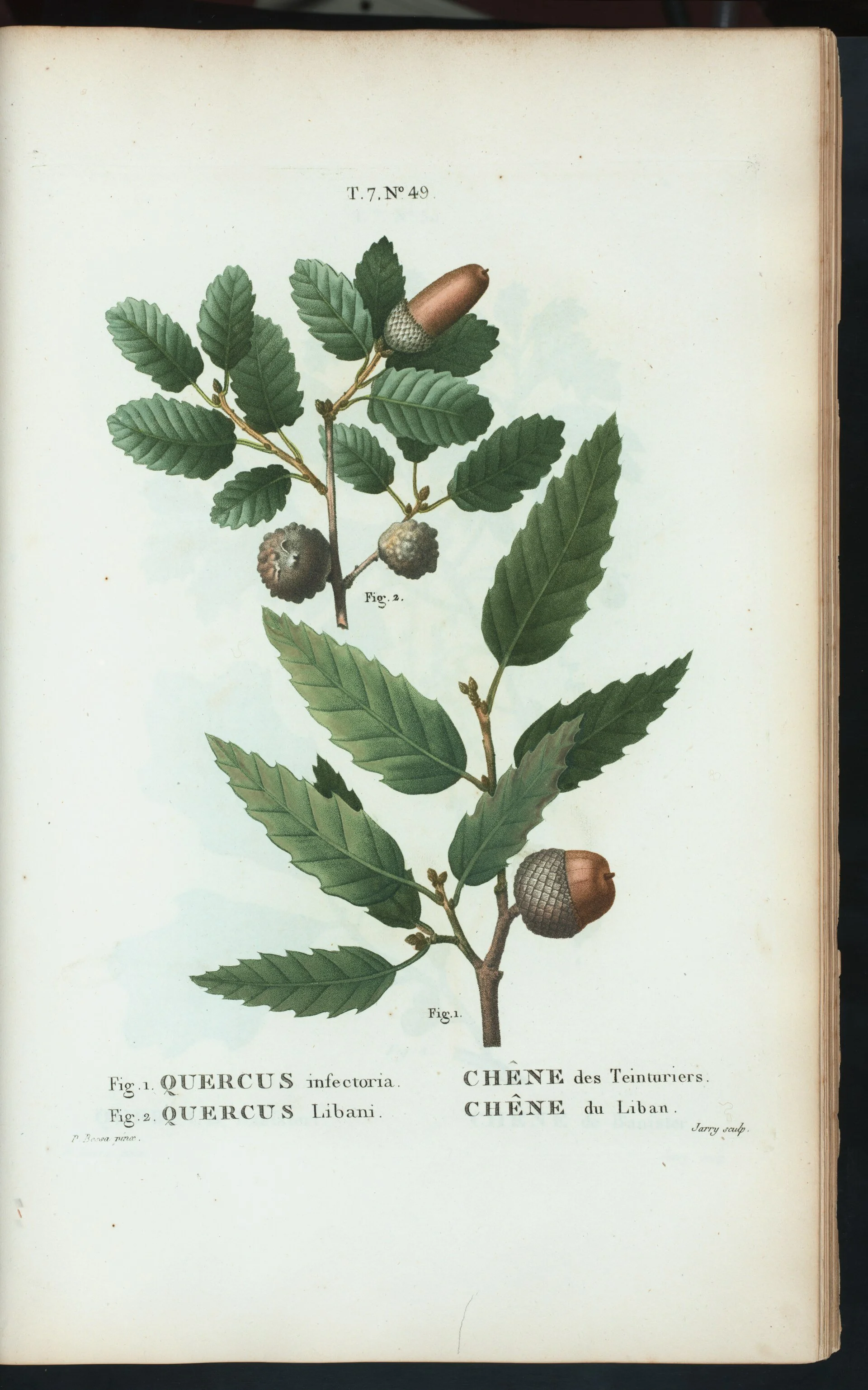
Quercus infectoria, the Aleppo oak — the dyers' oak — whose galls made the strongest ink; the galls pictured hang on the Lebanon oak drawn above it.
Quercus infectoria, plate 49 from Duhamel du Monceau's Traité des arbres et arbustes, drawn by P. Bessa. Scan by the New York Public Library. Public domain.
Before there was ink, there was a wasp.
★ On oak trees across Europe and the Near East, tiny gall wasps of the family Cynipidae lay their eggs in the buds of oaks. The tree responds the only way it knows: it grows. Around the egg it builds a round, hard chamber, marble-sized, ridged and warty, rich in tannins — astringent plant compounds, and the ink-maker's prize. The oak grows the chamber's outer wall hard as armor, and the tannins are stored within it; the soft inner tissue feeds the larva. The wasp gets a nursery. The tree gets a tumor. And centuries of scribes got their ink.
★ Not all galls served equally. The most prized were the Aleppo galls, grown on Quercus infectoria by the wasp Cynips tinctoria: hard, heavy, and extraordinarily rich in tannin, in some analyses two-thirds of their weight. Merchants distinguished the "blue" or "green" galls, gathered with the insect still inside, from the inferior "white" galls collected after the wasp had chewed its way out. The exit costs the gall its strength: the larva has eaten into the inner tissue where the tannins gather, and the opened, dead gall weathers and loses more — the unopened galls, gathered with the insect still inside, are richest in tannin. The ancients knew these growths well. Theophrastus described them, Dioscorides catalogued them, and Pliny the Elder recorded that paper soaked in green vitriol blackens when dipped in an infusion of nut-galls. Pliny had seen the reaction. It would be a thousand years before anyone wrote the recipe down.
Check in: The "white" galls were gathered only after the wasp had chewed its way out. Why did that make them the inferior ink-galls?
❦ In your workbook: record the wasp's gift in your own way: how a gall grows, and why the Aleppo gall was prized — copy, sketch, or note what matters.
The Recipe Tradition
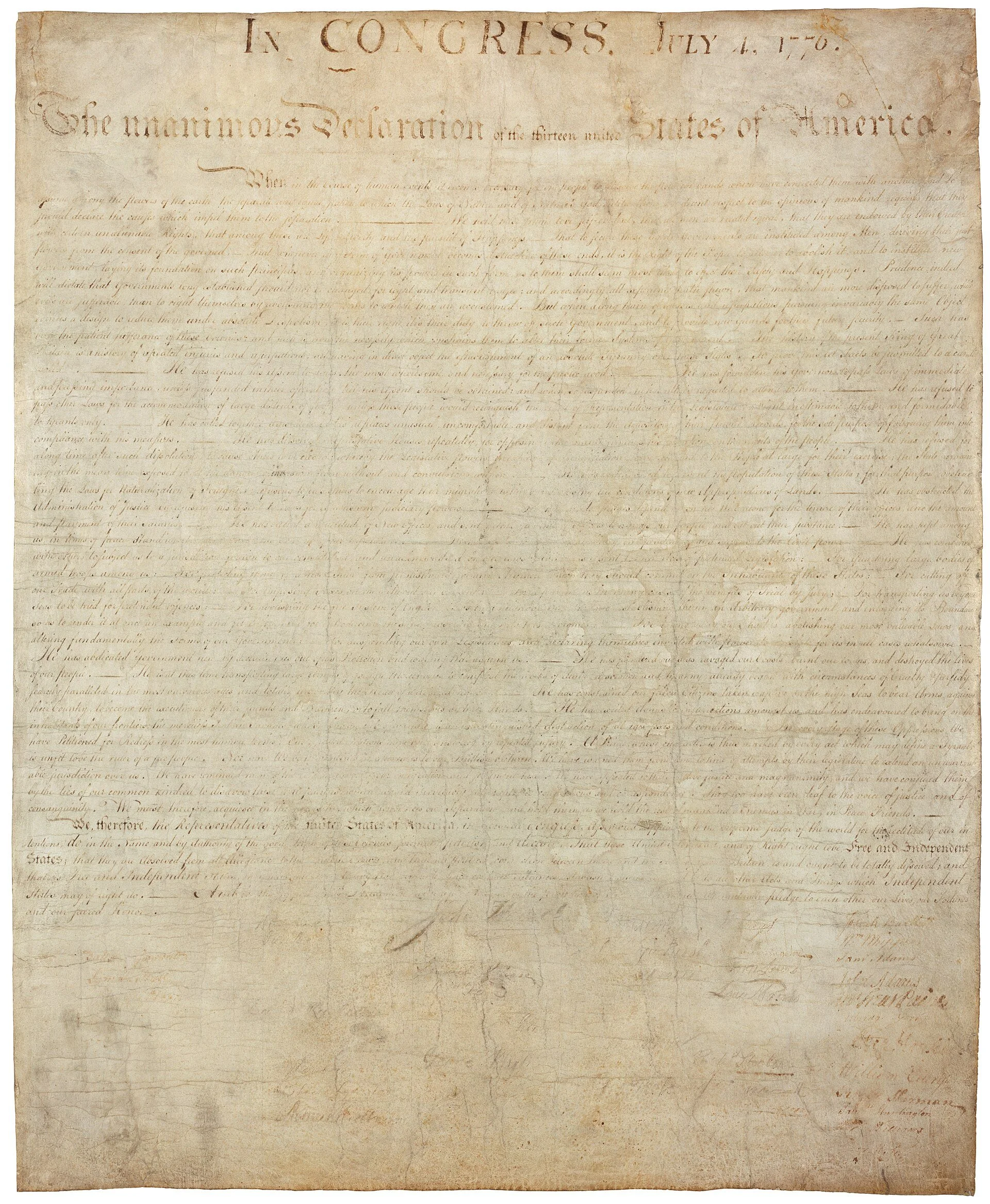
A nation's founding charter, written in iron gall ink on parchment in 1776 — and faded toward brown, as iron gall does.
The engrossed Declaration of Independence (1776), U.S. National Archives and Records Administration. Public domain.
★ The first written description of iron gall ink comes to us from a monk. Theophilus, writing in the 12th century in his handbook De diversis artibus (On Various Arts), set down how ink was made: not from soot this time, but from the dark chemistry of galls and iron. His is the earliest recipe we have, though the ink itself is older. Evidence suggests scribes were already experimenting with metal and gall mixtures as early as the 4th century, and the changeover from carbon ink was gradual, beginning around the 7th century. By the 11th to 13th centuries, iron gall ink had become the common ink of the Western world, nearly replacing carbon ink as the standard for books and documents (UCLA Scribes' Toolkit).
★ The recipes multiplied across the centuries, and they agree on the essentials. Galls were crushed and soaked in rainwater (sometimes wine or vinegar) to draw out the tannins. Green vitriol, the iron sulfate, was dissolved in. Gum arabic went in last, to thicken the mixture and keep it flowing from the pen. A 1540 recipe by the writing master Palatino gives the proportions plainly: three ounces of crushed galls soaked in rainwater in the sun, two ounces of copperas stirred in, one ounce of gum arabic to finish. Three ingredients, sunlight, patience — three, that is, besides the rainwater that carries them; some authorities count the liquid and say four. The proportions wandered from recipe to recipe, and with them the ink's character: too much iron and the ink would bite too fiercely; too little and it would fade to brown.
Check in: A recipe doubles the copperas and halves the galls. From the ink's character as this lesson describes it, what two changes would you predict, and why?
★ From the 12th century until the early 20th, iron gall ink was the primary writing ink of the Western world (IFLA Preservation FAQ). It wrote the charters, the chronicles, the music, and the law. Only in the 19th century did synthetic aniline dyes begin their long displacement of it. For eight hundred years, if words mattered enough to keep, they were kept in iron and gall.
❦ In your workbook: record the recipe tradition in your own way: Theophilus, Palatino's three-two-one, and what wandering proportions did to the ink — copy, sketch, or note what matters.
In your packet: Exercise II — The Recipe Comparison ✎ begins here. Work it now, or mark the place and take it as homework — your choice.
Professor Nocturne
Stop a moment, and fix this in your mind, because students always ask it backwards.
★ They ask: why did the scribes abandon good carbon ink for this corrosive stuff? As if permanence were a single virtue and the scribes were fools. They were not fools. Carbon ink sits upon the page. A damp cloth can lift it. A careless thumb can smudge a year's work into grey. Iron gall ink does what carbon cannot: it enters the fibers and becomes part of the sheet. A charter written in iron gall cannot be washed clean and forged anew. That is why the law courts demanded it. That is why the monasteries trusted it with Scripture.
Every ink is a bargain. Carbon offers gentleness and asks vigilance in return. Iron gall offers permanence and asks the page itself as payment, slowly, over centuries. The scribe's question was never which ink is best. It was: what does this writing need to survive, and what am I willing to spend?
Hold that question. You will need it at the end of this lesson.
The Chemistry of the Darkening
Here is the part that still surprises students, though the ink has been doing it for a thousand years: iron gall ink goes onto the page pale.
★ Mixed fresh, the ink is a thin grey-violet liquid, so faint that a scribe could barely see the line. The color comes from ferrous tannate, the compound formed when the iron meets the tannins: soluble, pale, unimpressive. Then the air does its work: oxidation, the ink's iron combining with oxygen from the air. Oxygen converts the ferrous iron to ferric iron, and the compound becomes ferric tannate: black, water-insoluble, and bound fast to the fibers of parchment or paper. The line darkens over hours and days, pale grey deepening to full black. The scribe wrote in ghost, and the air supplied the ink.
Check in: In your own words: what exactly changes between the moment the ink leaves the pen and the moment the line stands black? Name both iron states.
This is why the ink is permanent in a way carbon never was. Carbon particles rest on the surface, held by binder. Iron gall pigment is created inside the page, locked among the fibers by chemistry. Water will not lift it. Time fades it only slowly, toward brown.
★ But the same reaction that fixes the ink poisons the page. Forming the iron-tannin complex releases sulfuric acid, and free acid remains in the dried ink. Acid attacks cellulose, the fiber of paper, and collagen, the substance of parchment: it cuts the long molecules into shorter ones, and the sheet weakens wherever the ink lies thickest. The page browns in a halo around each letter. Given centuries, the letters crack, flake, and fall out, leaving the words as holes. Conservators call it ink corrosion. The scribes would have called it the bite. It was always there, in every recipe, from Theophilus onward. No medieval ink-maker could remove it, because the acid is not a contaminant. It is part of how the ink works.
❦ In your workbook: record the chemistry of the darkening in your own way: pale ferrous to black ferric, and the acid that rides along — copy, sketch, or note what matters.
The Manuscripts That Are Eating Themselves
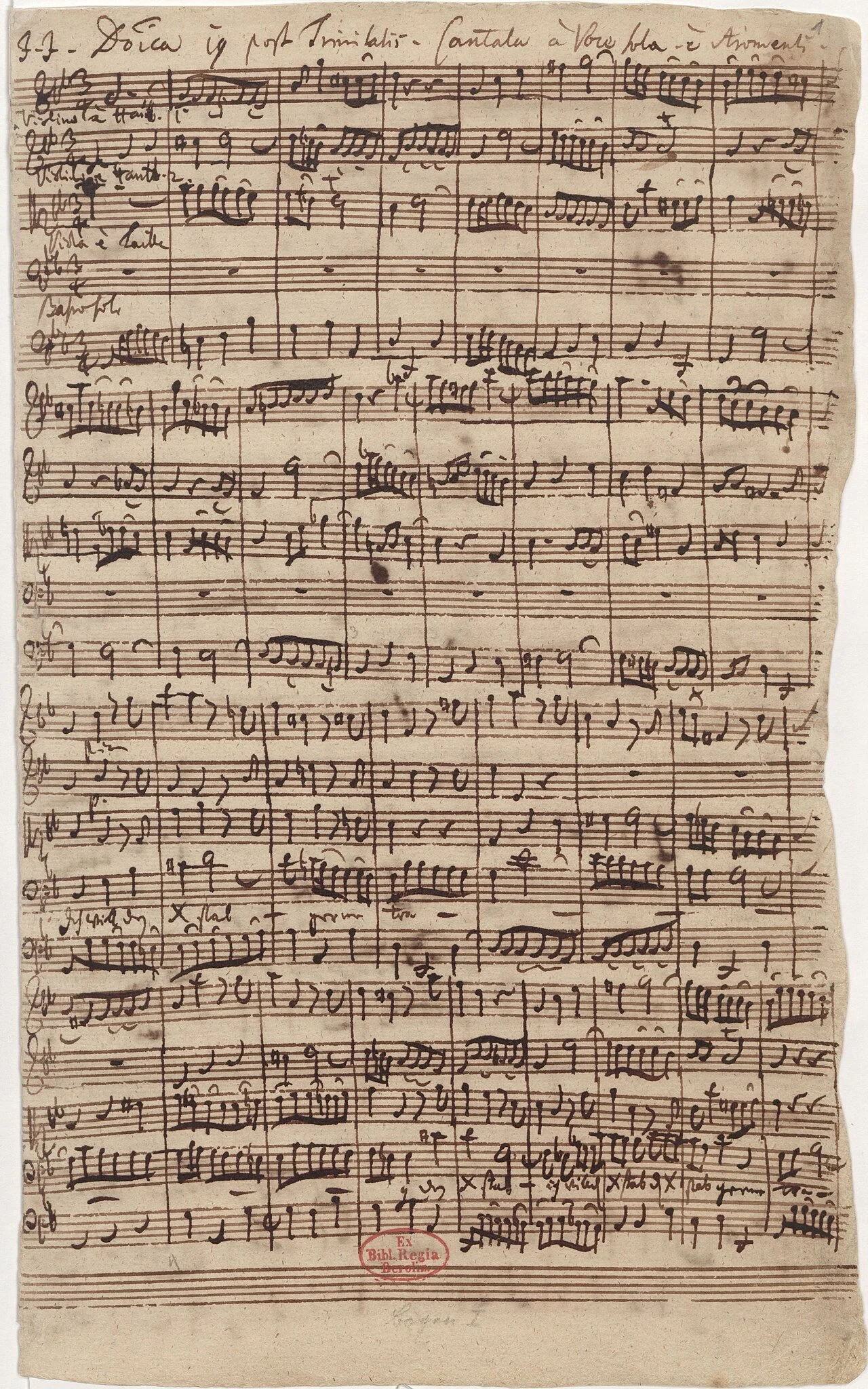
Bach's own hand, in iron gall ink: the first page of his cantata BWV 56, written in 1726 — the ink that now threatens the page.
J. S. Bach, autograph score of Ich will den Kreuzstab gerne tragen, BWV 56 (1726), first page, digitised by the Bach Digital archive, Leipzig. Public domain.
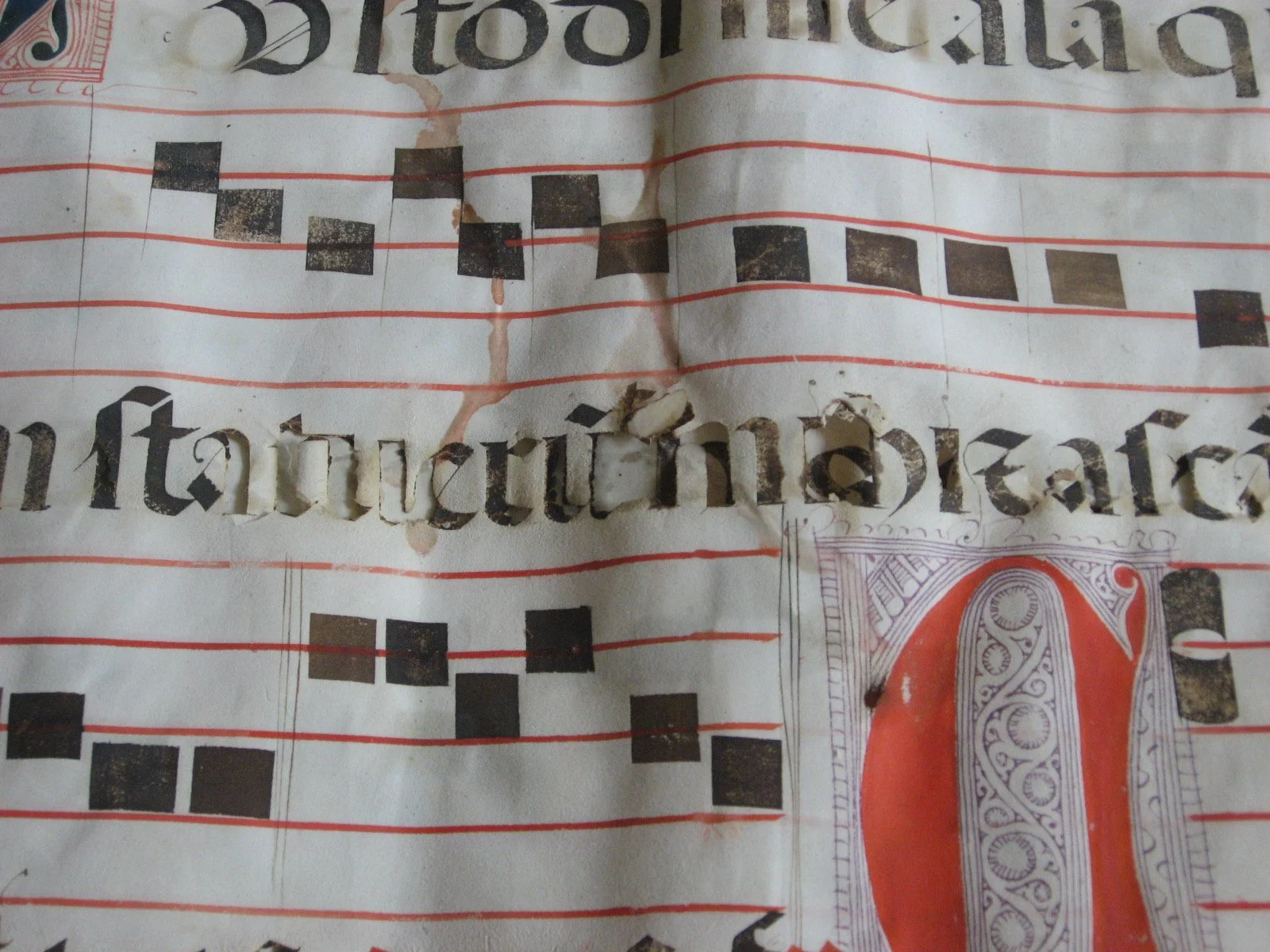
Ink bite, finished: the letters of this chant page have been eaten out of the sheet, leaving the words as holes.
Ink corrosion in a chant manuscript, Igreja de São Francisco, Évora, Portugal. Photograph by Ceinturion. Public domain.
You do not need to imagine ink corrosion. You can visit it.
★ The British Library holds manuscripts in the hand of Johann Sebastian Bach, and its conservators describe the problem plainly: they are being eaten by their own ink. Bach wrote his music in iron gall ink, as nearly every European did in the 18th century, and where he laid the ink on thickly, as composers do when the music runs urgent across the staff, the acid has gone to work. The Library's collection care specialists report the damage without euphemism: visible holes in some places, hairline cracks in others, the paper embrittled exactly along the lines of the notes. Music notation is cruelly vulnerable, because expression demands thick, repeated strokes, and every thick stroke is a dose of acid.
Check in: Why is a page of a composer's music in more danger from its own ink than a copyist's page of even text?
The Bach manuscripts are not exceptional. They are typical. Across Europe's libraries, the same brown halos spread around the letters of charters, chronicles, and letters. Some inks were gentle and the pages hold; some were fierce and the words are falling out. The difference lay in the recipe: the ratio of galls to vitriol, the purity of the ingredients, the hand of the maker. Seven hundred years of scribes, each striking the bargain a little differently, and the pages are still settling the accounts.
★ Modern conservators fight the corrosion with careful chemistry: phytate treatments that lock the free iron away, deacidification, and above all controlled storage, cool and dry and dark. They cannot undo the acid. They can only slow the reckoning. When you read that a library has digitized a manuscript "for preservation," sometimes what that sentence means is: the ink is winning, and the photograph must outlive the page.
❦ In your workbook: record the eating manuscripts in your own way: what the bite does to a page, and what conservators can and cannot do — copy, sketch, or note what matters.
In your packet: Exercise III — The Corrosion Case Study ◐ begins here. Work it now, or mark the place and take it as homework — your choice.
Guided Observation: The Pale Line That Darkens
Before you mix anything, train your eye on the phenomenon itself: a liquid that changes color in air.
You will need:
- strong black tea, brewed double strength and cooled (your tannin source)
- a small jar or glass
- white paper and a brush or cotton swab
- a second jar for a control
Prepare the observation. Pour tea into both jars. Leave one jar as your control. You will add iron to the other.
Make the iron solution. Place a small piece of fine steel wool in a jar, cover it with plain white vinegar, and leave it for two days. The vinegar dissolves iron from the wool. (Prepare this two days before your observation session. Keep the jar labeled and out of reach of small children.)
Mix and watch. Add a few drops of the iron-vinegar liquid to one tea jar and stir. Paint a stripe of plain tea and a stripe of the mixture side by side on white paper. Record the colors. Leave the paper undisturbed for 24 hours and observe again.
Consider:
- What color is the mixture at first? What color is it a day later?
- Does the control stripe change? What does that tell you?
- The tea holds tannins, as the galls do; the dissolved iron plays the part of vitriol. What have you just watched?
- Why would a scribe accept an ink he could barely see as he wrote?
Safety: do not drink any of these mixtures. Wash your hands after handling. The quantities are tiny and the materials are household, but the iron solution is not food. Adult supervision for younger scholars.
Demonstration: Making Iron Gall Ink
There are two paths through this demonstration. The first uses household materials to show the ink's chemistry honestly without claiming to be a historical recipe. The second makes true oak gall ink from purchased materials, for students ready to work as the recipe books describe. Read all safety notes before choosing.
Suggested Materials — Level One (Household)
- strong black tea (tannin source)
- fine steel wool and plain white vinegar (iron source)
- small jars with lids, a stirrer, a cloth for straining, white paper, brush or swab
- a clock or timer, for the oxidation checks
- gum arabic solution (optional; a small amount of liquid watercolor binder, or a drop of honey thinned in water, will show the binder's effect)
Safety: prepare the iron solution two days ahead. Keep all mixtures labeled and away from food, children, and pets. Do not drink. Wash hands after handling. Work near a sink.
Level One: The Household Ink
In Level One, you will make an iron-tannin ink from tea and dissolved iron. This is an experimental classroom formulation that demonstrates the true chemistry of iron gall ink. It is not a historical recipe.
Brew the tannin. Steep four black tea bags in one cup of just-boiled water for fifteen minutes. Remove the bags and let the tea cool completely. This dark liquor is your gall infusion in miniature.
Prepare the iron. Two days before, place a walnut-sized piece of fine steel wool in a jar and cover with white vinegar. Cap loosely and leave it. The liquid will darken as iron dissolves.
Combine. Strain the iron liquid through cloth. Add one teaspoon of it to a quarter cup of the strong tea. Stir and watch: the mixture darkens as the iron meets the tannins.
Add the binder. Stir in a quarter teaspoon of gum arabic solution (or your household stand-in). Test the flow with a brush on paper.
Observe the oxidation. Paint lines and leave them. Check after one hour, six hours, and the next day. Record the darkening. You are watching ferrous become ferric, the same transformation the medieval scribe watched.
Suggested Materials — Level Two (Historian's Ink)
- oak gall powder (purchased; Aleppo or domestic oak galls, finely ground)
- ferrous sulfate (purchased; sometimes sold for garden or pond use)
- gum arabic powder
- distilled water, small jars, cloth for straining, brush or dip pen
- nitrile gloves, eye protection
Safety: ferrous sulfate is a skin and eye irritant and harmful if swallowed. Wear gloves and eye protection. Work in a ventilated area, keep materials away from children and pets, label everything, and wash hands thoroughly when finished. Adult supervision required. Make only a small batch.
Level Two: The Historian's Ink
For students ready to work from the recipe tradition: combine three parts oak gall powder with twelve parts distilled water in a jar (parts by weight throughout; weigh the water too). Leave in a warm place for two days, shaking occasionally, then strain through cloth. Dissolve two parts ferrous sulfate in the strained liquid and stir. Add one part powdered gum arabic and stir until dissolved. Let the ink rest overnight, then strain once more and bottle.
Write with it and watch the pale line darken. Compare its behavior with your Level One tea ink: which darkens faster, which writes blacker, which flows better from the pen? Record everything. You are repeating, in miniature, the work of a thousand scriptoria.
In your packet: Exercise I — The Oxidation Log ⚒ begins here. Work it now, or mark the place and take it as homework — your choice.
Materials
Required (Level One — household items)
- Strong black tea: the tannin source, the gall infusion in miniature. Four tea bags steeped in one cup of just-boiled water for fifteen minutes, then cooled.
- Fine steel wool and plain white vinegar: the iron source. A walnut-sized piece of steel wool covered with vinegar and left for two days yields the iron solution. Keep it labeled and away from food.
- Small jars with lids, a stirrer, and a cloth for straining.
- White paper and a brush or cotton swab: for the test strips and the observation stripes.
- Gum arabic solution: optional. A small amount of liquid watercolor binder, or a drop of honey thinned in water, will show the binder's effect.
- A clock or timer: for the oxidation log's observations at 1 hour, 6 hours, 24 hours, and 48 hours.
- A workbook: for the observation record, the oxidation log, and the written exercises.
Suggested (Level Two — historically closer)
- Oak gall powder: purchased; Aleppo or domestic oak galls, finely ground. The true tannin source.
- Ferrous sulfate: purchased; the vitriol. A skin and eye irritant: gloves and eye protection required.
- Gum arabic powder: the historical binder.
- Distilled water, small jars, cloth for straining, brush or dip pen.
- Nitrile gloves and eye protection. Adult supervision required for Level Two.
Reflection Questions
Answer the following questions in your workbook.
- What is an oak gall, and what creature causes it to grow? Why were Aleppo galls the most prized?
- Name the three essential ingredients of iron gall ink and the role of each.
- Why does iron gall ink go onto the page pale? Describe the chemical change that darkens it, naming both iron states.
- What is ink corrosion, and what causes it? Why can it never be fully "fixed"?
- Why did scribes prefer iron gall ink to carbon ink for legal documents? What was the trade-off?
- What does the Bach manuscript case demonstrate about the relationship between permanence and preservation?
Workbook Checklist — Lesson 6
In my workbook I have:
- ☐ explained what an oak gall is, and how the gall wasp produces it
- ☐ named the three essential ingredients of iron gall ink, and the role of each
- ☐ defined oxidation, and explained why the ink darkens after writing
- ☐ told ferrous iron from ferric iron, and said which state the scribe writes with
- ☐ explained ink corrosion, and why it threatens the very manuscripts the ink preserved
- ☐ weighed the bargain in my own words: permanence against preservation
- ☐ made my ink, or its household analogue, by the lesson's safety procedures, and kept the oxidation log
☐ Lesson completed Date: ___ Signature: ___
Professor's Review
Review with me, then, what your hands now know.
The wasp builds the gall; the tree supplies the tannin; the earth supplies the iron; the scribe supplies the patience. Four companions, and the fifth is the air itself, which finishes what the pen began. Pale ferrous becomes black ferric. The line you could barely see becomes the line no water can lift.
And the acid remains. Every recipe, from Theophilus to Palatino to the bottle on a modern calligrapher's shelf, carries the same passenger: the acid that fixes the ink and eats the page. The Bach manuscripts are only the most musical of the casualties. Every archive in Europe holds the evidence.
So here is the lesson's question, and I expect you to carry it beyond this library. Carbon ink asked the scribe to protect the page from the world. Iron gall ink asked the page to survive the ink. Which bargain would you strike, if the words were yours and the centuries were watching? There is no safe answer. That is why it is worth asking.
Next lesson, we turn from black to red: the inks of rubrication, and the scribes who painted hierarchy onto the page in vermilion and red lead.
Professor Quillberry Nocturne Scrollwork Library Master Scribe & Illuminator
In your packet: Assignment V — The Bargain Essay ✎ begins here. Work it now, or mark the place and take it as homework — your choice.
Cross-Class Connections
Potions · Unit VI, Lesson 48 — Midnight Carbon & Oak Gall Inks
Muddlenook takes up this very ink in his laboratory, and says so plainly: Scrollwork Lesson 6 owns the making, the writing, and the watching-it-darken; his bench studies the reactions beneath our craft. Make the ink here. Then go and learn what it was doing inside the jar.
Potions · Unit VI, Lesson 50 — Paper Aging & Manuscript Staining
The bite has a second classroom. Muddlenook's aging lesson teaches his scholars to identify ink corrosion on real paper, alongside foxing and toning: the same slow acid this lesson met in Bach's scores, read there as evidence on the sheet itself.
Potions · Unit VI, Lesson 48 — Midnight Carbon & Oak Gall Inks
Professor Nocturne's scholars make this ink with their hands; in my laboratory we take it apart. You will study the reaction inside the jar: pale ferrous tannate turning to black ferric tannate, and the acid that rides along and must be respected. Make the ink in his library first. Then come to my bench and learn what it was doing while you watched it darken.
Potions · Unit VI, Lesson 50 — Paper Aging & Manuscript Staining
The bite has a second classroom, and it is mine. In my aging lesson you will learn to identify ink corrosion on real paper, beside foxing and toning: the same slow acid Professor Nocturne met in Bach's scores, read as evidence on the sheet itself. Come and read it with a chemist's eye.
PROFESSOR CRIMBLEBREW MUDDLENOOK
Potions Laboratory • Master Apothecary • Head of House Meridies

Runes · Lesson 15 — The Monastic Additions
Webblethorn's scholars draw the forfeda with a quill and oak gall ink, and her lesson sends them to this library for the making of it. The ink you bottle here is the ink their pens will carry. Draw them there, if you like, and feel the tools meet the signs.
Runes · Lesson 18 — The Celtic Manuscript Tradition
The island manuscripts Webblethorn studies were written in dark inks of this family, and her materials list names iron gall as the period ink of the Celtic tradition. The hand that wrote the Book of Kells' world held a pen filled with what this lesson brews.
Runes · Lesson 15 — The Monastic Additions
My scholars draw the forfeda with a quill and oak gall ink, the very ink this lesson bottles, and I send them to Professor Nocturne's library for the making of it. Draw the signs in my classroom first; then go and brew the ink their pens will carry. The tools and the signs belong together.
Runes · Lesson 18 — The Celtic Manuscript Tradition
The island manuscripts I study were written in dark inks of this lesson's family, and my materials list names iron gall as the period ink of the Celtic tradition. The hand that wrote the Book of Kells' world held a pen filled with what this lesson brews. Come and read those pages knowing what was in the well.
PROFESSOR THISTLELOOM WEBBLETHORN
Runes & Ancient Writing
Further Reading & Sources
*J. Kolar and M. Strlic, eds. Iron Gall Inks: On Manufacture, Characterisation, Degradation and Stabilisation. Ljubljana: National and University Library, 2006.* The scholarly standard on iron gall ink: how it was made, how it decays, and how conservators fight the decay. For the student who wants the full chemistry behind this lesson.
British Library, Collection Care Blog. "Iron gall ink on paper: saving the words that eat themselves." British Library: Iron gall ink on paper The conservation story behind this lesson's case study: what ink corrosion looks like up close, why it happens, and what the Library does about it, including the Bach manuscripts.
IFLA Preservation and Conservation Programme. "Iron Gall Ink: Frequently Asked Questions." IFLA: Iron gall ink FAQ (PDF) A clear, authoritative overview from the international library community: the four ingredients, the chemistry, which collections hold iron gall ink, and how it is preserved.
UCLA, Museum of Writing Research Collection. "Scribes' Toolkit: Medieval Inks." UCLA: Medieval Inks A university exhibit page covering carbon and metal-gall inks side by side, with Palatino's 1540 recipe quoted in full and the story of the gradual changeover from the 7th century.
*Frank Kaczmarek. "It Takes Gall(s) To Make This Ink." Northern Woodlands (The Outside Story).* Northern Woodlands: It Takes Gall(s) (PDF) An accessible natural history of the oak gall and its wasp, written by a biologist, including the story of a college class that made iron gall ink from foraged galls following a 1571 recipe.
*1911 Encyclopaedia Britannica, "Ink."* Britannica 1911: Ink The classic reference entry: Theophilus as the first describer of iron-gall ink, Pliny's observation of the gall-vitriol reaction, and the 19th-century chemistry that explained it all.
Browse the Scrollwork shelf in the school Library for readable editions of these works.
When a commission names oak gall, it names this lesson's ink — the black that bites into the surface and darkens with age, the ink the manuscripts were written in. The Desk will ask which ink your piece wants. You now know what this one does.
The Commission DeskPROFESSOR QUILLBERRY NOCTURNE · SCROLLWORK LIBRARY
You have ground the galls and learned what this ink does. In my Laboratory the same ink is brewed at working scale — the galls weighed, the iron measured to the shade you intend, the batch strained and bottled to keep. When you want a bottle of it that outlasts a lesson, the Ink Cauldron is lit, and the measures are exact.
The Ink Cauldron — Brew This InkPROFESSOR CRIMBLEBREW MUDDLENOOK · POTIONS LABORATORY
Submit your work for this lesson using the form below.
CONTINUE IN THE SCROLLWORK LIBRARY
← Previous · Lesson 5: Soot & Charcoal Ink Next · Lesson 7: Red Inks & Rubrication →
Unit II — Ink & Pigment Scrollwork Library — All 26 Lessons
The rest of Unit II: Lesson 5 · Soot & Charcoal Ink · Lesson 7 · Red Inks & Rubrication · Lesson 8 · Ink Flow & Preservation