

SCROLLWORK
Unit II · Lesson 8INK FLOW & PRESERVATION
Professor Quillberry Nocturne
Master Scribe & Illuminator
The Scrollwork Library • School of Evershade
Professor's Introduction
Notebooks open, scholars, and welcome to the close of our second unit.
You have made ink from soot. You have met the gall ink that bites the page. You have seen red ink speak where black would only whisper. Three inks, three histories, three sets of hands at the grinding slab. Tonight we ask the question that follows every ink-maker home: once the ink is made, what happens next?
An ink is not a substance. It is a negotiation between three parties: the liquid, the tool, and the surface. And there is a fourth party who never speaks during the making but delivers the final verdict all the same: time. Tonight we study the negotiation, and we listen for the verdict.
Bring your notebooks, your patience, and your willingness to watch a drop of ink the way a naturalist watches a bird. The drop has more to teach than you expect.
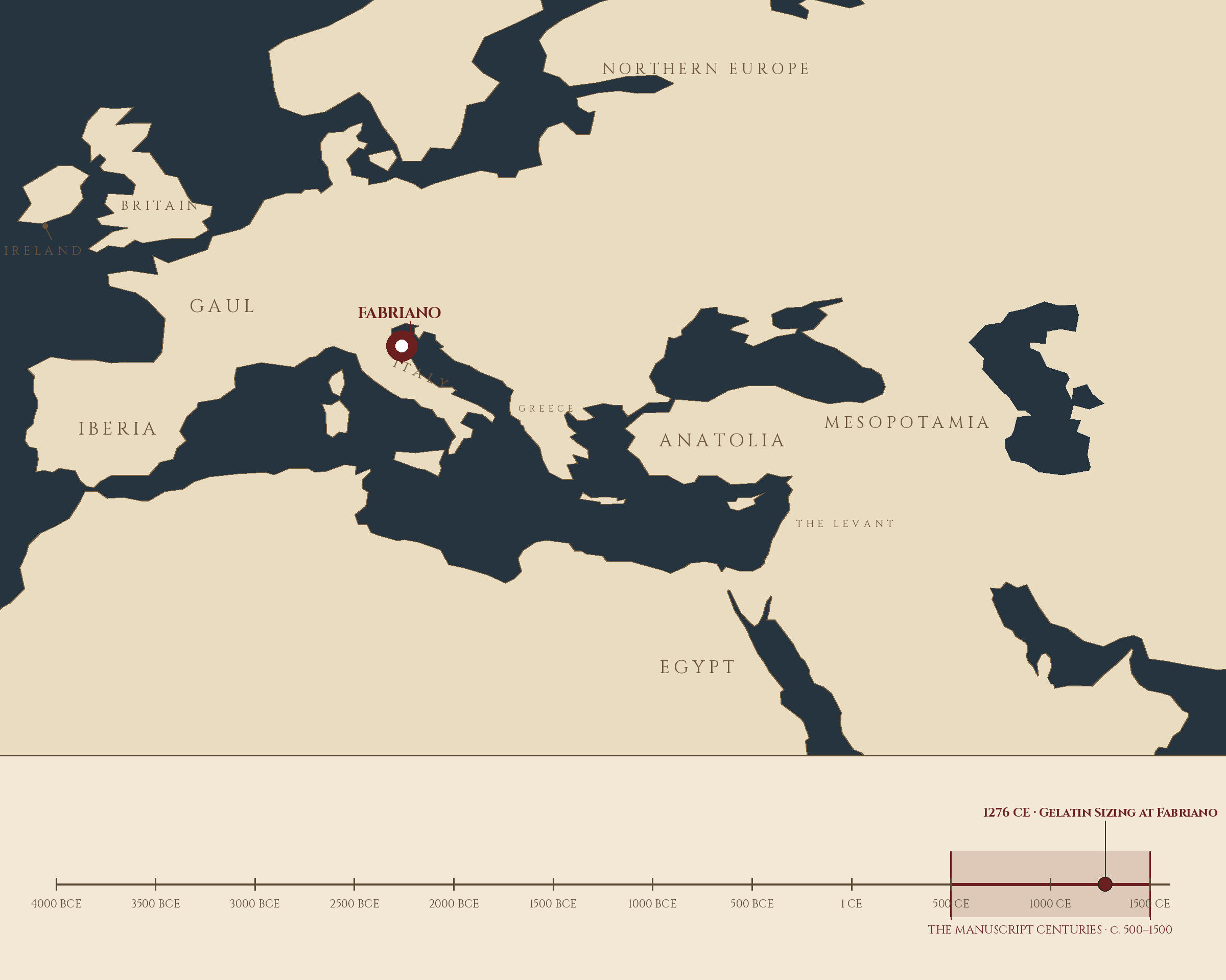
Where and when: Fabriano, Italy, 1276 CE — Gelatin Sizing at Fabriano. The pin is this lesson. The line beneath the map is our road: every stop a place where writing changed, every lesson a pin.
Lesson Objectives
By the end of this lesson, students should be able to:
- explain how capillary action carries ink through a nib slit and onto the page
- define feathering, bleed-through, and sizing, and describe how each shapes the written line
- compare how parchment, sized paper, and unsized paper receive the same ink
- describe the historical methods of drying a written line, from sand to blotting paper
- explain why carbon inks survive for millennia while iron gall inks can destroy the page they honor
- define iron gall corrosion, fugitive pigment, and foxing
- describe the conservator's approach to endangered manuscripts, including preventive care and the phytate treatment
- synthesize the four lessons of Unit II into a reasoned choice of ink for a book meant to last five centuries
Reading this lesson: ★ marks the passages to remember. They return on the unit quiz and the class test. Check in questions ask the material back as you go; answer them in your workbook when you meet them.
Working this lesson: Your assignment packet is the first download on this page. Work in it as the lesson moves along, answering each assignment as its subject is taught — or read the lesson through for your notes and take the assignments as homework afterward. Both are proper ways to sit this class. Signposts in the reading tell you where each assignment belongs. Written answers are short answers in your own words; a few honest lines are worth more than a filled page.
Your Assignment Packet
This lesson's assignments live in its packet: the Lexicon Handout (every term, course terms marked ◆), Materials, Guided Practice, the Assignment Manual with its answer key for self-checking, the Reflection Questions, and the Workbook Checklist. Download the packet before you begin and keep it beside you as you read.
The Journey of a Drop
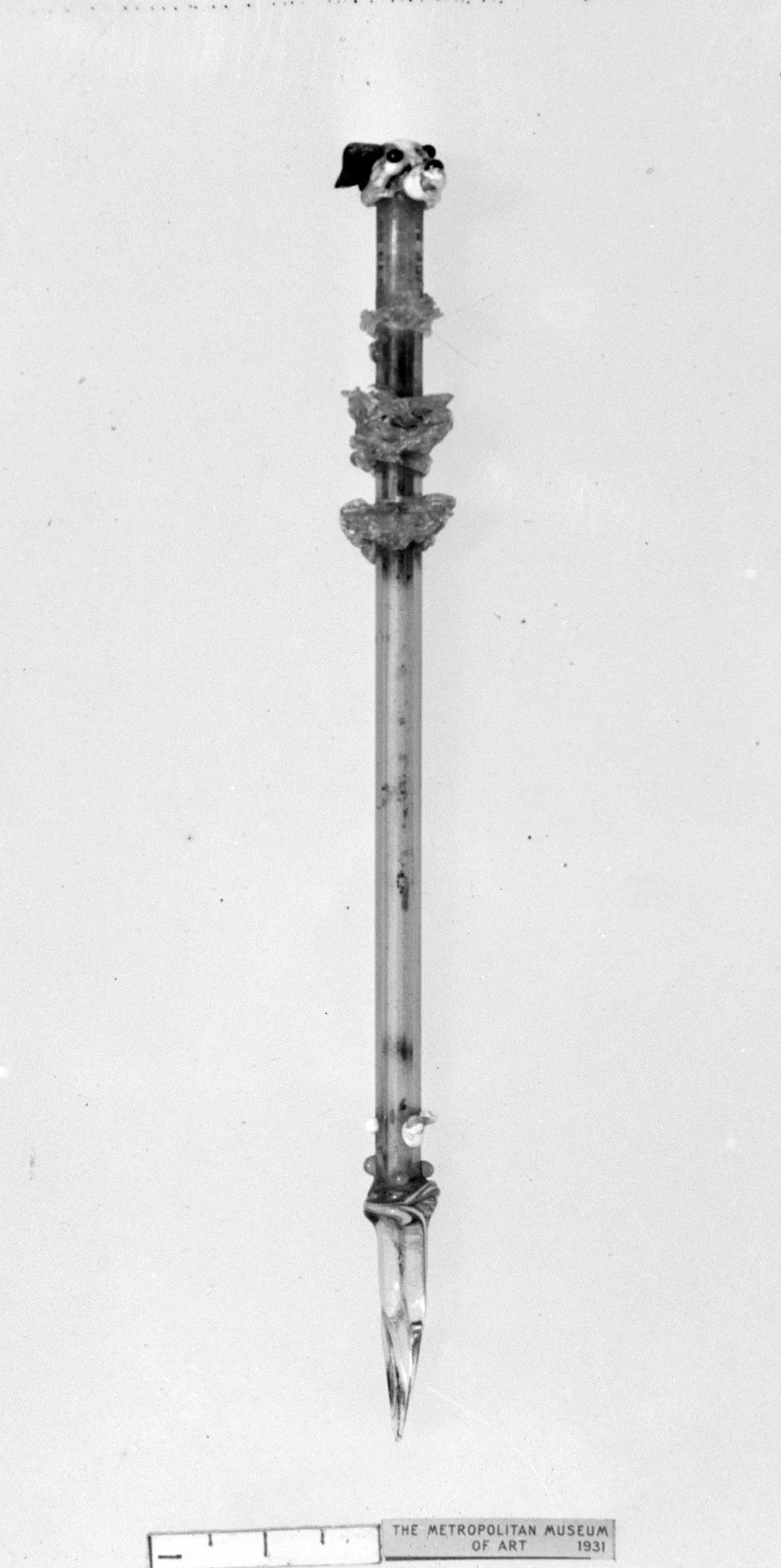
A glass dip pen: no slit, no feed — its twisted grooves carry the ink to the point by capillary pull alone.
Glass pen (19th century), The Metropolitan Museum of Art, New York (Gift of Mrs. Edward S. Harkness, 1930). Public domain.
Follow one drop of ink from the inkwell to the page, and you will understand this entire lesson.
★ The drop begins on the nib. In a quill or a dip pen, the ink is held in the narrow slit that runs up from the point. That slit is a capillary channel: the same attraction that draws water up a thin glass tube — capillary action — draws the ink down the slit toward the point. Two forces do the work. Adhesion pulls the liquid toward the solid surfaces of the slit; cohesion pulls each ink molecule toward its neighbors, so the whole column moves as one. The narrower the channel, the stronger the pull. This is why the slit must be clean and true: a clogged or ragged slit breaks the column, and the ink sulks at the top instead of flowing.
Touch the point to the page, and a third party joins the negotiation: the paper itself. Paper is a mat of tiny tube-shaped fibers, and those fibers exert their own capillary pull. The page drinks the ink off the nib, molecule by molecule, each one tugging the next behind it like a chain. Gravity assists, especially with a full pen, but the fibers do the true work of transfer. A thirsty, absorbent paper pulls hard and fast; a smooth, well-sized sheet pulls gently and lets the ink rest on the surface.
This is the whole physics of the written line: adhesion, cohesion, and the paper's thirst, balanced against the ink's viscosity and the binder's grip. Change any one of them and the line changes. The scribe who understands the drop can diagnose any misbehaving line, because every failure of the line is a failure somewhere in this chain.
The dip pen entry describes the slit as a capillary channel plainly, and the Indiana Public Media science explainer, reviewed by a Purdue fluid-dynamics researcher, walks through adhesion and cohesion exactly as your nib experiences them.
Check in: A pen lays a pale, broken line though the well is full. Walking the drop's journey in order, name two places where the chain could have failed.
❦ In your workbook: record the journey of a drop, from inkwell to page, in your own way — copy, sketch, or note what matters.
Professor Nocturne
I will be stern with you about one thing, because the ink will be stern with you if I am not.
When a line goes wrong, beginners blame the ink. The ink is almost never at fault. The ink is doing exactly what its chemistry commands. Your task is to learn the chemistry well enough to command it back. Is the line feathering? The paper is too thirsty, or the ink too thin. Is the pen starving? The slit is clogged, or the ink too thick. Is the line pale? The column is broken somewhere between well and page.
Do not curse the drop. Interrogate it. Every bad line is the ink telling you precisely what is wrong, in a language you are learning to read. That is the whole of this lesson, and a fair portion of the craft.
The Surface Decides
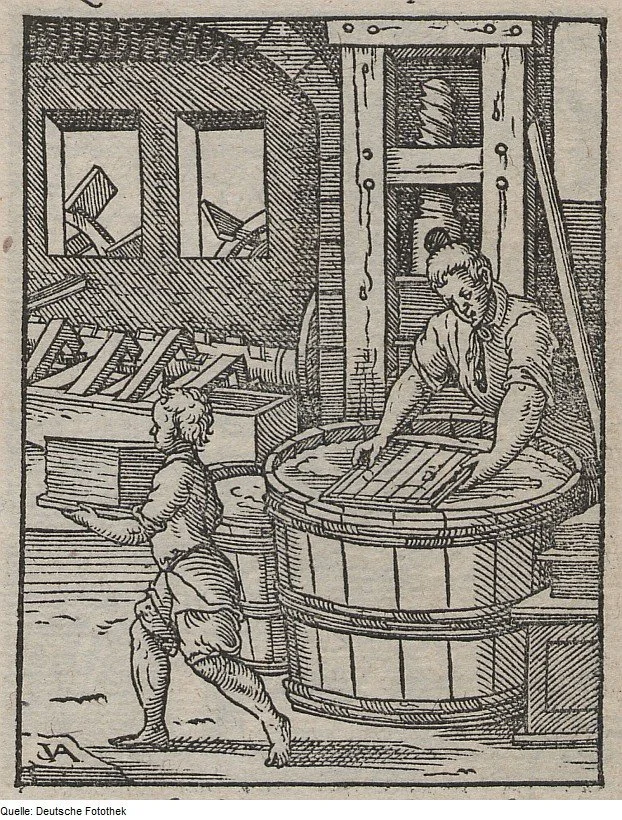
The papermaker at his vat, 1568: a sheet is formed — a thirsty mat of fibers, before sizing gives it its skin.
Jost Amman, The Papermaker, woodcut from the Ständebuch (Book of Trades, 1568), via the Deutsche Fotothek. Public domain.
The same ink, laid with the same pen, writes a different line on every surface. The surface is not a passive stage; it is a full partner in the writing.
Parchment, the prepared animal skin you studied in Lesson 3, is naturally resistant. Before writing, the medieval scribe rubbed it with pumice, powdered cuttlefish bone, or ground chalk to clean it and give the surface a fine, even tooth, then pricked and ruled the page to frame the text. A conservator's account of medieval writing instruments describes this preparation exactly: the page was engineered before a single letter touched it. Ink sits on prepared parchment rather than sinking in, which is one reason parchment manuscripts hold their lines so crisply after a thousand years.
★ Paper is a different negotiation. Fresh from the mold, paper is a thirsty mat of interlocked fibers, and unsized paper will drink ink the instant it lands, feathering the line into a blur; on thin paper it can go further, striking through to the back of the sheet — bleed-through, the line showing reversed on the other side. European papermakers solved this with sizing: each finished sheet was dipped in warm animal gelatin, often with alum added to harden the size and keep it from spoiling. Egg white could serve as a size as well: beaten and strained clear, it is glair, which you will meet again as a gilding size in Unit V. Gelatin surface sizing is documented in Europe by 1276, at the Fabriano mill, and it remained the standard surface treatment for centuries. The size fills the pores between fibers and lays a thin, ink-resistant skin across the sheet. A practical history of gelatin sizing traces the practice from Fabriano through the centuries of hand papermaking.
Too little size and the ink feathers. Too much and the ink beads and refuses the page. The papermaker's skill, like the ink-maker's, was balance, and the scribe inherited the result. When your line misbehaves on paper, ask the sheet what it was given before you blame the ink.
★ One caution from the nineteenth century belongs here, because it explains so many brown and brittle books. When papermaking was mechanized, manufacturers replaced gelatin tub-sizing with alum-rosin size added directly to the pulp. The heavy alum load left destructive acid in the finished paper, and those machine-made sheets have been darkening and embrittling ever since. The acid paper of the 1800s is the reason modern archivists insist on pH-neutral, acid-free stock: a sheet should read between pH 7.5 and 10 — neutral to mildly alkaline, never acidic — if it hopes to see the next century.
Check in: The same ink feathers on one sheet and sits crisp on another. Which party in the negotiation changed, and what had that sheet been given, or not given?
❦ In your workbook: record how the surface decides the line — parchment, sized paper, unsized paper — in your own way — copy, sketch, or note what matters.
In your packet: Assignment II — The Flow Trials ◐ begins here. Work it now, or mark the place and take it as homework — your choice.
Drying the Line
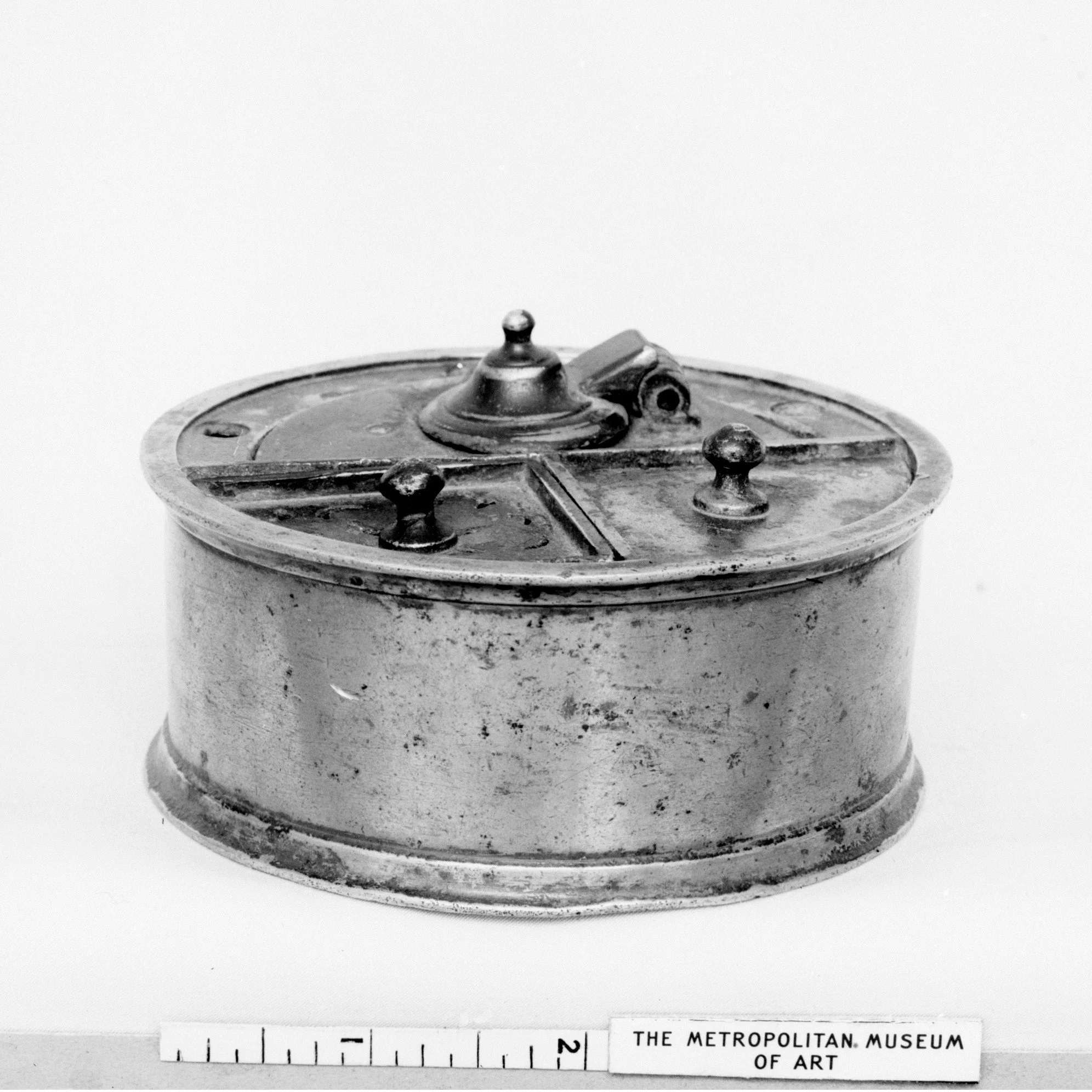
An inkstand with its sand compartment: the drying sand lived on the desk beside the ink, ready to shake and pour back.
Inkstand (pewter, second half of the 18th century), The Metropolitan Museum of Art, New York (Rogers Fund, 1914). Public domain.
A written line is vulnerable until it dries. The scribe's work was not finished when the pen lifted; the wet page had to be protected from smudging, and a manuscript page could not simply be left open on the desk in a busy room.
★ The oldest drying method is the simplest: sand. Fine, dry sand was sprinkled over the wet writing to absorb the surface ink, then shaken off and returned to its pot for reuse. The best writing sand was very fine-grained with rounded particles; one celebrated source was Calais. Sand remained in use for centuries because it was cheap and effective, and it survived well into the age of steel pens: an 1888 correspondent complained that Italian public offices still supplied sand so liberally that every desk was gritty with it.
Pounce served double duty. The same fine powder, often cuttlefish bone or sandarac resin, that dried the ink could also be dusted over a rough or greasy sheet before writing to give the quill a smooth, even surface. A pounce pot is recognizable by its concave top, made to catch the powder as it slides off the tilted page for reuse.
★ Blotting paper arrived as the deliberate opposite of writing paper: a sheet made absorbent on purpose, with the sizing left out. English references to blotting paper reach back to the 1400s, and one mill tradition holds that it was invented by accident when a batch of paper left the vats unsized and a worker discovered that it drank ink too fast to write on. Unusable as a page, it was perfect as a tool. For centuries the characteristic blotters were pink, because the red rags too discolored for white paper were diverted to the blotter vats. The history of blotting paper preserves the mill story, and the history of pounce) records its double service.
Note the conservator's warning, which I pass to you as sternly as it was given to me: blotting lifts pigment before it dries. A blotted line is a slightly robbed line. Use the blotter when you must; let the air do the work when you can.
Check in: Why is a blotted line a slightly robbed line, and when is the robbery worth committing anyway?
❦ In your workbook: record the drying of the line — sand, pounce, blotter, and patience — in your own way — copy, sketch, or note what matters.
In your packet: Assignment III — The Drying Ledger ◐ begins here. Work it now, or mark the place and take it as homework — your choice.
Professor Nocturne
You will notice that every drying method in this lesson is a negotiation with impatience.
The scribe who will not wait for the line to dry will smudge it. The scribe who blots too eagerly will thin it. The scribe who sands carelessly will grit it. Patience is not a virtue in this craft; it is a tool, as real as the penknife. Lay the line, and then do the next thing slowly. Ruling, perhaps. Grinding the next ink. Watching the light move across the desk.
The page rewards those who wait. It always has.
What Time Does to Ink
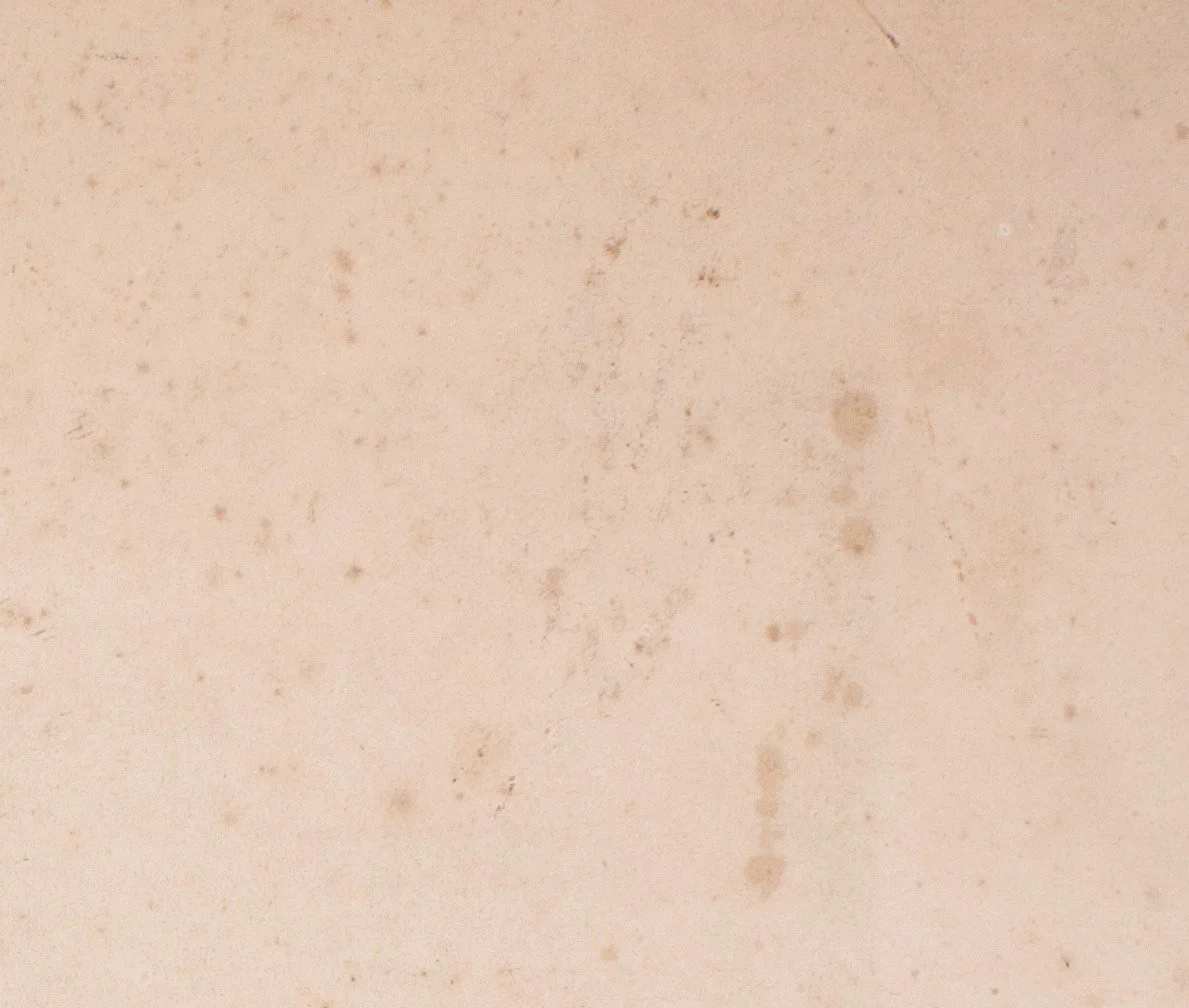
Foxing: the brown freckling that blooms on old paper, the sheet keeping its own accounts.
Foxing on old paper, detail. Photograph by Mauro Julian Mazzini. Public domain.
Now we come to the fourth party in the negotiation, the one who never attends the making: time. Every ink you have met in this unit has faced the centuries, and the centuries have judged them differently.
★ Carbon ink, your first ink, is the great survivor. Carbon is chemically steadfast: it does not fade in light the way dyes fade, and it does not attack the page. Properly bound and kept, carbon writing has remained dark and legible for thousands of years. The pigment is not the whole story, the binder and the page and the keeping all matter, but the carbon itself does not surrender. When archaeologists read carbon-ink writing from antiquity, they are reading the steadiness of soot.
★ Iron gall ink, your second ink, is the great tragedy of the archive. It was the standard writing ink of the Western world from the early Middle Ages into the late nineteenth century: the ink of charters, of parish registers, of Bach's scores and the notebooks of Leonardo da Vinci. And it eats the page it honors. The damage works by two mechanisms at once. The ink's acidity hydrolyzes the paper's cellulose, snapping the long fiber chains that give the sheet its strength. Meanwhile, free iron ions left over from the ink's making catalyze oxidation reactions that embrittle the fibers further. The writing first browns at the edges, the classic halo of iron gall corrosion; then the paper cracks along the inked lines; in the worst cases the words fall out of the sheet entirely, and the page becomes lace where the text was. A scientific review of iron gall ink degradation details both mechanisms and the conservation science built around them.
Whether a given manuscript survives is partly luck: the exact recipe, the amount of iron left unbound, the dampness of the centuries it slept through. Some iron gall manuscripts are stable and will outlive us all. Others are crumbling as you read this sentence.
Red inks, your third ink, face a different trial: light. Many historical reds and organic colorants are fugitive pigments, fading with exposure while the carbon black beside them holds fast. And the paper itself keeps its own accounts: foxing, the brown freckling caused by iron impurities or mold in the sheet, blooms on pages that were never mistreated at all.
This is the verdict of time, and it is never simple. The ink that bites deepest writes most permanently and destroys most thoroughly. The ink that merely rests on the surface may outlast them all. Choose your ink knowing what the centuries will do with it.
Check in: Two manuscripts, same century, same shelf: one crumbles, one is sound. Name two things besides age that decided between them.
❦ In your workbook: record what time does to ink — the survivor, the tragedy, and the fading reds — in your own way — copy, sketch, or note what matters.
The Conservator's Answer
When a manuscript is crumbling, what can be done? Less than you might hope, and more than you might fear.
★ The first answer of modern conservation is prevention. Stable, cool temperature. Relative humidity kept below sixty percent, because dampness feeds both the acid and the iron chemistry of corrosion. Minimal handling, clean hands or gloves as the institution requires, and digitization so that scholars can read the text without touching the page at all. Prevention cannot heal a damaged manuscript, but it can slow the decay of a stable one to a crawl, and for most collections prevention is the whole of the strategy.
★ When a manuscript is already disintegrating and intervention cannot be avoided, conservators reach, cautiously, for chemistry. The most studied treatment for iron gall corrosion was proposed in 1995 by the Dutch conservation scientist Han Neevel: bathing the manuscript in calcium phytate, a salt of the naturally occurring antioxidant phytic acid. The phytate binds the free iron(II) ions that drive the oxidation, locking them into stable complexes, and a follow-up bath in calcium bicarbonate rinses away the soluble products and leaves an alkaline reserve in the paper to neutralize future acid. The treatment has been tested on laboratory samples and on real manuscripts across Europe, including the papers of the scholar Christiaan Huygens, and it remains the most effective intervention known. It is also, every conservator will tell you, a last resort: the bath is invasive, the long-term effects are still being studied, and no treatment is chosen until testing shows the manuscript can survive it. The Huygens case study walks through the decision exactly as a conservation team made it.
Here is what this means for your own work, and I am entirely serious. Make your inks well, with the proportions this unit has taught you. Write on paper worth keeping. Keep your finished pages dry, cool, and out of the sun. The conservator's art begins at your desk, centuries before any conservator is born. The best-preserved manuscript is the one that was never given a reason to decay.
❦ In your workbook: record the conservator's answer — prevention first, chemistry last — in your own way — copy, sketch, or note what matters.
In your packet: Assignment IV — The Survivors' Report ✎ begins here. Work it now, or mark the place and take it as homework — your choice.
Unit Review: The Four Inks
Look back across the unit with me, and see what you have learned.
Lesson 5 gave you carbon ink: soot and charcoal, the oldest black, steadfast across millennia. Its lesson was the binder: without gum arabic the particles scatter, with too much the ink sulks, and the scribe lives in the balance.
Lesson 6 gave you oak gall ink: iron and tannin, the ink that darkens as it oxidizes and bites into the page it honors. Its lesson was permanence with a price: the most enduring writing of the Western archive, and the most destructive.
Lesson 7 gave you red ink: vermilion, red lead, and the organic reds, the ink of rubrication, of emphasis, of words the scribe needed the eye to find first. Its lesson was hierarchy: color as meaning, and the fugitive's warning that not all brightness survives.
Lesson 8 has given you the physics beneath all three and the centuries above them: capillary action carrying the drop, the surface deciding the line, sizing as the papermaker's gift to the scribe, and time delivering its uneven verdicts.
Four inks, four lessons, one craft. You came to this unit asking what carries the mark. You leave it knowing that the mark is carried by a partnership, liquid, tool, surface, and time, and that the scribe's art is keeping the partnership honest.
❦ In your workbook: record the four inks of this unit and the lesson each one taught, in your own way — copy, sketch, or note what matters.
In your packet: Assignment V — Unit Review: The Four Inks ✎ begins here. Work it now, or mark the place and take it as homework — your choice.
Guided Practice
Assignment I of the original manual — the Lesson Quiz — is not printed here. It now sits in the Unit II Quiz, where this unit's quizzes are gathered; the assignments below keep their original numbers, and Assignment II stands as this lesson's Guided Practice.
Assignment II — The Flow Trials ◐ ★
Objective: Observe how the same ink behaves on three different surfaces, and diagnose each line.
Instructions:
- Label your three surfaces: copy paper, heavy paper, smooth sheet. Using the same tool and the same ink, draw three slow lines on each: one thin, one medium, one laid on heavily.
- Examine every line with your magnifier. For each surface record: does the line feather? Does it bleed through? Does the ink sit on the surface or sink in? Which surface gives the crispest edge, and which the softest?
- Now interrogate one bad line the way the lesson teaches: is the failure in the ink, the tool, or the surface? Write your diagnosis in one paragraph, naming the mechanism (capillary pull, absorbency, viscosity) behind each observation.
- Level Two: write the same three lines on your gelatin-sized sheet and on an unsized sheet of the same paper. Describe the difference the size makes, in the scribe's terms: which sheet drinks, which holds?
To submit: Your labeled record sheet (photographed or scanned) plus the diagnosis paragraph. Neatness is welcome; honesty about what you see matters more.
❦ Workbook path: working from the text instead? Rule a three-row table in your workbook, one row per surface, and from the lesson's account write how the same ink should behave on each: where it feathers, where it bleeds, where it sits. Then take the pale, broken line from Professor Nocturne's warning above and write its diagnosis in one paragraph, naming the mechanism behind each failure you claim.
Materials
Required (Level One — household items)
- Your Lesson 5 carbon ink (or any bottled black ink): the test ink for the flow trials. One ink on three surfaces teaches more than three inks on one.
- Three surfaces: ordinary copy paper, a heavier sheet (watercolor paper, card stock, or a paper grocery bag cut flat), and a smooth non-absorbent sheet (baking parchment or wax paper). Label each before you begin.
- A dip pen, brush, or cotton swab: any tool that lays a comparable line on each surface.
- Fine dry sand or table salt: for the drying experiment. Clean playground sand is ideal; salt works in a pinch. A small dish catches what you shake off, as the scribe's pot caught his.
- Paper towels or tissues: the household blotter.
- A watch or timer: drying times are data. Record them.
- A magnifier: a reading loupe, a phone macro lens, or simply strong light and close looking, for examining feathered edges.
Suggested (Level Two — historically closer)
- Unflavored gelatin: the papermaker's size. Dissolve one packet in warm water per the package directions and brush a thin coat onto a sheet of watercolor paper; let it dry fully before writing, and keep a second sheet of the same paper unsized for Assignment II's comparison. You are repeating, in miniature, the Fabriano tub-sizing of 1276.
- A rough sheet of paper: for Assignment III's pounced-versus-unprepared comparison.
- A quill or reed pen: the slit behaves the same as in Lesson 2, but watch it now with new eyes: you are observing capillary action, not just making marks.
- Powdered chalk or cuttlefish bone: the pounce. Dust it over a rough sheet before writing and compare the line to the same sheet unprepared.
- Iron gall ink (bottled, from an art supplier, or your own from Lesson 6): for the flow trials only, alongside your carbon ink. Compare how the two inks sit on the same sized sheet. If you make it yourself, follow Lesson 6's recipe and safety notes exactly as written; do not improvise a batch for this lesson.
No purchased kits are required. The core observations (feathering, absorbency, drying times) are fully achievable with household materials.
Reflection Questions
Answer the following questions in your workbook.
- Describe the journey of a drop of ink from inkwell to page: what moves it through the slit, and what pulls it onto the paper?
- What is the difference between feathering and bleed-through? Which one is a surface failure, and what does each tell you about the paper?
- What is sizing, and how did it change the scribe's negotiation with the page? What went wrong with nineteenth-century machine sizing?
- Name three historical methods of drying a written line. What is the conservator's warning about blotting?
- Explain iron gall corrosion: the two mechanisms, the visible stages, and why some iron gall manuscripts survive while others crumble.
- What is the phytate treatment, who proposed it, and why do conservators call it a last resort?
- What is a fugitive pigment? What is foxing? How do they differ from corrosion?
- State the unit's through-line in your own words: what is the relationship between liquid, tool, surface, and time?
Workbook Checklist — Lesson 8
In my workbook I have:
- ☐ traced a drop of ink from the nib slit to the page and named the forces that move it
- ☐ defined feathering, bleed-through, and sizing, and told the failures apart
- ☐ compared how parchment, sized paper, and unsized paper receive the same ink, line by line (Guided Practice)
- ☐ recorded a written line's drying by air, sand, and blotter, and which kept the fullest black (Assignment III)
- ☐ explained why carbon ink endures while iron gall ink can destroy the page it honors
- ☐ defined iron gall corrosion, fugitive pigment, and foxing
- ☐ described the conservator's order of care: prevention first, the phytate bath only as a last resort
- ☐ chosen an ink for a book meant to last five centuries and defended the choice in writing (Assignment V)
☐ Lesson completed Date: ___ Signature: ___
Professor's Review
Review with me, then, what your hands now know.
The drop travels by capillary action: adhesion to the slit, cohesion among its molecules, and the thirsty fibers of the page completing the pull. The surface decides the line: parchment resists, sized paper holds, unsized paper drinks. Sizing is the papermaker's quiet gift, gelatin laid across the fibers since Fabriano, and its absence is the blotter's whole profession. Sand dries, pounce prepares, blotting paper drinks on purpose, and patience outperforms them all.
Time judges unevenly. Carbon endures. Iron gall corrodes, by acid and by iron, and the conservator answers with prevention first and phytate when there is no other choice. Reds fade. Paper foxes. Nothing written escapes the centuries unchanged; the scribe's task is to give the centuries as little to work with as possible.
You now know all four inks of this unit, and the physics and the history that govern them. In our next unit we take up the quill itself: its structure, its curing, and the cutting of the nib. You will need everything this unit taught you, because the quill is where the ink's journey begins.
PROFESSOR QUILLBERRY NOCTURNE
Scrollwork Library
Master Scribe & Illuminator
Cross-Class Connections

Runes · Lesson 2 — The Unilateral Sound-Signs (Egyptian ink on papyrus: black for the text, red for the headings)
Webblethorn's Egyptians were working this lesson's negotiation three thousand years before Fabriano: reed brushes, a palette of black and red, and a sheet that, her lesson says, took ink beautifully. The red headings her scribes wrote are the rubrication your Lesson 7 studied, in its oldest home.
Runes · Lesson 2 — The Unilateral Sound-Signs
My Egyptians were working this lesson's negotiation three thousand years before Fabriano: reed brushes, a palette of black and red, and a sheet that took ink beautifully. The red headings my scribes wrote are the rubrication of your Lesson 7, in its oldest home. Come and watch ink meet papyrus where both were young.
PROFESSOR THISTLELOOM WEBBLETHORN
Runes & Ancient Writing

Creative Arts · Unit II, Lesson 11 — Case Binding & Archival Boxes
This lesson teaches why pages decay; Timberclank teaches the housing that slows it: archival board with an alkaline reserve to neutralize acids as they arrive, and a Solander box built to one book's measure. Prevention, in the Workshop, is carpentry. The conservator's first answer has a bench and a saw.
Creative Arts · Unit II, Lesson 11 — Case Binding & Archival Boxes
Professor Nocturne teaches why pages decay; my workshop teaches the housing that slows it: archival board with an alkaline reserve to neutralize acids as they arrive, and a Solander box built to one book's measure. Prevention, in my workshop, is carpentry. Come and build the conservator's first answer.
PROFESSOR COGBRANCH TIMBERCLANK
Creative Arts Workshop
Potions · Unit VI, Lesson 48 — Midnight Carbon & Oak Gall Inks
Muddlenook studies this unit's two black families from the laboratory side: carbon particles resting on the surface, iron gall bonding with the fibers themselves. His lesson names this room outright, and sends his scholars to Nocturne's ink lessons for the making. Read his chemistry beside your corrosion, and the tragedy and the endurance explain each other.
Potions · Unit VI, Lesson 48 — Midnight Carbon & Oak Gall Inks
I study this unit's two black families from the laboratory side: carbon particles resting on the surface, iron gall bonding with the fibers themselves. My lesson names Professor Nocturne's room outright and sends my scholars to his ink lessons for the making. Read my chemistry beside his corrosion, and the tragedy and the endurance will explain each other.
PROFESSOR CRIMBLEBREW MUDDLENOOK
Potions Laboratory • Master Apothecary • Head of House Meridies
Further Reading & Sources
For scholars who want to go deeper. These are starting points, not assignments.
*Marc Drogin, Medieval Calligraphy: Its History and Technique (Dover, 1980).* The classic English-language manual on how medieval scribes actually worked: quills, inks, parchment, and the major hands, with practical instruction throughout. The chapter on materials remains the clearest short account of the scribe's toolkit.
*Michelle P. Brown, Understanding Illuminated Manuscripts: A Guide to Technical Terms (Getty Publications / British Library).* An illustrated glossary of manuscript terminology by one of the great manuscript scholars. Look up sizing, vellum, glair, and pigments here when a term in this unit needs a picture beside it.
The Iron Gall Ink Website — the Huygens case study. The research hub of the Dutch-led iron gall ink conservation community. The Huygens papers study walks through a real conservation decision, treatment choice, risks, and all, exactly as this lesson described it.
*"Iron-gall inks: a review of their degradation mechanisms and conservation treatments," npj Heritage Science (2022) — read the review.* The modern scientific survey of everything in this lesson's corrosion section: the acid and iron chemistry, the decay stages, and every major conservation treatment with its evidence. Technical in places, but the introduction and conclusions read clearly.
Natural Pigments, "Sizing Paper and Preparing Gelatin Sizing" — read the guide. A practical guide to gelatin sizing with its history attached, from Fabriano's 1276 milestone through alum, rosin size, and modern practice. The closest thing to standing beside a papermaker.
Wikipedia. "Dip pen." The dip pen's slit described as a capillary channel, as cited in The Journey of a Drop. en.wikipedia.org/wiki/Dip_pen
Indiana Public Media, A Moment of Science. "Fountain Pens." Adhesion and cohesion in the nib, reviewed by a Purdue fluid-dynamics researcher, as cited in The Journey of a Drop. ipm.org/show/amomentofscience/2019-09-19/fountain-pens
St George's Windsor. "A Conservator's Eye View: Writing Instruments." A conservator's account of parchment preparation before writing, as cited in The Surface Decides. stgeorges-windsor.org/conservators-eye-view-writing-instruments
Wikipedia. "Blotting paper." The mill story of blotting paper's accidental invention, as cited in Drying the Line. en.wikipedia.org/wiki/Blotting_paper
Wikipedia. "Pounce (powder)." Pounce's double service, drying ink and preparing surfaces, as cited in Drying the Line. en.wikipedia.org/wiki/Pounce_(powder))
Browse the Scrollwork shelf in the school Library for readable editions of these works.
Submit your work for this lesson using the form below.
THE UNIT II QUIZ
SCROLLWORK LIBRARY · UNIT II: INK & PIGMENT · LESSONS 5–8
Unit II is complete: soot and charcoal, oak gall, the red inks, and the keeping of them all. This quiz gathers the whole unit, all four lessons, into one sitting. Take it from memory first, before you look back at your notes, because it measures what has stayed with you. If you completed the Exercises marked ★ in your lesson packets, you have already practiced most of what it asks.
The quiz packet is a single download. Part I gathers questions from every lesson in the unit, Part II matches the unit's vocabulary, and the answer key waits at the back for self-checking. When you have finished, score it honestly, note the result in your workbook, and revisit any lesson whose questions went wrong before you move on to Unit III.
CONTINUE IN THE SCROLLWORK LIBRARY
← Previous · Lesson 7: Red Inks & Rubrication Next · Lesson 9: Feather Structure & Curing →
Unit II — Ink & Pigment Scrollwork Library — All 26 Lessons
The rest of Unit II: Lesson 5 · Soot & Charcoal Ink · Lesson 6 · Oak Gall Ink · Lesson 7 · Red Inks & Rubrication