

Creative Arts
Unit III, Lesson 13Pouches, Tool Rolls & Storage Bags
Professor Cogbranch Timberclank
Master Artisan, Head of House Occidens
The Creative Arts Workshop • School of Evershade
Professor's Introduction

Bench set, scholars. Today we sew the containers, and I want you to understand that you are joining one of the oldest trades there is.
The oldest complete carrying kit we know belonged to a man who died in the high Alps some fifty-three centuries ago, and we will read his kit in this lesson the way you would read a colleague's bench. His fire, his tools, and his repair gear rode in a pouch sewn onto his belt, closed with a thong, findable by touch in the dark. He was not a king. He was a working man with a walk ahead of him, and his pouch was designed the way I will teach you to design yours: measured against its burden, closed so it stays closed, and carried where the hand falls on it without looking.
A rule before we cut, and it governs the whole lesson. This workshop sews the container. What goes inside it belongs to other professors: Professor Muddlenook blends and judges what fills his sachets, Professor Fernfoot gathers and judges her herbs. A pouch that holds the wrong thing beautifully is still the wrong pouch, but judging the thing is their craft. Ours is the bag that keeps it safe, dry, and findable.
Your practice pouch will be sewn in scrap cloth, measured against the sewing kit you assembled in Lesson 12, so that the unit's tools end the day housed by the unit's own work.
PROFESSOR COGBRANCH TIMBERCLANK
Creative Arts Workshop
Master Artisan, Head of House Occidens
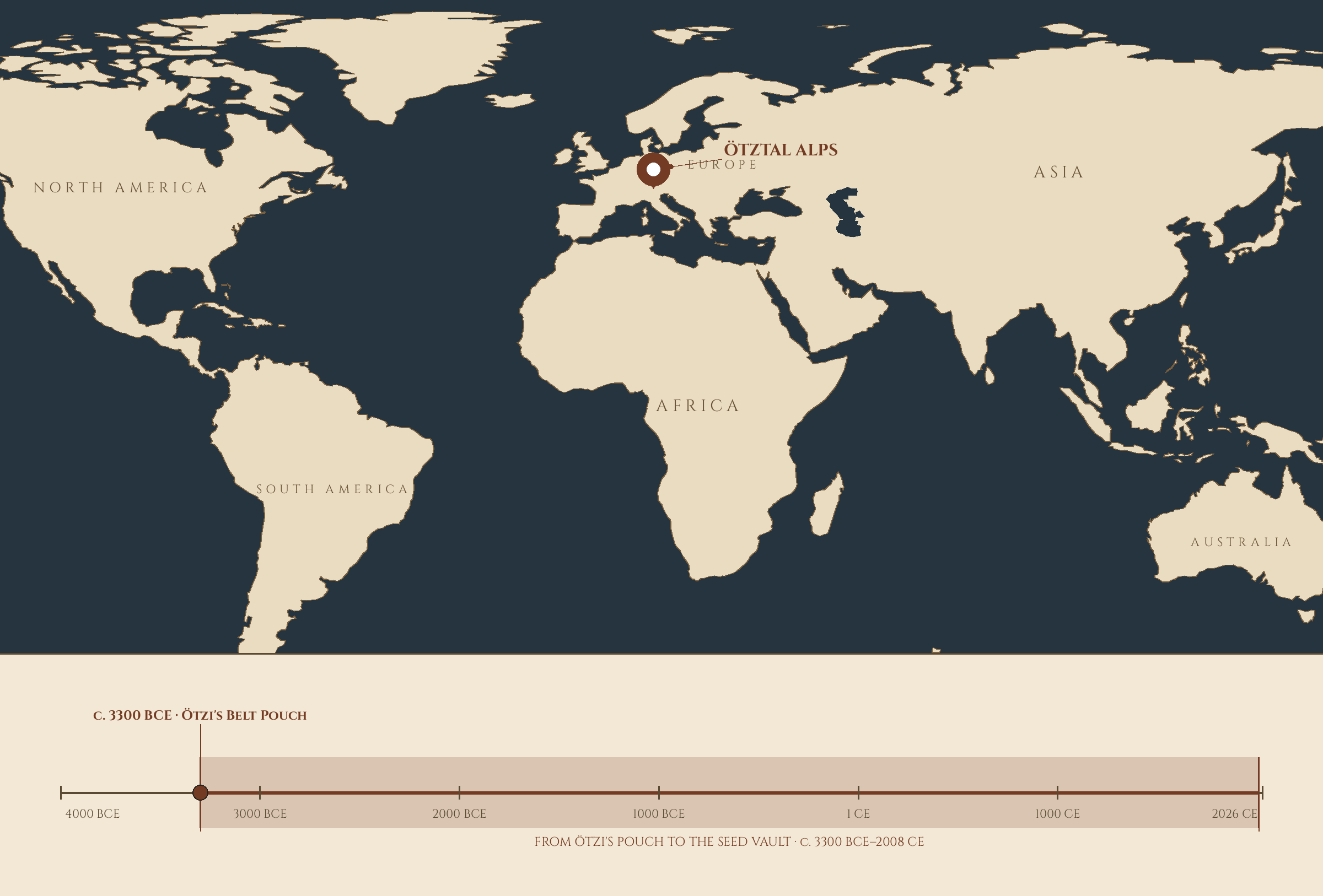
Where and when: the Ötztal Alps — c. 3300 BCE, Ötzi’s belt pouch.
Lesson Objectives
By the end of this lesson, students should be able to:
- Describe the Iceman's belt pouch and equipment, and what they show about carrying kits in the Copper Age.
- Measure a container against its contents, allowing for seams, the channel, and room to work.
- Sew a drawstring pouch whose hemmed channel opens and closes cleanly under load.
- Sew a tool roll with pockets measured to individual tools and ties that hold it shut.
- Describe the medieval scrip and drawstring purse, and the sailor's ditty bag, as carrying-kit traditions.
- State the boundary this workshop keeps: the container is sewn here, the contents are judged in Potions and Herbology.
Your Assignment Packet
This lesson's assignments live in its packet: the Lexicon Handout (every term, course terms marked ◆), the Assignment Manual, and the Reflection Questions. Download the packet before you begin and keep it beside you as you read — work from it as each subject is taught, or take the assignments as homework afterward.
Carrying the Kit: Five Thousand Years of Pouches
Begin with the man in the ice. Around 3300 BCE, a traveler died in the Ötztal Alps, and the cold kept what time usually takes. The South Tyrol Museum of Archaeology, which houses his equipment, describes a belt of calfskin four to five centimeters wide and nearly two meters long, wound twice around his hips. Stitched onto it was a pouch, its mouth closed with a fine leather thong. Inside the pouch rode the working heart of his kit: tinder fungus, black and light as foam, carrying traces of iron pyrite, half of a fire-lighting set that sparks when pyrite strikes flint; a flint scraper; a boring tool; a flint flake; and a bone awl some seven centimeters long, as useful for sewing as for a dozen other jobs.
Read that pouch as a maker. It is not a bag he happened to have. It is a decision: fire and tools at the waist, in a container that opens with one hand and closes with a tug, on a man who also carried a backpack frame of hazel rod and boards, whose hide sack has long since rotted away, birch-bark containers stitched with tree bast for his embers and provisions, and a coat whose torn seams he had repaired with grass fiber. The whole kit is maintained, measured, and layered, small kit on the body, large kit on the back. That layering is still how any sensible person packs for the field, and it begins with the pouch.
The Middle Ages carried the pouch into plain sight. The pilgrim's scrip, a leather satchel with a shoulder strap, appears in image after image of medieval travelers, saints, and road-worn nobodies; researchers have catalogued hundreds of depictions, from the tympanum at Autun to the margins of psalters, and the bag changes little across four centuries because it did not need to. Beside the scrip hung the drawstring purse: a bag-shaped receptacle of leather or textile that gathered shut at the neck, carried money, relics, alms, and gaming counters, and survives in museum collections from Roman leather scraps to the embroidered aumônières of fourteenth-century France. Square-based or round-based, plain or goldworked, it is the same thought as the Iceman's pouch: a soft container, gathered closed, worn on the body.
The tradition's most recent great chapter belongs to sailors. A sailor owned little and kept it in one place: the ditty bag, canvas with a tie and clasp, or its wooden brother the ditty box, a small lockable chest with a divided tray, of a size to hold a life in miniature. Museum examples hold sewing kit, letters, photographs, and souvenirs across a whole career at sea. The sailor mended his own clothes underway, as the Iceman mended his coat, and for the same reason: there is no one else, and the kit is at your belt.
Your pouches stand in this line. The forms are old because the problem is old and the answers were good.
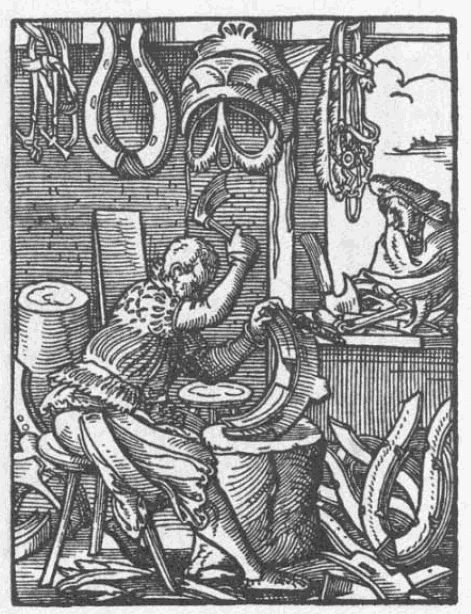
A saddler/leather worker's workshop, 1568 — hides, cutting and stitching tools, finished leather goods.
Woodcut from the Ständebuch (Book of Trades), Frankfurt, 1568. Public domain, via Wikimedia Commons.
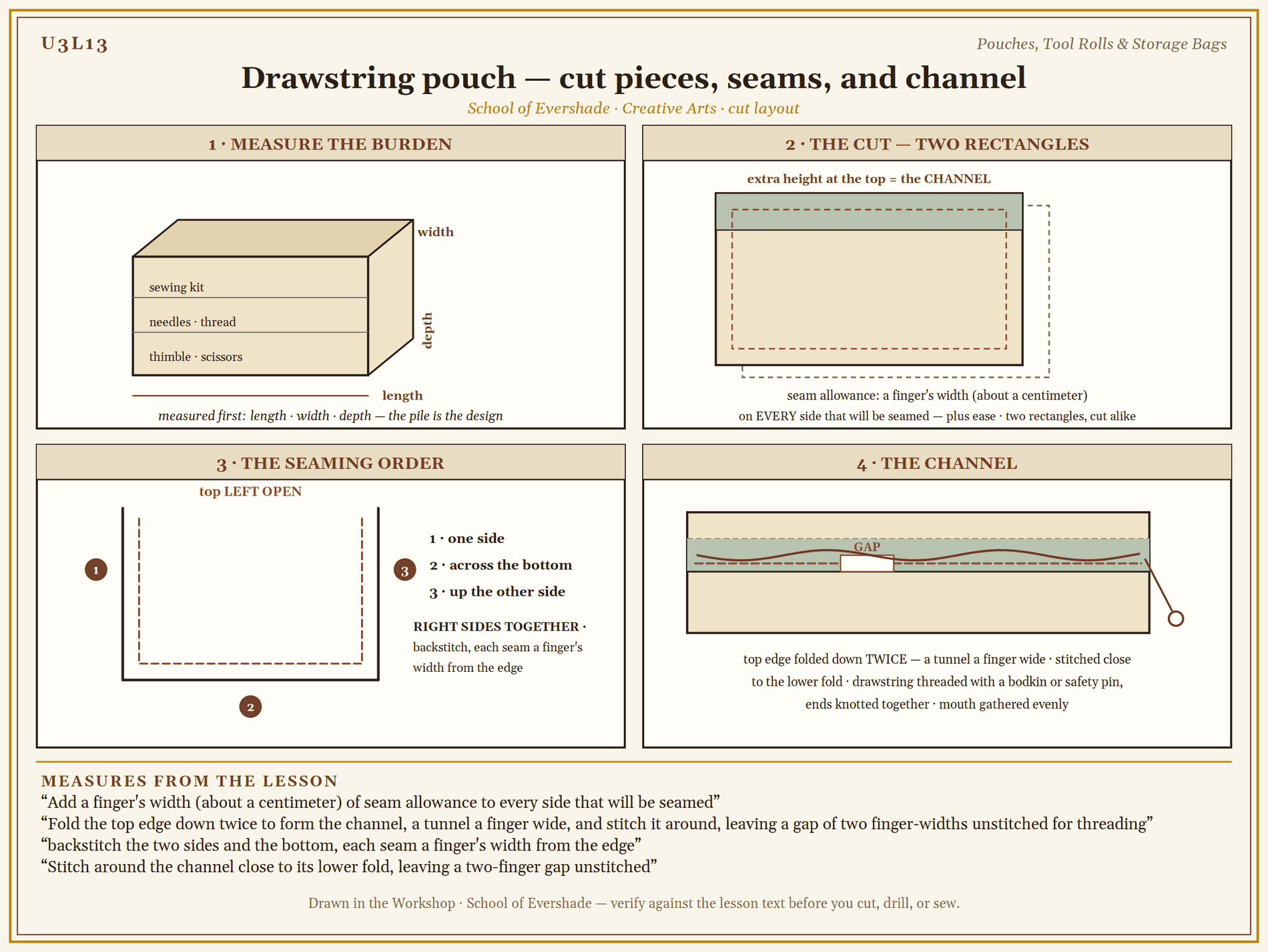
Drawstring pouch — cut pieces, seams, and channel
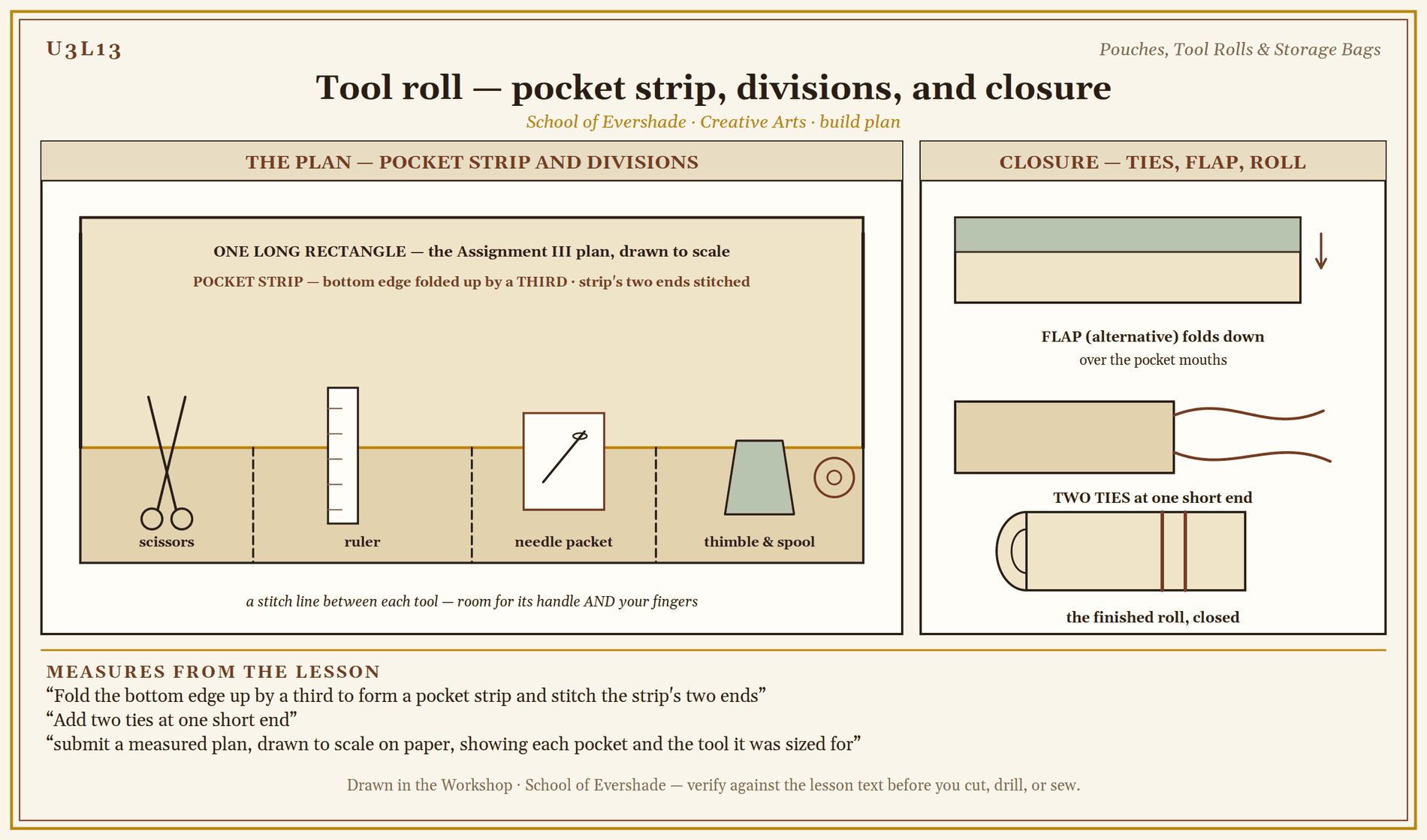
Tool roll — pocket strip, divisions, and closure
A Sealed Note from Professor Timberclank
The needle rules from Lesson 12 stand, scholars, and in this lesson they stand doubled.
A pouch is the best hiding place a lost needle ever found. It is dark in there, soft, and full of corners, and a needle left inside a finished pouch will wait patiently to introduce itself to the first hand that reaches in. So: needles are counted before the bag is closed, every time, and the count is spoken aloud. If the count is short, the bag is emptied on the bench and the work stops until the bench accounts for every needle. We stop. We make it safe. Then we begin again.
And measure your contents before you cut your cloth, not after. Cloth cut too small cannot be argued with. The bag serves the burden. It has never once been the other way round.
PROFESSOR COGBRANCH TIMBERCLANK
Creative Arts Workshop
Master Artisan, Head of House Occidens
Technique: Measure the Bag Against Its Burden
Lay out the burden. Put the actual things the container must hold on the bench, in the arrangement they will travel in. Measure the pile: its length, its width, and its depth when stacked as carried. These three numbers are the design. Everything else is addition.
Add the working room. Add a finger's width (about a centimeter) of seam allowance to every side that will be seamed, more height at the top for the channel, and ease: a bag cut to the exact size of its contents is a bag that cannot be loaded. The seam allowance is the margin of cloth between the stitching line and the cut edge: it is not waste, but the seam's working room. The drawstring channel is the hemmed tunnel at a pouch's mouth through which the drawstring runs, stitched as a folded hem with a gap left for threading, so one cord can gather the mouth shut evenly. Soft goods give, but they do not stretch on command.
The drawstring pouch. Cut two rectangles to your computed size. Place them right sides together and backstitch down one side, across the bottom, and up the other side, leaving the top open. Fold the top edge down twice to form the channel, a tunnel a finger wide, and stitch it around, leaving a gap of two finger-widths unstitched for threading. Turn the pouch right side out through the top. Thread the drawstring through the channel with a bodkin or a safety pin, knot its ends together, and load the bag. A channel gathered by one cord drawn from both ends closes flattest.
The tool roll. Cut one long rectangle. Fold the bottom edge up by a third to form a pocket strip and stitch the strip's two ends. Lay your tools on the strip, mark a stitch line between each tool with room for its handle and your fingers, and stitch the divisions from the fold to the strip's top edge. Add two ties at one short end, or a flap folded down over the pocket mouths before rolling, and the roll closes tool by tool, each in its own room.
Test under load. Load the container with its real burden. Carry it across the room. Shake it gently, hold it by its closure, set it down and pick it up by the body. Seams that strain now will fail later, in weather, uphill. Note every complaint the bag makes and mend the design, not just the bag.
Practice Practical: A Practice Pouch in Scrap Cloth
This drill is checked for a pouch measured against its burden, seams that hold under load, and a channel that closes cleanly.
- Bench drill and burden. Set up your bench and count your needles, as Lesson 12 taught. Lay out the burden: your sewing kit, arranged as it will travel. Measure the pile's length, width, and depth, and write the three numbers in your workbook.
- Compute and cut. Add seam allowance to each side, ease for loading, and extra height for the channel. Mark two rectangles on your scrap cloth and cut them. Check the cut pieces against the burden before a stitch is sewn.
- Sew the body. Right sides together, backstitch the two sides and the bottom, each seam a finger's width from the edge. Finger-press the seams open or to one side, as the cloth prefers.
- Form the channel. Fold the top edge down twice, making a tunnel a finger wide. Stitch around the channel close to its lower fold, leaving a two-finger gap unstitched. Test the tunnel with the bodkin before threading, so a sewn-shut channel is found now and not at the end.
- Thread and load. Thread the drawstring through the channel, knot the ends together, and turn the pouch right side out. Load the full burden. Draw the string and check the mouth: it should gather evenly and stay gathered when the pouch is lifted by its body.
- Carry test and count in. Carry the loaded pouch across the room, set it down, and pick it up twice. Inspect the seams. Count your needles back in, aloud, before the pouch is closed for keeping, and record the pouch's final measurements beside the burden's. The pouch stays: it is your sewing kit's home from today.
Assignment Manual
Assignment key: ✎ written work · ⚒ hands-on practical · ◐ both
Assignment I ⚒ — The Practice Pouch
Complete the Practice Practical in this lesson: a drawstring pouch in scrap cloth, measured against a real burden, seams holding under the carry test, channel closing cleanly, its measurements recorded.
Assignment II ✎ — Reading the Iceman's Kit
Using the museum sources below, write an inventory of the Iceman's belt pouch and backpack, item by item, and for each item answer one question: why does it ride where it rides? End with a paragraph on the kit as a whole: what does its layering (small kit on the body, large kit on the back) tell you about how its owner planned a journey?
Assignment III ◐ — Sew the Tool Roll
Design and sew a tool roll for your own Creative Arts tools: bench tools, sewing kit, or measuring instruments. The roll's pockets must be measured tool by tool. With it, submit a measured plan, drawn to scale on paper, showing each pocket and the tool it was sized for, and a maker's note of a half page on the one measurement you got wrong or nearly wrong, and what it taught you.
Materials
Level One (household)
- Scrap cloth for the practice pouch: an old cotton sheet, pillowcase, or canvas offcut, enough for two rectangles
- A drawstring: a shoelace, ribbon, or length of cord that runs freely
- Your sewing kit from Lesson 12 (needles, thread, thimble, scissors, pincushion)
- A bodkin or a large safety pin for threading the channel
- Ruler or tape measure, pencil or chalk for marking
- The burden itself: the Lesson 12 sewing kit, or the set of small tools the pouch is meant to hold
Level Two (historical)
Everything in Level One, plus:
- Linen or wool cloth for the pouch body, and waxed linen thread to sew it
- A leather thong or a braided cord of your own making for the drawstring (Lesson 14's braiding will replace it properly in time)
- For a tool roll in the older manner: heavier canvas or a piece of leather for the outer, with pocket divisions stitched in waxed thread
- A scrip-style flap and strap in cloth or leather, for scholars refitting their pouch as a shoulder bag in the medieval pattern
Both levels sew the same pouch and the same roll. Level Two sews them in the materials the forms grew up with.
Reflection Questions
Answer the following questions in your workbook.
- Where did your measurements nearly fail the burden, and what saved them: allowance, ease, or luck?
- The Iceman's pouch held fire before it held anything else. What does a person's smallest kit say about what they think the day might ask of them?
- Why does this workshop sew the container and leave the contents to other professors? Where else in the school does that same respect for another master's craft appear?
- A ditty bag held a sailor's whole private life in a space smaller than a shoebox. What would yours hold, and what does the choosing show?
- The tool roll shows a missing tool as an empty pocket. Where else in this workshop does a design make an absence visible, and why is that a kindness?
Professor's Review
A pouch that closes, scholars, and a kit that has a home.
You can read a five-thousand-year-old carrying kit and say why every item rides where it rides. You can lay a burden on the bench, take its three numbers, and cut cloth that respects them. Your pouch is measured, sewn in backstitch, channeled, threaded, and load-tested, and your needles were counted before it closed, which means the lesson's real subject arrived safely.
Next lesson we open fiber out to its full width: cordage, braiding, and weaving, and the garland, the one make in this course built to be beautiful for a season and gone, and worth the making anyway.
PROFESSOR COGBRANCH TIMBERCLANK
Creative Arts Workshop
Master Artisan, Head of House Occidens
Cross-Class Connections

Potions · Unit V, Lesson 37 — Sachets & Household Storage Blends
Scholars, the pouch this lesson sews is the one my laboratory fills. In Sachets & Household Storage Blends, my scholars blend and judge what a sachet holds — but the pouch itself, measured, seamed, and channeled to size, is built here at Professor Timberclank’s bench, and a scholar whose pouch was made in this lesson carries a container that will not spill her work across the laboratory bench. The container is Timberclank’s; the contents are ours. Bring your sewing to my sachets, and we will fill what your hands have made.
PROFESSOR CRIMBLEBREW MUDDLENOOK
Potions Laboratory
Further Reading & Sources
South Tyrol Museum of Archaeology. "Clothing." The belt and its sewn-on pouch, in the museum's own account: a calfskin belt near two meters long, and a pouch holding tinder fungus, a scraper, a boring tool, a bone awl, and a flint flake.
South Tyrol Museum of Archaeology. "The Belt and Pouch." The museum's earlier detailed page, kept in the Internet Archive: the thong closure, the pouch's contents, and the tinder fungus with its traces of iron pyrite explained as part of a prehistoric lighter.
South Tyrol Museum of Archaeology. "Equipment." The whole kit around the pouch: the hazel-rod backpack frame, the birch-bark containers stitched with bast, the quiver, and the dagger sheath.
Flagstaff Hill Maritime Museum, via Victorian Collections. "Ditty Bag, Late 19th Century." A sailor's canvas ditty bag and its history: the sewing kit, letters, and valuables it carried, and the competing stories of the name.
Student-friendly starting points for exploring this lesson's world. All links verified October 2026.
- Royal Museums Greenwich. "Ditty Box" (AAA3375). The ditty bag's wooden brother: Chief Stoker Bilby's camphorwood box, about 1900, with its divided tray, lock, and a photograph still inside its envelope.
- Karen Larsdatter. "Medieval Pilgrims' Scrips." A researcher's catalogue of the scrip in medieval art: hundreds of images of the pilgrim's satchel, from cathedral stone to psalter margins.
- Karen Larsdatter. "Medieval and Renaissance Drawstring Pouches and Purses." Surviving drawstring pouches and purses, square-based and round-based, from Roman leather to the embroidered aumônières of France.
Submit your work for this lesson using the form below.
CONTINUE IN THE CREATIVE ARTS WORKSHOP
← Previous · Lesson 12: Needles, Thread & First Stitches Next · Lesson 14: Garlands, Braiding & Weaving →
Unit III · Fiber, Thread & Soft Goods Creative Arts Workshop · All 39 Lessons
Bookstore Shelf The Library · Creative Arts Shelf Course Supplies
The rest of Unit III: Lesson 12 · Needles, Thread & First Stitches · Lesson 14 · Garlands, Braiding & Weaving