
Creative Arts
Unit III, Lesson 12Needles, Thread & First Stitches
Professor Cogbranch Timberclank
Master Artisan, Head of House Occidens
The Creative Arts Workshop • School of Evershade
Professor's Introduction

Bench set, scholars. Unit III begins with the smallest tools in the workshop, and I will thank you not to be fooled by the size of them.
A needle and a length of thread weigh almost nothing, fit in a closed hand, and between them they built the soft half of the world: every garment, sail, tent, and book binding that ever kept out weather or held a record. People were sewing with eyed needles cut from bone while the ice still stood at the door of Europe. An eyed needle carries its thread through a hole, the eye, pierced near one end, so it pierces and carries in a single motion. The stitches you learn today are older than the castle, older than the forest around it, older than farming.
Some of you met these stitches already, in Unit II, where a pamphlet binding borrowed them for an afternoon. Borrowing is finished. Today the stitches become yours: three of them, learned properly, in rows, on practice cloth, with a thimble on your finger and your needles counted out and counted back in like the small sharp tools they are. A thimble is a cap worn on the finger that pushes the needle, dimpled to catch the needle's eye end and keep it from slipping.
By the end of this lesson your sampler will hold the running stitch that gathers and basts, the backstitch that builds seams strong enough to trust, and the blanket stitch that finishes an edge so it cannot fray. A sampler is a practice cloth on which stitches are worked in ordered rows for learning and reference: a scholar's notebook in thread, kept, not thrown away. And you will mend a tear, because in this workshop the first use of a new skill is a repair.
PROFESSOR COGBRANCH TIMBERCLANK
Creative Arts Workshop
Master Artisan, Head of House Occidens
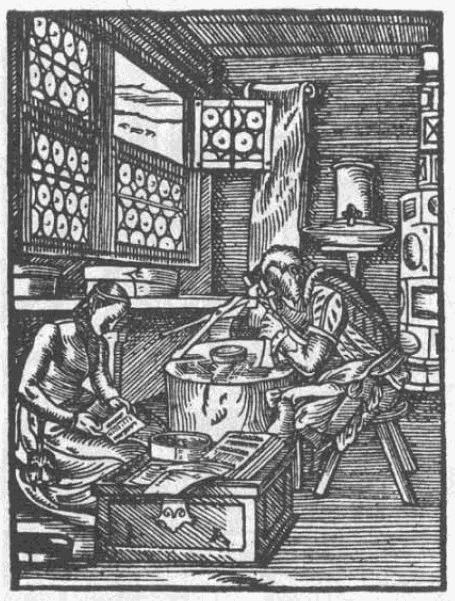
A needle maker's workshop, 1568 — needles being made, finished, and sorted.
Woodcut from the Ständebuch (Book of Trades), Frankfurt, 1568. Public domain, via Wikimedia Commons.
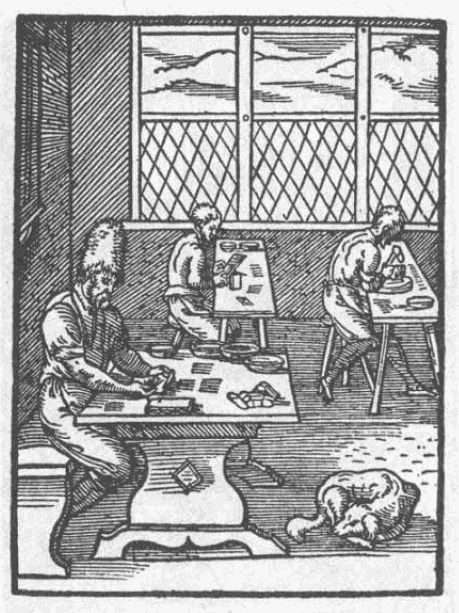
A clasp/hook maker's workshop, 1568 — small metal hooks and clasps being made.
Woodcut from the Ständebuch (Book of Trades), Frankfurt, 1568. Public domain, via Wikimedia Commons.
Lesson Objectives
By the end of this lesson, students should be able to:
- Trace the needle's history from the eyed bone needles of the Stone Age through iron to modern steel.
- Explain how the eyed needle improved on the awl, and why it spread with fitted clothing into cold climates.
- Tell the great sewing fibers apart (sinew, flax, nettle, wool, cotton) and say what each does well.
- Explain what a spindle and whorl do, and how the whorl's weight governs the thread.
- Thread a needle, knot, and sew running stitch, backstitch, and blanket stitch in even rows.
- Mend a tear so the repair is stronger than the cloth around it, and handle and store needles safely, counted out and counted in.
Your Assignment Packet
This lesson's assignments live in its packet: the Lexicon Handout (every term, course terms marked ◆), the Assignment Manual, and the Reflection Questions. Download the packet before you begin and keep it beside you as you read — work from it as each subject is taught, or take the assignments as homework afterward.
The Oldest Tool in the Sewing Basket
Sewing is not a refinement that arrived late in human history. It is one of the founding crafts. The Museum of American Heritage's history of sewing puts people at the work twenty thousand years ago, in the last Ice Age, sewing skins and furs together with bone needles that had eyes. The deeper record runs further still. A review in Science Advances of the evidence for Paleolithic eyed needles finds the earliest of them in Siberia around forty thousand years ago, with eyed needles appearing in the Caucasus soon after and in East Asia by about thirty thousand years ago, reaching Europe by about twenty-six thousand years ago. One bird-bone needle from Denisova Cave in Siberia was reported in 2016 from a layer its finders put at roughly fifty thousand years old; later reviews place the cave's eyed needles nearer forty thousand years, and the needle itself has never been dated directly. Who made it is honestly unsettled: Denisovans, Neanderthals, and modern humans all used that cave, and the needle does not say.
What the eyed needle did, whenever it arrived, is plain. The awl came first: a point that pierces a hole, after which thread or sinew must be worked through by hand, a two-part, two-handed business. Drill an eye through the awl's blunt end and the two parts become one motion. The needle pierces and carries. Finer sewing followed, and layered, fitted clothing followed that, and archaeologists link the eyed needle's spread to people clothing themselves completely against colder country than any unclothed ape could settle.
Thread is older than the needle. Sinew and gut served early sewers, and plant fiber served earlier still: twisted wild flax twine is known from Dzudzuana Cave in Georgia at around thirty-two thousand years. Flax became one of the great cultivated fibers of the ancient world, the linen of Egypt and of every European household that could grow it. But flax had a wild rival. In 2012, researchers reported that a fine cloth from the Lusehøj burial mound in Denmark, one of the richest Bronze Age graves in the country and some twenty-eight hundred years old, was not flax at all. Analysis of its fibers showed nettle, and analysis of their chemistry showed the nettles had grown far away, most likely in present-day Austria. Top-quality nettle cloth, the researchers concluded, could stand comparison with raw silk. Wool came to thread by a different road, spun from the fleece rather than stripped from a stem, warm and elastic where bast fibers are cool and crisp, and cotton joined the company later from warmer lands. Bast fiber is taken from the inner bark or stem of a plant — flax, nettle, and hemp among them — and bast fibers are long, strong, and smooth.
All of that thread began on the spindle. Before any wheel, a spinner drew fibers from a prepared mass, hooked them to a shaft, and let the shaft's whorl keep it turning while the twist ran up into the thread. Spindle whorls are among the commonest finds on archaeological sites anywhere in the world, small weights of clay, stone, and bone, and experimental work with replica whorls has shown what the old spinners knew in their fingers: the whorl's weight sets the thread's thickness, for a heavy whorl snaps a fine thread and a light one will not turn a coarse one.
The needle itself changed material slowly. Bone and ivory served for millennia. The earliest known iron sewing needles come from the Celtic hill fort at Manching in Germany, in the third century BCE. Steel followed, harder and finer, and fine steel needles became specialist goods, made in particular towns and traded far beyond them, long before the packet of needles in a modern sewing basket made them too cheap to think about. The thimble kept pace beside the needle. A sewing set reported from a Han dynasty tomb in China, of the centuries around the turn of the era, is said to include a thimble, which would make it the oldest known; thimbles were certainly mass-produced by the end of the seventeenth century, and nineteenth-century silver thimbles were given steel cores because needles will pierce soft silver in time. The guard was needed because the tool demands it: sewing pushes a needle's blunt end with the finger, thousands of times a garment, and the thimble is the armor that push requires.
A Sealed Note from Professor Timberclank
A needle is the smallest sharp tool in this workshop, scholars, and it is lost more easily than any saw I own. So we keep count.
Needles are counted out at the start of work and counted in at the end, aloud, and a count that comes up short stops the bench until the needle is found. A dropped needle is never a thing to search for later. We stop. We make it safe. Then we begin again. Mid-task, a resting needle sleeps in the pincushion or in the cloth itself, never in your clothes, never in a cushion, never, under any roof I teach under, in your mouth.
The thimble is not an ornament and it is not optional. The needle's eye end goes against the dimples, the push comes from the thimble, and your finger stays whole. That is the whole of the law on needles. Learn it once and keep it for life.
PROFESSOR COGBRANCH TIMBERCLANK
Creative Arts Workshop
Master Artisan, Head of House Occidens
Technique: Three Stitches and a Mend
Thread and knot. Cut thread the length of your forearm and no longer; longer thread tangles, frays, and saws at the cloth. Thread the eye, draw a short tail through, and knot the long end with a small overhand knot doubled on itself. Work with a single strand for samplers, doubled thread only where strength is worth the bulk.
Running stitch. In and out, in and out, the needle weaving through the cloth in a straight line. Evenness is the skill: stitches the length of two grains of rice, gaps the same. Running stitch bastes, gathers, and seams light cloth, and it is the stitch your hands will fall into when they are tired, so make its habits good ones.
Backstitch. The seam stitch, and the strongest of the three. Bring the needle up, go back down into the end of the previous stitch, come up a stitch-length ahead, and repeat: every stitch reaches back to lock hands with the one before it, leaving no gap for a seam to open along. This is the stitch that sews pouches, seams, and bindings in this workshop, the one Lesson 13 will spend all day.
Blanket stitch. The edge stitch. Working along a raw edge, bring the needle up through the cloth a short way in from the edge, pass it under the loop of thread before pulling snug, and the thread wraps the edge in a neat spine of knots. It finishes blanket edges, felt, and appliqué, and it stops a raw edge from fraying into the work.
The mend. A tear is closed two honest ways. A patch covers damage too wide or worn to draw together: a piece of sound cloth a finger-width larger than the tear on every side, hemmed and backstitched down over it. A darn weaves the hole shut: rows of thread laid across the gap one way, then woven over and under across them the other, making new cloth where the old cloth failed. Choose by the damage, not by which is prettier. A mend that outlasts the cloth around it has done its work.
Practice Practical: The Stitch Sampler
This drill is checked for even rows, safe needle handling, and a mend that holds.
- Bench drill and count. Set up your bench. Lay out needles, thread, thimble, and cloth. Count your needles aloud and write the count in your workbook. Every needle you take out comes back to this count at the end.
- Thread and rule. Thread a needle with a forearm's length of thread and knot the end. On your practice cloth, rule three straight lines with pencil or chalk, a hand's width apart, and mark a small patch of cloth to be your practice tear: snip a cut two finger-widths long in a spare corner piece.
- Running stitch row. Sew the first line in running stitch, stitches even, about two grains of rice long, gaps the same. When the row wanders, do not unpick it. Leave it; the sampler is a record, and the next row is where the lesson lands.
- Backstitch row. Sew the second line in backstitch, each stitch reaching back into the end of the one before. Then use backstitch to seam two scraps of practice cloth together along one edge, and test the seam with a firm pull. It should creak before it thinks of opening.
- Blanket stitch edge. Sew the third line as blanket stitch along a raw edge of the cloth, spacing the stitches evenly and keeping the thread's spine lying flat along the edge.
- Mend the tear. Close your practice tear with a patch or a darn, your choice by the damage. Work it fully: the repair should be flatter than the tear was and stronger than the cloth around it.
- Count in and keep. Count your needles back in, aloud, against the number in your workbook. Park them in the pincushion or felt. Label the sampler with your name and the date, and keep it. It is the first page of your sewing record, and Lesson 13 will ask for it.
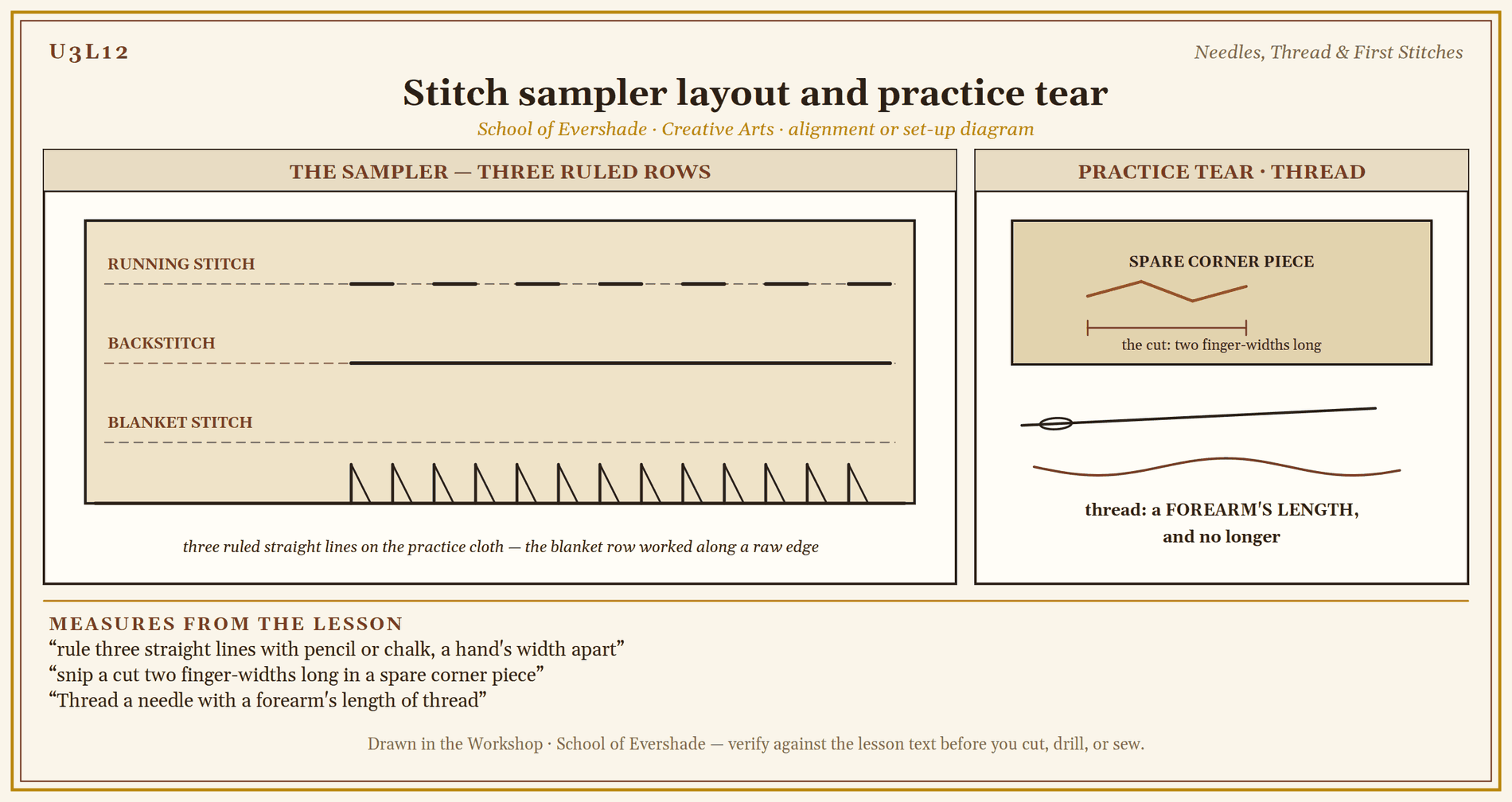
Stitch sampler layout and practice tear
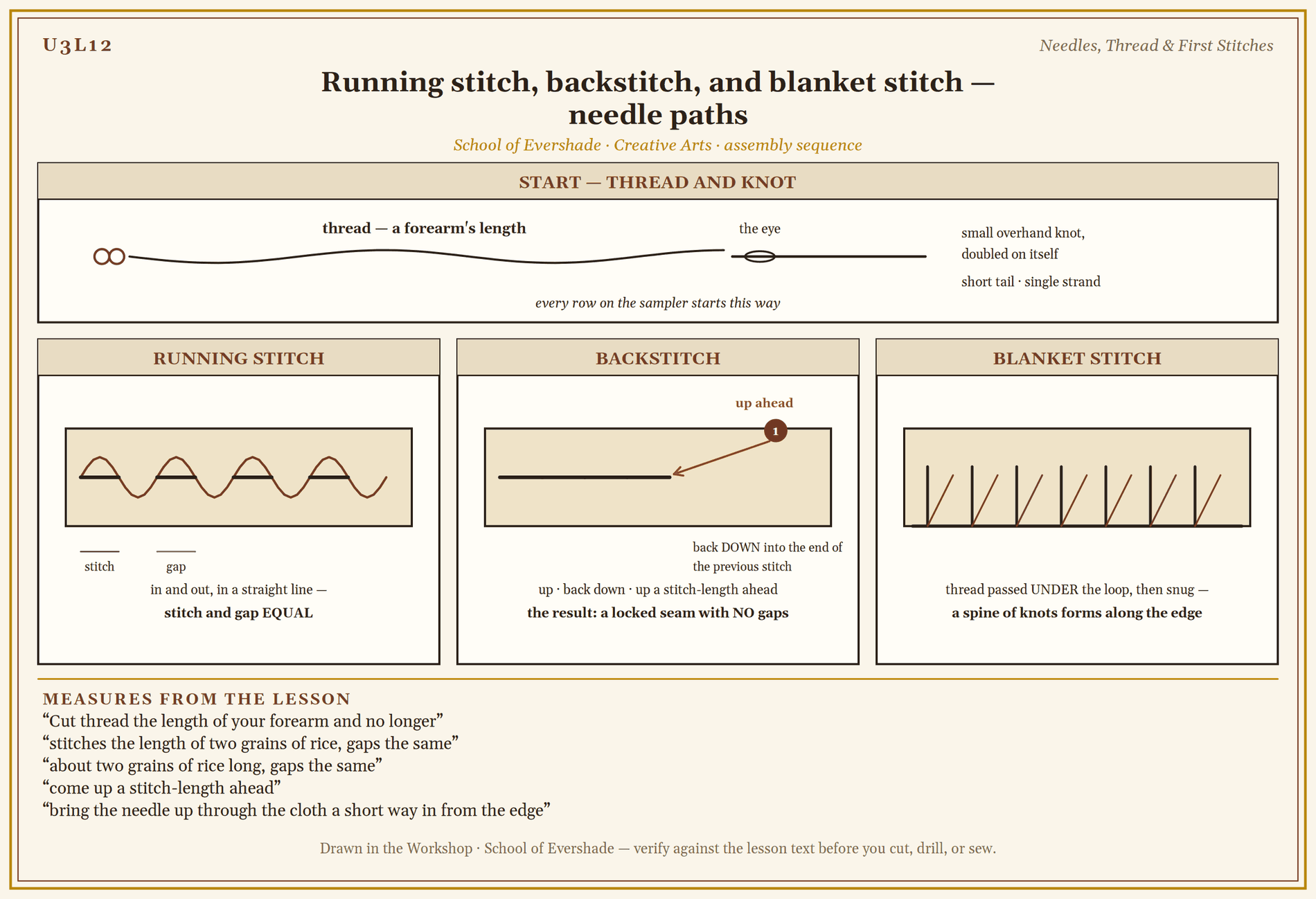
Running stitch, backstitch, and blanket stitch — needle paths
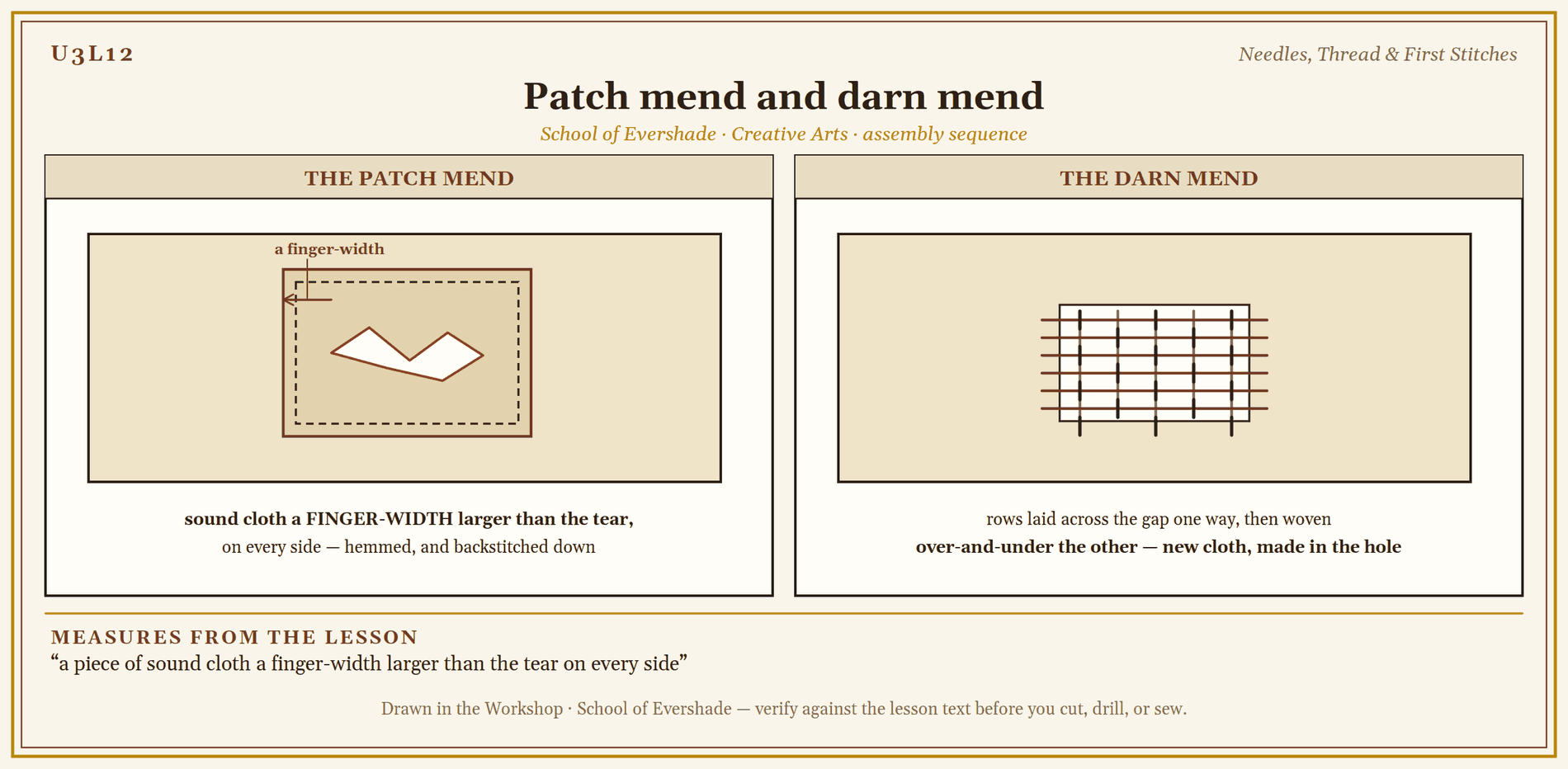
Patch mend and darn mend
Assignment Manual
Assignment key: ✎ written work · ⚒ hands-on practical · ◐ both
Assignment I ⚒ — The Stitch Sampler
Complete the Practice Practical in this lesson: three ruled rows (running, back, blanket), one backstitched seam that passes the pull test, one mended tear, needles counted out and in, sampler labeled and kept.
Assignment II ✎ — The Needle's Long Road
Using the lesson and the sources below, write a short account of the needle's journey: the eyed bone needle of the Stone Age, the iron needle, the specialist steel needle, and the packet needle of today. Cover what each change of material made possible, and end with the thimble: why the pusher needed armor of its own, and what the evidence for the earliest thimbles actually is.
Assignment III ◐ — Mend Something Real
Find a genuinely torn or worn textile in your household, with permission, and mend it for use, not for practice: a patch where the cloth has failed, a darn where it has thinned. Then write the repair up in a half page: what failed, which mend you chose and why, and what the repair taught your hands that the sampler did not. The mended thing itself is part of the assignment. Bring both.
Materials
Level One (household)
- A packet of ordinary sewing needles (sharps in assorted sizes)
- Cotton sewing thread in a color that shows against your practice cloth
- Practice cloth: two or three pieces of plain cotton, an old sheet, pillowcase, or canvas offcut
- A thimble that fits the middle finger of your sewing hand
- A pincushion, or a folded scrap of felt to park needles in
- Small sharp scissors
- Ruler or tape measure, and a pencil or chalk for ruling lines
- One torn textile you have permission to mend (a tea towel or worn shirt is the classic)
Level Two (historical)
Everything in Level One, plus:
- Waxed linen thread, and wool thread or fine yarn for darning, so the sampler holds the old fibers beside the new
- A leather palm guard or leather thimble, the thimble's elder cousins, for pushing a needle through heavier cloth
- Beeswax for drawing thread through, from Lesson 5's wax work, to strengthen and smooth it
- Practice cloth of natural fiber throughout (linen or wool), with one piece of nettle or hemp cloth if it can be had
Both levels sew the same three stitches. Level Two sews them in the fibers those stitches grew up with.
Reflection Questions
Answer the following questions in your workbook.
- Which of the three stitches did your hands resist longest, and what changed when it came?
- The eyed needle spread as people clothed themselves against colder country. What does it mean that a tool this small helped settle a continent?
- Why does this workshop count needles aloud, when nobody counts pencils?
- Your sampler keeps its wandering first row on purpose. What is the value of a record that keeps the mistake?
- The Lusehøj cloth traveled from Austria to Denmark before it was buried. What does a piece of cloth that well-traveled tell you about the people who made and moved it?
Professor's Review
Three stitches, scholars, and the whole unit is standing on them.
Your sampler holds running, back, and blanket stitch in rows you can defend, your seam passed its pull test, and somewhere in your house is a mended thing that was torn this morning. You know where the needle came from: out of bone in the Ice Age, into iron, into steel, into the packet in your basket, with the thimble riding beside it the whole long road.
Keep the sampler where you can find it. Next lesson we sew for keeps: pouches, tool rolls, and storage bags, every one of them measured against what it must hold, and every seam in them is the backstitch you learned today.
PROFESSOR COGBRANCH TIMBERCLANK
Creative Arts Workshop
Master Artisan, Head of House Occidens
Further Reading & Sources
Gilligan, Ian, et al. "Paleolithic Eyed Needles and the Evolution of Dress." Science Advances 10 (2024). The scholarly review of the eyed needle's evidence: earliest Siberian finds around 40,000 years ago, the awl before it, and the link between fine sewing, layered clothing, and settling cold country.
Archaeology Magazine. "Denisova Cave Yields a 50,000-Year-Old Needle." The bird-bone needle from Denisova Cave, complete with its eye, reported from a layer of Denisovan occupation.
Museum of American Heritage. "History of the Sewing Machine." Begins where this lesson begins: Ice Age bone needles with eyes, the iron needles of Manching, and the Han dynasty sewing set reported to include the oldest known thimble.
The Museum of English Rural Life. "Thimble." A silver thimble of about 1900 and the tool's story: "thumb-bell," mass production from the late seventeenth century, and steel cores against the needle's point.
Barber, Elizabeth Wayland. Women's Work: The First 20,000 Years. New York: W. W. Norton, 1994. The standard readable history of early cloth and the women who made it. Print reference; no stable public link, cited here by title.
Student-friendly starting points for exploring this lesson's world. All links verified October 2026.
- Joukowsky Institute, Brown University. "Early Islamic Spindle Whorls." Bone whorls from the early Islamic world, and how a spindle and its weight control the twist and thickness of thread.
- ScienceDaily. "Ancient Stinging Nettles Reveal Bronze Age Trade Connections." The Lusehøj nettle cloth and the chemistry that traced its fibers to Austria, from the University of Copenhagen and the National Museum of Denmark's research.
- Science News. "Textile Archaeologists Weave a Tapestry of the Past with Ancient Tools." Spinners and weavers testing replica whorls and looms, and what the weight of an old tool says about the cloth it made.
Submit your work for this lesson using the form below.
CONTINUE IN THE CREATIVE ARTS WORKSHOP
← Previous · Lesson 11: Case Binding & Archival Boxes Next · Lesson 13: Pouches, Tool Rolls & Storage Bags →
Unit III · Fiber, Thread & Soft Goods Creative Arts Workshop · All 39 Lessons
Bookstore Shelf The Library · Creative Arts Shelf Course Supplies
The rest of Unit III: Lesson 13 · Pouches, Tool Rolls & Storage Bags · Lesson 14 · Garlands, Braiding & Weaving