Creative Arts
Unit II, Lesson 11Case Binding & Archival Boxes
Professor Cogbranch Timberclank
Master Artisan, Head of House Occidens
The Creative Arts Workshop • School of Evershade
Professor's Introduction

Last bench of the unit, scholars, and the unit's summit. Everything before today was preparation for the question this lesson answers: how do you house a book so that the housing outlasts everyone in the room?
You have folded paper to measure, rolled and cased a chart, sewn a journal, and carried a kit up a hill. Now the same skills grow to their full strength. A case bound book is a text block sewn and rounded, given boards, and set into a case built separately and built to fit, the two joined at the end like a door set into its frame. The text block is the book itself apart from its cover: the sewn gatherings, trimmed, with endpapers attached, ready to be cased in. An archival box is the same thinking one size larger: a book-shaped case, hinged, lipped, and fitted, in which a precious or fragile volume lives when it is not being read. Professor Nocturne's capstone scholars will bind portfolios on this lesson. Professor Muddlenook's recipe journals will be cased on it. Professor Fernfoot's Materia Botanica, the great plant record of this school, will one day rest in a box built by these rules.
Build the practice corner first, on scrap, as always. Then build the real thing slowly. Cases are not hurried. Neither am I.
PROFESSOR COGBRANCH TIMBERCLANK
Creative Arts Workshop
Master Artisan, Head of House Occidens
Lesson Objectives
By the end of this lesson, students should be able to:
- Explain how case binding in publisher's cloth became the standard book of the nineteenth century and after.
- Describe the Bradel binding and why its construction suits working books.
- Build a case to measure: boards cut square, spine piece fitted, cloth turned in and corners formed.
- Attach a prepared text block into its case (casing in) with the hinges aligned and the squares even.
- Describe the Solander box, its inventor, and its standard form in libraries today.
- Explain what acid does to paper over time and what archival (acid-free, buffered) board is specified to prevent.
- Build an archival box to measure for a book or portfolio.
Your Assignment Packet
This lesson's assignments live in its packet: the Lexicon Handout (every term, course terms marked ◆), the Assignment Manual, and the Reflection Questions. Download the packet before you begin and keep it beside you as you read — work from it as each subject is taught, or take the assignments as homework afterward.
The Case and the Box: A History
Through most of the hand-binding centuries, a book's boards were attached as the book was sewn: cords laced into wooden, then paste, boards, and the covering leather worked over the whole. Beautiful, strong, and slow. The nineteenth century, with steam presses printing editions in the thousands, could not wait for it. The answer, developed in Britain in the 1820s and standard within a generation, was the publisher's cloth case: covers manufactured separately, in quantity, boards and spine piece covered in dyed, grained cloth, stamped at first with printed paper labels, soon with title and ornament blocked in gold, while the text blocks were sewn and trimmed on their own line. At the end, the two met: the block was cased in, pasted down by its endpapers, and a book that had never been near a traditional binder's bench went out into the world by the crate. Case binding put durable, decent books into ordinary homes at ordinary prices. This school's sympathies are with it entirely: it is the chapbook's economy grown up and given boards.
Within the same family sits the Bradel binding, named for a Bradel — tradition says Alexis-Pierre Bradel, a French binder working in Germany in the late eighteenth century, though the structure is German and the man's identity is still argued over — in which the case, hollow-backed, its boards split to receive the flanges of the spine lining, is built to fit the block exactly, so the book opens flat. Binders reach for the Bradel structure when a book must open flat, take daily handling, and still be rebacked or repaired generations later: a recipe journal's binding, in spirit, whether its builder knows the name or not.
The box has its own inventor, and he belongs to this school's story. Daniel Solander, born in Sweden in 1733, was Linnaeus's student and apostle; he carried the Linnaean system to England, worked at the British Museum from 1763 cataloguing its natural history collections, and sailed with Cook on the Endeavour's first voyage in 1768. For the museum's prints, drawings, maps, and dried plants, Solander devised a box shaped like a book, closing closely enough to shut out dust and light, shelved upright among the books it protected; its modern form — two shallow trays, hinged, with deep overlapping lips — is the Solander libraries still build. The Solander box is still the pattern: the Library of Congress's preservation manual provides for custom protective enclosures of exactly this kind for brittle and special volumes, and conservators build Solanders today of archival board to the measure of a single object.
That last material carries the modern half of the lesson. Nineteenth-century wood-pulp paper, Lesson 7's cheap triumph, carries acid in itself, and acid eats paper from inside: chains of cellulose shorten, pages yellow, then brown, then crumble at a touch. William J. Barrow, the American paper chemist and conservator, showed in the mid-twentieth century that, in his sample of American books printed 1900–1939, nine in ten were on paper too weak to survive another half-century of ordinary use, and his laboratory's thousand test volumes, printed across five centuries and studied sheet by sheet, are held today by the Library of Congress as the record of that discovery. Barrow's remedies, deacidification and alkaline-buffered housing, became preservation's standard. The acid-free, buffered board specified in the Library of Congress's own preservation supply specifications is this lesson's Level material: a box is not only a shape, it is a chemistry, and a housing that will slowly poison its book is a housing built wrong at any level of craftsmanship. Acid-free, buffered board is board manufactured without the acids that migrate into paper and embrittle it; buffered board carries an alkaline reserve, a measured dose of calcium carbonate, that neutralizes acids as they arrive: the standard material specified by preservation libraries for boxes and enclosures. In the Library of Congress specification, that means board at pH 8.0 to 9.5, carrying a 2-to-5 percent alkaline reserve of calcium carbonate, and made from lignin-free stock.
A Sealed Note from Professor Timberclank
A case is measured from the book, scholars, never from the plan.
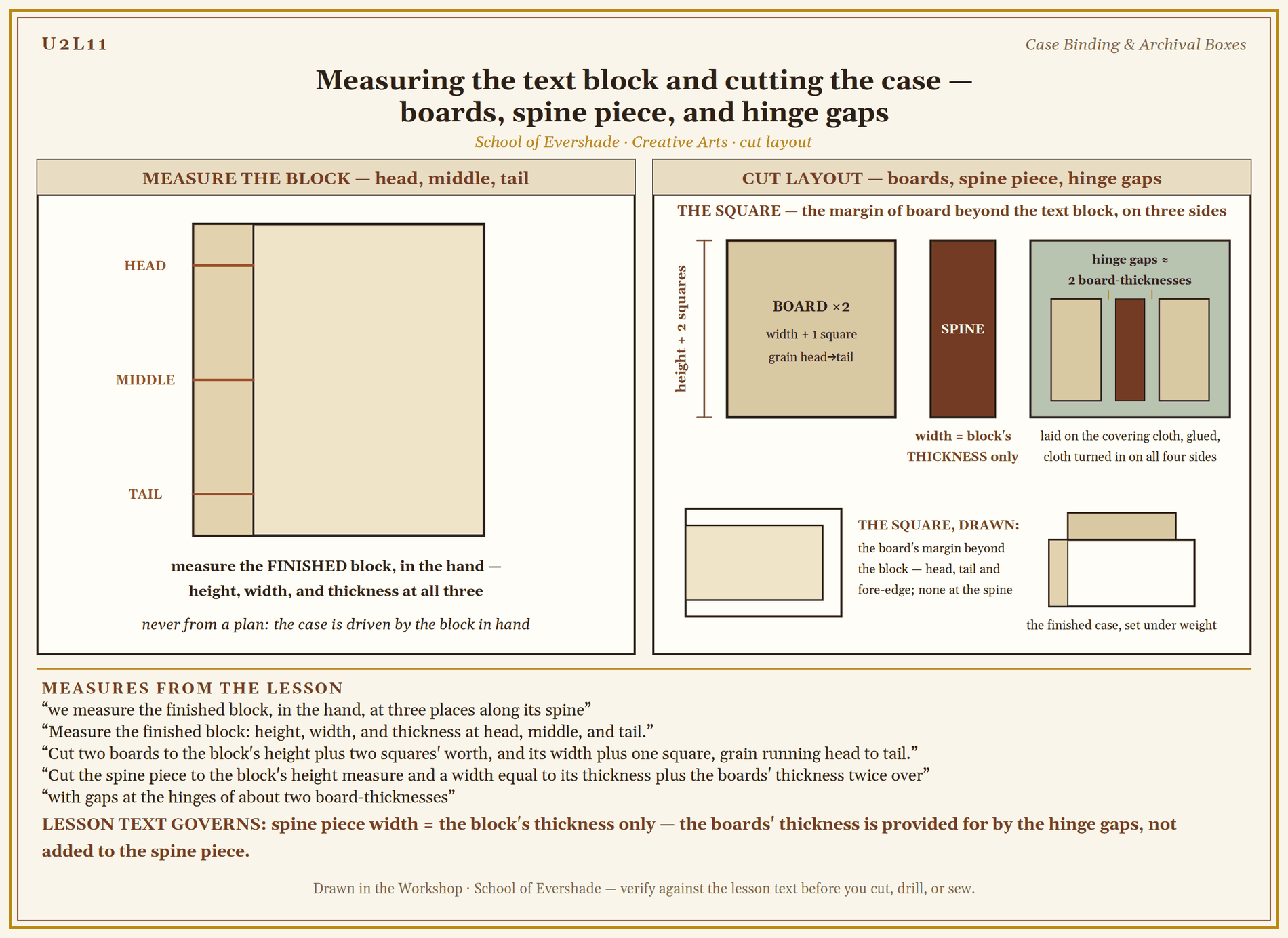
Books swell with sewing, shrink with trimming, and lie about their intentions at every stage. So we measure the finished block, in the hand, at three places along its spine, and we cut the boards to that book, with its squares even and its spine piece fitted to its thickness, not to the thickness we hoped for. The square is the margin of board that extends beyond the text block on three sides of a cased book: the book's bumper, taking shelf wear and drop damage so the page edges do not. A case built from a plan fits the plan beautifully and the book not at all.
Measure the thing in front of you. It is the only one you are housing.
Now hear the knife rules of this workshop stated whole, scholars, because this lesson lives by them. Every board in a case is cut with the knife against the straightedge, and the knife is a Lesson 3 tool with Lesson 3 discipline — no exceptions for familiar work. The board lies flat on the cutting mat, never in the hand, never over the knee. The straightedge is held with the holding hand's fingers curled up and back, well clear of the edge the blade will travel, and the blade moves away from your body, in its own line, on a path that never crosses any part of you.
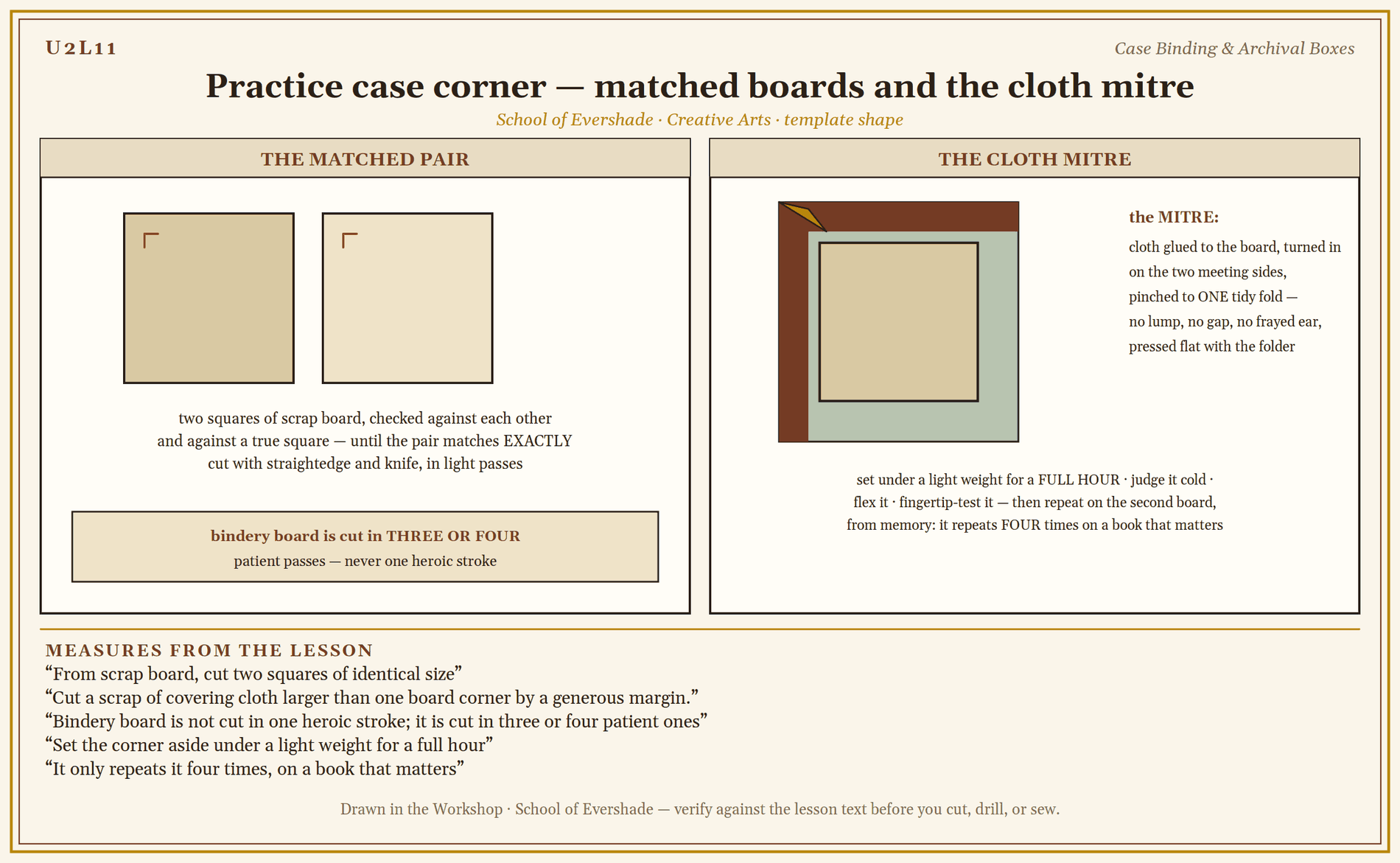
Cut in passes. Bindery board is not cut in one heroic stroke; it is cut in three or four patient ones, the blade following the same line a little deeper each time, kept upright and never levered sideways. A blade that must be forced is dull, or the cut is too deep, and both end the same way. Keep the blade sharp and the passes light, and keep count: a knife at rest is closed, sheathed, or put away, and at the end of the drill it is counted away like money. Younger scholars cut with an adult at the bench. And if anything about a cut feels wrong, the rule stands as it always stands: We stop. We make it safe. Then we begin again.
PROFESSOR COGBRANCH TIMBERCLANK
Creative Arts Workshop
Master Artisan, Head of House Occidens
Technique: Casing a Book and Boxing It
Prepare the block. For this lesson's build, the block is a multi-gathering text block sewn in Unit III's coming stitches or, for a first case, the Lesson 9 pamphlet's elder: several single sections sewn through the fold onto tapes, or a stout purchased blank book block. Round the spine gently if the block is thick, line it with a strip of cloth (the spine lining; in Bradel fashion it extends onto the boards), and attach endpapers. Measure the finished block: height, width, and thickness at head, middle, and tail.
Build the case. Cut two boards to the block's height plus two squares' worth, and its width plus one square, grain running head to tail. Cut the spine piece to the block's height and in width to the block's thickness, fitted in the hand, not from memory; the boards' own thickness is provided for by the hinge gaps, not added to the spine piece. Lay boards and spine piece on the covering cloth with gaps at the hinges of about two board-thicknesses, glue, and turn the cloth in on all four sides, forming the corners by pinching the cloth to a neat mitre or by the folded corner your practice corner rehearsed. Set under weight.
Case in. Open the case flat. Paste the block's endpaper and hinge, settle the block into the case with squares even on three sides (check by eye, then by measure; first impressions lie), close the book, and press it under weight overnight with blotting paper at the hinges. In the morning, open it slowly. A well-cased book opens flat-backed and free, hinges working like the joints they are.
Build the box. The archival box is the case's sibling: two trays, base and lid, or a book-form box with a hinged lid and a deep inner lip, built of archival board to the book's own measures plus working room for fingers. Cut the board square, score and fold the walls in Lesson 7's technique, cover or line as the object's worth dictates, and fit the lid to close with friction, lip inside lip, shutting out dust and daylight. Label on the spine face, as a book is labeled, because the box will live among books. Professor Nocturne's capstone portfolios and Professor Fernfoot's plant records deserve nothing less, and neither does your own most-handled journal.
Practice Practical: The Practice Case Corner
This drill is checked for square boards and a clean, tight corner, on scrap, before any real case is attempted.
Every cut in this drill is knife work under Lesson 3's rules, stated whole in this lesson's sealed note: board flat on the cutting mat, the straightedge hand curled clear of the blade's line, the blade traveling away from the body, and several light passes in one true line instead of one forced stroke. Do not begin the first cut until you can say those rules back.
- Bench drill and cut. Set up your bench. From scrap board, cut two squares of identical size with the straightedge and knife, checking each against the other and against a true square corner of the bench or a set square. Cut until the pair matches exactly; mismatched boards make a case that twists, and the twist cannot be glued out later.
- The cloth corner. Cut a scrap of covering cloth larger than one board corner by a generous margin. Glue the cloth to the board, then form the corner: turn the cloth in on two meeting sides, pinch and fold the corner to a neat mitre, and press it flat with the folder. The cloth at the corner should lie in one tidy fold, no lump, no gap, no frayed ear sticking out to catch.
- Judge it cold. Set the corner aside under a light weight for a full hour while you work on other bench tasks. Then test it: flex the board gently, run a fingertip over the corner, and look at it from both faces. A corner that survives the hour and the fingertip is a corner. One that lifts gets taken apart now, on scrap, and done again.
- Repeat to a pair. Form the second practice corner on the second board with no reference to the first except your memory. Compare them side by side. Write in your workbook the one thing your hands did differently the second time, and which corner is better.
- Record and put away. Keep the practice corners in the kit; they are your standard for every case corner that follows. Knife away and counted, tools away, bench clean.
The real case adds nothing new to this corner. It only repeats it four times, on a book that matters, with the whole school watching. Practice accordingly.
?
Practice case corner — matched boards and the cloth mitre
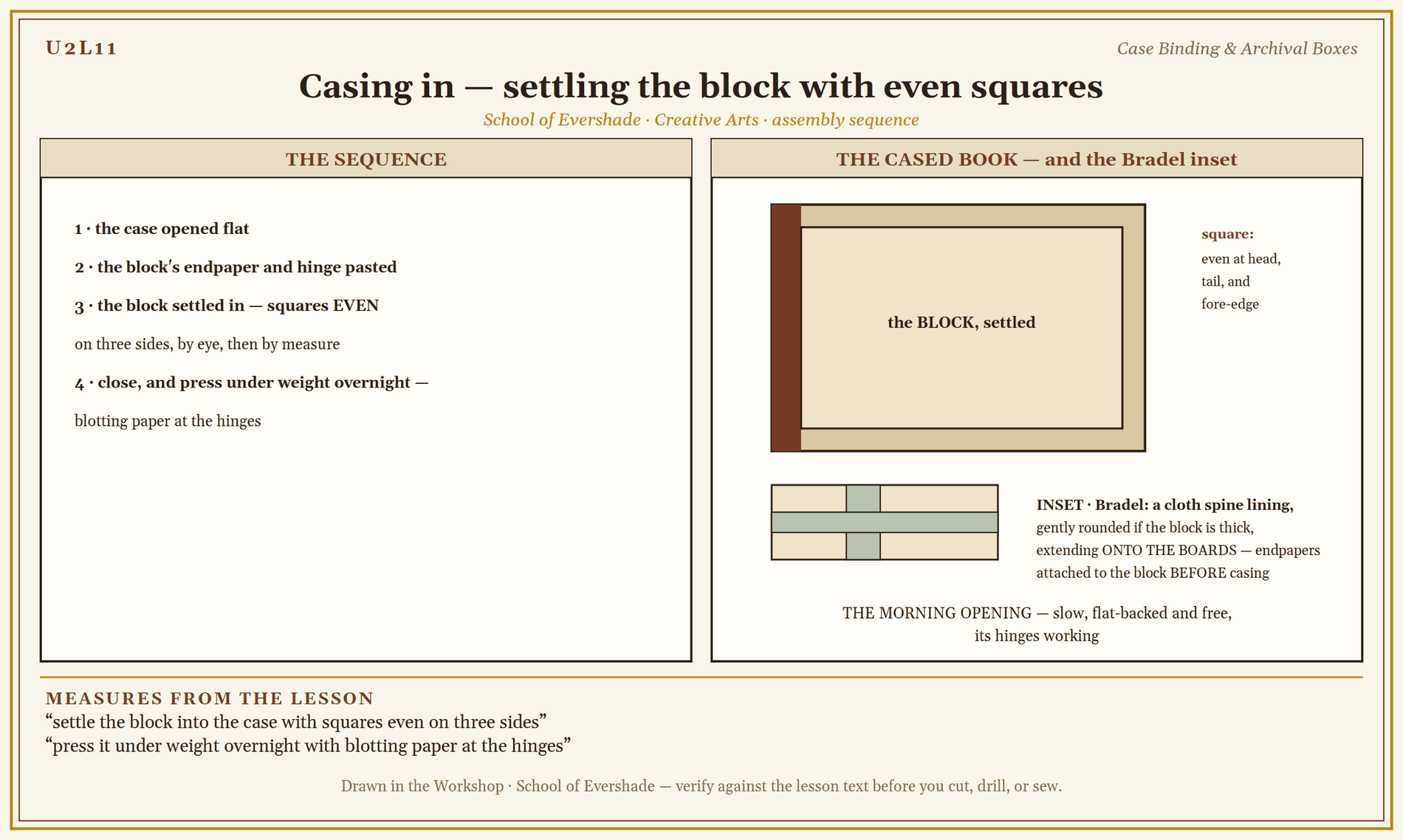
Casing in — settling the block with even squares
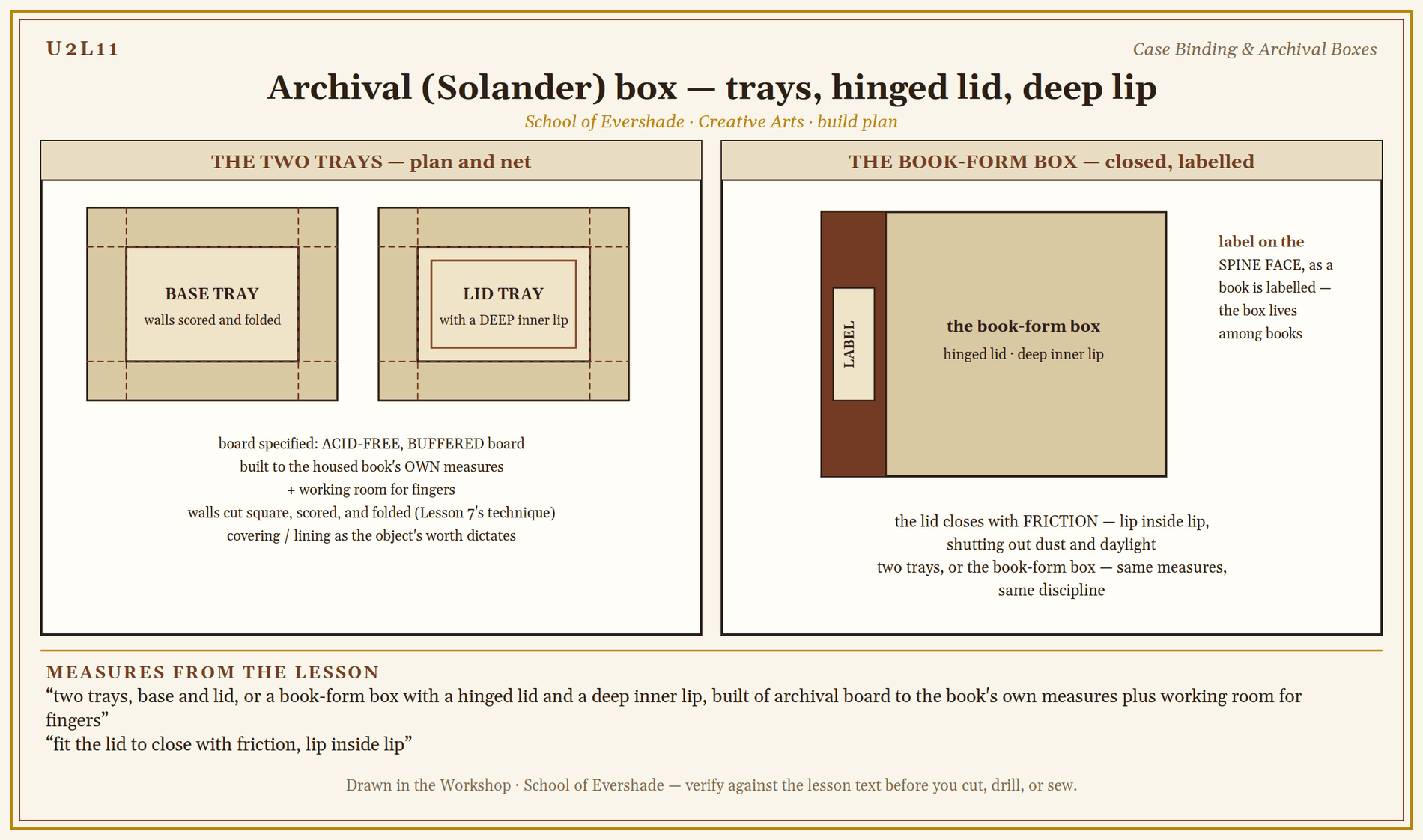
Archival (Solander) box — trays, hinged lid, deep lip
Assignment Manual
Assignment key: ✎ written work · ⚒ hands-on practical · ◐ both
Assignment I ⚒ — Case and Box
Following this lesson, case one text block (your prepared block or the school journal of your choosing) and build one archival box to the measure of a real book or portfolio you own. Both must pass their morning tests: the book opens free with even squares; the box closes with friction, lip inside lip.
Assignment II ✎ — The Chemist and the Naturalist
Using the lesson and the sources below, write connected short accounts of Daniel Solander and William J. Barrow: what each man was trying to protect, what each invented or proved, and why a box in a modern library carries both men's fingerprints.
Assignment III ◐ — Survey the Shelves
Choose five bound books in your home, of different ages if the shelves allow. For each, record: case or older binding, covering material, condition of the hinges, and the paper's color and feel at the fore-edge. Then write your shelf's verdict: which book will be readable in fifty years, which will not, and what housing this lesson would build for the one in most danger.
Materials
Level One (household)
- A prepared text block: your Lesson 9 build enlarged, several sewn sections, or a plain purchased blank book
- Stiff card or the board from heavy packaging, cut square; cereal-box board laminated double serves for a first case
- Cotton cloth or heavy paper for the case covering, and white glue
- Endpaper stock, blotting paper, ruler, pencil, folder, craft knife and straightedge (grown-up hands for the cutting stations, per school rule)
- For the box: the heaviest card in the house, and patience
Level Two (historical)
Everything in Level One, plus:
- Binder's board (Davey board) cut on the board shear, and book cloth for the covering
- Spine lining of linen or cambric, in the Bradel manner, with hide glue from Lesson 5 in the joints
- For the box: acid-free, buffered archival board of preservation specification, lined with acid-free paper
- Leather for a Solander of the first quality, if the object's worth argues for it
Both levels house the same book. Level One proves the structure; Level Two builds it to the standard the centuries set.
Reflection Questions
Answer the following questions in your workbook.
- Your practice corner, judged cold after an hour, told you something your hands had hoped was not true. What was it, and what changed in the second corner?
- Case binding separated the making of the cover from the making of the book. What did ordinary readers gain from that separation, and what did the book lose?
- Solander built his box for collections he catalogued; Barrow proved whole decades of books were doomed by their own paper. Which man's problem is your home library's problem?
- The square protects the page edges by being damaged in their place. Where else in this course does a part exist to take the harm so another part need not?
- A Materia Botanica must outlive its maker by centuries. Which decisions in this lesson are the ones that decide whether it does?
Professor's Review
The unit closes with the strongest thing paper can wear, built by your hands to a measure you took yourself.
You can case a book: boards square, spine fitted, corners formed the way your practice corners taught, block settled with even squares and hinges that work in the morning. You can build the box that outlives us all, and you can say why its board is buffered and what Barrow proved about the decades that were not. The capstone portfolio, the recipe journal, and the Materia Botanica are all, from today, buildable things in this school rather than wishes.
Unit III takes up thread in earnest: needles, stitches, and the soft housings, pouches, rolls, and bags, that this unit's hard cases will travel beside. Bring your pamphlet stitch with you. It is about to become a seam.
PROFESSOR COGBRANCH TIMBERCLANK
Creative Arts Workshop
Master Artisan, Head of House Occidens
Cross-Class Connections
Scrollwork · Unit VIII, Lesson 26 — The Evershade Manuscript
Scholars of the Workshop, my capstone sends its scholars to this bench: the portfolio that carries the finished Evershade Manuscript is cased and boxed by this lesson’s craft, and the promise my library makes its scholars is kept in this workshop. Come and see the other half of that promise — the manuscript written in my library, housed by your hands.
PROFESSOR QUILLBERRY NOCTURNE
Scrollwork Library

Potions · Unit I, Lesson 1 — Welcome to the Potions Laboratory
Scholars, in my laboratory every scholar begins a recipe journal, and a journal that lives beside steam and daily handling needs armor. That armor is this lesson: the case binding noted at the journal’s very beginning, so scholars know where its protection comes from. Begin your journal at my bench, and when it is ready for its case, you will know the workshop craft that keeps it whole.
PROFESSOR CRIMBLEBREW MUDDLENOOK
Potions Laboratory
Further Reading & Sources
Solander, Daniel (1733–1782). Scientist of the Day, Linda Hall Library — The library's account of Solander: Linnaeus's student, the British Museum cataloguer, and the inventor of the clamshell Solander box for drawings and dried plants.
Library of Congress. "Centuries of Cellulose" (lecture by Andrew Davis, Topics in Preservation Series No. 83, 2017) — Where Barrow's thousand test books, printed across five centuries, are now held, and what their study established about paper's decay.
Library of Congress, Preservation Directorate. Preservation Supply Specifications — The Library's own specifications for storage materials, including its board stock specifications for the storage of artifacts: the standard this lesson's archival board is measured against.
Roberts, Matt T., and Don Etherington. Bookbinding and the Conservation of Books: A Dictionary of Descriptive Terminology. Washington, DC: Library of Congress, 1982. The reference behind this lesson's case, Bradel, and box terminology, and behind the terms in the packet's Lexicon Handout. Print reference; the full text is also on Conservation OnLine (CoOL).
Student-friendly starting points for exploring this lesson's world.
- Daniel Solander — Linda Hall Library, "Scientist of the Day" — Meet the box's inventor: the Linnaeus student who catalogued the British Museum's natural history and devised the book-shaped box that libraries still build.
- Collections Care: General Manual, Introduction — Library of Congress — How the world's largest library houses its treasures: custom protective enclosures and boxes, built to the object, among the manual's core provisions.
- "Centuries of Cellulose" — Library of Congress, Topics in Preservation — The story of the thousand test books: five centuries of printing, examined sheet by sheet, and what they proved about why books die from inside.
- Preservation Supply Specifications — Library of Congress — Read the real specifications for buffered board stock and storage boxes: the paperwork behind the words "archival quality," published as a public service.
- Bookbinding — Encyclopaedia Britannica, 1911 edition (Wikisource) — The old encyclopedia's history of the binder's art, from clay covers to the cloth case age this lesson inherits.
Submit your work for this lesson using the form below.
THE UNIT II QUIZ
CREATIVE ARTS WORKSHOP · UNIT II: PAPER & BOUND RECORDS
This quiz covers all 5 lessons of Unit II — Paper & Bound Records. Complete it from memory, in one sitting if you can, before consulting your lesson notes — it is a measure of what has stayed with you, not of what you can look up.
The quiz has two parts. Part I gathers the lesson questions, grouped by the lesson they came from. Part II is a vocabulary matching exercise drawn from the unit’s lessons. When you have finished, score it honestly, note the result in your workbook, and revisit any lesson whose questions went wrong before you move on.
CONTINUE IN THE CREATIVE ARTS WORKSHOP
← Previous · Lesson 10: The Field & Observation Kit Next · Lesson 12: Needles, Thread & First Stitches →
Unit II · Paper & Bound Records Creative Arts Workshop · All 39 Lessons
Bookstore Shelf The Library · Creative Arts Shelf Course Supplies
The rest of Unit II: Lesson 7 · Paper, Card & Board Construction · Lesson 8 · Scrolls, Rolls & Cases · Lesson 9 · Pamphlet & Single-Section Binding · Lesson 10 · The Field & Observation Kit
From the Workshop Shelf
The printed companions to this lesson, from Professor Timberclank’s shelf in the shop.