

Creative Arts
Unit II, Lesson 7Paper, Card & Board Construction
Professor Cogbranch Timberclank
Master Artisan, Head of House Occidens
The Creative Arts Workshop • School of Evershade
Professor's Introduction

Set up your bench, scholars. Unit I taught your hands. This unit puts them to work for the whole castle, and it begins with the sheet in front of you.
Paper is the school's memory. Professor Glimmerwick's scholars chart the Moon on it. Professor Fernfoot's scholars will trust it with seeds that must stay dry and named until spring. Professor Nocturne's scribes fill it by the ream. Every one of those records is exactly as safe as the pocket, sleeve, or envelope somebody folded to hold it, and folded badly, paper fails quietly: a seed envelope that gaps spills its spring into a drawer, and a chart sleeve cut slack lets the chart slide and crease its own corners off. A pocket is an open-topped container of folded paper or card, attached on three sides and open on the fourth, that holds loose items flat against a page or board. A sleeve is a flat housing open at one end, into which a sheet, chart, or specimen slides for protection, guarding faces and corners while leaving the contents easy to draw out and read.
So we begin where all paper work begins, with the sheet itself: what it is, where it came from, and how to fold it so the fold goes where you intended. You will crease, you will score, you will tear one sampler clean in half by folding it the wrong way, and then you will understand grain in your fingers, which is the only place grain can truly be understood. To score is to press a shallow line into paper or card along the intended fold, made with a folder or an empty ballpoint pen against a straightedge: scoring does not cut the sheet; it tells the fibers where to bend, so the fold lands on the line instead of wandering beside it. Grain is the direction in which most of a sheet's fibers lie, set by how the paper was made: paper folds cleanly and tears straight along the grain, and resists, cracks, and tears ragged across it.
Bring me the torn one when it happens. We will look at it together, and it will teach the lesson better than I can.
PROFESSOR COGBRANCH TIMBERCLANK
Creative Arts Workshop
Master Artisan, Head of House Occidens
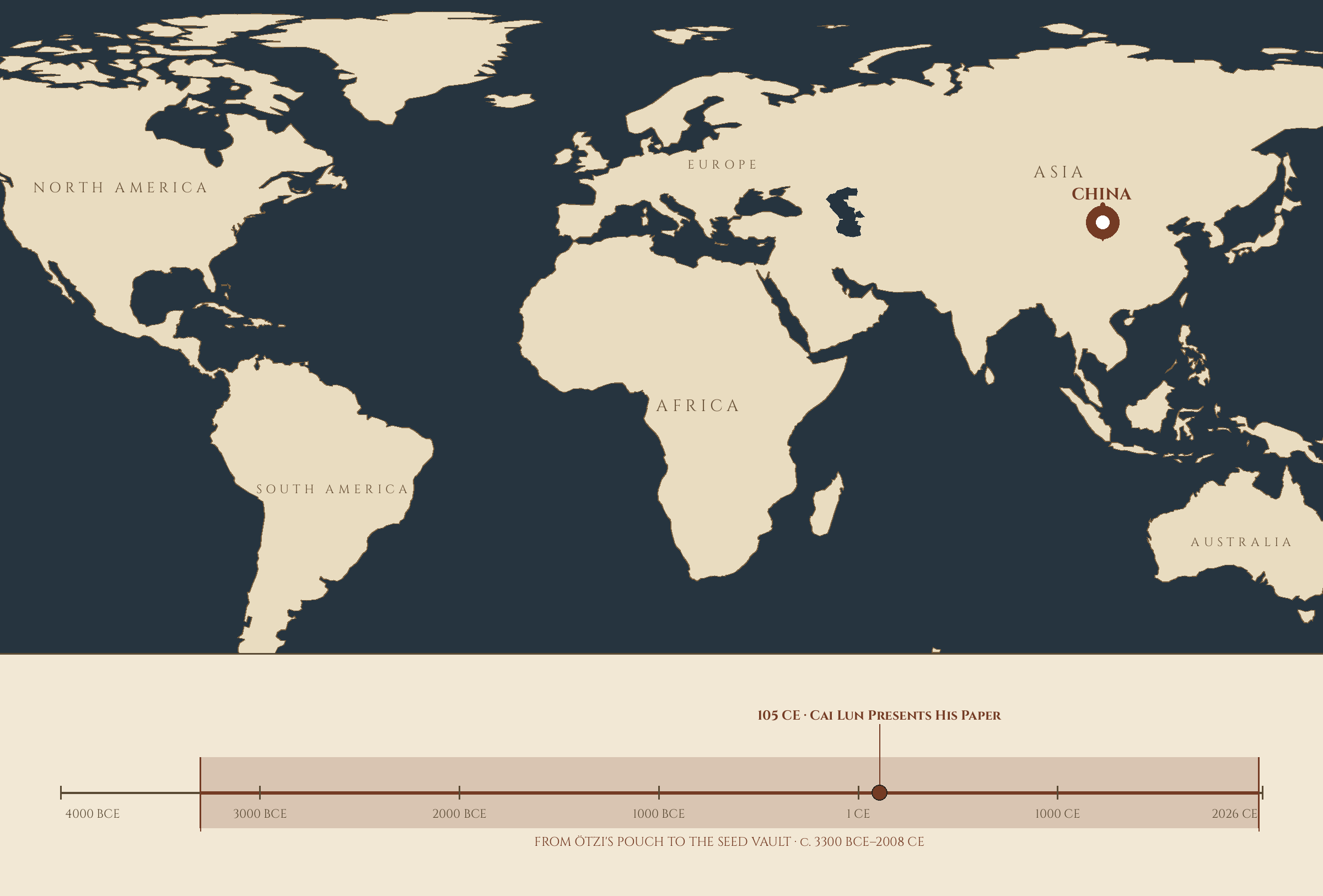
Where and when: China — 105 CE, Cai Lun presents his paper.
Lesson Objectives
By the end of this lesson, students should be able to:
- Explain how paper is made and how its history runs from Han-dynasty China westward across the world.
- Identify the grain direction of a sheet and explain why folds and tears follow it.
- Score a line and fold paper and light card accurately to a measured line.
- Construct three standard forms to measure: a pocket, a sleeve, and a folded envelope.
- Explain how the clay envelopes of ancient Mesopotamia served as the ancestors of the sealed envelope.
- Choose between paper, card, and board for a given housing job, and say why.
Your Assignment Packet
This lesson's assignments live in its packet: the Lexicon Handout (every term, course terms marked ◆), the Assignment Manual, and the Reflection Questions. Download the packet before you begin and keep it beside you as you read — work from it as each subject is taught, or take the assignments as homework afterward.
Where Paper Comes From
Paper is felted fiber: plant fibers beaten loose, floated in water, caught on a screen, and dried into a sheet that holds together by the fibers' own grip on one another. The process is simple to describe and took the world a long time to find.
China found it first. Paper of a rough kind, made from hemp fiber, existed there by the second century BCE; archaeologists have recovered hemp wrapping papers from that era. In 105 CE, the court official Cai Lun presented the emperor with paper made by a refined and repeatable process, using tree bark, hemp waste, old rags, and fishnets beaten to pulp. The official history credited him with the invention, and the credit has a fair shape to it: earlier paper existed, but Cai Lun's method made paper a material a government could rely on, cheap enough to write records on and good enough to keep them. He improved the craft the way this workshop honors, by making it dependable.
From China the craft traveled slowly, as valuable secrets do. It reached Korea — imported by the third century, made there by the sixth — and then Japan by about the seventh century. In 751 CE, after the Battle of Talas in Central Asia, Chinese papermakers are said to have been among the prisoners taken west, and the craft took root in Samarkand — paper was already known in Central Asia, but Samarkand now became a papermaking centre in its own right; from there it spread through the Islamic world, whose mills refined it, and into Europe by the twelfth century through Spain and Italy. European mills made paper from linen and cotton rags for centuries, and only in the nineteenth century did wood pulp take over, making paper cheap beyond anyone's earlier imagining, and, as Lesson 11 will show, considerably less permanent.
Before paper, records needed guarding too, and the guard was often the message's own container. In ancient Mesopotamia, accountants tracking goods used small clay tokens, one token for each kind of thing counted. For a shipment or a contract, the tokens went inside a hollow clay ball, a bulla, which was pinched shut and rolled over with the sender's seal. The sealed ball was the envelope: to alter the count inside, you had to break the clay, and the break showed. In time the tokens were pressed into the ball's outside before sealing, so the contents could be read without breaking it, and on Schmandt-Besserat's widely taught account, those pressed marks stand at the very beginning of writing itself. Later, letters written on clay tablets traveled inside clay tablet-covers, an outer shell of clay impressed with the address and the sender's seal. When this lesson asks you to fold a paper envelope that closes and shows tampering, understand that you are practicing a Mesopotamian idea in a Chinese material by way of a workshop in Kansas. Good ideas travel as far as paper does.
Paper and card also had to grow thicker when books demanded it. From around 1500, and long before that in Islamic bindings, binders built board by pasting sheets together into pasteboard, layer on layer, and by pressing waste paper and old manuscripts into stiff leaves; the boards of Lesson 11 descend from that thrift. Nothing in this lesson is new. It is old, tested, and still the way the work is done.
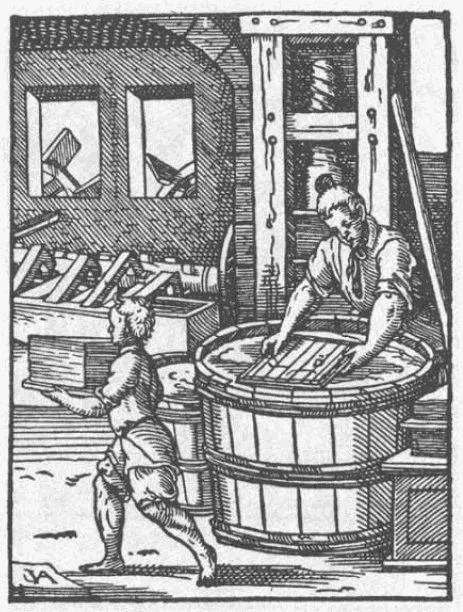
A papermaker at his vat with mould and deckle, sheets hung to dry, 1568 woodcut.
Woodcut from the Ständebuch (Book of Trades), Frankfurt, 1568. Public domain, via Wikimedia Commons.
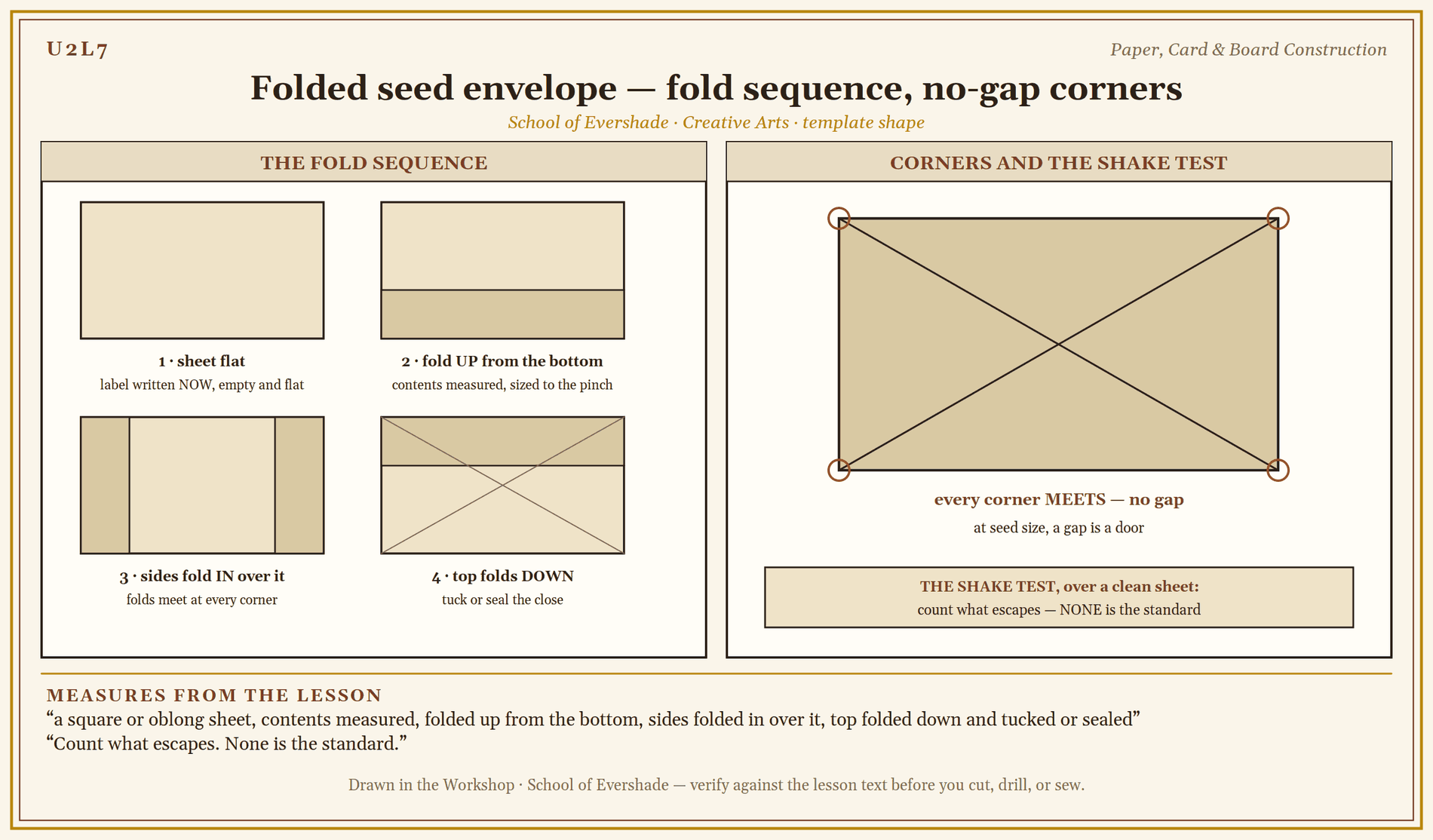
Folded seed envelope — fold sequence, no-gap corners
The Envelope's Long Line
Follow one form and you can watch the whole history at once. The bulla kept a count honest. The clay tablet-cover kept a letter private. Sealed letters of the paper age, folded from a single sheet and closed with wax, kept correspondence intact through some six centuries of letterlocking craft; the manufactured envelope is a nineteenth-century convenience laid over that older habit, and the pre-gummed flap a later nineteenth-century one still. The seed envelope Professor Fernfoot's scholars will fill in Herbology U4L30 is the same device again: a folded container, measured to its contents, closed against spilling, labeled against forgetting. Learn to fold it true here, and in her greenhouse you will only have to think about seeds.
A Sealed Note from Professor Timberclank
Paper forgives a pencil line. It does not forgive a fold.
A fold is a decision the sheet remembers forever, scholars, so we make folds the way we make cuts: measured first, marked plainly, and made once, on purpose. Score the line. Crease it with the folder, flat and firm. If the fold lands wrong, do not fold it back and pretend; paper keeps that crease too, and two creases quarrel in every housing built on them.
Use the spoiled sheet for the next sampler. That is what samplers are for. The sheet is not wasted. It is tuition, and cheap at the price.
One word about edges before your hands learn the folds, scholars. This lesson scores more than it cuts, but it does cut: sheets and card are trimmed to measure with scissors and with the knife against the straightedge, and both are Lesson 3 tools, under Lesson 3's rules. The knife travels away from your body, never toward it. The hand that holds the straightedge keeps its fingers curled back from the edge the blade will follow, and the work lies flat on the cutting board — never held in the hand, never balanced on a knee.
Cut in light passes and let the blade do the work. A forced blade wanders, and a wandering blade does not ask permission. Scissors travel closed and point down, and are set down closed; a knife at rest is a knife put away. If a cut feels wrong halfway through, you know the rule of this room: We stop. We make it safe. Then we begin again.
PROFESSOR COGBRANCH TIMBERCLANK
Creative Arts Workshop
Master Artisan, Head of House Occidens
Technique: Folding, Scoring, and Building to Measure
Finding the grain. Three tests, use any two. Tear a corner scrap: the tear that runs straight follows the grain; the ragged one fights it. Or fold a scrap both ways: the fold that creases smooth and willing runs with the grain. Or hold the sheet loosely from one edge and then the other: it droops more willingly across the grain. Mark the grain direction with a light pencil arrow on every sheet you cut in this course. Housings fold best with the grain running the way the fold bends.
Scoring. Lay the straightedge exactly on the measured line. Run the folder, or the empty ballpoint, along it with firm, even pressure, once. You are denting the fibers, not cutting them; a scored line that shows white has been cut, and will tear in service. On card, score from the outside of the fold. Then fold away from the score's valley, and burnish the crease flat with the folder's broad side.
The pocket. Measure the contents, then add room: a pocket should hold its contents the way a good shelf holds a book, snugly and without force. Cut the blank as one piece, fold up the bottom flap and in the two side flaps, paste or glue the side flaps behind the pocket's back, and burnish. A pocket attached inside a journal cover carries its load on its glued edges, so those edges get full, thin, even adhesive and time under weight.
The sleeve. Two measures matter: the chart's width, plus a finger's ease, and its length, plus a thumb's grip worth left open at the top. Fold a single sheet around the contents with a generous bottom fold, glue the side seam in a narrow, even line, and let it set flat. A specimen sleeve for Herbology is the same build in lighter paper; a chart sleeve for Celestial Studies wants card at the back for stiffness.
The envelope. The Lesson 7 standard is the folded seed envelope: a square or oblong sheet, contents measured, folded up from the bottom, sides folded in over it, top folded down and tucked or sealed. Diamond-fold and rectangular patterns both work; what matters is that the folds meet without a gap at any corner, because a gap at seed size is a door. Label before you fill. Penciled labels on the outside, written while the envelope is empty and flat, are legible; labels added after filling are archaeology.
Paste and patience. Every glued form in this lesson sets under a flat weight for at least an hour, overnight for card. A pocket glued and loaded at once will let go at the seam and teach the lesson expensively. Set it, weight it, walk away.
Practice Practical: The Sampler Set
This drill is checked for measure and fit, not for speed. All work is in practice paper until the final piece.
Before the first cut: the sampler set is trimmed with scissors and with the knife against the straightedge, under Lesson 3's cutting rules — blade traveling away from the body, the straightedge hand curled clear of the blade's path, work flat on the cutting board, and light passes instead of force. Scoring tools are for the scores; blades are for the cuts.
- Bench drill and grain. Set up your bench. Take one sheet of practice paper and find its grain by two of the lesson's tests. Mark the grain direction with a pencil arrow. Write in your workbook which tests you used and what they told you.
- The pocket. Choose a card or photograph to house. Measure it. Lay out a pocket blank on practice paper with room on every side, score every fold line, fold, glue the side flaps, and set it under the heavy book. When it has set, slide the card in and out three times. It should move freely and stop nowhere.
- The sleeve. Measure a full sheet or chart you actually own. Build its sleeve in practice paper or card: bottom fold up, side seam glued narrow and even, top left open by a thumb's width. Set it flat under weight. Test it with the real chart, in and out, held at a tilt. The chart should stay put at a tilt and leave willingly by hand.
- The envelope. Build the folded seed envelope: measure a pinch of dried beans or rice as stand-in seed, fold the envelope to fit that measure, close it, and shake it over a clean sheet, firmly, the way a packet gets shaken in a bag all winter. Count what escapes. None is the standard. If any escape, find the gap, name it in your workbook, and fold the second envelope to beat it.
- Record and put away. Label each sampler with its form and the date. Keep them; Lessons 8 and 9 will reach for exactly these hands. Tools away, bench clean.
A sampler set that holds its contents, releases them willingly, and spills nothing is this lesson learned. Everything after it is the same folds, trusted with real records.
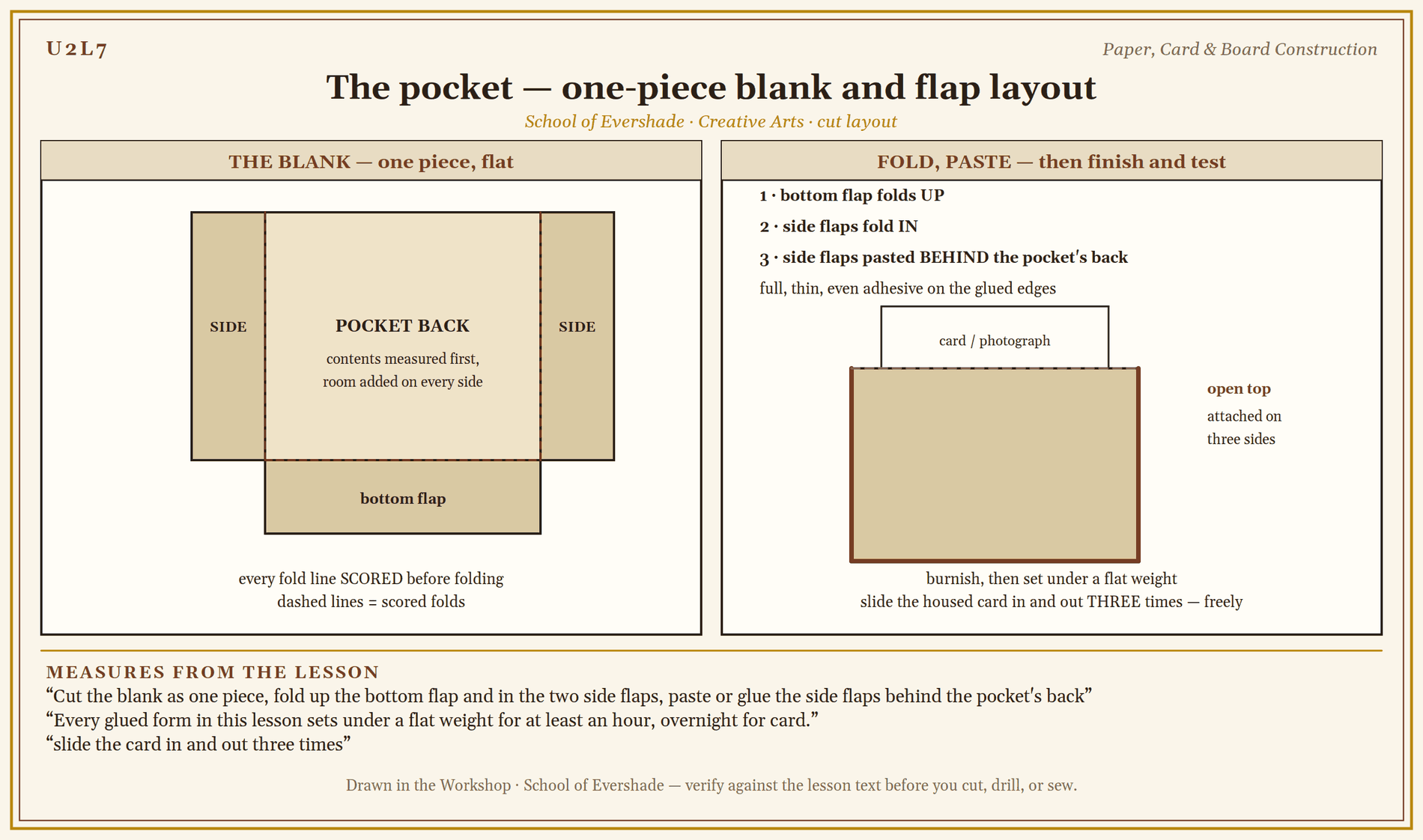
The pocket — one-piece blank and flap layout
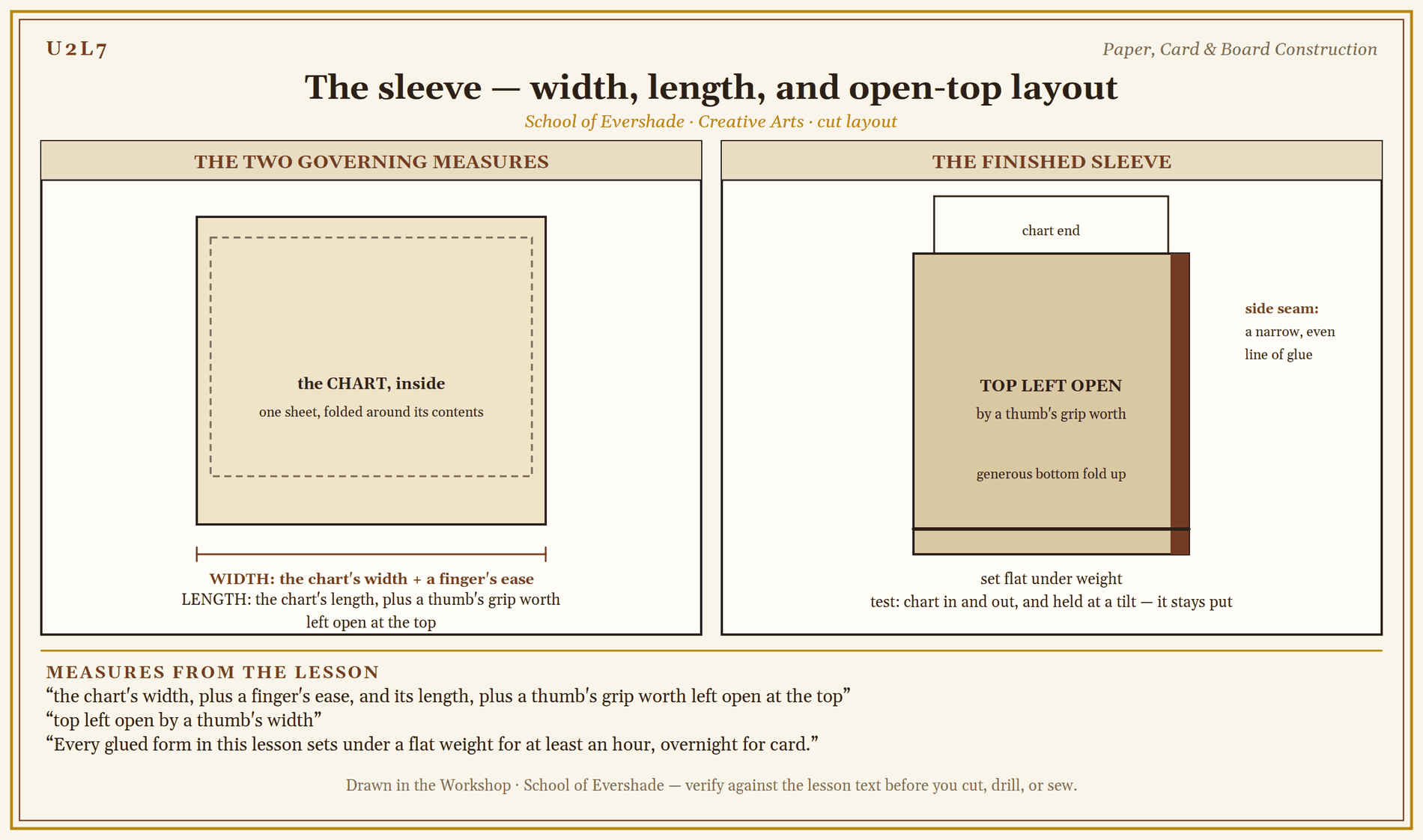
The sleeve — width, length, and open-top layout
Assignment Manual
Assignment key: ✎ written work · ⚒ hands-on practical · ◐ both
Assignment I ⚒ — The Sampler Set
Complete the Practice Practical in this lesson: one pocket, one sleeve, and one folded envelope, each built to a real measure, each tested, the envelope shaken over a clean sheet with nothing escaping.
Assignment II ✎ — The Road Paper Took
Using the lesson and the sources below, write a short account of paper's journey from Han-dynasty China to a European mill town. Include Cai Lun's part in it, fairly stated, the part played by the Battle of Talas, and one reason the journey took the better part of a thousand years.
Assignment III ◐ — Read an Envelope
Find three envelopes or folded housings in your home: a manufactured envelope, a seed packet if one exists, and any folded paper container. For each, write how it is folded, where it closes, where it would fail first, and what it is really protecting. Then say which of the three a Mesopotamian accountant would understand fastest, and why.
Materials
Level One (household)
- Printer or notebook paper and light card stock (cereal-box card serves for samplers)
- A ruler or straightedge, a pencil, scissors
- A bone folder if you have one; the back of a butter knife or an empty ballpoint pen serves for scoring
- A glue stick or white glue, applied thin
- A heavy book to serve as a press weight
- Scrap paper in quantity: samplers are the lesson, not a preliminary to it
Level Two (historical)
Everything in Level One, plus:
- Handmade or cotton-rag paper for one set of forms
- Wheat starch paste or hide glue (from Lesson 5) instead of the glue stick
- Sheets to paste together into your own pasteboard, with board and weights to press them
- A sheet of heavier handmade paper for a letterlocked folded letter, closed with wax from Lesson 17's craft
Both levels teach the same construction. Level One builds the forms in modern stock; Level Two builds them in the older materials and learns what the older materials ask of the hands.
Reflection Questions
Answer the following questions in your workbook.
- Which of your three samplers failed its first test, and what exactly did the failure teach your hands?
- Why does this workshop insist that a holder be measured to its contents rather than made a standard size?
- The bulla protected a count by being breakable. What do modern envelopes protect by being openable only in ways that show?
- Where in your own home is a record being kept in a housing that is failing it quietly? What would you build for it now?
- Grain is invisible and in charge. What other material in this course do you expect to have an invisible property like it, and how will you test for it?
Professor's Review
Your samplers are small things, and the whole school will lean on them.
You can find grain in a sheet and fold with it instead of against it. You can score a line and put a fold exactly on it. You know what paper cost the world in time, traveling from a Chinese court workshop to the mills of Europe across a thousand years, and you know the envelope on your bench is older than the letter inside it by well over a thousand years of clay. Professor Fernfoot's seeds, Professor Glimmerwick's charts, and your own loose pages are all safer than they were last week, because a pocket that fits is a promise kept.
Next lesson takes up the form paper wore before it was ever a page: the roll, and the cases that let a roll survive its centuries.
PROFESSOR COGBRANCH TIMBERCLANK
Creative Arts Workshop
Master Artisan, Head of House Occidens
Cross-Class Connections

Herbology · Unit IV, Lesson 30 — Seed Saving & Storage
You have built the envelope in the Workshop: folded, scored, and pocketed to measure. In my greenhouse that envelope earns its keep. Seed Saving & Storage teaches which seeds to save and how to keep them, and the envelope of this lesson is the one my scholars fill there; the specimen sleeve from the same bench is the housing our pressed specimens travel in. Come with your folding already true, and give your whole mind to the seeds.
PROFESSOR BERYL FERNFOOT
Herbology Greenhouse
Further Reading & Sources
Tsien Tsuen-Hsuin. Paper and Printing (Science and Civilisation in China, Vol. V:1). Cambridge University Press. The standard scholarly history of Chinese papermaking, its materials, and its spread. Print reference; no stable public link, cited here by title.
Dard Hunter. Papermaking: The History and Technique of an Ancient Craft. The classic maker's history of the craft, written by the founder of the paper museum at what is now Georgia Tech. Print reference; no stable public link, cited here by title.
About the Museum — Robert C. Williams Museum of Papermaking, Georgia Institute of Technology. The museum's own account of its collection, which follows the path of paper from the earliest writing materials to the modern mills.
Encyclopaedia Britannica. "Paper." General reference on paper's composition, manufacture, and history. Print and subscription reference; no stable public link, cited here by title.
Student-friendly starting points for exploring this lesson's world.
- About the Museum — Robert C. Williams Museum of Papermaking (Georgia Tech) — Tour the world's largest papermaking collection in words: follow paper from ancient writing materials, through the Chinese discovery of the craft, to the paper mills of Europe.
- "The Invention of Paper" — Early World Civilizations (Lumen Learning) — A clear, short account of Cai Lun, the earlier hemp papers, Song-dynasty paper envelopes, and how the craft passed west after Talas.
- "Technology of Mesopotamia: The Written Word" — History of Applied Science & Technology (Rebus Community open textbook) — Counting tokens, the clay bulla that held them, and how record-keeping in clay grew toward writing.
- "Bookbinding" — Encyclopaedia Britannica, 1911 edition (Wikisource) — Read the opening on the oldest covers of all: Assyrian tablets in clay shells, and Egyptian rolls kept in hollows cut in wood.
Submit your work for this lesson using the form below.
CONTINUE IN THE CREATIVE ARTS WORKSHOP
← Previous · Lesson 6: The Materials Library & First Tool-Making Next · Lesson 8: Scrolls, Rolls & Cases →
Unit II · Paper & Bound Records Creative Arts Workshop · All 39 Lessons
Bookstore Shelf The Library · Creative Arts Shelf Course Supplies
The rest of Unit II: Lesson 8 · Scrolls, Rolls & Cases · Lesson 9 · Pamphlet & Single-Section Binding · Lesson 10 · The Field & Observation Kit · Lesson 11 · Case Binding & Archival Boxes