

Creative Arts
Unit II, Lesson 8Scrolls, Rolls & Cases
Professor Cogbranch Timberclank
Master Artisan, Head of House Occidens
The Creative Arts Workshop • School of Evershade
Professor's Introduction

Bench drill, scholars, then look at what is on it: a long sheet, two rods, and a question older than the book itself. Before there were pages, there were rolls.
The roll is not a primitive book. It is a different answer to the same problem, and for some work it is still the better answer. A chart of the whole sky does not want to be folded into pages. A planisphere's star wheel, a long genealogy, a map of a coastline: these want length, and length is what a roll gives. Professor Nocturne's library keeps manuscripts that live as rolls, and Professor Glimmerwick's tower keeps charts that would be ruined by a crease, and both of those collections are one bad storage decision away from torn edges and cracked surfaces.
A roll's enemy is not use. A roll's enemy is being rolled badly, stored loose, and grabbed by its edges a hundred times. This lesson builds the roll properly, gives it rods to be handled by, a label so it need not be opened to be known, and a case fitted to it, so that the hundredth handling is as safe as the first. A case, in this course, is any fitted housing built around an object to its measure: this lesson's chart case, Lesson 11's archival box. A case takes the knocks so the contents do not.
You will roll and unroll your practice scroll until it lies flat and behaves. It is a humbler drill than it sounds, and every archivist who ever lived has done it.
PROFESSOR COGBRANCH TIMBERCLANK
Creative Arts Workshop
Master Artisan, Head of House Occidens

Lesson Objectives
By the end of this lesson, students should be able to:
- Describe how papyrus rolls were made, written, labeled, and stored in the ancient Mediterranean world.
- Roll a long sheet evenly on rods, with correct tension, and store it so it lies flat and uncreased.
- Fit a roll with a title label in the tradition of the Roman titulus.
- Explain how Torah scrolls are made and handled as a living craft tradition, and what their craftsmanship teaches about care.
- Describe the Chinese handscroll's construction and its manner of viewing.
- Build a simple protective case fitted to a measured chart, planisphere, or roll.
Your Assignment Packet
This lesson's assignments live in its packet: the Lexicon Handout (every term, course terms marked ◆), the Assignment Manual, and the Reflection Questions. Download the packet before you begin and keep it beside you as you read — work from it as each subject is taught, or take the assignments as homework afterward.
The Roll in History
For roughly three thousand years, the roll was the Mediterranean world's book. The Latin word for a papyrus or parchment roll was volumen, from the verb meaning "to roll"; it survives in our word "volume," which is why a book in parts is still called volumes long after rolls vanished. In Egypt, scribes joined sheets of papyrus, pith strips laid in two layers and pressed into a writing surface, into long rolls; the great surviving examples run to many meters, and the standard working roll of the Greek and Roman world settled near lengths a reader could manage across the knees. A Roman reader held the roll in both hands, unrolling with the right and rolling up with the left, reading down columns of text arranged across the roll's length. A finished roll might end in a rod, the umbilicus, giving the last turn its handle.
Finished rolls wore their names outside. A small strip, the titulus, was pasted to the roll (paintings suggest some may have hung from its end), naming the work and its author, because a library of rolls is a library of identical cylinders and no one unrolls forty of them to find the one he wants. Rolls lived in cases: the capsa and scrinium, cylindrical buckets and boxes, usually of wood, in which the rolls stood on end like arrows in a quiver, labels up. Egyptian rolls were also bound round with papyrus tape, sometimes sealed with Nile mud, and kept in rectangular hollows cut in wood. Storage was never an afterthought. It was half the technology.
The parchment roll lasted longest where the text mattered most. The Torah scroll, the Sefer Torah, is still made today as it has been made for centuries: a trained scribe, a sofer, writes the text by hand with a quill on sheets of parchment prepared from the hides of kosher animals, observing exacting rules of letterform and layout; the sheets are sewn together, and the finished Ashkenazi scroll is mounted on wooden rollers, the atzei chayim, the "trees of life," by which alone it is handled. Readers do not touch the parchment with bare hands; a pointer, the yad, keeps the place instead. (Sephardi scrolls are kept in a rigid case, the tik.) A scroll that develops damage can become unfit for ritual use until a scribe repairs it. This workshop does not teach that craft, which belongs to its own tradition and its own masters; we study it as the finest surviving proof of this lesson's whole argument, that a roll made carefully, handled by its rods, and housed with respect can serve for centuries.
East Asia made the roll into an art of viewing. The Chinese handscroll, paper or silk mounted with brocade borders and a wooden roller, is not read all at once. It is unrolled section by section, an arm's length at a time, the journey of its landscape or story passing through the viewer's hands in order, then rolled away and kept in its own labeled box, often wrapped in silk inside it, layers of considered housing around a single sheet. The Metropolitan Museum's essay on the form, linked below, describes the experience exactly: ceremony and anticipation, and a scroll whose value is reflected in its packaging.
The codex, the paged book, eventually replaced the roll for most texts, and Lesson 9 takes up that story. But the roll never died. It retired to the work it does best: charts, maps, scrolls of honor, and the long records of the sky, which is why this workshop still builds them properly.
How a Roll Wants to Be Handled
A roll fails at its edges and at its memory. Rolled too tight, the sheet takes a curl that fights every later opening; rolled loose and uneven, its edges telescope out of line and crumple against the case. Rolled always in the same direction for years, parchment and heavy paper remember the curl and must be coaxed, never forced, to lie flat, sometimes by a gentle reverse roll and rest.
So the handling rules are few and plain. Handle by the rollers, not the sheet. Roll with even, modest tension, edges aligned at every turn; a wandering edge is corrected by unrolling back to where it wandered, not by tugging. Store a roll in its case, lying or standing as the case is built for, never loose in a drawer among hard objects. And label it outside, always, so identification never requires an opening. These are the titulus's rules, and they have not needed improvement in two thousand years.
A Sealed Note from Professor Timberclank
Scholars, the edges of a roll are where its life is shortest, and they tear for one reason: a hand grabbed the sheet because the roller was not there to be grabbed.
Never build a roll without its rods, and never handle a roll by anything else once the rods are on. The rod is the handle the past thoughtfully provides. When you find a roll stored without one in some neglected corner of this castle, and you will, do not carry it by its sheet out of kindness. Roll it gently onto any clean rod or tube to hand, carry it by that, and bring it to the bench.
We mend what we can reach. Reach it properly.
A word about the cutting in this lesson, scholars, because it hides in plain sight. The sheet is trimmed to length, and the case is cut from card by Lesson 7's method, and both jobs are blade work under the rules you already hold: scissors closed in the hand and closed on the bench, the knife traveling away from the body against the straightedge, fingers curled clear of its road, work flat on the cutting board. If your case is a tube that must be cut to length, that is a heavier cut than paper ever asks for, and in this workshop it is an adult's cut, made by an adult's hands — or the tube waits, near enough in length, until one can be.
And handle your rods before you trust them. A dowel with a splinter raised will mark the sheet's face, and find your palm on the way to it. Run a hand slowly along every rod before the sheet meets it; sand smooth, or set aside, any that catch. We stop. We make it safe. Then we begin again.
PROFESSOR COGBRANCH TIMBERCLANK
Creative Arts Workshop
Master Artisan, Head of House Occidens
Technique: Building the Roll and Its Case
The sheet. Join sheets end to end if length requires it: overlap by a finger's width, paste or tape on the back, burnish flat, and let the joins set before any rolling. For a working chart roll, modern long paper or a joined run of sheets serves; for a ceremonial roll, one long sheet of good paper is worth its cost in behavior.
The rods. A wooden roller at the closing end and a flat stave at the opening end for a handscroll; a single rod at the end for a reader's roll. Attach the sheet's end squarely: an uneven attachment makes a roll that spirals forever after. Paste or tape the end along its full width, roll the first turn by hand with the sheet squared against the rod, and check alignment before continuing.
Rolling. Roll from the far end toward the rod, or rod to rod for a handscroll, at walking pace, keeping the edge line straight by eye and the tension modest: snug, never strained. Your practice drill is complete when the roll can be unrolled onto the bench and lies flat without a hand holding it, and rolls back up to the same even cylinder from either end.
The label. Make a titulus: a small tag of card, tied or pasted at the roll's outer end, or a label band around the case, carrying the work's name, its maker, and its date. Write it before the roll goes into storage, while you still remember what it is. Every archive on Earth is a monument to labels written later than they should have been.
The case. Measure the rolled chart: its length and its rolled diameter, with a finger's ease added. Build the case as a long box or a capped tube: a stiff tube (a postal tube is the modern servant), or a box folded from card in Lesson 7's technique with a separate lid, long walls, and both ends closed in a way that opens without force. Line nothing roughly; the chart's face should meet only smooth surfaces. Label the case outside. The case takes the shelf knocks, the dust, and the light; the chart takes none of them.
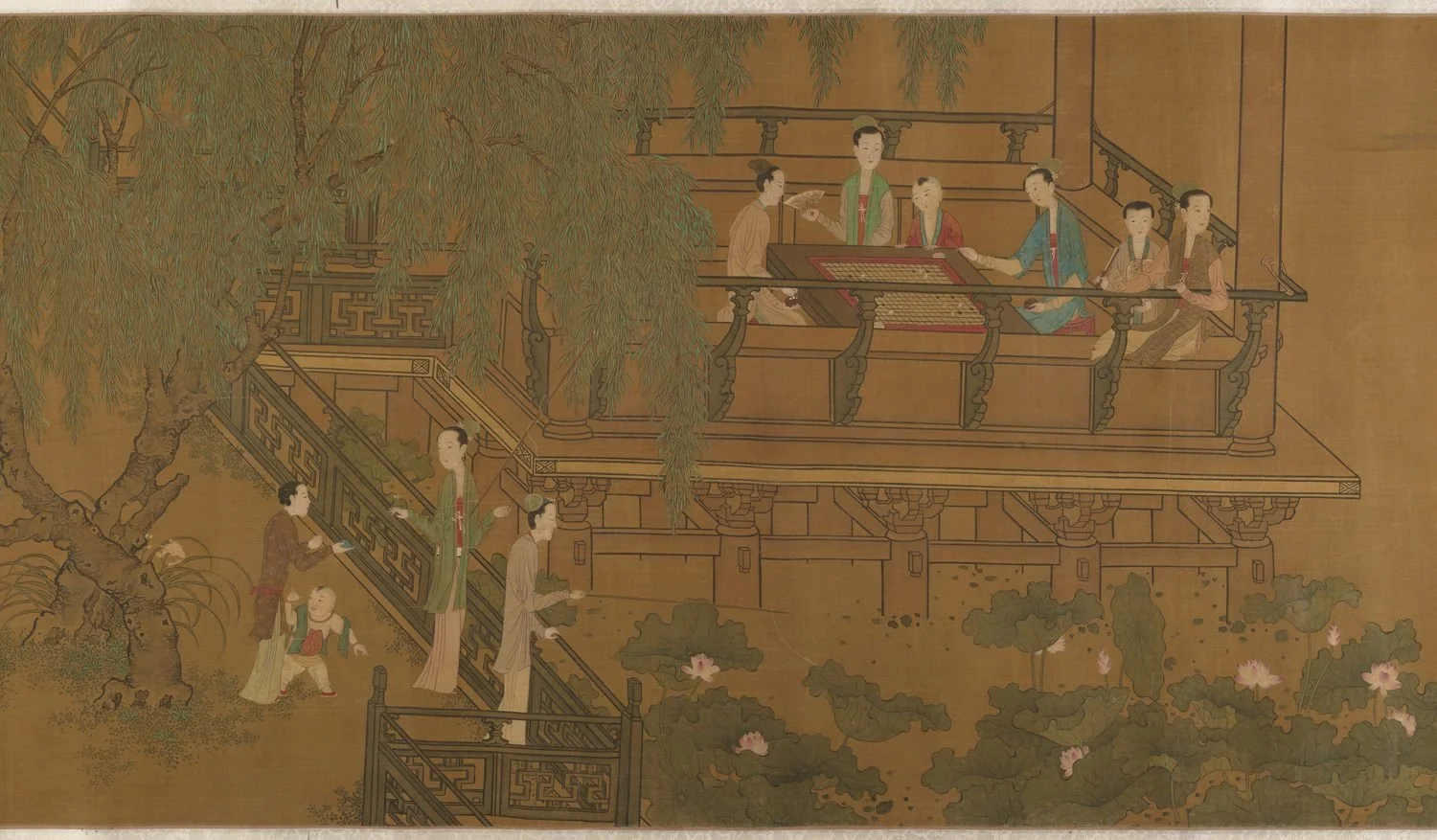
A real handscroll — "Women and children in a garden," ink and color on silk, 16th–17th century, over ten feet long when unrolled.
The Metropolitan Museum of Art (Object 13.220.2), Open Access (CC0).
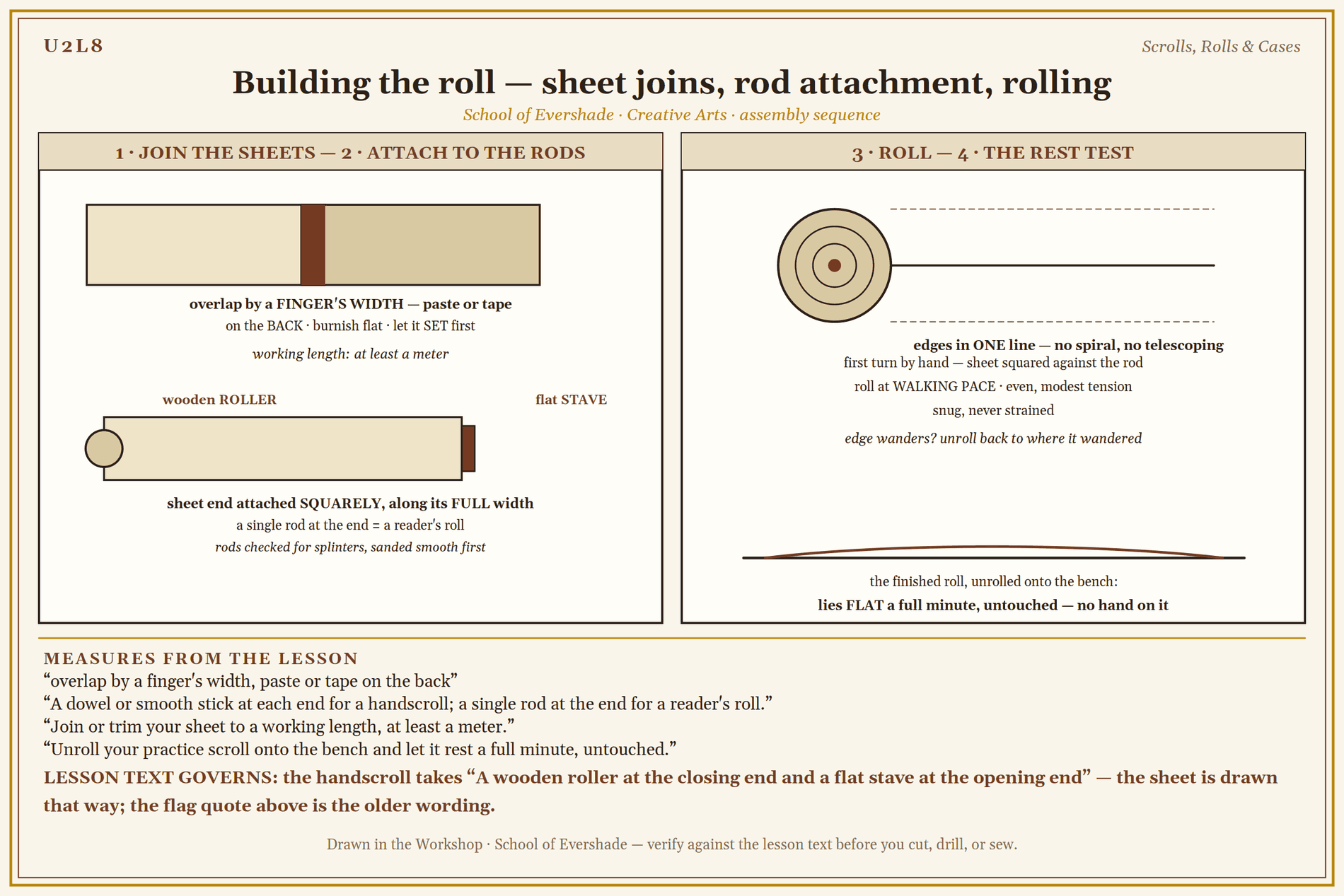
Building the roll — sheet joins, rod attachment, rolling
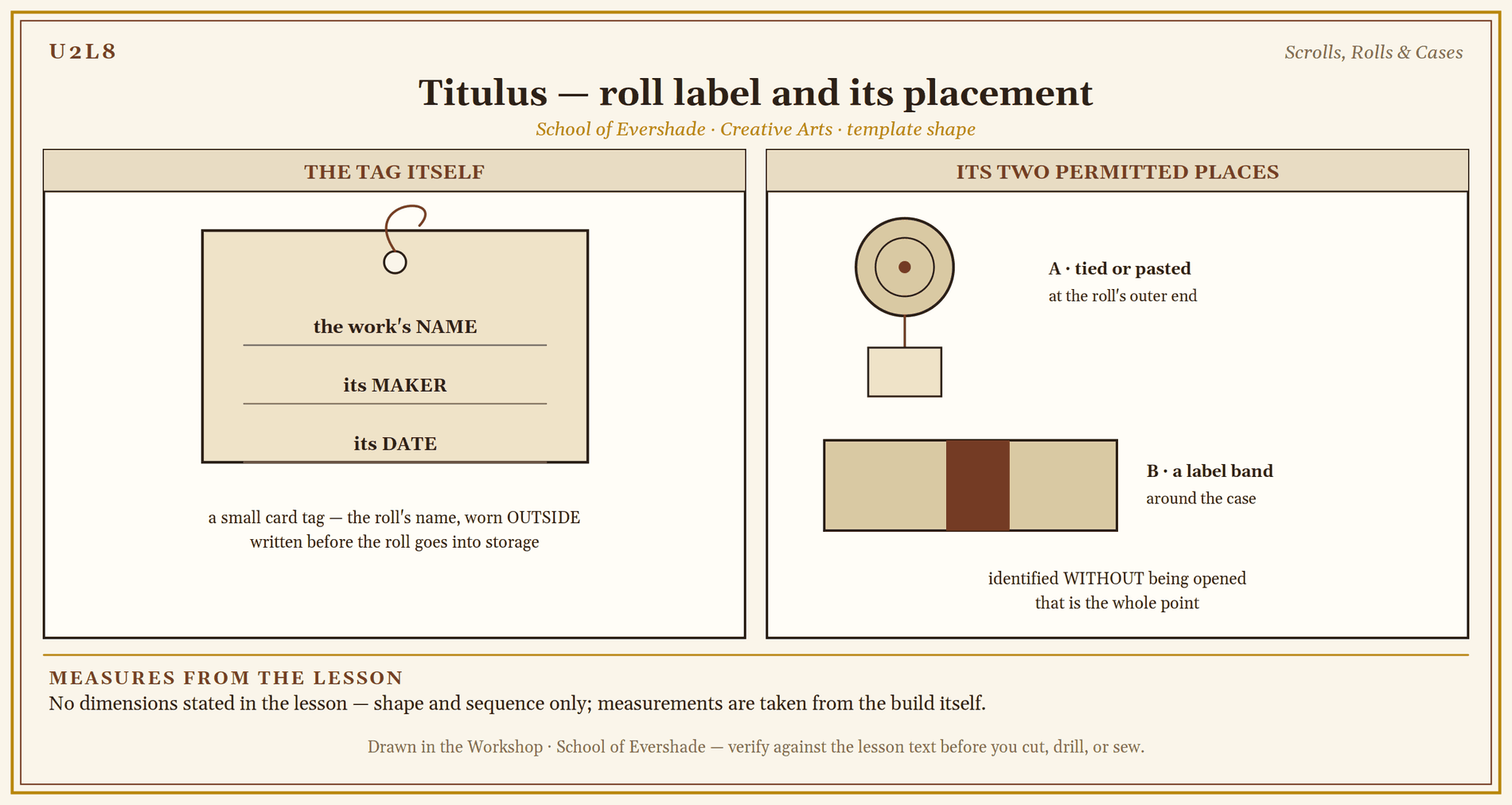
Titulus — roll label and its placement
Practice Practical: Roll, Label, and Case
This drill is checked for even rolling and a case that fits, not for speed.
Blades appear twice in this drill: trimming the sheet, and cutting the card case by Lesson 7's technique. Both follow the cutting rules of Lesson 3 — work flat on the board, blade traveling away from the body, the guiding hand clear of the cut. A tube that needs cutting to length is an adult's cut. Check every rod for splinters before the sheet meets it.
- Bench drill and build the roll. Set up your bench. Join or trim your sheet to a working length, at least a meter. Attach one end squarely to its rod, paste along the full width, and let the attachment set. Roll the sheet up once, slowly, and check the cylinder: edges in one line, no spiral. Unroll and correct until the roll behaves.
- Roll until it lies flat. Unroll your practice scroll onto the bench and let it rest a full minute, untouched. Note where it still curls. Roll and unroll it, from alternate ends if it has two rods, until it lies flat on the bench without a hand on it. This is the drill the craft demands: repetition until the sheet's memory is the roll you want, not the tube it arrived as.
- Make the titulus. Write the roll's label: its name, yours, and the date, on a card tag. Attach it at the roll's outer end or keep it for the case, but decide now and write in your workbook where the label lives and why.
- Fit the case. Measure the rolled scroll: length, and diameter at its fattest turn. Build or choose its case to those measures with a finger's ease: a card box in Lesson 7's technique, or a tube cut to length and capped. The scroll should slide in without persuasion and not rattle when the case is tilted gently end to end.
- The hundredth-handling test. Take the scroll out of its case and return it, five times, handling it only by the rods or the case. If any handling tempts your fingers to the sheet's edge, the case or the rods want adjusting. Adjust them, and write down what you changed.
- Record and put away. Label the case outside. Note in your workbook the roll's measures, so its next case can be built from the record. Tools away, bench clean.
A scroll that lies flat, rolls true, and can be found by its label in the dark has passed. It will still be passing in a hundred years if its keepers hold it by the rods.
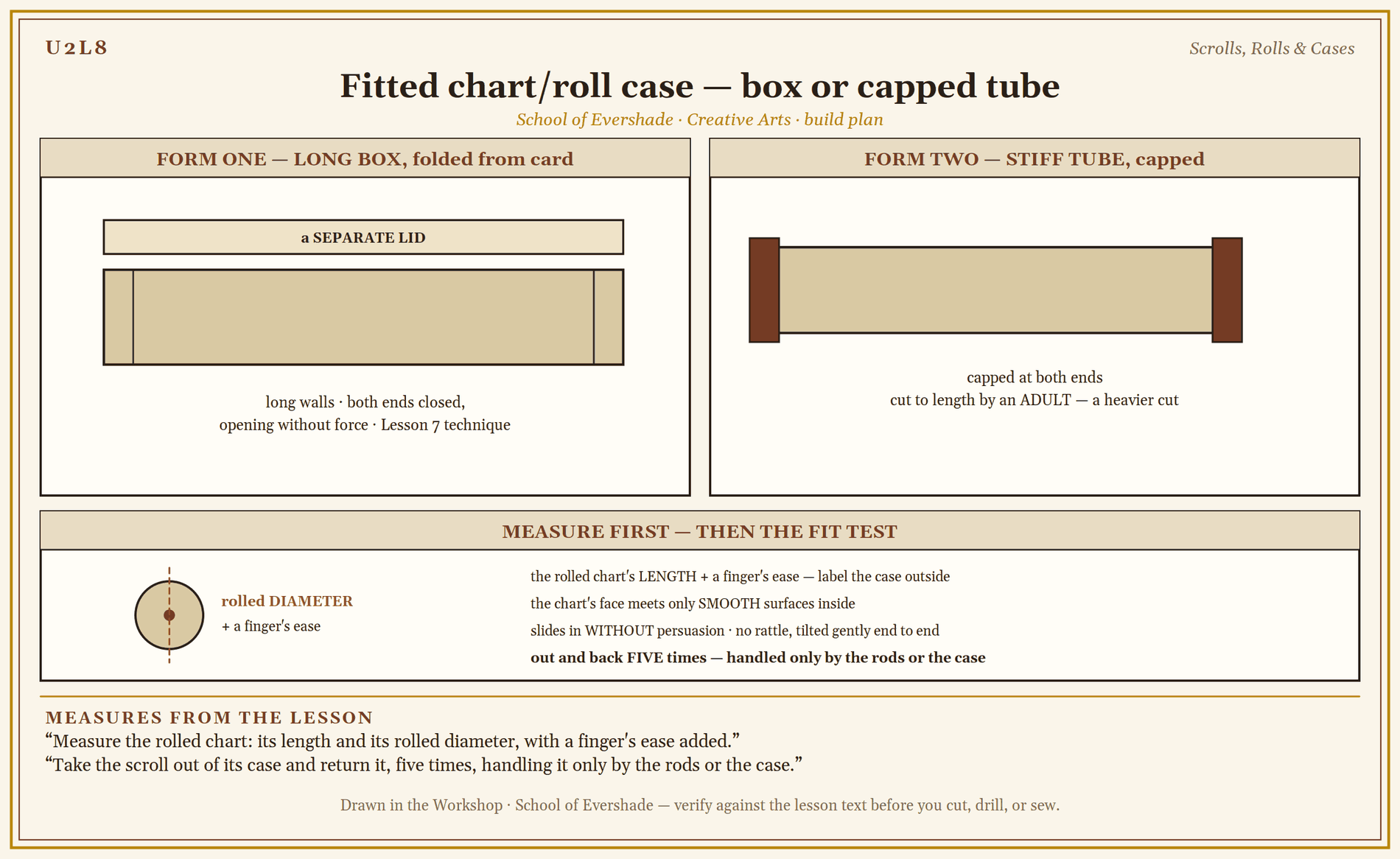
Fitted chart/roll case — box or capped tube
Assignment Manual
Assignment key: ✎ written work · ⚒ hands-on practical · ◐ both
Assignment I ⚒ — The Practice Practical
Complete the drill in this lesson: a roll built square and rolled until it lies flat, a titulus label made and placed, and a case fitted to the roll's own measures, passing the hundredth-handling test.
Assignment II ✎ — Two Libraries, Two Answers
Using the lesson and the sources below, compare a Roman reader's roll library with a Chinese handscroll collection: how each roll was stored, how each was found again without opening it, and how each was meant to be viewed. End with the one storage habit both traditions share, stated in your own words.
Assignment III ◐ — The Neglected Roll Interview
Find a rolled item in your home: a poster, a map, a roll of wrapping paper, a set of plans. Examine it and write a short condition report: its edges, its memory (does it lie flat?), its housing, and its label, or lack of one. Then state the three things this lesson would do for it, in order.
Materials
Level One (household)
- Long paper: a roll of craft or easel paper, or sheets joined end to end
- Two wooden dowels or smooth sticks for rods (a single rod is acceptable for a first roll)
- Card stock and Lesson 7's tools for the case: ruler, pencil, scissors, folder, glue
- A postal or storage tube if one is in the house, as an alternative case
- String or ribbon, and card for the titulus label
Level Two (historical)
Everything in Level One, plus:
- A single long sheet of cotton-rag or handmade paper for the roll itself
- Turned or sanded hardwood rods, finished with wax
- Book cloth or leather for the case covering, with pasteboard built by Lesson 7's method
- A silk or cloth wrap for inside the case, in the handscroll tradition
Both levels teach the same craft: a roll built square, rolled true, labeled outside, and cased to its measure.
Reflection Questions
Answer the following questions in your workbook.
- Rolling until the sheet lies flat is slow work. What did the repetition teach your hands that one careful roll did not?
- Why did libraries of rolls need the titulus so badly, and what is its modern descendant on your own shelves?
- The Torah scroll is handled only by its rollers and read with a pointer. What does that handling rule protect besides the parchment?
- Which serves its text better, the roll or the codex, for a star chart? For a novel? Defend each answer with the lesson's reasoning.
- Where did your case nearly fail the hundredth-handling test, and what did you change?
Professor's Review
Your scroll lies flat, and that small obedience took more honest repetition than anything in Unit I.
You know the roll as the book of three thousand years: papyrus joined and labeled in Rome, parchment sewn and mounted on its trees of life, silk mounted and boxed in China. You know why the label lives outside and why the hands live on the rods. And your chart case fits, because you measured the roll you actually made instead of the roll you intended.
Next lesson we fold the roll's successor: a single gathering of pages, sewn once through the fold, and the journals of this school begin.
PROFESSOR COGBRANCH TIMBERCLANK
Creative Arts Workshop
Master Artisan, Head of House Occidens
Further Reading & Sources
Delbanco, Dawn. "Chinese Handscrolls." Heilbrunn Timeline of Art History, The Metropolitan Museum of Art. On the handscroll's format, viewing, mounting, and boxed storage.
Tahan, Ilana. "The Kaifeng Torah Scroll: A British Library Treasure." British Library, Asian and African Studies blog. A curator's account of a surviving Torah scroll: its sewn sheepskin sheets, its silk thread, and its centuries of keeping.
Roberts, Colin H., and T. C. Skeat. The Birth of the Codex. Oxford University Press. The classic scholarly study of how the paged book emerged beside the roll. Print reference; no stable public link, cited here by title.
Encyclopaedia Britannica, 1911 edition. "Bookbinding" (Wikisource). Its opening pages cover rolls directly: rolls kept in cylinders with a title tag at each end, in a box called a scrinium, and Egyptian rolls bound with papyrus tape and sealed with Nile mud.
Student-friendly starting points for exploring this lesson's world.
- Chinese Handscrolls — Heilbrunn Timeline of Art History, The Metropolitan Museum of Art — How a handscroll is mounted, wrapped, boxed, and viewed an arm's length at a time, and why its packaging is part of its value.
- The Kaifeng Torah Scroll: A British Library Treasure — British Library — The story of one community's Torah scrolls: ninety-five strips of sheepskin sewn into a single roll, and the centuries that carried it to a library shelf.
- Bookbinding — Encyclopaedia Britannica, 1911 edition (Wikisource) — The old encyclopedia on roll storage: title tags, the scrinium box, and rolls preserved in hollows cut in wood.
- Codex — Dartmouth Ancient Books Lab — What the codex is, how it grew from folded sheets, and how it slowly replaced the papyrus roll it competed with for centuries.
Submit your work for this lesson using the form below.
CONTINUE IN THE CREATIVE ARTS WORKSHOP
← Previous · Lesson 7: Paper, Card & Board Construction Next · Lesson 9: Pamphlet & Single-Section Binding →
Unit II · Paper & Bound Records Creative Arts Workshop · All 39 Lessons
Bookstore Shelf The Library · Creative Arts Shelf Course Supplies
The rest of Unit II: Lesson 7 · Paper, Card & Board Construction · Lesson 9 · Pamphlet & Single-Section Binding · Lesson 10 · The Field & Observation Kit · Lesson 11 · Case Binding & Archival Boxes