

Creative Arts
Unit II, Lesson 9Pamphlet & Single-Section Binding
Professor Cogbranch Timberclank
Master Artisan, Head of House Occidens
The Creative Arts Workshop • School of Evershade
Professor's Introduction

Bench set, scholars. Today the folded sheet becomes a book.
Nearly every record this school keeps by hand begins as one of these. Professor Glimmerwick's Moon Journal, the first thing a Celestial scholar makes. Professor Fernfoot's field notebook. Professor Nocturne's practice books, filled with strokes and thrown away by the shelf-load in a good term. A pamphlet binding is a single gathering of folded pages, sewn once through the fold, in a cover that costs almost nothing and protects almost everything a journal needs protected. It is the humblest binding in this course and the one you will make most often for the rest of your lives.
Do not mistake humble for careless. A pamphlet bound badly gapes at the spine, sheds its cover in a satchel, and lets its pages saw through their own thread. Bound well, it lies flat, opens fully, and outlasts the notes inside it. The difference is five pierced holes and a seam sewn with attention, which is exactly the sort of difference this workshop exists to teach.
Your practice pamphlet will be sewn in scrap paper, folded, pierced, and stitched until the stitch is boring. Boring is the sound of a technique arriving.
PROFESSOR COGBRANCH TIMBERCLANK
Creative Arts Workshop
Master Artisan, Head of House Occidens
Lesson Objectives
By the end of this lesson, students should be able to:
- Explain what a codex is and how it rose from a convenience to the standard book form.
- Fold a single gathering (section) with its grain running correctly and nest its sheets in order.
- Pierce sewing stations accurately with an awl, using the safety training of Lesson 4.
- Sew a three-hole and a five-hole pamphlet stitch, with tension that holds without tearing.
- Describe the chapbook trade and the Japanese pouch binding (fukuro toji) as the pamphlet's fellow single-volume traditions.
- Fit a paper cover to a pamphlet and trim the finished book square.
Your Assignment Packet
This lesson's assignments live in its packet: the Lexicon Handout (every term, course terms marked ◆), the Assignment Manual, and the Reflection Questions. Download the packet before you begin and keep it beside you as you read — work from it as each subject is taught, or take the assignments as homework afterward.
How the Book Got Its Pages
The codex was not the ancient world's first idea; it was its second, and it won slowly. A codex is a book of folded sheets bound along one edge, the form of nearly every book you have ever held. Wax tablets, wooden boards coated in wax and laced together in pairs and sets, gave Rome a reusable notebook form, and folded parchment notebooks seem to have grown from that habit. Through the first centuries CE the codex spread, at first especially among early Christian communities, who adopted it for their scriptures with striking consistency, while rolls remained the prestige form for literature. By the fourth century the parchment codex had drawn level with the roll and was overtaking it for good. Its advantages read like a list of this lesson's skills: both sides of the sheet written, pages found again at once, a compact block that travels, and eventually, a spine worth labeling.
Cheap print gave the single-section binding its great age. The chapbook was the paperback of the sixteenth to nineteenth centuries, and of the seventeenth to nineteenth above all: slim booklets of eight, twelve, sixteen, or twenty-four pages, folded from a single printed sheet, stitched or stabbed, wrapped in plain paper if wrapped at all, and sold for a penny or so by traveling chapmen whose packs carried ballads, tales, almanacs, and lives of saints and criminals into villages no bookshop served. Scotland's printers alone put out chapbooks by the thousand; the National Library of Scotland's collection of them, digitised in its Data Foundry, runs to some three thousand booklets. Printers economized on every part: cheap paper, secondhand type, woodcuts reused until the pictures were ghosts. The chapbook is proof that a binding need not be strong for a century. It needs to be strong for its reader, and cheap enough to exist at all.
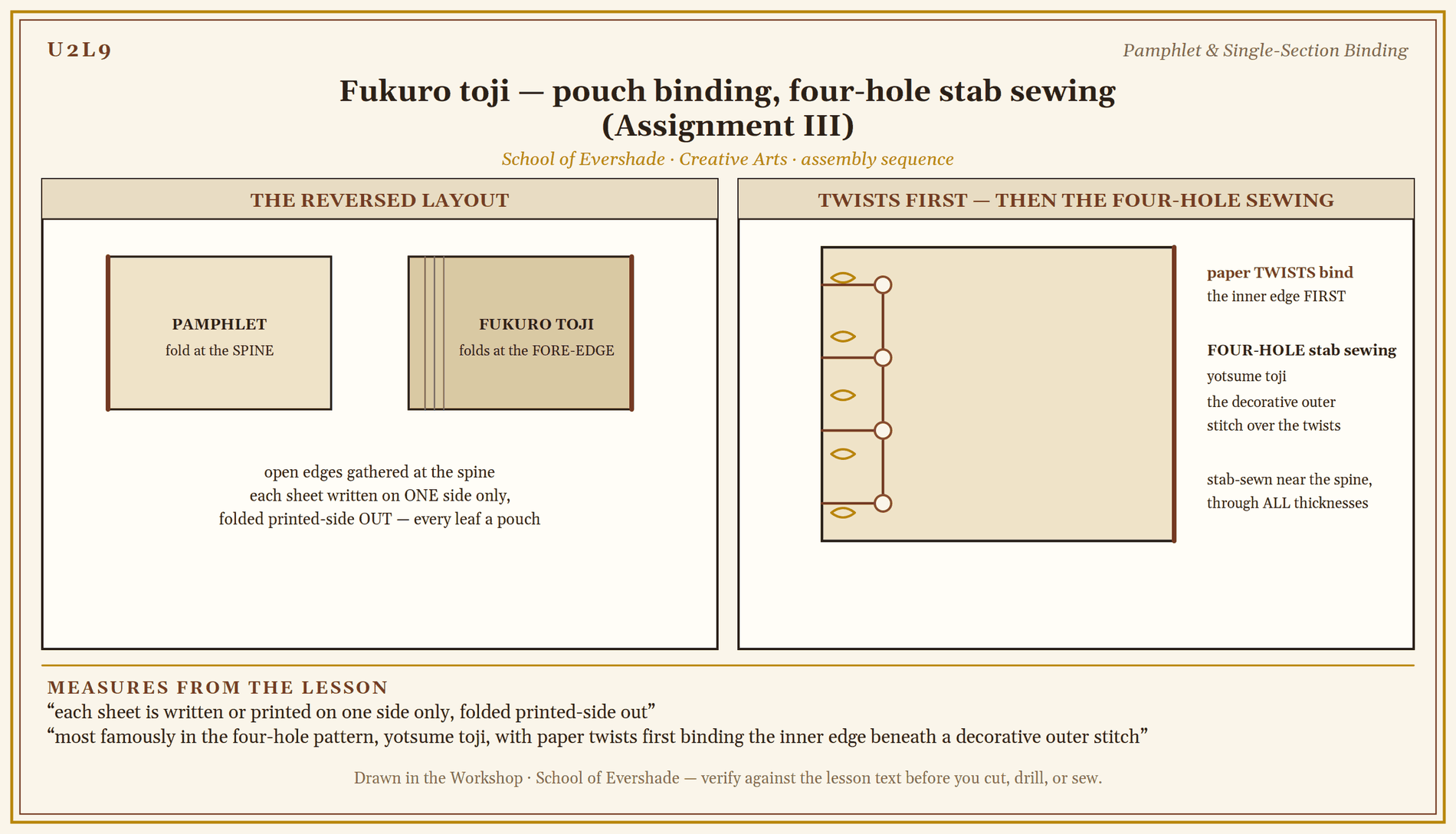
Japan bound single sections by a logic entirely its own. In fukuro toji, pouch binding, each sheet is written or printed on one side only, folded printed-side out, and the folded sheets are stacked with every fold at the fore-edge of the book, the open edges gathered at the spine. The stack is stab-sewn near the spine through all thicknesses, most famously in the four-hole pattern, yotsume toji, with paper twists first binding the inner edge beneath a decorative outer stitch. The result opens like our books in reverse perspective: the fold you would expect at the spine rides at the outside, and every leaf is a pouch. It is beautiful, durable, and a standing reminder that the codex has more than one correct answer.
Your pamphlet stitch stands in this long line: the sewn journal of the Mediterranean codex, the penny booklet of the chapman's pack, and the stab-sewn pouch of Edo Japan are cousins, and today your hands learn the family trade. The pamphlet stitch is a simple sewing that passes through the fold of a single gathering and its cover, typically at three or five stations, tying the section and cover together in one operation.
A Note on Paper Before Thread
A gathering folds correctly only when the grain runs parallel to the spine. Fold a sheet against its grain and the fold cracks, the pages creep, and the book pushes itself open forever. Test grain by Lesson 2's methods, fold with it, and nest the sheets smoothly, jogging the gathering square on the bench before a single hole is pierced. Everything sewn afterward inherits this decision.
A Sealed Note from Professor Timberclank
The awl is a patient tool with a sharp opinion, scholars.
Pierce away from yourself, always, with the gathering lying on the piercing board and your free hand well clear of the fold. An awl that slips goes where it was aimed; see that it is aimed at scrap wood and nothing softer. We stop. We make it safe. Then we begin again.
And sew snug, never savage. Thread pulled to tearing is not tightness; it is damage scheduled for later. A pamphlet stitch should hold the gathering the way a good handshake holds: firmly, and without hurting anything.
PROFESSOR COGBRANCH TIMBERCLANK
Creative Arts Workshop
Master Artisan, Head of House Occidens
Technique: The Pamphlet Stitch, Step by Step
Fold and nest. Fold each sheet in half, grain parallel to the fold, and crease with the folder. Nest the sheets inside one another in order, jog the gathering square on the bench, and check page order now; order cannot be fixed after sewing. A gathering considered as a unit, especially once folded and ready for sewing, is also called a signature; printers' marks that identify gatherings are also called signatures.
Measure the stations. For a three-hole stitch, mark the fold at its center and at a thumb's width from each end. For a five-hole stitch, center, ends, and the midpoints between. Mark on the inside of the fold with a pencil and a measured template, never by eye twice. A sewing station is one of the holes pierced along the fold through which the thread passes; stations are measured and pierced before sewing begins, because thread finds holes, it does not make them.
Pierce. Set the gathering on the piercing board, open flat at its center fold. Pierce each station from the inside of the fold outward, awl vertical, free hand clear. Five holes, each clean, each exactly where the template put it.
Sew. Thread a needle with linen or strong cotton thread about two and a half times the spine's length, and leave the ends untied. The three-hole path: out through the center hole, in through one end hole, out through the other end hole, in through the center again, so the thread's two ends meet at the center on the outside of the fold. Draw snug, and tie over the long stitch that runs along the spine, square knot, tails trimmed short or left as a small tassel by house custom. The five-hole path extends the same logic station by station, out and in in sequence, always finishing with ends meeting and tied over a long stitch. Your cover, cut a fold taller and wider than the gathering and pierced at the same stations, sews on in the same pass, which is the whole economy of the form: one sewing holds book and cover together.
Trim and press. Trim the fore-edge square if the pages creep, cutting against a straightedge with adult supervision where the school requires it, and press the finished pamphlet under weight overnight. A pamphlet pressed is a pamphlet that lies flat for its author from the first page.
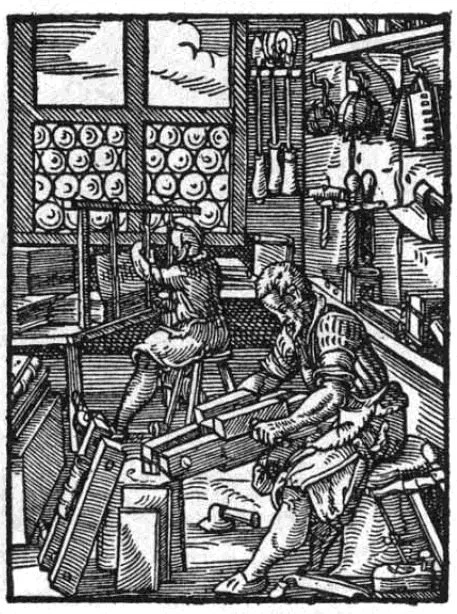
A bookbinder's workshop, 1568 — sewing, pressing, and finishing books at the bench.
Woodcut from the Ständebuch (Book of Trades), Frankfurt, 1568. Public domain, via Wikimedia Commons.
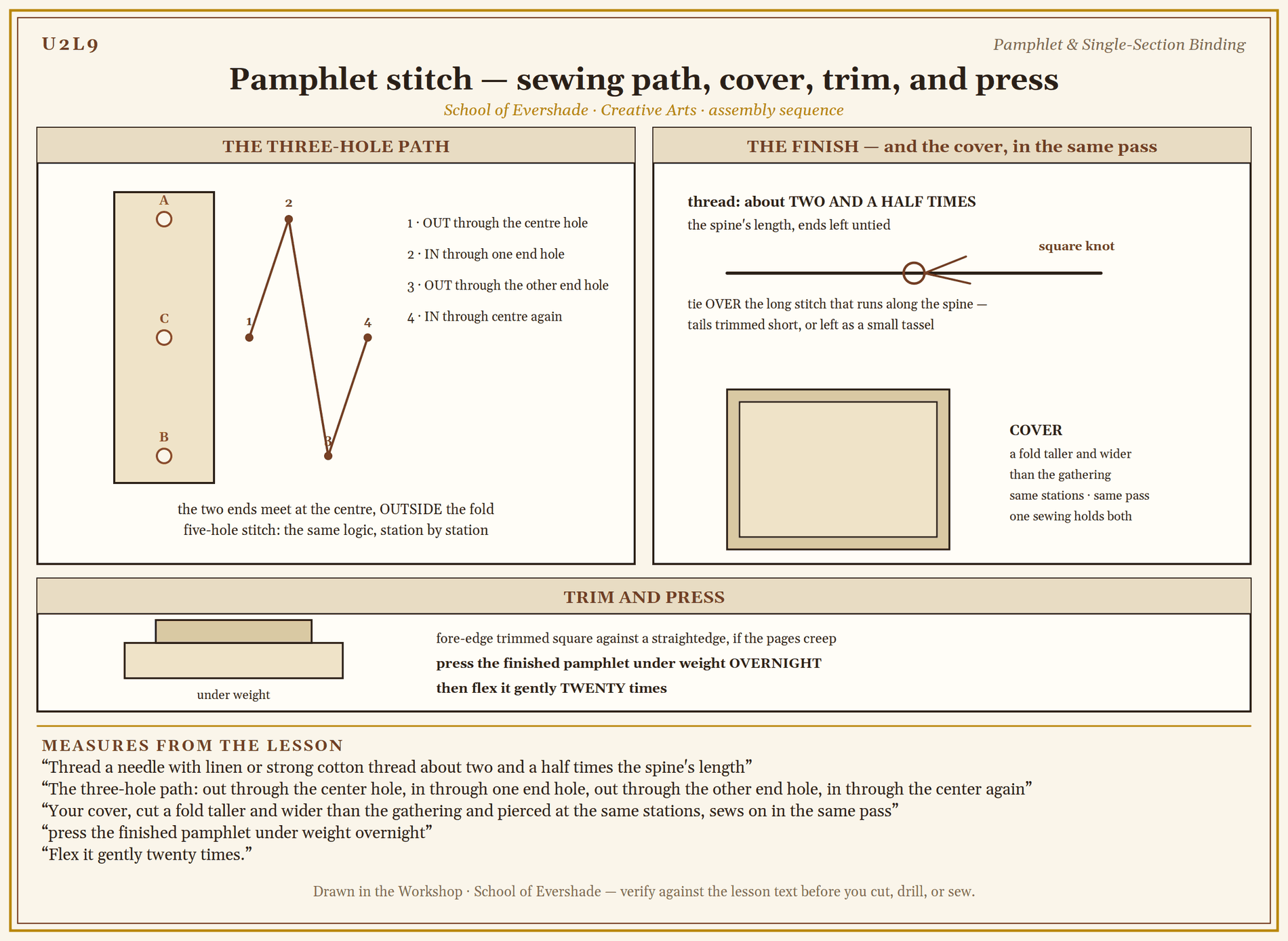
Pamphlet stitch — sewing path, cover, trim, and press
?
Practice Practical: Bind a Practice Pamphlet
This drill is checked for a gathering that lies flat and a stitch that holds without tearing.
- Bench drill and fold. Set up your bench. Test the grain of your scrap sheets, fold four of them with the grain, and nest them into one gathering of sixteen pages. Jog it square. Check the page order by counting through the folded gathering in pencil at the corners, small numbers, before anything is pierced.
- Mark and pierce. Draw a station template on scrap card for a five-hole stitch fitted to your gathering's height. Mark the fold from the template. Set the gathering on the piercing board, open at its center, and pierce the five stations from the inside out, awl vertical, hand clear. Inspect every hole: clean, on the fold, where the template put it.
- Sew the gathering. Thread the needle and sew the five-hole path through gathering and a scrap cover pierced to match, in one pass. Draw each pass snug, never tearing. Tie off over the long stitch at the center, square knot, and trim the tails.
- Test the book. Open the pamphlet flat at its middle and at its first and last pages. It should lie open without being held and close without a gap at the spine. Flex it gently twenty times. No page should saw at its thread, and no hole should stretch. If one does, note which station failed and why in your workbook.
- Record and put away. Press the pamphlet under weight and leave it there until tomorrow's bench. Record its measures: page size, station spacing, thread used. Your next journal, in another scholar's classroom, will be this exact build with real paper. Tools away, awl sheathed and counted, bench clean.
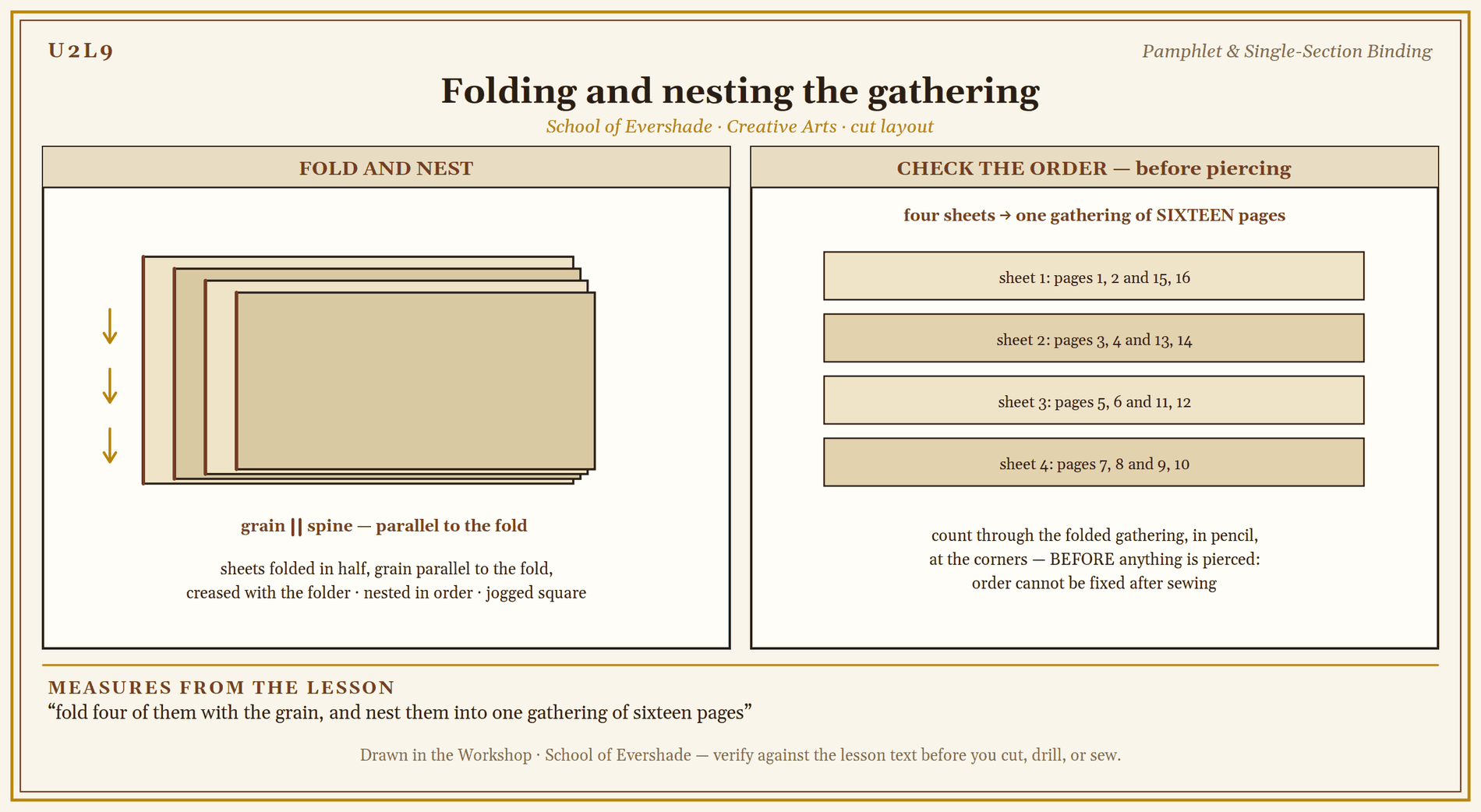
Folding and nesting the gathering
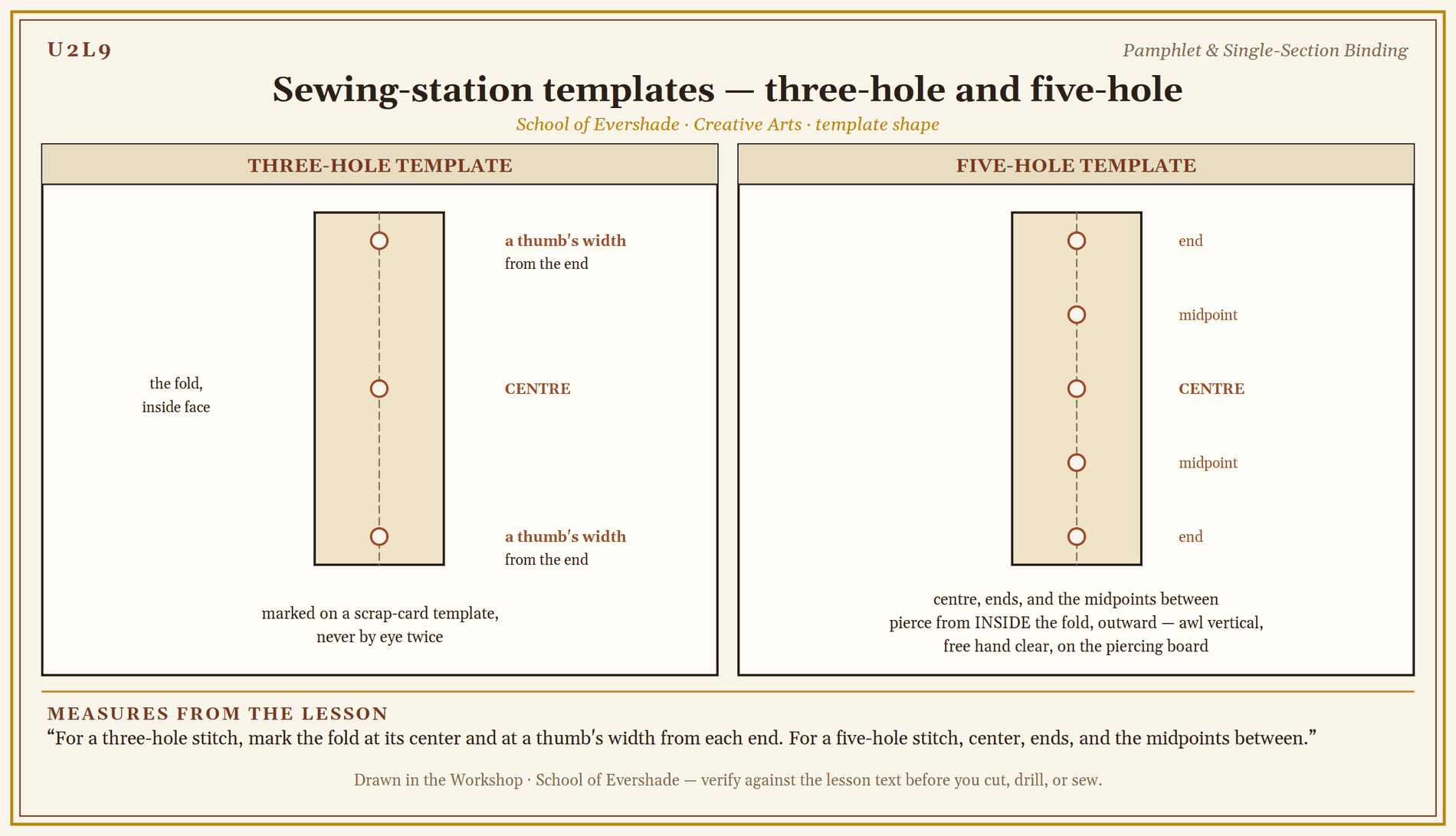
Sewing-station templates — three-hole and five-hole
Assignment Manual
Assignment key: ✎ written work · ⚒ hands-on practical · ◐ both
Assignment I ⚒ — The Practice Pamphlet
Complete the Practice Practical in this lesson: a five-hole pamphlet sewn in scrap, lying flat, passing the flex test, its page order correct from first leaf to last.
Assignment II ✎ — The Codex's Case
Using the lesson and the sources below, write the argument the codex made against the roll, and the roll's defense. Cover random access, economy of material, travel, and prestige, and end by naming one kind of record for which the roll still wins, with your reason.
Assignment III ◐ — Sew the Other Shore
Research the pouch binding, fukuro toji, from the National Diet Library's guide below. Then fold a short gathering printed-side out (write or draw on one side of each sheet first), stack folds at the fore-edge, and stab-sew it in the four-hole pattern. Write a half-page comparing the two books in your hands: which opens better, which protects its writing better, and which you would trust with a year's sky log, and why.
Materials
Level One (household)
- Printer or notebook paper for the gathering, and card stock or heavy paper for the cover
- A needle with an eye large enough for your thread, and strong cotton or linen thread (waxed with a candle stub if it frays)
- An awl, or a large needle set in a cork, with scrap wood or a folded stack of card as a piercing board
- Ruler, pencil, folder, scissors
- The templates from this lesson, drawn on scrap card before you begin
Level Two (historical)
Everything in Level One, plus:
- Cotton-rag or handmade paper for the gathering, grain tested sheet by sheet
- Waxed linen thread, the binder's standard, prepared in Lesson 5's wax work
- A sheet of paste paper or marbled paper for the cover, made when the workshop reaches Unit IV
- For a pouch-bound companion volume: sheets folded printed-side out and stab-sewn in the yotsume toji four-hole pattern, inner binding of twisted paper cord in the Japanese manner
Both levels sew the same stitch. Level Two sews it in the materials the stitch grew up with.
Reflection Questions
Answer the following questions in your workbook.
- Where did your stitch nearly tear, and what did your hands learn from the station that failed?
- The chapbook was built to be cheap enough to exist at all. What do we gain, and what do we risk, when a school builds its journals the same way?
- Why might a tradition bind a book with its folds at the fore-edge rather than the spine? Answer from the material, not from taste.
- Professor Glimmerwick's Moon Journal begins a year of nightly records. What does this binding promise that journal, and what does it ask of the scholar keeping it?
- Page order could not be fixed after sewing. Which other crafts in this course have a point of no return like that, and how does each one prepare you before it?
Professor's Review
Sixteen pages, five holes, one seam, and the school's journals are standing on their own spines.
You can fold a gathering true to its grain, pierce stations to a template with the awl handled the way Lesson 4 taught, and sew a stitch that holds without hurting the sheet. You know where this little book comes from: the wax tablet's grandchildren, the chapman's penny pack, the pouch-bound volumes of Japan. When Professor Glimmerwick hands her scholars a Moon Journal this year, or Professor Fernfoot a field notebook, the hands that bound it know its whole ancestry.
Next lesson we carry the journal out of the workshop: the field kit, where binding meets weather, pockets, and the far end of the garden.
PROFESSOR COGBRANCH TIMBERCLANK
Creative Arts Workshop
Master Artisan, Head of House Occidens
Cross-Class Connections

Celestial Studies · Unit I, Lesson 1 — Welcome to the Celestial Tower
Workshop scholars, my Tower opens with the Moon Journal, and the journal it asks for is this lesson’s build: one gathering, sewn once, in a cover that will take a year of nights. Bind it at Professor Timberclank’s bench first, and you will arrive in the Celestial Tower ready to observe — bring the journal, and we will fill it with the Moon.
PROFESSOR VESPER GLIMMERWICK
Celestial Studies
Further Reading & Sources
National Diet Library (Japan), Preservation Division. "Japanese Bookbinding: Four-Hole Binding (Yotsume Toji)" workshop guide. The definitions, materials, and step-by-step method for the pouch and four-hole bindings used in Assignment III.
National Library of Scotland. "Chapbooks Printed in Scotland." Data Foundry. The library's own account of its 3,000-plus chapbooks: single sheets folded to booklets, cheap paper, and the chapmen who carried them.
Ancient Books Lab, Dartmouth College. "Codex." On the codex's construction and its slow victory over the roll.
Glaister, Geoffrey Ashall. Encyclopedia of the Book. The standard reference for binding terms and structures, including pamphlet and stab-sewn forms. Print reference; no stable public link, cited here by title.
Student-friendly starting points for exploring this lesson's world.
- Japanese Four-Hole Book Binding (Yotsume Toji) — National Diet Library, Japan — A national library's own workshop manual: the pouch binding, its parts and vocabulary, and the four-hole stitch worked step by step with diagrams.
- Chapbooks Printed in Scotland — National Library of Scotland, Data Foundry — Browse a national collection of penny booklets: how a single sheet became 8, 12, or 24 pages, and the pedlars who sold them across Scotland.
- Codex — Dartmouth Ancient Books Lab — What a codex is, how folded quires make one, and how the form climbed from notebook convenience to the world's standard book.
- Bookbinding — Encyclopaedia Britannica, 1911 edition (Wikisource) — The old encyclopedia's history of sewing: gatherings stitched on bands, from the earliest codices toward the modern book.
Submit your work for this lesson using the form below.
CONTINUE IN THE CREATIVE ARTS WORKSHOP
← Previous · Lesson 8: Scrolls, Rolls & Cases Next · Lesson 10: The Field & Observation Kit →
Unit II · Paper & Bound Records Creative Arts Workshop · All 39 Lessons
Bookstore Shelf The Library · Creative Arts Shelf Course Supplies
The rest of Unit II: Lesson 7 · Paper, Card & Board Construction · Lesson 8 · Scrolls, Rolls & Cases · Lesson 10 · The Field & Observation Kit · Lesson 11 · Case Binding & Archival Boxes