

Creative Arts
Unit II, Lesson 10The Field & Observation Kit
Professor Cogbranch Timberclank
Master Artisan, Head of House Occidens
The Creative Arts Workshop • School of Evershade
Professor's Introduction

Set up, scholars, and this time, pack up. Everything this unit has built so far gets carried somewhere today, and most of it gets carried by you, uphill, in weather, with one hand full.
A record made indoors behaves. A record made in the field survives mud, dew, wind that wants every loose sheet, light that ruins a night's watching in one careless second, and the scholar's own cold fingers. Professor Fernfoot's scholars walk the hedgerows with specimens that must arrive home identifiable. Professor Glimmerwick's scholars climb to the tower top with charts, logs, and eyes adjusted to the dark that a single white light can undo. Both parties need the same thing: a kit, assembled on purpose, where the journal rides protected, the chart rides flat, the small finds ride separated, and everything can be found by touch. In this workshop's usage, a kit is an assembled set of tools and housings chosen for a particular work, carried together, and maintained as a unit: checked before, cleaned after, revised from experience.
This lesson assembles that kit from the unit's own builds: the pocket and sleeve of Lesson 7, the case of Lesson 8, the journal of Lesson 9, and one new member, the collecting case in the spirit of the botanist's vasculum. A vasculum is a botanist's collecting case: traditionally a tin box, longer than wide — flat-sided in the British pattern, rounder on the Continent — with a hinged lid and a strap, carried into the field to bring plant specimens home fresh and uncrushed; the word is Latin for a small vessel or case. A collecting case is this lesson's general term for the vasculum's modern household descendants: any rigid, closing case that carries small finds separated, protected, and identified to their place of finding. Then we do the part builders skip and field workers never do: we carry it, on a real walk, and fix what the walk complains about.
A kit untested is a rumor. We test ours.
PROFESSOR COGBRANCH TIMBERCLANK
Creative Arts Workshop
Master Artisan, Head of House Occidens
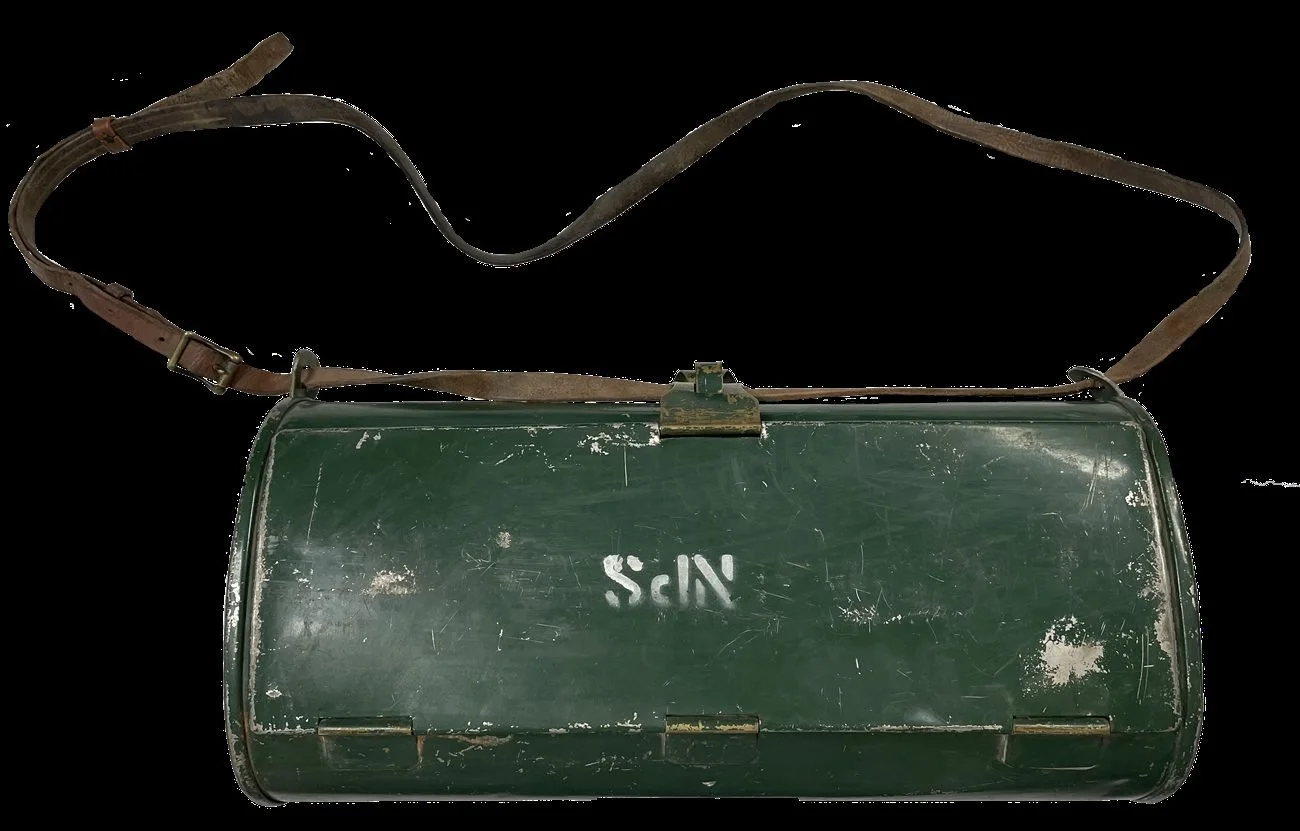
A real botanist's vasculum — the green oval metal field case with shoulder strap made by the NPS Western Museum Laboratories, ca. 1939–1941, used at Rocky Mountain National Park (NPS History Collection, HFCA 2770).
U.S. National Park Service, NPS History Collection (HFCA 2770). Public domain.
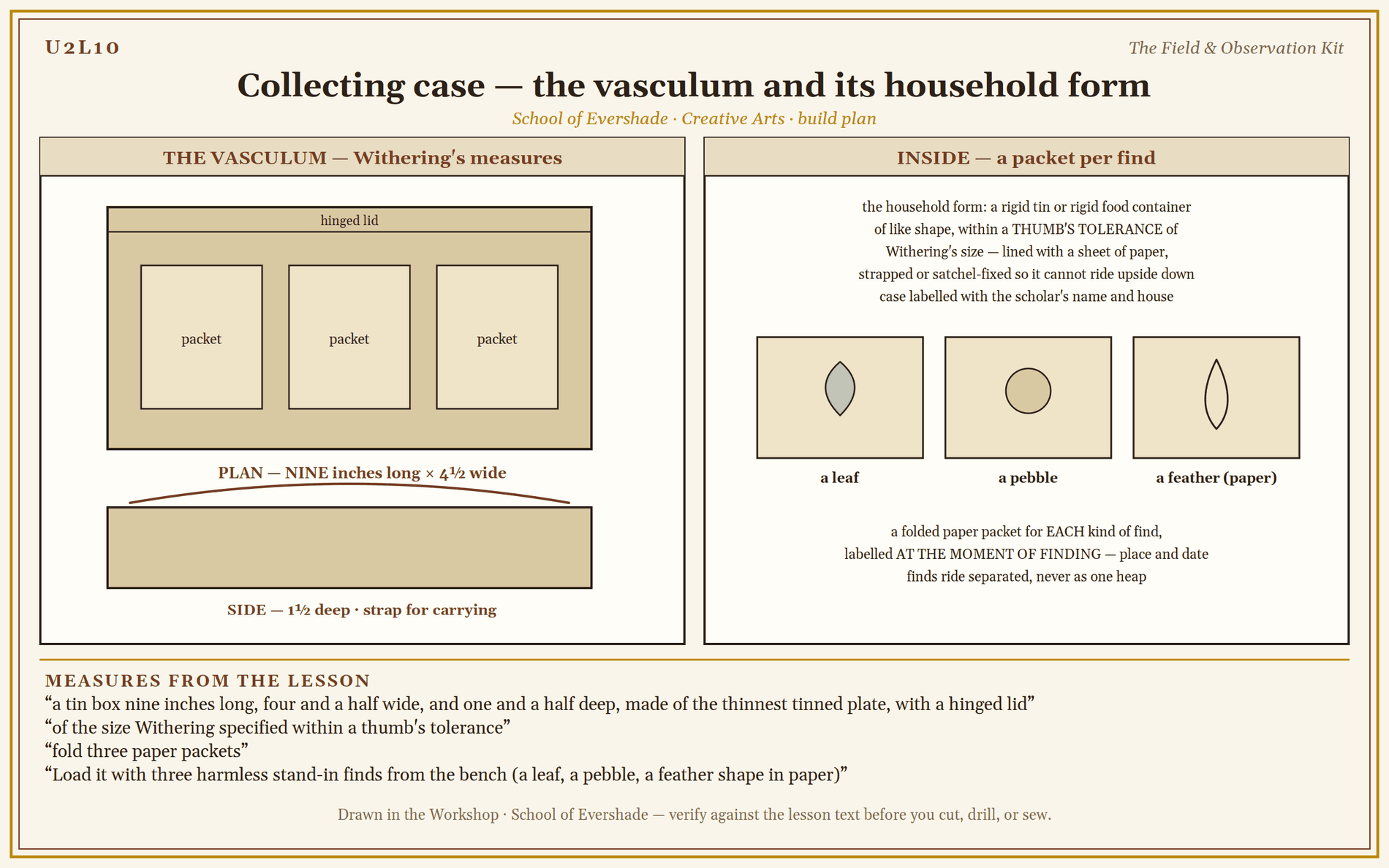
Collecting case — the vasculum and its household form
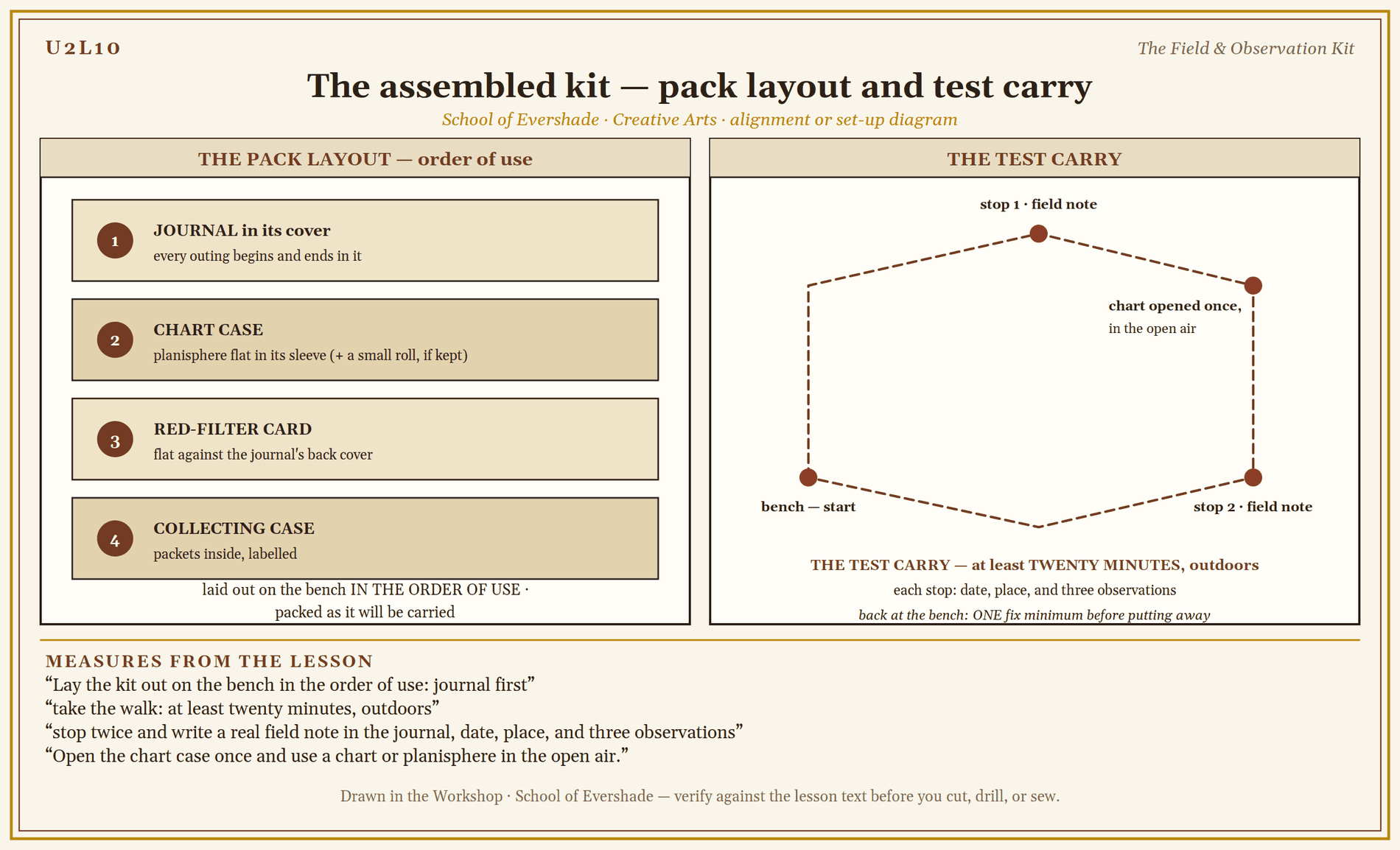
The assembled kit — pack layout and test carry
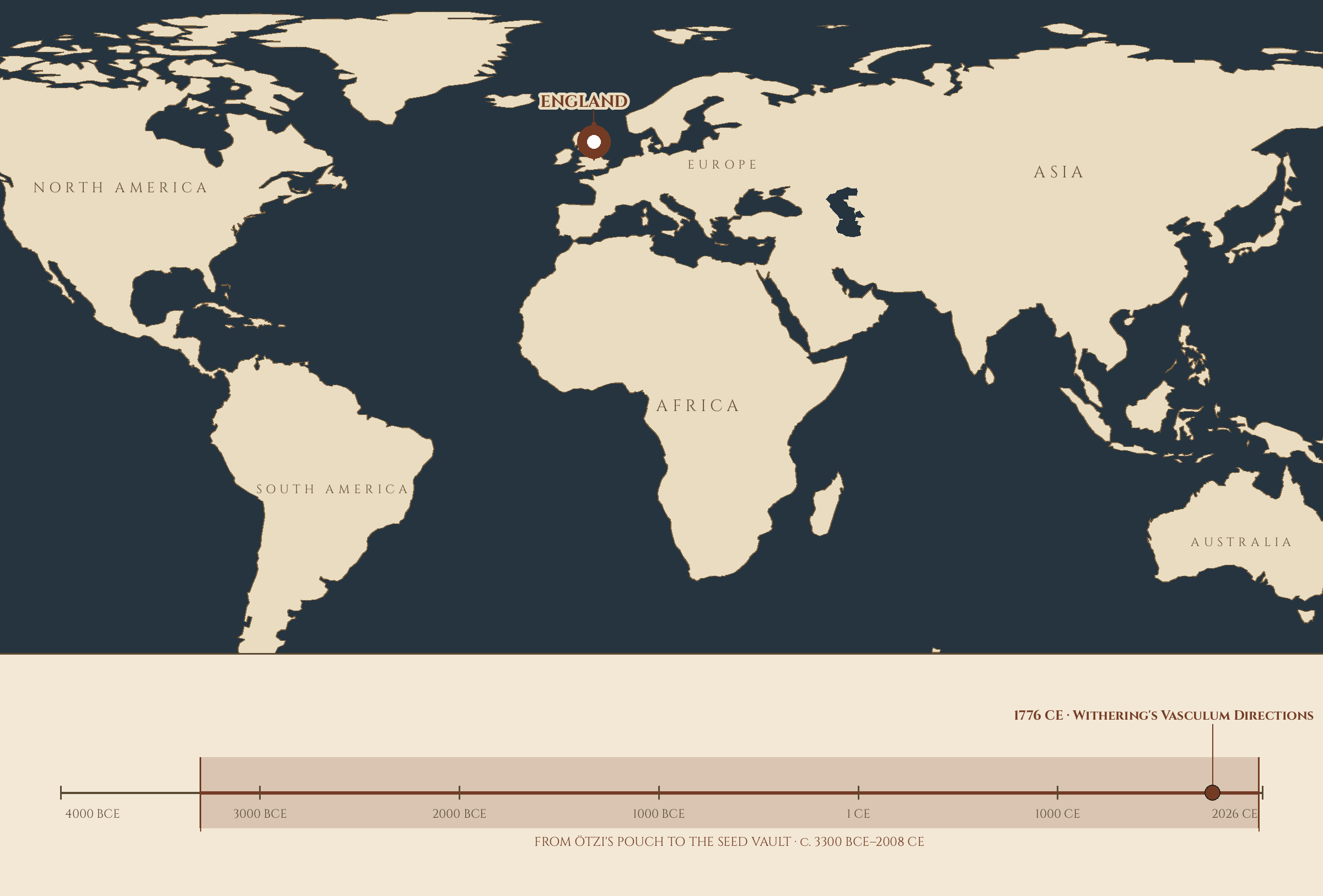
Where and when: England — 1776 CE, Withering’s vasculum directions.
Lesson Objectives
By the end of this lesson, students should be able to:
- Describe the vasculum's origin in Linnaean-era botany and its standard form and use.
- Explain how naturalists' field notebooks were worked: written on the spot, expanded later, and kept as the permanent record behind published science.
- Explain why observers use red light at night, in terms of dark adaptation and the eye's rod cells.
- Assemble a field kit from this unit's builds: journal cover, chart case, red-filter card, and collecting case, fitted to the scholar's own journal and charts.
- State the observe-don't-touch rule of modern collecting ethics and apply it in the field.
- Test-carry a kit and revise it from evidence.
Your Assignment Packet
This lesson's assignments live in its packet: the Lexicon Handout (every term, course terms marked ◆), the Assignment Manual, and the Reflection Questions. Download the packet before you begin and keep it beside you as you read — work from it as each subject is taught, or take the assignments as homework afterward.
The Vasculum and the Notebook
Serious field botany was systematised, largely, by Linnaeus and his students in the eighteenth century, and it ran on two pieces of equipment: a notebook and a tin box. The box, the vasculum, gets its first careful directions in English botany from William Withering's Botanical Arrangement of All the Vegetables Naturally Growing in Great Britain of 1776: a tin box nine inches long, four and a half wide, and one and a half deep, made of the thinnest tinned plate, with a hinged lid, made to be carried into the field so that specimens could travel home fresh instead of wilting in a pocket or a hat. Linnaeus himself had called such a case the vasculum dillenianum, after Dillenius; two botanizing vascula carried by Joseph Hooker on the Ross expedition of 1839–43 survive; and by the mid-nineteenth century the vasculum was standard issue, illustrated in textbooks and sold by instrument makers, later editions of Withering recommending a coat of paint against the rust that came free with English weather. The design barely changed because the need never did: a rigid, closing, carryable space that keeps a found thing a found thing, unbruised and unmixed, until it reaches the desk.
The notebook evolved beside it into a discipline of its own. That notebook is the field notebook: the notebook carried and written in at the place of observation, as distinct from the fair copy or journal written up afterward, and in the naturalists' tradition it is the primary record; everything published descends from it. The great field naturalists wrote where they stood. Darwin filled pocket notebook after pocket notebook through the Beagle voyage, small books, written in the field in pencil and haste; beside them he kept his specimen catalogues, the geological set bound in red leather. The field books were then expanded the same evening or the same season into fuller journals; the little field books remain the bedrock record, the layer nobody later edited. The lesson in that for every Evershade scholar is plain: the field note is taken in the field, in the kit's journal, at the moment, because memory is the least archival material known to this workshop.
Night work added the kit's third element. Watchers of the sky learned that the dark-adapted eye is an instrument that takes half an hour to build: the rods' pigment, spent by bright light, regenerates slowly, and one careless burst of white light at the telescope can cost a watcher the faint end of the sky for many minutes. That slow adjustment is dark adaptation: the pupil widens quickly, but the rod cells' light-sensitive pigment regenerates over twenty to thirty minutes or more, which is why full night vision takes half hours to earn and is spent, in proportion to the light, in seconds. Astronomers' answer, carried into modern observatory and dark-sky practice, is deep red light for charts and logs: the rod cells are nearly blind to it, so a scholar can read a star chart and keep the night. Your red-filter card is that answer in the cheapest possible materials, and it is standard equipment, not a novelty.
And the modern field ethic completes the kit by subtraction. Where the old collectors took freely, today's taught ethic — the Leave No Trace principles promoted across America's public lands — is to leave what you find: observe, record, photograph, sketch, and let the thing stay where it lives. This school's collecting case is built in that ethic's spirit: a case for the few things a lesson genuinely gathers, fallen, permitted, and purposeful, and a journal for everything else. The finest field kit ever assembled weighs the most in notes and the least in specimens.
A Sealed Note from Professor Timberclank
The field forgives nothing that the bench could have caught, scholars.
Every strap that will slip slips on the hill, not at the table. Every lid that will gap gaps in the rain. So we carry the kit before we need the kit: a full walk, the real journal and charts inside, the ground uneven if you can find it. Then we fix what the walk reported, without arguing with the report.
And the rule that outranks all the others, in the field as on the bench: if gathering a thing would harm the place it lives, the thing stays, and the notebook takes it home instead. We stop. We make it safe. Then we begin again. The notebook is always the safer tool.
One field rule before the kit leaves the bench, scholars. The case is for finds that are fallen, permitted, and known. A plant or fungus you cannot name is not gathered and not handled: some of the commonest hedge plants raise a rash that lasts for weeks, and a find is never worth that tuition. Look, note, sketch. The notebook takes it home as safely as the case would, and your hands stay your own.
Wash your hands when the walk is done, before food and before your face, whatever you did gather. And walk the ground as it is, not as the map wishes it were: eyes up at the turnings, feet placed, not guessed. If the ground or the weather turns against the walk, you know the rule: We stop. We make it safe. Then we begin again.
PROFESSOR COGBRANCH TIMBERCLANK
Creative Arts Workshop
Master Artisan, Head of House Occidens
Technique: Assembling the Kit
The journal cover. Your Lesson 9 journal rides in a cover of card or cloth built a margin larger than the book on every side, with one of Lesson 7's pockets inside the back cover for loose notes, a pencil loop at the spine, and a tie or band to keep the whole shut against wind. The cover takes the dew, the mud, and the satchel wear; the journal takes the notes.
The chart case. Lesson 8's fitted case, sized to the scholar's own charts: for Celestial work, the case carries the planisphere flat in its sleeve, and a small roll beside it if the kit's owner keeps a long chart. Flat stays flat; that is the rule the case enforces.
The red-filter card. Cut red transparent film or cellophane to a card an inch larger than your log's page on every side, mount it in a card frame, and carry it flat against the journal's back cover. Test it at home in a dark room after five minutes of dark: the log page must read clearly under the card or under a small lamp shone through it, and the room must stay, to your eyes, dark. If the film is pink and weak, double it. Night vision is earned in half hours and spent in seconds; the card is how a scholar reads without spending it.
The collecting case. The vasculum's household forms: a rigid tin with a hinged or tight lid, of the size Withering specified within a thumb's tolerance, or a rigid food container of like shape, lined with a sheet of paper, with a strap or a place in the satchel where it cannot ride upside down. Inside, a folded paper packet for each kind of find, labeled at the moment of finding with place and date. The case's whole virtue is separation: ten finds in one heap are one find with nine mysteries.
Assembly and the test carry. Lay the kit out on the bench in the order of use: journal first, because every outing begins and ends in it. Pack it as it will be carried. Then carry it: a real walk, the longer the better, over the ground your work will actually use, with the journal taken out and written in at least twice outdoors, the chart case opened and used, the collecting case opened and closed with cold or gloved fingers if the season offers them. Back at the bench, revise: move what was awkward, pad what rattled, re-label what could not be found by touch. A kit is never finished; it is current.
Practice Practical: Assemble and Test-Carry Your Field Kit
This drill is checked for fit and for revision from evidence, not for completeness of gear. Assemble from household stock.
Before the walk: gather nothing on the test carry beyond the bench's stand-ins. In the field, the case takes only finds that are fallen, permitted, and known to you; anything you cannot name is recorded in the journal, not handled. Wash your hands when you return, before food. If ground or weather turns against the walk, cut it short and record why. A shortened walk is evidence too.
- Bench drill and gather. Set up your bench. Bring your own journal and your own charts, the ones you actually use, and lay out this unit's builds: pocket, sleeve, case. The kit is fitted to your work, so your work is the measure.
- Cover and case. Build or fit the journal cover to your journal, with its inner pocket and pencil loop. Check the chart case against your largest chart: in, out, flat, unforced. Write in your workbook any measure that had to change and why.
- Make the red-filter card. Frame red film in card an inch larger than your log page per side. Set it by for the test carry: it will be judged in the dark, not at the bench.
- Fit the collecting case. Line your tin or container, fold three paper packets, and label the case itself with your name and house. Load it with three harmless stand-in finds from the bench (a leaf, a pebble, a feather shape in paper) and close it.
- The test carry. Pack the kit as carried and take the walk: at least twenty minutes, outdoors, ground as uneven as your neighborhood honestly offers. On the walk, stop twice and write a real field note in the journal, date, place, and three observations. Open the chart case once and use a chart or planisphere in the open air. In darkness or a dark room on your return, test the red-filter card over the journal page: five minutes of dark first, then read by the filtered light, and note what your eyes report.
- Revise and record. Back at the bench, list every complaint the walk made: the slip, the rattle, the thing not findable by touch. Fix at least one before the kit is put away, and record the rest in your workbook as the kit's first revision list. Tools away, kit stored assembled, bench clean.
A kit that has been carried, complained, and been revised is a kit. Everything else is luggage.
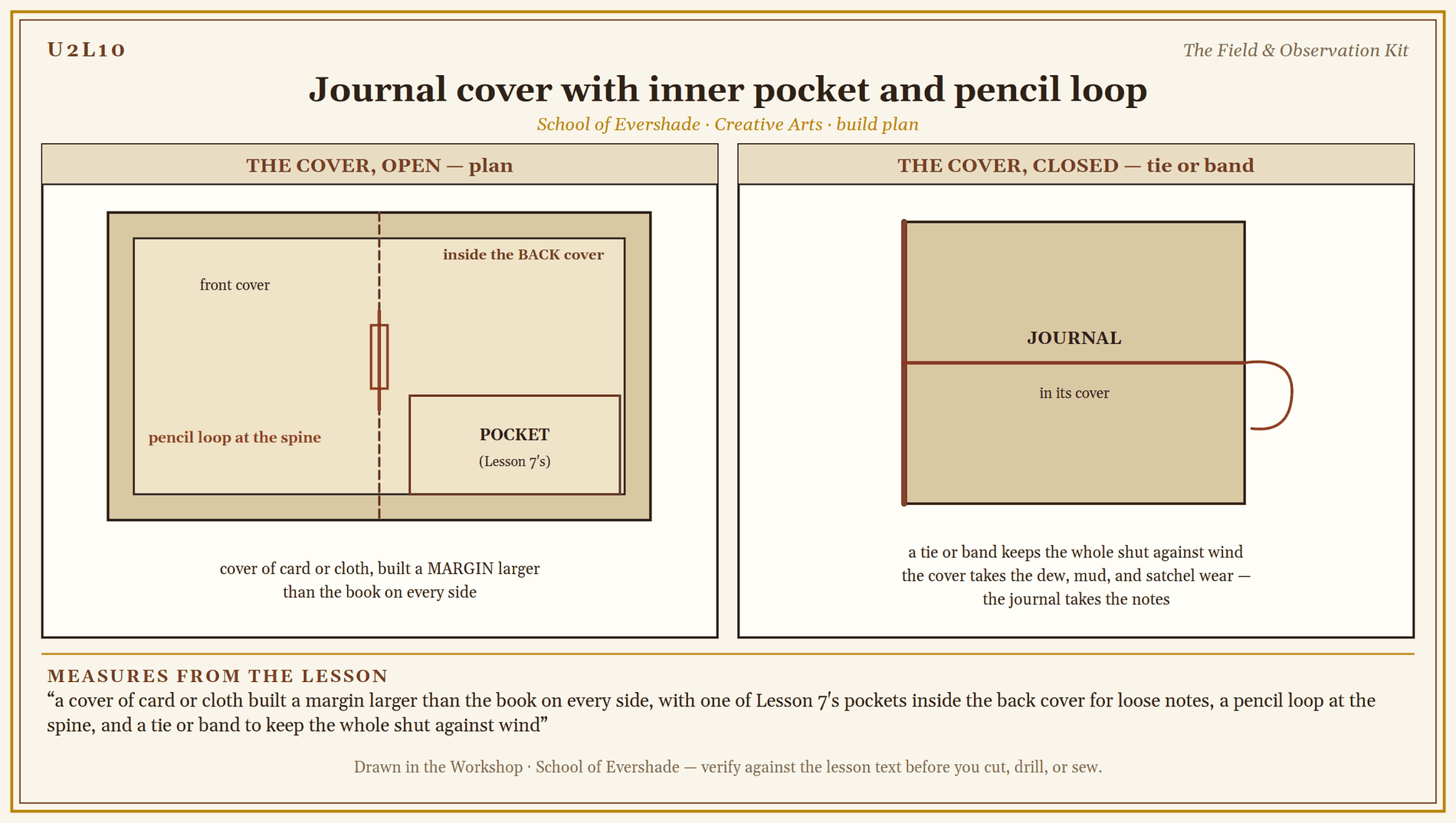
Journal cover with inner pocket and pencil loop
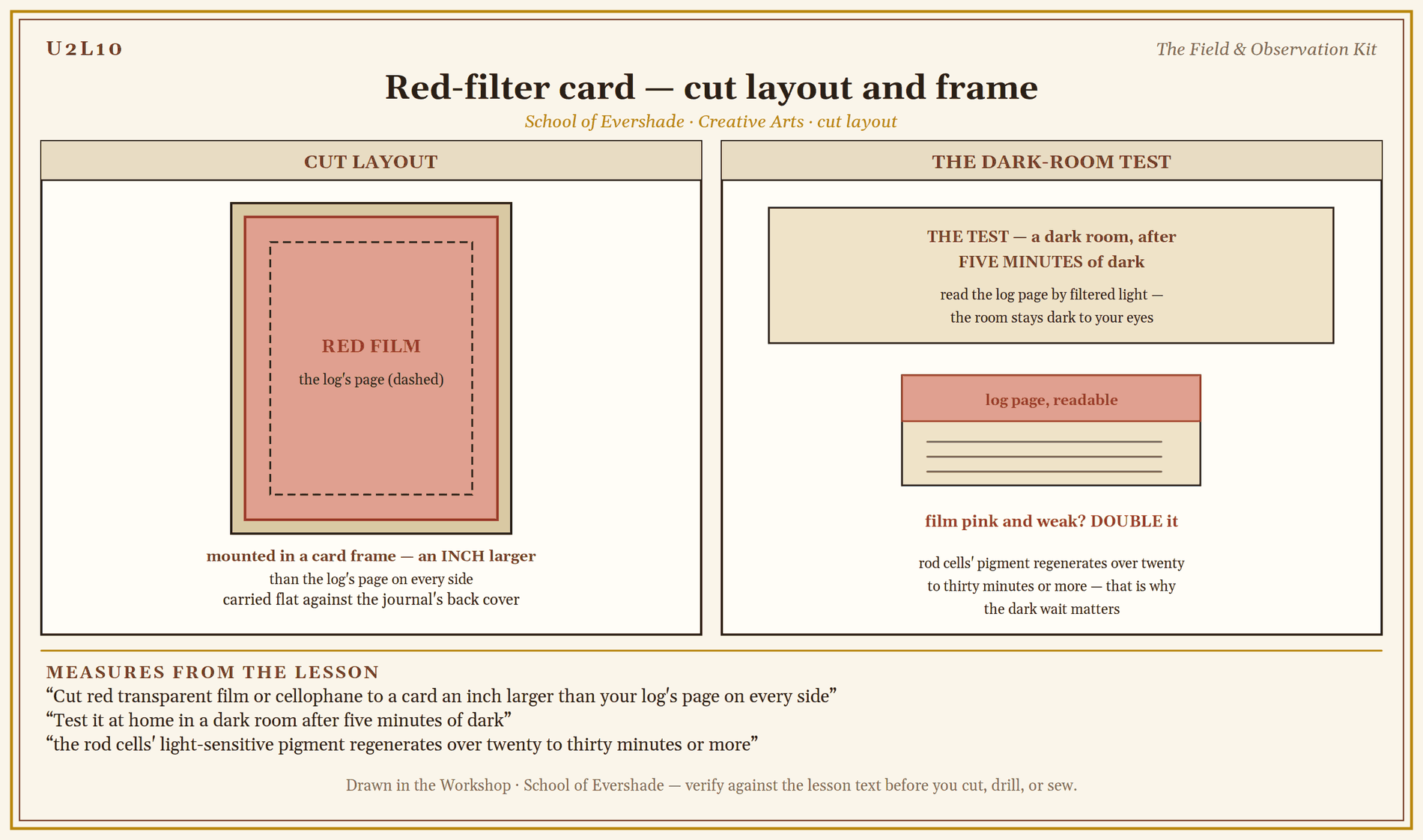
Red-filter card — cut layout and frame
Assignment Manual
Assignment key: ✎ written work · ⚒ hands-on practical · ◐ both
Assignment I ⚒ — The Assembled Kit
Complete the Practice Practical in this lesson: a field kit assembled from household stock around your own journal and charts, test-carried on a real walk, with at least one revision made from the walk's evidence.
Assignment II ✎ — The Naturalist's Two Records
Using the lesson and the sources below, explain the working relationship between a field notebook and the journal or book later written from it, using Darwin's Beagle notebooks as your example. End with the rule this school draws from it, in your own words.
Assignment III ◐ — A Vasculum's Biography
Research the vasculum's career using the sources below: Withering's 1776 directions, the two vascula Hooker carried on the Ross expedition, and its textbook standardization. Then examine your own collecting case and write its honest comparison: what it shares with the tin of 1776, what it lacks, and what the modern observe-don't-touch ethic would add to Withering's directions if he were writing today.
Materials
Level One (household)
- Your Lesson 9 journal, or any notebook in regular use as the kit's heart
- Card stock, Lesson 7's tools, and cloth or heavy paper for the journal cover
- Your Lesson 8 case, or a stiff folder, for the charts
- Red transparent film or cellophane (sweet wrappers and gift film serve) and card for the filter frame
- A rigid tin or food container with a tight lid, paper for lining and packets
- Pencil, strap or bag the kit will actually be carried in
Level Two (historical)
Everything in Level One, plus:
- A true vasculum: a flat tin case of Withering's proportions, hinged lid, carried on a strap; tins of the pattern survive in antique trade, and modern reproductions are made for botanical suppliers
- A leather or waxed-canvas journal cover with a brass pencil
- Red glass or deep-red gel of observatory grade for the filter card
- Brass or wooden fittings and a leather carrying strap for the assembled kit
Both levels teach the same kit. Level One assembles it from the household drawer; Level Two assembles the instruments as their first owners knew them.
Reflection Questions
Answer the following questions in your workbook.
- What did your test walk complain about that no amount of bench inspection had caught?
- Why does the field tradition insist the note be written in the field, when a scholar's memory of the walk home seems so clear?
- Dark adaptation takes half an hour to earn and seconds to spend. What other skills in this course have that same one-way shape, and how does the course protect them?
- Withering's botanists carried the vasculum to bring plants home. This school carries a notebook to leave them growing. What does each party gain, and what does each give up?
- Your kit's revision list is unfinished by definition. When is a kit revised enough to trust, and who decides?
Professor's Review
Your kit has been somewhere now, and it shows in the best way: one thing moved, one thing padded, one label rewritten where fingers could find it.
You know the company it keeps. Withering's tin, carried at the hip through English lanes; Darwin's red notebooks, filled where he stood; the astronomer's red card, guarding half an hour of earned darkness. And you know the modern term of the arrangement: the notebook comes home heavy, and the hillside keeps its flowers. Professor Fernfoot's field parties and Professor Glimmerwick's tower stairs will both be better equipped this term, because their kits were revised by walking, not by wishing.
One lesson remains in this unit, and it is the unit's summit: the case binding and the archival box, where records go to be kept for keeps.
PROFESSOR COGBRANCH TIMBERCLANK
Creative Arts Workshop
Master Artisan, Head of House Occidens
Further Reading & Sources
Baker, H. G. "Origin of the Vasculum." Proceedings of the Botanical Society of the British Isles, 3 (1958). The scholarly history used throughout this lesson: Withering's 1776 directions and dimensions, the evolution of the term, the two vascula Hooker carried in 1839, and Balfour's illustrations that standardized the instrument.
Chancellor, Gordon, et al. "Introduction to Darwin's Beagle Field Notebooks (1831–1836)." Darwin Online. The standard account of Darwin's field notebooks: their number, their red leather specimen books, and how the field layer underlies everything he later published.
Allen, D. E. "The History of the Vasculum." Proceedings of the Botanical Society of the British Isles, 3 (1958). The companion history to Baker's, on the instrument's design and makers. Print journal reference; no stable public link, cited here by title. (Its archive companion, Baker above, is the linked entry.)
Student-friendly starting points for exploring this lesson's world.
- H. G. Baker, "Origin of the Vasculum" — Proceedings of the Botanical Society of the British Isles (BSBI archive) — The vasculum's whole biography in seven pages: Withering's tin-box directions of 1776, Linnaeus's name for it, Hooker's two vascula, and the paint that kept the rust off.
- Introduction to Darwin's Beagle Field Notebooks — Darwin Online — How Darwin's pocket notebooks were made, carried, and written in the field, and what became of them. Darwin Online is Cambridge's scholarly edition of Darwin's works.
- Leave No Trace Seven Principles — U.S. National Park Service — The modern field ethic in full, including "Leave What You Find": the principle behind this school's collecting case and its notebook-first rule.
- "This Winter, Be Safe and Smart with Artificial Light at Night" — DarkSky Colorado — Why the eye needs half an hour to adapt to darkness, and why astronomers read by red light: the science inside your red-filter card.
Submit your work for this lesson using the form below.
CONTINUE IN THE CREATIVE ARTS WORKSHOP
← Previous · Lesson 9: Pamphlet & Single-Section Binding Next · Lesson 11: Case Binding & Archival Boxes →
Unit II · Paper & Bound Records Creative Arts Workshop · All 39 Lessons
Bookstore Shelf The Library · Creative Arts Shelf Course Supplies
The rest of Unit II: Lesson 7 · Paper, Card & Board Construction · Lesson 8 · Scrolls, Rolls & Cases · Lesson 9 · Pamphlet & Single-Section Binding · Lesson 11 · Case Binding & Archival Boxes