Creative Arts
Unit III, Lesson 14Garlands, Braiding & Weaving
Professor Cogbranch Timberclank
Master Artisan, Head of House Occidens
The Creative Arts Workshop • School of Evershade
Professor's Introduction

Bench set, scholars. Today fiber opens out to its full width, and Unit III closes with the oldest trick in the whole course: twist.
Twist is how loose fiber becomes string, string becomes cord, and cord becomes nearly everything: nets, bags, bowstrings, sail seams, the drawstring in the pouch you sewed last lesson. Twist is also how thread becomes cloth on the loom, and how a handful of flowers and leaves becomes a garland that carries a season into a room. A garland is a decorative chain or wreath of plant material, bound or sewn in sequence along a base. One motion, learned by hand, runs under all of it.
We will also speak honestly about the garland, because it asks a question no other make in this course asks. A shelf is built to last. A garland is built to be splendid for a while and then to be gone, and it asks to be made anyway. The garlands of the ancient world hung in temples, games, weddings, and feasts because human beings have always needed their gatherings to look like somebody cared. Ours will too.
Your practice today is in fiber only: a braided cord and a woven strip, made before any botanical material is touched. Learn the twist first. The flowers can wait their season.
PROFESSOR COGBRANCH TIMBERCLANK
Creative Arts Workshop
Master Artisan, Head of House Occidens
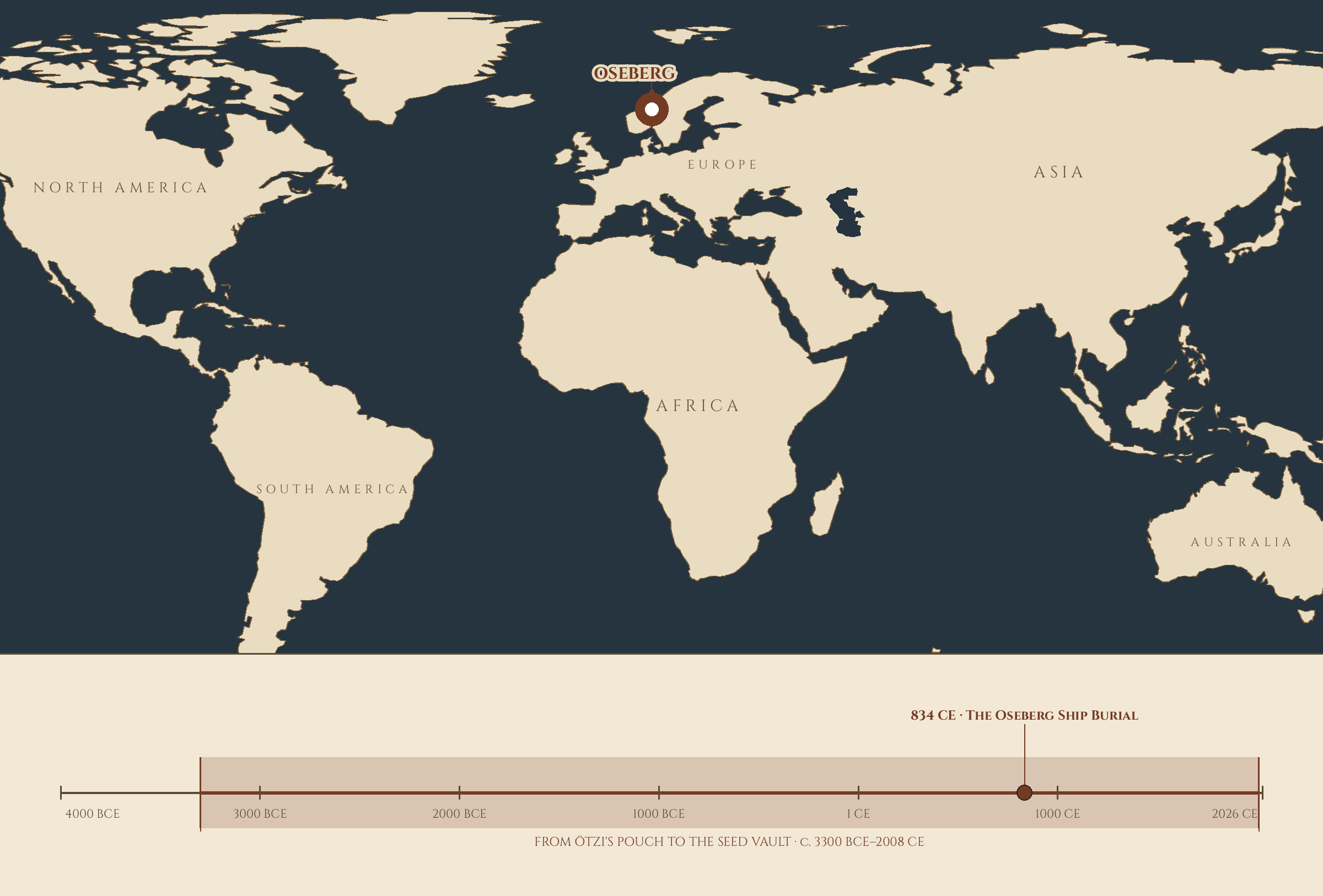
Where and when: Oseberg, Norway — 834 CE, the Oseberg ship burial.
Lesson Objectives
By the end of this lesson, students should be able to:
- Explain cordage as a foundational technology and describe the oldest known piece of string.
- Braid a three-strand cord with even tension and finish its ends so they cannot unravel.
- Weave a short strip in plain weave on a simple frame, keeping the edges true.
- Explain how the warp-weighted loom worked and what its weights tell archaeologists about lost cloth.
- Describe tablet weaving and the backstrap loom as band and cloth traditions.
- Describe the garlands of Egypt, Greece, and Rome as decoration and honor, and build a garland as seasonal decoration in that tradition.
Your Assignment Packet
This lesson's assignments live in its packet: the Lexicon Handout (every term, course terms marked ◆), the Assignment Manual, and the Reflection Questions. Download the packet before you begin and keep it beside you as you read — work from it as each subject is taught, or take the assignments as homework afterward.
Twist, Braid, Weave: The Deep History of Fiber
Cordage comes first, because everything else stands on it. In 2020, researchers reported a fragment of cord clinging to a stone tool from the Abri du Maras rock shelter in France, in layers dated between about fifty-two and forty-one thousand years ago. The fragment is six millimeters long. It is made of three strands of inner tree-bark fiber, each strand twisted one way and the three plied together the other: a true three-ply cord, and the oldest direct evidence of string making known. Its makers were Neanderthals. Before that find, the oldest known fragments of twisted fibre came from Ohalo II, in present-day Israel, around nineteen thousand years ago — and twisted flax fibres from Georgia reach back some thirty-two thousand. The lesson in the dates is not the record itself. It is that twisting fiber is as old as any technology we have, older than farming, older than pottery, and that nets, bags, hafted tools, and sewn clothing all become possible the day somebody first twists two fibers together and they hold.
Spinning, from Lesson 12, turns that twist into thread by the spindle-full. Weaving turns thread into cloth. Loom weaving is placed by researchers as early as the seventh millennium BCE in what is now Turkey, and for much of the ancient world the standard loom was the warp-weighted loom: two uprights and a top bar, the warp threads hanging from the bar in bundles, each bundle tied to a clay or stone weight that held it taut, the weaver standing and working downward from the top. The warp is the set of threads held under tension on the loom, the roadbed; the weft is the thread carried over and under across the warp, row by row, the traffic. Greek vase painting shows women at just such looms. The cloth perished; the weights did not. Whole households of textile work survive as piles of loom weights, and experimental archaeologists at the Centre for Textile Research in Copenhagen have rebuilt the looms and woven with replica weights to learn what the piles mean: a weight's heft suits it to a thread's thickness, light weights to fine cloth, heavy to coarse, so a dead weaver's fabric can be read from her tools.
Other looms solved the same problem with the body. The backstrap loom tensions its warp between a fixed point and a strap around the weaver's hips, so the weaver's own lean is the tension, adjustable breath by breath. It is portable enough to carry to the shade, ancient in Asia and the Americas, and still in use today in forms a photographer in the Guatemalan highlands in 1932 recorded as unchanged in principle since prehistoric times.
For narrow work, bands and straps, the northern world perfected tablet weaving: warp threads passed through the holes of small tablets of wood, bone, or card, and turned together like the pages of a book, each quarter turn opening a shed for the weft and working a twist into the band that makes it famously strong. Tablet-woven bands served first as the starting and finishing edges of cloth woven on warp-weighted looms, then outgrew the job and became pattern work in their own right. The Oseberg ship burial in Norway, of 834 CE, held an unmatched treasury of them, including a band found at the burial chamber's entrance still threaded on its fifty-two tablets, half finished, its weaver's pattern recorded by the excavators before the band was lifted. A band in progress, stopped mid-row eleven centuries ago, is the closest thing textile history has to a sentence broken off mid-word.
And the garland stands at the festive end of all this twisting and binding. Egypt's floral collars were sewn work: alternating rows of flower petals and blossoms, leaves, berries, and blue faience beads stitched to a papyrus backing and tied with linen, gorgeous engineered decoration. Several were buried in the embalming cache of Tutankhamun, made for the ceremonies of the king's funeral and kept afterward in great storage jars, where they survived three thousand three hundred years. In Greece, the wreath (stephanos, from a verb meaning "to put round") was bent from leafy branches and tied into a circle, and its plant was a language: olive for the victors at Olympia, laurel at Delphi, pine at Isthmia, wild celery at Nemea. Wreaths crowned athletes and poets, hung at weddings and funerals, and marked the wearer or the occasion as set apart. Rome took the Greek wreath and made a system of it, crowns of oak, laurel, and grass awarded as military honors, the grass crown, for saving an army, the rarest of all. In this workshop we borrow the forms and the craftsmanship, and we leave the honors and the altars to history, where this lesson found them: our garlands dress a room for a season, and say that people who live and learn here notice the year turning.
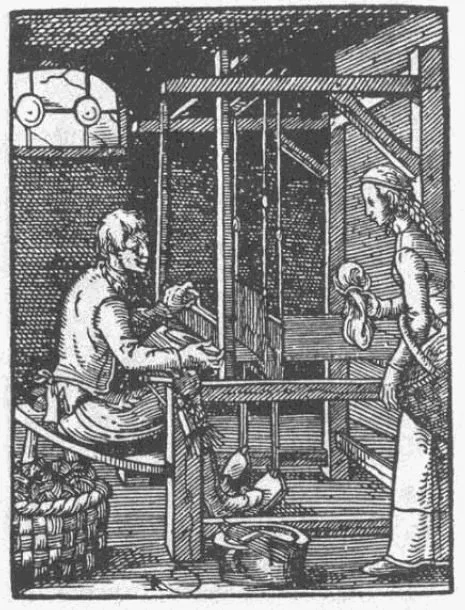
A weaver at a treadle loom with the warp stretched before him, 1568 woodcut.
Woodcut from the Ständebuch (Book of Trades), Frankfurt, 1568. Public domain, via Wikimedia Commons.
Plain weave strip — warping the frame and keeping the edges true
Technique: The Braid and the Plain Weave
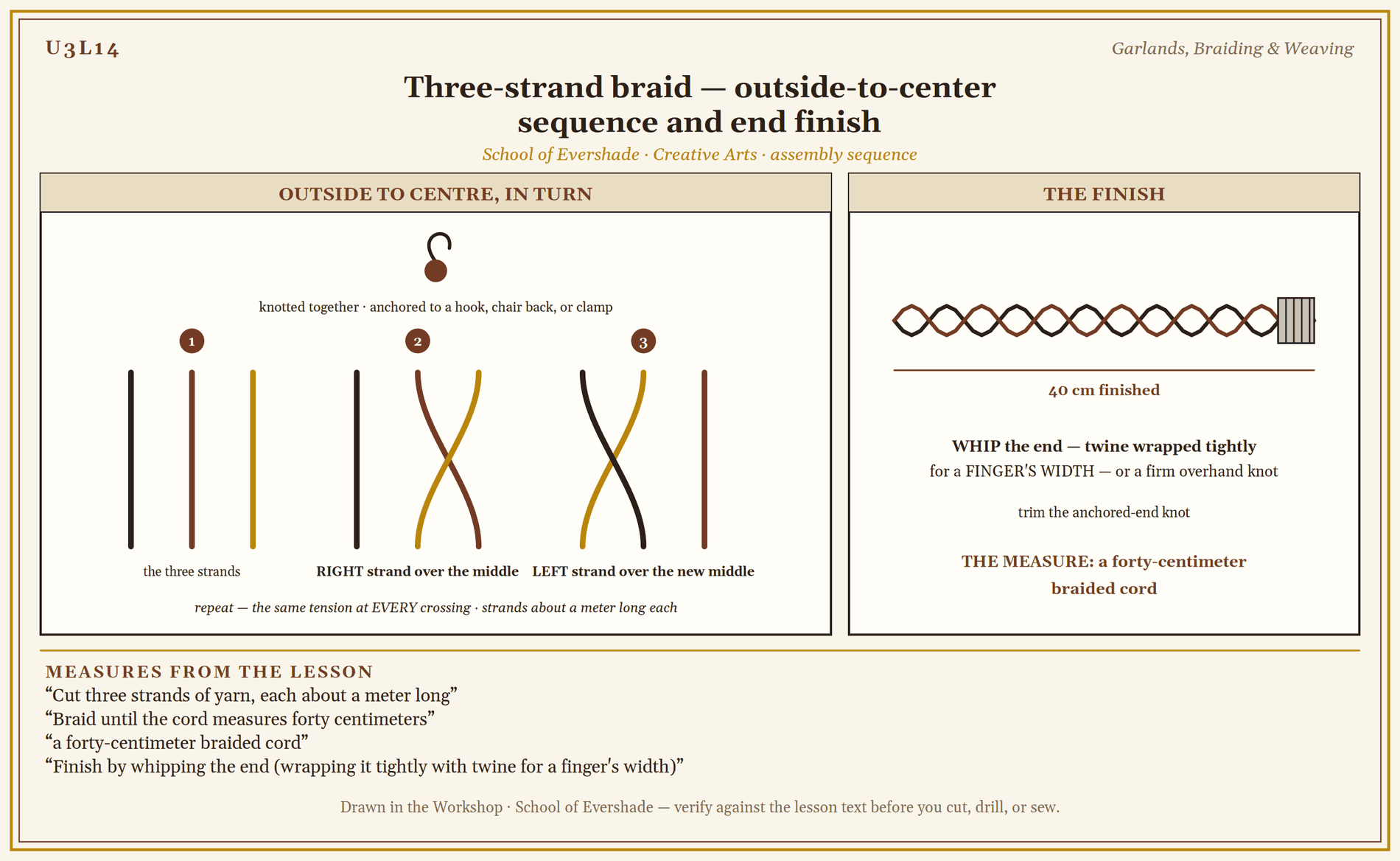
The three-strand braid. Take three strands of yarn or cord, knot them together at the top, and anchor the knot to a hook, a chair back, or a companion's patient hand. The rhythm is outside to center, outside to center: bring the right-hand strand over the middle strand so it becomes the middle; bring the left-hand strand over the new middle; repeat. The braid's evenness lives in your pull: the same tension on every crossing, or the braid spirals and sulks. Finish by whipping the end (wrapping it tightly with twine for a finger's width) or with a firm overhand knot, so the work cannot walk itself undone.
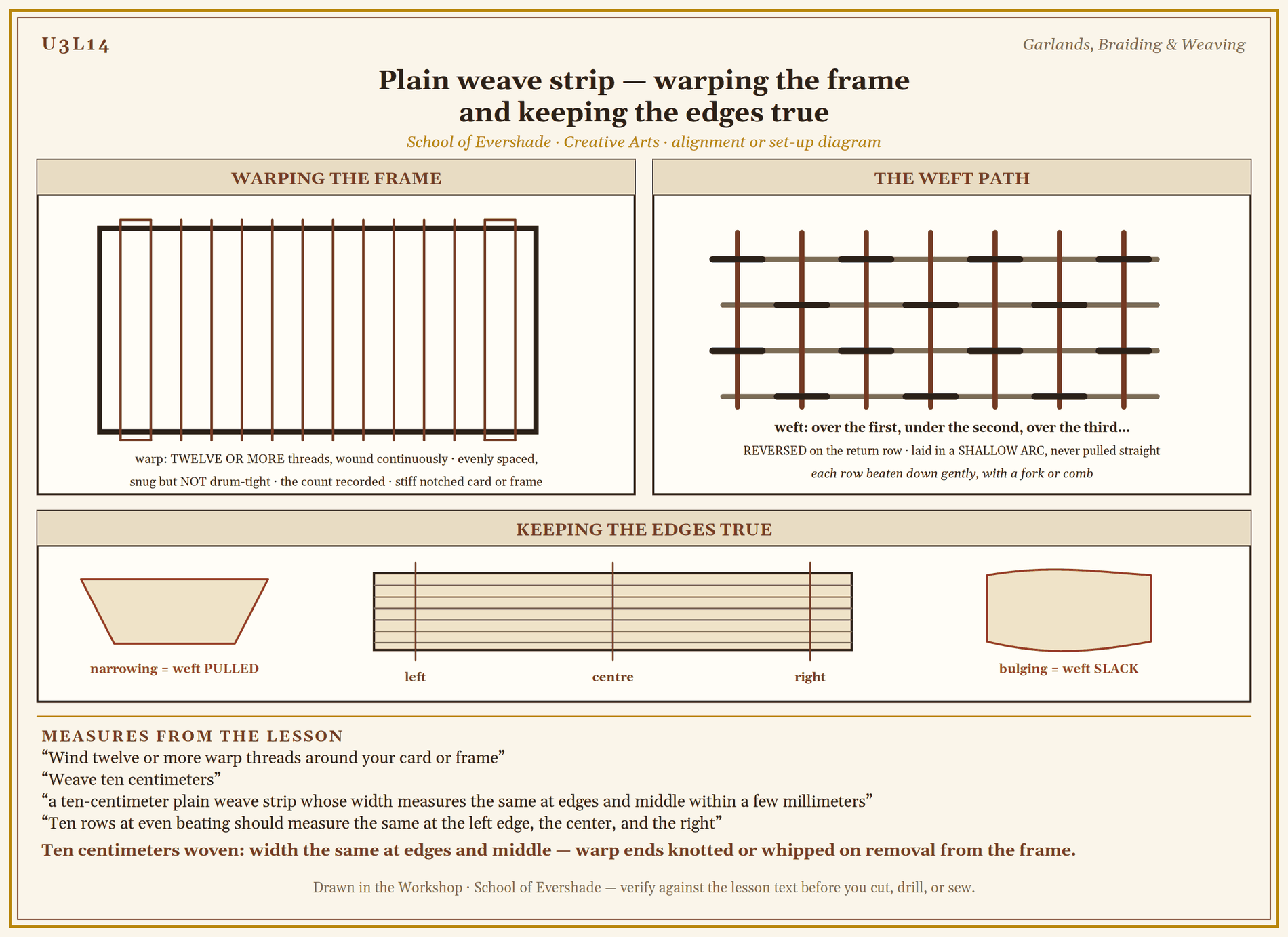
The plain weave strip. Warp a simple frame: a stiff card with notches, a wooden frame, or two sticks held apart. Wind your warp threads around it in a continuous run, evenly spaced, snug but not drum-tight. Then weave: carry the weft over the first warp thread, under the second, over the third, across the whole row. On the return row, reverse: under where you went over, over where you went under. Two habits keep the strip honest. Lay the weft in a shallow arc rather than pulling it straight across, so the edges are not dragged inward. And beat each row down gently with a fork or comb, evenly, so the rows pack alike. A strip whose edges wander has been pulled, not woven; ease off and let the arc do the work.
Reading your strip. Plain weave is a checkerboard at the crossings and straight lines at the edges. Count your rows. Ten rows at even beating should measure the same at the left edge, the center, and the right. Where the strip narrows, the weft was pulled. Where it bulges, the weft was left slack. The cloth reports its own making, which is why we practice on it.
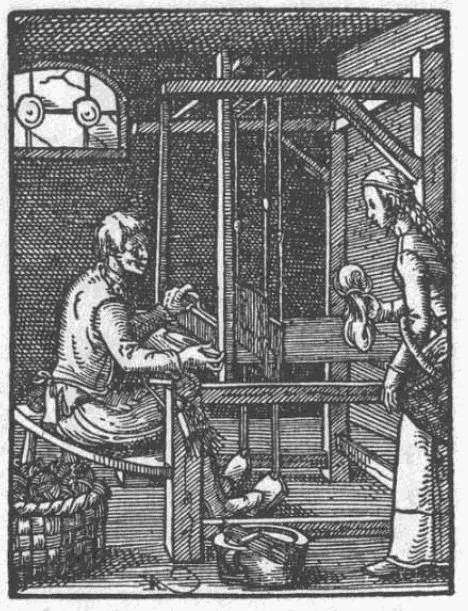
A carpet/tapestry maker at a large vertical loom, 1568 woodcut.
Woodcut from the Ständebuch (Book of Trades), Frankfurt, 1568. Public domain, via Wikimedia Commons.
A Sealed Note from Professor Timberclank
Now a word before any plant material comes to the bench, scholars, and it is a word about knowing what is in your hands.
Garland work in this workshop uses dried material only: identified, clean, and sound. Check every bunch before it is bound. Material that smells musty, shows mold, or crumbles to dust is not decoration; it is refuse, and it goes out, not up. Wash your hands when the work is done, as you would after the garden. Scholars with hay fever or asthma in the family should tell me before botanical work begins, and we will find them the fiber side of the lesson to master instead; there is no make in this course worth a scholar's breath.
And we gather nothing protected, nothing poisonous, and nothing we cannot name, from anywhere, ever. What to gather and when is Professor Fernfoot's teaching. Mine is the binding. Keep to your own side of that fence and the work stays safe.
PROFESSOR COGBRANCH TIMBERCLANK
Creative Arts Workshop
Master Artisan, Head of House Occidens
Technique: Building a Garland
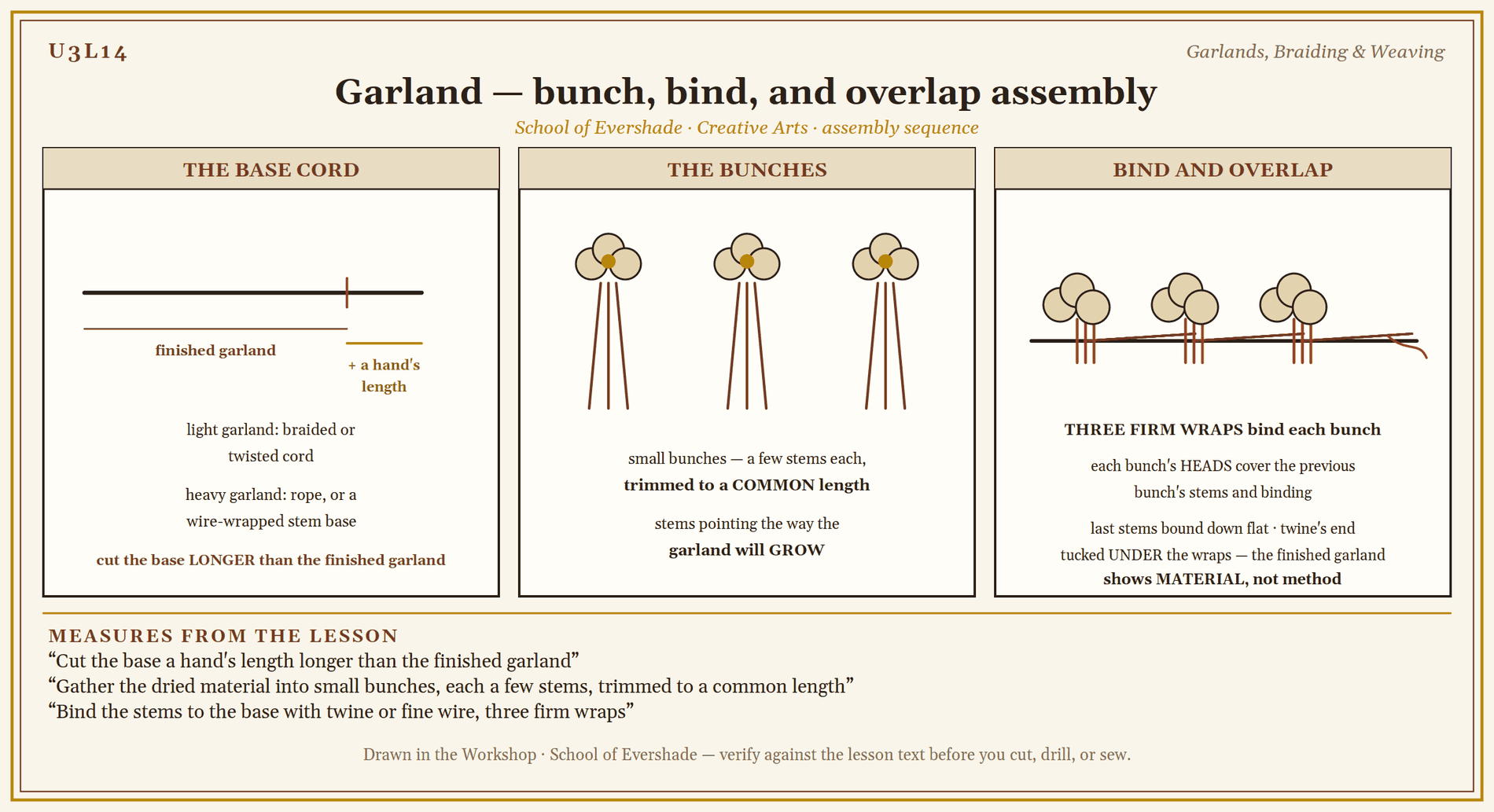
The base. A garland is built on the cords of this lesson: a braided or twisted cord for a light garland, a rope or a wire-wrapped stem base for a heavy one. Cut the base a hand's length longer than the finished garland, for tying.
The bunches. Gather the dried material into small bunches, each a few stems, trimmed to a common length, alike enough to repeat. A garland is a rhythm before it is a picture: same bunch, same binding, same overlap, all the way along.
The binding. Lay the first bunch along the base with its stems pointing in the direction the garland will grow. Bind the stems to the base with twine or fine wire, three firm wraps. Lay the next bunch so its heads cover the first bunch's stems and binding, and bind it the same way. Continue, each bunch hiding the mechanics of the last, until the base is clothed end to end. Finish by binding the last stems down flat and tucking the twine's end under the wraps. Hung or laid, the garland should show material, not method.
Keeping. Dried garlands are kept out of damp and direct sun, and retired when they fade or shed. Composting the retired garland returns it to Professor Fernfoot's side of the fence, which is where every plant in this castle eventually reports.
Practice Practical: A Braided Cord and a Woven Strip
This drill is in practice fiber only, and it is checked for an even braid, a true-edged strip, and ends that hold.
- Bench drill and measure. Set up your bench. Cut three strands of yarn, each about a meter long, in colors you can tell apart at a glance, so your crossings can be read and corrected. Knot them together at one end and anchor the knot to a hook, chair back, or clamp.
- Braid the cord. Work outside to center, outside to center, keeping the same tension on every crossing. Braid until the cord measures forty centimeters. Finish the end with a whipping of twine or a firm knot, trim the knot at the anchored end, and give the cord a steady pull test: it should lengthen not at all and unravel nowhere.
- Warp the frame. Wind twelve or more warp threads around your card or frame, evenly spaced and snug. Count them and write the count in your workbook; the strip's width is decided here.
- Weave the strip. Weave plain weave with a contrasting weft, laying each row in a shallow arc and beating it down gently with the fork. Weave ten centimeters, reversing the over-under pattern every row, and measure the strip's width at both edges and the middle as you go; correct the pull, not the cloth.
- Finish and record. Slip the strip off the frame, knot or whip the warp ends, and lay the strip and the cord side by side on the bench. Record strand counts, colors, and finished lengths. The cord becomes a drawstring for a Lesson 13 pouch; the strip is kept with your Lesson 12 sampler as the record of your fiber beginnings. Sweep the bench of fiber waste: fiber on the floor is a slipping hazard and a discourtesy to the next scholar.
Three-strand braid — outside-to-center sequence and end finish
Garland — bunch, bind, and overlap assembly
Assignment Manual
Assignment key: ✎ written work · ⚒ hands-on practical · ◐ both
Assignment I ⚒ — The Braided Cord and Woven Strip
Complete the Practice Practical in this lesson: a forty-centimeter braided cord, evenly tensioned, ends whipped or knotted, and a ten-centimeter plain weave strip whose width measures the same at edges and middle within a few millimeters.
Assignment II ✎ — Wreaths as Honors
Using the lesson and the sources below, write a short study of the garland as an honor: the Egyptian floral collar, sewn to its papyrus backing, and the Greek games wreath, bent from its branch. Cover the materials, the construction, and what each one said about the person or the occasion, and end with Rome: what changed when the wreath became a military award system?
Assignment III ◐ — Weave a Bookmark or Strap
Weave one finished small piece (a bookmark, a strap, or a belt length) in plain weave with true edges, using the drill's technique at a finished standard. With it, submit a maker's note of a half page: your fiber and colors, your warp count and finished measurements, and what the edges of the piece taught you about tension that the practice strip did not.
Materials
Level One (household)
- Yarn or cord in two or three colors for braiding (wool or cotton, medium weight)
- A stiff card or simple frame for the strip loom, and a fork or wide comb as a beater
- Twine for whipping and binding, and scissors
- A length of cord, rope, or craft wire for a garland base
- Dried plant material from the household or garden, with permission and identified by an adult: dried flowers, seed heads, herbs, or evergreen cuttings (or fabric and paper strips as stand-ins where no dried material is available)
Level Two (historical)
Everything in Level One, plus:
- Wool yarn in plant-dyed or undyed colors, and linen thread, the garland and band fibers of the old world
- A set of simple weaving tablets (card or thin wood, four holes each) to try a tablet-woven edging after the plain weave strip
- A backstrap arrangement, belt and fixed post, for scholars weaving the strip under body tension in the older manner
- Dried botanicals gathered and prepared in season under Professor Fernfoot's rules, bound on a braided cord base of your own making from this lesson
Both levels braid, weave, and bind the same way. Level Two works in the fibers and tools the crafts grew up with.
Reflection Questions
Answer the following questions in your workbook.
- A three-ply cord made by Neanderthals survives as six millimeters of bark fiber. What does it change in your thinking that string is that old?
- Where did your woven strip narrow or bulge, and what was your weft hand doing at that moment?
- A garland is made to fade. What other honest work is done well precisely because nobody expects it to last, and how is that different from shoddy work?
- The Oseberg band was found half finished, mid-pattern. What would a stranger learn about you from the piece of work on your own bench right now, stopped as it is?
- This course keeps garlands as decoration and history, and nothing more. Why does stating that limit plainly make the lesson stronger rather than smaller?
Professor's Review
Cord, strip, and the grammar of fiber, scholars.
Your braid runs even because your hands learned to pull alike, and your strip's edges stand true because you learned to lay the weft in an arc and let it be. You know why a pile of clay weights in a museum case is a wardrobe in disguise, how a band stopped mid-row in a ship burial still speaks, and what a collar of sewn petals said at a king's funeral three thousand years ago.
Unit III is complete: stitches, containers, and cordage, the soft skeleton of half the crafts in this castle. Unit IV takes up pigment, print, and seals, where the workshop starts making marks that stay: ground color, stamped labels, and the wax that closes a scholar's work as their own.
PROFESSOR COGBRANCH TIMBERCLANK
Creative Arts Workshop
Master Artisan, Head of House Occidens
Further Reading & Sources
The Metropolitan Museum of Art. "Floral Collar from Tutankhamun's Embalming Cache." Object 09.184.214: rows of petals, leaves, berries, and faience beads sewn to a papyrus backing, from the cache (KV 54) buried after the king's funeral, about 1328–1318 BCE.
Science News. "This Is the Oldest Known String. It Was Made by a Neandertal." The Abri du Maras cord fragment: three bark fibers twisted into a ply, dated between 52,000 and 41,000 years ago, and what it implies about Neanderthal craft.
Science News. "Textile Archaeologists Weave a Tapestry of the Past with Ancient Tools." The Centre for Textile Research's experiments with replica whorls and warp-weighted looms, and how a loom weight's heft reads as a fabric's thickness.
Martins, Matthew. "Crowns and Wreaths: Resting on Their Laurels," in Dress and Adornment in Ancient Greece (open textbook). The Greek stephanos: bent branches tied into circles, the wreath plants of the four great games, and gold wreaths made to imitate leafy ones.
Barber, Elizabeth J. W. Prehistoric Textiles. Princeton: Princeton University Press, 1991. The deep history of fiber, cordage, and loom weaving in the ancient world. Print reference; no stable public link, cited here by title.
Student-friendly starting points for exploring this lesson's world. All links verified October 2026.
- Oseberg Viking Heritage (Bente P. Skogsaas). "The Tablet-Woven Bands from Oseberg." The ship burial's bands reconstructed: the half-finished band on its fifty-two tablets, how the tablets turn, and what the bands were for.
- Lowe Art Museum, University of Miami (eMuseum). "Weaver with Backstrap Loom, Atitlán" (1932 photograph). Samuel K. Lothrop's photograph of a weaver at work in Santiago Atitlán, Guatemala, with the museum's note that the backstrap loom's technology is essentially unchanged since prehistoric times.
- ScienceDaily. "Ancient Stinging Nettles Reveal Bronze Age Trade Connections." Nettle as a weaving fiber of the first rank: the fine Lusehøj cloth and the long journey of its fibers, for scholars following Unit III's plant fibers to their end.
Submit your work for this lesson using the form below.
THE UNIT III QUIZ
CREATIVE ARTS WORKSHOP · UNIT III: FIBER, THREAD & SOFT GOODS
This quiz covers all 3 lessons of Unit III — Fiber, Thread & Soft Goods. Complete it from memory, in one sitting if you can, before consulting your lesson notes — it is a measure of what has stayed with you, not of what you can look up.
The quiz has two parts. Part I gathers the lesson questions, grouped by the lesson they came from. Part II is a vocabulary matching exercise drawn from the unit’s lessons. When you have finished, score it honestly, note the result in your workbook, and revisit any lesson whose questions went wrong before you move on.
CONTINUE IN THE CREATIVE ARTS WORKSHOP
← Previous · Lesson 13: Pouches, Tool Rolls & Storage Bags Next · Lesson 15: Pigments, Paints & Color Charts →
Unit III · Fiber, Thread & Soft Goods Creative Arts Workshop · All 39 Lessons
Bookstore Shelf The Library · Creative Arts Shelf Course Supplies
The rest of Unit III: Lesson 12 · Needles, Thread & First Stitches · Lesson 13 · Pouches, Tool Rolls & Storage Bags
From the Workshop Shelf
The printed companions to this lesson, from Professor Timberclank’s shelf in the shop.