

Creative Arts
Unit IV, Lesson 15Pigments, Paints & Color Charts
Professor Cogbranch Timberclank
Master Artisan, Head of House Occidens
The Creative Arts Workshop • School of Evershade
Professor's Introduction

Bench set, scholars. Unit IV begins with the oldest work in this workshop, and I mean oldest in the world, not oldest in the castle.
Before there were brushes worth the name, before there was paper, before there was a wheel, there was a person with a lump of red earth and a flat stone, grinding. Paint is where making starts: rock made fine, bound with something sticky, spread on a surface to say I was here or this is mine or simply look. Every classroom in this school reaches for color. Webblethorn's scholars paint stones. Nocturne's illuminators lay it in borders. Muddlenook's apprentices stir it into inks and dyes. This lesson is where the color itself is made, properly, at the stone.
You will grind and mull a batch of paint today and paint it out into a chart with every swatch labeled. Mulling is the second, finer stage of paint-making, after grinding: pigment and binder worked together on a flat slab with a broad, flat-bottomed tool called a muller, in small circles, until the mixture is smooth and every grain is wetted — grinding makes powder, and mulling makes paint. The chart is the workshop's color chart, a painted record of its colors: a swatch of each paint, labeled with the pigment, the binder, any mixture, and the date. That chart is not paperwork. It is the difference between a color you made once and a color you can make again, and a workshop that cannot repeat its colors is guessing.
One warning before we begin, and it is the lesson's spine: the history of pigment is beautiful and it is also a history of poisons, handled daily by people who did not know or could not afford to care. A pigment is the colored powder itself — earth, mineral, or manufactured substance that gives paint its color — and it becomes paint only when a binder carries it and holds it to the surface. We will study the dangerous colors the way we study a river in flood. From the bank, with respect, and we will not wade in.
PROFESSOR COGBRANCH TIMBERCLANK
Creative Arts Workshop
Master Artisan, Head of House Occidens

Where and when: Edinburgh — 1814 CE, Werner’s Nomenclature of Colours.
Lesson Objectives
By the end of this lesson, students should be able to:
- Trace the history of pigment from the ochre workshops of deep prehistory to Egyptian blue, the first manufactured pigment.
- Explain the difference between a pigment and a binder, and name the classic binders: gum arabic, egg, and oil.
- Grind and mull a safe earth pigment into paint at the right consistency, with proper dust discipline.
- Name the famous poisonous pigments (lead white, cinnabar and vermilion, orpiment), say what each contains, and give the modern safe substitute for each.
- Paint out and label a color chart complete enough for another scholar to reproduce every color on it.
- Explain what Werner's Nomenclature of Colours (1814) did, and why a shared color language mattered before photography.
Your Assignment Packet
This lesson's assignments live in its packet: the Lexicon Handout (every term, course terms marked ◆), the Assignment Manual, and the Reflection Questions. Download the packet before you begin and keep it beside you as you read — work from it as each subject is taught, or take the assignments as homework afterward.
The Oldest Bench in the World
At Blombos Cave on the South African coast, archaeologists found a paint workshop left where its owner set it down about a hundred thousand years ago. Two abalone shells held the remains of an ochre-rich mixture. Around them lay the whole kit: grindstones, hammerstones of quartz and quartzite, pieces of ochre, bone, and charcoal. The ochre had been rubbed and crushed to a fine powder, mixed with crushed bone and charcoal and a liquid, and stirred in the shells, very likely with a bone. It is a bench, scholars. Ingredients sourced, tools laid out, mixture stored in a container for later use. Whoever worked there had planned the work, and the shells still carried both red and yellow pigment when they were found, which suggests the kit served more than one sitting. The findings, published in Science in 2011, are the earliest firm evidence we have of people making paint as a deliberate, repeatable craft.
Ochre is iron earth, and it is where color begins in nearly every tradition: reds and yellows from the ground itself, needing nothing but grinding. But the ancient world wanted blue, and blue is rare in the earth. Lapis lazuli gave a magnificent blue and came from a handful of mines, in what is now Afghanistan, at ruinous cost. So Egyptian craftspeople did something nobody had done before. By the third millennium BCE they were manufacturing a blue: Egyptian blue, a frit of quartz sand, lime, alkali, and copper, ground fine and fired at a controlled heat until it fused into a bright, stable blue that could be powdered and painted like any pigment. It was meant, the Brooklyn Museum's conservators note, to imitate lapis, and it became the standard blue of Egyptian art, painted on walls, coffins, and pottery for thousands of years. It is generally counted the first synthetic pigment: the first color human beings engineered rather than dug up.
A pigment is only half of paint. The other half is the binder, and the binders are a history of their own. Egyptian painters mixed pigments with liquid binders, plant or animal gums among them, and painted onto shell palettes not so different from the ones you will use today. Gum arabic, the hardened sap of acacia trees, dissolved in water, became the binder of watercolor and of the Persian and Indian miniature traditions. Egg yolk, beaten with pigment, gives tempera: quick-drying, matte, and durable enough that medieval panels still glow with it. Drying oils, linseed chief among them, came to dominate European painting in the fifteenth century and after, slow to dry and rich in depth. Three binders, three tempers of paint, and a scholar choosing among them is choosing how the paint will behave, not merely what it will look like.
Then there is the shelf this lesson keeps behind glass. The most beautiful historical pigments include some of the most poisonous substances in the workshop. Lead white, basic lead carbonate, was the essential white of European painting for centuries, the only white in general use until the 1800s, when it began to be displaced by zinc white, and restricted by law in the twentieth century, precisely because lead is a poison that builds in the body. Cinnabar, ground from a mercury ore, and its manufactured form, vermilion, are both mercury sulfide: a red of unmatched fire. Orpiment is arsenic sulfide, a golden yellow so lovely that painters reached for it knowing it was arsenic, and so quarrelsome that it blackens lead pigments painted beside it, as Yale's conservators found when they mapped a sixteenth-century Persian watercolor and watched the lead and arsenic maps overlap where the colors had spoiled each other. Painters of the past ground these powders by hand, breathed their dust, and pointed their brushes with their lips. The colors outlasted many of the painters.
Our rule is simple, and it is not negotiable. These pigments are studied here as history: their names, their chemistry, their substitutes. They are never handled, ground, or bought for this workshop. The modern substitutes are excellent. Titanium white and zinc white stand in for lead white. Modern vermilion hues — imitations made from other pigments — stand in for the mercury red; read their labels as you read every label, for some red and yellow paints are cadmium colours, and cadmium is a fourth metal this workshop treats with the same respect. Yellow ochre and modern golden hues stand in for orpiment. Nothing on your chart will miss them.
One more ancestor before the bench. In 1814 the Edinburgh flower painter Patrick Syme published Werner's Nomenclature of Colours, adapting a scheme the mineralogist Abraham Gottlob Werner had devised for describing minerals. Each color got a name, a painted swatch, and examples from the animal, vegetable, and mineral kingdoms, so that a naturalist in Scotland and a naturalist at sea could mean the same blue. In an age before photography, this was how you sent a color through the mail: by agreeing on its name. Naturalists carried the little book on their voyages; Darwin used Werner's system on the Beagle. Your chart is the same idea at bench scale, and it is the real assignment hiding inside today's painting.
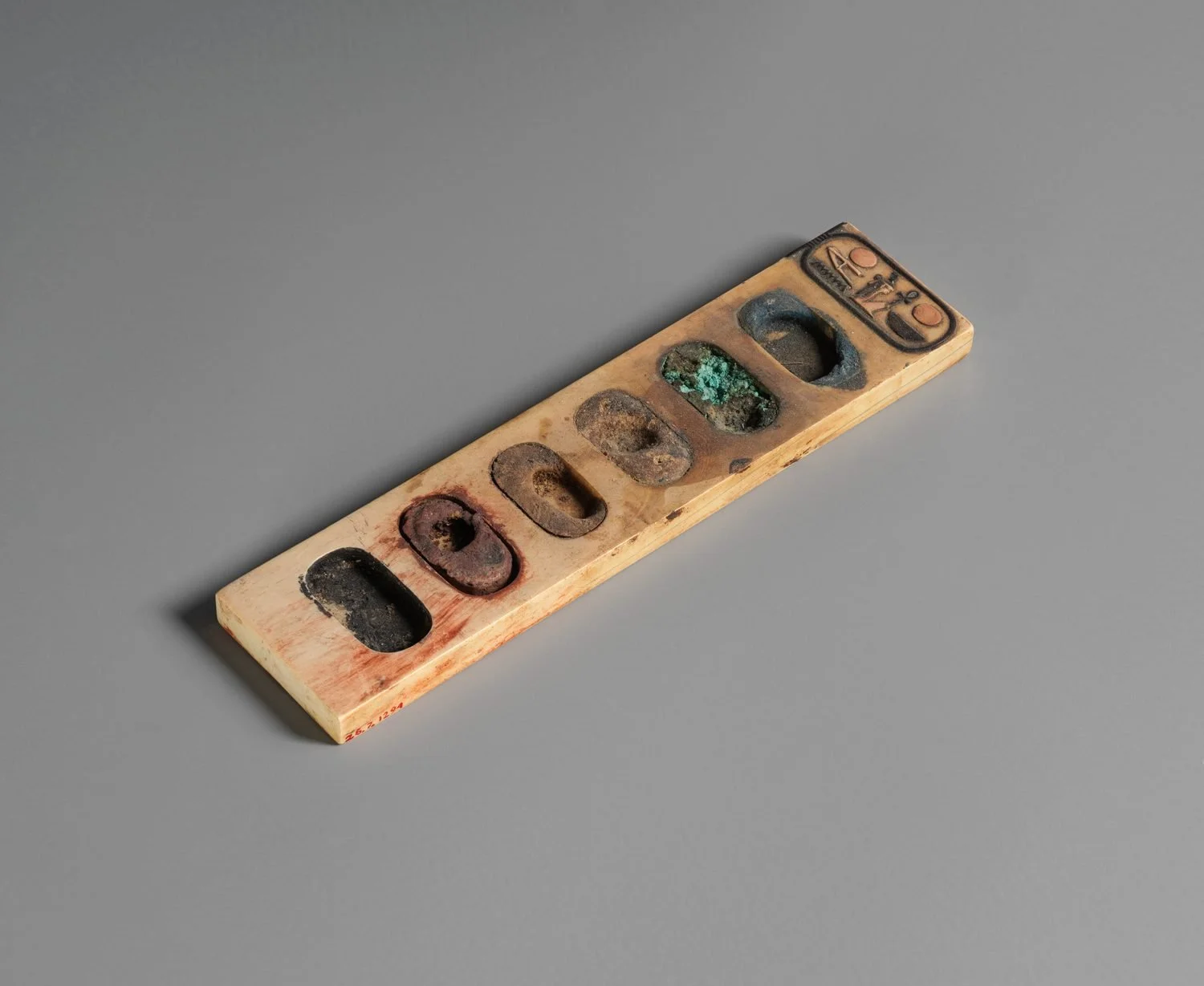
An Egyptian painter's palette inscribed with the name of Amenhotep III (ivory, ca. 1386–1347 BCE): six oval wells still holding pigment cakes — blue, green, brown, yellow, red, and black.
The Metropolitan Museum of Art (Object 26.7.1294), Open Access (CC0).
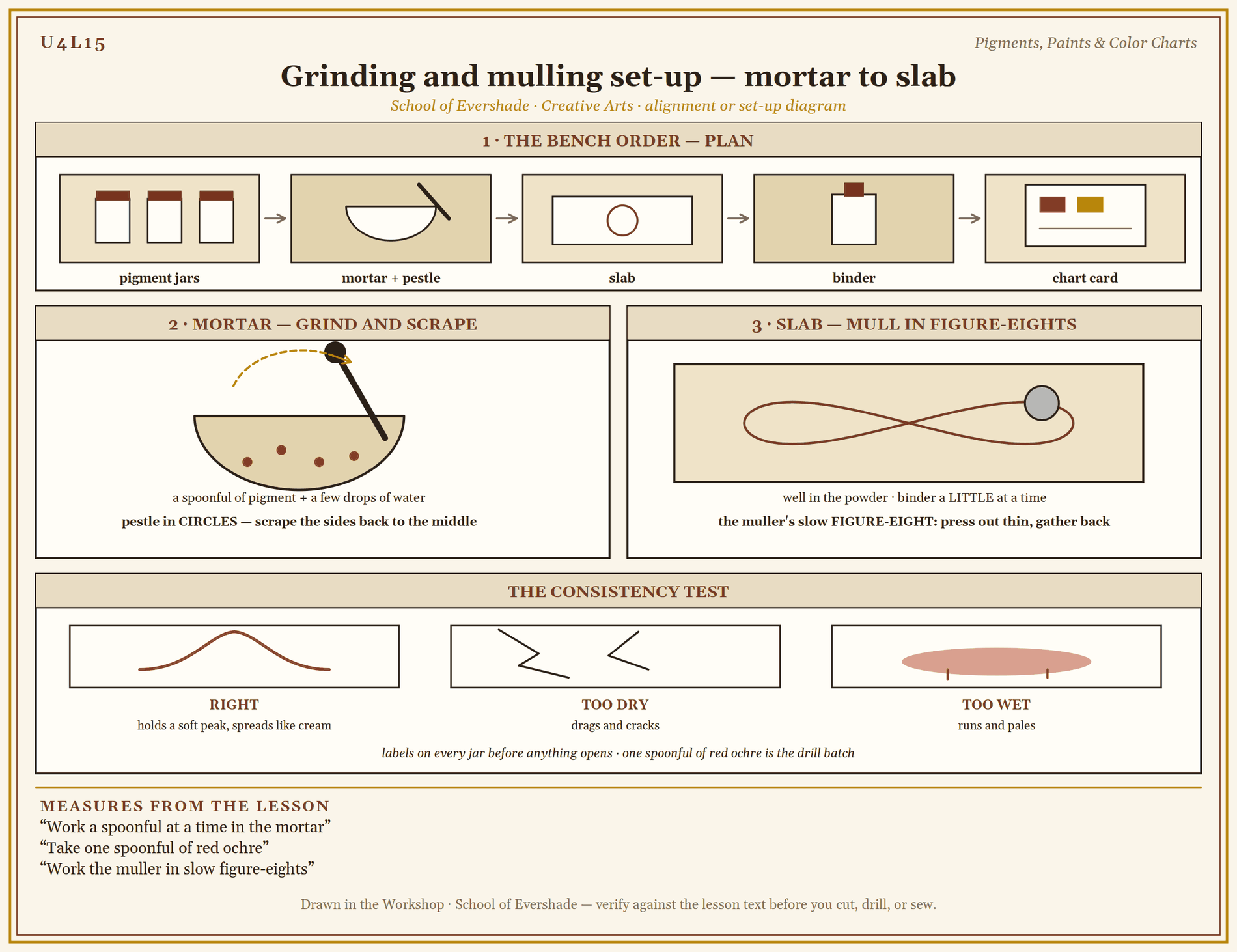
Grinding and mulling set-up — mortar to slab
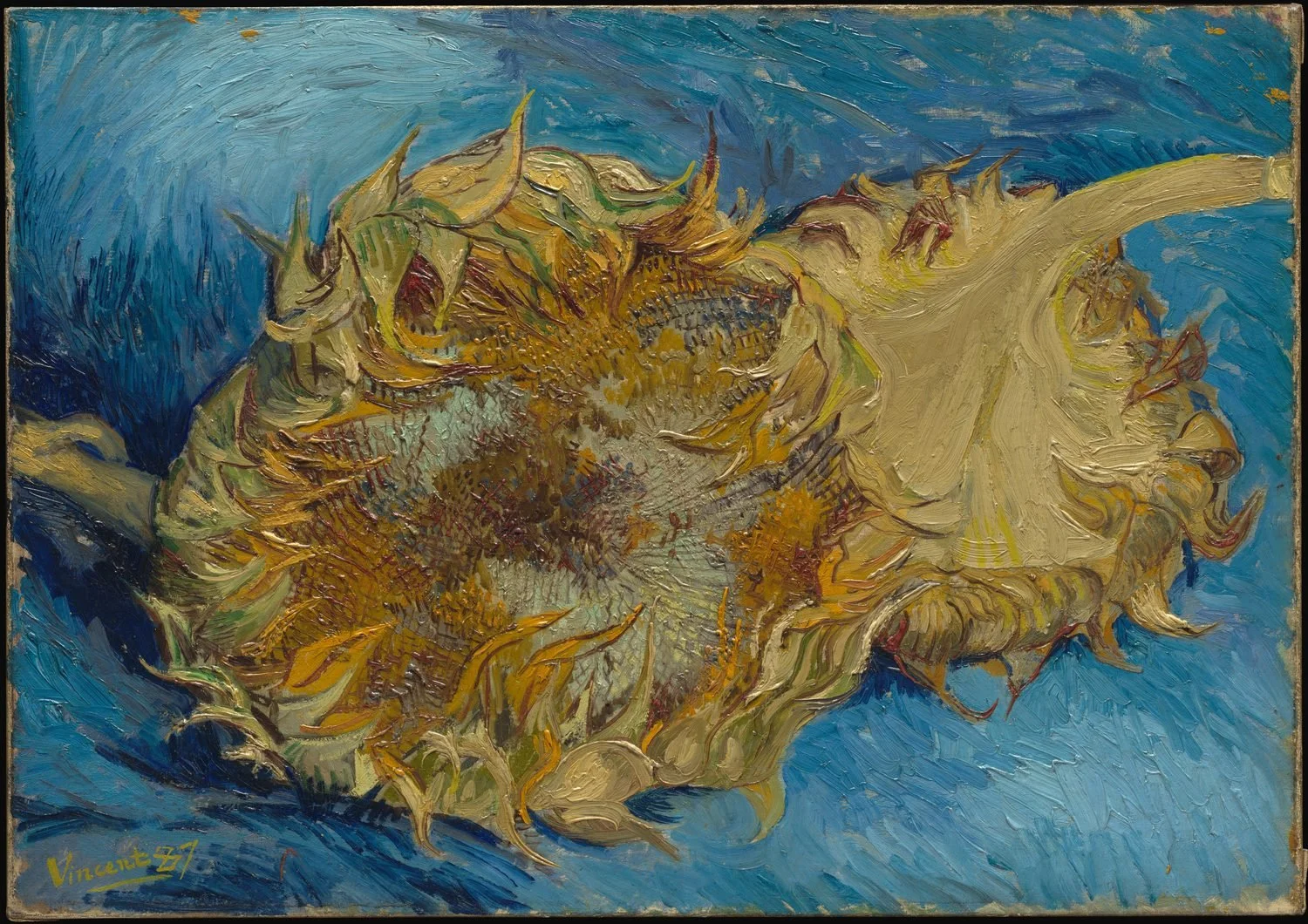
Vincent van Gogh, *Sunflowers* (1887), oil on canvas, 43.2 × 61 cm — sunflower heads studied in yellows and oranges against green and blue.
The Metropolitan Museum of Art (Object 49.41), Open Access (CC0).
A Sealed Note from Professor Timberclank
Dust is the quiet hazard of this bench, scholars, and it does not announce itself. So we work like the geologists do.
Pigment is ground in small amounts, and ground damp and under a mask both, never dry-swept afterward. Work where the air moves, by an open window or out of doors, so what dust escapes the mask does not linger in the room. Gloves on for the grinding and the mulling, and eye protection whenever powder is on the move. The bench is wiped with a damp cloth, not brushed, so what settled stays settled and goes in the bin, not the air. Hands are washed before food, every time, no exceptions made for hunger. Nothing from this bench goes in a mouth: not a brush, not a finger, not a swatch to test it. Old painters pointed their brushes with their lips and paid for the habit. We know better, so we do better.
And learn the four forbidden metals by name: lead, mercury, arsenic, and cadmium. If a pigment's true name hides one of those four, it does not come through my door, however fine the color. We stop. We make it safe. Then we begin again.
PROFESSOR COGBRANCH TIMBERCLANK
Creative Arts Workshop
Master Artisan, Head of House Occidens
Technique: Grinding, Mulling, and the Chart
Sort before you grind. Lay out only the pigments this session needs, each in its labeled jar. In this lesson that means earth pigments and modern artist colors from a reputable supplier, marked nontoxic. Read every label. A pigment you cannot identify does not get ground; it gets set aside and asked about.
Grind coarse, then fine. Work a spoonful at a time in the mortar. Earth pigments crush down quickly; keep the pestle moving in circles and scrape the sides back to the middle. The goal at this stage is an even powder with no grit you can feel between finger and thumb through a glove. Add a breath of water to keep dust down as you work.
Mull on the slab. Tip the powder onto the slab, make a well, and add binder a little at a time: gum arabic solution for a water paint. Work the muller in slow figure-eights, pressing the mixture out thin and gathering it back. You are not stirring. You are persuading every grain to take its coat of binder. Too dry and the paint drags and cracks; too wet and it runs and pales. The right paint holds a soft peak and spreads like cream.
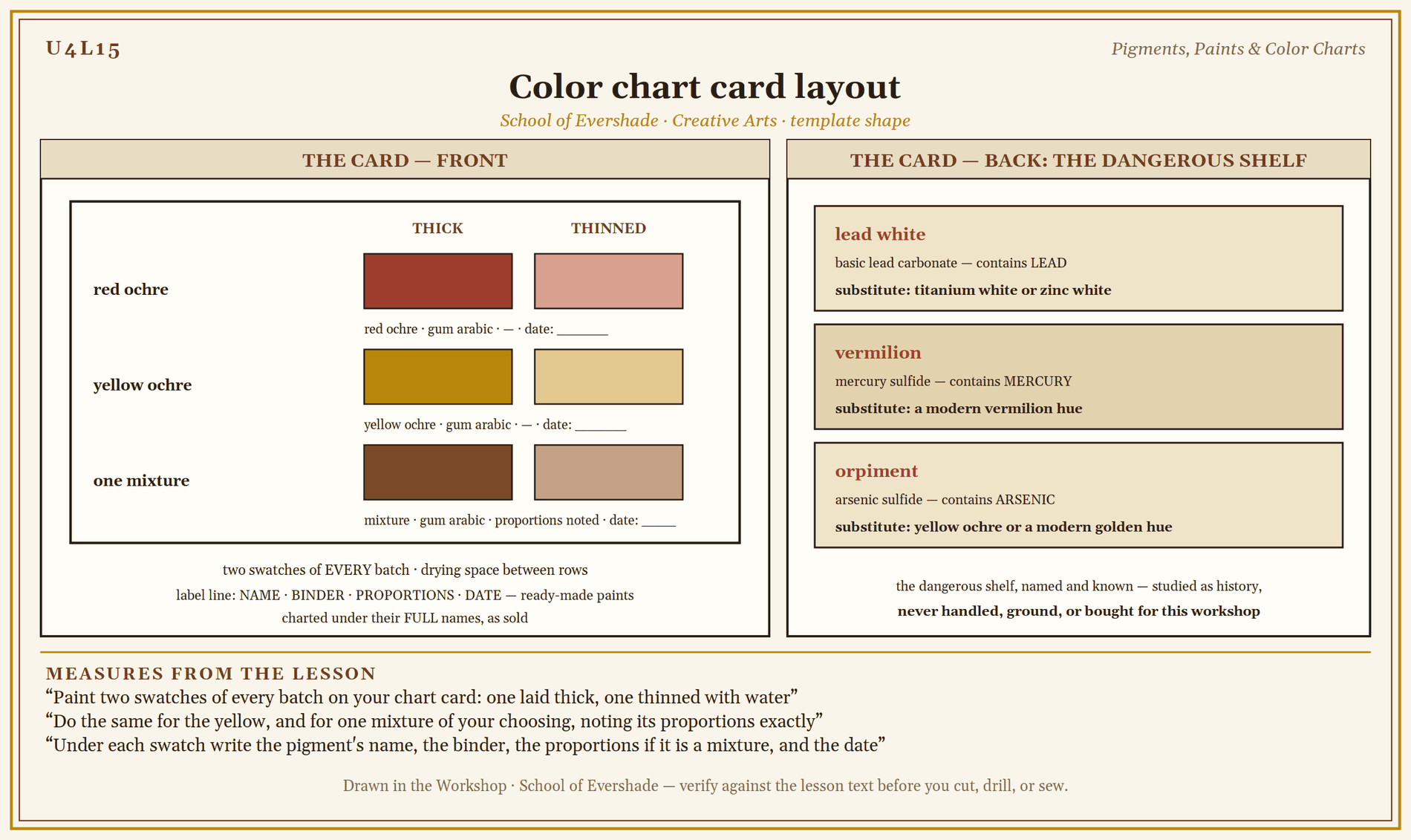
Paint out immediately. A pigment is not known until it is dry on the surface it will live on. Paint two swatches of every batch on your chart card: one laid thick, one thinned with water, because many colors dry a shade different from how they look wet, and the chart must tell the truth about the dry color.
Label like Werner. Under each swatch write the pigment's name, the binder, the proportions if it is a mixture, and the date. A swatch without its label is a rumor. A swatch with it is a recipe any scholar in this school can follow, which is the entire point.
Clean the bench like a record. Tools washed, jars closed and labeled, damp wipes in the bin, never pigment slurry poured in quantity down the sink. Wash your hands. The bench should be able to tell the next scholar exactly what happened here, and no more than that.
Practice Practical: The Color Chart
This drill is checked for dust discipline, an even mull, and labels complete enough to reproduce every swatch.
- Set the bench. Apron on, mask on, damp cloth laid by. Lay out pigments, mortar, slab, binder, jars, and chart card. Read every pigment label aloud. Anything unlabeled or unidentified is set aside untouched.
- Grind the ochre. Take one spoonful of red ochre. Grind in the mortar with a few drops of water until the powder is even and no grit can be felt between finger and thumb through a glove. Repeat with the yellow ochre.
- Mull the paint. Tip the red powder onto the slab. Add gum arabic solution a little at a time and mull in slow figure-eights until the paint spreads like cream and holds a soft peak. Jar half of it, labeled with pigment, binder, and date.
- Paint the swatches. On the chart card, paint two swatches of the red: one full strength, one thinned. Do the same for the yellow, and for one mixture of your choosing, noting its proportions exactly. Leave drying space between rows.
- Chart the ready colors. Add swatches of any ready-made paints you will actually use this term, each labeled with its full name as sold, so the chart covers your whole working shelf, ground and bought alike.
- Write the dangerous shelf from memory. On the back of the chart, list lead white, vermilion, and orpiment, what each contains, and its modern substitute. This list is part of the drill, and it is the part I will check first.
- Clean and keep. Wipe the bench with the damp cloth, bin the wipes, wash tools and hands, close and label every jar. File the chart where you can find it. Every lesson after this one will send you back to it.
Assignment Manual
Assignment key: ✎ written work · ⚒ hands-on practical · ◐ both
Assignment I ⚒ — The Color Chart
Complete the Practice Practical in this lesson: two ochres ground and mulled, swatches painted thick and thin, one mixture with its proportions recorded, ready colors charted, and the dangerous-shelf list written on the back from memory, all labeled so another scholar could reproduce every color.
Assignment II ✎ — The Dangerous Shelf
Write a short history of the poisonous pigments: lead white, cinnabar and vermilion, and orpiment. For each, give what it is, why painters prized it, how it harmed the people who made and used paint, and the modern substitute this workshop uses instead. End with the bench rule in your own words: how this school studies a dangerous color without handling it.
Assignment III ◐ — A Page Out of Werner
Choose three colors you can find on the castle grounds or in your own neighborhood: a stone, a leaf, a feather, a roof tile. For each, invent a plain, exact name in Werner's manner and give its animal, vegetable, and mineral example, then paint the swatch from your chart's colors to match it as closely as you can. The page goes in your workbook: names, examples, and swatches together, as Syme would have laid them out.
Materials
Level One (household)
- Nontoxic watercolor or gouache paints, or dry earth pigments (red and yellow ochre) from an art supplier, clearly labeled
- A mortar and pestle kept for pigment work only, never for food
- A smooth tile, plate, or piece of glass to mull on, and a palette knife or old spoon as a muller
- Gum arabic solution (sold ready-made for watercolor) or plain water for tempera-style practice paints
- Small jars with lids for mixed paint, and labels
- Heavy watercolor paper or card stock for the color chart
- A dust mask, an apron, a damp cloth for wiping the bench, pencils for labeling
Level Two (historical)
Everything in Level One, plus:
- A glass muller and ground-glass or stone slab, the muller's proper kit
- Egg yolk for true tempera: one fresh egg, separated, the yolk skin pierced and the yolk alone used
- A small quantity of linseed oil to feel how an oil paint differs in the mulling; any cloth that has wiped it is never wadded up or left in a heap, for the oil heats as it dries and can set the cloth smoldering — spread the cloth flat to dry where nothing can catch, or keep it in a sealed metal tin of water until it can be disposed of safely
- A shell for a palette, in the Egyptian manner, or a shallow ceramic dish of the oldest pattern
- One manufactured historical-style color for comparison: a modern Egyptian blue pigment from a specialist supplier, handled with the same dust discipline as every pigment on this bench
Both levels grind, mull, and chart the same colors. Level Two binds them the way the old workshops did.
Reflection Questions
Answer the following questions in your workbook.
- The Blombos painter left a complete kit: shells, stones, pigment, stored mixture. What does a stored mixture tell you about the painter that a single painted stone would not?
- Egyptian blue was invented because lapis was rare and costly. Name another craft in this course where a shortage taught people to make something new.
- Why does the chart record the binder and the date, when the swatch itself is right there to look at?
- The old painters knew some of their colors were dangerous and used them anyway. What do you make of that bargain, and where does this workshop draw its line instead?
- Werner's little book let strangers agree on a color they could not show each other. What is your chart doing that is the same, and for whom?
Professor's Review
Color is bench work now, scholars, and not a mystery in a tube.
Your chart holds colors you ground and mulled with your own hands, each one labeled well enough to make again, and its back holds the three names this workshop respects and refuses. You know where paint begins: in a shell at Blombos, on an Egyptian palette, in a mortar that asks patience and gives color in exchange.
Keep the chart dry and findable. Next lesson we take the mark itself in hand: stamps, the ancestors of print, and the label station where this school's jars and specimens get their names. The colors you charted today will be waiting on the bench, in their jars, with their labels on. See that yours are.
PROFESSOR COGBRANCH TIMBERCLANK
Creative Arts Workshop
Master Artisan, Head of House Occidens
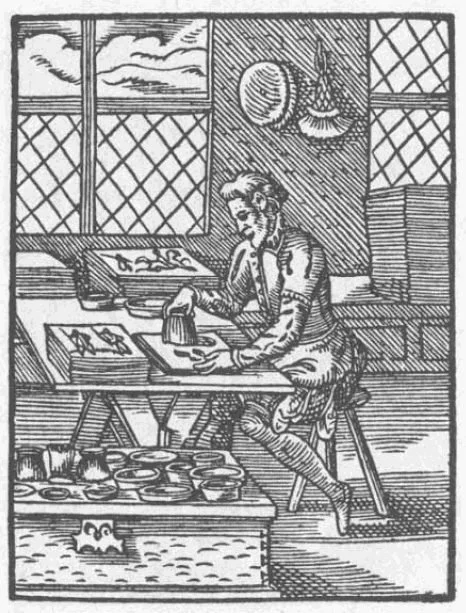
A print colorist (Briefmaler) at work hand-coloring printed sheets, 1568 woodcut.
Woodcut from the Ständebuch (Book of Trades), Frankfurt, 1568. Public domain, via Wikimedia Commons.
Color chart card layout
Further Reading & Sources
ScienceDaily. "100,000-Year-Old Ochre Toolkit and Workshop Discovered in South Africa." The Blombos Cave paint kit as reported from the Science paper: two abalone shells of ochre mixture, grindstones, hammerstones, and a workshop a hundred thousand years old.
Brooklyn Museum. "The Many Shades of Ancient Egyptian Pigments." Conservators analyze real New Kingdom pigments: ochres, carbon black, and Egyptian blue, the fired frit counted the world's oldest synthetic pigment, ground and bound for painting.
Penn Today. "Tracing an Ancient Blue Across the Ancient World." Penn Museum researchers on Egyptian blue: how it was made from copper, sand, alkali, and lime, how it traveled as far as Iron Age Iran, and how its glow under infrared light gives it away.
UCL Pigment Timeline Project. "Mineral Pigment Processing: Health and Safety Tips." A geologist's plain account of pigment risk: dust as the enemy, and the arsenic and mercury sulfides, orpiment and cinnabar among them, named as the worst offenders. This lesson's bench rules follow it closely.
Syme, Patrick. Werner's Nomenclature of Colours. Edinburgh, 1814; facsimile edition, Natural History Museum, London, 2018. The little book of named swatches itself: colors with their animal, vegetable, and mineral examples. Print reference; consult the facsimile in a library.
Student-friendly starting points for exploring this lesson's world. All links verified October 2026.
- Archaeology Magazine. "Stone Age Art Supplies." The Blombos toolkit told for general readers: shells caked with red and yellow pigment, and a painter who plainly came back to the bench more than once.
- Yale University Art Gallery. "Transforming Discolored Pigments in a 16th-Century Persian Watercolor." X-ray maps show lead white and orpiment reacting where they meet in a Shahnama miniature, and conservators coax the white back. The dangerous shelf, caught in the act.
Submit your work for this lesson using the form below.
CONTINUE IN THE CREATIVE ARTS WORKSHOP
← Previous · Lesson 14: Garlands, Braiding & Weaving Next · Lesson 16: Printmaking, Stamps & the Label Station →
Unit IV · Pigment, Print & Seals Creative Arts Workshop · All 39 Lessons
Bookstore Shelf The Library · Creative Arts Shelf Course Supplies
The rest of Unit IV: Lesson 16 · Printmaking, Stamps & the Label Station · Lesson 17 · Seal Matrices & Waxwork